2.7 Al-qadō’ va‘l-qadar
2.7 Al-qadā’ Wa‘l-qadar
Al-qadā’ wa‘l-qadar, ushbu nom bilan, ya’ni ikki so‘zni bir ma’no uchun birga bog‘lash orqali, aniq bir ma’noga ega; ya’ni al-qadā’ al-qadar bilan bog‘langan holda, ikkisini bir-biridan ajralmaydigan, birga keladigan ikki masala qilib olish orqali, va ular faqat o‘ziga xos bo‘lgan ma’noga egadirlar. Unga bu ma’nodan boshqasini kiritish to‘g‘ri emas, chunki bu ma’no Sahobalar yoki Tobe’inlar tomonidan ishlatilmagan. Shar’iy va lug‘aviy matnlarni o‘rganish, shuningdek, Sahobalar, Tobe’inlar va ulardan keyin kelgan Ulamolarning so‘zlarini tahlil qilish shuni ko‘rsatadiki, al-qadā’ va al-qadar atamalari birgalikda Sahobalar yoki Tobe’inlardan hech biri tomonidan aniq istilohiy ma’noda ishlatilmagan, shuningdek, ular Qur’on yoki Hadisda ham aniq istilohiy ma’noda birga kelmagan; garchi ular al-Bazzor Jobir hadisidan, hasan zanjir bilan Nabiy ﷺ dan rivoyat qilgan hadisda lug‘aviy ma’noda birga kelgan bo‘lsalar ham, u zot ﷺ shunday degan:
Al-qadā’ wa‘l-qadar, with this name, that is, by connecting two words together for one meaning, has a specific referent; that is, al-qadā’ linked to al-qadar, by making them two concomitant matters whereby one is not separable from the other, and they have a meaning that is exclusive to them. It is not correct to include in it other than this meaning which has not been used by the Sahabah or the Tabi’een. By studying the shar’i and linguistic texts and studying the sayings of the Sahabah, Tabi’een and those who came after them from the Ulama’, it is apparent that the terms al qadā’ wa‘l-qadar together, have not been used with a specific technical [istilāhī] meaning by any of the Sahabah or Tabi’een, nor have they come together with a specific technical meaning in the Qur’ān or the Hadīth; though they have come together in their linguistic meaning in what al Bazzār reported from the hadīth of Jabir with a hasan chain on the authority of the Prophet (PBUH) that he said:
"Mening ummatimning ko'pchiligi Allohning qazosi va qadari bilan, jonlar [anfus] o'lganidan keyin vafot etadi."
“Most of my Ummah die after the qadā’ of Allaah and his qadar with the souls [anfūs].”
, بناءً على ذلك فإن هذا المعنى الاصطلاحي الذي يشير إلى هذا الاسم لا يوجد إلا عند المتكلمين، بعد مضي القرن الأول وبعد ترجمة الفلسفة اليونانية. ولم يكن موجودًا في زمن الصحابة، ولم يقع أي خلاف أو نقاش حول هذين اللفظين بوصفهما اسمًا واحدًا لمعنى اصطلاحي محدد. وطوال عصر الصحابة لم يكن المسلمون يعرفون مصطلح «القضاء والقدر»، وإن كان لفظ «القضاء» قد ورد منفردًا، ولفظ «القدر» قد ورد منفردًا في الأحاديث، كما ورد اللفظان مجتمعين في حديث جابر المذكور آنفًا، لكنهما في جميع هذه الحالات جاءا بمعناهما اللغوي، ولم يردا بالمعنى الاصطلاحي. وقد ورد لفظ «القضاء» في حديث القنوت، فقد قال الحسن: علمني رسول الله ﷺ كلمات أقولهن في قنوت الوتر، ثم ذكر دعاء القنوت، ومنه:
Therefore this terminological meaning which alludes to this name is not found except from the Mutakallimūn, after the first century had passed and after the translation of the Greek philosophy. It did not exist in the time of the Sahabah nor was there any dispute or discussion of those two terms as one name for a specific technical meaning. Throughout the era of the Sahabah the Muslims did not know of ‘al-qadā’ wa‘l-qadar’ though the word qadā’ had come on its own and the word qadar had come on its own in the ahadīth just as the two had come together in the aforementioned hadīth of Jabir, but in all of these cases they had come in the linguistic meaning. They have not come in the technical meaning. The word qadā’ has come in the hadīth of al-qunut. Al-Hasan said, the Messenger of Allah (PBUH) taught me words I say in the qunut of the witr, then he mentioned the du’a of qunut, of which is,
"...va Sen meni Sen hukm qilgan narsadan saqla, chunki Sen hukm qiluvchisan, Senga hech kim hukm qila olmaydi," — [Reported by al-Darimi , Narrated by al-Hasan ibn Ali]
“...and save me from what You have decreed, for You are the one Who Decrees and you are not decreed upon,” [Reported by al-Darimi , Narrated by al-Hasan ibn Ali]
Uning ma'nosi: "Meni Sen hukm qilgan narsaning yomonligidan asra, chunki Sen xohlaganingni hukm qilasan va Sening ustingdan hech kim hukm qilmaydi." Jibril hadisining ba'zi rivoyatlarida "qadar" so'zi kelgan. U (Jibril) aytdi:
Its meaning is, protect me from the evil of what you have judged, for you judge what you wish and no one judges over you. The word qadar has come in the hadīth of Jibrīl in some of its narrations: He said,
“Va qadarga, uning yaxshisi va yomoniga iymon keltirish”, [Reported by Muslim, Narrated by Umar ibn al-Khattab]
“And to believe in al-qadar, the good and the bad thereof”, [Reported by Muslim, Narrated by Umar ibn al-Khattab]
Va uning so'zida
And in his saying
“…Sizga biror narsa yetsa, “Agar men shunday qilganimda, shunday va shunday bo‘lardi”, deb aytmang, balki “Alloh taqdir qildi va xohlaganini qildi”, deb ayting”, — [Reported by Muslim, Narrated by Abu Hurairah]
“…If anything befalls you do not say, ‘had I done (this), it would have been such-and-such, but rather say, ‘Allah determined [qaddara] and He did what He willed,’”[Reported by Muslim, Narrated by Abu Hurairah]
Ushbu ikki hadisda "qadar" so'zining ma'nosi Allohning taqdiri [taqdīr] va ilmidir, ya'ni narsalar Alloh tomonidan Lavhi mahfuzda yozilganiga va ular vujudga kelishidan oldin Uning ularni bilishiga, ular yaxshi bo'lsinmi yoki yomon bo'lsinmi, ishonishingiz kerak; va Alloh buni Lavhi mahfuzda yozgan va u vujudga kelishidan oldin uni bilgan va xohlaganini qilgan, deb aytishingiz kerak. Bu hadisda kelgan ma'noda yoki boshqa joyda kelgan "al-qazo'" so'ziga kelsak, musulmonlar uning ma'nosi yoki mazmuni borasida bahslashmaganlar.
The meaning of the word qadar in these two ahadīth is the Determination [taqdīr] and Knowledge of Allah , that is, that you should believe that the things have been written by Allah in the Lawh al-Mahfūdh and He knows of them before they come into existence, whether they be good or bad; and say Allah has written this in the Lawh al-Mahfūdh and he knew it before it came into being and he did what he wished. The word al-qadā’ in the meaning which it came in this hadīth or anywhere else it came was not disputed by the Muslims; they did not have discussions with regards to its wording or its import.
Qadar so'zining ikki hadisda zikr etilgan ma'nosiga kelsak, musulmonlar yunon falsafasi ularning orasida paydo bo'lguncha, bu haqda ixtilof qilmas edilar va uning lafzi yoki mazmuni xususida bahs yuritmas edilar. Lekin yunon falsafasi musulmonlar orasida paydo bo'lgach, Kufadan bir guruh chiqib, dedi: qadar yo'q, ya'ni hech kim oldindan belgilovchi emas va hamma narsa oldindan hech qanday belgilanmasdan yuz beradi. Ular Qadariyya deb atalgan bo'lib, qadarni inkor qiluvchi va Alloh ﷺ narsalarning asoslarini yaratib, so'ngra ularni tark etgan, shu sababli Uning ularning juz'iyotlari [juz'iyāt] haqida ilmi yo'q, deb aytuvchilardir. Bu esa Qur'oni karimning aniq matnida kelgan narsaga ziddir, u Allohning ﷺ kichik yoki katta, asosiy yoki tarmoqli barcha narsalarning Yaratuvchisi ekanini va Uning ﷺ ularning mavjud bo'lishidan oldin hammasini belgilaganini, ya'ni uni Lavhi mahfuzda yozganini, ya'ni u vujudga kelishidan oldin Uning ﷺ uni bilganini bildiradi. U zot aytdi:
As for the word qadar in the meaning mentioned in those two ahadīth, the Muslims, before the presence of Greek philosophy, did not disagree about it or have discussions with regards to its wording or import. But after the presence of the Greek philosophy amongst the Muslims, a group from Kufa arose and said: there is no qadar, that is, there is no one who (pre)determines and everything occurs without any previous determination; they were called the Qadariyyah and they are the ones who deny the qadar and say that Allah created the fundamentals of things and then left them, so He does not have knowledge of their particulars [juz'iyāt]. This is contrary to what has come in the clear text of the Qur’ān which states that Allah is the Creator of all things, small or big, fundamental or branchial, and that He determined everything before its existence, that is, He wrote it in the Lawh al-Mahfūdh, that is, He knew it before it came to be. He said:
U hamma narsani yaratgan va U har narsani biluvchi Zotdir. [TMQ-An’ām: 101]
“He created all things and He is the All-Knower of everything” [TMQ-An’ām: 101]
Va
And
Va U yer yuzidagi va dengizdagi barcha narsani biladi: bitta barg ham tushmaydi, buni U bilmasdan. Yerning zulmatida bitta don ham, hech bir yashil yoki quruq narsa ham yo'qki, u aniq bir Kitobda yozilmagan bo'lsin. [TMQ-An’ām: 59]
“And He knows whatever there is in the Earth and in the sea: not a leaf falls, but He knows it. There is not a grain in the darkness of the Earth nor anything fresh or dry, but is written in a Clear Record.” [TMQ-An’ām: 59]
Biroq, bu ixtilof va munozara faqat Allohning qadari, ya'ni Uning ilmi jihatidan bo'lgan. Shunday qilib, qadariyya Allohning narsalarning asosiy jihatlarini bilishini, ammo ularning qismiy jihatlarini bilmasligini da'vo qildi, Islom esa Allohning narsalarning asosiy jihatlarini ham, qismiy jihatlarini ham bilishini bayon qiladi. Demak, Allohning qadari, ya'ni Uning ilmi haqidagi munozara Allohning ilmi mavzusiga oiddir. Bu al-qadā’ wa‘l-qadar mavzusidan boshqa mavzudir. Bu al-qadā’ wa‘l-qadar haqidagi munozaradan alohida, boshqa munozaradir. Uning haqiqatda sodir bo'lgan ko'rinishi bir xil, ya'ni u al-qadā’ wa‘l-qadar mavzusidan boshqa mavzudir.
However, this disagreement and discussion is only with respect to the ‘qadar of Allah’ in terms of His Knowledge. So the Qadariyyah claimed that Allah knows the fundamentals of things but not their partial aspects, whilst Islam states that Allah knows the fundamentals of things as well as their partial aspects. Thus, the discussion with respect to the qadar of Allah , that is, His Knowledge, is about the subject of Allah's Knowledge. It is a subject different to that of al-qadā’ wa‘l-qadar. It is a different discussion, separate from the discussion of al-qadā’ wa‘l-qadar. Its reality that took place is the same, that is, it is a different subject to that of al-qadā’ wa‘l-qadar.
Shunday qilib, al-qadā’ va al-qadar so‘zlarining har biri alohida kelib, o‘ziga xos ma’noga ega bo‘lgani ravshan ko‘rinib turibdi. Ular al-qadā’ wa‘l-qadar mavzusini o‘rganish bilan hech qanday aloqaga ega emas. Boshqacha aytganda, al-qadā’ so‘zi Shar’ tomonidan kelgan barcha lug‘aviy va shar’iy ma’nolari bilan, al-qadar so‘zi esa Shar’ tomonidan kelgan barcha lug‘aviy va shar’iy ma’nolari bilan, ular alohida yoki birga zikr qilinganda ham, al-qadā’ wa‘l-qadar mavzusidagi muhokama bilan hech qanday aloqaga ega emas. Ularning ma’nosi faqat ular bilan kelgan lug‘aviy va shar’iy ma’nolar doirasida chegaralangan.
Thus, it is plainly apparent that the words al-qadā’ and al-qadar have each come on their own with each having a specific meaning. They do not have any relation with the study of al-qadā’ wa‘l qadar. In other words, the word al-qadā’ in all its linguistic and shar’i meanings that have come from the Legislator, and the word al-qadar in all its linguistic and shar’i meanings that have come from the Legislator, have no relation to any of these terms, whether mentioned alone or together, in the discussion of al-qadā’ wa‘l-qadar. They are confined with regards to their meaning, to that what they come with from the linguistic and shar'i meanings.
Allohning ilmini bayon qiluvchi oyatlar — bu Allohning ilmi barcha narsalarni qamrab olishini ko‘rsatuvchi oyatlardir, shuningdek Uning shu so‘zi:
The ayāt which have come in demonstrating the Knowledge of Allah are the ones that indicate the all-encompassing nature of Allah's Knowledge with regards to all things, thus His saying:
Yer yuzida yoki o'zlaringizda biror musibat yuz bermasin, u yaratilishimizdan oldin Kitobda yozilgandir. Albatta, bu Allohga oson. [TMQ-Hadīd: 22]
“No calamity befalls on the Earth or in yourselves but is inscribed in a Book, before We bring it into existence. Indeed, that, upon Allah, is easy” [TMQ-Hadīd: 22]
Va Uning
And His saying,
"De: «Bizga Allah biz uchun belgilagan narsadan boshqa hech narsa yetmaydi. U bizning Mavlomizdir», — de. Mo‘minlar esa faqat Allohga tavakkal qilsinlar." [TMQ Tawba: 51]
“Say: ‘Nothing shall ever happen to us except what Allah has ordained for us. He is our Mawla.’ Then in Allah let the believers put their trust” [TMQ Tawba: 51]
Va Uning
And His saying,
Osmondagi yoki yerdagi zarra og‘irligicha yoki undan kichik, yoki undan katta bo‘lgan hech narsa Uning ilmidan yashirin emas, u esa Ochiq Kitobdadir. [TMQ Saba: 3]
“Escapes not from His Knowledge even the weight of an atom, in the Heavens or in the Earth, or less than that, or greater, but it is in a Clear Book” [TMQ Saba: 3]
Va Uning
And His saying,
U Shunday, U sizning jonlaringizni kechasi oladi va kunduz qilgan barcha ishlaringizni biladi, so'ngra belgilangan muddat tugashi uchun sizni yana uyg'otadi. Keyin qaytishingiz Unga bo'ladi. So'ngra U sizga qilib kelgan ishlaringizni xabar qiladi. [TMQ An’ām: 60]
“It is He, Who takes your souls by night, and (Who) has knowledge of all that you have done by day, then He raises (wakes) you up again that a term appointed be fulfilled, then unto Him will be your return. Then He will inform you what you used to do” [TMQ An’ām: 60]
Bu oyatlar Payg'ambarga (ﷺ) nozil bo'lgan, ularni sahobalar yod olgan va tushungan, ular qazo va qadar masalasini muhokama qilish xayollariga ham kelmagan. Bundan tashqari, bu oyatlarning lafzi, ma'nosi va ishorasi shuni bildiradiki, ular Allohning ilmi haqidagi bayondir va qazo va qadar ilmi bilan hech qanday aloqasi yo'q. Xuddi shunday, oyat,
These verses were revealed to the Messenger (PBUH) and they were memorised and understood by the Sahabah, it did not occur to them to discuss al-qadā’ wa‘l-qadar. Furthermore, the wording, understanding and indication of these verses states that they are a clarification about the Knowledge of Allah and have no relation to the study of al-qadā’ wa‘l-qadar. Similarly the ayah,
Agar ularga biror yaxshilik yetsa, "Bu Allohdandir", deydilar; agar biror yomonlik yetsa, "Bu sendandir", deydilar. Ayting: "Hammasi Allohdandir". Bu odamlarga nima bo'ldiki, biror so'zni anglashga yaqinlashmaydilar? [TMQ-Nisā’: 78]
“And if some good reaches them, they say, ‘This is from Allah’, but if some evil befalls them, they say, ‘This is from you’. Say: ‘All things are from Allah’; so what is wrong with these people that they fail to understand any word?’ [TMQ-Nisā’: 78]
Bu gap al-qadā’ va’l-qadar muhokamasi bilan aloqador emas, chunki bu kufforlarning yomon va yaxshini ajratgan holda qilgan e’tirozlariga raddir. Ular yomonlikni Payg‘ambar ﷺ dan, yaxshilikni esa Allohdan keladi deb hisoblashgan. Shunda Alloh ularni rad etib, hammasi Allohdan ekanini bildirgan. Muhokama insonning qilgan yaxshi ishlari va ortidan quvgan yomonligi haqida emas, balki jang va o‘lim haqidadir. Oyatning o‘zi va undan oldingi gap buni aniqlashtiradi.
It has nothing to do with the discussion of al-qadā’ wa‘l-qadar because it is a refutation of the kuffār who differentiated between bad and good. Thus, they made bad to come from the Messenger and good from Allah . So Allah refuted them by declaring that everything is from Allah . The discussion is not about the good that a human being does and the evil that he pursues; rather the discussion is about fighting and death. The ayah itself and that what precedes it clarifies this:
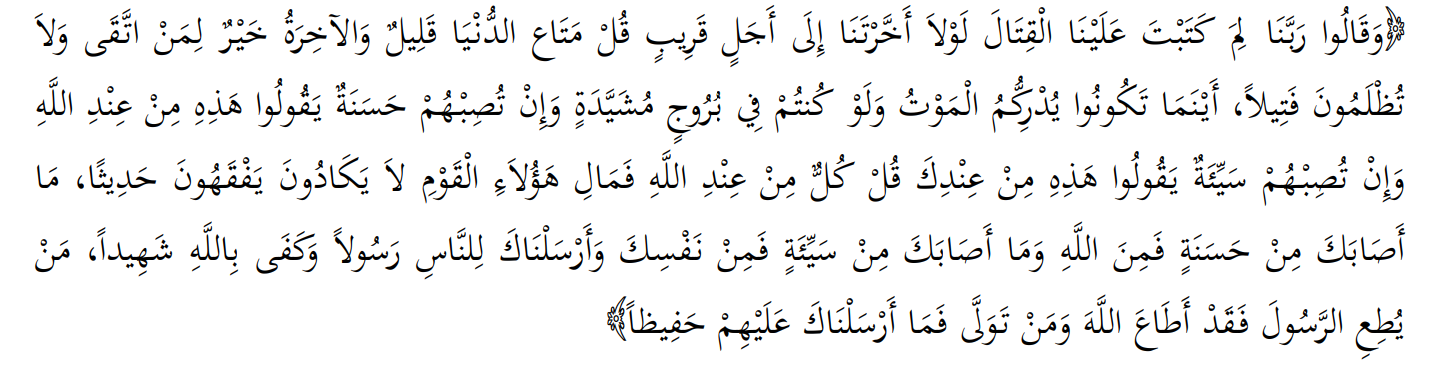
Ular aytadilar: "Ey Parvardigorimiz! Nega bizga jihodni farz qilding? Ozgina muddatgacha bizga mohlat berganingda edi-chi!" Ayting: "Dunyo bahrasi oz, Oxirat esa Allohdan qo'rqqan kishi uchun yanada yaxshiroqdir va sizlarga zarracha ham zulm qilinmas. Qayerda bo'lsangiz ham, mustahkam va baland qal'alarda bo'lsangiz ham, o'lim sizlarni topadi." Agar ularga biror yaxshilik yetsa, "Bu Allohdandir", deydilar; agar biror yomonlik yetsa, "Bu sendandir", deydilar. Ayting: "Hammasi Allohdandir". Bu qavmga nima bo'ldiki, biror so'zni anglashga yaqinlashmaydilar? Sizga yetgan har qanday yaxshilik Allohdandir, sizga yetgan har qanday yomonlik esa o'zingizdandir. Biz sizni (ey Muhammad ﷺ) odamlarga Payg'ambar qilib yubordik, guvoh sifatida Alloh yetarlidir. Kim Payg'ambarga itoat etsa, u, albatta, Allohga itoat etgan bo'ladi. Kim yuz o'girsa, biz sizni ularning ustidan kuzatuvchi qilib yubormadik. [TMQ-Nisā’: 77-80]
“They say: Our Lord! Why have you ordained for us fighting? Would that you have granted us respite for a short period?’ Say: ‘Short is the enjoyment of this world. The Hereafter is (far) better for him who fears Allah, and you shall not be dealt with unjustly in the least. Wheresoever you may be, death will overtake you even if you are in fortresses built up strong and high! And if some good reaches them, they say, ‘This is from Allah,’ but if some evil befalls them, they say, ’This is from you.’ Say: ‘All things are from Allah’, so what is wrong with these people that they fail to understand any word? Whatever of good reaches you, is from Allah, but whatever of evil befalls you, is from yourself. And We have sent you (O Muhammad) as a Messenger to mankind, and Allah is sufficient as Witness. He who obeys the Messenger, has indeed obeyed Allah, but he who turns away, then we have not sent you as a watcher over them.” [TMQ-Nisā’: 77-80]
Demak, bu yerda gap ular nima qilayotgani haqida emas, balki ularning boshiga nima tushishi haqida. Shuning uchun bu gap al-qadā’ va’l-qadar (taqdir va qazo-qadar) ilmini o‘rganishga aloqasi yo‘q.
So the subject is what befalls them and not what they are doing. Thus it has nothing to do with the study of al-qadā’ wa‘l-qadar.
Shuning uchun, yuqorida zikr etilgan barcha narsalar al-qadā’ wa‘l-qadar ilmini o‘rganishga aloqasi yo‘q; ular uning ma’nosiga kirmaydi va yuqorida zikr etilganlar bilan hech qanday munosabati yo‘q. Aksincha, al-qadā’ wa‘l-qadar ma’no sifatida yunon falsafasidan kelib chiqqan bo‘lib, uni Mu’tazilalar o‘zlashtirgan va bu borada o‘z fikrlarini bildirganlar. Ahl as-Sunnah va al-Jabriyya ularni rad etdi, Ahl as-Sunnah esa al-Jabriyyaga ham raddiya yozdi. Bahs bir xil ma’no doirasida davom etdi va bir xil asosga tayandi. Shunday qilib, bu masala yunon falsafasidan kelib chiqqan ma’no bo‘lib, u musulmonlar bilan yunon falsafasi bilan qurollangan kofirlar o‘rtasida bo‘lib o‘tgan munozaralarda ko‘tarildi. Bu ma’no aqidaga aloqador bo‘lib, shu sababli bu ma’no borasida Islomning fikrini bayon qilish talab etiladi. Mu’tazilalar fikr bildirdilar, al-Jabriyya ularni rad etib, boshqa fikr bildirdi. Ahl as-Sunnah ularning barchasini rad etdi va o‘z fikrini bayon qildi hamda uni ikki fikrdan chiqqan uchinchi fikr deb ta’riflab, uni «tezak va qon orasidan chiqqan, ichishga shirin, toza sut» deb atadilar.
Therefore, all that has been mentioned above has nothing to do with the study of al-qadā’ wa‘l qadar; they do not come under its meaning and have no relation whatsoever with what has been mentioned above. Rather, al-qadā’ wa‘l-qadar as a meaning has come from Greek philosophy which was transmitted by the Mu'tazilah who gave an opinion with regards to it. Ahl al-Sunnah and the Jabriyyah refuted them and Ahl al-Sunnah (also) made a refutation of the Jabriyyah. The discussion was confined to the same meaning and preceded upon the same premise. Thus the issue is a meaning/sense that came from Greek philosophy and it came to the fore in the debate which used to take place between the Muslims and the kuffar who used to be armed with the Greek philosophy. It is a meaning which has a relevance to the ‘aqīdah (creed), thus what is desired is to give Islam's opinion regarding this meaning. The Mu'tazilah gave an opinion and the Jabriyyah refuted them and gave another opinion. Ahl al-Sunnah refuted all of them and gave an opinion, and said about it that it is a third opinion which has come out from the two opinions and they described it as ‘the pure milk, sweet to drink, that comes out from between excrement and blood’.
Shunga ko'ra, Yunon falsafasidan kelib chiqqan bahs mavzusi ma'lum bo'ldi va u aqidaga tegishli bo'lgani uchun musulmon bu masalada o'z e'tiqodi qanday ekanini aniq bilishi lozim. Musulmonlar haqiqatan ham o'z fikrlarini bayon qildilar va uch xil maktab paydo bo'ldi. Shuning uchun al-qadā’ va al-qadar masalasini lug'atda va shariatda ularning ma'nosidan kelib chiqqanicha emas, balki faqat taxmin, tasavvur yoki xayolga tayanib, ularga biror ma'no berish mumkin emas. Masalan, al-qadā’ faqat umumiy narsalarga oid umumiy hukm, al-qadar esa qismiy narsalar va ularning tafsilotlariga oid umumiy hukm, yoki al-qadar narsalar uchun azaliy reja, al-qadā’ esa o'sha oldindan belgilangan qaror va reja asosidagi ijro va yaratish, deyish ham joiz emas. Chunki bu faqat xayol, taxmin va ba'zi lug'aviy hamda shar'iy ifodalarni o'z o'rnida qo'llamaslikdan iborat xato urinishdir, chunki ular bunday ma'noga emas, balki umumiy ma'nolarga ishora qiladi. Dalilsiz ravishda ikki so'zni shunday aniq ma'nolar bilan cheklash esa o'zboshimchalik bo'lardi.
"Har bir jon o'zi qo'lga kiritgan narsasiga garovdir," [TMQ Muddathir: 38]
“Every soul is a pledge for what it earns,” [TMQ Muddathir: 38]