21.2 Josuslik qilish
21.2 Spying
Casusluk xabarlarni tekshirib-o‘rganishdir. Tilda shunday deyiladi: "xabarni tekshirdi (ya'ni xabarni ayg‘oqchilik qildi) va u haqida tekshirmoqda", undan esa "josus" (ayg‘oqchi) so‘zi kelib chiqadi. Agar kishi xabarni tekshirsa, u uni ayg‘oqchilik qilgan bo‘ladi va u ayg‘oqchidir, xohi ochiq, xohi yashirin xabarni tekshirsin. Xabarni tekshirishda uning yashirin, ya'ni sir bo‘lishi shart emas, shunda u casusluk bo‘ladi; aksincha, casusluk xabarni, sir bo‘lsinmi yoki oshkora bo‘lsinmi, ya'ni yashirin va oshkora bo‘lgan xabarni tekshirishdir. Biroq kishi tekshirmasdan, o‘z holicha narsalarni ko‘rsa, uning harakati xabarlarni tekshirish yoki xabarlarni to‘plab, odamlarga e'lon qilish maqsadida bo‘lmasa, yoki xabarlarga aloqador bo‘lmasa, bularning hammasi casusluk emas, chunki u xabarni tekshirmayapti va xabarni tekshirish uning ishlari orasida yo‘q. Shu vaziyatlarda u xabarlarni kuzatsa ham, bu casusluk emas, chunki casusluk bo‘lgan xabarni tekshirish faqat uni o‘rganish maqsadida kuzatish va chuqur tekshirish bo‘lgandagina bo‘ladi. Xabarni to‘plash uchun kuzatuvchi esa uni o‘rganish maqsadida tekshirmaydi, balki uni odamlarga e'lon qilish uchun to‘playdi. Shunga ko‘ra, gazeta va axborot agentliklarining muxbirlari kabi xabarni kuzatib, to‘playdiganlarni ayg‘oqchi deyilmaydi, agar ularning ishi casusluk bo‘lmasa va gazeta hamda agentliklarning muxbirligini vosita qilib olmasalar. Bu holatda u muxbir bo‘lgani uchun emas, balki ishi casusluk bo‘lib, muxbirlikni pardа sifatida vosita qilib olgani uchun ayg‘oqchidir, ko‘plab muxbirlar holati shunday, ayniqsa ulardan urush qiluvchi kofirlar. Tekshiruv idoralari xodimlari, tergov idorasi va ularga o‘xshash xabarlarni tekshiruvchilar esa ayg‘oqchidirlar, chunki ularning ishi casusluk.
Spying is investigating information. It is said in the language “spied the news and spying it (is) investigating regarding it” and from it is the spy. If the man investigates information then he has spied it and he is a spy, whether he investigates open or hidden information. It is not a condition in investigating information that it be hidden i.e. secret so that it is spying; rather spying is investigating news whether secret or open i.e. secret and non-secret. Whereas if he sees things naturally without investigation and without his action being investigation of news, or collection of information to publish it or is concerned with news, all this is not spying as long at it is not investigating news and investigating news is not part of his actions. Even if he follows news in these situations, it is not spying because investigating of information which is spying is only where following and scrutinising it is for the objective of examining it. As for the one who follows information to collect it, he does not scrutinize it for the objective of examining it but rather he collects it to publish it to the people. Accordingly it is not said about the one who follows news and collects it like the correspondents of gazettes and news agencies that they are spies, except if their work is spying and they take the correspondence of gazettes and agencies as a tool. In this situation he is a spy not because of his being a correspondent who is following the news but rather because his work is spying and he takes correspondence as a tool for cover as is the situation with many correspondents and particularly the belligerent disbelievers among them. As for the officers of investigative departments and the investigative office and their like who investigate news, they are spies because their work is spying.
Bu josuslikning haqiqati va josusning haqiqatidir. Josuslik hukmi, kuzatilayotgan tomonga qarab farq qiladi. Agar musulmonlarni yoki musulmonlar kabi davlat fuqarolari bo‘lgan zimmiylarni kuzatish bo‘lsa, bu haromdir va ruxsat etilmaydi. Agar harbiy kofirlarni, ular haqiqatda harbiy holatda bo‘lsinmi yoki hukmda bo‘lsinmi, kuzatish bo‘lsa, bu musulmonlar uchun joiz, xalifa uchun esa majburiydir. Musulmonlar va Islom davlati fuqarolarini kuzatish haromligi esa Qur’oni Karim bilan ochiq-oydin isbotlangan. Alloh (SWT) aytadi:
This is the reality of spying and the reality of the spy. As for the rule of spying, it differs according to those spied upon. If it is spying upon Muslims or dhimmis who are citizens like Muslims, then it is haram and not allowed. If it is spying upon belligerent disbelievers, whether they are belligerent in actual fact or by rule, this is allowed for Muslims and obligatory upon the Khalifah. As for spying upon Muslims and citizens of the Islamic State being haram, this is established by the Qur’an explicitly. Allah (swt) said:
"Ey iymon keltirganlar, ko'p gumondan saqlaningiz, chunki ba'zi gumon gunoh bo'ladi va josuslik qilmang." [TMQ 49:12]
“O you who believe avoid much suspicion (dhann) as some suspicion is sin and do not spy” [TMQ 49:12]
Demak, Alloh oyatda josuslikni taqiqlagan. Bu taqiq umumiy bo'lib, barcha josuslikni qamrab oladi: o'zi uchun yoki kimdir uchun qilingan bo'lsinmi, davlat uchunmi yoki shaxslar yoki guruhlar uchunmi, uni amalga oshiruvchi hokim bo'lsinmi yoki mahkum, farqi yo'q. Gap umumiy bo'lib, josuslik deb nomlanadigan har qanday ishga nisbatan qo'llanadi.
So Allah prohibited spying in the ayah. This prohibition is general covering all spying whether it is spying for himself or anyone, whether it is for the State or individuals or groups, and whether the one performing it i.e. the spying is the ruler or the ruled. The speech is general covering everything applying upon it that it is spying.
Shunga ko'ra, musulmonning tergov yoki surishtiruv bo'limlari yoki shularga o'xshash, ishining bir qismi yoki hammasi josuslik bo'lgan idoralarda xizmat qilishi joizmi? Javob holatga bog'liq. Agar bu idora musulmonlarni yoki musulmonlar kabi fuqaro bo'lgan zimmiylarni kuzatish uchun bo'lsa, u holda bu Qur'onning aniq matni bilan harom qilinadi. Dor ul-Islomda zimmiy ham musulmon kabi, aqida va ibodatlarga oid bo'lmagan masalalarda, o'ziga nisbatan Islom hukmlarini bajarishga mukallaf bo'lgani uchun, bu unga ham man etiladi. Agar idora bizning yurtlarimizga kirgan, jangovar kofirlardan, aman berilganlar yoki ahd ostidagilar orasidan kofirlarni kuzatsa, bu joiz, chunki jangovar kofirlarni, ular amalda yoki hukmda jangovar bo'lsalar ham, ularning yurtlarida yoki bizning yurtimizda bo'lishidan qat'i nazar, kuzatish joizdir. Demak, surishtiruv yoki tergov bo'limlari va ularga o'xshash idoralarning mavjudligi harom emas, balki vojibdir; ularda harom qilingan narsa esa musulmonlarni yoki musulmonlarning fuqarosi bo'lgan zimmiylarni josuslik qilishdir. Davlat musulmonlar va boshqa fuqarolarni kuzatish uchun bo'lim tuzishi joiz emas; aksincha, bu ular uchun man etilgan. Shuningdek, davlat manfaati fuqarolarning axborotini bilishni talab qiladi, shunda fitnalar fosh etiladi va jinoyatchilarga yetiladi, deyish ham to'g'ri emas, chunki davlat buni politsiya va tungi patrul usuli bilan biladi, josuslik usuli bilan emas. Aql biror narsada foyda ko'rsa yoki ko'rmasa, bu narsani taqiqlash yoki ruxsat berish uchun sabab bo'la olmaydi; faqat Shar'at foyda deb ko'rgan narsagina foydadir. Qur'onning aniq oyatlari biror narsani taqiqlaganda, uni halol qilish uchun unda foyda bor-yo'qligini muhokama qilish uchun joy qolmaydi, chunki aniq Qur'on matni oldida bunday mulohazaning qiymati yo'q. Qur’on aytadi: “Josuslik qilmanglar” — bu josuslikning taqiqlanishidir va bu oyatni oyatning ko‘rsatgan ma’nosi hamda so‘zlarining aniq ma’nosidan boshqacha tushunish yo‘li yo‘q. Bu oyatning umumiyligini tasdiqlovchi yoki undan biror narsani chiqaruvchi dalil kelmagan, shuning uchun u o‘z umumiyligida qoladi va barcha josuslikni qamrab oladi; demak, fuqarolar ustidan qilingan barcha josuslik harom.
Here a question arises: Is it allowed for the Muslim to work as an officer in an inquiry department or an investigative department or other departments whose work, or some of it, is spying? The response depends. If it is an office to spy upon Muslims or dhimmmis who are citizens like Muslims, then it is haram by the explicit Qur’anic text. It is prevented for the dhimmi like it is prevented for the Muslim as the dhimmi in Dar al-Islam is addressed to implement the Islamic rules upon himself except what relates to creeds and worships, and this is not part of that. If the office is spying upon belligerent disbelievers who enter our lands from the ones who have been granted security or the ones under covenant, then it is allowed as it is allowed to spy upon belligerent disbelievers whether they are belligerent in practice or by the rule and whether they are in their lands or ours. Accordingly the existence of inquiry or investigative departments and their like is not haram but obligatory and what is prohibited (haram) in them is spying upon Muslims or dhimmis who are citizens of Muslims. It is not allowed for the State to have a department to spy upon Muslims and the rest of the citizens; rather this is forbidden against them. Nor is it said that the State’s interest requires knowing the citizens’ information so as to expose conspiracies and lead to criminals because the State can know this via the method of police and night patrol not via the method of spying. Just because the mind sees benefit or not in something it is not a reason for forbiddance or allowance; only what the Shar’a sees as benefit is benefit. When the Qur’anic ayat come explicitly forbidding anything there remains no place for discussion whether there is benefit in it to reason it into making it halal, as there is no value in that in front of the explicit Qur’anic text. The Qur’an says: “Do not spy” meaning prohibition of spying, and there is no way to understand other than what the ayah indicates and the clear meaning of its words. There came no evidence specifying the generality of this ayah or excluding something from it, so it remains in its generality covering all spying so all spying upon the citizens is haram.
"Mening bu kitobimga qaraganingizda, Makka bilan Toif orasidagi Nakhlaga yetib borguningizcha yuring. Quraysh ustiga pusib, ularning xabarlarini bizga bilib keling."
“When you look into this book of mine, go until you descend upon Nakhlah between Makkah and Taif. Lie in wait for Quraysh and find out their news for us.”
Ushbu kitobda Rasulullah ﷺ Abdulloh ibn Jahshni Quraysh ustidan josuslik qilib, ularning xabarlarini unga yetkazishga buyurganlar. Biroq ular o'z sahobalariga sayohat qilish yoki qilmaslik o'rtasida ixtiyor berdilar; Abdulloh uchun esa bu amalni bajarish majburiy edi. Demak, Rasul ﷺ hammadan josuslik qilishni so'radilar, ammo Abdullohni majbur qildilar, qolganlarga esa ixtiyor berdilar. Bu dalil qilinadiki, guruh rahbariga qaratilgan talab qat'iy talab, uning bilan birga bo'lgan qolganlarga qaratilgan talab esa qat'iy bo'lmagan talabdir. Bu, shuningdek, musulmonlarning dushman ustidan josuslik qilishi joizligiga dalildir. Dushman ustidan josuslik qilish islom qo'shini ilojsiz qoladigan ishlardan biridir. Dushman ustidan josuslar bo'lmasdan turib urush uchun qo'shin tuzish mumkin emas, shuning uchun qo'shin tarkibida josuslikning bo'lishi davlat zimmasiga vojib bo'ladi, bu esa "min bab" (...ning qoidasi asosida) tarzida.
In this book the Messenger (saw) command Abdullah bin Jahsh to spy for him upon Quraysh and to inform him of their news. However he gave a choice to his companions whether to travel or not; as for him (Abdullah), it was obliged upon him to execute the operation. So the Messenger had requested all to perform spying but obliged Abdullah and gave a choice to the rest. This is evidence that the request in relation to the leader of a group is a decisive request, and in relation to the rest together with him it is an indecisive request. It is also evidence that spying by Muslims upon the enemy is allowed. Spying upon the enemy is from the matters which the Islamic army cannot do without. It is not possible to accomplish the formation of an army for war without there being spies for it upon the enemy, so the presence of spying in the army becomes obligatory upon the State from the category (min bab) of
“Vojib ish bajarilishi uchun zarur bo‘lgan narsa ham vojibdir.”
“That without which an obligation cannot be fulfilled is obligatory.”
Bu casuslikning hukmi haram, mubah yoki farz bo‘lishiga nisbatan qo‘llaniladigan hukmdir. Quyidagi holatga kelsak, ya’ni harbiy kofirlar uchun casusga nisbatan jazo hukmi, bu casusning fuqaroligi va dініга bog‘liq ravishda farqlanadi. Harbiy kofir casus bo‘lganda, uning hukmi bitta qat’iy so‘z bilan o‘ldirishdir, va undan boshqa hukm yo‘q. U faqat casus ekanligi bilinishi bilan, ya’ni uning casus ekanligi shunchaki isbotlanishi bilan o‘ldiriladi. Bu Al-Bухорий Salamah ibn al-Akva’dan rivoyat qilgan hadisga asoslanadi, u kishi shunday degan:
This is the rule of spying in relation to it being haram or allowed or obligatory. As for the rule on punishing the spy who spies for the belligerent disbelievers, this differs in relation to the citizenship of the spy and his deen. As for the belligerent disbeliever when he is a spy, his rule is killing as one decisive word and there is no rule for him other than that. He is killed merely upon knowing he is a spy i.e. upon mere proving that he is a spy. This is due to what Al-Bukhari narrated from Salamah bin Al-Akwa’ who said:
Sayohatda bo‘lganida Payg‘ambar ﷺ huzuriga mushriklarning bir josusi keldi. U Payg‘ambar ﷺ ning sahobalari bilan suhbatlashib o‘tirdi, so‘ng shoshilib ketdi. Payg‘ambar ﷺ dedilar: “Uni izlang va o‘ldiring.” Men ularning oldiga o‘tib, uni o‘ldirdim, shunda u o‘ljasini menga in’om qildi.
“There came to the Prophet (saw) a spy of the polytheists while he was travelling. He sat with his (saw) Sahabah discussing then he hastened. The Prophet (saw) said: Seek him and kill him. I preceded them to him and killed him, so he gifted me his booty.”
Va Muslim kitobida Ikrima orqali quyidagi so'zlar bilan rivoyat qilingan:
And in Muslim it has been narrated from Ikrimah with the words:
U'ning egar-jabdug'idan bir bo'lak charm tasmani oldi va tuyani o'sha bilan bog'ladi, so'ngra odamlar bilan birga ovqatlana boshladi va (atrofga qarab) qaray boshladi. Biz ahvolimiz yomon edi, chunki ba'zilarimiz piyoda edik (minadigan hayvonimiz yo'q edi). To'satdan u bizni shoshilib tark etdi.
“He took a strip of leather from its girth and tethered the camel with it and then he began to take food with the people and look (curiously around). We were in a poor condition as some of us were on foot (being without any riding animals). All of a sudden, he left us hurriedy”
Abu Nu’aymning "Al-Mustakhraj" kitobidagi rivoyatda, Yahyo ibn Al-Hamoniy orqali, u Abu Al-‘Umaysdan keltirgan.
And in the narration of Abu Nu’aym in Al-Mustakhraj via the way of Yahya bin Al-Hamani from Abu Al-‘Umays
“Uni quvib yetinglar, chunki u josusdir.”
“Overtake him for he is a spy.”
Muhammad ﷺ ushbu fikrga binoan, faqat uning oldida josuslikda gumon qilinganligi sababli, aniq aytganki…
The is explicit in that the Messenger (saw) on the basis of merely being established before him that he is a spy said
"Uni toping va o'ldiring"
“Find him and kill him”
Bu shuni anglatadiki, buyruq qat'iy buyruqdir. Shuning uchun uning hukmi bitta qat'iy so'z bilan, ya'ni o'ldirilish bilan belgilanadi va bu barcha harbiy kofirlarga umumiy bo'ladi, ular ahd (sulh) ostida bo'lsinlar, aman (xavfsizlik) va'dasi bilan bo'lsinlar yoki mu'ahid yoki musta'man bo'lmaganlarning boshqa biri bo'lsinlar. Ularning hammasi harbiy kofirlardir, agar ular josuslik qilsalar, ularning hukmi o'ldirilishdir.
This is a connotation that the request is a decisive request. So its rule becomes killing as one decisive word and it is general for all belligerent disbelievers whether he is under a covenant or with a pledge of security or other than a mu’ahid or musta’man. All are belligerent disbelievers whose rule is to be killed if they are spies.
Zimmiy kofirlarga kelsak, agar ular josuslik qilsa, bu masala ko'rib chiqiladi. Agar zimmaga kirayotganda unga josuslik qilmaslik sharti qo'yilgan bo'lsa va u josuslik qilsa, o'ldirilishi kerak bo'lsa, u holda shart amalga oshiriladi. Demak, agar u josuslik qilsa, shartga ko'ra o'ldiriladi. Biroq, agar unga bunday shart qo'yilmagan bo'lsa, u holda Xalifaga o'lim jazosini belgilash mumkin, shuning uchun u josuslik qilsa, Ahmad Furrat ibn Hayyondan rivoyat qilgan hadisga ko'ra o'ldiriladi.
As for the dhimmi disbelievers when he is a spy, then it is looked into. If it was made a condition when he entered into the dhimma that he should not spy and if he spied he will be killed, then the condition is acted upon. So if he became a spy, he is killed according to the condition. However, if that is not made a condition upon him then it is allowed for the Khalifah to make killing as his punishment so he is killed if he becomes a spy due to what Ahmad narrated from Furrat bin Hayyan

Пайғамбаримиз ﷺ уни ўлдиришни буюрганлари ва у зиммий бўлгани ҳақида. У Абу Суфён учун жосус ва иттифоқчи эди. Шунда у Ансор гуруҳи ёнидан ўтиб, "Мен мусулмонман", деди. Улар: "У мусулмонлигини даъво қилмоқда", дейишди. Шунда Аллоҳнинг Элчиси ﷺ дедилар: "Сизларнинг орангизда эътиқодига ишонган кишилар бор. Улар орасида Фуррот ибн Ҳайён ҳам бор".
“That the Prophet (saw) commanded his killing and he was a dhimmi. He was a spy for Abu Sufyan and an ally. So he passed by a circle of the Ansar and said: ‘I am a Muslim.’ They said: ‘He claims he is a Muslim’ so the Messenger of Allah (saw) said: ‘There are men among you whom we trust to their belief. Among them is Furrat bin Hayyan.”
Bu aniq, Elchi (ﷺ) zimmiy josusni o‘ldirishni buyurgani haqida. Biroq bu hukm imom uchun ruxsat etilgan, lekin unga majburiy emas, xuddi harbiy kofir josus bo‘lganida bo‘lgani kabi. Davlat tomonidan zimmiy josusni o‘ldirishning ruxsat etilgan, majburiy emas ekanligining dalili shundaki, hadisda qat’iylikni bildiruvchi qarina yo‘q, shuning uchun bu talab ravshan emas. Talabning qat’iy emasligini bildiruvchi qarina esa shuki, hadisning matni Payg‘ambar (ﷺ) Furrat josus ekani haqida shunchaki xabar topgach, uni o‘ldirishga shoshilmaganini ko‘rsatadi. Salama ibn al-Akva’ hadisidagi harbiy kofir esa, uning josusligi Payg‘ambar (ﷺ) huzurida sof isbot bo‘lgach, Payg‘ambar (ﷺ) u haqda buyurib, musulmonlarga: “Uni izlang va o‘ldiring”, degan. Payg‘ambar (ﷺ) uni o‘ldirishga shoshmaganining dalili shuki, Elchi (ﷺ) uni tanirdi, bu hadisning “u zimmiy va josus edi” degan so‘zida, ya’ni u ma’lum edi, va Payg‘ambarning “ular orasida Furrat ibn Hayyon bor” degan so‘zida ham shu ko‘rinadi. Bundan tashqari, Payg‘ambar (ﷺ) harbiy kofir haqida: “Uni izlang va o‘ldiring”, degan, Furrat ibn Hayyon masalasida esa uni o‘ldirishni buyurgan, lekin musulmonlardan uni izlashni so‘ramagan. Ularning orasidagi farq ravshan: harbiyni o‘ldirish haqidagi talab qat’iy talabdir, zimmiyni o‘ldirish haqidagi talab esa qat’iy emas, bu esa zimmiy josusni o‘ldirishning ruxsat etilganini va o‘ldirmaslikning ham ruxsat etilganini bildiradi.
This is explicit that the Messenger commanded the killing of a dhimmi spy. However this is allowed for the Imam and not obligatory upon him as is the case when the spy if he is a belligerent disbeliever. The evidence that the killing of a dhimmi spy by the State is allowed and not obligatory is that the hadith is not associated with a connotation indicating decisiveness so it is an indecisive request. There is a connotation which indicates the non-decisiveness in the request which is that the text of the hadith indicates that the Messenger (saw) did not hasten to kill Furrat after the mere knowledge that he is a spy whereas the belligerent disbeliever mentioned in the hadith of Salama bin Al-Akwa’, the Prophet had commanded his killing upon it being merely established before him that he is a spy and he said to the Muslims: “Seek him and kill him.” The evidence that he did not hasten to kill him is that the Messenger (saw) used to know him, which appears in the saying of the hadith “he was a dhimmi and he was a spy” i.e. he was known, and (also) the saying of the Messenger “of them is Furrat bin Hayyan.” In addition to that, the Messenger said in the matter of the belligerent disbeliever: “Seek him and kill him” whereas in the matter of Furrat bin Hayyan he commanded his killing but did not request the Muslims to seek him. It is clear therein the distinction between both of them in that the request to kill the belligerent is a decisive request and the request to kill the dhimmi is an indecisive request which indicates the permissibility of killing the dhimmi spy and the permissibility of not killing him.
Sizlar orasida o'z e'tiqodiga ishonib topshirsa bo'ladigan kishilar bor, Furrat bin Hayyan ham ulardan biridir.
“Among you are men whom we trust them to their belief, and Furrat bin Hayyan is among them”
Demak, (ʿillat) uni o‘ldirishdan qaytarishning sababi uning musulmon bo‘lishidir. Al-Buxoriy Ali ibn Abu Tolib (roziyallohu anhu) dan rivoyat qilib aytadi:
So the reason (‘illah) abstaining from killing him is his becoming a Muslim. Al-Bukhari narrated from Ali bin Abu Talib (ra) said:
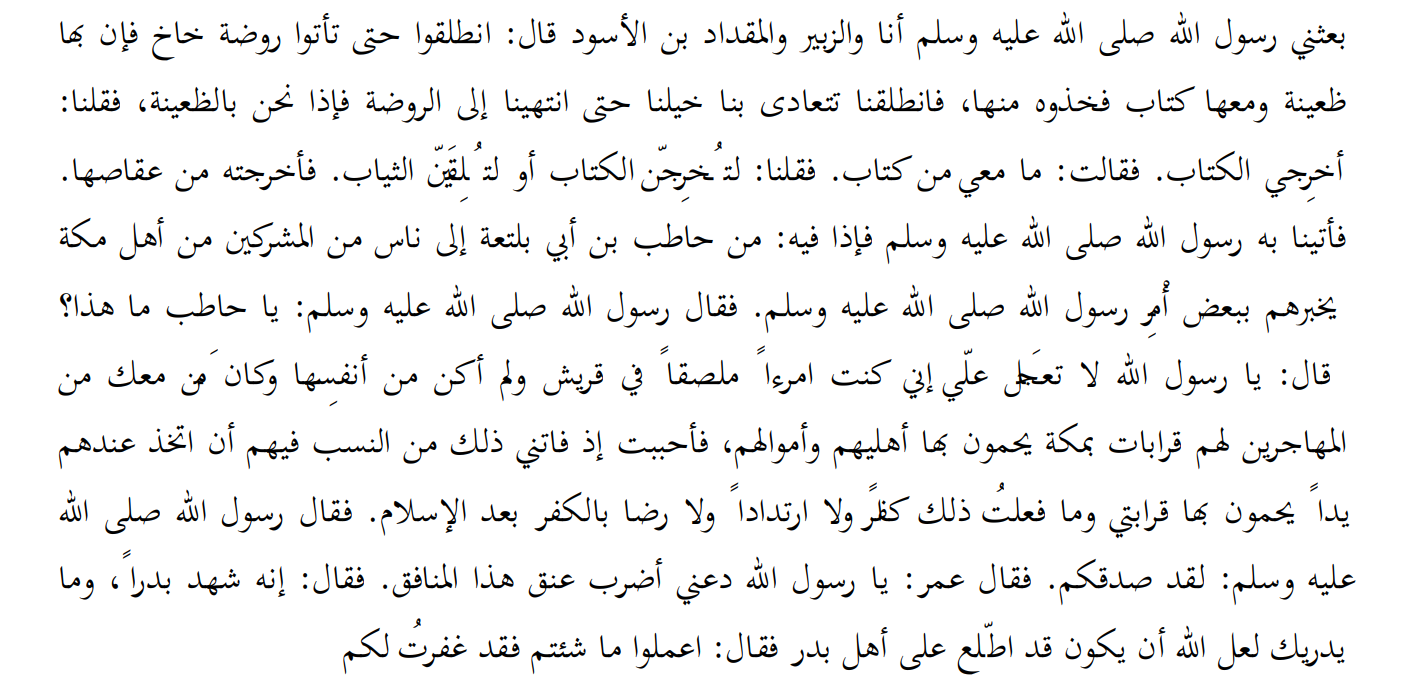
Rasululloh ﷺ meni, Az-Zubayr ibn Al-‘Avvom va Al-Miqdod ibn Al-Aswadni yuborib dedilar: “Xox bog‘iga yetguningizcha yo‘lga chiqinglar. U yerda bir ayolning tuyasi bo‘ladi, uning yonida bir kitob bo‘ladi, uni undan olinglar.” Shunda biz otlarimizni tez yurishda haydab bordik va bog‘ga yetib, u yerda ayolning tuyasini ko‘rdik. Biz dedik: “Kitobni chiqar!” U esa: “Mening yonimda hech qanday kitob yo‘q”, dedi. Shunda biz dedik: “Kitobni chiqarasan yoki biz kiyimlaringni yechamiz”. Shunda u kitobni sochining o‘rimlari orasidan chiqardi. Biz uni Rasululloh ﷺ oldiga olib keldik. Unda shunday yozilgan edi: “Abu Balta’aning o‘g‘li Hotibdan Makka aholisining ba’zilariga, Rasulullohning ﷺ ishlaridan ba’zilarini ularga xabar qilish uchun.” Shunda Rasululloh ﷺ dedilar: “Bu nima, ey Hotib?” U dedi: “Ey Rasulullohning ﷺ Rasuli, meni shoshilib hukm qilmang. Men Quraysh bilan ittifoqdosh bo‘lgan odam edim, lekin uning qavmidan emas edim. Siz bilan birga bo‘lgan muhojirlarning Makkada qarindoshlari bor, ular oilalarini va mollarini himoya qiladilar. Shuning uchun men, ularning bilan aloqam uzilib qolsa, qarindoshlarimni himoya qilish uchun ulardan biron yaxshilik qilishni istadim. Men kufr qilmadim, dinimdan qaytmadim va Islomdan keyin kufrdan mamnun bo‘lmadim.” Shunda Rasululloh ﷺ dedilar: “U sizga rost gapirdi.” Umar dedi: “Ey Rasulullohning ﷺ Rasuli, menga bu munofiqning bo‘ynini urishga ruxsat bering.” U dedi: “U Badr jangida ishtirok etgan. Sizga nima ma’lum, balki Alloh Badr ahlini kechirgan bo‘lib, “Nima xohlasangiz qilavering, men sizlarni kechirdim”, degan bo‘lishi mumkin.”
“The Messenger of Allah (saw) sent me, Az-Zubayr bin Al-‘Awwam and Al-Miqdad bin Al-Aswad and said: ‘Go forth until you reach the garden of Khakh. There will be a woman’s litter and with her is a book, so take it from her.’ So we went with our horses in a rapid gait until we ended in the garden where there was a woman’s litter. We said: ‘Remove the book’ and she said: ‘There is no book with me.’ So we said: ‘You will remove the book or we will remove the clothes’ so she removed it from her plaits. We brought it to the Messenger of Allah (saw) and therein was: ‘From Hatib bin Abu Balta’ah to some people of the people of Makkah informing them with some of the matter of the Messenger of Allah (saw). So the Messenger of Allah (saw) said: ‘What is this, O Hatib?’ He said: ‘O Messenger of Allah, do not be hasty with me. I was a man allied to Quraysh, and I was not from her body (i.e. tribe). Those with you from the Muhajirin have relatives in Makkah who protect their families and property. So I wished if the relation with them escaped me that I take a hand with which to protect my relatives. Nor did I commit disbelief or apostasy nor was I pleased with disbelief after Islam. So the Messenger of Allah (saw) said: ‘He has spoken the truth to you.’Umar said: ‘O Messenger of Allah, leave me to strike the neck of this hypocrite.’ He said: “He witnessed Badr, and you do not know but that Allah may have overlooked the people of Badr and said: ‘Do whatever you wish for I have forgiven you.’”
Hotib haqidagi bu hadisda u musulmonlarga qarshi josus bo‘lgani aniqlangan, ammo Rasulullah ﷺ uni o‘ldirmagan, bu esa musulmon josusning o‘ldirilmasligini ko‘rsatadi. Bu hukmni Badr ahliga xos deb aytish mumkin emas, chunki hadis uning Badr ahlidan bo‘lganligi bilan illatlangan. Buni aytib bo‘lmaydi, chunki matnda illatni talab qiladigan narsa bo‘lsa-da, va uning konteksti bu illatni tushunishga imkon bersa ham, Ahmadning Furrat ibn Hayyan haqidagi hadisida uni o‘ldirish u zimmiy bo‘lgandan keyin musulmon bo‘lgani sababli ko‘tarilgan. Bu hadisning illatini bekor qiladi va uni voqelikning tavsifiga aylantiradi, chunki Furrat ibn Hayyan Badr ahlidan emas edi. Shuningdek, Abu Dovudning Furrat ibn Hayyan haqidagi hadisida silsilada Abu Hammom Ad-Dallol Muhammad ibn Muhabbib borligi va uning hadislari dalil sifatida qabul qilinmasligi, u Sufyon As-Savriydan rivoyat qilishi sababli, bu gapni ham aytib bo‘lmaydi. Chunki Ahmad bu hadisni Sufyon ibn Bushr ibn As-Sirriy Al-Basriydan rivoyat qilgan, u esa Imom Buxoriy va Muslim hadisi bilan dalil sifatida kelishib olgan kishilardandir. Demak, hadis sobit bo‘ladi va undan xulosa chiqariladi, hamda musulmon josus o‘ldirilmaydi, balki qozi yoki xalifaning ijtihodiga ko‘ra qamoq yoki boshqa jazo bilan jazolanadi, degan dalildir.
It was established in this hadith about Hatib that he was a spy against the Muslims and the Messenger did not kill him, which indicates that the Muslim spy is not killed. One should not say that the rule is specific to the people of Badr because the hadith is reasoned (mu’allil) on his being of the people of Badr. This should not be said became even if the text came with what requires reasoning and its context was in a way that reasoning is understood from it; nevertheless (in) the hadith of Ahmad about Furrat bin Hayyan, killing was lifted from him because he became a Muslim after he was a dhimmi which invalidates the reasoning of this hadith and makes it a description of a reality because Furrat bin Hayyan was not from the people of Badr. Nor should one say that the hadith of Furrat bin Hayyan in Abu Dawud has Abu Hammam Ad-Dalal Muhammad bin Muhabbib in its chain and his hadith are not considered as proofs, and he is narrating from Sufyan Ath-Thawri. One should not say this because Ahmad has narrated this hadith from Sufyan bin Bushr bin As-Sirri Al-Basri, and he is from those whom Al-Bukhari and Muslim agreed to consider as proof with his hadith. So the hadith is established and is extrapolated upon, and it is an evidence that the Muslim spy is not killed but is punished with imprisonment or something else according to the view of the judge or Khalifah.
Bularning barchasi musulmonlar va zimmiylarni harbiy kofir dushman uchun josuslik qilish haqida. Musulmonlarni dushman, ya’ni harbiy kofir uchun emas, balki josuslik qilish maqsadida yoki musulmonlar yoki Davlat manfaati uchun josuslik qilish esa – garchi harom bo‘lsa-da, Shar’at bu gunoh uchun aniq jazo belgilamagan, shuning uchun uning jazosi ta’zir jazosi bo‘ladi.