2.13 Payg'ambarlar va Elchilar
2.13 The Prophets And Messengers
"Nabiy" (payg'ambar) va "rasul" (elchi) ikki qarama-qarshi atama bo'lsa-da, ikkalasi uchun ham shariat vahiy qilinishi jihatidan ular o'rtasida umumiylik bor. Rasul va nabiy o'rtasidagi farq shundaki, birinchisiga targ'ib qilishga buyurilgan shariat ilhom qilinadi, ikkinchisi esa ham ilhom qilinadi, lekin rasullarning shariatini targ'ib qilishga buyuriladi. Boshqacha aytganda, rasul shariatni o'zi targ'ib qilishga buyuriladi, nabiy esa rasullarning shariatini targ'ib qiladi.
‘Prophet’ (nabi) and ‘Messenger’ (rasul) are two contrastive terms but they share in the respect that a shari’a is revelaed to both of them. The difference between the Messenger and the prophet is that the former is inspired with a Sharī’ah which he is commanded to propagate, whereas the latter, i.e. the prophet is also inspired, but commanded to propagate the Sharī’ah of the messengers. In other words, the messenger is commanded to propagate the Sharī’ah himself, whilst the prophet propagates the Sharī’ah of the messengers.
Qodi al-Baydawiy Allohning quyidagi so'zi tafsirida:
Qadi al-Baydawi in commentary of the saying of Allah ,
Sizdan oldin hech bir elchi yoki payg'ambarni yubormaganmiz, lekin u biror istak tilaganida, {shaytон uning istagiga aralashgan} [TMQ Hajj: 52];
"Never did we send an apostle or a prophet before thee, but, when he framed a desire" [TMQ Hajj: 52];
U "elchi" (rasul) Allohning yangi yoki tiklangan Shariat bilan yuborgan zotdir, va u o'sha Shariatga odamlarni chaqiradi. Nabiy esa Allohning avvalgi Shariatni tasdiqlash uchun yuborgan zotdir. Shunga ko'ra, Muso (a.s.) nabiy edi, chunki unga Shariat vahiy qilingan edi, va elchi edi, chunki bu Shariat uning risolati uchun berilgan edi. Boshqa tomondan, Horun (a.s.) ham vahiy bilan Shariat olgani uchun nabiy edi, lekin u elchi emas edi, chunki unga vahiy qilingan Shariat uning risolati uchun emas, balki Muso (a.s.) ning risolati uchun edi. Xuddi shunday, Muhammad ﷺ ham vahiy bilan o'z risolati uchun berilgan Shariat olgani sababli, ham nabiy, ham elchi edi.
Says, ‘The messenger is sent by Allah with a revived or new Sharī’ah which he calls people to, whereas the prophet is sent by Allah to affirm the former Sharī’ah.’ Thus, Musa was a prophet because he was inspired with a Sharī’ah and a messenger because this Sharī’ah was for his mission. On the other hand, although Aaron was also a prophet because he was inspired with a Sharī’ah, he was not a messenger because the Sharī’ah, which was revealed to him was not for his mission, rather it was for the mission of Musa . By the same token, Muhammad was a prophet and a messenger because he was inspired with a Sharī’ah, which was for his mission.
Risolat — Alloh bilan bandalar o‘rtasidagi vositachilik bo‘lib, bu dunyo va oxirat ehtiyojlarini qondirish usulini bayon qilish va aniqlashtirish uchun xizmat qiladi. Hikmat elchilarni yuborishni taqozo etadi, chunki ular odamlar uchun qonunlar va manfaatlar olib keladilar.
The message is the mediation between Allah and the slaves in order to explain and clarify the method of satisfying the needs of this world and the hereafter. Wisdom necessitates the sending of messengers as they bring laws and benefits for people.
Demak, elchilarni yuborish haqiqatan ham sodir bo‘lgan. Alloh odamlar orasidan elchilar tayinladi va ularni iymon va itoatda bo‘lgan kishilarga jannat va savob haqida xushxabar keltiruvchi sifatida yubordi. Ular kufr va itoatsizlikda bo‘lgan kishilarga do‘zax olovi va azob haqida ogohlantiruvchilar edi, hamda insonga bu dunyo va oxirat uchun zarur bo‘lgan narsalar va talablarni bayon qildilar. Buning sababi shuki, aql yaxshi va yomonni hal qilishga ham, insonning o‘zini va uning ishlarini to‘liq anglashga ham qodir emas.
Thus, the sending of Messengers has actually occurred. Allah appointed messengers from amongst mankind and sent them as bearers of glad tidings of paradise and reward to the people of belief and obedience. They were warners of the hell fire and punishment to people of disbelief and disobedience and they clarified the needs and requirements of this world and the hereafter for man. All because the mind is incapable of either deciding the good and bad or able to comprehend man himself and his affairs.
Odam Rabbisining amrini buzdi, shunda u istagan narsasiga yetolmadi. Keyin uning Rabbisi uni tanladi, unga rahmati bilan murojaat qildi va unga O'zining sevimli yaqinligiga yo'lni ko'rsatdi. [TMQ Tā Hā: 121-2]
"Adam slipped the commandment of his Lord then what he had desired, did not get the way to it. Thereafter his Lord chose him and turned to him with his mercy and showed him the way to his favoured nearness" [TMQ Tā Hā: 121-2]
Ijtaba bu o'rinda uni tanlash ma'nosini anglatadi. Qur'on ham Allohning Odamga ba'zi narsalarni buyurgani va boshqa ba'zi narsalarni taqiqlagani haqida dalil keltiradi. Shu sababli Alloh shunday deydi:
The meaning of Ijtaba in this context means selecting him. The Quran also proves that Allah both commanded and prohibited Adam certain things. Hence Allah says,
Biz aytdik: "Ey Odam, sen ham, xotining ham jannatda makon toping va u yerdan xohlaganingizcha erkin yeng, lekin bu daraxtga yaqinlashmang, aks holda zolimlardan bo'lib qolasiz." [TMQ Baqarah: 35]
"And we said, O Adam, dwell you and your wife in paradise and eat freely thereof where you will, but do not approach this tree lest you become of the transgressors" [TMQ Baqarah: 35]
Bu narsa bir ma'noda, uning davrida boshqa hech qanday payg'ambar bo'lmaganini qat'iy isbotlaydi. Shunday ekan, Odam (alayhissalom) vahiy orqali payg'ambar bo'lgan va bundan boshqa hech narsa emas edi. U shariat bilan vahiy qilingan payg'ambar edi, chunki har bir amr va nahiy shariatdir. Demak, u vahiy olgani uchun payg'ambardir.
This categorically proves that there was no other prophet during his time. Therefore, Adam was a prophet by revelation and nothing else. A prophet who was inspired with a Sharī’ah, as every commandment [amr] or prohibition [nahi] is Sharī’ah. Thus since he received inspiration he is a prophet.
Ikkinchi manba — Sunnat. At-Tirmiziy Abu Saʼid al-Xudriydan rivoyat qilgan: Payg‘ambar ﷺ aytdilar:
The Second source is the Sunnah. Tirmidhi reported from Abu Said al-Khudri that the prophet said,
Qiyomat kuni men Odam farzandlarining sayyididirman, lekin buning bilan maqtanmayman. Hamd bayrog'i mening qo'limda bo'ladi, lekin buning bilan maqtanmayman. O'sha kuni Odamdan boshlab barcha paygambarlar mening bayrog'im ostida bo'ladilar.
"I will be the leader of the sons of Adam on the day of resurrection but I do not boast. I will have the banner of al-Hamd in my hand but I do not boast and on that day, all the prophets from Adam will be under my banner."
Nihoyat, Sahoba (roziyallohu anhum) ijmosi ham Odam (alayhis-salom)ning payg'ambar bo'lganini isbotlaydi.
Lastly, the consensus of the Sahaba also proves that Adam was a prophet.
Muhammad ﷺning payg'ambarligiga kelsak, u ham payg'ambarlik da'vo qilgan va mo''jizalar ko'rsatgan. Payg'ambarligi mutavotir rivoyatlar orqali ma'lum bo'lib, bu uni shubhasiz isbotlaydi. Mo''jizaga kelsak, ya'ni Qur'onga, u Allohning kalomi bo'lib, Makkaning fasih va buyuk notiqlariga meydon o'qigan va ularni o'ziga qarshi chiqishga da'vat etgan. Ular hatto eng qisqa surani ham qarshilik qilib yarata olmadilar, garchi shunga harakat qilishgan bo'lsalar ham. Keyin ular o'z zamonlarining eng yaxshi va eng hurmatli tilshunoslari bo'lishlariga qaramay, qarshilik ko'rsatishni nutq va notiqlikdan zo'ravonlik va qilichga o'tkazdilar. Kofirlardan birortasi ham Qur'onga o'xshash biror narsa kimdir tomonidan yaratilganini rivoyat qilmagan, holbuki, agar kerak bo'lsa, bu haqda xabar berishga imkoniyatlari bor edi. Bularning barchasi Qur'onning, ya'ni Muhammad ﷺga berilgan mo''jizaning Allohdan ekanini qat'iy isbotlaydi va payg'ambarning ﷺ haqiqiy da'vosini shubhasiz tasdiqlaydi.
As for the prophethood of Muhammad , as he also claimed prophethood and brought forth miracles, the prophethood is known by Mutawatir narrations, which substantiates it beyond any doubt. As for the miracle (i.e. the Qur’ān) it is the speech of Allah , which challenged and defied the eloquent and great speakers of Mecca. They were unable to oppose the shortest Sura of the Qur’ān, although they strived to do so. They then abandoned their styles of opposition from talk and rhetoric, even though they were the best and most revered linguists of their time, to force and the sword. Not even one of the disbelieving Kuffars ever related that someone was ever able to produce anything similar to the Qur’ān, despite the fact that they had the means to relate this information if required. All this categorically proves that the Qur’ān, i.e. the miracle given to Muhammad is from Allah and without any doubt verifies the true claim of the prophet .
Payg'ambarlar va elchilarning soni noma'lum, chunki Alloh O'z elchisiga xabar bergan.
The number of prophets and messengers are unknown because Allah informs his messenger,
Biz sizdan oldin ham elchilar yubordik, ularning ba'zi qissalarini sizga aytib berdik, ba'zilarini esa aytib bermadik. [TMQ Ghafir:78]
"We have sent messengers before you, we have mentioned some of their stories to you, whilst we have not mentioned others." [TMQ Ghafir:78]
Garchi bu raqam ba'zi hadislarda zikr etilgan bo'lsa-da, o'sha hadislar ahad toifasiga kiradi. Shu sababli ularning aqidada hech qanday qiymati yo'q; ya'ni ular aqidaning bir qismini tashkil etmaydi. Agar ahad hadis usul al-fiqh talablarining barchasiga javob bersa ham, u faqat taxminga olib keladi, taxmin esa e'tiqodning bir qismi sifatida qabul qilinmaydi. Shuning uchun bu raqam Qur'onda zikr etilgan payg'ambarlar va elchilar bilan chegaralanadi, chunki u qat'iydir. Bundan tashqari, payg'ambarlar soni mutavatir hadisda ham zikr etilmagan. Qur'onda zikr etilgan payg'ambarlarga kelsak, Alloh taolo aytadi,
Although the number has been mentioned in some Ahadith, the Ahadith in question are of the Ahad category. Thus they do not have any value in ‘aqīdah (creed); i.e. they do not form part of the ‘aqīdah (creed). Assuming that the Ahad Hadith met all the pre-requisites of Usul-al-fiqh, it would only lead to conjecture, and conjecture can not be accepted as part of belief. Therefore the number is limited to the prophets and messengers mentioned in the Qur’ān because that is definite. Moreover, the number of prophets is neither mentioned in the Mutawatir Hadith. In respect to the prophets mentioned in the Qur’ān, Allah says,
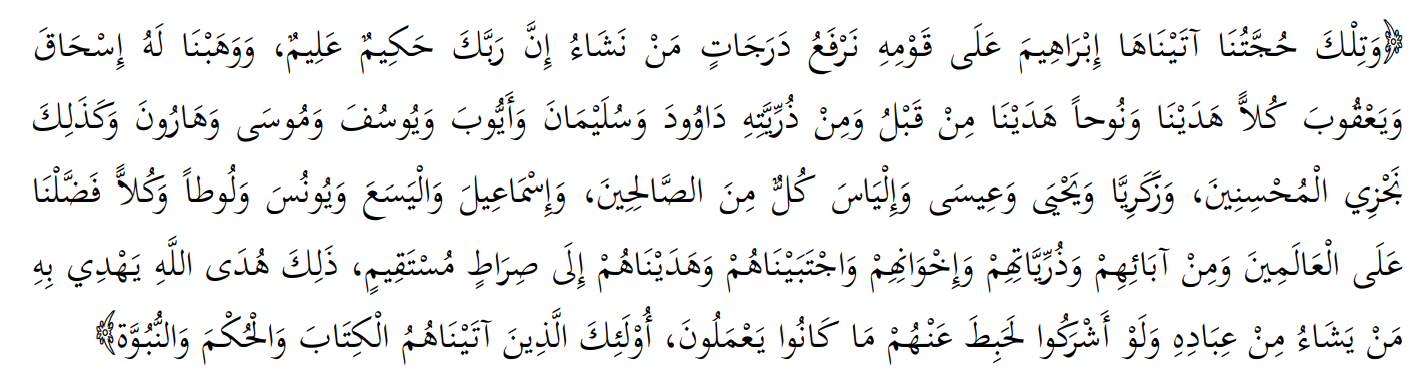
Va bu bizning Ibrohimga uning qavmiga qarshi bergan hujjatimizdir: biz xohlaganimizni darajalar bilan ko'taramiz. Albatta, Robbingiz donodir, bilguvchidir. Biz unga Ishoq va Yoqubni in'om qildik, ularning hammasini to'g'ri yo'lga yo'lladik. Undan oldin Nuhni ham to'g'ri yo'lga yo'lladik, uning avlodidan Dovud, Sulaymon, Ayyub, Yusuf, Muso va Horunni ham. Biz yaxshilik qiluvchilarni shunday mukofotlaymiz. Zakariyo, Yahyo, Iso va Ilyosni ham. Bularning hammasi solihlardandir. Ismoil, Alyasa, Yunus va Lutni ham; ularning har birini o'z zamonidagi barcha odamlardan afzal qildik. Shuningdek, ularning ota-bobolaridan, avlodlaridan va birodarlaridan ba'zilarini ham tanladik va ularni to'g'ri yo'lga yo'lladik. Bu Allohning hidoyatidir. U o'z bandalaridan xohlaganini unga hidoyat qiladi. Agar ular shirk keltirganlarida edi, qilgan barcha amallari behuda ketardi. Ana shular Biz kitob, hukm va payg'ambarlik bergan kishilardir. [TMQ An’ām: 83-89]
"And this is our argument that we gave to Abraham against his people, we raise in degrees whom we please, undoubtedly, your lord is wise, knowing. And we gave him Ishaq and Yaqub, we showed the path to all of them and showed the path to Nuh before them, and of his progeny, to Daud and Sulaiman and Ayub and Yusuf and musa and Haroon, and thus we recompense the righteous. And to Zakaria, Yahya, Isa and Ilyas. These are all entitled to be our near ones. And to Ismail and Yasa and Yunus and lot, and to each one we preferred above all in his time. And also to some of their fathers and their progeny and some of their brothers, and we chose them and showed them the straight path. This is the guidance of Allah. He gives whom he will of his bondmen, and if they would have committed polytheism, then surely all that they had already done would have been destroyed. These are they to whom we gave the book and order and prophet hood" [TMQ An’ām: 83-89]
Ismoil, Idris va Zul-Kifl ham sabr qiluvchilardan edilar, Biz ularni rahmatimizga kiritdik. Albatta, ular solihlardandir. [TMQ Anbiya: 85-86]
"And Ismail and Idrees and Dhul-Kifl all were from the patient ones who we took into our mercy. Indeed they are from the righteous." [TMQ Anbiya: 85-86]
"Va Madyanga, ularning birodari Shu'aybni yubordik." [TMQ Araf: 85]
"And to Madyan, we sent their brother Shu'aib." [TMQ Araf: 85]
Va Samudga, ularning birodari Solihni yubordik. [TMQ Araf: 73]
"And to Thamud, we sent their brother Salih." [TMQ Araf: 73]
Va Odga biz ularning birodari Hudni yubordik. [TMQ Araf:65]
"And to A'ad, we sent their brother Hud." [TMQ Araf:65]
Biz aytdik: "Ey Odam, sen ham, xotining ham jannatda yashanglar." [TMQ Baqarah: 35]
"And we said, o Adam dwell you and your wife in paradise." [TMQ Baqarah: 35]
Muhammad ﷺ Allohning elchisidir. Uning yonidagilar kofirlarga nisbatan qattiqqo'l, o'zaro esa mehribondirlar. [TMQ Fath: 29]
"Muhammad is the messenger of Allah. Those with him are severe on the Kuffar and merciful between themselves." [TMQ Fath: 29]
Barcha payg'ambarlar va elchilar Allohdan xabar beruvchilar bo'lganlar, chunki payg'ambarlik va elchilik ma'nosi aynan shudir. Ular rostgo'y, xalqqa ogohlantiruvchilardir, toki risola va xabar behuda bo'lib qolmasin; ular o'z da'vatlarida yolg'ondan va xatodan, xuddi har qanday gunohdan ma'sum bo'lganlari kabi, ma'sumdirlar. Bundan tashqari, Qur'oni karimda ham, payg'ambar ﷺ sunnatida ham payg'ambarlar payg'ambarlik va elchilik vazifasiga tayinlanganlaridan keyin adashganliklari haqida qat'iy (qat'i) matnli dalil yo'qdir. Bu haqda naql qilingan narsalar yo ishonchliligi noaniq (zanniy as-subut) bo'lgan hadislarda, yoki dalolati noaniq (zanniy ad-dalolat) bo'lgan oyatlardadir, noaniq (zanniy) dalil esa ma'sumlik haqidagi aniq aqliy dalilni bekor qila olmaydi. Qur'onda Odam alayhissalom haqida nozil bo'lgan, Alloh taqiqlagan daraxtdan yeganliklari haqidagi xabarga kelsak, bu xalq uchun yer yuzida xabarni yetkazishdagi ma'sumlikka zid emas, chunki Odam alayhissalomdan sodir bo'lgan ish jannatda ro'y bergan bo'lib, uning hikmatini faqat Alloh biladi. Shu sababli bu alohida masala (ya'ni Odam alayhissalomning daraxt mevasidan yeganlari), chunki ma'sumlik yer yuzidagi odamlarga xabar yetkazish bilan bog'liqdir.
All the prophets and messengers were informers from Allah because this is the meaning of prophethood and messengerhood. They are truthful, admonishers to creation lest the mission and message become futile and they are infallible from lying and error in their propagation, just as they are infallible from committing any sin. Further there is no definite [Qati] textual evidence in the Qur’ān or the Sunnah of the prophet informing about the erring of the prophets after their Prophethood of Messengership. Whatever has been reported is either in the ahadith that are indefinite in their transmission [dhanni athuboot] or in the ayat that are indefinite in their evidence [dhanni ad-dalala] and the Indefinite [dhanni] cannot over ride the definite rational evidence on infallibility. As for what was revealed regarding Adam in the Qur’ān about him eating from the tree which Allah had prohibited him to eat from, this does not contradict the requirement of infallibility in the propogation of the message to the people on the earth because what happened from Adam was in the Paradise, the wisdom of which is only known to Allah . Therefore this is separate matter (i.e Adam’s eating of the fruit of the tree) because infallibility is related to the propogation of the message to the people on the earth.