17. Xilofat
17. The Khilafah
Xilofat — barcha dunyo musulmonlari uchun umumiy yoki umumiy rahbarlik bo‘lib, uning maqsadi Islom shariati qonunlarini joriy etish va Islom da’vatini dunyoga yetkazishdir. U imomat bilan bir xil, chunki imomat va xilofat bir xil ma’noni anglatadi. Bir qator sahih hadislarda ular bir xil ma’noda zikr qilingan. Shariat matnlarida, ya’ni Qur’on va Sunnatda, bu ikki atama hech qachon bir-biridan farqli ma’noda kelmagan, chunki bu ikki manba shariatning yagona manbalaridir. Xilofat yoki imomat atamasiga amal qilish majburiy emas, balki atamaning ma’nosiga amal qilish majburiydir.
The Khilafah is the general or overall leadership for all the Muslims in the world in order to establish the laws of the Islamic Shari’ah and to carry the da’wa of Islam to the world. It is the same as the Imamah, as the Imamah and Khilafah have the same meaning. Several saheeh ahadith mention them with the same meaning. Neither of the two terms has ever come with any meaning different from the other in any Shari’ah text i.e. the Qur’an or the Sunnah, as these two (sources) are the only Shari’ah sources. It is not compulsory to hold to the term of Khilafah or Imamah, but rather it is compulsory to hold to the meaning of the term.
Barcha mintaqalardagi barcha musulmonlar uchun Xilofatni barpo etish farzdir. Uni barpo etish, Alloh (subhanahu va taolo) musulmonlarga yuklagan har qanday farzni ado etish kabi, muqarrar bo'lgan ishdir, unda ixtiyor yoki yengillik yo'q. Uni ado etishda beparvolik qilish Alloh (subhanahu va taolo) eng qattiq jazo bilan jazolaydigan eng og'ir gunohlardan biridir.
Establishing the Khilafah is an obligation upon all Muslims in all regions of the world. Establishing it, like the performing of any obligation that Allah (swt) obliged upon Muslims, is an inevitable matter without choice or leniency in it. Negligence in performing it is one of the worst sins for which Allah (swt) punishes with the strictest of the punishments.
Xalifalikni barcha musulmonlar ustidan o‘rnatishning dalillari (quyidagilardan): Qur’on, Sunnat va Sahobalarning ijmosi.
The evidence for establishing the Khilafah upon all Muslims (come from): The Qura'n, The Sunnah and Ijmaa as-Sahabah.
Qur'on haqida aytadigan bo'lsak, Alloh (SWT) Rasulga (ﷺ) Unga nozil qilgan hamma narsa bilan musulmonlar o'rtasida hukm qilishni buyurgan va Uning (SWT) Rasulga (ﷺ) bergan buyrug'i qat'iy shaklda bo'lgan. Alloh (SWT) Payg'ambarga (ﷺ) shunday deb murojaat qilgan:
As for the Qura'n, Allah (swt) has ordered the Messenger (saw) to rule between Muslims by all that He (swt) revealed to him (saw), and His order (swt) to him was in a decisive manner. Allah (swt) addressed the Prophet (saw) saying:
Va Alloh nozil qilgan narsa bilan ular o'rtasida hukm qil va sendan kelgan haqiqatdan chetga chiqib, ularning nafsiy xohishlariga ergashma. [TMQ 5:48]
"And rule between them by that which Allah revealed to you, and do not follow their vain desires away from the truth which came to you" [TMQ 5:48]
U у (SWT) деди: Note: the original reads "And He (swt) said", so I rendered the honorific as "(SWT)" as instructed, keeping it as written.
And He (swt) said:
Ular o'rtasida Alloh tomonidan sizga nozil qilgan narsa bilan hukm qiling va ularning havoyi istaklariga ergashmang hamda ehtiyot bo'ling, ular sizni Alloh sizga nozil qilgan narsaning hatto bir qismidan ham chetga burib yubormasliklari uchun. [TMQ 5:49]
"And rule between them by that which Allah revealed to you and do not follow their whims, and beware (be on the alert) that they may deviate you away from even some part of what Allah revealed to you" [TMQ 5:49]
Allohning (SWT) Payg'ambarga (ﷺ) qaratilgan xitobi, uni cheklovchi dalil bo'lmagan hollarda, uning ummatiga ham xitobdir. Bu holda bunday cheklovchi dalil yo'q, shuning uchun xitob barcha musulmonlarga qaratilgan bo'lib, hukmni joriy etish talab etiladi. Xalifani o'rnatish hukm va hokimiyatni o'rnatishdan boshqa narsa emas. Bundan tashqari, Alloh (SWT) musulmonlarga hokimiyatdagilarga, ya'ni hukmdorga itoat qilishni farz qildi, bu esa hokimiyat egasining mavjudligi musulmonlar uchun majburiy ekanini bildiradi. Alloh (SWT) shunday degan:
The speech of Allah (swt) to the Prophet (saw) is a speech to his Ummah unless there is evidence which limits the speech to him (saw). In this case there is no such evidence, so the address is to all the Muslims to establish the rule (hukm). The establishment of the Khalifah does not mean other than the establishment of the rule and the authority. Moreover, Allah (swt) made it obligatory upon Muslims to obey those in authority i.e. the ruler, which indicates that the existence of the one in authority is obligatory upon Muslims. Allah (swt) said:
Ey iymon keltirganlar! Allohga itoat qilinglar, Rasulga va aralaringizdagi ulug' amr egalariga itoat qilinglar. [TMQ 4:59]
"O you who believe obey Allah and obey the Messenger and those in authority amongst you" [TMQ 4:59]
Alloh (swt) hokimiyatda bo‘lgan kishiga itoat buyurmaydi, agar u mavjud bo‘lmasa. Bu shuni ko‘rsatadiki, hokimiyatdagi shaxsning mavjud bo‘lishi vojibdir. Alloh (swt) hokimiyatdagilarga itoat qilishni buyurganda, aslida ularning o‘rnatilishini buyurgan bo‘ladi. Hokimni o‘rnatishning natijasi shar’iy hukmning joriy etilishidir, uni o‘rnatmaslik esa shar’iy hukmning e’tiborsiz qoldirilishiga olib keladi. Shunday ekan, uning mavjudligi vojibdir, chunki uni o‘rnatmaslikning natijasi taqiqlangan ishlardan bo‘lgan, ya’ni shar’iy hukmning e’tiborsiz qoldirilishidir.
Allah (swt) does not order obedience to someone who does not exist. This indicates that the existence of the person in authority is obligatory. When Allah (swt) commands obedience to those in authority then He (swt) is commanding their establishment. The result of establishing the ruler is the establishment of the Shari’ah rule (hukm shar’i) and the failure to establish it will result in neglecting the Shari’ah rule (hukm shar’i). Thus his existence is obligatory as the result of the failure to establish it is will be from the prohibited matters i.e. the neglect of the Shari’ah rule (hukm shar’i).
Sunnat haqida: Nofi‘ rivoyat qilishicha, Abdulloh ibn ‘Umar unga aytdi: u Payg‘ambar ﷺ aytayotganlarini eshitgan.
As for the Sunnah, Nafi‘ reported saying: Abdullah bin ‘Umar said to me that he heard the Prophet (saw) saying:
"Kimki itoatdan qo‘lini tortib olsa, Qiyomat kuni Allohni shunday holatda uchratadiki, uning uchun hech qanday hujjati bo‘lmaydi; kimki bo‘yniga bay’at (sadoqat ahdi) bo‘lmagan holda vafot etsa, johiliyat o‘limi bilan o‘ladi."
“Whoever removes his hand from obedience will meet Allah on the Day of Resurrection without having any proof for him, and whoever dies without a pledge of allegiance (bay’ah) on his neck dies a death of ignorance (jahiliyyah).”
Shunday qilib, Payg'ambar (saw) har bir musulmonga bo'ynida bay'ah bo'lishini farz qilgan va kimki bo'ynida bay'ah bo'lmagan holda vafot etsa, u johiliyyat o'limi bilan o'lgan bo'ladi, deb bayon qilgan. Bay'ah Xalifadan boshqa kimga bo'lishi mumkin emas. Payg'ambar (saw) har bir musulmonga Xalifaga bo'lgan bay'ahni bo'ynida bo'lishini majburiy qilgan, ammo har bir musulmonga Xalifaga bay'ah berishni majburiy qilmagan. Farz bo'lgan narsa — har bir layoqatli musulmonning bo'ynida bay'ah mavjud bo'lishidir, ya'ni shunday Xalifaning mavjud bo'lishidirki, u tegishli tarzda har bir musulmonning bo'ynidagi bay'ahga loyiqdir. Demak, har bir musulmonning bo'yniga bay'ah qo'yadigan narsa Xalifaning mavjudligidir, musulmon unga bizzat (shaxsan) bay'ah bergan bo'lsinmi yoki yo'qmi, farqi yo'q. Shuning uchun Payg'ambarning (saw) ushbu hadisi Xalifani tayinlashning farz ekanligiga dalil bo'ladi, bay'ah berish farz ekanligiga dalil bo'lmaydi. Buning sababi, Payg'ambar (saw) qoralagan narsa musulmonning o'lguncha bo'ynida bay'ah bo'lmasligi edi, bay'ah berilmasligini u qoralamagan. Muslim Al-A'raj orqali Abu Hurayra (ra) dan, u Payg'ambardan (saw) rivoyat qiladi, u (saw) shunday degan:
So the Prophet (saw) made it compulsory upon every Muslim to have a bay’ah on his neck, and described that whoever dies without a bay’ah on his neck that he dies a death of jahiliyyah. The bay’ah cannot be for anyone except the Khalifah. The Prophet (saw) made it obligatory upon every Muslim to have on his neck a bay’ah to a Khalifah, yet he did not make it an obligation upon every Muslim to give bay’ah to a Khalifah. The duty is the existence of a bay’ah on the neck of every eligible Muslim i.e. the existence of a Khalifah who accordingly deserves a bay’ah upon the neck of every Muslim. So it is the presence of the Khalifah which places a bay’ah on the neck of every Muslim, whether the Muslim actually gave a bay’ah to him (in person) or not. Therefore, this hadith of the Prophet (saw) is evidence that the appointment of the Khalifah is an obligation and not a proof that giving the bay’ah is obligatory. This is so because what was rebuked by the Prophet (saw) was the absence of a bay’ah on the neck of a Muslim until he dies, but he did not rebuke the absence of the bay’ah. Muslim narrated from Al-’Araj from Abu Hurairah (ra) from the Prophet (saw) who said:
"Diqqat qiling, imom — bu shunday qalqonki, uning orqasida odamlar jang qiladi va uning vositasida o‘zlarini himoya qiladi."
“Behold, the Imam is a shield from behind whom the people fight and by whom they protect themselves.”
Muslim Abu Hazimdan rivoyat qiladi, u shunday degan:
And Muslim reported from Abu Hazim who said:
“Men Abu Hurayra bilan besh yil birga bo‘ldim va u Payg‘ambardan rivoyat qilib, shunday deganini eshitdim: Payg‘ambar ﷺ aytdilar: «Isroil o‘g‘illarini Payg‘ambarlar boshqarib turardi. Qachonki bir Payg‘ambar vafot etsa, uning o‘rniga boshqa Payg‘ambar keldi, lekin mendan keyin hech qanday Payg‘ambar bo‘lmaydi. Xalifalar bo‘ladi va ularning soni ko‘p bo‘ladi». Sahobalar so‘radilar: «Unda bizga nima buyurasiz?» U zot aytdilar: «Ularga ketma-ket bay’at ado eting va ularning haqqini bering. Albatta, Alloh ularga topshirgan narsalari haqida ulardan so‘raydi».”
“I accompanied Abu Hurairah for five years and heard him reporting from the Prophet who said: The Prophets ruled over the children of Israel. Whenever a Prophet died another Prophet succeeded him, but there will be no Prophet after me. There will be Khulafaa and they will number many. They asked: What then do you order us? He said: Fulfil the bay’ah to them one after the other and give them their due right. Surely Allah will ask them about what He entrusted them with.”
Ibn ʿAbbos (roziyallohu anhumo) rivoyat qiladi, Nabiy ﷺ shunday degan:
And from bin ‘Abbas from the Prophet (saw) who said:
"Agar kimdir o‘z amiridan biror narsani yoqtirmasa, sabr qilsin. Chunki kim sultondan (Islom hokimiyatidan) bir qarich bo‘lsa ham ajralib chiqsa va shu holatda vafot etsa, u johiliyat o‘limi bilan o‘lgan bo‘ladi."
“If anyone sees in his Amir something that displeases him let him remain patient. For, behold, he who separates himself from the sultan (authority of Islam) by even so much as a hand span and dies thereupon, has died a death of jahiliyyah”.
Ushbu hadislarda Payg'ambar (saw) musulmonlarning ishlarini boshqaruvchi rahbarlar bo'lishini xabar qiladi va ularni qalqon, ya'ni himoya sifatida tavsiflaydi. Shunday ekan, Imomni qalqon deb ta'riflash Imomning mavjudligi foydalarini bildiradi va bu amal qilishga buyruqdir. Chunki Alloh (swt) va Payg'ambar (saw) tomonidan yetkazilgan xabar agar qoralashni o'z ichiga olsa, bu man qilish buyrug'i bo'ladi, agar maqtovni o'z ichiga olsa, bu amal qilish buyrug'i bo'ladi. Agar buyurilgan amal shar'iy hukmni amalga oshirish uchun zarur bo'lsa yoki uni e'tiborsiz qoldirish bilan shar'iy hukm bajarilmay qolsa, bu buyruq qat'iy bo'ladi. Bu hadislarda yana shunday ma'lumot borki, musulmonlarning ishlarini boshqaruvchilar Xulafo deb ataladi, bu esa ularni tayinlash buyrug'iga ishora qiladi. Ularda yana musulmonlarning hokimiyatdan ajralishi man qilinadi, bu esa musulmonlarning o'zlari uchun hokimiyat, ya'ni boshqaruv tayinlash majburiyatiga ishora qiladi. Bundan tashqari, Payg'ambar (saw) musulmonlarga Xalifaga itoat etishni va uning Xalifalik hokimiyatiga da'vo qiluvchilar bilan urushishni buyurdi, bu esa Xalifa tayinlash va uning xilofatini himoya qilish uchun, unga qarshi da'vo qiluvchilarga qarshi kurashish buyrug'iga ishora qiladi. Muslim rivoyat qilishicha, Payg'ambar (saw) shunday degan:
In these ahadith, the Prophet (saw) informs us that leaders will run the affairs of Muslims, and they include the description of the Khalifah as a shield i.e. a protection. So the description of the Imam as a shield is informative of the benefits of the presence of the Imam, thus it is a command for action. This is because if the information conveyed by Allah (swt) and the Prophet (saw) contained rebuke then it is a command of prohibition, and if it contained praise then it is a command for action. If the ordered action is necessary to implement a hukm shari’ (Shari’ah rule), or by its negligence a hukm shar‘i will be neglected, then this command is decisive. In these ahadith there is information also that those who run the affairs of Muslims are Khulafaa, which indicates an order to appoint them. They also include a prohibition for Muslims to separate from the authority, which indicates the obligation upon Muslims to appoint an authority for themselves i.e. ruling. Moreover, the Prophet (saw) ordered the Muslims to obey the Khalifah and to fight those who dispute his authority as Khalifah, which indicates an order to appoint a Khalifah and to protect his Khilafah by fighting against whosoever disputes with him. Muslim reported that the Prophet (saw) said:
"Kim bir imomga qo'lini berib, yuragining mevasini bergan bo'lsa, qo'li yetgancha unga itoat etsin; agar boshqa biri unga talashib kelsa, o'sha odamning bo'yinini uring."
“He who pledged allegiance to an Imam giving him the clasp of his hand and the fruit of his heart shall obey him as long as he can, and if another comes to dispute with him you have to strike the neck of that man.”
Demak, Imomga itoat qilish haqidagi buyruq uni o'rnatish uchun buyruqdir, uning hokimiyatiga qarshi chiqqanlar bilan urushish haqidagi buyruq esa bu buyruqning bitta Xalifa mavjudligini saqlashda hal qiluvchi ekanligiga dalildir.
So the command to obey the Imam is an order to establish him, and the command to fight those who dispute with him is evidence that this command is decisive in maintaining the presence of one Khalifah.
Sahobalarning ijmoʼiga kelsak, ular barchasi Payg‘ambar (s.a.v.) vafotidan keyin uning o‘rnini bosuvchi, ya’ni xalifa tayinlash zarurligida birdek fikr bildirdilar, shuningdek, ularning har biri vafot etganidan keyin Abu Bakrning, so‘ngra Umarning, so‘ngra Usmonning o‘rniga boshqa birini tayinlashga ham kelishdilar. Sahobalarning xalifa tayinlash to‘g‘risidagi ijmoʼi Payg‘ambar (s.a.v.) vafotidan keyin uning dafn etilishini kechiktirishda yaqqol namoyon bo‘ldi: ular unga o‘rin bosuvchi tayinlash bilan band bo‘lib, dafnni kechiktirdilar, holbuki, marhumni dafn etish farz bo‘lib, dafn tugallanguncha uni dafn qilishga mas’ul bo‘lganlarga boshqa ish bilan shug‘ullanish harom hisoblanadi. Sahobalar Payg‘ambar (s.a.v.) dafnini tayyorlashga majbur edilar, biroq ularning ba’zilari dafn qilish o‘rniga xalifa tayinlash bilan shug‘ullandilar, boshqalari esa bu shug‘ullanishga jim qarab, dafnni ikki kecha davomida kechiktirishda ishtirok etdilar, holbuki ular kechikishga qarshi chiqishga va Payg‘ambar (s.a.v.) ni dafn etishga qodir edilar. Demak, bu dafn qilishdan ko‘ra xalifa tayinlash bilan band bo‘lish to‘g‘risidagi ijmo edi. Bu, xalifa tayinlash dafn etishdan ko‘ra ko‘proq vojib bo‘lmasa, to‘g‘ri bo‘la olmas edi. Shuningdek, barcha sahobalar umrlari davomida xalifa tayinlashning vojibligida kelishdilar. Ular xalifani kimning saylashi haqida ixtilof qilgan bo‘lsalar-da, xalifa tayinlash to‘g‘risida hech qachon ixtilof qilmadilar, na Payg‘ambar (s.a.v.) vafot etganda, na Xulafoi Roshidinlardan biri vafot etganda. Shunday ekan, sahobalarning ijmoʼi xalifa tayinlashning vojib ekanligiga aniq va kuchli dalildir.
As for the Ijma’a of the Sahabah (ra) they all agreed upon the necessity to establish a successor or Khalifah to the Prophet (saw) after his death, and they all agreed to appoint a successor to Abu Bakr, then to ‘Umar, then to ‘Uthman, after the death of each one of them. The Ijma’a of the Sahabah (ra) to establish a Khalifah manifested itself emphatically when they delayed the burial of the Prophet (saw) after his death while engaged in appointing a successor to him, despite the fact that the burial of the dead person is fard, and that it is haram upon those who are supposed to prepare for his burial to engage themselves in anything else until they complete the burial. The Sahabah (ra) were obliged to engage themselves in preparing the burial of the Prophet (saw), instead some of them engaged themselves in appointing a Khalifah rather than carrying out the burial, and some others kept silent on this engagement and participated in delaying the burial for two nights despite their ability to deny the delay and their ability to bury the Prophet (saw). So this was an Ijma’a to engage themselves in appointing a Khalifah rather than to bury the dead. This could not be legitimate unless the appointment of a Khalifah is more obligatory than the burial of the dead. Also, all the Sahabah (ra) agreed throughout their lives upon the obligation of appointing a Khalifah. Although they disagreed upon the person to be elected as a Khalifah, they never disagreed upon the appointment of a Khalifah, neither when the Prophet (saw) died, nor when any of the Khulafaa ar-Rashidun died. Therefore the Ijma’a of the Sahabah is clear and strong evidence that the appointment of a Khalifah is obligatory.
“Vojib (majburiy amal)ni ado etish uchun zarur bo‘lgan narsa o‘zi ham vojibdir”
‘What is necessary to accomplish a wajib (duty) is itself a wajib’
Shunga ko'ra, Xalifalikning tashkil etilishi ham ushbu ilohiy qoida bo'yicha vojibdir.
So the establishment of a Khalifah is also compulsory according to this divine principle.
Shuning uchun ushbu dalillardan ayon bo‘ladiki, musulmonlar orasida hokimiyat va boshqaruvni o‘rnatish farzdir. Shuningdek, ayon bo‘ladiki, Shari’at hukmlarini amalga oshirish uchun, faqat hokimiyat va boshqaruvning o‘zi uchun emas, balki boshqaruv va hokimiyat mas’uliyatini o‘z zimmasiga oluvchi Xalifani tayinlash musulmonlar zimmasiga vojibdir. Muslim o‘zi Avf ibn Molik orqali rivoyat qilgan, uning (saw) so‘zlariga e’tibor bering:
Therefore, it is clear from these evidences that the establishment of the rule and the authority amongst Muslims is fard, and it is also clear that the appointment of a Khalifah who takes the charge of the rule and the authority is compulsory upon Muslims in order to implement the Shari’ah rules and not merely for the sake of rule and authority in themselves. Reflect upon what Muslim narrated of his saying (saw) via ‘Awf bin Malik:
“Sizning eng yaxshi imomlaringiz (rahbarlaringiz) shunday kishilarki, siz ularni sevasiz va ular sizni sevadilar, siz ular uchun duo qilasiz va ular siz uchun duo qiladilar; sizning eng yomon imomlaringiz esa shunday kishilarki, siz ulardan nafratlanasiz va ular sizdan nafratlanadilar, siz ularni la'natlaysiz va ular sizni la'natlaydilar». Allah Elchisi ﷺdan so'radilar: «Biz ularga qilich bilan qarshi chiqmaymizmi?» U zot ﷺ dedilar: «Yo'q, to ular orangizda namozni (ya'ni Islomni) qoim qilar ekanlar».
“The best of your Imams (leaders) are those whom you love and they love you, who pray for you and you pray for them; and the worst of your Imams are those whom you hate and they hate you and you curse them and they curse you. The Messenger of Allah (saw) was asked: Should we not face them with the swords? He said: No, not as long as they establish salat (meaning Islam) among you.”
Bu hadis yaxshi va yomon rahbarlar haqida xabar berishda aniq, va ular dinni o‘rnatar ekanlar, ularga qilich bilan qarshi chiqishni taqiqlashda ham aniqdir, chunki namozni o‘rnatish dinni qo‘llab-quvvatlash va unga muvofiq hukm qilishdan dalolat beradi.
This hadith is clear in informing about the good and bad leaders, and clear in prohibiting confronting them with the sword as long as they establish the deen, since establishing the salat (prayer) indicates upholding of the deen and ruling by it.
Shariat matnlarida musulmonlarning ilm va ilm bilan yo'l tutadigan, Islom qonunlarini o'rnatadigan va uning da'vatini yetkazadigan Xalifani tayinlashi majburiyati, uning sodir bo'lishi haqida shubha bo'lmagan masaladir. Bundan tashqari, bu Alloh (SWT) musulmonlarga Islom hukmini o'rnatish va musulmonlarning sha'nini himoya qilishni farz qilgani sababli majburiy vazifadir. Biroq, bu vazifa jamoaviy bo'lib, agar ummatning ba'zi kishilari uni amalga oshirsa, farz ado etilgan bo'ladi va mas'uliyat qolgan ummatdan soqit bo'ladi. Agar ummatning bir qismi farzni amalga oshirishga qodir bo'lmasa, garchi ular uni o'rnatadigan amallarni bajargan bo'lsalar ham, mas'uliyat barcha musulmonlar zimmasida qoladi va musulmonlarda Xalifa bo'lmagan ekan, farz har bir musulmonning zimmasida qoladi.
So the obligation upon Muslims to appoint the Khalifah who establishes the laws of Islam and conveys its call is a matter which has no doubt with regard to its certainty in the sound texts of Shari’ah. Moreover, it is an obligatory duty due to the fact that Allah (swt) made it fard upon Muslims to establish the rule of Islam and to protect the honour of Muslims. However, this duty is a collective one, so if some people of the Ummah accomplished it, the fard is fulfilled and thus responsibility drops from the rest of the Ummah. And if part of the Ummah was unable to achieve the fard, though they carried out the actions which establish it, then the responsibility remains upon all the Muslims, and the fard remains upon every Muslim as long as Muslims are without a Khalifah.
Muslimlar uchun Xalifalik o'rnatishdan bosh tortish eng katta gunohlardan biridir, chunki bu Islomning eng muhim farzlaridan birini ado etishdan voz kechishdir, u farzga esa dinning amalga oshirilishi bog'liqdir; hatto hayot maydonida Islomning mavjudligi ham unga bog'liqdir. Shunday ekan, butun Muslimlar Muslimlar uchun Xalifa o'rnatishdan bosh tortish orqali katta gunohga botadilar. Agar ular barchasi Xalifasiz qolishga kelishib olsalar, gunoh barcha obod hududlardagi (butun dunyodagi) barcha Muslimlarga tushardi. Ammo agar Muslimlarning bir qismi Xalifalik o'rnatish ishiga kirishsa, boshqalari esa kirishmasa, gunoh Xalifalik o'rnatishga kirishganlar yelkasidan tushadi, biroq Xalifa tayinlanguncha farz ularning zimmasida qoladi. Buning sababi shuki, farzni o'rnatish ishida qatnashish uni o'z vaqtida o'rnatishdagi kechikish va uni o'rnatmaslik gunohini ketkazadi, chunki inson uni o'rnatish uchun harakat qilayotgan va uni o'rnatishga to'sqinlik qilayotgan narsadan nafratlanayotgan bo'ladi.
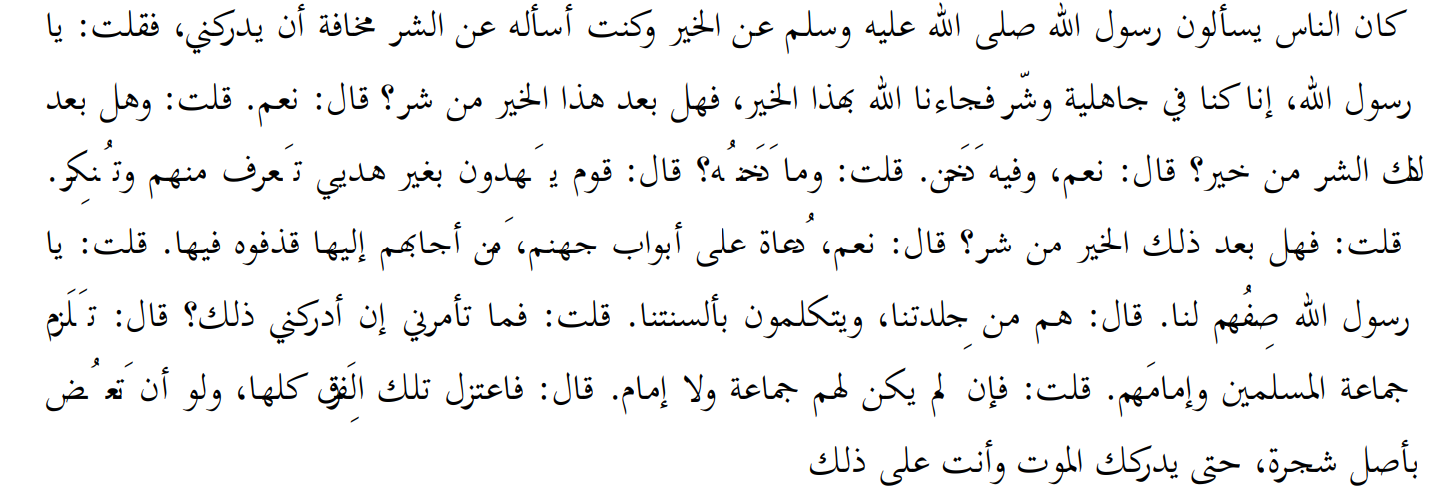
Odamlar Allohning Elchisidan (ﷺ) yaxshilik haqida so‘rashardi, men esa uni yomonlikdan so‘rardim, chunki u menga yetib kelishidan qo‘rqardim. Shunda men dedim: “Ey Allohning Elchisi! Biz johiliyat va fitna zamonida edik, so‘ng Alloh bizga ushbu yaxshilikni keltirdi. Bu yaxshilikdan keyin ham fitna bormi?” U (ﷺ) dedi: “Ha.” Men dedim: “Bu fitnadan keyin ham yaxshilik bo‘ladimi?” U dedi: “Ha, va uning tutuni (dukhan) bor.” Men dedim: “Uning tutuni nima?” U dedi: “Mening hidoyatimga amal qilmasdan hidoyat beradigan odamlar. Ulardan ba’zilarini tanirsan, ba’zilarini inkor qilasan.” Men dedim: “Bu yaxshilikdan keyin yana fitna bo‘ladimi?” U dedi: “Ha, do‘zax eshiklariga da’vat qiluvchi du‘otlar. Ularning da’vatiga kim javob bersa, uni o‘sha (do‘zax)ga tashlaydilar.” Men dedim: “Ey Allohning Elchisi, ularni bizga ta’riflab bering.” U dedi: “Ular bizning o‘z terimizdan (ya’ni bizning qavmimizdan) bo‘lib, bizning tilimizda gapiradilar.” Men dedim: “Agar bu narsa menga yetib kelsa, menga nimani buyurasiz?” U dedi: “Musulmonlarning jamoatiga va ularning imomiga mahkam yopishib tur.” Men dedim: “Agar musulmonlarning jamoati ham, imomi ham bo‘lmasa-chi?” U dedi: “Unda o‘sha guruhlarning hammasidan ajralib ol, hatto o‘lim seni shu holda topguncha daraxt ildizini tishlab bo‘lsa ham.”
“The people used to ask the Prophet of Allah (saw) about the good and I used to ask him about the bad in fear that it might catch me. So I said: O Prophet of Allah! We were in times of jahiliyyah and mischief then Allah brought us this good, so is there any mischief after this good? He (saw) said: Yes. I said: Will there be any good after that mischief? He said: Yes, and it has smoke (dukhan). I said: What is its smoke? He said: People guiding but not on my guidance. You recognise some (from them) and deny some. I said: Will there be any mischief after that good? He said: Yes, callers (du’at) who invite at the doors of Hellfire. They throw him into it (hell) whoever accepted their invitation. I said: O Prophet of Allah, describe them to us. He said: They are of our own skin (of our people) and talk our language. I said: What do you order me to do if that (matter) caught me? He said: Adhere to the jama‘ah of Muslims and their Imam. I said: What if the Muslims have no jama‘ah nor an Imam? He said: Then separate from all those groups, even if you (have to) bite the root of a tree till death comes to you as such.”
Ushbu hadis ifodasi jihatidan aniqki, Payg‘ambar (saw) musulmonlarni musulmonlar jamoatiga mahkam yopishishga va ularning imomiga itoat etishga, hamda jahannam eshiklariga da’vat qiluvchilardan uzoqlashishga buyurgan. Savol beruvchi undan, musulmonlarda imom ham, jamoat ham yo‘q bo‘lgan vaziyatda, jahannam eshiklariga da’vat qiluvchilarga nisbatan nima qilishi kerakligini so‘radi; shunda Payg‘ambar (saw) uni bu guruhlarning barchasidan ajralib turishga buyurdi, musulmonlardan yuz o‘girmaslikka va imom tayinlash ishidan qochmaslikka buyurdi. Demak, uning buyrug‘i aniq: “Shu guruhlarning barchasidan ajral”. U bu guruhlardan ajralishni shu darajada ta’kidladiki, ulardan ajralib qolish, o‘lim kelguncha daraxt tanasiga mahkam yopishib yotishga olib kelishi mumkinligini aytdi. Uning ma’nosi – dinингга mahkam yopishish va adashtiruvchi, jahannam eshigida turgan da’vatchilardan uzoq bo‘lishdir. Bu hadisda xalifalik o‘rnatish ishini tark etish uchun hech qanday bahona yoki ruxsat yo‘q; u faqat dinga mahkam yopishish va jahannam eshiklaridagi da’vatchilarni tark etish buyrug‘i bilan cheklangan, va agar kishi xalifalik o‘rnatish uchun harakat qilmasa, gunoh uning zimmasida qoladi. Shunday ekan, adashtiruvchi guruhlarni tark etish uchun unga buyurilgan – dinini adashtiruvchi da’vatchilardan saqlab qolish maqsadida, hatto daraxt ildizini tishlashga to‘g‘ri kelsa ham, lekin musulmonlar jamoatidan uzoqlashish, din qonunlarini o‘rnatish va musulmonlar uchun imom tayinlash ishini tark etish uchun emas.
This hadith is clear in its expression that the Prophet (saw) ordered the Muslims to adhere to the jama‘ah of Muslims and to adhere to their Imam, and to leave those who invite people to the doors of hell. The questioner asked him what he has should do in relation to those callers at the doors of Hellfire in the situation wherein the Muslims have no Imam and no jama‘ah; thereupon the Prophet (saw) ordered him to separate from all these groups, not to disassociate himself from the Muslims nor to abstain from the action for establishing an Imam. So his order is clear “Separate from all those groups”, and he emphasised the separation from those groups even to the extent that his isolation from them would make him clench to the trunk of a tree until death comes to him. Its meaning is to adhere to your deen and keep away from the misguiding callers who are at the doors of Hellfire. In this hadith there is no excuse or permission (for anybody) to abandon the work for establishing a Khalifah, it is, rather, confined to the command of adhering to the deen and abandoning the callers at the doors of hell, and the sin will remain on him if he does not work to establish a Khalifah. So he is ordered to abandon the misguiding groups in order to save his deen from the callers of the misguidance, even if he had to bite the root of a tree, but not to distance himself from the Muslim community and abandon the work for establishing the laws of the deen and establishing an Imam for Muslims.
Allohning Elchisi ﷺ aytdilar: "Shunday zamon keladiki, musulmonning eng yaxshi boyligi qo'ylari bo'ladi, ularni tog' cho'qqilariga va yomg'ir yog'adigan joylarga (vodiylarga) olib chiqib ketadi, shunda o'z dinini fitnalardan qochib saqlab qoladi".
“The Messenger of Allah (saw) said: A time will come that the best property of a Muslim will be sheep which he will take on the top of mountains and the places of rainfall (valleys) so as to flee with his religion from afflictions (fitan)”
Bu shuni anglatmaydiki, musulmon kishi musulmonlar jamoatidan ajralib olishi, din ahkomlariga amal qilishni tark etishi va yer yuzida Xalifalik bo‘lmagan holda musulmonlar uchun xalifa tayinlash vazifasini tashlab qo‘yishi kerak. Bu matn faqat musulmonning fitna-sinov zamonlarida eng yaxshi boyligi nima ekanini bayon qiladi; u musulmonlardan ajralishga va odamlardan chetlanib yashashga da’vat qilmaydi.
This does not mean that one should isolate oneself from the Muslim community, abandon practising the laws of the deen and establishing a Khalifah for Muslims when there is no Khilafah on earth. All that it contains is an explanation of what is the best wealth of the Muslim at the times of affliction; it does not encourage separation from the Muslims and isolation from the people.
Shunga ko'ra, yer yuzidagi hech bir musulmonning Alloh (swt) buyurgan dinni barpo etish, ya'ni Xalifalik yo'q bo'lganda musulmonlar uchun Xalifa tayinlash vazifasini tark etishga uzri yo'q. Chunki Alloh (swt)ning hududlarini, ya'ni Uning muqaddas narsalarini himoya qilish uchun Alloh (swt)ning jazolarini (hudud) ijro etadigan, dinning qonunlarini amalga oshiradigan va musulmon jamoasini "La ilaha illa Allah, Muhammad ur-Rasul Allah" bayrog'i ostida birlashtiradigan hech kim yo'q bo'lsa, bu vazifa uni amalga oshirilmaguncha, bu ishni tark etishga Islomda hech qanday ruxsat yo'q.
Accordingly, no Muslim on the face of this earth has an excuse to abandon the duty of establishing the deen which Allah (swt) has ordered, that is, the establishment of a Khalifah for Muslims when there is no Khilafah on the earth, when there is no one to implement the punishments (hudood) of Allah (swt) to protect the sanctities of Allah (swt), and no one to implement the laws of the deen and unify the Muslim community under the banner of La ilaha illa Allah, Muhammad ur-Rasul Allah. There is no permission in Islam to abandon the work for this duty until it is indeed completed.