26. Mo'minning kofirlar bilan do'stlashishi
26. The Believer's Befriending The Disbelievers
Alloh (SWT) shunday degan:
Allah (swt) said:
Mo‘minlar mo‘minlarni qo‘yib, kofirlarni do‘st tutmasinlar. Kim shunday qilsa, uning Allohdan hech narsasi yo‘q, faqat ulardan biror narsadan qo‘rqsangiz (bundan mustasno). Alloh sizni O‘z zotidan ogohlantiradi, qaytish esa Allohgadir. [TMQ 3:28]
“Let not the believers take the disbelievers as friends instead of believers, and whoever does that is not of Allah in anything except if you fear from them something to be feared. And Allah warns you against Himself and to Allah is the return” [TMQ 3:28].
Yaqub va Sahl uni (taqiyyah) deb o‘qiydilar, bu al-Hasan va Mujohidning qiroatidir, qolganlari esa (tuqat) deb o‘qiydilar. Al-Qomus al-Muhitda shunday deyilgan: “(At-tawqiyya) – bu (al-kalau) va himoyadir. Men (taqa) narsadan saqlandim, uni (taqaytu) qildim, (taqi) va (taqa) deyiladi, u (tiqa) qildi, xuddi (kisa) kabi, ya’ni u undan qo‘rqdi.” Ayatdagi bu matn uning mavzusini aniqlaydi, va (taqiyyah) so‘zining bu lug‘aviy ma’nosi ayatda uning ma’nosini belgilaydi, chunki unga shar’iy ma’no berilmagan. Shu sababli uni lug‘aviy ma’nosi bilan izohlash lozim bo‘ladi. Faqat shu asosda ayat o‘zining umumiyligi va tafsilotlari bilan tushuniladi. Sabab-i nuzul haqida rivoyat qilingan hadislarga kelsak, agar ular sahih bo‘lsa, ular ayatda kelgan tafsilotlarga yo‘l-yo‘riq beradi, lekin ayatning mavzusini va jumlalarining lug‘aviy hamda shar’iy ma’nosini o‘zgartirmaydi. Ayatning mavzusi uning jumlasida aniq ko‘rinadi, ya’ni mo‘minlarning kofirlarni do‘st tutishi, ya’ni ularni do‘st sifatida qabul qilishi.
Ya’qub and Sahl recite it as (taqiyyah) which is the recitation of Al-Hasan and Mujahid, while the rest (recite it) as (tuqat). It is said in Al-Qamus Al-Muheet: ‘(At-tawqiyya) is (al-kalau) and protection. I do (taqa) something and I did (taqa) it and do (taqi) it (taqa) and he (taqi) it (tiqa) like (kisa) is I feared it.’ This text in the ayah specifies its subject and this linguistic meaning of the word (taqiyyah) specifies what this word means in this ayah in meaning since no Shari’ah meaning was established for it. So it specifies interpreting it with its linguistic meaning. Upon this basis alone is the ayah understood in its generality and details. As for what came in the ahadith of the circumstances of its revelation, if authenticated, guides to the details of what came in the ayah but would not change its subject neither the meaning of its sentences according to the language and Shar’a. The subject of the ayah is clear in its sentence which is believers befriending the disbelievers i.e. treating them as friends. The text is:
“Mo‘minlar mo‘minlar o‘rniga kofirlarni do‘st tutmasinlar” [TMQ 3:28].
“Let not the believers take the disbelievers as friends instead of believers” [TMQ 3:28].
Agar oyat yoki hadis ma'lum bir masala haqida kelgan bo'lsa, u holda u faqat shu masalaga xosdir va undan boshqa narsalarni o'z ichiga olmaydi. Masala mo'minlarning kofirlar bilan do'stlashishi masalasidir, unga nisbatan qat'iy ravishda man qilgan oyat kelgan. Bu masala bo'yicha yagona oyat emas; Allohning quyidagi so'zi kabi ko'plab oyatlar kelgan:
If the ayah or ahadith came about a specific subject, then it is specific to this subject and does not include anything else. The issue is the issue of believers befriending disbelievers for which came the ayah decisively prohibiting it. Nor is this the only ayah upon this subject; there have come numerous ayahs like Allah’s statement:
Munofiqlarga dard bilan azob borligini xushxabar bering. Ular mo'minlarni qo'ygan holda kofirlarni do'st (avliyo) qilib oladilar.
“Give tidings to the hypocrites that for them is a painful punishment. Those who take the disbelievers as (awliya) instead of believers” [TMQ 4:138-139].
Va Allohning bu so‘zi:
And Allah’s statement:
"Ey iymon keltirganlar, imon keltirmaganlarni mu'minlar o'rniga do'st (avliyo) qilmanglar." [TMQ 4:144]
“O you who believe, do not take the disbelievers as (awliya) instead of disbelievers” [TMQ 4:144]
Va Uning (SWT) ushbu so'zi:
And His (swt) statement:
Allohga va Qiyomat kuniga iymon keltirgan qavmni topa olmaysan, ular Allohga va Uning Rasuliga qarshi chiqqanlarni sevadigan bo'lsa. [TMQ 58:22]
“You will not find a people who believe in Allah and the Day of Judgement loving those who oppose Allah and His Messenger” [TMQ 58:22]
Va Uning (SWT) bayonoti
And His (swt) statement
"Yahudiy va nasroniylarni (avliyo) qilib olmanglar" [TMQ 5:51]
“Do not take the Jews and Christians as (awliya)” [TMQ 5:51]
Va Uning so‘zi:
And His statement:
“Mening dushmanimni va sening dushmaningni avliyo sifatida olma” [TMQ 60:1]
“Do not take my enemy and your enemy as (awliya)” [TMQ 60:1]
Mavzu mo'minlarning kofirlar bilan do'stlashishi haqidadir, ayatning qolgan qismi esa mavzuni batafsil bayon qiladi. Chunki Alloh taolo mo'minlarga kofirlarni do'st tutishni qat'iy ravishda man qilgan va bu man qilishni shunday qat'iy hukm bilan bog'lagan: kim shunday qilib, kofirlarni do'st tutsa, u Allohdan uzildi (ya'ni Alloh undan barî'dir). Shu qat'iy taqiqdan bitta holat istisno qilingan: mo'min kofirdan zarar yetishidan qo'rqqan holat. Bunday holatda, zararning oldini olish uchun kofirlar bilan do'stlashish joiz bo'ladi. Bu holat musulmon kofirlarning hokimiyati ostida, o'z ishida mag'lub bo'lgan vaqtda sodir bo'ladi, ya'ni kofirning qo'rquvi uning bilan do'stlashishga ruxsat beradi. Agar qo'rquv yo'qolsa, do'stlashish harom bo'ladi. Demak, bu yerda masala do'stlikni ko'rsatib, boshqa narsani yashirish emas, balki musulmon mag'lub bo'lib, kofirdan qo'rqqan holatni umumiy taqiqdan chiqarish masalasidir. Ayatning ma'nosi shuki, mo'minlarga kofirlarni o'zlariga do'st qilib olish, ulardan yordam so'rash, ularga tayanish, ular bilan do'stlashib, ular o'rtasida muhabbat bo'lishi qat'iy man qilingan. Avval mo'minlarga kofirlarni do'st tutish man qilingan, so'ngra bitta holat istisno qilingan: ular hokimiyati ostida bo'lib, ulardan qo'rqish mavjud bo'lgan holat. Bunday holatda ularga muhabbat ko'rsatish va ularning yomonligi hamda zarariga yo'l qo'ymaslik uchun do'stlashish joizdir. Ya'ni ular hukmronligi ostida ulardan qo'rqish mavjud bo'lgan holatda ularni do'st tutish mumkin. Bundan tashqari, mutlaqo joiz emas. Bu hukm faqat mo'minlar bilan munosabatda bo'lgan kofirlar uchun, chunki ayat Makkadagi mushriklar bilan do'stlik munosabatida bo'lgan mo'minlar haqida nozil bo'lgan. U'sha taqiqlanganlar Madinadagi musulmonlarga Makkadagi mushriklar bilan do'stlashish edi, va bu taqiq barcha mo'minlarga qaratilgan edi, lekin bundan Makkada yashab, o'z ishlarida mag'lub bo'lgan mo'minlar istisno qilindi. Ular o'zlariga yaqin bo'lgan kofirlarning zararidan qo'rqish sababli istisno qilindi. Ayat mavzusi shu, uning ma'nosi ham shu, va undan chiqadigan shar'iy hukm shuki, mo'minlarga kofirlar bilan do'stlashishning barcha turlari — yordam berish, do'stlik, ko'mak va boshqalar — harom qilinadi, chunki ayatdagi "avliyo" so'zi barcha ma'nolarni o'z ichiga olgan umumiy so'z bo'lib keldi. Kofirlar musulmonlar ustidan g'alaba qozonib, musulmonlar o'z ishida mag'lub bo'lgan vaziyatda, ya'ni ularning zulmi va zararidan qo'rqilganda, aynan Makkadagi musulmonlarning mushriklar bilan bo'lgan holatiga o'xshab, bunga ruxsat beriladi. Ayatda bundan boshqa ma'no ham, bu hukmdan boshqa hukm ham yo'q. Ba'zilarning "taqiyya" — ya'ni musulmon zarar yetishidan qo'rqqan yoki o'zining haqiqatini va ichidagi narsani bilib qolishidan qo'rqqan har qanday kishi oldida, u kofir bo'lsin yoki mo'min bo'lsin, ichidagi narsaga zid ko'rinishni namoyon qilishi, degan so'zlari sof xatodir. Ayat buning hech qanday dalili emas, chunki "Agar ulardan qo'rqsangiz (tuqotu)" ya'ni ulardan qo'rqiladigan biror narsadan qo'rqsangiz, degan ma'noni anglatadi; "otqaytu" — "men undan qo'rqdim" degan ma'noda, "tuqotu" va "taqiyya" bir ma'noli. Bu mo'minlarning kofirlarni do'st tutishi taqiqidan, mo'minlar o'rniga kofirlarni do'st tutish taqiqidan istisno qilingan, shuning uchun u faqat istisno qilingan narsaga xosdir.
"Allohga va Oxirat kuniga iymon keltirgan biror qavmni topmaysan, toki ular Allohga va Uning Rasuliga qarshi chiqqanlarni sevsa." Note: this sentence is a Qur'an verse (Al-Mujadila 58:22), so it is rendered with the verse's meaning and no ﷺ is added inside it. Since "His Messenger" refers to the Prophet Muhammad, ﷺ is written after the mention of the Messenger in the original. Corrected translation with the required honorific: "Allohga va Oxirat kuniga iymon keltirgan biror qavmni topmaysan, toki ular Allohga va Uning Rasuliga ﷺ qarshi chiqqanlarni sevsa." [TMQ 58:22]
‘You will not find a people who believe in Allah and the Last Day loving those who oppose Allah and His Messenger’ [TMQ 58:22]
Va Uning (SWT) ushbu so'zi:
And His (swt) statement:
«Yahudiy va nasroniylarni do‘st tutmang» [TMQ 5:51]
‘Do not take the Jews and Christians as friends’ [TMQ 5:51]
Va Uning (SWT) ushbu so'zi:
And His (swt) statement:
"Mening dushmanimni va sening dushmaningni do'st tutma." [TMQ 60:1]
‘Do not take my enemy and your enemy as friends.’ [TMQ 60:1]
Va Uning (SWT) ushbu so'zi:
And His (swt) statement:
"Mening dushmanimni va sening dushmaningni do'st tutma." [TMQ 60:1]
‘Do not take my enemy and your enemy as friends.’ [TMQ 60:1]
Uning (SWT) bayonoti:
His (swt) statement:
Mo'minlar o'rniga [TMQ 28:53]
‘Instead of believers’ [TMQ 28:53]
Bu mo'minlar bilan do'stlik majburiy ekanini bildiradi va bu kofirlar bilan do'st bo'lish hamda ularga mo'minlarga qarshi yordam berishning taqiqlanishidir. Shuningdek, aytilishicha, bu kofirlarga mehr va do'stona munosabatda bo'lishning taqiqlanishidir. Ibn Abbosdan rivoyat qilinadi: "do'stlar" (awliyo) so'zi "do'st" (waliyy) so'zining ko'plik shakli bo'lib, u o'z ishidan rozi bo'lgan kishiga yordam va qo'llab-quvvatlash bilan buyruq beruvchi shaxsdir, va bu ikki xil bo'ladi. Birinchisi, yordam beruvchi va qo'llab-quvvatlovchi tayinlangan kishi, ikkinchisi esa yordam va qo'llab-quvvatlash oluvchi kishidir. Uning (swt) quyidagi so'zi:
Means that friendship is obliged with believers, and this is a prohibition from befriending disbelievers and assisting them against believers. And it is said (that it is) a prohibition of treating the disbelievers with kindness and friendliness. It is narrated from ibn Abbas: "friends" (awliya) is the plural of "friend (waliyy) who is the one who commands the one pleased with his action with assistance and support, and it occurs in two ways. Firstly, the designated supporter with support and the other who is the supported. So His (swt) statement:
"Alloh iymon keltirganlarning do‘stidir" [TMQ 2:257
‘Allah is the friend of those who believe’ [TMQ 2:257
Ularning yordamchilari va tarafdorlari, degani Uning yordami bilan; va aytilishicha, mo'min Allohning do'stidir, ya'ni Uning yordami bilan qo'llab-quvvatlanadigan kishidir. Uning so'zi: "kim shunday qilsa", ya'ni mo'minlar o'rniga kofirlarni do'st tutgan kishi, "u Allohdan hech narsada emas", ya'ni Allohning do'stlaridan emas, Alloh (SWT) esa undan uzoqdir; va aytilishicha, u Allohning do'stligi (valoyat)dan hech narsada emas. So'ngra U istisno qilib dedi:
Means their helpers and supporters by His support, and it is said that the believer is the friend of Allah i.e. one assisted by His support. His statement: ‘whoever does that’ means whoever takes disbelievers as friends instead of believers ‘then he is not of Allah in anything’ i.e. he is not from the friends of Allah (swt) and Allah (swt) is absolved of him, and it is said he is not from the friendship (wilayah) of Allah in anything. Then He excluded and said:
"agar ulardan biror narsadan qo'rqsangiz, bundan mustasno"
‘except if you fear from them something to be feared’
Istisnо qilinadi, agar kofirlar g'alaba qilsa va mo'minlar mag'lub bo'lsa, shunda mo'min ulardan qo'rqadi, agar ularga roziligini bildirmasa yoki ular bilan do'stligini yaxshi ko'rsatmasa. O'sha paytda unga o'z nafsi uchun ulardan saqlanish (taqiyya) va himoyalanish maqsadida tili bilan ularga mehr bildirishi va ularga itoat qilishi joiz bo'ladi, ammo bunga e'tiqod qilmagan holda. Bu oyatda dinda taqiyya joiz ekanligiga ishora bor, qachonki o'zi uchun xavf bo'lsa. Bizning ulamolarimiz aytadilarki, zarurat vaqtida taqiyya barcha masalalarda joiz bo'ladi, ko'pincha esa mehr-oqibat va sulh uchun vojib bo'lib qoladi. Ammo mo'minni o'ldirish yoki ma'lum bo'lgan yoki eng ehtimolli deb bilingan dinning buzilishiga (istifsod) olib keladigan amallarda taqiyya joiz emas. Al-Mufid aytdiki, ba'zan u vojib bo'ladi va farz bo'lib qoladi, ba'zan joiz bo'ladi va mustahab bo'ladi, ba'zan esa vojib bo'lmasdan joiz bo'ladi va ba'zan uni tark etishdan yaxshiroq bo'ladi; ba'zan esa uni tark etish yaxshiroq bo'lishi mumkin, garchi uni qilgan kishi uzr topsa va tark etmagani uchun unga ayb qo'yilmasligi bilan kechirilsa. Shayx Abu Ja'far at-Tusiy aytdiki, rivoyatlarning zohiriy ma'nosi hayotga xavf tug'ilganda taqiyya vojib ekanligini ko'rsatadi va u haqda haqiqatni ochiq aytishga ruxsat berilganligi rivoyat qilingan. Al-Hasan rivoyat qildi
means except that if the disbelievers are victorious and the believers defeated so the believer fears them if he does not show his agreement with them or make good his companionship with them. At that time, it is allowed for him to show his affection for them with his tongue and compliance to them as a precaution (taqiyyah) from them and protection for himself without believing that. In this ayah there is an indication that taqiyyah is permitted in the deen when there is fear over oneself and our companions say it is permitted in all matter at times of necessity and often it becomes obligatory for the variety of kindness and reconciliation, but it is not permitted from the actions in killing a believer or what is known or he considers most probable that it is spoiling (istifsad) in the deen. Al-Mufid said that it is obligatory at times and becomes fard, and it is permitted at times and becomes recommended. And it is permitted at time without obligation and it becomes at times better than leaving it; and it could at times be better to leave it even though its performer is excused and forgiven over it by leaving the blame over it. Sheikh Abu Ja’far At-Tusi said that the apparent meaning of the narrations indicate that it is obligatory during fear of one’s life, and it has been narrated that a dispensation in allowing speaking clearly the truth thereupon. Al-Hasan narrated
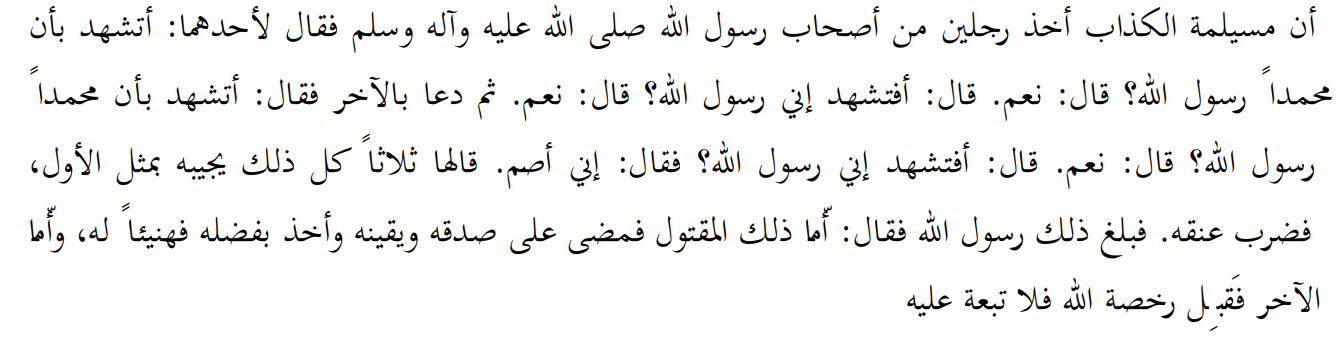
Ўша ёлғончи Мусайлима Пайғамбар (ﷺ)нинг саҳобаларидан икки кишини олиб келди ва уларнинг бирига: «Муҳаммад Аллоҳнинг элчиси эканига guvohlik berasanmi?» деди. У: «Ҳа», деди. Мусайлима: «Унда менинг Аллоҳнинг элчиси эканимга guvohlik berasanmi?» деди. У: «Ҳа», деди. Сўнгра у иккинчисини чақириб: «Муҳаммад Аллоҳнинг элчиси эканига guvohlik berasanmi?» деди. У: «Ҳа», деди. Шунда Мусайлима: «Унда менинг Аллоҳнинг элчиси эканимга guvohlik berasanmi?» деди. У: «Мен кар», деди. Мусайлима уч марта шундай деди, ҳар safar у биринчисидек жавоб берди, шунда Мусайлима унинг бўйнини узди. Бу хабар Пайғамбар (ﷺ)га етказилганда, у зот: «Ўлдирилган киши ўз ҳақиқатига ва эътиқодига содиқ бўлди, у фазилатни қўлга киритди, демак, унга яхшилик бўлсин. Иккинчиси эса, Аллоҳнинг рухсатини қабул қилди, унинг устида гуноҳ йўқ», дедилар.
‘That Musaylimah the liar took two men of the Sahabah of the Messenger of Allah (saw) and said to one of them: Do you bear witness that Muhammad is a Messenger of Allah? He said: Yes. He said: Then do you bear witness that I am a Messenger of Allah? He said: Yes. Then he called for the other and said: Do you bear witness that Muhammad is a Messenger of Allah? He said: Yes. Then he said: Then do you bear witness that I am a Messenger of Allah? He said: I am deaf (to that). He said it thrice each time answering him like the first so he struck off his neck. This was conveyed to the Messenger of Allah who said: As for the one killed, he executed his truth and conviction, and he took his virtue so may it be good for him. As for the other, he accepted the concession of Allah so there is no liability on him.’
Shunga ko'ra, taqiyya — bu ruxsat (imtiyoz) bo'lib, haqiqatni ochiq aytish esa fazilatdir”, (at-Tabariyning so'zi shu bilan tugaydi).
Accordingly taqiyyah is a dispensation and speaking clearly the truth is a virtue” (At-Tabarsi’s speech ends).
Shunga ko'ra, ikki xil fikr maktabiga mansub ikki mufassir — at-Tabariy va at-Tabarsiy so'zlaridan ko'rinadiki, ular ohatning ma'nosini bayon qilishda bir-biri bilan kelishadilar: bu mo'minlarning kofirlar bilan do'stlashishi uchun qilingan taqiqdir, va mo'minlar kofirlarning zarariдан qo'rqqan holatni bu taqiqdan istisno qiladilar. At-Tabariyning so'zlariga qarang: "Ammo ulardan biror qo'rqiladigan narsadan qo'rqsangiz (tuqat)" — ya'ni, ammo siz ularning hokimiyati ostida bo'lib, jonlaringiz uchun ulardan qo'rqsangiz, u holda tilingiz bilan ularga do'stlik ko'rsatasiz. At-Tabarsiyning so'zlariga qarang: "So'ng Alloh istisno qilib: 'Ammo ulardan biror qo'rqiladigan narsadan qo'rqsangiz', dedi, va ma'nosi shuki, kofirlar g'olib, mo'minlar mag'lub bo'lsa-yu, mo'min ularning kelishuvini ko'rsatmasa va ular bilan do'stligini tuzatmasa, ulardan qo'rqsa, — ana shu holda unga o'z muhabbatini tili bilan va ularga itoat qilish orqali ehtiyot yuzasidan hamda jonini himoya qilish uchun ko'rsatishi halol bo'ladi." Ikki mufassir ushbu taqiqdan istisno mavzuga taalluqli ekanligi va faqat shu bilan chegaralanishiga kelishadilar. Lekin at-Tabarsiy mavzudan tashqari narsaga ergashib, ohatni dinda, hayot uchun taqiyya ruxsat etilganining dalili qilib oldi. Bu esa ohatda mavjud emas, chunki uning mavzusi mo'minlarning kofirlar bilan do'stlashishini taqiqlash va kofirlar musulmonlarni mag'lub etgan holatda ulardan qo'rqish holatini istisno qilishdir. Bu dindagi taqiyya emas va jon uchun qo'rqishga ham xoslanmagan, chunki istisno umumiydir: "Ammo ulardan biror qo'rqiladigan narsadan qo'rqsangiz" — ya'ni, ulardan qo'rqiladigan narsadan qo'rqsangiz. Zamaxshariy "al-Kashshof" kitobida shunday degan:
Accordingly it is shown from the words of the two mufasireen, At-Tabari and At-Tabarsi, who are of two different schools of thought, their agreement upon explaining the meaning of the ayah as it came in that it is a prohibition for believers befriending disbelievers and excluding the situation of believers fearing the harm of the disbelievers from this prohibition. Look at the words of At Tabari: “except if you fear from them something to be feared (tuqat)’ (i.e.) except if you are in their authority and you fear them over your lives so you show them friendship with your tongues.” And look at the words of At-Tabarisi: “Then He excluded and said: ‘except if you fear from them something to be feared’ and the meaning is except if the disbelievers are victorious and believers defeated so the believer fears them if he does not show his agreement with them and does not make good his friendship with them. At that time it is allowed for him to show his love for them by his tongue and compliance to them as a precaution and in protection of his soul.” The two mufasireen agree that the subject is excluding the prohibition of believers befriending disbelievers and that it is limited to that. Except that At-Tabarisi followed upon that which is outside the subject and made the ayah an evidence that taqiyyah is permitted in the deen during for one’s life which is not present in the ayah since its subject is the prohibition of believers befriending disbelievers and excluding the situation of fear of the disbelievers when they defeat the Muslims in allowing their friendship in this situation. It is not taqiyyah in the deen nor is it specified to fear over life because the exclusion is general “except if you fear from them something to be feared” (i.e.) except if you fear from them what is to be feared from. Az-Zamakhshari said in Al Kashaf
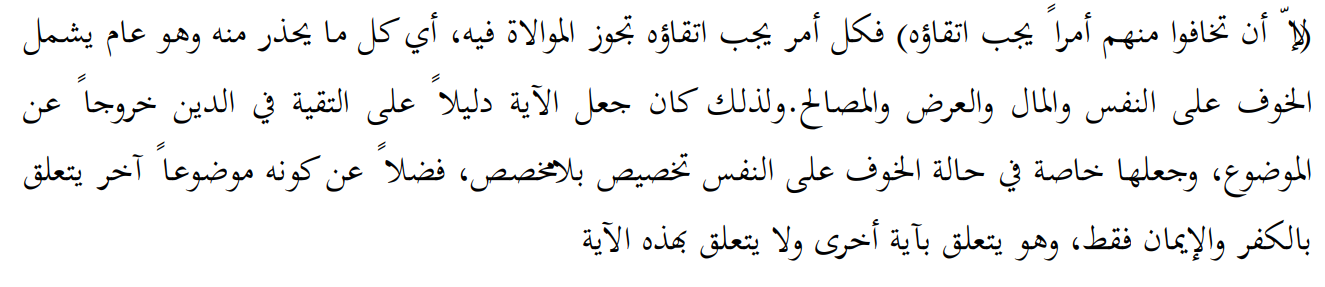
«Изузуки, улардан бирор нарсадан, ҳимоя қилиниши зарур бўлган нарсадан қўрқсангиз, (мустаснодир)» — шунинг учун ҳар қандай ҳимоя қилиниши керак бўлган нарса, уларни дўст тутишга рухсат беради, яъни сизлар улардан қўрқадиган барча нарса: жон, мол, обрў ва манфаатлар устидан қўрқиш ҳам шу жумлага киради. Шунга кўра, бу оятни дин ишларида (тақиyya) учун далил қилиш, мавзудан ташқари, ва жон устидан қўрқиш ҳолати билан чеклаш — далилсиз тахсиз (махсус қилиш) бўлади. Бундан ташқари, бу бошқа мавзу бўлиб, фақат куфр ва иймон билан боғлиқ, у бошқа оят билан боғлиқ бўлиб, бу оятга алоқаси йўқ.
“Except if you fear from them a matter which requires protection from” so any matter which must be protected from permits befriending it i.e. all that you fear them which is general covering fear over life, wealth, honour and interests. Accordingly making the ayah an evidence for (taqiyyah) in the deen outside the subject, and making it specific in the situation of fear over life is specification without a specifying (evidence). This is besides it being another subject relating to kufr and iman only which is related to another ayah and it is not related to this ayah.
At-Tabarisiyning: "Bizning ulamolarimiz zarurat holatida barcha masalalarda (bu) ruxsat etilgan, deganlar", degan gapiga va uning Al-Mufidning vojib yoki vojib emasligi haqidagi, zikr qilgan so'zining oxirigacha keltirgan naqliga kelsak, bu hech qanday dalilga asoslanmagan mavhum gapdir. Oyat, hatto At-Tabarisiyning o'z tafsiri bo'yicha ham, bunga hech qanday tarzda ishora qilmaydi, va u Kitobdan, Sunnatdan yoki sahobalarning ijmo'idan boshqa hech qanday dalil keltirmagan. Shuning uchun bu rad etiladi va e'tiborga olinishdan tushib qoladi. Shuningdek, agar qo'rquv holatida kofirlar bilan do'stlashish ruxsat etilgan bo'lsa, unda zolim yoki haddan oshgan, qudratga ega bo'lgan hukmdorga bo'ysunish yanada afzalroq, degan gap ham aytilmaydi. Bu aytilmaydi, chunki afzalroq bo'lgan narsa gapning mazmunidir, bu esa undan emas, va unga hech qanday aloqa kengaytmasi ham yo'q. Bu Allohning quyidagi so'zi kabi emas:
As for the statement of At-Tabarisi: “Our companions said (it is) permitted in all matters during necessity” then what he quotes from Al-Mufid of its being obligatory or not obligatory to the last of what he mentioned is abstract speech of any evidence. The ayah does not indicate this in any way even according to At-Tabarisi’s own tafsir, nor did he come with any other evidence neither from the Book or Sunnah or Ijma’a of the Sahabah, hence it is rejected and falls from the rank of consideration. Nor is it said that if befriending disbelievers in the situation of fear of them is allowed then compliance with the unjust or transgressor ruler with power is of greater precedent. This is not said because that which is of greater precedent is the sense of the speech and this is not from it nor is their any extention of any connection with it. It is not like Allah’s statement:
Ular orasida shunday biri borki, agar unga bir dinor ishonib topshirsangiz, uni sizga qaytarib bermaydi. [TMQ 3:75]
“Among them is one whom if you entrust him with a Dinar would not return it to you” [TMQ 3:75]
Bu Allohning Note: this fragment is incomplete, so I have translated only the words given. Please send the rest of the sentence if you would like it translated in full.
Nor is it like Allah’s statement:
"Ahli kitob orasida shunday kishi borki, agar unga bir qintorni omonat qo'ysang, uni ssenga qaytarib beradi" [TMQ 3:75].
“And of the People of the Book is one whom if you entrusted with a qintar will return it to you” [TMQ 3:75].
Bu, zolim bo‘lgan kishi kofir toifasiga yoki ularning sinfiga kirmagani uchun, hamda bu oyatda man etilgan do‘stlik mo‘minlar o‘rniga ularni do‘st tutish ekanligi uchun shunday. Qudratga ega bo‘lgan, zolim va haddan oshgan hokim mo‘minlar orasidadir; undan sodir bo‘lgan zulm yoki uni qoplagan haddan oshish uning iymon sifatini inkor etmaydi. Shu sababli bu masala katta kufr bo‘yicha tadqiqotga kirmaydi va shunga ko‘ra katta kufr bu yerga tegishli bo‘lmaydi, shuning uchun uni dalil sifatida keltirib bo‘lmaydi.
This is because the transgressor is not from the category of the disbeliever or from their class, and because the friendship prohibited in this ayah is befriending instead of the believers. The unjust and transgressor ruler with power is among the believers injustice occurring from him or the transgression covering him does not negate the description of iman from him. Hence this subject does not enter in the research of greater precedent, so accordingly the greater precedent does not come into it such that it is used as a witness.
Bundan tashqari, adolatsiz va zolim hokimiyat egasi bilan do‘stlashish xavfsizlik holatida ham, qo‘rquv holatida ham baravar joizdir, chunki u mo‘minning o‘zidir va mo‘minlar bilan do‘stlashish, albatta, joizdir, chunki Uning: “kofirlar o‘rniga” degan so‘zidagi “mo‘minlar” so‘zi barcha mo‘minlarni qamrab oladigan umumiy so‘zdir. Adolatsiz yoki zolim hokimni, yoxud fojir va yomon odamlarni do‘st tutishni man etuvchi biror matn kelmagan; aksincha, matnlar faqat kofirlar bilan do‘stlashishni man etishda aniqdir. Bundan tashqari, adolatsiz hokimga gunohdan boshqa ishlarda itoat qilish vojib, uning bayrog‘i ostida jihod qilish vojib va fojir imomning ortida namoz o‘qish joizdir; bular ularning do‘stligiga ruxsat berilganligining eng kuchli dalillaridir. Man etilgani esa hokimning zulmiga va fojirning fisqiga rozi bo‘lishdir. Shunga ko‘ra, mo‘min kishi qudratli adolatsiz yoki zolim hokim yoki raqib oldida fikr yoki shunga o‘xshash masalalarda yashirgan narsasiga qarama-qarshi ko‘rsatsa, taqiyya rad etiladi va bunday qilish haromdir, chunki bu munofiqlikdir, munofiqlikning esa barchasi man etilgandir.
Moreover the befriending of the unjust and transgressor ruler with power is allowed in the situation of security and the situation of fear equally because he is a believer and befriending believers is definitely allowed because the word “believers” in His statement: “instead of believers” is general covering all believers. There did not come any text prohibiting befriending the unjust or transgressor ruler or befriending transgressors and the wicked (fujjar); rather the texts are specific in prohibiting the befriending of disbelievers. More than that, the obedience to the unjust ruler is obliged in other than sin and jihad is obliged under his banner and it is allowed to pray behind the Imam in prayer if he is a transgressor which are of the greatest indication regarding permitting their friendship. What is prohibited is the pleasure with the injustice of the ruler and the transgression of the transgressor. Accordingly taqiyyah is rejected when it is a believer showing opposite to what he hides in front of powerful unjust or transgressor ruler or opponent in the opinion or similar, and doing it is haram as it is hypocrisy and all hypocrisy is forbidden.
“Ular bundan mustasno, majburlangan holda, lekin yuragi iymonga tinch-xotirjam bo‘lgan kishi bundan mustasno” {Nahl, 106}.
“Except the one who is compelled and his heart is content upon iman” [TMQ 16:106].
Ba'zi mufassirlar bu narsani quyidagi oyat bilan bog'laydilar: "Ularlardan biror narsadan qo'rqsangiz, bundan mustasno", va shundan kufrni namoyon qilish va imonni yashirishni do'stlik toifasiga kiritish, ular "taqiyya" deb atagan narsaga kiritish xulosasini chiqaradilar. Ba'zilari esa undan faqat hayotidan qo'rqqan holatdagina do'stlik ruxsat etilishini, boshqa holatlarda esa ruxsat etilmasligini xulosa qiladilar. Bu sof xatodir, chunki: "Majbur qilingan va yuragi imonga tinch bo'lgan kishi bundan mustasno" degan oyatning vaziyati ham, mavzusi ham boshqadir. Uning mavzusi Islomdan qaytishdir, va bu ham taxmin qilinadigan emas, balki aniq va tasdiqlangan o'lim xavfi mavjud bo'lgan holatdadir. "Ularlardan biror narsadan qo'rqsangiz, bundan mustasno" degan oyatning mavzusi esa kofirlarni do'st tutishni barcha turlari bilan man etish va bu do'stlikning, qo'rquv mavjud bo'lgan holatda, hayot, mol, manfaat yoki har qanday zarar bo'yicha qo'rquv bo'lsa ham, ruxsat etilishini istisno qilishdir. U ikki holatni va ikki mavzuni farqlaydi, shuning uchun biri ikkinchisiga kirmaydi va vaziyat va mavzu farqi tufayli ular bir-biriga bog'lanmaydi. Musulmon kofirlar hukmronligi ostida, ularning oldida o'z ishi mag'lub bo'lgan holda bo'lsa, unga kofirlarga itoat ko'rsatish uchun Islomdan qaytish ruxsat etilmaydi; aksincha, agar u dinining hukmlarini bajara olmasa, ularni do'st tutishga qarshi, bu esa ruxsat etilgan, hijrat qilishi vojibdir. Biroq, agar musulmonlar uning hayotidan aniq o'lim xavfini sezsa va unga kufr majbur qilinsa, u holda kufrni namoyon qilish va imonni yashirish unga ruxsat etiladi, bundan boshqa holatda esa, oyatning matni tufayli, ruxsat etilmaydi.
Some mufasireen link it with the ayah: “except if you fear from them something to be feared” and deduce from it the entering of showing kufr and hiding iman in the category of friendship and making it to enter what they call (taqiyyah), with some deducing from it that friendship is allowed in the situation of fearing for one’s life only but not in other (situations). This is pure error because the ayah: “except the one who is compelled and his heart is content upon iman” has a different situation and a different subject as its subject is apostasy from Islam in the situation where there exists fear of definite, confirmed killing not probable and the subject of the ayah: “except if you fear from them something to be feared” is prohibiting befriending disbelievers in all its types and excluding the permissibility of this befriending in the situation of there existing what is feared from whether it was fear over life, wealth, interest or any harm. It distinguishes between the two situations and two subjects such that one does not enter into the other nor are they linked with it due to the difference in situation and subject. When the Muslim is under the authority of disbelievers defeated over his matter before them, it is not permitted for him to apostatise from Islam as a show of compliance to them; rather it is obligatory upon him to emigrate if he is unable to perform the rules of his deen contrary to befriending them which is allowed. However if the Muslims fear over his life a confirmed death and he is forced upon kufr then it is permitted for him to show kufr and hide iman, and other than that it is not permitted because of the text of the ayah:
"Kim iymonidan so‘ng Allohga kufr keltirsa — majburlangan holda, yuragi iymonga mutmain bo‘lgan kishi bundan mustasno — (uning hukmi boshqa)." [TMQ 16:106].
“Whoever disbelieves in Allah after his iman except the one who is compelled and his heart is content upon iman.” [TMQ 16:106].
Demak, mavzu imondan keyin kufr qilish, ya'ni islomdan murtad bo'lish masalasidir, va vaziyat o'lim qo'rquvi vaziyatidir. Fuqaha bunga "alikrah al-mulji" (boshpana topish majburiyati, ya'ni o'limga aniq qo'rqish orqali majburlash) deydi, bu esa Shar'at barcha holatlarda majburlanganidan hukmni olib tashlaydigan yagona majburlash sifatida qabul qilgan majburlashdir. Shar'at chetlatgan majburlash esa boshpana orqali majburlash, ya'ni aniq o'limdan qo'rqish holatidir. Bu o'lim qo'rquvi bilan murtad bo'lgan musulmonlar haqida nozil bo'lgan oyat bilan mustahkamlanadi. Rivoyat qilinishicha, bu oyat Ammor ibn Yosir haqida nozil bo'lgan. At-Tabariy aytadi: "Muhammad ibn Sa'd menga rivoyat qildi va dedi: Amakim menga rivoyat qildi va dedi: Otam menga o'z otasidan, u Ibn Abbosdan rivoyat qildi. Uning (Allohning) so'zi: "Kim imonidan keyin Allohni inkor qilsa, majbur qilingan va yuragi imonga tinch bo'lgan kishi bundan mustasno" – oyat oxirigacha. Bu, mushriklar Ammor ibn Yosirni urib, azoblaganlari va so'ngra qo'yib yuborganlari sababli bo'lgan. U Rasulullohga (saw) qaytib keldi va Quraysh tomonidan ko'rgan kulfatlari va aytgan so'zlari haqida xabar berdi. Shunda Alloh (swt) uning uzrini eslatib nozil qildi: "Kim imonidan keyin Allohni inkor qilsa" – "buyuk azob" degan so'zigacha." Bashr menga rivoyat qildi va dedi: Yazid menga rivoyat qildi va dedi: Sa'id menga Qatoda'dan rivoyat qildi: "Kim imonidan keyin Allohni inkor qilsa, majbur qilingan va yuragi imonga tinch bo'lgan kishi bundan mustasno" va dedi: Bizga aytildiki, bu oyat Ammor ibn Yosir haqida nozil bo'lgan, uni Banu al-Mug'ira asir olib, Maymun quduqiga tashlagan va: "Allohni inkor qil", deganlar. U ularga ergashib shunday qildi, lekin yuragi majbur bo'lgan edi. Shunda Alloh (swt) nozil qildi: "majbur qilingan va yuragi imonga tinch bo'lgan kishi bundan mustasno." Va at-Tabariy dedi: Ibn Abdul A'la bizga rivoyat qildi va dedi: Muhammad bin Savr bizga Mu'ammardan rivoyat qildi, u Abdulkarim al-Juziydan, u Abu Ubayd bin Muhammad bin Ammar bin Yosirdan rivoyat qildi, u esa aytdi:
So the subject is the subject of kufr after iman i.e. the subject of apostasy from Islam, and the situation is the situation of fearing death. This is what the fuqaha term as alikrah almulji (compulsion of refuge) which is the only compulsion considered by the Shar’a in all situations in which the rule is lifted from the one compelled. The compulsion which the Shar’a excluded is the compulsion by refuge i.e. the situation of fearing definite death. This is strengthened in the ayah that was revealed about Muslims who apostatised fearing death. It was narrated that this ayah was revealed about Ammar bin Yasir. At-Tabari said: “Muhammad bin S’aad related to me and said: My paternal uncle related to me and said: My father related to me from his father from ibn Abbas that His statement: ‘Whoever disbelieves in Allah after his belief except the one who is compelled and his heart is content upon iman’ to the end of the ayah. This was because the polytheists struck Ammar bin Yasir and punished him then left him. So he returned to the Messenger of Allah (saw) and informed him about what he met with from Quraysh and what he said. So Allah (swt) revealed his mention of his excuse: ‘Whoever disbelieves in Allah after his iman’ until His statement ‘great punishment.’ Bashr related to us and said: Yazid related to us and said: Saeed related to us from Qatadah: ‘Whoever disbelieves in Allah after his belief except the one who is compelled and his heart is content upon iman’ and said: It was mentioned to us that it was revealed about Ammar bin Yasir whom Banu Al-Mughira captured and covered him in the well of Maymun and said: Disbelieve in Allah, so he followed them in that and his heart was compelled. So Allah (swt) revealed His statement: ‘except the one who is compelled and his heart is content upon iman.’ And At-Tabari said: Ibn Abd al-‘Ala related to us and said: Muhammad bin Thawr related to us from Mu’ammar from Abdulkareem Al-Juzri from Abu Ubayd bin Muhammad bin Ammar bin Yasir who said:
Mushriklar Ammor ibn Yosirni ushlab, unga ular istagan narsalarning bir qismini aytmaguncha azob berdilar. U bu voqeani Payg'ambar ﷺ ga aytdi. Payg'ambar ﷺ dedilar: "Qalbingni qanday topding?" U dedi: "Iymonga mustahkam bog'langan holda." Payg'ambar ﷺ dedilar: "Agar ular yana takrorlasalar, sen ham takrorla."
The polytheists took Ammar bin Yasir and punished him until he said to them in some of what they wished. He mentioned that to the Prophet (saw) and the Prophet (saw) said: How did you find your heart? He said: Secured upon iman. The Prophet (saw) said: If they repeat, then you repeat.”
Bu hadislar ko'rsatadiki, oyatning nozil bo'lish sababi Ammor voqeasi bo'lib, uning mavzusi Islomdan qaytishdir. Unga xos vaziyat — o'ldirilish xavfining aniq mavjudligi — o'zi yetarli bo'lib, bu aniqlikni mustahkamlaydi, va u quyidagi oyat bilan hech qanday aloqasi yo'qdir: "Agar ulardan biror narsadan qo'rqsangiz, bundan mustasno." "Majbur qilingan, lekin yuragi iymonga mustahkam bo'lgan kishi bundan mustasno" degan oyat Makkada iymon mavzusida nozil bo'lgan, "Agar ulardan biror narsadan qo'rqsangiz, bundan mustasno" degan oyat esa Madinada nozil bo'lib, mo'minlarning kofirlar bilan do'stlashishini man etish hukmidan qo'rqinchli vaziyatni istisno qilish mavzusidadir. Shunga ko'ra, bu oyat o'sha mavzuga qo'llanilmaydi.
These ahadith indicate that the circumstance of revelation of the ayah is the incident of Ammar and its subject is apostasy from Islam. The situation specific to it is the definite fear of killing which alone is sufficient to strengthen that it has no relationship with the ayah: “except if you fear from them something to be feared.” The ayah: “except the one who is compelled and his heart is content upon iman” was revealed in Makkah on the subject of iman, and the ayah: “except if you fear from them something to be feared” is Madinan revealed on the subject of excluding the situation of fearing what is to be feared from the prohibition of believers befriending disbelievers. Accordingly this ayah is not applicable on that subject.
Qolgan bir hukm bor: qatl qilinishi aniq bo‘lgan kishi haqidagi hukm. Kufrni izhor qilib, imonni yashirish va shu yo‘l bilan o‘limdan saqlanish afzalmi, yoki imonida qat’iy turib, o‘limga olib kelsa ham, bu ma’qulroqmi? Javob shuki, imonida sobit turib, o‘limga olib kelsa ham, bu afzalroq, chunki kufrni izhor qilishning ruxsat etilishi bu yengillik va qiyinchilikni ko‘tarishdir, imonni saqlash esa asl qoida bo‘lgan azimatdir, shuning uchun u afzalroqdir. Rivoyat qilinadi
There remains the rule regarding the one threatened with confirmed killing: Is it more virtuous to show kufr and hide iman so as to be safe from death or is it better to persevere upon his iman even if it leads to death? The answer is that persevering to iman even if it leads to death is better because the permissibility of showing kufr is a dispensation and lifts difficulty, and preserving the iman is (‘azeemah) which is the principle therefore it is better. It is narrated

Musaylimah ikki kishini chaqirdi. Ulardan biriga dedi: "Muhammad haqida nima deysan?" U javob berdi: "U Allohning Elchisi." Musaylimah dedi: "Unda mening haqimda nima deysan?" U dedi: "Sen ham." Shunda uni ozod qildi. Ikkinchisiga dedi: "Muhammad haqida nima deysan?" U javob berdi: "U Allohning Elchisi." Musaylimah dedi: "Unda mening haqimda nima deysan?" U dedi: "Men kardman." U uch marta shunday deb so'radi, u ham javobini takrorladi, shunda uni o'ldirdi. Bu xabar Allohning Elchisi ﷺ ga yetib bordi va u dedi: "Birinchisi Allohning ruxsatini oldi. Ikkinchisi esa haqiqatni ochiq aytdi, shuning uchun unga salom bo'lsin."
“That Musaylimah took two men and said to one of them: What do you say about Muhammad? He said: A Messenger of Allah. He said: Then what do you say of me? You as well. So he left him free. He said to the other: What do you say of Muhammad? He said: A Messenger of Allah. He said: Then what do you say of me? He said: I am dumb. He repeated it thrice and he repeated his answer, so he killed him. That reached the Messenger of Allah (saw) so he said: As for the first, he took the dispensation of Allah. As for the second, he exposed the truth so blessed be he.”
Bu aniq dalil shuni ko'rsatadiki, sabr qilib iymonni mahkam tutgan kishi, Allohning ruxsatidan foydalanib, o'z jonidan qo'rqqan holda, aniq o'ldirilish xavfi ostida kufr izhor qilgan kishidan afzaldir.
This is explicit in preferring the one who was patient and stuck to iman over the one who took the dispensation of Allah (swt) and showed kufr fearing for his life from a confirmed killing.
Bu kufr talab qilinadigan shaxs haqida. Kufrdan kamroq narsa talab qilinadigan shaxsga kelsak, masalan Islom da'vatini tark etish yoki gunoh qilish yoki shunga o'xshash narsa, bu holatda ushbu oyatdan ruxsat olinmaydi. Shunga ko'ra, agar Alloh Muslimga kufr izhor qilishga ruxsat bergan bo'lsa, unda kufrdan kamroq narsa ko'proq ustuvorlikka ega, deyilmaydi. Buning sababi, itoatsizlik kufr turiga kirmaydi, shuning uchun u ustuvorlik bo'yicha tadqiqotga kirmaydi. Xuddi shunday, kufr va gunoh o'rtasida qiyos qilinmaydi, chunki qiyos amalga oshishi uchun sabab mavjud bo'lishi kerak. Biroq, tasdiqlangan o'ldirilish xavfi ostida o'z jonidan qo'rqqan va undan gunoh yoki kufrdan kamroq narsani qilish talab qilingan kishiga, hayotini saqlab qolish uchun bunday qilish ruxsat etiladi va uning zimmasida gunoh yo'q. Bu Nabiy ﷺning quyidagi so'zlari sababli:
This is regarding the one from whom kufr is demanded. As for the one from whom is sought less than that like leaving the Islamic da’wah or performing a sin or something similar; permissibility is not taken from this ayah. Accordingly it is not said that if Allah permitted the Muslim to show kufr, then what is lesser than kufr is of greater precedent. This is not said because disobedience is not from the species of kufr, so it does not enter the research by greater precedent. Similarly an analogy between kufr and sin is not performed since there does not exist a reason until analogy occurs. However as for the one who fears for his life over confirmed killing and it is sought from him sin or doing less than kufr, it is permitted for him to do so to save his life and there is no sin upon him. This is due to his (saw) statement:
Ummatimdan xato, unutish va ular majbur qilingan narsalar ko'tarilgan.
“Lifted from my Ummah is the mistake, forgetfulness and what is compelled upon it”
Ya'ni, gunoh va javobgarlik ko'tariladi va hukm ko'tariladi, ya'ni buni qilishning ruxsat etilganligi ham. Biroq (bu) faqat bitta holatda, ya'ni aniq va tasdiqlangan o'ldirish xavfi holatida bo'ladi, fuqaholar buni "alikrah almulji" (panoh izlash orqali majburlash) deb atashgan. Shariat barcha holatlarda faqat shu majburlashni e'tiborga oladi, va majburlangan kishidan talaq, nikoh, savdo va boshqa amallar hamda shartnomalar bo'yicha hukm ko'tariladi. Uning (ya'ni Payg'ambarning) "va majburlab qilinganlari" degan so'zi esa "alikrah almulji" (panoh izlash orqali majburlash)ni anglatadi.
I.e. the blame and sin is lifted, and the rule is lifted, which means the permissibility of doing it. However (this is) only in one situation which is the situation of definite, confirmed killing which is what the fuqaha called alikrah almulji (compulsion by refuge) which is the only compulsion considered by the Shar’a in all conditions in which there is lifted from the one compelled like divorce, marriage, trade and other actions and contracts. His statement “and what is forced upon it” which is alikrah almulji (compulsion by refuge).