17.3 Bay’a (ahd-sadoqat)
17.3 The Pledge (bay’ah)
Bay'ah — barcha musulmonlar uchun farz va har bir musulmon, erkak yoki ayol bo'lishidan qat'i nazar, uning haqqidir. Uning farz ekanligiga dalil Payg'ambar ﷺ dan rivoyat qilingan ko'plab hadislardir, unda u shunday degan:
Bay’ah is an obligation upon all Muslims, and it is a right for every Muslim, man or woman. The evidence for it being an obligation is in many ahadith of the Prophet (saw), in which he said:
“Kimki boynida bay’ah bo‘lmagan holda vafot etsa, u johiliyyat o‘limi bilan o‘ladi.”
“Whosoever dies without having a bay’ah upon his neck dies a death of jahiliyyah.”
Bay’ah ning o‘zi buni ko‘rsatadi, chunki bay’ahni musulmonlar Xalifaga beradi, Xalifa musulmonlarga emas. Musulmonlarning Payg‘ambar ﷺ ga bergan bay’ahi hadislarda tasdiqlangan. Imom al-Buxoriy rivoyat qilishicha, ‘Uboda ibn as-Somit (roziyallohu anhu) shunday degan:
As for being a right for Muslims, the bay’ah itself indicates that, because the bay’ah is offered by the Muslims to the Khalifah, and not by the Khalifah to the Muslims. The bay’ah of the Muslims to the Prophet (saw) was confirmed in the ahadith. Al-Bukhari reported that ‘Ubadah bin as-Samit (ra) said:
Biz Payg'ambarga ﷺ (saw) yoqsa-da, yoqmasa-da, eshitish va itoat etish, buyruq beruvchilar bilan tortishmaslik, qayerda bo'lmaylik haqiqatni gapirish va Alloh uchun gapirganda yoki harakat qilganda hech kimning malomatidan qo'rqmaslik to'g'risida bay'at qildik.
“We made a bay’ah to the Prophet (saw) to hear and to obey in whatever pleases and displeases us, and that we would not dispute the order of those in charge, that we would speak the truth wherever we are, and that we would not fear the blame of anyone when acting or speaking for the sake of Allah.”
Al-Bukhariy Ayyubdan, u Hafsadan, u Umm ‘Atiyyadan rivoyat qilgan, u shunday degan:
Al-Bukhari reported from Ayyub from Hafsa from Umm ‘Atiyyah who said:
“Biz Payg‘ambar ﷺ ga bay‘at qildik, u zot menga {Allohga biror narsani sherik qilmaslik} oyatini o‘qib berdilar. Shuningdek, u zot bizni o‘liklar uchun yig‘i-sig‘i qilish va nola chekishdan qaytardilar. Bizdan bir ayol qo‘lini cho‘zib dedi: “Falonchi ayol mening oilamdagi bir o‘lik uchun yig‘lagan edi, men uning shu yig‘isi uchun unga haq to‘lamoqchiman.” Payg‘ambar ﷺ unga hech narsa demadilar, shunda u ketib, qaytib keldi.”
“We gave a bay’ah to the Prophet (saw) and he recited to me the verse That they will not associate anything in worship with Allah (TMQ 60.12). And he also prevented us from wailing and lamenting over the dead. A woman from us held her hand out and said, "Such-and-such a woman cried over a dead person belonging to my family and I want to compensate her for that crying" The Prophet did not say anything in reply and she left and returned.”
Va Al-Buxoriy rivoyat qilgan hadisda Abu Hurayra (roziyallohu anhu) aytadi: Payg'ambar ﷺ shunday dedilar:
And in Al-Bukhari from Abu Hurairah (ra) who said: The Prophet (saw) said:
"Qiyamat kunida Alloh ular bilan gaplashmaydi, ularni poklamaydi, ularga esa alamli azob bor, deb ta'kidlangan uch kishi bor: yo'lda ortiqcha suvi bo'lib, uni yo'lovchidan to'sadigan kishi; faqat dunyoviy manfaati uchun imomga bay'at qiladigan kishi — agar imom unga xohlaganini bersa, bay'atga vafo qiladi, aks holda vafo qilmaydi; va asrdan keyin tovarni boshqasiga sotayotib, "Unga falon-falon narx taklif qilindi", deb Alloh nomi bilan qasam ichadigan, holbuki unday taklif qilinmagan bo'lsa-da, xaridor unga ishonib sotib oladigan kishi."
“(There are) three persons to whom Allah will not talk on the Resurrection Day, nor purify them, and for them is a severe punishment: A person who has an excess of water on the road and prevents the wayfarer from it; a person who gives bay’ah to an Imam for his worldly affairs only, so if the Imam gave him that which he wants he fulfilled (the bay’ah) to him, otherwise he would not; and a person trading a commodity to another after asr (late afternoon) and he swore by Allah that he was offered so and so for it, although he was not, and the person believed him and bought it.”
Al-Buxoriy Abdulloh ibn Umar (roziyallohu anhu)dan rivoyat qilib, u shunday degan: " Note: the original text ends mid-quote with an opening double quote, which I have kept as-is in the translation.
Al-Bukhari narrated from ‘Abdullah bin ‘Umar (ra) who said:
"Biz Nabiy ﷺ ga eshitish va itoat etish bo‘yicha bay’at bergan paytimizda, u bizga shunday derdi: Qodir bo‘lganingiz darajada."
“When we gave a bay’ah to the Prophet (saw) to hear and obey, he would say to us: As much as you are capable of”
"Biz Payg'ambar ﷺga eshitish va itoat qilish uchun bay'a berganimizda, u bizga shunday derdi: Qodir bo'lganingiz darajada."
“When we gave a bay’ah to the Prophet (saw) to hear and obey, he would say to us: As much as you are capable of”
“Men Payg‘ambarga ﷺ eshitish va itoat etish uchun bay‘at berdim, u menga: «Qodir bo‘lganingizcha» va har bir musulmonga yaxshi maslahat berish, deb buyurdi.”
“I gave bay’ah to the Prophet (saw) to hear and obey and he instructed me: As much as you are able, and to give good advice to every Muslim.”
Al-Buxoriy Junoda ibn Abu Umayya dan rivoyat qilib, u shunday degan:
Al-Bukhari narrated from Junada bin Abu Umayyah who said:
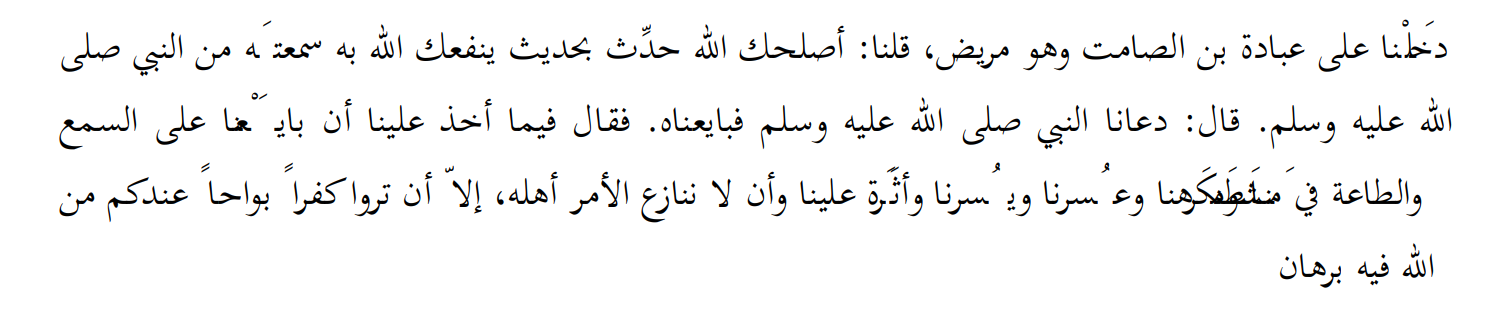
“Biz ‘Ubada ibn as-Somit kasal bo‘lib yotgan paytida uning huzuriga kirdik va dedik: Alloh sizga shifo bersin! Alloh (SWT) sizga foyda keltirishi uchun Payg‘ambar ﷺdan eshitgan biror hadisni bizga xabar bering. U dedi: Payg‘ambar ﷺ bizni chaqirdi va biz unga bay’a (sadoqat ahdi) berdik. U bizdan ahd olgan shartlar orasida shu ham bor edi: biz (buyruqlarni) faol bo‘lganimizda ham, charchaganimizda ham, qulaylik va qiyinchilik paytlarida ham, shuningdek, (boshqalarni) bizdan ustun ko‘rsatilganda ham tinglab va itoat qilishimiz kerak; hokimiyat berilgan kishilar bilan uning vakolati borasida bahslashmasligimiz kerak. Faqat Allohdan aniq dalilingiz bo‘lgan ochiq kufrni (kufr bawah) ko‘rsangina, shunda boshqacha bo‘lishi mumkin, deb aytdi.”
“We entered the house of ‘Ubadah bin as-Samit while he was ill and we said: May Allah make you healthy, inform us of a hadith you heard from the Prophet (saw) by which Allah (swt) may benefit you. He said: The Prophet (saw) invited us and we gave him our bay’ah (pledge of Allegiance). And among the conditions on which he took the pledge from us, was that we were to listen and obey (the orders) both at the time when we were active and when we were tired , and in the times of ease and hardship and when we see preference (for others over us), and not to dispute the authority of those who are entrusted with it saying: Unless you see open disbelief (kufr bawah) upon which you have a clear proof from Allah.”
Halifa uchun bay'a musulmonlar qo'lida bo'lib, bu ularning huquqidir; bay'a beruvchilar aynan ular bo'lib, aynan ularning bay'asi bilan halifa uchun xilofat shartnomasi tuziladi. Bay'a qo'l berish orqali yoki yozma tarzda bo'lishi mumkin. 'Abdulloh ibn Dinar rivoyat qilib aytdi:
The bay’ah for the Khalifah is in the hands of the Muslims, and it is their right; it is they who give the bay’ah, and it is their bay’ah which makes the Khilafah contracted for a Khalifah. The bay’ah can be by shaking hand or by writing. ‘Abdullah bin Dinar narrated saying:
“Men Ibn ‘Umarning huzurida bo‘lganman, o‘sha paytda odamlar ‘Abdulmalik ibn Marvonning atrofiga to‘plangan edi. U yozdi: Men Allohning bandasi, mo‘minlarning amiri ‘Abdulmalikka Allohning Sunnati va Uning Payg‘ambarining Sunnatiga muvofiq, qodir bo‘lganim darajada, itoat etish va tinglashga roziman.”
“I witnessed bin ‘Umar where the people gathered around ‘Abdulmalik bin Marwan. He wrote: I agree to listen and obey to the slave of Allah, ‘Abdulmalik the Amir al-Mu’mineen, according to the Sunnah of Allah and the Sunnah of His Prophet as much as I am able.”
Bundan tashqari, bay'a har qanday vosita (vasila) orqali ham to'g'ri bo'ladi. Biroq bay'a balog'atga yetgan shaxs tomonidan berilishi kerak, shuning uchun bolalar tomonidan berilishi noto'g'ri hisoblanadi. Abu Aqil Zahra ibn Ma'bad o'z bobosi Abdulloh ibn Hisham dan rivoyat qiladi — u Nabiy ﷺ ning zamonida bo'lgan — uning onasi Zaynab, Hamidning qizi, uni Nabiy ﷺ huzuriga olib kelib, dedi: "Ey Allohning Nabiysi, undan bay'a oling." Nabiy ﷺ dedi:
Moreover, the bay’ah is correct by any means (waseelah). However, the bay’ah has to be given by the mature person, so it is improper to be given by the young. Abu Aqeel Zahra bin Ma‘bed reported from his grandfather ‘Abdullah bin Hisham--who witnessed the Prophet (saw)--that his mother Zaynab, the daughter of Hameed, took him to the Prophet (saw) and said: O Prophet of Allah, take a pledge from him. The Prophet (saw) said:
U'sha bola, uning boshini silab, unga duo qildi.
“He is a child, wiped his head and made a du‘a for him.”
Bay’ah so‘zlari aniq shakllar bilan cheklanmaydi. Biroq ular Allohning Kitobi va Uning Payg‘ambari (saw) Sunnatiga Xalifa tomonidan amal qilishni, qiyinchilikda va osonlikda itoat etishni, hamda bay’ah beruvchi shaxs tomonidan (Xalifaga) yoqadigan va yoqmaydigan narsalarda itoatni o‘z ichiga olishi kerak. Bay’ah beruvchi Xalifaga bay’ah bergan bo‘lsa yoki boshqa musulmonlarning bay’ahi bilan Xilofat Xalifaga bog‘langan bo‘lsa, u holda bay’ah bay’ah beruvchining bo‘ynida amanat bo‘ladi va uni qaytarib olishga ruxsat berilmaydi. U Xilofat shartnomasi uchun haqdir, to uni bermagunicha, bergandan so‘ng esa unga amal qilishi shart. Undan qaytishga ruxsat yo‘q. Al-Buxoriy Jobir ibn Abdulloh (ra) dan rivoyat qilgan: bir badaviy kishi Payg‘ambar (saw) ga Islom uchun bay’ah bergan edi, unga kasallik yetdi va u Payg‘ambar (saw) ga dedi: “Bay’ahimni qaytarib olishimga ruxsat bering”, lekin Payg‘ambar (saw) rad etdi va o‘sha kishi ketdi. So‘ngra Payg‘ambar (saw) dedilar:
As for the words of the bay’ah they are not restricted to specific terms. However they must include acting according to the Book of Allah (swt) and the Sunnah of His Prophet (saw) by the Khalifah, and obedience in hardship and ease and obedience, and whatever pleases and displeases on the part of the person who gives the bay’ah (to the Khalifah). Whenever the one who pledges has given his bay’ah to the Khalifah or the Khilafah is contracted to the Khalifah by the bay’ah of other Muslims, then the bay’ah has become a trust on the neck of the one who gives the bay’ah and he is not allowed to retract it. It is a right for the contract of the Khilafah until he has given it, and once he has given it he must abide by it. He is not allowed to retract from it. Al-Bukhari narrated from Jabir bin ‘Abdullah (ra) that a Bedouin gave the Prophet (saw) his pledge on Islam, and an illness struck him so he said to the Prophet (saw): “Let me withdraw my bay’ah but the Prophet (saw) refused, and the man left. The Prophet (saw) then said:
"Madina pechga o'xshaydi: u nopokliklarni chiqarib tashlaydi, yaxshilarini tanlab oladi va ularni mukammal qiladi."
“Medina is like a furnace, it expels out the impurities and selects the good ones and makes them perfect.”
Nofe‘dan rivoyat qilinadi, u aytdi: Ibn ‘Umar (ra) menga aytdiki, u Payg‘ambar ﷺ shunday deganlarini eshitgan:
And it is narrated from Nafi‘a who said: Ibn ‘Umar (ra) said to me that he heard the Prophet (saw) saying:
"Kim (amirga) itoatdan qo‘lini tortsa, Qiyomat kuni Allohning huzurida turganida, unga hech qanday hujjat (o‘z himoyasi uchun) topilmaydi."
“Whoever withdraws his hand from obedience (to the Amir) will find no argument (in his defense) when he stands before Allah on the Day of Resurrection.”
Xalifaning bay‘ahini buzish — bu Allohning (SWT) itoatidan qo‘lni tortib olishdir. Bu holat, agar uning xalifaga bergan bay‘ahi shartnoma bay‘ahi bo‘lsa yoki musulmonlar qabul qilib, bay‘ah bergan xalifaga itoat bay‘ahi bo‘lsa, shunday bo‘ladi. Ammo agar u dastlab bir xalifaga bay‘ah bergan bo‘lib, musulmonlar bir butun holda uni xalifa sifatida qabul qilmagani sababli bu bay‘ah yakunlanmagan bo‘lsa, u holda u o‘sha bay‘ahdan qaytish huquqiga ega. Hadisda zikr etilgan taqiq xalifaga berilgan bay‘ahni qaytarishga qaratilgan, xilofat amalga oshmagan kishiga berilgan bay‘ahni qaytarishga emas.
To break the bay’ah of the Khalifah is withdrawing of one’s hand from the obedience of Allah (swt). This is the case if his bay’ah to the Khalifah is a bay’ah of contract or it is a bay’ah of obedience to a Khalifah whom the Muslims accepted and gave their bay’ah to. However, if he gave his bay’ah in the beginning to a Khalifah and it was not completed because the Muslims as a whole did not accept him as Khalifah, then he has the right to withdraw from that bay’ah. The prohibition mentioned in the hadith is focused on the withdrawal of a bay’ah to a Khalifah, not to a man for whom the Khilafah was not accomplished