3.1 Qur’onning jamlanishi
3.1 The Compilation Of The Qur’ān
Aniq va ishonchli dalillar bilan isbotlanganki, Payg‘ambar ﷺ vafot etganlarida butun Qur’on kurak suyaklari (hayvonlarning) bo‘laklariga, xurmo po‘stlog‘iga va lukhaf (yupqa, keng oq tosh)larga yozilgan edi. Bularning hammasi Sahobalar (Allohning ulardan rozi bo‘lsin) qalbida saqlangan edi. Biror oyat yoki oyatlar nozil bo‘lganda, u zot ﷺ ularni darhol o‘zlari oldida yozib olishni buyurar edilar. U zot ﷺ musulmonlarni, vahyni yozib olgan kotiblarga aytib yozdirganlaridan boshqa narsalarga Qur’onni yozishdan man qilmas edilar. Muslim Abu Sa'id al-Xudriy (roziyallohu anhu)dan rivoyat qilgan hadisda Allohning Elchisi ﷺ shunday degan:
It has been proven by decisive and definite evidence that when the Prophet died the whole Qur’ān had been written on pieces of shoulder blades (of animals), palm risps and on lukhaf’s (a thin broad white stone). All of it was preserved in the hearts of the Sahabah (may Allah be pleased with them). When an ayah or ayāt would be revealed he would order that they be written down before him at once. He did not prevent the Muslims from writing the Qur’ān in other than what he used to dictate to the scribes who wrote down the revelation. Muslim reported a hadīth from Abu Sa'id al-Khudri that the Messenger of Allah said:
"Mendan Qur'ondan boshqa biror narsani yozmanglar; kim mendan Qur'ondan boshqa biror narsani yozgan bo'lsa, uni o'chirib tashlasin."
“Do not write down anything from me, whosoever writes anything I have said other than the Qur’ān let him erase it”
Vahiydan yozib olingan narsalar varaqlarga to‘plandi. U (Payg‘ambar) dedi:
What the scribes wrote from the revelation was collected on sheets. He said:
Allohdan bir Elchi, tozalangan sahifalarni (suhuf) (Qur’ondan) o‘qiydigan. [TMQ Bayyinah:2]
“A Messenger from Allah, reciting purified pages (suhuf) (of the Qur’ān)” [TMQ Bayyinah:2]
ya'ni, batil (yolg'on)dan poklangan sahifalarni o'qish, haqiqatan qo'lda yozilgan, aniq haq va adolatli. Alloh taolo aytdi:
i.e, reciting sheets purified from falsehood, honestly handwritten unequivocally true and just. Allah said:
Yo‘q, albatta, bu (Qur’on oyatlari) eslatmadir. Kim xohlasa, unga e’tibor bersin. (U) hurmatga sazovor, mukarram Sahifalarda (yozilgan). Yuksak (martabali), poklangan. Kotiblar qo‘lida. Sharafli va itoatkor. [TMQ ‘Abasa: 11-16]
“Nay, indeed it (verses of the Qur’ān) are an admonition (tazkirah). So whoever wills, let him pay attention to it. (It is) in Records held (greatly) in honour. Exalted (in dignity), purified. In the hands of scribes. Honourable and obedient” [TMQ ‘Abasa: 11-16]
ya'ni, bu nasihat yozuvlarda qayd etilgan bo'lib, Alloh huzurida (yuksak) qadrga ega va qadri ulug'dir; u buzuqlarning qo'lidan xoli bo'lib, uni taqvodor kotiblar yozib qoldirganlar. U mushafning ikki muqovasi orasida, uning oldida yozilgan barcha narsani tark etdi. 'Abd al-'Aziz ibn Rufay' rivoyat qildi:
i.e this admonition established in the records is held (highly) in honour with Allah and exalted in value, free from the hands of those that are corrupt and that they have been written down by God fearing scribes. He left everything that was written between the two covers of the mushaf which had been written down in front of him. 'Abd al-'Aziz b Rufayya' narrated:
"Shaddad bin Ma'qil va men Ibn Abbos huzuriga kirdik. Shaddad bin Ma'qil undan so'radi: "Payg'ambar ﷺ (Qur'ondan tashqari) biror narsa qoldirganmilar?" U javob berdi: "U zot ﷺ faqat Qur'onning ikki muqovasi orasida bo'lganidan boshqa hech narsa qoldirmaganlar." Keyin biz Muhammad bin al-Hanafiyya huzuriga bordik va undan ham shu savolni so'radik. U javob berdi: "Payg'ambar ﷺ faqat Qur'onning ikki muqovasi orasida bo'lganidan boshqa narsa qoldirmaganlar."
“Shaddad bin Ma'qil and I entered upon Ibn 'Abbas. Shaddad bin Ma'qil asked him, 'Did the Prophet leave anything (besides the Qur’ān)?' He replied. “He did not leave anything except what is between the bindings (of the Qur’ān).' Then we visited Muhammad bin al-Hanafiyya and asked him (the same question). He replied, 'The Prophet did not leave except what is between the bindings (of the Qur’ān)”
Ijmo' (kelishuv) shu narsada qaror topganki, Qur'ondagi barcha oyatlar o'z suralarida Payg'ambar ﷺ ga vahiy nozil bo'layotganda ularning ro'parasida to'g'ridan-to'g'ri yozib olingan va ular sahifalarda (suhuf) yozilgan. Payg'ambarlarning eng buyugi ﷺ Qur'on haqida, arablar va butun dunyo uchun dalil bo'lgan eng buyuk mo''jizasi haqida rozi bo'lgan holda vafot etdi. U Qur'on oyatlari yo'qolib ketishidan qo'rqmadi, chunki Alloh ﷻ Qur'onni aniq matn bilan saqlab qo'ygan:
An Ijma' (consensus) has been established on the fact that all of the verses of the Qur’ān in their respective chapters (Sura’s) had been written down directly in front of the Messenger when the revelation was being revealed to him, and that they were written on sheets (suhuf). The greatest of the Messengers died content about the Qur’ān, his greatest miracle which established the proof for the Arabs and the world. He did not fear for the verses of the Qur’ān that they would be lost because Allah has preserved the Qur’ān with an explicit text:
Albatta, Biz Zikrni (Qur’onni) Biz nozil qildik va Biz uni (buzilishdan) albatta saqlaymiz. [TMQ Hijr: 9]
“Verily We: It is We who have sent down the Zikr (the Qur’ān) and surely, We will guard it (from corruption)” [TMQ Hijr: 9]
Bu oyatlar Payg‘ambar ﷺ hayotlik davrlarida yozib olingani, shuningdek, sahobalarning qalblarida saqlangani va musulmonlarga Qur’onni yozib olishga ruxsat berilgani sababli abadiy saqlab qolindi. Shu sababli Rasulullah ﷺ vafotlaridan keyin sahobalar Qur’onni bir kitobga jamlash yoki uni yozib qo‘yish zarurati sezmadilar, to Riddah urushlarida ko‘plab huffoz (Qur’onni yod olganlar) shahid bo‘lguniga qadar. Shunda 'Umar ﷺ suhuf (yozilgan varaqlar) va qurro' (Qur’onni butunlay yod olganlar)ning vafot etishidan xavotirga tushdi, natijada ba’zi oyatlar yo‘qolib ketishi mumkin edi. Shuning uchun u yozilgan varaqlarni bir joyga to‘plash fikriga keldi. Bu fikrini Abu Bakr ﷺ ga taklif qildi va shu tariqa Qur’onni jamlash amalga oshirildi. 'Ubayd ibn as-Sibaq rivoyat qilishicha, Zayd ibn as-So‘bit al-Ansoriy aytdi: Yamома jangida (bu jangda ko‘plab qurro' shahid bo‘lgandan) keyin Abu Bakr ﷺ meni chaqirib yubordi. 'Umar ﷺ Abu Bakr ﷺ huzurida edi. Abu Bakr ﷺ aytdi: "'Umar ﷺ oldimga kelib dedi: "Yamома kunida (jang) odamlar og‘ir yo‘qotishlarga uchradi va men xavotirdaman, boshqa jang maydonlarida ham qurro' (Qur’onni yoddan biladiganlar) ko‘plab halok bo‘ladi va Qur’onning katta qismi yo‘qolib ketishi mumkin, agar sen uni to‘plamasang. Menimcha, sen Qur’onni jamlashing kerak." Abu Bakr ﷺ davom etdi: "Men 'Umar ﷺ ga dedim,
Because these verses had been preserved permanently via them being written down before him , and being preserved in the hearts of the Sahabah and by the permission granted to the Muslims to write down the Qur’ān. This is why after the death of the Messenger the Sahabah did not feel the need to compile the Qur’ān in one book or the need to write it down until many of the Huffaz (memorisers of the Qur’ān) had been killed in the Riddah wars. So due to this 'Umar feared for the loss of the sheets (suhuf) and the death of the Qurra' (Those who had committed the whole of the Qur’ān to memory), thereby causing some verses to be lost. So he thought about bringing the written sheets together (in one compilation). He presented his idea to Abu Bakr and so the compilation of the Qur’ān was performed. It has been narrated by 'Ubayd ibn al-Sibaq that Zayd b al-Thabit al-Ansari said: Abu Bakr sent for me after the (heavy) casualties among the warriors (of the battle) of Yamama (where a great number of Qurra' were killed). 'Umar was present with Abu Bakr who said, 'Umar has come to me and said, The people have suffered heavy casualties on the day of (the battle of) Yamama, and I am afraid that there will be more casualities among the Qurra' (those who know the Qur’ān by heart) at other battle-fields, whereby a large part of the Qur’ān may be lost, unless you collect it. And I am of the opinion that you should collect the Qur’ān.” Abu Bakr added, “I said to 'Umar ,
«Siz Allohning Rasuli qilmagan ishni qanday qilasiz?»
'How can you do something which Allah's Apostle did not do?'
Umar aytdi (menga):
'Umar said (to me),
Allohga qasamki, bu haqiqatan ham yaxshi ish.
'By Allah, it is (really) a good thing.'
Shunda ‘Umar meni ko‘ndirish va bu taklifini qabul qilishga undashdan to‘xtamadi, hatto Alloh mening qalbimni unga ochdi va men ham ‘Umarning fikriga qo‘shildim. (Zayd ibn Sobit qo‘shimcha qildi:) ‘Umar u (ya’ni Abu Bakr) bilan birga o‘tirardi va men bilan gaplashmasdi. (Abu Bakr aytdi:) “Sen donishmand yigitsan va biz senga shubha qilmaymiz (yolg‘on gapirish yoki unutuvchanlikda ayblamaymiz). Sen Alloh Elchisi ﷺ uchun vahiyni yozib kelgansan. Shunday ekan, Qur’onni izlab top va uni (bir mushafda) jamla.” “Alloh haqqi, agar u (Abu Bakr) menga tog‘lardan birini o‘z joyidan siljitishni buyurganida ham, Qur’onni jamlash haqidagi buyrug‘idan ko‘ra og‘irroq bo‘lmagan bo‘lardi. Men ikkovlariga dedim: “Payg‘ambar ﷺ qilmagan ishni qanday qilib qilmoqchisiz?” Abu Bakr esa dedi: “Alloh haqqi, bu aslida yaxshi ish.” Shunday qilib, men bu borada u bilan bahslashishda davom etdim, to Alloh Abu Bakr va ‘Umarning qalblarini ochgan narsaga mening qalbimni ham ochguncha. Shunda men Qur’on parchalarini qidirib, ularni tosh lavhalar, yelka suyaklari, xurmo bargi bandlaridan va yodlab olgan odamlarning xotirasidan to‘play boshladim. Men Surat at-Tavba’ning ikki oyatini Abu Xuzaymaning yonidan topdim, bu oyatlarni boshqa hech kimda topmadim, ular quyidagilar edi:
So ‘Umar kept on trying to convince me and persuade me to accept his proposal till Allah opened my heart for it and I had the same opinion as 'Umar.' (Zayd b al-Thabit added:) Umar was sitting with him (i.e Abu Bakr) and was not speaking to me). 'You are a wise young man and we do not suspect you (of telling lies or of forgetfulness): and you used to write the revelation (wahy) for Allah's Apostle . Therefore, look for the Qur’ān and collect it (in one manuscript). 'By Allah, if he (Abu Bakr) had ordered me to shift one of the mountains (from its place) it would not have been harder for me than what he had ordered me concerning the collection of the Qur’ān. I said to both of them, “How dare you do a thing which the Prophet has not done?' Abu Bakr said, 'By Allah, it is (really) a good thing So I kept on arguing with him about it till Allah opened my heart for that which He had opened the hearts of Abu Bakr and Umar . So I started locating the Qur’ānic material and collecting it from the parchments, scapula bones, leaf-stalks of date palms and from the memories of men (who knew it by heart). I found two Verses of Sura at-Tawba with Abu Khuzaima which I did not find with anybody else, (and they were):
Haqiqatan, sizlarga o'zlaringizdan bir Elchi keldi. Sizning har qanday zarar yoki qiyinchilikka uchrashingiz uni qattiq xafa qiladi. [TMQ Tawba: 128]
“Verily, there has come unto you a Messenger from amongst yourselves. It grieves him that you should receive any injury or difficulty” [TMQ Tawba: 128]
...Bara'ah surasining oxirigacha. Qur'on to'plangan qo'lyozma Abu Bakr qo'lida to'liq vafot etguniga qadar saqlangan, so'ngra u 'Umar qo'lida uning hayotligida bo'lgan va nihoyat Hafsa bint 'Umar qo'lida qolgan. Zayd ning Qur'onni to'plashi Huffoz (ya'ni Qur'onni yodlab olganlar) dan yozib olganlaridan iborat bo'lmagan. Aksincha, uning to'plami Allohning Elchisi ﷺ huzurida o'zi yozgan narsalarini jamlagan. U ikki guvoh tasdiqlamagunicha bir varaqni boshqa varaq bilan joylashtirib to'plamagan, ya'ni taqdim etilgan har bir varaq Allohning Elchisi ﷺ huzurida yozilganiga ikki kishi guvohlik bergan bo'lishi kerak edi. Bundan tashqari, u varaqni ikki shartga javob bermagunicha qabul qilmagan: birinchidan, u Sahobalardan biri yonida yozma shaklda mavjud bo'lishi kerak edi; ikkinchidan, u Sahobalardan biri tomonidan yodlangan bo'lishi kerak edi. Yozma va yodlangan shakllar to'plashga mo'ljallangan varaq bilan mos kelganda, uni qabul qilar edi, aks holda qabul qilmas edi. Shu sababli, u Zayd o'zi bu oyatni eslab qololgan bo'lsa-da, Abu Xuzayma huzurida yozma shaklda topmaguncha, Bara'ah surasining oxirini olishdan tiyilgan. Yahyo ibn 'Abdurrahmon ibn Hotib orqali rivoyat qilinishicha, u shunday degan:
until the end of Sura Bara'ah. The manuscript on which the Qur’ān was collected, remained with Abu Bakr till he passed away, and then with 'Umar during his lifetime, and finally it remained with Hafsa bint Umar . Zayd's compilation of the Qur’ān did not consist of what he wrote down from the Huffaz (i.e the memorisers of the Qu’ran). Rather his compilation brought together what he had written himself in front of the Messenger of Allah . He did not place one sheet/page with another sheet in order to compile them unless two witnesses testified, for every sheet that had been presented to him that it was written in the presence of the Messenger of Allah . Furthermore, he did not accept a sheet unless it met two conditions; firstly, that it was present in written form with one of the Sahabah. And second, that it had been memorised by one of the Sahabah. When the written and memorised forms concurred with the sheet that was intended to be compiled, he accepted it. Otherwise he did not accept it. This is why he refrained from taking the end of sura al-Bara'ah until he found it in written form with Abu Khuzayma even though Zayd could himself recall and remember it. It has been narrated via Yahya b 'abd al-Rahman ibn Hatib that he said:

“Umar (ra) o‘rnidan turib dedi: kimda Allohning Elchisidan ﷺ Qur’on oyatlaridan biror narsa olgan bo‘lsa, uni olib kelsin. Ular buni varaqlarga, taxtachalarga va xurmo barglarining qattiq tolalariga yozib qo‘yishardi. Ibn Hatib aytdi: u (Zayd) ikki guvoh uni tasdiqlamagunicha hech kimdan hech narsa qabul qilmasdi. Bu shuni ko‘rsatadiki, Zayd, Qur’onni yozma shaklda topgan bo‘lsa ham, uni qabul qilgan kishi buni Allohning Elchisidan ﷺ eshitganini tasdiqlamaguncha qoniqmasdi, garchi Zayd uni allaqachon yodlagan bo‘lsa ham. U buni o‘ta ehtiyotkorligi tufayli shunday qilardi.”
“Umar (ra) stood up and said; whosoever has received anything of the Qur’ān from the Messenger of Allah , let him bring it forth. They used to write that on sheets, tablets and palm risps. Ibn Hatib said: He (Zayd) did not accept anything from anyone until two witnesses had given testimony to it. This shows that Zayd was not satisfied by merely finding something in written form until the one who received it testified that he had heard it despite the fact that Zayd had memorised it already. He used to do this due to his extreme caution”.
Shunday qilib, jamlash jarayoni Allohning Elchisi ﷺ huzurida yozilgan varaqlarni ikki muqova orasidagi bitta kitobga jamlashdan boshqa narsa emas edi. Qur’on avvallari varaqlarga yozilgan, ammo ular alohida-alohida saqlanardi. Shuning uchun Abu Bakr ularni bir joyga to‘pladi. Shu sababli Abu Bakrning Qur’onni jamlash haqidagi buyrug‘i uni bitta mushafga yozish haqida emas, balki Elchi ﷺ huzurida yozilgan varaqlarni bir joyga yig‘ish haqidagi buyruq edi, shuningdek, ularning avvalgi holatiga mos ekaniga ishonch hosil qilish buyrug‘i edi. Buning uchun ikki guvohning shahodati bilan tasdiqlash talab qilindi: ular Allohning Elchisi ﷺ huzurida yozilgan, sahobalarda yozma shaklda bo‘lgan va ular buni yodlagan. Bu varaqlar Abu Bakrning hayoti davomida uning qo‘lida saqlandi, so‘ngra Umarning hayoti davomida uning qo‘lida, keyin esa Umarning vasiyatiga binoan mo‘minlarning onasi, Umarning qizi Hafsaning qo‘lida saqlandi. Bundan ayon bo‘ladiki, Abu Bakrning Qur’onni jamlashi faqat Allohning Elchisi ﷺ huzurida yozilgan varaqlarni bir joyga yig‘ishdan iborat bo‘lgan va bu Qur’onning haqiqiy jamlanishi emas edi. Yodlash ham aynan shu varaqlarga, ya’ni Allohning Elchisi ﷺ huzurida yozilgan hujjatlarga nisbatan qilingan, Qur’onning o‘zini yodlashga nisbatan emas edi. Bunday parchalarni to‘plash va saqlash faqat ehtiyotkorlik yuzasidan hamda Elchi ﷺ dan rivoyat qilingan narsalarning aniq yodlanganligini tekshirishga barcha kuchni sarflash orqali amalga oshirilgan. Qur’onning o‘zi esa sahobalarning qalblarida saqlangan va ularning xotirasida yodlangan. Yodlashda ko‘plab sahobalarga tayanilgan, chunki uni to‘liq yoki qisman yodlaganlar juda ko‘p edi.
Thus, the (process) of compilation was nothing other than the bringing together of sheets that had already been written in the presence of the Messenger of Allah into one book between two covers. The Qur’ān used to be written down on sheets but they were kept seperately. So Abu Bakr assembled them in one place. That is why Abu Bakr's order to compile the Qur’ān was not an order to write it down in one mushaf, rather it was an order to bring the sheets that had been written in the Messenger's presence together in one place and it was an order to make certain; that they are in the same form as they were by supporting it with the testimonies of two witnesses that they had been written in front of the Messenger of Allah and that they were in the possession of the Sahabah in written form and that they had memorised them. These sheets remained preserved in the possession of Abu Bakr during his life and then with 'Umar during his lifetime and them with Hafsa the daughter of 'Umar , the mother of the Believers in accordance with 'Umar's bequest. From this it becomes clear that Abu Bakr's compilation of the Qur’ān constituted only the bringing together of sheets that had been written in the presence of Allah's Messenger and it was not an actual compilation of the Qur’ān. And the memorisation was in regard to these sheets i.e the documents which were written in front of the Messnegr of Allah and not the memorisation of the Qur’ān. The bringing together of such pieces and their preservation was not done except by way of cautiousness and expending all efforts in examining the memorisation of exactly what had been reported from the Messenger of Allah . As for the Qur’ān itself, it was preserved in the hearts of the Sahabah and memorised in their memory. In memorization, dependence was put on a great multitude of Sahabah because those memorising it completely or partially were many.
"Alloh uchun hajj va umrani to'g'ri ado eting (wa atimmul hajja wal 'umrata lillah)" [TMQ Baqarah: 196]
“And perform properly the hajj and 'Umra for Allah (wa atimmul hajja wal 'umrata lillah)” [TMQ Baqarah: 196]
Va boshqasi o'qidi:
And the other read:
"Ulug' uy (Alloh uyi)ga hajj va umrani to'liq ado eting (va atimmul-hajja val-'umrata lil-bayt)"
''And perform properly the hajj and 'Umra to the House (of Allah)(wa atimmul hajja wal 'umrata lil bayt)”
Shunda Huzayfah g'azablandi va g'azabdan ko'zlari qizarib ketdi. Huzayfah haqida rivoyat qilinadiki, u shunday degan:
So Huzayfah became angry and his eyes went red with rage. It has been narrated about Huzayfah that he said:
Kufa aholisi Ibn Mas'ud qiroatiga amal qiladi, Basra aholisi esa Abu Musa qiroatiga amal qiladi. Allohga qasamki, agar Ameer al-Mumineen (Mo'minlarning amiri) huzuriga borsam, unga buyuraman, shunda u bitta qiroat bo'lishi uchun amr qiladi. Shunday qilib, u Usmon huzuriga sayohat qildi.
The people of Kufah adhere to the recitation of Ibn Mas'ud and the people of Basra adhere to the recitation of Abu Musa . By Allah ! If I go to the Ameer al Mumineen (Leader of the Believers) I will order him to make it a single recitation. So he travelled to 'Uthman .
Ibn Shihob rivoyat qilishicha, Anas ibn Molik aytgan: Huzayfa ibn al-Yaman Usmon huzuriga keldi, o'sha paytda Shom ahli va Iroq ahli Armaniston va Ozarbayjonni egallash uchun urush olib borayotgan edi. Huzayfa ularning (Shom va Iroq ahlining) Qur'on tilovatidagi ixtiloflaridan qo'rqdi va Usmonga shunday dedi:
It has been reported by Ibn Shihab that Anas ibn Malik narrated: Huzayfa bin al-Yaman came to Uthman at the time when the people of al-Sham and the people of Iraq were waging a war to conquer Armenia and Azerbaijan. Hudhayfa was afraid of their (the people of al-Sham and Iraq) differences in the recitation of the Qur’ān, so he said to 'Uthman ,
"Ey Mo'minlar amiri! Bu ummatni, Yahudiylar va Nasroniylar Kitob (Qur'on) haqida ilgari ixtilofga tushganlari kabi, ixtilofga tushishdan saqlang!"
'O Ameer Al Mumineen! Save this nation before they differ about the Book (Qur’ān) as Jews and the Christians did before.'
Ustoz Usmon Hafsaga xabar yubordi va dedi:
So 'Uthman sent a message to Hafsa saying,
Bizga Qur’on qo‘lyozmalarini yuboring, shunda biz Qur’on materiallarini mukammal nusxalarda tartibga solib, qo‘lyozmalarni sizga qaytarib beramiz.
Send us the manuscripts of the Qur’ān so that we may compile the Qur’ānic materials in perfect copies and return the manuscripts to you.
Hafsa uni Usmonga yubordi. Keyin Usmon Zayd ibn Sobit (roziyallohu anhu), Abdulloh ibn az-Zubayr, Said ibn al-As va Abdurrahmon ibn al-Horis ibn Hishomga nusxalarni mukammal shaklda qayta yozib chiqishni buyurdi. Usmon uchta qurayshlik kishiga dedi:
Hafsa sent it to 'Uthman . 'Uthman then ordered Zaid bin Thabit (ra), 'Abd Allah ibn al Zubair, Said ibn al-'As and 'Abd al-Rahman ibn Harith ibn Hisham to rewrite the manuscripts in perfect copies. 'Uthman said to the three Qurayshi men,
"Agar siz Qur'on oyatlarining biror jihatida Zayd ibn Sobit (roziyallohu anhu) bilan ixtilof qilsangiz, uni Quraysh lahjasida yozing, chunki Qur'on aynan ularning tilida nozil bo'lgan."
'Incase you disagree with Zaid ibn al-Thabit (ra) on any point in the Qur’ān, then write it in the dialect of Quraysh, the Qur’ān was revealed in their tongue.'
Shunday qilishdi va ko'plab nusxalar ko'chirilgach, Usmon (r.a.) asl sahifalarni Hafsa (r.a.) ga qaytarib berdi. Usmon (r.a.) ko'chirilgan nusxalardan birini har bir musulmon viloyatiga yubordi va Qur'on materiallarining qolgan barcha qismlari, ular parchalangan sahifalar yoki to'liq nusxalar bo'lishidan qat'i nazar, yoqib yuborilishini buyurdi. Ko'chirilgan nusxalar soni yettita edi. Yetti mushafdan biri Makkaga, biri Shomga, biri Yamanga, biri Bahrayn ga, biri Basraga, biri Kufaga yuborildi, bittasi esa Madinada saqlab qolindi.
They did so, and when they had written many copies, 'Uthman returned the original manuscripts to Hafsa . 'Uthman sent one copy of what they have copies to every Muslim province, and ordered that all the other Qur’ānic materials, whether written in fragmentary manuscripts or whole copies, be burnt. The number of copies made was seven. The seven mushaf’s were sent to Makkah, al-Sham, Yemen, Bahrain, Basra, Kufah, and one copy was kept in Madinah.
Shunday qilib, Usmon (r.a.) ning ishi Qur'onni jamlash emas edi, balki u Allohning Elchisidan ﷺ aynan shu holatida yozib olingan narsaning ko'chirilishi va nusxalanishidan iborat edi. U Mo'minlarning onasi Hafsa (r.a.) ning huzuridagi saqlangan nusxadan yetti nusxa ko'chirishdan boshqa hech narsa qilmadi, xalqni shu yagona yozuv ustida birlashtirdi va undan boshqa har qanday yozuv yoki tilga olishni taqiqladi. Masala shu nusxada, yozuv va tilga olish jihatidan hal bo'ldi. Bu Allohning Elchisi ﷺ huzurida vahiy nozil bo'lganda sahifalar yozilgan o'sha yozuv va tilga olishdir. Va bu Abu Bakr (r.a.) jamlagan o'sha nusxadir. Shundan so'ng musulmonlar aynan shu nusxadan ko'chirma olishni boshladilar, boshqa nusxadan emas. Usmon (r.a.) mushafidan boshqa narsa, uning yozuvi qolmadi. Bosmaxonalar paydo bo'lganda, mushaf aynan shu nusxadan, xuddi shu yozuv va tilga olish bilan chop etildi.
Therefore, 'Uthman's action was not the compilation of the Qur’ān rather it constituted in only the copying and transcription of the same thing transcribed from the Messenger of Allah as it was. He did not do anything other than make seven copies from the preserved copy in the possession of Hafsa , the mother of the Believers and unite the people on this single script and forbade any other script or dictation other than it. The matter was settled on this copy as a script and dictation. It is the same script and dictation in which the sheets were written as was written in the presence of Allah's Messenger when the revelation was revealed. And it is the same copy which Abu Bakr had compiled. Then the Muslims began to make copies from this copy and not any other copy. Nothing remained except the mushaf of 'Uthman in its script. When printers came about, the mushaf was printed from this copy with the same script and dictation.
Abu Bakr ning jamlash va Uthmon ning jamlash o‘rtasidagi farq shundaki, Abu Bakr ning jamlashi Qur’ondan biror narsa yo‘qolib ketishidan qo‘rqilganda amalga oshirildi, chunki uning hofizlaridan (yodlovchilaridan) biri vafot etsa, Qur’on yo‘qolishi mumkin edi. Sabab shu ediki, Qur’on varaqlarga yozilgan bo‘lsa-da, u bitta kitobdek bir joyga to‘plangan emas edi. Shu sababli u sahifalarga jamlandi. Uthmon ning jamlashi esa Qur’onning ayrim jihatlarida ixtiloflar ko‘paygani uchun amalga oshirildi: ba’zilar uni o‘z lahjalarida o‘qir edi, bu esa ba’zilarning boshqalarni xato qilishda ayblashiga olib keldi. Masala kengayib ketishidan qo‘rqildi, shuning uchun o‘sha varaqlar bitta mushafga ko‘chirildi. Biz hozir qo‘limizdagi mushaf Allohning Elchisi ﷺ ga nozil qilingan o‘sha mushafdir, Allohning Elchisi ﷺ huzurida yozilgan varaqlardagi o‘sha mushafdir. Va bu Abu Bakr ning varaqlar bir joyga jamlanganda to‘plagan mushafidir. Uthmon ning undan yetti nusxa ko‘chirtirib, qolganlarini yoqib yuborishni buyurgan mushafi ham aynan shu. Va bu oyatlarning bir-biriga nisbatan tartibi, suralardagi joylashuvi, yozilishi va aytib yozdirilishi bo‘yicha ham o‘sha Sharif Qur’ondir. Allohning Elchisi ﷺ vahiydan aytib yozdirgan, varaqlari bir joyga jamlanib, so‘ngra ko‘chirilgan nusxaga kelsak, u mo‘minlarning onasi Hafsa ning qo‘lida saqlanib qoldi. Marvon Madina noibi bo‘lguncha shunday davom etdi. U esa uni yirtib tashladi, chunki mushaf nusxalari hamma joyga tarqalgan edi va bu nusxa muhim hisoblanmadi. Ibn Shihob rivoyat qiladi: Solim ibn Abdulloh ibn Umar unga xabar berdi:
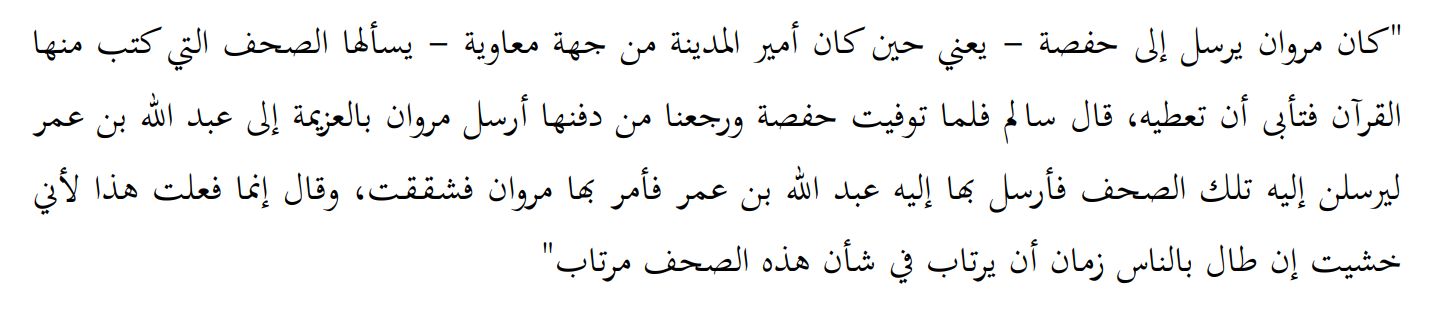
Marvon Hafsaga odam yuborib, u Madinada amir bo‘lib turgan paytida Mu‘oviya orqali, Qur’on yozilgan varaqlarni so‘ragan. U unga bermagan. Solim aytadi: Hafsa vafot etganida, biz uning dafnidan qaytayotganimizda Marvon ‘Abdulloh ibn ‘Umarga o‘zining qat’iy qaroriga ko‘ra o‘sha mushafni yuborishni bildirdi. Shunda ‘Abdulloh ibn ‘Umar uni unga yubordi. Marvon uni yo‘q qilishni buyurdi. U shunday dedi: “Buni men qildim, chunki agar bu varaqlar odamlar orasida uzoq vaqt qolsa, odamlar ularga nisbatan shubhaga tushishlaridan qo‘rqdim.”
‘That Marwan used to send for Hafsa – i.e when he was the amir of Madinah via Mu'awiyya - asking her for the sheets from which the Qur’ān was written. She refused to give him it. Salim said: When Hafsa died, while we were returning from her burial Marwan communicated his firm decision to 'Abd Allah ibn 'Umar that he send him that mushaf. So 'Abd Allah ibn 'Umar sent it to him. Marwan ordered it to be destroyed. He said: I did this because I feared that if it remained with people for a long time then people will have doubts regarding these sheets’.