17.8 Xalifani tayinlash usuli
17.8 The Method To Appoint The Khalifah
Shariat xalifa tayinlashni ummatga farz qilganda, xalifaning tayinlanish usulini ham belgilab qo‘ydi. Bu usul Qur’on, Sunnat va sahobalar (roziyallohu anhum) ijmo’i bilan isbotlangan, va bu usul bay’ahdir. Demak, xalifaning tayinlanishi unga bay’ah berish orqali amalga oshiriladi. Bu usul bay’ah ekanligining dalili Muslimlarning Payg‘ambar ﷺ ga bergan bay’ahlari va Payg‘ambar ﷺ ning imomga bay’ah berishimizni buyurganidan tasdiqlanadi. Muslimlarning Payg‘ambar ﷺ ga bergan bay’ahi uning payg‘ambarligi uchun emas edi; balki hukmronlik uchun edi, chunki bu amal ustidagi bay’ah edi, e’tiqod ustidagi bay’ah emas edi. Shunday ekan, Payg‘ambar ﷺ ga bay’ah u zot davlat boshlig‘i sifatida berilgan, payg‘ambar va elchi sifatida emas edi. Chunki Payg‘ambarlik va risolatni tan olish e’tiqod masalasi bo‘lib, bay’ah emas, shuning uchun bay’ah faqat uning davlat rahbari sifatidagi maqomi uchun bo‘lishi mumkin edi. Bay’ah Qur’on va hadislarda zikr qilingan. Alloh (subhanahu va taolo) aytadi:
When the Shari’ah made it obligatory upon the Ummah to appoint a Khalifah, it also defined the method by which the Khalifah is appointed. This method is proven by the Qur’an, the Sunnah and the Ijma’a of the Sahabah (ra), and this method is the bay’ah. So the appointment of the Khalifah is carried out by the bay’ah to him. The Proof that this method is the bay’ah is confirmed from the bay’ah of the Muslims to the Prophet (saw) and from the order of the Prophet (saw) for us to give bay’ah to the Imam. The bay’ah of the Muslims to the Prophet (saw) was not on his Prophethood; rather it was on ruling, since it was a bay’ah over action and not a bay’ah on belief. So the Prophet (saw) was given the bay’ah in his capacity as a ruler and not as a Prophet and a Messenger. Because the acknowledgement of the Prophethood and the Message is a matter of belief and not a bay’ah, so the bay’ah could only have been for him in his capacity as the head of the State. The bay’ah was mentioned in the Qur’an and the ahadith. Allah (swt) said:
Ey Payg‘ambar, agar iymonli ayollar sizning oldingizga kelib, Allohga hech narsani sherik qilmaslik, o‘g‘rilik qilmaslik, zino qilmaslik, farzandlarini o‘ldirmaslik, qo‘l-oyoqlari oldida o‘zlari to‘qigan biron bir bo‘htonni keltirmaslik va yaxshi ishda sizga itoatsizlik qilmaslik ustida bay’at bersalar, ularning bay’atini qabul qiling ﷺ. [TMQ 60:12]
"O Prophet, if the believing women come to give you a bay’ah that they will not associate anything as partners to Allah, not to steal, not to commit adultery, not to kill their children, not to produce any lie that they have devised between their hands and feet, nor disobey you in what is right then give them the bay’ah" [TMQ 60:12]
Alloh (SWT) ham shunday degan:
Allah (swt) also said:
Albatta, sizga (Muhammad ﷺ) bay'at berayotganlar aslida faqat Allohga bay'at berayotirlar. Allohning qo'li ularning qo'llari ustidadir.
"Lo! Those who give bay’ah to you (Muhammad) they give bay’ah only to Allah. The hand of Allah is above their hands"
Imom al-Bukhoriy rivoyat qilgan: Ismoil bizga rivoyat qildi, Molik menga Yahyo ibn Said orqali rivoyat qildi, u dedi: "Ubada ibn Valid menga xabar berdi, otam menga Ubada ibn as-Somit (roziyallohu anhu) dan xabar berdi, u dedi:
Al-Bukhari reported: Ismail related to us that Malik related to me from Yahya bin Said who said: “Ubadah bin Waleed informed me that my father informed me from ‘Ubadah bin as-Samit (ra) who said:
“biz uni tinch vaqtimizda ham, charchagan vaqtimizda ham tinglashga va itoat qilishga, hokimga qarshi urushmaslikka yoki unga itoatsizlik qilmaslikka, qayerda bo‘lmaylik haqiqat uchun mustahkam turishga yoki haqiqatni aytishga, Alloh yo‘lida esa malomat qiluvchilarning malomatidan qo‘rqmaslikka ahd qilganmiz.
“that we would listen to and obey him both at the time when we were active and at the time when we were tired and that we would not fight against the ruler or disobey him, and would stand firm for the truth or say the truth wherever we might be, and in the Way of Allah we would not be afraid of the blame of the blamers.
Al-Buxoriy rivoyat qildi: Ali ibn Abdulloh bizga rivoyat qildi, u Abdulloh ibn Yazid bizga rivoyat qildi, u Saiyd (ya'ni ibn al-Musayyab) aytdi: Abu Aqil Zahra ibn Ma'bad menga bobosi Abdulloh ibn Hishomdan rivoyat qildi, u Nabiy ﷺ bilan birga bo'lgan. Uning onasi Zaynab, Hamid qizi, uni Allahning Rasuli ﷺ huzuriga olib keldi va dedi: "Ey Allahning Rasuli, uning bay'atini qabul qiling". Nabiy ﷺ dedilar:
Al-Bukhari reported: Ali bin Abdullah related to us that Abdullah bin Yazeed related to us that Saeed (who is ibn al-Musayyib) who said: Abu ‘Aqeel Zahrah bin Ma’bad narrated to me from his grandfather ‘Abdullah bin Hisham who witnessed the Prophet (saw) that his mother Zaynab, daughter of Hameed, took him to the Messenger of Allah (saw) and said: “O Messenger of Allah, take his pledge. The Prophet (saw) said:
U‘shbu bola, va uning boshini silab, unga duo qildi.
“He is a child, and rubbed (wiped) his head and said du‘a for him.”
Al-Buxoriy dedi: «Abdon ibn Abu Hamza bizga Al-A'mash orqali, u Abu Solih orqali, u Abu Hurayra (roziyallohu anhu) orqali rivoyat qildi, u dedi: Allohning Elchisi ﷺ dedilar:
Al-Bukhari said: ‘Abdan bin Abu Hamza related to us from Al-‘Amash from Abu Salih from Abu Hurairah (ra) who said: The Messenger of Allah (saw) said:

“Uch turdagi odamlar bor, ularga Alloh Qiyomat kuni gapirmaydi, ularni gunohlaridan poklamaydi va ularga alamli azob bor: Ular: (1) yo'lda ortiqcha suvi bo'lgan, lekin uni yo'lovchilardan ayab qoladigan odam. (2) imomga (hokimga) bay'at bergan va bu bay'atni faqat dunyoviy manfaat uchun beradigan odam: agar imom unga istagan narsasini bersa, bay'atiga vafo qiladi, aks holda bay'atini bajarmaydi. (3) 'Asr namozidan keyin birovga biror narsani sotadigan va Alloh nomi bilan qasam ichib (yolg'on qasam), bunga shuncha narx taklif qilinganini aytadigan odam; xaridor unga ishonib, uni sotib oladi, holbuki sotuvchiga aslida bunchalik narx taklif qilinmagan bo'ladi.”
“(There will be three types of people whom Allah will neither speak to them on the Day of Resurrection nor will purify them from sins, and they will have a painful punishment: They are, (1) a man possessed superfluous water (more than he needs) on a way and he withholds it from the travelers. (2) a man who gives a pledge of allegiance to an Imam (ruler) and gives it only for worldly benefits, if the Imam gives him what he wants, he abides by his pledge, otherwise he does not fulfill his pledge; (3) and a man who sells something to another man after the `Asr prayer and swears by Allah (a false oath) that he has been offered so much for it whereupon the buyer believes him and buys it although in fact, the seller has not been offered such a price..”
Ushbu uch hadisdan ayonki, bay'ah xalifani tayinlash usuli ekanligi ma'lum bo'ladi. 'Ubadah hadisida u Payg'ambar ﷺ ga eshitish va itoat qilish uchun bay'ah bergani aytilgan, bu esa hokimga berilgan bay'ahdir. 'Abdulloh ibn Hisham hadisida Payg'ambar ﷺ uning bay'ahini balog'atga yetmagani uchun qabul qilmagani aytilgan, bu esa bay'ahning hukmronlik haqida ekanini ko'rsatadi. Abu Hurayra (ra) rivoyat qilgan hadisdan esa bu imomga berilgan bay'ah ekani ayon bo'ladi. Hadisdagi "imom" so'zi aniqlanmagan, ya'ni istalgan imom ma'nosida. Boshqa hadislarda ham imomga bay'ah berish haqida so'z boradi. Muslim kitobida 'Abdulloh ibn 'Amr orqali rivoyat qilinishicha, Payg'ambar ﷺ shunday degan:
From these three ahadith it is explicit that the bay’ah is the method of appointing the Khalifah. The hadith of ‘Ubadah states that he gave bay’ah to the Prophet (saw) to listen and obey and this is a bay’ah to a ruler. The hadith of ‘Abdullah bin Hisham states that the Prophet (saw) rejected his bay’ah because he was not mature which indicates that it is a bay’ah on ruling. From the hadith reported by Abu Hurairah (ra) it is evident that it is a bay’ah to the Imam. The word ‘Imam’ in the hadith is undefined i.e. any Imam. There are other ahadith which refer to giving bay’ah to the Imam. It is reported in Muslim via Abdullah bin ‘Amru that the Prophet (saw) said:
"Kim bir imomga qo‘l berib va yuragining mevasini bergan bo‘lsa, unga imkoni boricha itoat etsin. Agar boshqa biri uning bilan talashish uchun kelsa, o‘sha keyingisining bo‘ynini uring."
“Whoever gave bay’ah to an Imam giving him his handshake and the fruit of his heart should obey him as much as he can. If another person comes to dispute with him, strike the neck of the latter”.
Muslim Abu Said al-Xudriydan rivoyat qiladi, u aytdi: Payg'ambar ﷺ dedilar:
Also Muslim narrates from Abu Said al-Khudri who said: The Prophet (saw) said:
"Agar ikki xalifaga bay'a berilsa, ulardan keyingisini o'ldiring."
“If a bay’ah is given to two Khalifahs kill the latter of them.”
Abu Hozim aytadi: "Men Abu Hurayra (ra) bilan besh yil birga bo'ldim va u Payg'ambar ﷺ dan rivoyat qilganini eshitdim, u (Payg'ambar ﷺ) shunday degan edi:"
And Muslim narrated that Abu Hazim who said: “I accompanied Abu Hurairah (ra) for five years and heard him narrate from the Prophet (saw) who said:
“Payg‘ambarlar Isroil o‘g‘illari ustidan hukm yuritar edilar. Qachonki bir payg‘ambar vafot etsa, uning o‘rniga boshqa payg‘ambar almashar edi. Lekin mendan keyin payg‘ambar bo‘lmaydi. Xalifalar bo‘ladi va ularning soni ko‘p bo‘ladi”. Ular so‘radilar: “Unda bizga nima buyurasiz?” U dedi: “Ularga ketma-ket bay’ah bering va ularning haqqini ado eting. Albatta, Alloh ularga topshirgan narsalari haqida ulardan so‘raydi”.
“The Prophets ruled over the children of Israel. Whenever a Prophet died another Prophet succeeded him, but there will be no Prophet after me. There will be Khulafaa and they will number many. They asked: What then do you order us? He said: Fulfill the bay’ah to them one after the other and give them their due. Surely Allah will ask them about what He entrusted them with.”
Shunday qilib, Qur'on va Sunnatdan aniq ravshan bo'ladiki, xalifani tayinlash usuli bay'ahdir. Barcha sahoba buni tushungan va unga amal qilgan. Abu Bakr (ra) Banu Sa'ida hovlisida maxsus bay'ah oldi, so'ngra masjidda umumiy bay'ah berildi. Masjidda unga bay'ah bermaganlar, ularning bay'ahi e'tiborga olinadi, masalan, 'Ali ibn Abu Tolib (ra) keyinroq bay'ah berdi. 'Umar (ra)ga musulmonlar tomonidan bay'ah berildi, 'Usmon (ra)ga ham musulmonlar tomonidan bay'ah berildi, 'Ali (ra)ga ham musulmonlar tomonidan bay'ah berildi. Demak, musulmonlar uchun xalifa tayinlashning yagona usuli bay'ahdir.
So the texts from the Qura'n and the Sunnah are clear that the method of appointing the Khalifah is the bay’ah. All the Sahabah understood this and followed it. So Abu Bakr (ra) was given a special bay’ah in the courtyard of Banu Sa‘ida, and a public bay’ah in the mosque, those who did not give him the bay’ah in the mosque and whose bay’ah is considered gave it later on like ‘Ali bin Abu Talib (ra). ‘Umar (ra) was given the bay’ah from the Muslims, ‘Uthman (ra) also was given the bay’ah by the Muslims and ‘Ali (ra) was given the bay’ah by the Muslims as well. So the bay’ah is the only method to appoint a Khalifah for the Muslims.
Bay'ahni amalga oshirishning amaliy tafsilotlari Payg'ambar (saw) vafotidan keyin darhol kelgan to'rt xalifaning tayinlanishida aniq ko'rinadi. Ular Abu Bakr (ra), 'Umar (ra), 'Usmon (ra) va 'Ali (ra)dir. Barcha sahobalar (ra) buni qabul qilib, tasdiqladilar. Agar bu Shariatga zid bo'lganida, ular albatta uni rad etgan bo'lardilar, chunki bu musulmonlarning farovonligi va Islom davlatining barqarorligi tayanadigan eng muhim masalaga taalluqlidir. Kim bu xalifalarning tayinlanishida yuz bergan voqealarni kuzatsa, Banu Sa'ida hovlisida ba'zi musulmonlar bahslashganini ko'radi. Nomzodlar faqat Sa'd (ra), Abu 'Ubayda (ra), 'Umar (ra) va Abu Bakr (ra) edi. Bahs natijasida Abu Bakr (ra)ga bay'ah berildi. Ertasi kuni musulmonlar masjidga chaqirildi va ular unga bay'ah berdilar. Ushbu bay'ah natijasida Abu Bakr (ra) musulmonlarning xalifasi bo'ldi. Abu Bakr (ra) kasalligi o'limga olib kelayotganini his qilganida, musulmonlarni keyingi xalifa kim bo'lishi haqida maslahatlashish uchun chaqirdi. Ushbu maslahatlarda fikrlar faqat 'Ali (ra) va 'Umar (ra) atrofida to'plandi. U uch oy davomida shu maslahatlarni davom ettirdi. Maslahatlarni yakunlab, musulmonlarning ko'pchilik fikrini bilgach, u ularga 'Umar (ra) o'zidan keyin xalifa bo'lishini e'lon qildi. Uning vafotidan so'ng darhol musulmonlar masjidga kelib, 'Umar (ra)ga xalifalik bay'ahini berdilar. Shunday qilib, u maslahatlar yoki Abu Bakr (ra)ning e'loni bilan emas, balki musulmonlarning bay'ahi bilan xalifa bo'ldi. 'Umar (ra) pichoqlanganida, musulmonlar undan o'ziga voris tayinlashni so'radilar, lekin u rad etdi. Ular o'z talablarida turib olganlarida, u masalani sahobalardan olti kishi o'rtasida qoldirdi. Keyin uning vafotidan so'ng, nomzodlar ulardan biri, 'Abdurrahmon ibn 'Avf (ra)ni vakil etib tayinladilar. U musulmonlarning fikriga murojaat qildi va ular bilan maslahatlashdi. So'ngra u 'Usmon (ra)ga bay'ahni e'lon qildi. Musulmonlar o'rnidan turib, Usmon (roziyallohu anhu)ga bay'at berdilar va shu tariqa u Abdurrahmon (roziyallohu anhu)ning e'loni bilan emas, balki musulmonlarning bay'ati bilan xalifa bo'ldi. Keyinchalik Usmon (roziyallohu anhu) o'ldirildi va Madina hamda Kufadagi musulmonlarning ko'pchiligi Ali ibn Abu Tolib (roziyallohu anhu)ga bay'at berdilar, shunday qilib u ham musulmonlarning bay'ati bilan xalifa bo'ldi.
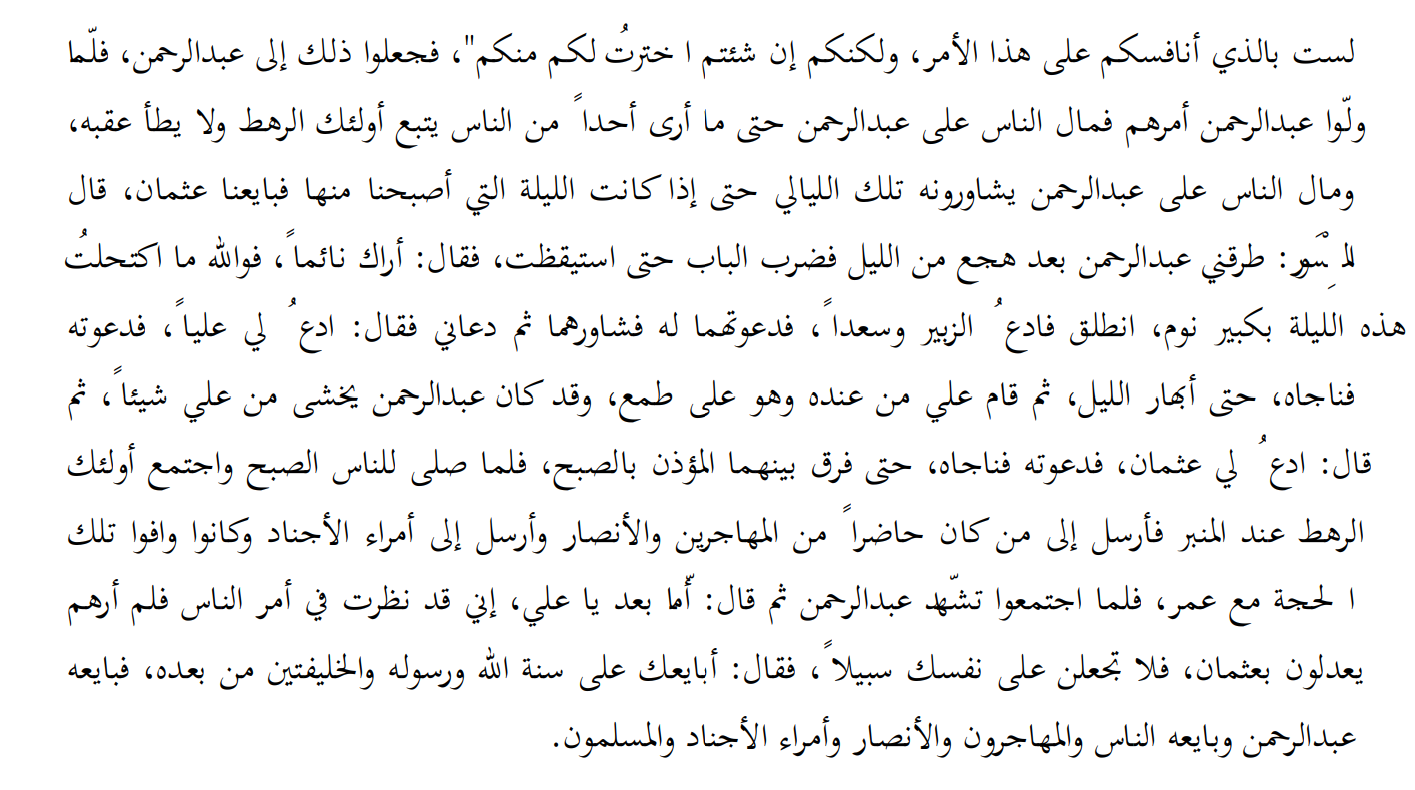
"Men bu masalada sizlar bilan raqobatlashuvchi emasman, lekin xohlasangiz, sizlar orasidan birini tanlab berishim mumkin." Shunday qilib, bu ish Abdurrahmonga topshirildi. Abdurrahmon bu ishni o‘z zimmasiga olgach, odamlar unga shu darajada yuzlandiki, men bu guruhga ergashgan yoki ularning orqasidan ergashgan birorta odamni ko‘rmadim. Odamlar o‘sha kechalarda ham unga murojaat qilib, maslahat so‘rashdi, to tong otib, biz uyg‘onib, Usmonga bay‘at berguncha. Al-Miswar aytdi: Abdurrahmon kechaning bir qismi o‘tgach, eshigimni taqillatdi, men uyg‘ongunimcha. U dedi: Sizni uxlayotganingizni ko‘ryapman. Allohga qasamki, bu kecha ko‘zlarimga uyqu deyarli kelmadi. Turing va Az-Zubayr hamda Sa‘dni chaqiring. Men ularni unga chaqirdim. U ular bilan maslahatlashdi. Keyin meni chaqirib dedi: Menga ‘Alini chaqiring. Men uni chaqirdim. U u bilan pichirlab suhbatlashdi, to tun tugab borguncha. Shundan so‘ng ‘Ali u yerdan qaytdi, ba’zi umidlar bilan, Abdurrahmon esa ‘Alidan biror narsadan xavotirda edi. Keyin u dedi: Menga ‘Usmonni chaqiring. Men uni chaqirdim. U u bilan pichirlab suhbatlashdi, to ular ajralishguncha, bomdod azoni aytilayotgan payt. Odamlarga bomdod namozini o‘qib bergach, olti kishilik guruh minbar yonida yig‘ilganda, u hozir bo‘lgan barcha muhojirlar va ansorlarni, shuningdek, ‘Umar bilan o‘sha yili haj qilgan qo‘shin sardorlarini chaqirtirdi. Ular yig‘ilgach, Abdurrahmon ikki shahodat kalimasini aytdi va dedi: Ey ‘Ali! Men odamlarning ishini ko‘rib chiqdim va ularning hech biri ‘Usmonga teng kelmasligini ko‘rmadim, shuning uchun o‘zingizni hech narsa bezovta qilmasin. So‘ng u ‘Usmonga dedi: Men sizga Allohning yo‘li, Uning Rasuli va undan keyin kelgan ikki xalifaning yo‘liga muvofiq bay‘at beraman. Shunday qilib, Abdurrahmon, muhojirlar, ansorlar, qo‘shin sardorlari va qolgan barcha musulmonlar unga bay‘at berdilar.
“I am not one who competes with you for this matter but if you wish I could choose for you one from among you. So they assigned this to ‘Abdurrahman . When they charged ‘Abdurrahman with this matter, people turned to him to the extent that I did not see any one who followed this group or stepped behind them. The people turned to ‘Abdurrahman consulting him in those nights until the night of which we woke up in the morning and gave our pledge to ‘Uthman. Al-Miswar said: ‘Abdurrahman knocked at my door, after a part of the night had passed, until I woke up. He said: I see you sleeping. By Allah, my eyes did not find much sleep tonight. Set forth and call Az-Zubair and Sa‘d. I invited them to him. He consulted with them. Then he called me and said: Call ‘Ali for me, so I called him. He carried on a whispered conversation with him until the night faded away. Then ‘Ali left him with some expectations, and ‘Abdurrahman was afraid about something from ‘Ali. Then he said call ‘Uthman for me, so I called him. He carried on whispered conversation with him until they departed as the muezzin called for fajr prayer. After he led the people in the fajr prayer, and the group of six persons met near the minbar (pulpit), he sent for all the Muhajirs and Ansar who were present (in Madinah) and sent for the leaders of the army who delivered the pilgrimage that year with ‘Umar. When they met, ‘Abdurrahman recited the two testimonies of faith (shahadahs) and said: O ‘Ali! I viewed the matter of the people and did not see them equalling anyone to ‘Uthman, so do not let anything disturb yourself. And he said (to ‘Uthman): I give you the bay’ah upon the way of Allah, His Messenger and the two Khulafaa who came after him. So ‘Abdurrahman, the Muhajirs, the Ansar, the leaders of the army and rest of the Muslims gave him the bay’ah.”
Shunday qilib, xalifalikka nomzodlar ‘Umar (ra) tomonidan, musulmonlar undan shunday qilishni so‘raganidan keyin, nomlab o‘tilgan guruh bilan cheklangan edi. ‘Abdurrahmon ibn ‘Avf (ra) xalifalikka nomzodlikdan o‘zini chetga olgach, xalifa kim bo‘lishi haqida musulmonlarning fikrini oldi. So‘ng u musulmonlar bilan maslahatlashgach, ular istagan shaxsning nomini e’lon qildi. U kishining nomi e’lon qilinganidan keyin unga bay’at berildi va u shu bay’at bilan xalifa bo‘ldi. Demak, xalifani tayinlash borasidagi shar’iy hukm shundaki, xalifalikka nomzodlar musulmonlarning ko‘pchiligining fikrini ifodalovchilar bilan cheklanadi. So‘ng ularning ismlari musulmonlarga ko‘rsatiladi va ulardan birini barcha uchun xalifa qilib tanlash so‘raladi. Keyin musulmonlarning ko‘pchiligi kimni tanlaganligi aniqlanadi va har bir kishi unga alohida ovoz bergan bo‘lsin yoki bermagan bo‘lsin, barcha musulmonlardan uning uchun bay’at olinadi. Bu usul ‘Umar (ra)ning xalifalikka nomzodlarni olti nafar aniq shaxs bilan cheklagani haqidagi sahobalar ijmo‘i, ‘Abdurrahmon (ra)ning musulmonlar xalifa kim bo‘lishini tanlashi uchun barchaning fikrini olishi haqidagi sahobalar konsensusi va musulmonlar tomonidan xalifa etib saylangan deb ‘Abdurrahmon (ra) e’lon qilgan shaxsga bay’at berish haqidagi konsensus asosida belgilangan. Buni u kishining: … degan so‘zi aniq ko‘rsatadi.
So the nominees for the Khilafah were limited to the group named by ‘Umar (ra) after the Muslims had asked him to do so. ‘Abdurrahman bin ‘Auf (ra), after he withdrew himself from the nomination to the Khilafah, took the opinion of the Muslims about who would be the Khalifah. He then announced the name of the person who the Muslims wanted after consulting with them. After he announced the name of the person who the people wanted, the bay’ah was given to him and he became the Khalifah by this bay’ah. Therefore the hukm shari’ concerning the appointment of the Khalifah is to limit the nominees for the Khilafah by those who represent the opinion of the majority of Muslims. Then their names are displayed to the Muslims and they are asked to select one of the nominees to be Khalifah for all. Then it is determined whom the majority of the Muslims have chosen, and the bay’ah from all the Muslims is taken for him, whether each person had specifically chosen him or not. This is the method because of the Ijma’a of the Sahabah about ‘Umar (ra) limiting the nominees for the Khilafah to six specific persons, and the consensus of the Sahabah that ‘Abdurrahman (ra) takes the opinion of all the Muslims about who will be the Khalifah for them, and the consensus to give the bay’ah to the one who ‘Abdurrahman (ra) announced as the person elected by Muslims as a Khalifah is clear when he said:
“Men odamlarning moyilliklariga nazar solib, ularning hech kimni Usmonga teng ko‘rmasliklarini payqadim.”
“I have looked at the people's tendencies and noticed that they do not consider anybody equal to `Uthman.”
Ushbu barcha dalillar xalifa tayinlash borasidagi hukmi shar'iyni aniqlab beradi.
All of these points clarify the hukm shari’ concerning the appointment of the Khalifah.
Ikki masala ko'rib chiqilishi kerak. Ulardan biri: xalifani kim tayinlaydi? U ta'sirli kishilarmi yoki ma'lum bir aniq sonli musulmonlarmi? Yoki barcha musulmonlar xalifani tayinlaydimi? Ikkinchi masala bu asrda sodir bo'layotgan amallarga tegishli: yashirin ovoz berish, saylov qutilari va ovozlarni sanash kabi ishlar. Bu narsalar Islomga muvofiqmi va Islom ularga ruxsat beradimi yoki yo'qmi?
Two issues remain to be examined. One of them is who are the Muslims who appoint the Khalifah? Are they the influential people or a certain specific number of Muslims? Or do all of the Muslims appoint the Khalifah? The second issue concerns the actions occurring in this century in elections such as secret ballots, polling boxes and counting votes. Are these matters consistent with Islam and does Islam allows them or not?
Birinchi masalaga kelsak, Alloh (SWT) hokimiyatni Ummatga bergan va Xalifani tayinlashni barcha musulmonlar uchun huquq va vazifa qilib qo'ygan; uni bir guruhga, boshqasini chetlatgan holda, va bir jamoatga, boshqa jamoatni e'tibordan chetda qoldirgan holda huquq qilib qo'ymagan, chunki bay'a barcha musulmonlar zimmasidagi vazifadir. Payg'ambar ﷺ aytdilar:
As for the first issue, Allah (swt), has given the authority to the Ummah and he (swt) made the appointment of the Khalifah a right and duty for all Muslims; and He did not make it a right for one particular group excluding another, nor for a jama‘ah leaving another jama‘ah aside, since the bay’ah is a duty upon all the Muslims. The Prophet (saw) said:
“Kimki boʻynida biror bay'at bo'lmagan holda vafot etsa, u johiliyyat o'limi bilan o'ladi”,
“Whoever dies without having a pledge upon his neck would die the death of jahiliyyah”,
Bu barcha musulmonlar uchun umumiydir. Shu sababli nufuzli kishilar Xalifani tayinlash huquqiga yakka tartibda ega emaslar va qolgan musulmonlarni e'tibordan chetda qoldira olmaydilar. Shuningdek, alohida shaxslar ham bu huquqqa xos emas. Aksincha, bu huquq istisnosiz barcha musulmonlarga tegishli, hatto fojirlar (fosiq kishilar) va munofiqlarni ham o'z ichiga oladi, agar ular balog'atga yetgan musulmonlar bo'lsalar. Chunki bu masalada Shariat matni umumiy shaklda kelgan va uni alohida kishilar bilan cheklaydigan hech narsa kelmagan, faqat balog'at yoshiga hali yetmagan yoshlarning bay'at berishdan bosh tortishi bundan mustasno. Demak, matnni umumiy ma'noda tushunish lozim.
And this is general for every Muslim. Therefore, the influential people do not possess the exclusive right to appoint the Khalifah and cannot ignore the rest of the Muslims. Nor do specific persons have the exclusive right. Rather, this right is for all the Muslims with no exception, it even includes the fajirs (wicked people) and munafiqeen (hypocrites), provided they are mature Muslims because the Shari’ah text came in a general form in this instance and nothing came to limit it (make it specific to certain people) except the refusal of the pledge from the young who have not yet reached the age of puberty. So the text has to be taken generally.
Biroq, barcha musulmonlar bu huquqdan foydalanishi shart emas. Bay'ah farz bo'lgani uchun u farzi kifoya (kifoya qiluvchi farz) hisoblanadi, farzi ayn (har bir kishi zimmasidagi farz) emas. Shunday ekan, agar musulmonlarning bir qismi buni ado etsa, vazifa qolgan musulmonlardan soqit bo'ladi. Ammo barcha musulmonlar halifani saylashdagi huquqlaridan foydalana olishlari, ular bu huquqdan foydalanadimi yoki yo'qmi, farqi yo'q, ta'minlanishi kerak. Boshqacha aytganda, har bir musulmon halifani tanlashda ishtirok eta olishi lozim. Demak, masala Alloh (SWT) musulmonlar zimmasiga yuklagan, ularni shu vazifadan xalos etadigan tarzda halifalik o'rnatish vazifasini bajarish imkoniyatini ularga berishdadir. Masala barcha musulmonlarning bu vazifani amalda bajarishida emas. Chunki Alloh (SWT) yuklagan vazifa musulmonlarga ularning roziligi bilan halifa o'rnatishdir, barcha musulmonlar uni bajarishi shart emas. Bundan ikki narsa kelib chiqadi: birinchidan, halifa o'rnatishda barcha musulmonlarning roziligi hosil bo'ladi; ikkinchidan, tayinlash borasida barcha musulmonlarning roziligi hosil bo'lmaydi. Ikkala holatda ham musulmonlar (tayinlashda ishtirok etishga) imkoniyat bilan ta'minlanadi.
However, it is not a condition that all Muslims practise this right. While it is a duty, because the bay’ah is fard, it is fard kifayah (obligation of sufficiency) and not fard ain (individual obligation). Thus, if some of the Muslims fulfill it, the duty drops from the rest of the Muslims. But all Muslims must be enabled to practice their right in electing the Khalifah, regardless of whether they use their right or not. In other words, every Muslim must be able to participate in selecting the Khalifah. So the issue is to enable the Muslims to carry out the duty of establishing the Khalifah which Allah (swt) prescribed upon them, in such a way that this duty falls (from their shoulders). The issue is not the actual participation of all the Muslims in conducting this duty. This is because the duty which Allah (swt) has prescribed is to establish the Khalifah for the Muslims by their consent, and it is not a requirement for all Muslims to perform it. Two matters result from this: One of them is that the consent of all the Muslims in the establishment of the Khalifah is achieved. Secondly, the consent of all the Muslims about the appointment is not achieved. The Muslims are however enabled (to participate in the appointment) in both cases.
"Asosan, dalil bilan man etilgan bo'lmasa, narsalar mubohdir."
“In Principle things are permitted unless there exists an evidence of prohibition.”
Metod (tariqah) bilan uslub o'rtasidagi farq shundaki, metod shunday amalki, u o'zi asos sifatida yoki umumiy dalili bo'lmagan amalga tarmoq sifatida qaraladi; uning dalili esa faqat unga xos bo'ladi. Uslub esa asos bo'lgan amalga, ya'ni asl amalga tarmoq bo'lgan amaldir, unga umumiy dalil yo'q. Shu sababli metod Shariat dalili asosida bo'lishi shart, chunki u Shariat hukmidir; shuning uchun unga rioya qilish lozim bo'ladi va agar uning hukmi ibohat (ruxsat berilgan) bo'lmasa, musulmonlar unda ixtiyorga ega emas. Bu uslubdan farq qiladi, chunki uslub Shariat dalilига tayanmaydi; aksincha, u o'zining asl hukmiga kiradi. Shuning uchun, hatto Payg'ambar ﷺ biror uslubda ish tutgan bo'lsalar ham, muayyan uslubga rioya qilish majburiy emas.
The difference between method (tareeqah) and style is that the method is an action which is considered by itself as an origin, or a branch to an action that does not have a general evidence for its origin; rather its evidence is specific to it. The style is an action which is a branch to an action—i.e. the origin—upon which there is no general evidence. Therefore, the method must depend upon a Shari’ah evidence because it is a Shari’ah rule, thus it must be adhered to and Muslims have no choice concerning it unless its rule is ibaha (of permissibility). This is different from the style which does not depend on a Shari’ah evidence; rather it is included in the rule of its origin. Therefore, it is not obligatory to follow a particular style even if the Messenger (saw)
Shunga ko‘ra, musulmon amalni bajarishga olib keladigan har qanday uslubdan foydalanishi mumkin, chunki shu tariqa u amalning bir tarmog‘iga aylanadi. Shu sababli aytiladiki, uslub amal turi bilan belgilanadi.
did so. Rather a Muslim is allowed to use any style as long as it leads to the performance of the action, and thus it becomes a branch to the action. Thus it is said that the style is defined by the type of action.