3.2 अध्याय दो: पशुधन पर ज़कात
3.2 Chapter Two Zakah On Livestock
पशु जगत में अनेक प्रजातियाँ हैं। मानवजाति ने उनमें से केवल कुछ ही का उपयोग किया है। अरब इन्हें "अल-अन'आम" के नाम से जानते हैं। ऊँट, गाय, भैंस, भेड़ और बकरी, ये सब उस चीज़ का हिस्सा हैं जो God ने अपने बंदों को प्रदान की है। इनके लाभों का उल्लेख उसकी पवित्र किताब में कई स्थानों पर किया गया है। सूरा अन-नहल, जिसे कभी-कभी सूरा अल-अन'आम (पशुधन) भी कहा जाता है, में God कहता है: "और उसने तुम्हारे लिए चौपाए पैदा किए, जिनसे तुम गर्माहट पाते हो, और अनेक लाभ, और उनमें से तुम खाते हो। और उनमें तुम्हारे लिए शोभा और सुंदरता है, जब तुम शाम को उन्हें घर लाते हो, और सुबह उन्हें चराने ले जाते हो। और वे तुम्हारे भारी बोझ उन देशों तक ले जाते हैं जहाँ तुम जान को कष्ट में डाले बिना नहीं पहुँच सकते थे, निस्संदेह तुम्हारा रब अत्यंत करुणामय, अत्यंत दयावान है।"1 और भी: "और चौपायों में तुम्हारे लिए एक शिक्षाप्रद निशानी है, उनके पेट में जो गोबर और रक्त के बीच है, उससे हम तुम्हें शुद्ध और पीने वालों के लिए स्वादिष्ट दूध पिलाते हैं।"2 "और उसने चौपायों की खालों से तुम्हारे लिए घर बनाए, जिन्हें तुम यात्रा में और ठहरते समय हल्का और सुविधाजनक पाते हो, और उनके ऊन, रोएँ और बालों से सामान और कुछ समय के लिए काम आने वाली वस्तुएँ बनाईं।"3 सूरा यासीन में: "क्या वे देखते नहीं कि हमने अपने हाथों की बनाई चीज़ों में से उनके लिए चौपाए पैदा किए, जो उनके अधीन हैं। और हमने उन्हें उनके वश में कर दिया है: उनमें से कुछ पर वे सवारी करते हैं और कुछ को खाते हैं, और उनमें उनके लिए और भी लाभ हैं, और वे उनका दूध पीते हैं। फिर क्या वे कृतज्ञ नहीं होंगे?"4 God ने इन पशुओं को मानवजाति के लिए बनाया, और उन्हें मनुष्यों के अधीन कर दिया ताकि वे उन पर सवारी करें और उनकी खाल और बालों का उपयोग करें। यह आश्चर्य की बात नहीं कि God लोगों से कृतज्ञ होने को कहता है।
The animal kingdom has many species. Mankind has made use of only a few of them. This is what is known by Arabs as al an'am. Camels, cows, buffalo, sheep, and goats, are all part of what God bestowed on His servants. Their benefits are mentioned in several places in His Holy Book. In sura al Nahl - sometimes called sura al An'am (livestock) - God says "and cattle He has created for you, from which ye derive warmth, and numerous benefits, and of their meat ye eat. And ye have a sense of pride and beauty in them as ye drive them home in the evening, and as ye lead them forth to pasture in the morning, And they carry your heavy loads to lands that ye could not otherwise reach except with souls distressed, for your Lord is indeed most kind, moat merciful,"1 Also "and buried in cattle will ye find an instructive sign, from what is within their body between excretions and blood, we produce for your drink, milk, pure and agreeable to those who drink it,"2 "and made for you, out of the skins of animals, tents for dwellings, which ye find so light and handy when in travel and when ye stop, and out of their wool, and their soft fibers, and their hair, furniture and articles for all convenience to serve you for a time"3. In sura Yasin, "See they not that we have created for them among the things which our hands have fashioned, cattle which are under their domination. And that we have subjected them to their use: of them some do carry them and some they eat, and they have other profits from them besides, and they get milk to drink. Will they not then be grateful?".4 God fashioned this livestock for mankind, and He subjects then to humans to ride and to make use of their skin and hair. It is not surprising that God asks people to be thankful.
कुरआन-ए-करीम और नबी करीम ﷺ की पाक सुन्नत द्वारा आभार प्रकट करने का सबसे स्पष्ट और व्यावहारिक रूप ज़कात की अनिवार्यता है। इसका निसाब और दर निर्धारित है, हर वर्ष पशुओं के मालिकों के पास वसूली करने वाले भेजे जाते हैं, और जो लोग इसकी अदायगी से इनकार करते हैं उनके लिए चेतावनी दी गई है। नबी ﷺ के समय में अरबों के लिए पशुधन, विशेष रूप से ऊँट, सबसे उपयोगी संपत्ति थे। इसी कारण सुन्नत ने उनका निसाब और दरें बहुत स्पष्ट रूप से निर्धारित कीं। आज भी बहुत से देशों में, विशेषकर मुस्लिम देशों में, पशुधन अब भी राष्ट्रीय संपत्ति और आय के सबसे महत्वपूर्ण स्रोतों में से एक है।
The most obvious and practical thankfulness urged by the Holy Qur'an and the purified tradition of the Prophet (p) is the obligation of zakah. Its nisab and rates are determined, collectors are sent every year to owners of cattle, and warning to those who refuse its payment is put forth. Livestock, especially camels, were the most useful asset for the Arabs at the time of the Prophet (p). Consequently, Sunnah determined their nisab and rates very clearly. In many countries today especially Muslim countries, livestock still represent one of the most important national assets and source of income.
निम्नलिखित भाग पशुधन (मवेशियों) पर ज़कात का पूरा विवरण प्रस्तुत करने का प्रयास करते हैं।
The following sections attempt to provide full account of zakah on livestock.
खंड एक: पशुओं पर ज़कात की सामान्य शर्तें
SECTION ONE GENERAL CONDITIONS FOR ZAKAH ON LIVESTOCK
ज़कात हर मात्रा और हर प्रकार के पशुओं पर अनिवार्य नहीं है। पशुओं की ज़कात योग्य होने के लिए कुछ शर्तें पूरी होनी चाहिए, जो यहाँ गिनाई गई हैं।
Zakah is not imposed on livestock of all quantity and kind. There are certain conditions that should be fulfilled for the zakatability of livestock which are ennumerated here:
1. ज़कात के योग्य होने की न्यूनतम सीमा (निसाब)
1. The minimum for zakatability (Nisab)
पहली शर्त निसाब है, क्योंकि ज़कात केवल धनी लोगों पर फ़र्ज़ है, और हर पशुधन का मालिक धनी नहीं होता। हमेशा एक सीमा होनी चाहिए जिसके ऊपर लोगों को धनी माना जाए। यही सीमा निसाब है। सदियों से मुसलमानों की सर्वसम्मति से यह पाँच ऊँट है। पाँच ऊँट से कम पर कोई ज़कात फ़र्ज़ नहीं है। भेड़ों का निसाब चालीस भेड़ें है, इस पर भी सर्वसम्मति है। निसाब का निर्धारण नबी ﷺ के कथनों, आपके वास्तविक आचरण और आपके ख़लीफ़ाओं के अमल से होता है। गायों का निसाब फ़िक़्ह की विचारधारा के अनुसार, जिसे कोई अपनाता है, पाँच से लेकर तीस-दो और पचास तक भिन्न होता है।
The first condition is nisab, since zakah is only on the rich, and not every owner of livestock is rich. There always should be a limit above which persons are considered rich. This limit is nisab. It is five camels by unanimous agreement of Muslims for centuries. There is no obligated zakah for anything below five camel, nisab for sheep is forty sheep, also unanimous. Nisab is determined by sayings of the Prophet (p), by his actual practice and by the application of his successors. Nisab for cows varies from five to thirty-two to fifty, depending upon the school of jurisprudence one adopts.
2. वर्ष (एक साल) का गुज़रना
2. The passage of a Year (Annual)
यह बात प्रामाणिक रूप से नबी (ﷺ) और उनके ख़लीफ़ाओं से वर्णित है। वे हर साल ज़कात वसूल करने वालों को भेजते थे, ताकि पशुओं की गिनती की जा सके। पिछले अध्याय में यह बताया जा चुका है कि ग़ैर-कमाई वाली संपत्ति पर पूरे एक चंद्र वर्ष के गुज़रने की शर्त सर्वसम्मति से स्वीकार की गई है। यहाँ यह जोड़ा जा सकता है कि जो अधिकतर विद्वान कमाई वाली आय पर यह शर्त लगाते हैं, वे वर्ष के दौरान प्रजनन से पैदा हुए पशुओं के बच्चों पर यह शर्त नहीं लगाते, और बच्चों के ज़कात-योग्य वर्ष को उनकी माताओं के वर्ष के समान मानते हैं।
This is reported authentically from the Prophet (p) and his successors. They used to send zakah collectors once every year to take the count on livestock. It was shown in the previous chapter that the condition of the passage of one full lunar year for non-earned assets is accepted unanimously. One can add here that the majority who assert this condition on earned income do not require it on the offspring of livestock that result from reproduction during the year, and accept the zakatable year for offspring to be that of their mothers.
3. उन्हें प्राकृतिक रूप से चराया जाना चाहिए
3. They should be pastured naturally
चरागाह में चरने वाले पशु वे हैं जो साल के अधिकांश हिस्से में प्राकृतिक और बिना लागत वाली चरागाह भूमि पर प्रजनन, दूध देने और वज़न बढ़ाने के उद्देश्य से चराए जाते हैं। प्राकृतिक चराई का विपरीत पशुओं के लिए चारा ख़रीदना है।
Pastured livestock are those that are grazed on natural and cost-free pasture land during the major part of the year for the purpose of breeding, milking, and putting on weight.5 The opposite of natural grazing is buying feed.
यदि पशु वर्ष के अधिकांश समय प्राकृतिक रूप से चरते हों, तो यह शर्त पूरी हो जाती है।
The condition is satisfied if livestock is pastured naturally most of the year.
चरागाह इस उद्देश्य से होना चाहिए कि जानवर बढ़ें, उनकी नस्ल बढ़े और उनका दूध निकाला जाए; अतः यदि उन्हें व्यक्तिगत सवारी या खाने के लिए रखा गया हो, तो ये जानवर ज़कात योग्य नहीं हैं, क्योंकि ऐसा निर्धारण जानवरों को वृद्धि के साधनों की श्रेणी से हटाकर व्यक्तिगत उपयोग की श्रेणी में डाल देता है, और व्यक्तिगत उपयोग की वस्तुओं पर ज़कात नहीं है, जैसा कि अगले उपखंड में बताया जाएगा।
Pasturing should be made for the purpose of growth, reproduction, and milking; thus if it is made for the purpose of personal riding or eating, these animals are not zakatable, since such allocation removes animals from being growth assets and put them in the category of personal use which is not zakatable as shall be shown in the next subsection.
इस शर्त का कारण यह है कि ज़कात उस अतिरिक्त (बचत) पर अनिवार्य है जिसे लोग आसानी से दे सकें, उस आयत के अनुसार, "जो अतिरिक्त हो वह ले लो" {और वे आपसे पूछते हैं कि वे क्या खर्च करें, कह दीजिए: जो अतिरिक्त हो}। यानी वह धन जिसकी लागत अधिक न हो और जो तेज़ी से बढ़े। यह तभी संभव है जब जानवर चरागाह में मुफ़्त चरें, क्योंकि कृत्रिम रूप से चारा खिलाए गए जानवरों की लागत अधिक होती है, जिससे लोगों के लिए उन्हें ज़कात के रूप में देना कठिन हो जाता है।
The reason for this condition is that zakah is obligated on the surplus, what is easy for persons to pay, in accordance to the verse, "take the surplus"6 and the verse "when they ask you what to spend, say the surplus"7, that is, on what does not cost much and grows rapidly. This can only be fulfilled if the animals pastured cost-free, since artificially fed animals have high cost, which makes it hard for people to give then away as zakah.
यह शर्त अहमद, अल-नसाई और अबू दाऊद द्वारा बहज़ बिन हकीम से, उन्होंने अपने पिता से, और उन्होंने अपने दादा से रिवायत की गई बात पर आधारित है, जिन्होंने कहा: मैंने God के Messenger ﷺ को चरागाह में खुद चरने वाले (बिना खर्च के पले) ऊँटों के बारे में यह फ़रमाते सुना कि हर चालीस पर एक (ऊँट) ज़कात के रूप में है ... आदि। इस हदीस को विद्वानों के एक समूह ने सही (प्रामाणिक) करार दिया है। यहाँ विशेषण "प्राकृतिक रूप से, बिना खर्च के चरने वाले" इस बात का संकेत देता है कि कृत्रिम रूप से चारा खिलाए गए ऊँटों पर ज़कात लागू नहीं होती; अन्यथा ऐसा विशेषण जोड़ना निरर्थक हो जाता है, और नबी ﷺ व्यर्थ बात नहीं कहते। इस कथन से स्पष्ट है कि जो ऊँट प्राकृतिक रूप से, बिना खर्च के चरने वाले के रूप में विशेषित हैं, वे उनसे भिन्न हैं जो ऐसे नहीं हैं।
4. ज़कात योग्य पशु कार्य करने वाले पशु नहीं होने चाहिए
4. Zakatable livestock should not be working animals
यह मवेशियों की ज़कात-योग्य होने की चौथी और अंतिम शर्त है। इसका अर्थ है कि उन्हें खेती, पानी या बोझ ढोने, सवारी आदि के लिए काम में न लाया जाए। यह शर्त केवल ऊँटों और गायों पर लागू होती है। अबू उबैद ने 'अली से रिवायत किया है कि "काम करने वाली गायों पर कोई सदक़ा नहीं है।" जाबिर बिन 'अब्दुल्लाह से भी एक रिवायत है कि उन्होंने कहा, "खेती में काम करने वाले जानवर ज़कात-योग्य नहीं हैं।" अबू दाऊद ने अपनी सुनन में ज़ुहैर से रिवायत किया है: "हमें अबू इस्हाक़ ने 'आसिम बिन दमरह और अल-हारिस से, उन्होंने 'अली से बताया (ज़ुहैर ने कहा, "मेरे विचार में यह नबी ﷺ से है") कि उन्होंने फ़रमाया, 'मेरे पास चालीसवें हिस्से का एक चौथाई लाओ, यानी हर चालीस दिरहम पर एक दिरहम...' और उन्होंने आगे कहा, 'और काम करने वाले जानवरों पर कुछ भी वाजिब नहीं है।'" यही बात इब्न अबी शैबा ने भी नबी ﷺ की ओर संबंधित करके रिवायत की है, और 'अब्दुर्रज़्ज़ाक़ ने अपनी मुसन्नफ़ में अल-सौरी और मा'मर के माध्यम से केवल 'अली से रिवायत की है।12
This is the fourth and last condition for zakatability of livestock. It means that they should not be used for cultivation, carrying water or loads or riding, etc. This condition only applies to camels and cows. Abu Ubaid reports from 'Ali, that " There is no sadaqah on working cows."There is also a report that Jabir bin 'Abd Allah said "Animals working in cultivation are not zakatable."11 Abu Daud, in his Sunan, reports from Zuhair "We are told by Abu Ishaq from 'Asem bin Damurah and al Harith from 'Ali, (Zuhair said "I think from the Prophet") that he said, "Bring me one-fourth of a tenth, i.e. on each forty dirhams one dirham..." and he continued, "and there is nothing due on working animals." This is reported also by Ibn Abi Shaibah linked to the Prophet, and by 'Abd Al Razzaq, in his Musannaf, via al Thawri and Mamar as from 'Ali only.12
इसी आशय की रिपोर्टें इब्राहीम, मुजाहिद, अल-ज़ुहरी, उमर बिन अब्दुल अज़ीज़ और कुछ अन्य ताबिईन से भी आती हैं।13 यही मत अबू हनीफ़ा, अल-सौरी, अल-शाफ़ई और ज़ैदियों का भी है। जहाँ तक गायों का संबंध है, अल-लैस का मत भी यही है।
Similar reports exist as coming from Ibrahim, Mujahid, al Zuhri, Umar bin 'Abd al Aziz, and some other Followers.13 It is also the view of Abu Hanifah, al Thawri, al Shafi'i, and the Zaidis. It is the opinion of al Layth as far as cows are concerned.
दो बातें इन रिवायतों और इस दृष्टिकोण का समर्थन करती हैं। पहली बात यह सिद्धांत है कि वे संपत्तियाँ जो निजी उपयोग और सेवा के लिए निर्धारित हैं, उन पर ज़कात नहीं है, और इसी तर्क से खेती के लिए या निजी सवारी के लिए रखे गए पशुओं पर भी ज़कात नहीं होनी चाहिए। स्पष्ट है कि ऐसे पशु उन संपत्तियों में शामिल नहीं हैं जो वृद्धि के लिए निवेश की जाती हैं।14 दूसरी बात अबू उबैद की वह रिवायत है जो उन्होंने अज़-ज़ुहरी से नक़ल की है, कि सवारी के लिए इस्तेमाल होने वाली गायें और ऊँट ज़कात के योग्य नहीं हैं, और खेती में प्रयुक्त गायें भी नहीं।15 सा'द बिन अब्दुल अज़ीज़ अत-तनूखी कहते हैं, "खेती में प्रयुक्त गायों पर ज़कात नहीं है, क्योंकि ज़कात उपज के अनाज पर दी जाती है, और उस उपज में गायों का श्रम भी लगा होता है।"
खंड दो: ऊँटों पर ज़कात
SECTION TWO ZAKAH ON CAMELS
मुसलमानों की सर्वसम्मति के साथ-साथ ईश्वर के दूत ﷺ की कई सही हदीसें और उनके साथियों की रिवायतें इस बात का संकेत देती हैं कि ऊँटों का निसाब और उन पर निसाब की दरें इस प्रकार हैं:
The unanimous agreement of Muslims, as well as several correct sayings of the Messenger of God (p) and reports from his Companions indicate nisab of camels and the rates of nisab on them are as follows:
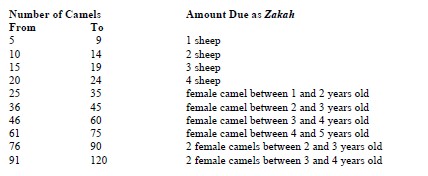
उस अनुसूची पर इज्मा है, सिवाय 'अली से वर्णित एक रिवायत के कि 25 ऊँटों पर पाँच भेड़ें हैं और 26 ऊँटों पर एक मादा ऊँट है जो एक से दो वर्ष की हो।20 इब्न अल-मुंधिर कहते हैं: सर्वसम्मति भंग नहीं होती, क्योंकि 'अली से जो वर्णित है वह प्रामाणिक नहीं है। इन मात्राओं और परिमाणों पर अनस का कथन सही है, और उसकी विषय-वस्तु पर सर्वसम्मति है।21 120 ऊँटों से अधिक के लिए बहुमत का मत यह है कि हर अतिरिक्त 50 ऊँटों पर अतिरिक्त ज़कात की राशि एक मादा ऊँट है जो तीन से चार वर्ष की हो, जबकि हर अतिरिक्त 40 ऊँटों पर अतिरिक्त ज़कात की राशि एक मादा ऊँट है जो दो से तीन वर्ष की हो।22 यह निम्नलिखित तालिका में दर्शाया गया है:
There is ijma on this schedule,l9 except for a report from 'Ali that on 25 camels there is five sheep and on 26 camels there is one female camel between one and two years old.20 Ibn al Mundhir says. The unanimity is net broken, because what is reported from 'Ali is not authentic. The saying of Anas on these quantities and amounts is correct and there is a unanimous agreement on its content.21 For more than 120 camels the majority's view is that for each additional 50 camels the additional amount of zakah is a female camel between three and four years old while on each additional 40 camels the additional amount of zakah is a female camel between two and three years old.22 This is shown in the following table :
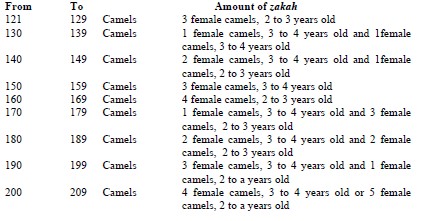
तालिका से स्पष्ट है कि बड़ी संख्या के लिए, दस ऊँटों से कम की वृद्धि ज़कात की राशि को प्रभावित नहीं करती। जब संख्या दस से बढ़ जाती है, तब आप ऊपर वाले नियम के अनुसार ज़कात की देय राशि में एक चरण आगे बढ़ जाते हैं। इन दोनों तालिकाओं से यह स्पष्ट है कि यदि स्वामित्व में ऊँटों की संख्या पाँच से कम है तो कोई ज़कात नहीं है। जब वे पाँच तक पहुँच जाते हैं, तो देय राशि एक भेड़ होती है। अल-मबसूत के लेखक एक विद्वान का यह कथन उद्धृत करते हैं: "इसका अर्थ है कि पशुओं का मूल्य देखा जाता है। एक से दो वर्ष की आयु वाले ऊँट चालीस दिरहम में और एक भेड़ पाँच दिरहम में बिकते थे, इसलिए पाँच ऊँट 200 दिरहम के बराबर हैं और 40 भेड़ों के भी बराबर। इससे यह निष्कर्ष निकलता है कि ऊँटों, भेड़ों और चाँदी के सिक्कों की ज़कात-योग्यता की न्यूनतम सीमा समान है।" इब्न अल-हुमाम ने अल-फत्ह में और इब्न नुजैम ने अल-बहर में उत्तर दिया कि एक कथन है जो कहता है: "जो व्यक्ति किसी निश्चित आयु-वर्ग का ऊँट ज़कात के रूप में देने के लिए बाध्य है, किंतु उस आयु का कोई ऊँट उसके पास नहीं है, वह उसके बदले, यदि उसके पास भेड़ न हो, तो प्रति भेड़ औसतन दस दिरहम देकर भुगतान कर सकता है।" यह एक स्पष्ट पाठ है जो अल-सरख़सी की व्याख्या का खंडन करता है। उल्लिखित यह कथन अनस से अल-बहर द्वारा वर्णित है।
It is seen from the table that for big numbers, an increase of less than ten camels does not affect the amount of zakah. Once it is increased by ten, then you go one step higher in the amount of zakah due according to the same rule mentioned above. It is obvious from these two tables that if the number of camels owned is less than five then there is no zakah. Once they reach five , the amount due is one sheep. The author of al Mabsut quotes a scholar as saying, "this means that the value of the livestock is considered. Camels between one and two years old used to be priced at forty dirhams and a sheep at five dirhams, so five camels equal 200 dirhams also equal 40 sheep. This implies that the minimum for zakatability of camels, sheep, and silver money is the same. Ibn al Humam in al Fath and Ibn Nujaim in al Bahr reply, there is a saying that states "Whoever is obliged to give as zakah a camel of a certain age group, but does not own any in that age, can pay in substitution on the average of 10 dirhams for a sheep, if he does not have a sheep. This is an explicit text that contradicts the explanation of al Sarakhsi.24 The saying referred to is reported by al Bahr from Anas.
शरीअत में, यदि ज़कात योग्य ऊँटों की संख्या 25 से कम हो, तो ज़कात के रूप में भेड़ें अनिवार्य की गई हैं, हालाँकि आम तौर पर ज़कात उसी प्रकार की संपत्ति में से दी जाती है जिस पर वह लागू होती है।
Shari'ah obligates sheep as zakah on camels if the number of zakatable camels is lees than 25, though usually zakah is paid out of the same kind of the zakated assets.
कारण स्पष्ट है कि देय राशि एक ऊँट से कम है, लेकिन साथ ही शरीअत पाँच ऊँटों को उस व्यक्ति की पहचान के लिए पर्याप्त मानती है जो धनी है।25
अनस (रज़ि.) से रिवायत है कि अबू बकर, अस-सिद्दीक़ ने यह संदेश लिखा जब उन्हें बहरैन भेजा गया:
Anas narrated that Abu Bakr, the Truthful wrote this message when he sent him to Bahrain:
अल्लाह के नाम से, जो अत्यंत दयालु और अत्यंत कृपाशील है। यह वह ज़कात (दान) का अनिवार्य नियम है जो अल्लाह के रसूल ﷺ ने मुसलमानों पर लागू किया, जैसा कि अल्लाह ने उन्हें इसका आदेश दिया था।
In the name of God, most merciful, most gracious. This is the obligation of sadaqah imposed on Muslims by the Messenger of God (P), as ordained to him by God.
जिसे इन नियमों के अनुसार भुगतान करने को कहा जाए, उसे देना चाहिए, और जिसे इससे अधिक भुगतान करने को कहा जाए, उसे इनकार करना चाहिए। हर 24 ऊँटों या उससे कम पर ज़कात भेड़ों के रूप में देय है। हर पाँच ऊँटों पर एक भेड़ आवश्यक है। जब वे 25 तक पहुँचें और 35 तक, तो एक मादा ऊँट, जो एक से दो वर्ष की हो, आवश्यक है। 36 से 45 तक, एक मादा ऊँट जो दो से तीन वर्ष की हो।
Whoever is asked to pay it according to these rules must give it, and whoever is asked to pay more should refuse. On each 24 camels or less, zakah is due in sheep. On each five camels, one sheep is required. Once they reach 25 and up to 35 one female camel, one to two years old, is required. From 36 to 45, there is one she-camel two to three years old.
अगर वे 46 से 60 तक पहुँचें, तो एक तीन से चार साल की मादा ऊँट देय होगी, जो गाभिन हो सकती हो। अगर वे 61 से 75 तक पहुँचें, तो एक चार से पाँच साल की मादा ऊँट देय होगी। अगर वे 76
If they reach 46 to 60, there is one she-camel three to four years old due, one that can be bred. If they reach 61 to 75, one she-camel four to five years old is due. If they reach 76
90 तक, दो ऊँटनियाँ दो से तीन वर्ष की देय हैं। यदि वे 91 से 120 तक पहुँच जाएँ, तो दो ऊँटनियाँ, तीन से चार वर्ष की देय हैं। यदि वे 120 से अधिक हों, तो हर 40 के लिए
to 90, there is two she-camels two to three years old due. If they reach 91 to 120, there are two she-camels, three to four years old due. If they are more than 120, for each 40
हर पाँच ऊँटों में एक ऊँटनी दो से तीन साल की होती है, और हर 50 पर एक ऊँटनी तीन से चार साल की होती है। जो व्यक्ति चार ऊँटों का मालिक है, उस पर ज़कात नहीं है, जब तक वह स्वेच्छा से न दे; लेकिन जब वे पाँच ऊँट हो जाएँ, तो उन पर ज़कात के रूप में एक भेड़ वाजिब होती है। भेड़ों के सदक़े में, यदि वे प्राकृतिक रूप से, बिना किसी खर्च के चरती हों और उनकी संख्या 40 से 120 के बीच हो, तो एक भेड़ वाजिब होती है। 120 से अधिक और 200 तक हों, तो दो भेड़ें वाजिब होती हैं।
there is one she-camel two to three years old, and for each 50 there is one she-camel three to four years old. A person who owns [up to] four camels is not zakatable unless he volunteers, but if they reach five camels, one sheep is due on them as zakah. In the sadaqah on sheep, if they are naturally, cost-free pastured, and number between 40 and 120 sheep, there is one sheep due. For more than 120 and up to 200, there are two sheep.
120 ऊँटों के बाद दरों में भिन्नता
Variance on the Rates after 120 Camels
मैंने पहले बताया था कि एक सौ बीस से अधिक ऊँटों पर ज़कात की दर के बारे में फ़क़ीहों (इस्लामी विधिवेत्ताओं) में अलग-अलग मत हैं। मालिक, शाफ़िई, अहमद और बहुमत का मानना है कि अतिरिक्त हर पचास ऊँटों पर तीन से चार साल की एक मादा ऊँटनी, और हर अतिरिक्त चालीस ऊँटों पर दो से तीन साल की एक मादा ऊँटनी दी जाएगी। यह बात अबू बक्र और उमर की उस लिखित आज्ञा में आई है, जिसे अनस और इब्न उमर ने एक के बाद एक रिवायत किया है। यही बात इब्न हज़्म और ज़ियाद बिन लबीद के हज़रमौत के लोगों के नाम लिखे पत्रों में भी मिलती है। नबी ﷺ के शब्द भी यही हैं: "यदि वे एक सौ बीस से अधिक हो जाएँ, तो हर चालीस पर दो से तीन साल की एक मादा ऊँटनी, और हर पचास पर तीन से चार साल की एक मादा ऊँटनी।" इस अंतिम कथन के कुछ रूप उस रावी ने संक्षेप में बताए हैं, कि "हर पचास पर एक मादा ऊँटनी ..." और हर अतिरिक्त चालीस की दर का उल्लेख नहीं किया। लेकिन विभिन्न रूप एक-दूसरे को पूरा करते हैं।
I pointed out earlier that there are varying views among jurists on zakah on above 120 camels. Malik, Shafi'i, Ahmad, and the majority consider the rate to be one female camel, three to four years old for each additional 50, and one female camel, two to three years old, for each additional 40,39 as mentioned in the message of Abu Bakr and 'Umar narrated successively by Anas and Ibn 'Umar. The same also appears in the messages of Ibn Hazm and Ziad bin Labid to the people of Hadramut,40 in the words of the Prophet (p) "If they exceed 120, then for each 40 one female camel two to three years old, and for each 50 one female camel three to four years old". Some versions of the last saying are summarized by that narrator, as "In each 50 one female camel ..." without mentioning the rate for each additional 40, but the different versions complete each other.
अबू हनीफ़ा का मत
Abu Hanifah's view
अल-नख़ई, अल-थवरी और अबू हनीफ़ा⁴¹ कहते हैं कि "120 से ऊपर की संख्या के लिए हम दरें शुरू से ही आरंभ करते हैं, अर्थात्, अतिरिक्त 5 से 24 ऊँटों के लिए दर हर 5 ऊँट पर एक भेड़ है, और अतिरिक्त 25 ऊँटों पर देय ज़कात एक मादा ऊँट है, जो एक से दो साल की है, इत्यादि।" निम्नलिखित तालिका इस मत के अनुसार देय राशि दर्शाती है:
Al Nakha'i, Al Thawri, and Abu Hanifah41 say that "for what is above 120, we start the rates from the beginning, i,e., for an additional five to 24 camels, the rate is one sheep for each 5 camels, and for an additional 25 camels zakah due is one female camel, one to two years old, etc."The following table shows the amount due according to this opinion:
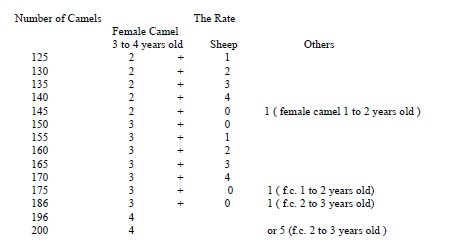
200 के बाद दर अपने आप को दोहराती है, हर अतिरिक्त पाँच ऊँटों पर एक भेड़, और जब भी अतिरिक्त ज़कात-योग्य ऊँट पचास तक पहुँचते हैं, तो उन पर देय ज़कात की राशि तीन से चार साल की एक मादा ऊँट होती है।
After 200 the rate repeats itself, one sheep for each additional five camels, and each time the additional zakatable camels reach fifty, the amount of zakah due on it is one female camel three to four years old.
हनफ़ी विद्वान यह तर्क देते हैं कि अबू दाऊद ने इसे मुरसल रूप में रिवायत किया है [ऐसा कथन जिसकी सनद में रिवायत करने वाले सहाबी का नाम उल्लेखित नहीं होता], और इशाक़ ने अपनी मुसनद में तथा अल-तहावी ने अपनी मुश्किल में हम्माद बिन सलमा से रिवायत किया है, जिन्होंने कहा, "मैंने क़ैस बिन साद से कहा कि मुझे मुहम्मद बिन हज़म का संदेश दे दो, तो उन्होंने मुझे एक पत्र दिया जो उन्होंने अबू बक्र बिन मुहम्मद बिन हज़म से लिया था, और उन्होंने कहा कि नबी ﷺ ने इसे मेरे दादा को लिखवाया था। मैंने उसे पढ़ा और उसमें ऊँटों पर ज़कात की दरें पाईं..." और उन्होंने यह कथन इस तक सुनाया कि, "जब वे 120 से अधिक हो जाएँ, तो हर 30 पर एक तीन से चार वर्ष की मादा ऊँट वाजिब है। बढ़ोतरी के लिए दरों को फिर से शुरू से लिया जाएगा, और 25 ऊँटों से कम के लिए ज़कात भेड़ों में वाजिब है, हर पाँच पर एक भेड़।" यह रिवायत अल-ज़ैलई की नस्बुर्राया में नक़ल हुई है। इसी प्रकार की एक रिवायत 'आसिम बिन दमुरह ने अली से नक़ल की है, जो नबी ﷺ तक जुड़ती है तथा अली पर समाप्त होती है, और इब्न मसऊद से भी इसी तरह की बातें रिवायत की गई हैं। इब्न रुश्द के अनुसार हनफ़ी विद्वानों का तर्क यह है कि ऐसी बात नबी ﷺ के आदेश के बिना तय नहीं की जा सकती, क्योंकि यह ऐसी चीज़ नहीं है जिसे क़ियास के द्वारा निकाला जा सके।44
The Hanafites argue that Abu Daud reports as mursal [saying in whose chain the name of the reporting Companion is not mentioned], Ishaq in his Musnad and al Tahawi in his Mushkel from Hmmad bin Salamah, who said, "I told Qais bin Sa'd to get me the message of Mohammad bin Hazm, so he gave me a letter which he said he took from Abu Bakr bin Mohammad bin Hazm, who said that the Prophet (p), wrote it to my grandfather. I read it and found in it the rates of zakah on camels... " and he narrated the saying until, "Once they exceed 120 make due on each 30 one female camel three to four years old. For the increments, restart the rates from the beginning, and for what is less than 25 camel increments, the amount of zakah is due in sheep, one sheep for each five." This is reported in Nasb Al Rayah by al Zaila'i.42 A similar version is narrated by 'Asem bin Damurah from Ali, linked to the Prophet as well as ending at 'Ali,43 and Ibn Mas'ud is reported to have said similar things. The Hanafites are said by Ibn Rushd to have argued that such a thing cannot be decided but by instructions from the Prophet, because it is not anything that can be deducted by analogy.44
अधिकांश विद्वान हनफ़ियों के तर्कों को अस्वीकार करते हैं और उनके निष्कर्षों में कमज़ोरी देखते हैं। अल-बैहक़ी दिखाते हैं कि इस मामले में इब्न मसऊद से जो कुछ भी रिवायत किया गया है, वह सही नहीं है। अली का वह कथन, जो नबी ﷺ से जोड़ा जाता है, वह भी गलत है, और अली से जिस रूप में इसे बताया गया है उस पर भी मतभेद है। एक रूप में यह अबू बक्र और उमर के पत्रों से मेल खाते हुए रिवायत किया गया है, जबकि दूसरे रूप में यह भिन्न तरीके से रिवायत किया गया है। ऐसे मामले में सामान्य रूप से लागू होने वाला नियम यह है कि हम उस रूप को अधिक महत्व देते हैं जो उन अन्य सही कथनों से मेल खाता है जिन पर कोई विवाद नहीं है। यह बात अल-हाज़िमी ने नोट की थी। इसके अलावा, ('आसिम से वर्णित) इसी कथन के रूप में एक वाक्य भी है जिसे सभी विद्वान उसकी कमज़ोरी के कारण त्याग देने पर सहमत हैं। वह वाक्य यह है कि हर 25 ऊँटों पर ज़कात में एक से दो साल की ऊँटनी के बजाय पाँच भेड़ें देय हैं। दूसरी ओर, उन भिन्न रूपों की ऐसी व्याख्या करना संभव है जिससे वे अन्य सही कथनों के साथ मेल खा जाएँ।
अल-तबरी का मत
The view of Al Tabari
अबू जाफ़र अल-तबरी एक तीसरा, समन्वयकारी मत प्रस्तुत करते हैं, जिसके अनुसार दोनों मत स्वीकार्य हैं और यह ज़कात वसूल करने वाली एजेंसी पर निर्भर है कि वह किस मत को लागू करे।52 मेरी राय में यह दृष्टिकोण अधिक उत्तम है, क्योंकि किसी हदीस की विषय-वस्तु को उस समय तक निरस्त और रद्द नहीं माना जाना चाहिए जब तक नबी (ﷺ) से वर्णित सभी रिवायतों के समन्वय की ज़रा-सी भी संभावना मौजूद हो। अल-तबरी द्वारा प्रस्तावित यह समन्वय निस्संदेह स्वीकार्य है, यदि हम इस बात को ध्यान में रखें कि ज़कात में दिए जाने वाले ऊँटों की आयु और संख्या का निर्धारण ज़कात की गणना, अदायगी और वसूली को आसान बनाने तथा प्रक्रियाओं को सरल करने के लिए किया गया है, ताकि ज़कात वसूल करने वाली एजेंसी को कुछ विवेकाधिकार प्राप्त रहे।
Abu Ja'far al Tabari expresses a third, reconciling view, stating that both opinions are acceptable, and it is up to the zakah collection agency to select which view to apply.52 In my opinion this is a better approach, since one should not consider the content of a saying superseded and annulled if there is the slightest chance of a reconciliation of all the reports from the Prophet (p). The reconciliation proposed by al Tabari is undoubtedly acceptable if we keep in mind that the determination of ages and quantity of camels due as zakah is meant to facilitate zakah calculation, payment, and collection, and to simplify the procedures so that the zakah collecting agency can exercise some discretion.
ज़कात के अक्षरों में मामूली अंतर
The slight differences in the letters of zakah
मुहम्मद (ﷺ) के ईश्वर के संदेशवाहक (ﷺ) और उनके बुद्धिमान उत्तराधिकारियों से ज़कात के बारे में बताई गई बातों के विभिन्न रूपों को देखें, तो कुछ मामूली अंतर मिलेंगे। एक उदाहरण यह है कि विभिन्न उम्र के ऊँटों के मूल्य में अंतर दस दिरहम (या दो भेड़ें) है या बीस दिरहम (या दो भेड़ें)। 'अली के पत्र और अबू बक्र तथा 'उमर के पत्रों के बीच के अंतर को कैसे समझाया जा सकता है? यह ज्ञात है कि 'अली की रिपोर्ट को पैग़म्बर (ﷺ) से जोड़ना गलत है, लेकिन यह भी ज्ञात है कि वह संस्करण सही है जो बताता है कि यह स्वयं 'अली का कथन है। 'अली पैग़म्बर (ﷺ) के पत्र से कैसे भिन्न हो सकते थे? जो अबू बक्र और 'उमर के युग में जीवित थे, वे उनके पत्रों और उनके अमल से अनजान कैसे रह सकते थे? क्या उन्होंने यह माना कि उनके पास ऐसी जानकारी थी जो दूसरे पत्र में मौजूद बातों को निरस्त कर देती थी?
Looking at the different versions of messages about zakah reported from the Messenger of God (p), and his Wise Successors, one would find some minor differences. An example is whether the difference in value between different age camels is ten dirhams (or two sheep) or twenty dirhams (or two sheep)53. How can the difference between the letter of 'Ali and those of Abu Bakr and 'Umar be explained? It is known that the report of 'Ali is incorrect as linked to the Prophet (p), but it is also known that the version stating that it is a saying of 'Ali himself is correct. How could 'Ali differ with the letter of the Prophet (p)? How could he, who lived the era of Abu Bakr and 'Umar not be aware of their letters and application? Did he believe that he had information which superseded that contained in the other letter?
मेरी राय में इन सभी प्रश्नों का उत्तर नकारात्मक है, और मुझे लगता है कि इन मामूली अंतरों की दूसरी व्याख्या आवश्यक है। मेरा मानना है कि इनमें से कुछ समानताएँ, जैसे भेड़ का चाँदी में मूल्य, पैग़म्बर (ﷺ) ने राज्य के प्रमुख की हैसियत से निर्धारित की थीं। उनके समय में भेड़ों के दाम ऐसे थे कि एक भेड़ लगभग दस दिरहम के बराबर होती थी। यह ज्ञात है कि क़ीमतें समय-समय पर बदलती रहती हैं, और जब पैग़म्बर (ﷺ) ने दो भेड़ों का अनुपात बीस दिरहम बताया, तो वे अपने समय की प्रचलित क़ीमतों का उल्लेख कर रहे थे। अली की ख़िलाफ़त के समय भेड़ों के दाम अलग थे, और उन्होंने दो भेड़ों के लिए दस दिरहम के हिसाब से निर्धारण किया। यह पैग़म्बर (ﷺ) की बात का उल्लंघन नहीं, बल्कि उसी नियम का प्रयोग है जिसे पैग़म्बर (ﷺ) ने अपनाया था, ताकि वह अली के समय के अनुकूल हो। मेरी राय में यह व्याख्या उन सभी प्रयासों से बेहतर है जिनमें भिन्न-भिन्न पाठों में से किसी को नज़रअंदाज़ किया जाता है, जैसा कि याह्या बिन मुईन ने यह दावा करके किया कि ज़कात की दरों और मात्राओं के निर्धारण पर कुछ भी सही रूप से वर्णित नहीं है। इब्न हज़्म ने ऐसे दावे की कड़ी आलोचना की और पूछा कि इब्न मुईन जैसा व्यक्ति बिना किसी सबूत के ऐसी बात कैसे कह सकता है। शाख़्त जैसा प्राच्यविद् ज़कात से संबंधित सभी सही वचनों को अस्वीकार करने के प्रयास में इस दावे का पूरी तरह दुरुपयोग करता है।
In my opinion all these questions are answered negatively and it seems to me that another interpretation of those minor differences is due. I believe that some of these equalities, like the value of sheep in silver, are given by the Prophet (p), in his capacity as the head of the state. Their prices at his time were such that a sheep equaled approximately ten dirhams. It is known that prices vary from time to time, and when the Prophet (p), gave the ratio as twenty dirhams for two sheep he was quoting his period's current prices. At the time of 'Ali's caliphate, prices of sheep were different, and his quotation of those prices were ten dirharms for two sheep. This is not a violation of the Prophet's saying, but rather an application of the rule used by the Prophet (p), to what suits the time of 'Ali. This interpretation is, in my opinion, better than any attempt to disregard any of the differing texts, like what Yahya bin Ma'in did in claiming that nothing correct is reported on the determination of rates and quantities of zakah.55 Ibn Hazm came down very hard on such a claim and asked how a person like Ibn Ma'in could state such a thing without even the slightest supporting evidence.56 An Orientalist like Schacht abuses to the utmost that claim in his attempt to reject all the correct sayings on zakah.
खंड तीन: गायों पर ज़कात
SECTION THREE ZAKAH ON COWS
गायें, जिन्हें मानवजाति खेती-बाड़ी, मांस और दूध के लिए उपयोग करती है, अल्लाह की अपने बन्दों पर एक और नेमत हैं। इस प्रजाति की उपयोगिता कभी-कभी इतनी अधिक थी कि कुछ क़ौमों, जैसे प्राचीन मिस्रवासियों और आज के हिन्दुओं ने इस जानवर की पूजा की। Note: I was instructed to render "God" as the Hindi word for God rather than "Allah," so the translation should read: गायें, जिन्हें मानवजाति खेती-बाड़ी, मांस और दूध के लिए उपयोग करती है, ईश्वर की अपने बन्दों पर एक और नेमत हैं। इस प्रजाति की उपयोगिता कभी-कभी इतनी अधिक थी कि कुछ क़ौमों, जैसे प्राचीन मिस्रवासियों और आज के हिन्दुओं ने इस जानवर की पूजा की।
Cows, used by mankind for land cultivation, meat and milk, are another bounty of God on His servants. The usefulness of this species was so great at times that some peoples, such as the ancient Egyptians and contemporary Hindus worshiped this animal.
सभी मुस्लिम फ़क़ीहों ने भैंस को गाय के साथ गिना है, जैसा कि इब्नुल मुंज़िर ने बयान किया है।
Buffalo is counted with the cows by all Muslim jurists, as stated by Ibn al Mundhir.
गाय पर ज़कात का फ़र्ज़ होना सुन्नत और इज्मा से साबित है। इमाम बुखारी ने अपनी सहीह किताब में अबू ज़र से रिवायत किया है: "मैं नबी (ﷺ) के पास आया तो आपने फ़रमाया: 'उस ज़ात की क़सम जिसके हाथ में मेरी जान है,' या 'उस ज़ात की क़सम जिसके सिवा कोई माबूद नहीं। जिस किसी के पास ऊँट, गाय या भेड़-बकरियाँ हों और वह उनका हक़ अदा न करे, तो क़यामत के दिन वे जानवर उसे उसकी पूरी जसामत और मोटापे के साथ रौंदेंगे। वे अपने खुरों से उसे कुचलेंगे और अपने सींगों से उसे टक्कर मारेंगे। जब आख़िरी जानवर उसके साथ यह कर चुकेगा, तो पहला जानवर फिर लौटाया जाएगा, यहाँ तक कि लोगों के बीच फ़ैसला हो जाए।" इमाम बुखारी ने कहा: यही बात बकीर ने अबू सालेह से, उन्होंने अबू हुरैरा से और उन्होंने नबी (ﷺ) से रिवायत की है। हदीस में मज़कूर "हक़" से मुराद, सबसे पहले ज़कात है। ज़कात माल पर वह हक़ है जिसे अबू बक्र ने उन लोगों से जंग के वक़्त बयान किया जिन्होंने ज़कात देने से इनकार किया था, और इस बयान को उमर और बाक़ी तमाम सहाबा ने मंज़ूर किया (बुखारी और मुस्लिम ने इसे रिवायत किया है)। मुस्लिम की रिवायत में "हक़" की जगह लफ़्ज़ "ज़कात" आया है। इसके अलावा, तमाम ज़मानों के मुसलमानों ने इस बात पर इत्तेफ़ाक़ किया है कि गायों पर ज़कात वाजिब है, और इस मसले में किसी एक भी आलिम का इख़्तिलाफ़ नहीं है। हाँ, गायों के निसाब और ज़कात की दरों के निर्धारण में मतभेद पाया जाता है।
Zakah on cows is obligated by Sunnah and Ijma. Bukhari, in his correct collection, reports from Abu Dharr "I came to the Prophet (p)58 and he said 'I swear by He who holds my soul in His hand,' or 'I swear by the one beside whom there is no God. No man who has camels, cows or sheep and does not pay their right due but on the Day of Judgement will be trampled by them at their largest and heaviest. They will be stepping on him with their hooves and ramming him with their horns, and when the last one is done with him the first is brought back until judgement has been given to all people." Imam al Bukhari said "It is also narrated by Bakir from Abu Saleh from Abu Hurairah from the Prophet (p). The "right due" mentioned in the saying means zakah before any other thing. Zakah is the right due on wealth as defined by Abu Bakr at the time of fighting those who rejected zakah, this definition was approved by 'Umar and all other Companions, (reported by al Bukhari and Muslim). In the version reported by Muslim the word "zakah" is used in place of the word "right due", moreover, Muslims through all generations have unanimously confirmed that zakah is obligated on cows. Not a single scholar disagrees.59 There are however, differences in determining nisab and zakah rates on cows.
गायों पर ज़कात का निसाब और दरें
Nisab and rates of zakah on cows
गायों पर ज़कात के निसाब और दरों के बारे में हमें ऊँटों की तरह कोई सही हदीस नहीं मिलती। इसका कारण यह हो सकता है कि हिजाज़ (मक्का और मदीना के आसपास के क्षेत्र) में गायें दुर्लभ थीं; या यह भी हो सकता है कि गायें आकार और मूल्य में ऊँटों के लगभग समान थीं, इसलिए नबी ﷺ ने उनकी स्पष्ट समानता को मानकर उनकी दरें अलग से निर्धारित नहीं कीं। लेकिन इस विषय पर कोई सही हदीस न होने के कारण विद्वानों में निसाब और दरों के निर्धारण पर अलग-अलग मत पैदा हो गए।
There is no correct saying that provides us with the nisab and rates of zakah on cows as we have seen on camels. This may be because cows were rare in the area of Hijaz (around Makkah and Madinah); it may be also because cows are close in size and value to camels, so the Prophet did not determine their rates on the assumption of their obvious similarity. But the fact that there is no correct saying on the issue left the jurists with varying views on the determination of nisab and rates.
लोकप्रिय राय: निसाब 30 गायें है
The popular opinion: Nisab is 30 cows
फ़िक़्ह की चारों मज़हबों (मकातिब-ए-फ़िक़्ह) द्वारा स्वीकृत और प्रसिद्ध राय यह है कि निसाब 30 है।
The reputed position upheld by the four schools of jurisprudence is that nisab is 30
गायों के मामले में, 30 से कम गायों पर कोई ज़कात अनिवार्य नहीं है। 30 गायों पर एक साल की एक गाय देय होती है, और 40 से 59 गायों पर दो साल की एक गाय देय होती है। 60 गायों पर एक-एक साल की दो गायें देय होती हैं; 70 गायों पर एक साल की और दो साल की एक गाय; 80 पर
cows, and there is no obligated zakah on less than 30 cows. For 30 cows, a one-year old cow is due, and for 40 to 59 cows there is one cow, two years old, due. For 60 cows, two one-year-old cows are due; for 70 cows, a one-year-old and a two-year-old; for 80
गायें: 80 गायों पर दो-दो साल की दो; 90 गायों पर एक-एक साल की तीन; 100 गायों पर एक दो साल की और दो एक साल की; 110 पर दो दो साल की गायें और एक एक साल की गाय; और 120 गायों पर तीन दो साल की या चार एक साल की।
cows, two two-year olds; for 90 cows, three one- year-olds; for 100 cows, one two-year old and two one-year-olds; for 110, two cows two year olds and one cow one year old, and for 120 cows, three two-year olds or four one-year olds.
इस राय का आधार वह कथन है जिसे अहमद और चार किताबों — सुनन अत-तिर्मिज़ी, अन-नसाई, अबू दाऊद और इब्न माजा — में मसरूक़ से, उन्होंने मुआज़ बिन जबल से रिवायत किया है, जिन्होंने कहा: "रसूलुल्लाह ﷺ ने मुझे यमन भेजा। आपने मुझे आदेश दिया कि हर 30 गायों पर एक साल की एक गाय और हर 40 गायों पर दो साल की एक गाय ली जाए।" इस कथन को अत-तिर्मिज़ी ने हसन (अच्छा) कहा है, जबकि इब्न हिब्बान और अल-हाकिम ने इसे सहीह (प्रामाणिक) कहा है। इब्न अब्दुल बर्र ने टिप्पणी की, "इसकी सनद सही, मुत्तसिल और प्रामाणिक है," और इब्न बत्tal ने भी इसी तरह का कथन किया है। इब्न हजर ने "फत्ह" में कहा, "इस कथन की सहीह होने के बारे में किसी भी फैसले की जांच करना ज़रूरी है, क्योंकि मसरूक़ (जो एक ताबेई हैं) की मुआज़ से मुलाकात नहीं हुई।" अत-तिर्मिज़ी ने इसे हसन इसलिए माना है क्योंकि इसकी पुष्टि करने वाले अन्य कथन भी हैं, जैसे मुवत्ता में तावूस से मुआज़ से रिवायत किया गया कथन, लेकिन तावूस की भी मुआज़ से मुलाकात नहीं हुई थी।61
This opinion relies on the saying reported by Ahmad and the four books of Sunan al Tirmidhi, al Nasa'i, Abu Daud and Ibn Majah from Masruq from Mu'adh bin Jabal who said "The Messenger of God, (p) sent me to Yemen. He instructed me to collect on each 30 cows, a one year-old cow, and on each 40 cows one two-year-old"60. This saying is graded as good by al Tirmidhi and as correct by Ibn Habban and al Hakim, Ibn 'Abd al Barr comments "Its chain is correct, continuous and authentic" and similar statement is made by Ibn Battal. Ibn Hajar said in al Fath "We need to scrutinise any ruling about the correctness of this saying, because Masruq [The follower] did not meet Mu'adh." al Tirmidhi considers it good because there are other sayings that testify with it, such as the one in al Muwatta, from Taus from Mu'adh, but Taus did not meet Mu'adh either.61
अल-तबरी का यह मत कि निसाब 50 है
The view of al Tabari that nisab is 50
इब्न जरीर अल-तबरी का तर्क है कि निसाब 50 गायें होना आवश्यक है, कि यह बिल्कुल निर्विवाद रूप से सहमत है कि हर 50 गायों पर एक गाय की ज़कात वाजिब है। 50 से कम किसी भी संख्या पर मतभेद है और उसके पक्ष में कोई स्पष्ट नस (पाठ) नहीं है।69 इब्न हज़्म अपनी किताब अल-मुहल्ला में अल-तबरी की उसी दलील के आधार पर इस राय का समर्थन करते हैं। वे टिप्पणी करते हैं: "जो भी बात मतभेदपूर्ण हो और जिस पर कोई ऐसा पाठ न हो जो उसे वाजिब ठहराए, उसे लोगों पर थोपा नहीं जाना चाहिए, क्योंकि इसका अर्थ है एक मुसलमान के माल का एक हिस्सा बिना इस बात के पक्के सबूत के छीन लेना कि वह अल्लाह की ओर से या उसके रसूल ﷺ की ओर से किसी सही पाठ द्वारा वाजिब है।"70 फिर उन्होंने अपनी सनद के ज़रिये 'अम्र बिन दीनार से यह रिवायत नक़ल की: "इब्न अल-ज़ुबैर के आमिल (वसूल करने वाले) तथा इब्न 'औफ़ के आमिल हर 50 गायों पर एक गाय वसूल करते थे,71 हर 100 पर दो गायें, और उससे अधिक होने पर दर से हर 50 पर एक गाय।"72 ये आमिल मदीना में बहुत से सहाबा की मौजूदगी में अपना काम करते थे, और इस पर किसी ने आपत्ति नहीं की।
Ibn Jarir al Tabari argues that nisab must be 50 cows, that if is undoubtedly unanimous that for each 50 cows there is an obligatory zakah of one cow. Anything below 50 is controversial and not supported by a clear text.69 Ibn Hazm in al Muhalla supports this opinion on the same grounds as al Tabari. He comments "Anything that is controversial and on which there is no text making it obligatory must not be imposed on people, because it means confiscating a part of a Muslim's wealth without being certain about its requirement by virtue of a correct text from God or His messenger (p).70 He went on to quote, through his own chain, from 'Amr bin Dinar, "The commissioners of Ibn al Zubair as well as Ibn 'Auf used to collect one cow from each 50 cows,71 2 cow from each 100 and for more than that, the rate was one cow out of each 50.72 These commissioners were performing their duties in the presence of many, many Companions in Madinah, and this performance was not objected to.
लेकिन इस राय का खंडन दो आधारों पर किया जा सकता है:
But one may disprove this opinion on two grounds:
A. पाठ की दृष्टि से। 'अम्र बिन हज़्म का ज़कात के बारे में लंबा कथन कहता है: "और हर 30 गायों पर एक साल की एक गाय लो, और हर 40 गायों पर एक गाय।" इस कथन को कई प्रमुख विद्वानों ने हसन (अच्छा) दर्जे का माना है, और अल-तबरी ने इसे अपनी किताब अल-इमाम में तक़ीउद्दीन बिन दक़ीक़ अल-ईद के मत के विरुद्ध इस्तेमाल किया।73
A. From the point of view of the text. The long saying of 'Amr bin Hazm on zakah says "and from each 30 cows, take one cow one-year-old, and from each 40 cows, one cow". This saying is graded good by a handful of leading scholars and it was used by al Tabari against the view of Taqiy al Din bin Daqiq al 'Id in his book Al Imam.73
इब्न अल-मुसय्यब और अल-ज़ुहरी की राय
The opinion of Ibn al Musayyeb and Al Zuhri
दो प्रमुख विद्वान, सईद बिन अल-मुसय्यब और मुहम्मद बिन शिहाब अल-ज़ुहरी, तथा अबू क़िलाबा और अन्य, गायों पर निसाब को ऊँटों के निसाब के समान मानते हैं, और गायों के लिए ज़कात की दर ऊँटों की ज़कात की दर के समान मानते हैं, केवल एक मामूली बदलाव के साथ, यानी ऊँटों की आयु का ध्यान न रखते हुए। इसी प्रकार का मत ज़कात पर 'उमर बिन अल-ख़त्ताब के पत्र के एक संस्करण में भी वर्णित है, जिसे जाबिर बिन अब्दुल्लाह और उन अन्य लोगों से रिवायत किया गया है जिन्होंने नबी ﷺ के ज़माने में ज़कात अदा की थी। अबू उबैद ने मुहम्मद बिन अब्दुर्रहमान से रिवायत किया कि 'उमर बिन अल-ख़त्ताब ने ज़कात के बारे में जो निर्देश लिखे थे, उनमें यह था कि "गायों से वही लिया जाए जो ऊँटों से लिया जाता है।" अबू उबैद आगे कहते हैं, "दूसरों से गायों की ज़कात के बारे में पूछा गया तो जवाब मिला कि यह ऊँटों की ज़कात के समान है।"
Two leading scholars, Said bin al Musayyeb and Muhammad bin Shehab al Zuhri, along with Abu Qulabah and others view nisab on cows to be the same as nisab on camels, and the zakah rate of camels to be the same for cows with only a minor change, that is, disregarding the ages of camels. A similar opinion is reported as a version of the letter of 'Umar bin Al Khattab on zakah, from Jabir bin 'Abd Allah and others who paid zakah at the time of the Prophet (p). Abu 'Ubaid reported from Mohammad bin 'Abd al Rahman that the instructions 'Umar bin al Khattab wrote on zakah included "from cows one should take the same as from camels." Abu 'Ubaid continues "Others were asked about zakah on cows and the answer was it is the same on camels".
इब्न हज़्म अपनी सनद के साथ अज़-ज़ुहरी और क़तादा से, और दोनों जाबिर बिन अब्दुल्लाह से रिवायत करते हैं कि उन्होंने कहा: "हर पाँच गायों में एक भेड़ वाजिब है, दस में दो भेड़, 15 में तीन भेड़, और 20 में चार भेड़ वाजिब होती हैं।" अज़-ज़ुहरी कहते हैं: "गायों पर ज़कात ऊँटों की ज़कात की तरह है, सिवाय उम्रों के। यानी अगर गायों की संख्या 25 से 75 के बीच हो..."
Ibn Hazm reports with his own chain from al Zuhri and Qatadah, both from Jabir bin 'Abd Allah his saying that "in each five cows there is one sheep due, in ten two sheep, in 15, three sheep, and in 20, four sheep due." Al Zuhri says "zakah on cows is like zakah on camels except for the ages. That is, if the number of cows were between 25 and 75
उस पर देय ज़कात की राशि एक गाय है; 76 से 120 के बीच दो गायें। 120 से ऊपर, हर अतिरिक्त 40 गायों पर एक और गाय है। हमें बताया गया था कि यह कथन कि 'हर 30 गायों पर एक साल की एक गाय देय है, और हर 40 गायों पर एक गाय देय है' यमन के लोगों के लिए केवल एक सरलीकरण और दरों में कमी थी, जिसे बाद में छोड़ दिया गया।76 'इकरिमा बिन वलीद' से यह भी वर्णित है कि उन्होंने कहा: बाद में मुझे 'इक्क' की ज़कात पर नियुक्त किया गया, और मैं कुछ बुज़ुर्गों से मिला जो ईश्वर के रसूल ﷺ के समय में ज़कात अदा करते थे। उनमें मतभेद था: उनमें से कुछ ने कहा कि गायों पर ज़कात वैसे ही ली जाए जैसे ऊँटों पर ली जाती है, कुछ ने कहा कि हर 30 गायों से एक साल की एक गाय ली जाए, और कुछ और ने कहा कि हर 40 गायों से दो साल की एक गाय ली जानी चाहिए।76 इब्न हज़्म अपनी ही सनद से इब्न अल-मुसय्यब, अबू कुलाबा और एक अन्य विद्वान से अल-ज़ुहरी के मत से मिलता-जुलता मत वर्णित करते हैं। वे 'उमर बिन अब्द अल-रहमान बिन ख़िल्दah अल-अंसारी' से भी वर्णित करते हैं: "गायों पर ज़कात वही है जो ऊँटों पर है, सिवाय उम्र के।77
सहायक प्रमाण
Evidence supporting this view
A. यह मत अबू उबैद की एक रिवायत से समर्थित है, जो उन्होंने अपनी सनद के साथ मुहम्मद बिन अब्दुर्रहमान से नक़ल की है: "यह नबी ﷺ के ज़कात वाले पत्र में है और उमर बिन ख़त्ताब के पत्र में है कि गायों से वही लिया जाए जो ऊँटों से लिया जाता है।"78
A. This opinion is supported by a report of Abu Ubaid with his own chain from Muhammad bin 'Abd al Rahman, "It is in the Prophet's letter on zakah and in the letter of 'Umar bin al Khattab that from cows, one should take the same as from camels."78
इसी मत का समर्थन 'अब्दुर्रज़्ज़ाक़ द्वारा मा'मर से वर्णित उस रिवायत से भी होता है, जिसमें मा'मर ने कहा: "सम्माक बिन अल-फ़ज़्ल ने मुझे नबी ﷺ का एक पत्र दिया, जो मालिक बिन कुफ़लानिस अल-मुस'अबियन के नाम था, जिसमें मैंने पढ़ा, 'और गायों पर वही (ज़कात) लागू होती है जो ऊँटों पर होती है।'"79
Also, this view is supported by what is reported by 'Abd al Razzaq from Ma'mar, who said, " Sammak bin al Fadl gave me a letter from the Prophet, to Malik bin Kuflanis Al Mus'abiyn, in which I read, 'and on cows is due the same as on camels.'"79
B. इसकी पुष्टि इस बात से होती है जो अल-ज़ुहरी ने उल्लेख किया है कि यह ईश्वर के दूत (ﷺ) की ओर से आई अंतिम रिवायत थी, और यह कि यमन के लोगों के लिए शुरुआत में हर 30 गायों में से एक वर्ष की एक बछिया (गाय) लेना एक रियायत (कृपा) की बात थी। यह रिवायत मुरसल है, लेकिन इसे पिछली हदीस तथा कुछ साथियों (सहाबा) के कथनों से समर्थन मिलता है।
B. This is confirmed by what is mentioned by al Zuhri that it was the latest report from the Messenger of God (p), and that taking a one-year-old cow of each 30 cows was, at the beginning, a matter of favor for the peoples of Yemen. This report is mursal, but it is supported by the previous saying and by statements from some Companions.
इब्न हज़्म टिप्पणी करते हैं, "यदि किसी भी व्यक्ति से मुरसल कथन स्वीकार्य हो सकता है, तो वह अल-ज़ुहरी से स्वीकार्य होने के योग्य है, क्योंकि वे सुन्नत में निपुण थे और उन्होंने कई सहाबा से मुलाकात की थी।"80
Ibn Hazm comments "If a mursal saying would be accepted from anyone, it deserves to be accepted from al Zuhri because he was well versed in Suunah and met a number of the Companions".80
C. इस मत को उस सामान्य सिद्धांत से भी समर्थन मिलता है जो ध. 3 की शुरुआत में बताए गए कथन में निहित है: "और जो कोई गायों का मालिक हो और उनका हक़ अदा न करे, तो क़यामत के दिन उसे उन गायों के नीचे डाल दिया जाएगा ताकि वे उसे रौंदें।" यह तर्क दिया जाता है कि यह एक सामान्य पाठ है, जो किसी भी संख्या की गायों को शामिल करता है, सिवाय उन प्रतिबंधों के जो किसी पाठ या इज्मा' द्वारा लगाए गए हों। आगे यह भी तर्क दिया जाता है कि वह कथन, जिसमें कहा गया है कि हर 30 गायों पर एक साल की एक गाय और हर 40 पर दो साल की एक गाय देय है, इस मत का और समर्थन करता है, क्योंकि वह 30 से कम गायों पर से ज़कात को माफ़ नहीं करता। वह केवल ज़कात की दर का बयान है।
चौथा मत
A fourth opinion
इब्न रुश्द एक और राय देते हैं, बिना इसके लेखक का नाम बताए और न ही उसका तर्क दिए: हर दस गायों पर एक भेड़ ज़कात के रूप में देय है, यहाँ तक कि वे 30 गायों तक पहुँच जाएँ, जिन पर एक साल की एक गाय देय है।84 मुझे मिलता है कि इब्न अबी शैबा अपनी "अल-मुसन्नफ़" में इस मत को शहर बिन हौशब से जोड़ते हैं। वह कहते हैं: "ज़कात यह होनी चाहिए कि हर दस गायों पर एक भेड़ देय हो, हर बीस गायों पर दो भेड़ें, और 30 गायों पर एक साल की एक गाय।"
Ibn Rushd gives yet another opinion without providing the name of its author nor its argument: On each ten cows there is one sheep due, until they reach 30 cows, on which there is a one-year-old cow due.84 I find that Ibn Abi Shaibah attributes this view to Shahr bin Haushab in his al Musannaf. The latter says "zakah should be one sheep due on each ten cows, two sheep on each twenty cows, and one cow, one year old, on 30
"cows."85 इसका अर्थ है कि गायों का निसाब पाँच के बजाय दस है, जैसा कि पहले उल्लिखित मत में था। इब्न अबी शैबा इसके समर्थन में कोई प्रमाण नहीं देते। यह तर्क मन में आ सकता है कि इसका समर्थन उस कथन से होता है जो जान की क्षतिपूर्ति के लिए 100 ऊँट या 200 गायें निर्धारित करता है। यह 'उमर से वर्णित है, तथा नबी ﷺ से भी जोड़ा गया है।86 इससे यह निहितार्थ निकलता है कि एक ऊँट दो गायों के बराबर है। यदि ऊँटों का निसाब पाँच है, तो गायों का निसाब दस होना चाहिए, और यदि हर पाँच ऊँटों पर देय ज़कात एक भेड़ है, तो हर दस गायों पर भी एक भेड़ देय होनी चाहिए।
cows."85 This means that nisab of cows is ten as compared to five in the previously mentioned opinion. No evidence of support is given by Ibn Abi Shaibah. It may come to mind that this argument can be supported by the saying that estimates the compensation for the loss of life at 100 camels or 200 cows. This is reported as said by 'Umar, as well as linked to the Prophet (p).86 This implies that one camel equals two cows. If nisab for camels is five, that of cows must be ten, and if for each five camels the amount of zakah due is one sheep, there should be one sheep due for each ten cows.
विश्लेषण और तौल-परख
Analysis and weighing
इन सभी मतों को सूचीबद्ध करने के बाद, मुझे प्रत्येक 30 और 40 गायों पर दर के बारे में बहुमत का मत अधिक वज़नदार लगता है, मुआज़ और अमर बिन हज़्म के कथन के आधार पर। फिर भी, यह ध्यान देने योग्य है कि ये दोनों कथन 30 से कम गायों के बारे में कोई जानकारी नहीं देते, न सकारात्मक और न नकारात्मक, बल्कि केवल ज़कात की दर निर्धारित करते हैं, न कि उसका निसाब, सिवाय विरोधाभास के माध्यम से। दिलचस्प बात यह है कि इब्न हज़्म का कथन आगे कहता है, "और हर 40 दीनार (सोने के) पर एक दीनार देय है।" अधिकांश विधिवेत्ता सहमत हैं कि सोने का निसाब 40 नहीं बल्कि 20 दीनार है, जो इंगित करता है कि यह कथन ज़कात की दर निर्धारित करने के लिए दिया गया था, न कि आवश्यक रूप से उसका निसाब, क्योंकि सोने पर दर ढाई प्रतिशत या चालीसवाँ हिस्सा है।
After listing all these opinions,87 it seems to ms the view of the majority about the rate on each 30 and 40 cows is the one that carries more weight, on the basis of the saying of Mu'adh and Amr bin Hazm. However, it is notable that these two sayings do not give information about what is below 30 cows, whether negative or positive, but only determine the rate of zakah rather than its nisab, except by contrast. Interestingly enough, the saying of Ibn Hazm goes on to state, "And on each 40 dinars (of gold) there is due one dinar". The majority of jurists agree that nisab on gold is 20 dinar and not 40, which indicates that this saying was given to determine the rate of zakah and not necessarily its nisab, since the rate on gold is two-and-half percent or one-fortieth.
यह राय इब्न अल-मुसय्यब, अल-ज़ुहरी और उनके अनुयायियों के समूह की राय के साथ मिलाई जा सकती है, कि गायों पर निसाब पाँच पर रखा जाए, विशेषकर इसलिए कि ज़कात पर 'उमर के एक पत्र के एक रूप में यह पाँच पर रखा गया है, जो एक सहाबी जाबिर बिन 'अब्दुल्लाह से एक रिवायत के रूप में आया है, और कभी-कभी इसे नबी ﷺ के पत्र से जोड़ा जाता है। अबू उबैद टिप्पणी करते हैं कि यह राय लोगों में ज्ञात नहीं थी, लेकिन यह पहले दिखाया जा चुका है कि यह वास्तव में कई सहाबा और ताबिईन को ज्ञात थी। इसके अतिरिक्त, यह तर्क दिया जा सकता है कि गायों और ऊँटों का क़ियास (सादृश्य) एक मज़बूत क़ियास है, और इब्न हज़म की आपत्ति को इस आधार पर अनदेखा किया जा सकता है कि वह अपने निजी मत पर आधारित है कि सभी क़ियास अमान्य हैं। अधिकांश विद्वान इस सिद्धांत पर सहमत हैं कि सही क़ियास शरीअत में अनुमान का एक स्रोत है।
It is possible to combine this opinion with that of Ibn al Musayyib, al Zuhri and their group of followers in putting nisab on cows at five, especially since it is put at five in a version of 'Umar's letter on zakah, as a report from Jabir bin 'Abd Allah, a Companion, and is sometimes attributed to the letter of the Prophet (p). Abu 'Ubaid comments that this opinion was not known by people, but it was shown earlier that it was in fact known to a number of Companions and Followers. Additionally, one can argue that the analogy of cows and camels is a strong one and the objection of Ibn Hazm can be disregarded as based on his personal view that all analogy is invalid. The majority of scholars are in accord on the principle that the correct analogy is a source of deduction in Shari'ah.
चौथा भाग: भेड़-बकरियों की ज़कात
SECTION FOUR ZAKAH ON SHEEP
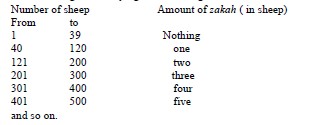
भेड़-बकरियों पर ज़कात सुन्नत और इज्मा' के आधार पर अनिवार्य है। सुन्नत में, अनस (रज़ि.) वर्णन करते हैं कि पहले उल्लेखित अबू बक्र (रज़ि.) के आदेश-पत्र में आया है कि "जहाँ तक भेड़-बकरियों की सदक़ा का संबंध है, जो स्वाभाविक रूप से चरने के लिए छोड़ी गई हों, तो हर चालीस में एक भेड़ देय है, एक सौ बीस तक।"
Zakah on sheep is obligating by virtue of Sunnah and Ijma'. In Sunnah, Anas narrates in the letter of instruction of Abu Bakr mentioned earlier that "As for sadaqah on sheep, naturally cost-free pastured, out of each 40 there is one sheep due, up to 120.
यदि संख्या बढ़ जाए, तो 200 तक दो भेड़ें देय होती हैं, और यदि संख्या एक बढ़कर 300 तक हो, तो तीन भेड़ें देय होती हैं। यदि यह 300 से अधिक हो, तो हर अतिरिक्त 100 के लिए एक भेड़ ली जाती है। यदि स्वाभाविक रूप से, बिना खर्च के चरने वाली भेड़ें 40 से कम हों, यहाँ तक कि केवल एक कम हों, तो उन पर कोई अनिवार्य सदक़ा नहीं है, जब तक कि मालिक स्वेच्छा से देना न चाहे। और ज़कात के रूप में बूढ़ी, दोषपूर्ण या मेढ़ा नहीं लेनी चाहिए, सिवाय उस स्थिति के जब मालिक स्वेच्छा से दें। इसी प्रकार के कथन इब्न उमर की हदीस में तथा कई अन्य में भी आए हैं।
If the number increased, then two sheep are due up to 200, and if the number increases by one up to 300, there are three sheep due. If it is above 300,90 then one sheep is taken for each additional 100. If naturally, cost-free pastured sheep are less than 40, even by only one, there is no obligatory sadaqah on it unless the owner wishes to volunteer, As zakah one should not accept the old, the damaged, or the ram except when volunteered by the owners." Similar statements appear in the saying from Ibn 'Umar and in several others.
फ़क़ीहों (इस्लामी विधिवेत्ताओं) की सर्वसम्मति है कि भेड़ों पर ज़कात अनिवार्य है। यह भी सर्वसम्मत मत है कि शब्द "ग़नम" में भेड़ और बकरी दोनों शामिल हैं, इस प्रकार कि वे एक ही वस्तु के रूप में मिलाकर गिने जाते हैं।91
Jurists unanimously agree that zakah is obligatory on sheep. There is also unanimous opinion that the word "ghanam" includes both sheep and goats in such a way that they are combined together as one item.91
इस कथन के अनुसार निम्नलिखित तालिका बनाई जा सकती है:
According to this saying the following table can be drawn:
हम खंड 6 में उस पशु का वर्णन करेंगे जिसे ज़कात के रूप में लिया जाना चाहिए, उसके आकार, आयु और लिंग के संदर्भ में।
We will discuss in section 6 the description of what animal should be taken as zakah as for its size, age and sex.
भेड़ों पर ज़कात की दर पर चर्चा
Discussion of the rate on sheep
यह ध्यान देने योग्य है कि शरीअत ने भेड़ों पर लगने वाली दर को उनकी संख्या बढ़ने के साथ घटाया है। पिछली सारणी से देखा जाता है कि जब संख्या 120 से ऊपर बढ़ती है, तो दर एक प्रतिशत पर स्थिर हो जाती है, जबकि व्यापारिक सामान, नकदी और अन्य संपत्तियों पर सामान्यतः ढाई प्रतिशत लगता है। इस कमी के पीछे क्या तर्क है? कुछ समकालीन शोधकर्ता92 इस कमी की व्याख्या यह तर्क देकर करने का प्रयास करते हैं कि शरीअत इस कमी के द्वारा पशुपालन को प्रोत्साहित करना चाहती है, क्योंकि 40
It is notable that Shari'ah reduced the rate on sheep as their number increases. From the previous schedule it is observed that as the number grows above 120 the rate stabilizes at one percent in contrast with the usual two-and-half percent on business assets, money and other assests. What is the rationale for this reduction? Some contemporary researchers92 attempt to explain this reduction with the argument that Shari'ah intends to encourage animal breeding by this reduction, since the rate on 40
भेड़ पर ज़कात ढाई प्रतिशत है और जब संख्या 200 तक पहुँचती है तो यह दर घटकर एक प्रतिशत हो जाती है। लेकिन सवाल उठता है कि अगर यह व्याख्या सही है, तो यही सिद्धांत अन्य पशुओं की ज़कात पर क्यों लागू नहीं होता? ऊँट और गाय, दोनों पर ज़कात की दर बड़ी संख्याओं पर लगभग ढाई प्रतिशत पर स्थिर हो जाती है, जो ज़कात की सामान्य दर के अनुरूप है। यदि उपरोक्त व्याख्या सही होती, तो इसे अन्य पशुओं पर भी लागू होना चाहिए था।
sheep is two-and-half percent and it regresses at 200, going clean to one percent. But one wonders, if this explanation is correct, why the same is not applied on zakah on other kinds of livestock. The rate on both camel and cows stabilizes around two-and half percent on big numbers, which is consistent with the general rate of zakah. If the above-mentioned interpretation is correct, it should apply to other animals as well.
मेरे विचार से -- अल्लाह बेहतर जानता है -- जब भेड़ों की संख्या बढ़ती है, तो भेड़ों की कुल संपत्ति में बहुत से छोटे मेमने शामिल हो जाते हैं, क्योंकि अधिकतर भेड़ें साल में एक से अधिक बार बच्चे देती हैं। ये बच्चे भेड़ों की गिनती में तो शामिल होते हैं, लेकिन ज़कात के भुगतान के रूप में स्वीकार नहीं किए जाते, जैसा कि आगे के दो भागों में दिखाया जाएगा। मुझे लगता है कि इसी कारण न्याय की माँग है कि दर में कुछ कमी की जाए। यदि हर 40 में से एक की दर बनाए रखी जाए, जबकि झुंड में बहुत से बच्चे हों, तो वास्तविक दर कहीं अधिक हो जाती है। जहाँ तक पहली 40 का सवाल है, उसकी दर ढाई प्रतिशत है, क्योंकि उम्मीद की जाती है कि पहली 40 में बच्चों को नहीं गिना जाएगा, जैसा कि पाँचवें भाग में समझाया जाएगा।
The way I see it --God knows best-- is that once the number of sheep grows, the total assests of sheep shall contain many baby lambs because most sheep give birth more than once a year, These babies are counted in the number of sheep but not accepted as payment of zakah, as shall be shown in the following two sections. It seems to me that the justice requires certain reduction in the rate for this reason. If the rate is kept at one out of each 40 while the herd contains many babies, the actual rate becomes much higher. As for the first 40, the rate is two-and-half percent because it is expected that babies would not be counted in the first 40, as will be explained in Section five.
सेक्शन पाँच: क्या छोटे जानवर (बच्चे जानवर) ज़कात-योग्य हैं?
SECTION FIVE ARE BABY ANIMALS ZAKATABLE ?
अहमद, अबू दाऊद और अन-नसाई ने सुऐद बिन ग़फ़लह से रिवायत किया है कि "रसूलुल्लाह ﷺ के ज़कात वसूल करने वाले हमारे पास आए। हम उनके क़रीब बैठ गए और मैंने उन्हें कहते सुना, 'मेरे आदेश में यह है कि मैं दूध पिलाने वाले जानवरों से न लूँ'।"94 इससे यह संकेत मिलता है कि छोटे पशुओं पर ज़कात नहीं है, और यही विद्वानों के एक समूह की राय है। लेकिन इस हदीस की सनद (श्रृंखला) विवादित है। दूसरी ओर, मालिक ने अल-मुवत्ता में रिवायत किया है कि उमर ने अपने ज़कात वसूल करने वाले सुफ़ियान बिन अब्दुल्लाह अस-सक़फ़ी से कहा कि "उनके बच्चों को गिनो, यहाँ तक कि वे भी जो चरवाहे अपने हाथों में उठाए हुए हों, लेकिन उन्हें भुगतान के रूप में स्वीकार न करो।"95 यह रिवायत अश-शाफ़ई और अबू उबैद ने भी नक़ल की है।96 उमर की यह रिवायत पिछली रिवायत के विपरीत है और यह संकेत देती है कि छोटे पशु निसाब में गिने जाते हैं और इसलिए उन पर ज़कात है। यही बात फ़क़ीहों के एक समूह ने अपनाई है, यहाँ तक कि अगर सारे ज़कात योग्य पशु छोटे हों, तो उनमें से एक को भुगतान के रूप में स्वीकार किया जा सकता है।97 हालाँकि कुछ अन्य विद्वान कहते हैं कि ज़कात की अदायगी के लिए मालिक से बाहर से एक बड़ा पशु ख़रीदने को कहा जाना चाहिए।98
Ahmad, Abu Daud, and al Nasa'i report from Suaid Bin Ghaflah that "the zakah commissioner of the Messenger of god (p), came to us. We sat close to him and I heard him saying 'In my instructions it is pleased that I should not take from nursing animals'.94 This indicates that baby livestock are not zakatable, and this is the opinion of a group of leading scholars. But the chain of this saying is contested. On the other hand, Malik in al Muwatta reports that 'Umar told his commissioner, Sufian bin 'Abd Allah al Thaqafi, to "Count the babies in them, even those carried by the shephered in his hands, but do not accept them in payment."95 This is also reported by al Shafi'i and 'Abu Ubaid.96 This report of 'Umar contradicts the previous report and indicates that baby animals are counted in nisab and consequently zakatable. This is what a group of jurists adopt, to the extent that if all the zakatable animals were babies, one of them would be acceptable as payment,"97 though others say the owner should be asked to buy an older animal from outside to fulfil the payment of the zakah.98
कुछ विद्वान 'उमर की रिपोर्ट और सुऐद के कथन में सामंजस्य बिठाने का प्रयास करते हैं: वे यह कहते हैं कि यदि ज़कात-योग्य पूरा पशुधन केवल छोटे जानवरों से बना हो, तो उन पर ज़कात अनिवार्य नहीं होती। उनके अनुसार सुऐद का कथन इसी स्थिति पर लागू होता है, जबकि छोटे जानवरों को तब गिना जाता है जब वे अपनी माताओं के साथ हों। परंतु कुछ फ़क़ीह यह मानते हैं कि छोटे जानवरों को ज़कात-योग्य झुंड की कुल संख्या में तभी गिना जाता है जब निसाब पूरा करने के लिए बड़े जानवर मौजूद हों। यही मत अबू हनीफ़ा, अश-शाफ़ई, इब्न हज़्म और अन्य का है। मेरी राय में यही मत इस्लामी न्याय के सबसे निकट है और अन्य मतों से अधिक वज़नदार लगता है। यदि कोई व्यक्ति, उदाहरण के लिए, चार बूढ़े ऊँटों का मालिक है, तो उसे ज़कात से मुक्त रखना और पाँच छोटे ऊँटों या चार छोटे मेमनों के मालिक से ज़कात वसूलना न्याय के सिद्धांत का उल्लंघन है, क्योंकि दूसरा व्यक्ति पहले से कम धनी है। जब निसाब केवल बड़े जानवरों को गिनकर पूरा हो जाए, तभी छोटे जानवरों को ज़कात-योग्य कुल संख्या निर्धारित करने में गिना जा सकता है। बड़ी मात्राओं के लिए दर-संरचना स्वयं लचीली है, क्योंकि यह मात्राओं को स्तरों में बाँटती है और हर स्तर के निचले और ऊपरी सिरे पर एक ही दर लागू करती है। इस प्रकार पाँच ऊँटों पर भी वही एक बकरी ज़कात के रूप में लागू होती है, जो नौ ऊँटों पर लागू होती है।
खंड छह: ज़कात के रूप में दिए जाने वाले जानवरों की शर्तें
SECTION SIX CONDITIONS OF ANIMALS GIVEN AS ZAKAH
ज़कात के रूप में दिए जाने वाले जानवरों के लिए कुछ शर्तें आवश्यक हैं, जिनमें शामिल हैं:
A few conditions are required of the animals that can be paid as zakah, which include:
1. दोषों और क्षति से मुक्त: पशु बीमारी, हड्डी टूटने, बुढ़ापे, या जन्मजात या दुर्घटनावश होने वाले दोषों या क्षति से मुक्त होना चाहिए। कुरआन कहता है: "और ऐसी चीज़ का इरादा मत करो जो बुरी हो, ताकि उसमें से तुम खर्च करो" [100] और नबी ﷺ ने फ़रमाया: "न तो बूढ़ा या दोषपूर्ण पशु दिया जाए, और न ही कोई वसूल करने वाला भेड़ा ले, जब तक कि देने वाला स्वेच्छा से उसे न देना चाहे।" यह अनस की हदीस का हिस्सा है। क्षतिग्रस्त पशुओं को ज़कात के रूप में स्वीकार करना गरीबों और अन्य हकदार लोगों के साथ इंसाफ़ नहीं है; यह मालिक के पक्ष में पक्षपात है, जो अनुचित है।
1. Free of defects and damage. The animal should be free of illness, bone fracture, old age, or birth and accidental defects or damages. The Qur'an says "and do not aim at getting anything which is bad, in order that out of it ye may spend "100 and the Prophet (p) states "and one should not give an old or defective animal, nor should a collector accept a ram unless the payer wishes to volunteer it". This is part of the saying from Anas. Accepting damaged animals as zakah payment is not fair to the poor and other deserving recipients; it is a bias in favor of the owner, which is improper.
जहाँ तक दोष या क्षति की परिभाषा का संबंध है, अधिकांश विद्वानों का मत है कि यह वही परिभाषा है जो बिक्री के अनुबंधों में प्रयोग होती है, हालांकि कुछ का कहना है कि जो जानवर कुर्बानी के लिए स्वीकार्य नहीं है, वह ज़कात के रूप में भी स्वीकार्य नहीं है।l0l एक अनूठी स्थिति का उल्लेख किया जाना चाहिए, जिसमें दोषपूर्ण या क्षतिग्रस्त जानवर ज़कात के रूप में स्वीकार किया जाता है, और वह स्थिति है जब ज़कात दिए जाने वाले सभी जानवरों में एक ही दोष या क्षति हो, जैसे कोई आम बीमारी। ऐसा इसलिए है क्योंकि ज़कात का आदेश ज़कात देने वाले व्यक्ति की अपनी संपत्ति में से भुगतान माँगता है, बिना उसे केवल ज़कात देने के लिए बाहर से एक अच्छा जानवर खरीदने पर मजबूर किए।l02
As for the definition of defect or damages, the majority are of the view that it is the same definition used in sales contracts, though some say that anything not accepted for sacrifice is not accepted as zakah.l0l One should mentions unique case where a defected or damaged animal is accepted as zakah, which is if all the animals being zakated have the same defect or damage, such as a common disease. This is because the ordinance of zakah asks payment from what the zakatable person owns without forcing him or her to purchase from outside a good animal only for the payment of zakah.l02
मवेशियों पर ज़कात 101
Zakah on Livestock 101
2. पशु के लिंग का निर्धारण: ज़कात के रूप में दिया जाने वाला पशु उसी जाति की मादा होना चाहिए। यह नियम केवल ऊँटों पर लागू होता है, सिवाय उन स्थितियों के जिनका उल्लेख अनस की हदीस में है, जहाँ निर्धारित मादा के स्थान पर उच्च आयु-वर्ग का नर स्वीकार किया जाता है।
4. औसत की माँग: ज़कात वसूल करने वाले को न तो सबसे उत्तम गुणवत्ता वाले जानवर लेने चाहिएँ और न ही सबसे घटिया, बल्कि देय जानवरों का औसत लेना चाहिए। इब्न 'अब्बास से रिवायत है कि नबी ﷺ ने मुआज़ से कहा, "लोगों के माल में से सबसे उत्तम चीज़ लेने से बचो, और मज़लूम की दुआ से डरो, क्योंकि उसके और अल्लाह के बीच कोई पर्दा नहीं होता।" इब्न अबी शैबा रिवायत करते हैं कि नबी ﷺ ने ज़कात में इकट्ठा किए गए ऊँटों में एक उत्तम ऊँटनी देखी। आप ने वसूल करने वाले पर नाराज़गी जताई और फ़रमाया, "यह क्या है?" वसूल करने वाले ने जवाब दिया, "मैंने इसे दो घटिया क्वालिटी के ऊँटों के बदले लिया है।" नबी ﷺ ने फ़रमाया, "तो फिर ठीक है।"115
4. The average The zakah collector should not take the best or the worst in quality, but the average of the animals owed. Ibn 'Abbas narrates that the Prophet (p) said to Mu'adh, "Avoid the best of people's wealth, and be fearful of the prayer of the oppressed, for there is no curtain between it and God." Ibn Abi Shaibah reports that the Prophet (p) saw among the camels collected as sadaqah, an excellent she-camel. He was furious at the collector and said, "What is this?" The collector answered "I exchanged it for two lesser quality camels". The Prophet said, "Then it is all right."115
यह इसलिए है क्योंकि ज़कात दोनों पक्षों, देने वालों और लेने वालों, के बीच न्याय पर आधारित है, और सबसे अच्छा या सबसे घटिया लेना किसी एक पक्ष का पक्ष लेना है। फिर भी, यह स्पष्ट है कि मूल्य के आधार पर सबसे अच्छा या सबसे घटिया, पशु के मालिक के विकल्प पर, लिया जा सकता है। अबू दाऊद अपनी ही सनद से नबी (ﷺ) से रिवायत करते हैं: "तीन चीज़ें ऐसी हैं जिन्हें जो पूरा करेगा वह ईमान की मिठास चखेगा: अल्लाह को अकेला मानकर उसकी इबादत करना, यह जानना कि अल्लाह के सिवा कोई इबादत के लायक नहीं, और अपने माल की ज़कात इस तरह देना कि तुम्हारा मन साल दर साल उसे देकर प्रसन्न रहे... और बूढ़ा, बीमार या बच्चा, या वह दोषपूर्ण पशु जो कम दूध देता हो, न देना, बल्कि अपने माल के औसत में से देना। अल्लाह तुमसे यह नहीं चाहता कि तुम उसमें से सबसे अच्छा दो, और न ही वह तुम्हें उसमें से सबसे घटिया देने का आदेश देता है।"116 ज़कात के रूप में वसूल करने वाले को वह पशु नहीं लेना चाहिए जो बच्चों को दूध पिलाता हो, न गर्भवती पशु, न भेड़ों में से मेढ़ा, और न वह पशु जो ज़कात देने वाले के घर के मांस के लिए रखा गया हो।117 इमाम मालिक ने अल-मुवत्ता में आइशा (रज़ि.) से रिवायत किया है कि उमर बिन अल-ख़त्ताब सदक़े में लाई गई भेड़ों के पास से गुज़रे और एक ऐसी भेड़ देखी जिसके थन बड़े थे, तो पूछा, "यह भेड़ क्या है?" उत्तर मिला, "सदक़े में ली गई।" उन्होंने कहा, "इसके मालिकों ने इसे ख़ुशी से नहीं दिया, इसलिए लोगों को लौटने पर मजबूर न करो, और मुसलमानों के माल में से सबसे अच्छा न लो।"118
This is essentially because zakah is based on fairness to the two parties, payers and recipients, and taking the best or the worst means favoring one of them. However, it is obvious that the worst or the best can be taken on the basis of value at the option of the livestock owner. Abu Daud reports, through his own chain, from the Prophet (p) "There are three things, which whoever fulfills them will taste the sweetness of faith: to worship God alone, realizing that there is no deity but God, to give zakah on your wealth with your soul pleased at paying it year after year... and to give not the old, or the ill or the baby, or the defective animal that give little milk, but to give from the average of your wealth. God does not ask you to give the best of it, nor does He ordain you to give the worst of it."116 As zakah payment, the collector must not take the animal that nurses babies, nor pregnant animals, nor the ram out of sheep, nor the animal that is meant to provide meat for the household of the zakah payer.117 Malik reports in al Muwatta from 'Aishah that 'Umar bin al Khattab passed by the sheep taken as sadaqah, and saw one with big udders and asked, "What is this sheep? "He was answered, "One taken as sadaqah." He replied, "Its owners did not give it pleasantly, so do not force people to turn back, and do not take the best of the wealth of Muslims."118
सातवाँ भाग: पशुओं की ज़कात पर मिलाने और साझेदारी का प्रभाव
SECTION SEVEN THE EFFECT OF MIXING AND PARTNERSHIP ON ZAKAH ON LIVESTOCK
पशुपालक मालिकों के लिए अपने मवेशियों को एक साथ मिलाकर रखना आम बात है, ताकि ऊपरी खर्चों में बचत हो सके। क्या निसाब और ज़कात की दर तय करने में इकट्ठे किए गए सभी पशुओं को एक इकाई माना जाए? या हर मालिक के पशुओं को उसके अपने हिसाब से अलग-अलग देखा जाए?
It is common for livestock owners, to put together their cattles in order to save on overhead expenses. Should all gathered livestock be treated as one unit in determining the nisab and rate of zakah? or should they be considered for each owner alone?
इस प्रश्न से निपटने के लिए यह ध्यान रखना चाहिए कि सामूहिक पशुपालन के दो प्रमुख रूप हैं। एक में स्वामित्व अलग रखा जाता है और कुछ खर्चों में साझेदारी होती है, और दूसरा वह है जब पशु साझेदारों के बीच सामूहिक रूप से स्वामित्व में होते हैं। दूसरे रूप में, प्रत्येक मालिक का हिस्सा संख्या से नहीं बल्कि कुल का एक अनुपात भर के रूप में तय होता है, जबकि पहले रूप में हर व्यक्ति के अपने पशु अलग पहचाने जाते हैं। इन दोनों प्रकार के सामूहिक निवेश का ज़कात-योग्यता पर एक ही प्रभाव हो, यह आवश्यक नहीं है।
To deal with this question one should note that there are two leading forms of collective breeding. One involves keeping the ownership separate and sharing in certain expenses, and the other is when the cattle is owned commonly among the partners. In the latter form, the share of each owner is not determined in number but only as a proportion of the total, whereas in the former each person's own animals are distinguished. These two forms of investing together need not have the same effect on zakatability.
इब्न रुश्द ने *बिदायत अल-मुज्तहिद* में फ़क़ीहों (न्यायविदों) के मत को निम्न प्रकार से संक्षेप में प्रस्तुत किया है:
Ibn Rushd in Bidayat al Mujtahid, summarizes the views of jurists according to the following:
अधिकांश विधिवेत्ता पशुओं के मिलाने को ज़कात योग्यता पर प्रभाव डालने वाला मानते हैं, सिवाय अबू हनीफ़ा और उनके शिष्यों के, जिनका मानना है कि पशुओं का मिलाना निसाब या लागू दर पर कोई प्रभाव नहीं डालता। मालिक, अल-शाफ़ई और अधिकांश विधिवेत्ता इस बात पर सहमत हैं कि जो पशुपालक अपने मवेशियों को एक साथ मिलाते हैं, उन्हें एक ही स्वामी माना जाएगा। फिर भी ये विधिवेत्ता दो बातों में भिन्न हैं: निसाब के निर्धारण में और प्रभावी रूप से मिलाने की परिभाषा में।
Most jurists view mixing animals as affecting the zakatability except for Abu Hanifah and his disciples, who believe that mixing together of animals does not have any effect on nisab or on the applicable rate. Malik, al Shafi'i, and most jurists agree that the group of breeders who mix their cattles together are treated as if they were one owner. Those jurists however differ in two areas: the determination of nisab and the definition of effective mixing together.
अध्याय आठ: घोड़ों पर ज़कात
SECTION EIGHT ZAKAH ON HORSES
व्यक्तिगत सवारी और युद्ध के लिए इस्तेमाल होने वाले घोड़े ज़कात से मुक्त हैं।
Horses used for personal transportation and fighting are exempt from zakah.
मुसलमानों के बीच यह सर्वसम्मत है कि वे घोड़े जो निजी सवारी, निजी सामान ढोने और अल्लाह के मार्ग में लड़ने के उद्देश्य से रखे गए हों, उन पर ज़कात नहीं है, चाहे वे प्राकृतिक रूप से चरागाहों में चरते हों या फ़ार्मों में चारा खिलाकर पाले जाते हों, क्योंकि वे निजी और घरेलू उपयोग के लिए होते हैं और व्यक्तिगत आवश्यकताओं से अधिक बढ़ने वाली वृद्धिशील संपत्ति नहीं हैं।126 दूसरी ओर, ज़ाहिरी संप्रदाय को छोड़कर सभी मुसलमान इस पर सहमत हैं कि वे घोड़े जो घोड़ों के व्यापारियों द्वारा व्यापारिक माल के रूप में रखे गए हों, उन पर ज़कात अनिवार्य है, चाहे वे प्राकृतिक रूप से चरते हों या हाथ से चारा खिलाए जाते हों, इस आधार पर कि व्यापार के माल के लिए रखे गए घोड़े वस्तुएँ हैं, जैसे अन्य व्यापारिक संपत्ति।127 यह भी सर्वसम्मत है कि वे घोड़े जिन्हें मालिक साल के अधिकांश हिस्से में चारा खिलाते हैं और जो ऊपर बताए गए किसी उद्देश्य के लिए नहीं रखे गए, उन पर ज़कात नहीं है, क्योंकि बहुमत विद्वानों के अनुसार पशुओं पर ज़कात के योग्य होने की एक शर्त स्वतंत्र प्राकृतिक चराई है।128
It is agreed upon among Muslims that horses owned for the purpose of personal riding, carrying personal loads, and fighting for the sake of God are exempt whether they are naturally pastured or fed in ranches, because they are for personal and household use and are not growing assets in excess of personal needs.126 On the other hand, all Muslims except Zahirites have agreed that horses used as business inventory owned by horses' merchants, are zakatable whether they are naturally pastured or manually fed on the grounds that horses designed for business inventory are commodities, like other business asset.127 It is also agreed upon that horses that are fed by owners most of the year, which are not owned for any of the previously mentioned purposes, are exempt from zakah, because natural free pasturing is a condition for zakatability of animals, according to the majority of scholars.128
प्राकृतिक रूप से चरने वाले, प्रजनन के लिए निर्धारित घोड़ों पर ज़कात का विधान
Zakatability of naturally pastured horses designated for breeding
प्राकृतिक रूप से मुफ़्त चरने वाले, नस्ल और वृद्धि के लिए रखे गए घोड़ों की ज़कात-योग्यता पर दो मत हैं। अबू हनीफ़ा का मत है कि ये ज़कात-योग्य हैं, बशर्ते कि उनके पास मौजूद सारे घोड़े नर न हों, क्योंकि ऐसी स्थिति में वे नस्ल नहीं बढ़ा सकते।129 अधिकांश फ़क़ीह इन घोड़ों को ज़कात से मुक्त मानते हैं, और यह मत इब्न अल-मुंज़िर ने 'अली, इब्न 'अम्र अल-शा'बी, 'अता, अल-हुसैन अल-अब्दी, 'उमर बिन 'अब्द अल-अज़ीज़, अल-सौरी, अबू यूसुफ़, मुहम्मद (अबू हनीफ़ा के दो शिष्य), अबू सौर, अबू ख़ैसमा और अबू बक्र बिन शैबा से नक़ल किया है। कुछ लोग यह मत 'उमर, मालिक, अल-अव्ज़ाई, अल-लैस और दाऊद की ओर भी जोड़ते हैं।130
There are two opinions on the zakatability of naturally cost-free pastured horses that are designated for breeding and growth. Abu Hanifah believe they are zakatable, provided that not all horses owned are males since in this case they cannot breed.129 The majority of jurists consider these horses exempt from zakah, and this is narrated by Ibn al Mundhir from 'Ali, Ibn 'Amr al Sha'bi, 'Ata, al Husain al Abdi, 'Uamar bin 'Abd al Aziz, al Thawri, Abu Yusuf, Muhammad (the two disciples of Abu Hanifah) Abu Thawr, Abu Khaithamah, and Abu Bakr bin Shaibah. Others attribute this opinion to 'Umar, Malik, al Awza'i, al Laith and Daud.130
घोड़ों पर ज़कात न होने के बारे में बहुमत (जमहूर) का प्रमाण
Evidence of the majority for the non-zakatability of horses
1. सहीह दोनों किताबों में और अन्य किताबों में अबू हुरैरा (रज़ि.) से रिवायत है कि नबी ﷺ ने फ़रमाया: "मुसलमानों पर उनके ग़ुलामों और घोड़ियों पर कोई सदक़ा वाजिब नहीं है।" इस छूट में सभी घोड़े शामिल हैं, चाहे वे चरागाहों में चरते हों या नहीं, और मादा हों या नर, क्योंकि यह हुक्म आम है।
1. It is reported in the two correct books and in others from Abu Hurairah that the Prophet (p) said " There is no sadaqah obligated on Muslims on their slaves and mares."131 This exemption includes all horses, naturally pastured or not, female or male because it is general.
2. अहमद, अबू दाऊद और अत-तिर्मिज़ी की रिवायत, अली (रज़ि.) से, उन्होंने नबी ﷺ से
2. The report of Ahmad, Abu Daud, and al Tirmidhi from Ali from the Prophet (p)
मैंने तुम्हारे लिए घोड़ों और गुलामों पर सदक़ा माफ़ कर दिया था। चाँदी के सिक्कों पर सदक़ा अदा करो, हर 40 में एक दिरहम।132
"I waived for you sadaqah on horses and slaves. Pay sadaqah on silver money, one dirham for each 40."132
3. नबी (स) के कर्मों में घोड़ों पर ज़कात वसूल करना शामिल नहीं था, जबकि ऊँटों, गायों और भेड़-बकरियों पर यह वसूल की जाती थी। रसूल ही वह हैं जो क़ुरआन में बताई गई अनिवार्यता का विवरण देते हैं, और उनके कथन और कर्म से यह संकेत मिलता है कि घोड़े ज़कात के योग्य नहीं हैं।
3. The actions of the Prophet (p) did not include collecting zakah on horses, even though it was collected on camels, cows and sheep. The Messenger is the one who gives the details of the obligation outlined in the Qur'an, and his word and deed indicate that horses are not zakatable.
4. वे यह भी तर्क देते हैं कि ज़कात-योग्य पशु स्पष्ट रूप से घोड़ों से बहुत भिन्न हैं, और घोड़ों को उपयोग और इन विभिन्न प्रकार के पशुओं के स्वामित्व के उद्देश्य में मूल अंतरों के कारण सादृश्य (क़ियास) द्वारा ज़कात-योग्य नहीं बनाया जा सकता। घोड़े युद्ध में, इस दीन की स्थापना में, और शत्रुओं के विरुद्ध रक्षा के लिए प्राप्त किए जाते हैं, इसलिए लोगों को उन्हें इन्हीं उद्देश्यों के लिए प्राप्त करने और रखने के लिए प्रोत्साहित किया जाना चाहिए। अल्लाह तआला फ़रमाता है: "और उनके मुकाबले के लिए, जितनी ताक़त और जितने बंधे हुए घोड़े तुम जुटा सको, तैयार रखो।"133 युद्ध के घोड़े लड़ाई का साज़ो-सामान हैं, जैसे हथियार और अन्य युद्ध-उपकरण; जब तक उन्हें व्यापार की वस्तु के रूप में इस्तेमाल न किया जाए, वे ज़कात-योग्य नहीं हैं।134
4. They also argue that livestock that are zakatable are obviously very different from horses and that horses cannot be made zakatable by analogy because of the basic differences in use and in the purpose of owning these different kinds of animals. Horses are obtained for use in fighting, in establishing this religion, and in defense against enemies, so people should be encouraged to obtain them and keep them for such purposes. God says "Against them make ready your strength to the utmost of your power, including seeds of war.133 Horses of war are fighting equipment, like weapons and like other fighting tools are not zakatable as long as they are not used as a commodity for trade.134
अबू हनीफ़ा की राय और उसके समर्थन में दलील
Abu Hanifah's opinion and its supporting evidence
अबू हनीफ़ा, जो मानते हैं कि चरागाह में प्राकृतिक रूप से चरने वाले घोड़ों पर ज़कात वाजिब है, वे निम्नलिखित तर्क प्रस्तुत करते हैं:
Abu Hanifah, who believes that naturally pastured horses are zakatable, provides the following arguments:
सबसे पहले, इमाम अल-बुखारी ने अपनी सही (प्रामाणिक) किताब में अबू हुरैरा (रज़ि.) से रिवायत किया है कि नबी ﷺ ने फ़रमाया: "घोड़े किसी के लिए सवाब (पुण्य) का ज़रिया होते हैं, किसी के लिए रोज़ी का ज़रिया होते हैं, और किसी के लिए गुनाह का ज़रिया होते हैं। जिसके लिए वे सवाब का ज़रिया हैं, वह वह शख़्स है जो अल्लाह की राह में जिहाद के लिए घोड़े रखता है, उन्हें जंग में सवारी के लिए रखता है या किसी और को जंग में सवारी के लिए देता है। इसीलिए वे उसके लिए सवाब का ज़रिया हैं। और जो शख़्स घोड़े अपनी निजी सवारी के लिए रखता है ताकि वह दूसरों का मोहताज न रहे, और न उनकी पीठ के हक़ (अल्लाह के हक़) को भूलता है और न लोगों के उन पर सवारी कराने के हक़ को, तो वे उसके लिए रोज़ी का ज़रिया हैं। और जो शख़्स घोड़े शान और दिखावे के लिए रखता है और इस्लाम के मानने वालों के ख़िलाफ़ लड़ाई के लिए रखता है, तो वे उसके लिए गुनाह का ज़रिया हैं।" यह हदीस इस बात की ओर इशारा करती है कि घोड़ों पर अल्लाह का हक़ है, जिसमें ज़कात और उन्हें सवारी के लिए देना शामिल है। दूसरे उलेमा (इस्लामी विद्वान) कहते हैं कि घोड़ों के हक़ से मुराद उनका जंग में इस्तेमाल है।137
Firstly, al Bukhari reports in his correct collection from Abu Hurairah that the Prophet (p) said "Steeds are for a person a source of reward, for another they are a source of sustenance, and for yet another they are a source of sin. He for whom they are a source of reward is the man who owns horses for the purpose of fighting for the sake of God, to ride it in battle or to give it to someone else to ride in battle. That is why they are a source of reward. For one who keeps horses for personal transportation so he does not need others, and does not forget God's right on the horses or the right of people to be given lifts on their backs, they are source of sustenance. And for the person who keeps steeds as a matter of pride and to fight against the people of Islam, they are a source of sin."135 This saying indicates that there is a right of God on horses, zakah and giving lifts on their backs.136 Other jurists argue that what is meant by the right on horses is the use of horses in fighting.137
Secondly, it is reported from Jabir from the Prophet ﷺ, "On each naturally pastured mare there is due one dinar or ten dirhams." It is reported by al-Daraqutni and al-Baihaqi, and they grade it weak. For this reason, the majority of jurists argue that it cannot stand against the authentic saying of the Prophet ﷺ, "There is no zakah on the slaves and mares of Muslims." Thirdly, by analogy to camels, both are growing and useful animals, and in both the condition for zakatability, natural cost-free pasturing, is fulfilled. The claimed differences between horses and other livestock are no more than those among the other kinds of livestock, since each animal has its unique characteristics. There are many differences between camels and sheep, yet both are zakatable. Abu Hanifah holds to this argument on the basis that the reason for the obligation of zakah is a matter that can be rationalized and not a matter of worship only. This reason is growth or growth potential, and once growth exists in another asset, zakatability must be extended to it.
घोड़ों पर निसाब और ज़कात की दरें
Nisab and rates of zakah on horses
अबू हनीफ़ा घोड़ों के लिए कोई निसाब निर्धारित नहीं करते। अल-दुर्र अल-मुख़्तार के लेखक लिखते हैं, "यह सर्वविदित है कि अबू हनीफ़ा घोड़ों के लिए निसाब का अनुमान नहीं लगाते; इस बारे में उनसे हमारे पास कोई रिवायत नहीं है।"146 इब्न आबिदीन अपनी टीका में अल-क़हस्तानी का कथन उद्धृत करते हैं, "कुछ लोग निसाब तीन पर बताते हैं और कुछ पाँच पर।"147 ऐसा प्रतीत होता है कि पाँच का अनुमान अधिक सही है, क्योंकि यह ऊँटों के निसाब से मेल खाता है। पाँच की संख्या निसाब में बार-बार प्रयोग होती है: निसाब पाँच ऊँट है, पाँच उक़िय्या चाँदी [जो 200 दिरहम के बराबर है] है, और पाँच वसक़ अनाज है।
Abu Hanifah does not determine a nisab for horses. The author of al Durr al Mukhtar writes "It is best known that Abu Hanifah does not estimate nisab for horses; we have no report from him about that."146 Ibn 'Abidin in his commentary quotes al Qahastani as saying "Some indicate nisab at three and others indicate it at five."147 It seems that the estimation of five is mare correct because of its similarity to that of camels. The number five is often used in nisab . nisab is five camels, five 'uqiyyah of silver [equals 200 dirhams] and 5 wasq of grain.
इब्न आबिदीन ने अबू हनीफ़ा से यह दर बयान की है: अरबी घोड़ों के मालिकों को यह विकल्प दिया जाता है कि वे हर घोड़े पर एक दीनार दें, या अपने घोड़ों का मूल्यांकन करके (उसके मूल्य का) 5
The rate is explained by Ibn Abidin from Abu Hanifah: Owners of Arabian horses are given the choice of paying one dinar on each or evaluating their horses and paying 5
हर 200 दिरहम की क़ीमत पर (ज़कात के रूप में) दिरहम — दर केवल ढाई प्रतिशत है। ग़ैर-अरबी घोड़ों के मामले में केवल उनकी क़ीमत का ही विचार किया जाता है।148
dirhams for each 200 dirhams of value - the rate is just two-and-half. For non-arabian horses, only the value is considered.148
विश्लेषण
Analysis
मेरे विचार में, दोनों तर्कों की चर्चा के बाद यह स्पष्ट होता है कि रसूल (ﷺ) ने घोड़ों पर ज़कात के होने को स्पष्ट रूप से नकारा नहीं, और न ही उसे स्पष्ट रूप से अनिवार्य ठहराया। अबू हुरैरा का यह कथन, "मुसलमान के गुलाम और घोड़ी पर कोई सदक़ा नहीं," उस घोड़े के सिवा किसी अन्य चीज़ पर लागू नहीं होता जो निजी सवारी के लिए और युद्ध में वाहन के रूप में प्रयोग होता है। इस व्याख्या को ज़ैद बिन साबित और इब्न अब्बास की व्याख्या का समर्थन प्राप्त है, जो उनसे सही रूप में वर्णित है। कथन के शब्द "उसका गुलाम और उसकी घोड़ी" भी इसी अर्थ की ओर संकेत करते प्रतीत होते हैं। इसके अतिरिक्त, फ़क़ीहों के बीच इज्मा' के द्वारा यह सर्वसम्मत है — ज़ाहिरियों को छोड़कर — कि जब घोड़े और गुलाम व्यापार की वस्तुओं (व्यापारिक माल) का हिस्सा हों तो उन पर ज़कात अनिवार्य है। अबू हुरैरा शब्दों के शाब्दिक अर्थ की ओर झुकाव रखते थे और सहाबा के बीच अपनी सटीक स्मरणशक्ति के लिए जाने जाते थे, किंतु उनकी ज़ैद और इब्न अब्बास की तरह विश्लेषण और विस्तार करने की प्रसिद्धि नहीं थी। अली का कथन, "मैंने तुम्हारे लिए घोड़ों और गुलामों पर सदक़ा माफ़ कर दिया है," अद-दारकुत्नी ने सही माना है जब यह अली पर समाप्त होता है और रसूल (ﷺ) से जुड़ा नहीं है। यह सर्वविदित है कि अद-दारकुत्नी इस प्रकार के विषयों के विशेषज्ञ हैं। फिर भी, "तुम्हारे लिए माफ़ कर दिया" शब्द यह संकेत देते हैं कि इन सम्पत्तियों पर सिद्धांततः ज़कात होनी चाहिए थी, परन्तु रसूल (ﷺ) ने किसी विशेष कारण से उन पर से ज़कात माफ़ कर दी। यह कारण युद्ध के घोड़ों की गंभीर आवश्यकता हो सकता है, या यह कि अरब में घोड़े धन की कोई बड़ी मद नहीं थे।
After discussing the two arguments, it seems to me that the Messenger (p) did not negate the existence of zakah on horses in a clear way, but neither did he obligate it clearly. The saying from Abu Hurairah, "There is no sadaqah on a Muslim's slave and mare" does not touch on anything other than the horse used for personal transportation and as a mount for war. This explanation is supported by the interpretation from Zaid bin Thabit and 'Abbas, correctly reported to him. The very words "His slave and his mare" in the saying seem to indicate this meaning. Also, that it is unanimous by Ijma' among jurists -- except Zahirites-- that zakah is obligatory on horses and slaves when they are part of business inventory. Abu Hurairah was inclined to hold to the letters of texts, and was known among the Companions for his precise memory, and did not have a reputation of analyzing and elaborating like Zaid and Ibn 'Abbas. The saying from 'Ali, "I have waived for you the sadaqah on horses and slaves" is noted by al Daraqutni as correct when it ends at 'Ali and is not linked to the Prophet. It is well known that al Daraqutni is the expert on such matters. However the words "waived for you" imply that these assets should be in principle zakatable but the Prophet (p) waived the zakah are them for certain reason.l49 This could be the desperate need for steeds of war or the fact that horses were not a substantial item of wealth in Arabia.
फ़िक़्ह अज़-ज़कात (खंड I), डॉ. यूसुफ़ अल-क़रज़ावी 108
विषयांतर: ईश्वर के संदेशवाहक के रूप में पैग़म्बर ﷺ के आदेशों और एक लौकिक राष्ट्राध्यक्ष के रूप में उनके आदेशों के बीच अंतर।
Digression: The distinction between orders of the Prophet as a messenger of God orders as a temporal head of state.
पिछली चर्चा हमें इस महत्वपूर्ण बिंदु पर कुछ अनुच्छेद समर्पित करने की ओर ले जाती है। हमें हमेशा उन परिस्थितियों को देखना चाहिए जो पैगंबर मुहम्मद ﷺ द्वारा किए गए किसी कथन को घेरे हुए हैं, तथा उस कथन के विषय को भी, ताकि यह पता चल सके कि वह लौकिक, राजनीतिक, आर्थिक, सैन्य या प्रशासनिक मामलों से संबंधित है, या इस्लामी जीवन-शैली के सिद्धांतों से। कभी-कभी कोई अन्य पाठ मौजूद हो सकता है जो किसी विशेष लौकिक प्रयोग के स्थायी सिद्धांत को इंगित करता है, या समान घटनाओं के साथ अलग तरह का व्यवहार किया गया हो सकता है, जो यह संकेत देता है कि यह व्यवहार धार्मिक की बजाय लौकिक हो सकता है।
The previous discussion leads us to devote a few paragraphs to deal with this important point. One should always look at the circumstances that surround a statement made by the Prophet (p) and the subject matter of the saying to see whether it relates to temporal, political, economic, military, or administrative affairs, or to the principles of the Islamic way of life. There may exist sometimes another text that indicates the enduring principle of a special temporal application, or similar events may have been differently treated, which indicates this treatment may be temporal rather than religious.
उदाहरण के तौर पर अल-क़राफ़ी ने अपनी किताब *अल-इह्काम* में उस कथन के बारे में बताया है, "जो कोई दुश्मन के सिपाही को मारेगा, उसका निजी सामान उसी का होगा।" मालिक कहते हैं कि यह फ़ैसला नबी ﷺ ने एक राष्ट्र-प्रमुख के रूप में दिया था और यह कोई सामान्य नियम नहीं है। अगर इस्लामी राज्य के नेता युद्ध की शुरुआत में ऐसा नियम घोषित करें, तो वह लागू होगा, अन्यथा युद्ध की लूट के बारे में सामान्य सिद्धांत बाकी रहता है कि उसका बँटवारा क़ुरआन की सूरह आठ (अल-अनफ़ाल) के पाठ के अनुसार होगा। मालिक इस मत के समर्थन में ये तर्क देते हैं:
An example is give by al Qarafi in his al Ihkam about the saying "One who kills an enemy soldier shall have his personal property". Malik says this is a decision by the Prophet (p) as a head of state and is not a general rule. If the leaders of the Islamic state declare such a regulation at the beginning of a war, then it should apply, but otherwise, the general principle that war booty is distributed according to the text of the Qur'an in sura eight (al Anfal) remains applicable. Malik gives the following arguments to support this view:
1. सूरा (अल-अनफ़ाल) में युद्ध के माल (ग़नीमत) के बँटवारे के बारे में जो आयत है, वह इस कथन का विरोध करती है।
1. The verse about the distribution of war booties in sura (al Anfal) contradicts this saying.
2. ऐसा नियम लड़ने वालों की नीयत में दखल दे सकता है और उन्हें इस ओर मोड़ सकता है कि उनका इरादा ईश्वर की ख़ुशी के बजाय दुश्मन के माल की चाहत बन जाए।
2. Such a regulation may interfere with, and divert the intentions of the fighters from being for the sake of God to being the desire for the enemy's property.
अध्याय नौ: अन्य प्राकृतिक रूप से चरने वाले घरेलू पशु
SECTION NINE OTHER NATURALLY PASTURED DOMESTIC ANIMALS
इस भाग में उन सामान्य मामलों की चर्चा की गई है जिनमें प्राकृतिक रूप से निःशुल्क चरागाहों में चरने वाले, लाभ के उद्देश्य से पाले जाने वाले घरेलू पशु आते हैं। क्या हम ऐसे सभी पशुओं पर ज़कात के मामले को सामान्यीकृत कर सकते हैं या नहीं? दूसरे शब्दों में, क्या ज़कात केवल पहले बताई गई चार प्रजातियों तक सीमित होनी चाहिए, या इसमें सभी घरेलू पशु शामिल होने चाहिए? आज के कुछ प्रमुख इस्लामी अध्ययन के विद्वानों, जिनमें मुहम्मद अबू ज़हरा, 'अब्द अल-वहाब ख़ल्लाफ़ और 'अब्द अल-रहमान हसन शामिल हैं, 'उमर की व्यवहार-पद्धति से यह निष्कर्ष निकालते हैं कि ज़कात के विषय में क़ियास (सादृश्य द्वारा अनुमान) लागू किया जा सकता है।
This section deals with the general case of naturally cost-free pastured domestic animals maintained for profit. Can we generalize the case of zakah on all such animals or not? In other words should zakah be restricted to the four previously mentioned species or should it include all domestic animals? Some of today's leading professors of Islamic studies, including Muhammad Abu Zahra, 'Abd al 'Wahab Khallaf, and 'Abd al Rahman Hasan, deduct from the practice of 'Umar that one can apply analogy on zakah.
उमर बिन अल-ख़त्ताब ने घोड़ों पर क़ियास के आधार पर ज़कात अनिवार्य की, इस तर्क पर कि घोड़े मूल्यवान संपत्ति बनते जा रहे थे। क़ियास के उपयोग में माहिर अबू हनीफ़ा ने इस मत का समर्थन किया है। जो लोग घोड़ों पर ज़कात अनिवार्य नहीं करते, वे क़ियास का इनकार करने के कारण ऐसा नहीं करते, बल्कि इसलिए करते हैं कि वे पशुओं की खाए जाने योग्य प्रकृति को उनके ज़कात-योग्य होने का एक महत्वपूर्ण कारण मानते हैं। चूँकि घोड़े खाए नहीं जाते, इसलिए वे घोड़ों तक ज़कात-योग्यता का विस्तार नहीं करते। अल-मुग़नी के लेखक लिखते हैं, "घोड़ों और पशुओं का क़ियास ग़लत है, क्योंकि पशु बढ़ने वाली संपत्ति हैं जो दूध और माँस के लिए काम आते हैं और जिन्हें क़ुर्बानी के लिए इस्तेमाल किया जा सकता है।" बहुसंख्यक विद्वान केवल बढ़ने के गुण को ज़कात-योग्यता का कारण नहीं मानते।
'Umar bin al Khattab obligated zakah on horses by analogy, on the grounds that horses were becoming valuable assets. This is upheld by Abu Hanifah, the master in the application of analogy. Those who do not obligate zakah on horses do not do so in denial of analogy, but because they consider the edible character of livestock an important reason for their zakatability. Since horses are not edible, they refuse to extend zakatability to horses. The author of al Mughni writes "The analogy of horses and livestock is incorrect, because the latter are growing wealth that is used for milking and meat and can be used for sacrifice." The majority of scholars does not consider the character of growth alone the reason for zakatability.
इन तीनों प्रोफ़ेसरों का कहना है: यदि बुद्धिमान ख़लीफ़ा 'उमर ने वृद्धि (बढ़ोतरी) को ज़कात-योग्य होने की अनिवार्य शर्त माना, और अबू हनीफ़ा ने उनका अनुसरण किया, तो हम इसके प्रयोग को अन्य जानवरों तक बढ़ा सकते हैं, और यह घोषित कर सकते हैं कि वे सभी जानवर जो बढ़ रहे हों और प्राकृतिक रूप से, बिना किसी लागत के चरागाह में चरते हों, ज़कात-योग्य हैं, यदि वे ज़कात-योग्यता की न्यूनतम सीमा (निसाब) तक पहुँच जाएँ, जो बीस दीनार के बराबर है, और दर 2.5% है। निसाब का अनुमान सोने के सापेक्ष लगाया जाता है, क्योंकि 'उमर ने ज़कात निर्धारित करने के लिए घोड़ों का मूल्यांकन करने का सिद्धांत स्वीकार किया था, और वर्तमान में मूल्य का अनुमान सोने में लगाया जाता है।158
खंड दस: पिछले खंडों से निकले सामान्य सिद्धांत
SECTION TEN GENERAL PRINCIPLES DERIVED FROM THE PREVIOUS SECTIONS
इस अध्याय के पिछले खंडों में चर्चा लंबी रही है, क्योंकि शरीअत स्वयं मवेशियों की ज़कात से संबंधित अनेक सिद्धांत और आदेश निर्धारित करती है, जो ज़कात के अन्य क्षेत्रों में उतने विस्तार से नहीं मिलते, और क्योंकि इस विषय के विस्तृत विश्लेषण से ऐसे महत्वपूर्ण सिद्धांत सामने आते हैं जो सामान्य रूप से ज़कात के सार को समझने में बहुत लाभदायक होंगे। इन सिद्धांतों में निम्नलिखित शामिल हैं:
The discussion in the previous sections of this chapter has been lengthy because Shari'ah itself dictates many principles and rulings about zakah on livestock that may not be as detailed in other areas of zakah, and because the lengthy analysis of this issue uncovers important principles that will be of great benefit in understanding the essence of zakah in general. Among these principles are the following:
1. ज़कात, यद्यपि एक इबादत है, एक सार्वजनिक संस्था भी है जिसकी देखरेख इस्लामी राज्य करता है। ज़कात के आमिल (अधिकारी) नियुक्त करना और उन्हें भेजना इस्लामी राज्य का कर्तव्य है।
1. Zakah, although a worship, is also a public institution supervised by the Islamic state. Appointing and sending zakah commissioners is the duty of the Islamic state.
2. ज़कात के नियम दो पक्षों के बीच संतुलन बनाते हैं: एक ओर गरीबों की ज़रूरतें, और दूसरी ओर धनवानों के हित। इसलिए थोड़ी मात्रा के धन को ज़कात से मुक्त रखा जाता है, और ज़कात के रूप में केवल औसत गुणवत्ता की संपत्ति ही स्वीकार की जाती है।
2. Zakah regulations balance the concerns of the poor on one hand and the interests of the rich on the other hand, so that small quantities of wealth are exempted from zakah and average quality assets only are accepted as zakah payment.
3. किसी संपत्ति का महंगा रखरखाव उस संपत्ति पर लगने वाली ज़कात को कम कर देता है या उसे माफ़ कर देता है। इसी कारण अधिकांश प्रमुख फ़क़ीहों (इस्लामी विधिवेत्ताओं) का मत है कि हाथ से चारा खिलाए जाने वाले जानवर ज़कात से मुक्त हैं, क्योंकि उन पर मालिक का खर्च उतना ही होता है जितना उसे उनसे लाभ होता है।
3. The expensive upkeep of an asset reduces zakah or waives it on that asset. For that reason, the majority of leading jurists consider manually fed animals exempt from zakah on the ground that they cost as much as they profit the owner.
4. विद्वानों के बहुमत के अनुसार, बढ़ने वाली संपत्ति को लाभ के लिए उपयोग से व्यक्तिगत उपयोग में बदल दिया जाए तो वह ज़कात से मुक्त हो जाती है। यह नियम उन गायों और ऊँटों के संबंध में है जिनका उपयोग पानी ढोने, खेती करने और निजी भार ढोने के लिए किया जाता है।
4. A transformation of a growing asset from its use for profit to personal use exempts it from zakah, according to the majority of scholars with regard to cows and camels used for watering, cultivation, and carrying personal loads.
1. सूरा अन-नहल, 16:5-7.
1. Sura al Nahl, 16:5-7.
2. इबिद।
2. Ibid.
3. Ibid.
3. Ibid.
4. सूरा यासीन: 36:71-73.
4. Sura Yasin: 36:71-73.
5. अल दुर्र अल मुख़्तार और उसकी टीका, रद्द अल मुहतार, खंड 2, पृ. 20-21.
5. Al Durr al Mukhtar and its commentary, Rad al Muhtar, Vol. 2, p. 20-21.
6. सूरह अल-आराफ़, 7:199।
6. Sura al A'raf, 7:199.
7. सूरा अल-बक़रह, 2:219.
7. Sura al Baqarah, 2:219.
8.. अर रौज़ अन-नज़ीर, खंड 2, पृ. 399.
8.. Al Rawd al Nadir, Vol. 2, p. 399.
9. वही, पृ. 400।
9. Ibid, p. 400.
10. वही, पृष्ठ 399।
10. Ibid, p.399.
11. अल-अमवाल, पृ. 380।
11. Al Amwal, p. 380.
12. नस्बुर-रायह, खंड 2, पृ. 360.
12. Nasb al Rayah, Vol. 2, p. 360.
13. अल-अमवाल, पृ. 380-382, और अल-रौज़ अल-नादिर, खंड 2, पृ. 408।
13. Al Amwal, pp. 380.382, and al Rawd al Nadir, Vol. 2, p. 408.
14. अल-रौज़ अल-नज़ीर, वही।
14. Al Rawd al Nadir, Ibid.
15. अल-अम्वाल, पृ. 381.
15. Al Amwal, p. 381.