10.2 注释学家的诠释方法
10.2 The Exegetical Approaches Of Mufassirun
圣门弟子对《古兰经》的经文作注释,或是出于他们自己的伊supporting判断(ijtihād),或是从先知穆罕默德ﷺ那里听来的。他们常常说明某节经文的降示原因,或说明该节经文是针对谁而降示的。在解释经文时,他们往往只用最简洁的词语阐明他们从经文中理解到的字面含义,比如他们说的:“ghayr mutajanif li ithm”(不偏向罪过),即不倾向于犯罪(ghayr muta'arrid li ma'siyya)。同样,他们关于安拉的话语……的说法也是如此。
The Sahabah made tafsīr for the verses of the Noble Qur’ān either as their own Ijtihād in tafsīr or by hearing it from the Messenger of Allah . Many a time they would explain the cause of revelation for a verse or explain with respect to whom it had been revealed. In explaining a verse they would restrict themselves to elucidating the linguistic meaning which they understood from the verse with the most concise of words like their saying: ghayr mutajanif li ithm (not inclined to sin) i.e, not predisposed to sin (ghayr muta'arrid li ma'siyya). Similarly their statement regarding His saying:
“(被禁止的)还有,使用箭矢来求吉凶或求决断,也是不允许的” [TMQ Mā’idah: 3]
“(Forbidden) also is to use arrows seeking luck or decision” [TMQ Mā’idah: 3]
在蒙昧时代,人们中若有人想要出门,就会取一支箭,说:这支箭命令我出去。如果他出门远行,就会遇到好运。他又会取另一支箭,说:这支箭命令我留下,那么他的远行就不会顺利。那支不吉的箭就是这两支箭之一。因此,安拉禁止他们这种做法。例如,关于伊本·阿拔斯对安拉所说的话,有如下传述:
The people of jahiliyya when one of them wanted to go out (on a journey) he would take an arrow and say: This one orders me to go out. So if he goes out on his journey will meet good luck. And he will take another arrow and say: This one orders me to stay, so he will not be lucky in his journey. The unlucky arrow is one of the two arrows. So Allah forbade them from this practice. An example would be what has been narrated about Ibn 'Abbas regarding His saying:
“他必定会使你们回归到归宿(ma'ad,回归之地)” [TMQ Qasas: 85]
“ He will surly bring you back to the ma'ad (place of return)” [TMQ Qasas: 85]
他说:前往麦加。如果他们在此之外还添加了什么,那就是关于经文降示的起因,以及该节经文是为谁而降示的相关传述。据传,关于阿布·胡莱赖(愿安拉喜悦他)所传的那段话——即关于真主的话语……
He said: to Makkah. If they added anything to that it would be what has been narrated about the cause of revelation and with regards to whom the verse in question was revealed. It has been narrated about Abu Hurairah regarding His saying:
“誠然!你(穆罕默德ﷺ)不能引導你所喜愛的人。” [TMQ Qasas: 56]
“Verily ! You (O Muhammad (saw)) guide not whom you like” [TMQ Qasas: 56]
他所说的,那节经文是为安拉的使者(愿主福安之)试图劝说其叔父艾布·塔利布归信伊斯兰时而降示的。随后,圣门弟子之后出现了塔比along,他们以同样的方式转述圣门弟子所提及的一切。塔比尔中有人解释了《古兰经》的经文,或陈述了降示的原因,或凭自己的伊杰提哈德来作注释,或听自他人而得。塔比尔之后,学者们出现了,扩充了经注,并引用了犹太教徒和基督教徒的传闻。各个时代、各个世代的注释学家前后相继,每个时代都在前人的基础上解释《古兰经》并扩充经注。注释学家开始关注经文,从中推导教法裁决,并依据自由意志(ikhtiyar)与前定论(jabr)来阐明各自的学派观点。他们又依照各自在立法、神学(ʿilm al-Kalam)、修辞学(balaagha)、词形变化学(sarf)和语法等方面的倾向,解释经文以证明自己的主张。考察自圣门弟子时代至今各个时期的经注可以清楚看到,每个时代的《古兰经》注释都受到当时学术潮流的影响,呈现出反映当时观点、理论和学派思想的面貌。很少有经注能够不受当时见解、思想和规则的影响。
that he said the verse had been revealed concerning the Messenger of Allah when he tried to win over his uncle Abu Talib to Islam. Then came the Tabi'un after the Sahabah who reported everything the Sahabah mentioned in this manner. From among the Tabi'un there were those who explained the verses of the Noble Qur’ān or stated the cause of revelation, either as their own Ijtihād in tafsīr or by hearing it from (other authorities). After the Tabi'un the 'Ulama came and expanded the tafsīr and quoted reports from the Jews and Christians. The mufassirun succeeded one after another in every age and generation, who explained the Qur’ān and expanded the tafsīr in each age on what had come before. The mufassirun began to give their attention to the verses to deduce rulings from them and explain their schools of thought in terms of freewill (ikhtiyar) and predestination (jabr). And they began to explain verses proving their opinions according to their inclinations in legislation, scholasticism ('ilm al-Kalam), rhetorics (balaagha), declension (sarf) and grammar etc. What is apparent from an examination of the tafaseers through the different ages since the time of the Sahabah until now is that the tafsīr of the Qur’ān in every age was influenced by the scholarly movement of the time, it presented a picture which reflected the views, theories and schools of thought of the time. Seldom were there tafsīrs that were free from the influence of opinions, thoughts and rules of the time.
然而,这些tafsīr并非从mufassirun出现的第一天起就编纂成书的,即从圣门弟子时代开始就如此。相反,它们的形式随着时代和情况而不断变化。最初,tafsīr是圣训(hadīth)的一部分,也是其中的一个章节。圣训是涵盖所有伊斯兰学科的综合性主题。因此,传述者在传述包含教法裁决的圣训时,同样也会传述包含某节古兰经经文释义的圣训。后来,在阿拔斯王朝初期和倭马亚王朝末期,即伊斯兰历第二世纪初,学者们开始把所有相似和相关的圣训归于一个主题之下,并将其与其他主题区分开来。于是圣训中所包含的tafsīr与fiqh等学科被彼此分离。学科的这种发展,也带来了圣训、Sīrah、法学和tafsīr各自的成果。由此,tafsīr学科得以确立,成为一门可以独立研习的学科。然而,早期的tafsīr并没有形成有序的体例,古兰经的经文并未按照《穆斯哈夫》(古兰经经本)中的排列顺序依次列出并随之释义,而是零散地分布各处,如同圣训一样,只是对一些零星经文的释义。这种状况一直持续到tafsīr从圣训中分离出来、并作为独立学科确立起来。此后,学者们开始按照《穆斯哈夫》的顺序,为古兰经的每一节经文或经文的一部分撰写释义。第一位逐节引述经文并依次加以解释的人是al-Farra'(卒于伊斯兰历207年)。伊本·纳迪姆在其著作《目录》(al-Fihrist)中记载道:
However, all of these tafsīrs were not compiled in books from the first day mufassirun came to exist i.e, from the time of the Sahabah. Rather, they changed from situation to situation through the ages. In the beginning, the tafsīr used to be a part of the hadīth and one of its chapters. The hadīth was the all-extensive topic which encompassed all the Islamic disciplines. So the transmitter of a hadīth just as he would narrate a hadīth containing a legal ruling he would also narrate a hadīth which contained the tafsīr of a Qur’ānic verse. Then writers, in the beginning of the Abbasid era and towards the end of the Umayyad era i.e, in the beginning of the second century hijri, began to bring together all the similar and relevant ahadīth under a topic and separate them from other topics. So the disciplines such as tafsīr and fiqh which the hadīth contains were separated from each other. What resulted from the sciences is what resulted in terms of hadīth, Sīrah, jurisprudence and tafsīr. Thus, the science of tafsīr came to exist and it became an independent science which was studied on its own. However, the tafsīrs did not take any organised form, in that verses of Qur’ān were not mentioned in an ordered manner like the arrangement found in the mushaf (Qur’ān) and then followed by their tafsīr. Rather the tafsīrs narrated were scattered here and there. They were tafsīr for miscellaneous verses as was the case with the hadīth. This situation continued until the tafsīr became separated from the hadīth and began to stand up as a science in its own right. Tafsīr was written for each ayah of the Qur’ān or part of an ayah, arranging these verses according to the order in mushaf. The first one to undertake the tafsīr of the Qur’ān quoting ayah after ayah and explain them one after another was al-Farra' (d.207 A.H.). Ibn al-Nadim reports in his book alFihirst that:
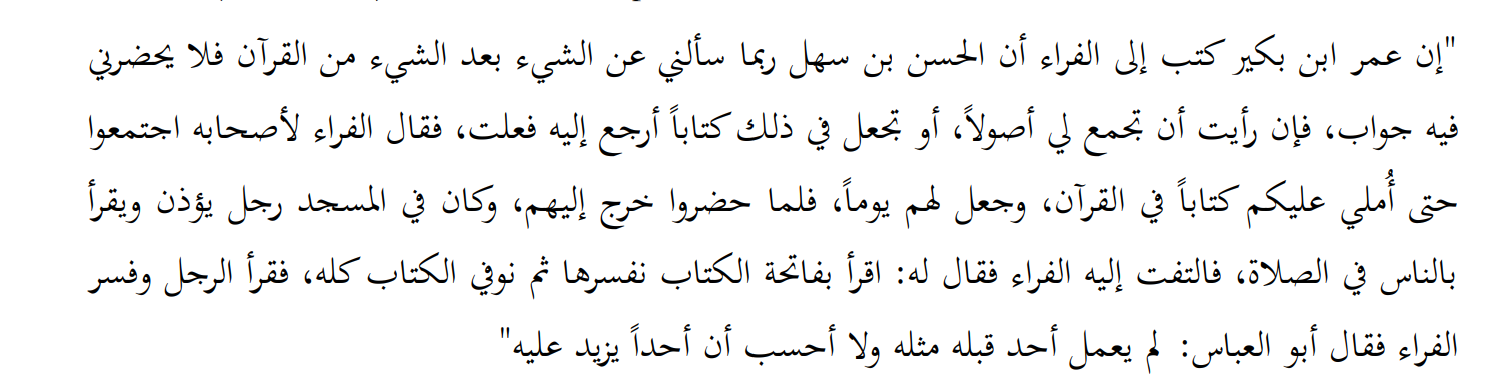
“欧麦尔·伊本·布凯尔致信给法拉厄,说哈桑·伊本·萨赫勒或许会接连向我询问《古兰经》中的许多问题,而我无法记住所有的答案。我认为你应当汇集其中的要点,编纂成一部书,以便我能够查阅。于是法拉厄对他的学生们说:你们聚集起来,我好向你们口述一部关于《古兰经》的书。他给了他们一天的时间。当他们到来时,他走到他们中间。清真寺里有一个人在宣礼,并与众人一同礼拜时诵读《古兰经》。法拉厄转向他说:诵读《古兰经》的首章(Fatihatul Kitab),我们将对它加以解释,然后再全面讲述整部经典。那人便诵读,法拉厄随即进行了释义。阿布·阿拔斯说:在他之前,从未有人做过类似的事,我也认为此后无人能够超越他。”
“Umar ibn Bukayr wrote to al-Farra' that al-Hasan ibn Sahl perhaps may ask me one thing after another from the Qur’ān but I will not be able to recall all the answers. I think you should bring together the essential points and compile them in a book I will refer to it, so al-Farra' said to his students; gather together so that I can dictate to you a book about the Qur’ān. He gave them a day. When they came he went to them, in the mosque there was man giving azan and reciting the Qur’ān with the people in prayer. Al-Farra' turned to him and said: recite the opening chapter of the Qur’ān (fatihatul kitab), we will explain it and then we will speak fully about the whole book. The man recited and al-Farra' made tafsīr. Abu al-'Abbas said: no one did anything like him before and I don't think anyone can add to that.'
随后,在他之后出现了伊本·贾里尔·塔巴里(卒于公元310年),他撰写了著名的《古兰经注》。在伊本·贾里尔的注释广为人知之前,已有若干部注释,例如伊本·朱莱哲的注释。他的情况与早期的圣训学家相同,这些学者收集所有传到他们手中的材料,而不区分正确(Sahih)与不正确的传述。人们说:"伊本·朱莱哲的目的不在于考证真伪;相反,他记录了关于每一节经文所传述的一切,无论其正确(Sahih)还是薄弱(saqim)。"此外,属于这些注释的还有苏迪的注释(卒于公元127年)和穆卡提尔的注释(卒于公元150年)。阿卜杜拉·伊本·穆巴拉克谈到穆卡提尔的注释时说:"他的注释多么出色,只可惜他不够可靠(thiqa)。"其中还有穆罕默德·伊本·伊斯哈格的注释。他惯于转述犹太教徒和基督教徒的说法,也常引用瓦哈卜·伊本·穆纳比赫、凯卜·艾哈巴尔等人的言论,他们转述的内容来自《讨拉特》、《引支勒》及其注释。这些注释并未流传到我们手中,不过伊本·贾里尔·塔巴里收集了其中的大部分,并将其纳入自己的著作。此后,注释家们一个接一个出现,以完整而有条理的方式,在内容全面、体系严密的著作中阐释《古兰经》。
Then, after him came Ibn Jarir al-Tabari (d.310 A.H.) who wrote his famous tafsīr. A number of tafsīrs before the tafsīr of Ibn Jarir became well known such as the tafsīr of Ibn Jurayj. His situation was the situation of the first muhaddithin who compiled everything that reached them without differentiating between the correct (Sahih) and incorrect reports. They said 'that Ibn Jurayj's aim was not authenticity; rather he reported everything that was reported about every ayah whether it was correct (Sahih) or weak (saqim).' Also from these tafsīrs is the tafsīr of al-Suddi (d.127 A.H.) and the tafsīr of Muqatil (d.150 A.H.). 'Abd Allah ibn al-Mubarak said about the tafsīr of Muqatil: How excellent is his tafsīr, if only he were reliable (thiqa).' Amongst them is also the tafsīr of Muhammad ibn Ishaq. He used to transmit from the Jews and Christians and he used to quote sayings of Wahb ibn Munabbih, Ka'b al-Ahbar and others, who reported thing from the Torah, Bible and their commentaries. These tafsīrs have not reached us, although Ibn Jarir al-Tabari has collected most of it and included it in his book. Then came mufassirun one after another explaining the Qur’ān in an complete and well-ordered manner in books that were complete and systematic.
然而,任何考察过各类tafsir(经注)的人都会发现,mufassirun(注释家)从不同角度对tafsir进行研究。有些人关注《古兰经》的文体与含义,以及其中在balaagha(修辞)方面的各种形式,以了解高雅卓越的言辞与其他言辞相比的独特之处。因此,他们的tafsir中修辞层面占据主导。Muhammad ibn al-Zamakhshari便是其中之一,他的tafsir名为al-Kashaf。也有人研究信仰的根基,驳斥伪信者,并与持异见者(反对伊斯兰)辩论,例如Fakhr al-Din al-Razi,其著名的tafsir为al-Tafsir al-Kabir。还有一些人研究Shari'ah(伊斯兰教法)的条例,致力于从经文中推导出这些条例,于是他们将兴趣投向ahkam(教法经文),例如通常被称为al-Jassas的Abu Bakr al-Razi,其广为人知的tafsir为Ahkam al-Qur'an。另有一些人追寻故事,将历史书籍和israiliyyat(以色列传说)中的内容添加到《古兰经》的故事中,凡所听闻,无论多寡,皆收集起来,却不加考订,即便那些与Shari'ah相抵触、不符合理智、或与意义确定的《古兰经》经文相矛盾的内容,也未加甄别。Sufi('Ala' al-Din 'Ali ibn Muhammad al-Baghdadi)即以al-Khazin之名为人所知,他在其tafsir Bab al ta'weel fi ma'ani al-tanzeel中便是如此。还有一些人专注于支持自己的mazhab(学派),并依据能够支持其派别的观点来解释经文,例如al-Shaykh al-Tibrisi的tafsir al-Bayan和al-Shaykh al-Tusi的tafsir al-Tibyan。这两部著作都支持什叶派在信仰('aqaid)和教法(ahkam)方面的观点与其学派立场。另有一些人只关注tafsir,旨在解释《古兰经》的经文与律例,而不带任何特定的立场。 他们是那些注释经文的学者,其tafsīr(注释)被视为各部tafsīr著作的精髓。他们也被视为tafsīr学及其他学科的伊玛目。例如伊本·哲里尔·泰伯里的tafsīr、艾布·阿卜杜拉·穆罕默德·古尔图比的tafsīr、纳赛菲的tafsīr以及其他人的著作。至于这个时代以及衰落时期末期所写的tafsīr,例如穆罕默德·阿卜笃的tafsīr、坦塔维·哲瓦希里的tafsīr和艾哈迈德·穆斯塔法·穆拉吉的tafsīr等,它们不被视为tafsīr文献的一部分,也没有人信任它们。这是因为在解释许多经文时,它们会对安拉的宗教造成危害,例如穆罕默德·拉希德·里达对这节经文的tafsīr:
However, anyone who inspects the tafaseer will find that the mufassirun approached the tafsīr from various perspectives. Some were interested in looking at the styles and meanings of the Book and whatever it included in terms of the forms of rhetorics (balaagha) to know the highest and distinguished forms of speech as compared to other types of speech. So the rhetorical aspect prevailed in their tafsīrs. One of those people is Muhammad ibn al-Zamakhshari in his tafsīr entitled al-Kashaf. There were those who looked into the foundations of belief, the fighting of pretenders and debating those who disagreed (with Islam) like Fakhr al-Din al-Razi in his famous tafsīr: al-Tafsīr al-Kabir. And some of them studied the Sharī’ah rules and were interested in deducing them from the verses. So they channelled their interest towards the verses of ahkām like Abu Bakr al-Razi commonly known as al-Jassas in his well known tafsīr Ahkām al-Qur’ān. There were those who went after stories and added to the Qur’ānic stories from the books of history and israiliyyat (Judaica) and began to collect everything they heard however meagre or abundant without revising the things that contradicted the Sharī’ah, did not agree with the mind or contradicted Qur’ānic ayāt which are definite in meaning. One such person is 'Ala' al-Din 'Ali ibn Muhammad al-Baghdadi, the sufi otherwise known as al-Khazin who did this in his tafsīr Bab al ta'weel fi ma'ani al-tanzeel. And there were those that concerned themselves with supporting their mazhab (school) and explaining the verses in accordance with whatever supports their faction like the tafsīr al-Bayan of al-Shaykh al-Tibrisi and the tafsīr al-Tibyan of al-Shaykh al-Tusi. Both of them supported the views of the Shi'a and their mazhab regarding belief ('aqaid) and ahkām. And there were those that were only concerned with the tafsīr in order to explain the verses and rulings of the Qur’ān regardless of any perspective. They are the mufassirun whose tafsīrs are considered the essence of the books of tafsīr. And they are considered the imams of tafsīr and other topics. Like the tafsīr of Ibn Jarir al-Tabari, the tafsīr of Abu 'Abd Allah Muhammad al-Qurtubi, and the tafsīr of al-Nasafi and others. As for the tafsīrs written in this age and towards the end of the period of decline like the tafsīr of Muhammad 'Abduh, the tafsīr of Tantawi Jawhari and the tafsīr of Ahmad Mustafa al-Muraghi and others, they are not considered part of the tafsīr literature and nor is there any trust put in them. This is because there is a risk in the deen of Allah in the explanation of many verses like Muhammad Rasheed Ridha’s tafsīr of the verse:
“凡不依据真主所降示的(律法)裁决的人,他们就是Fasiqun(悖逆者)。” [TMQ Mā’idah: 44]
“And whosoever does not judge by what Allahhas revealed, such are the Fasiqun (transgressors)” [TMQ Mā’idah: 44]
他允许印度的穆斯林采用英国法律,并服从英国法官的裁决。谢赫穆罕默德·拉希德·里达在广为人知的《古兰经注》(即《光明灯塔》)第六册中,于《筵席章》的注释里提到这一点,当时他在解释经文:
He permitted the Muslims of India to adopt English laws and submit to the rulings of English judges. Shaykh Muhammad Rasheed Ridha mentioned in volume six of the Tafsīr of the Noble Qur’ān widely known as al-Manar in the tafsīr of sura al- Mā’idah when he explained His saying:
“以及凡不依照安拉所降示的来裁决的人,他们就是法希格(悖逆者)。” [TMQ Mā’idah: 44]
“And whosoever does not judge by what Allah has revealed, such are the Fasiqun (transgressors)” [TMQ Mā’idah: 44]
在第406至409页中,他被问道:
In pages 406-409 he was asked:
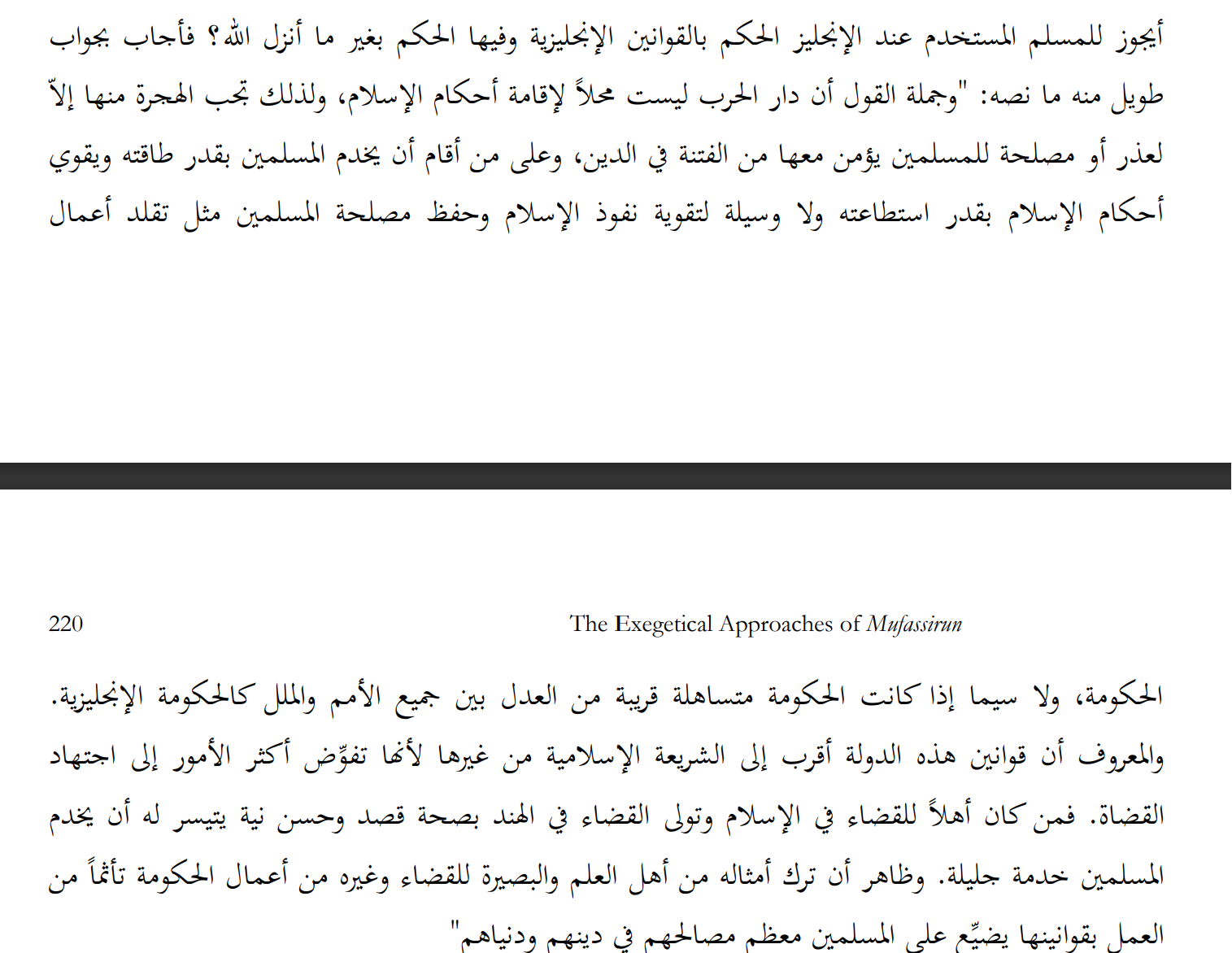
是否允许穆斯林受雇于英国人,依照英国的法律进行统治,而其中一些内容属于以非安拉所降示之法统治?他给出了一段长篇回答:“简而言之,战争之地(dar al-harb)并非建立伊斯兰律法的地方,因此,除非有某种借口,或对穆斯林有利,使他能够在宗教上免受考验(fitna),否则迁徙(hijra)是必须的。居住在(印度)的人有责任尽其所能为穆斯林服务,并尽可能加强伊斯兰律法。除了担任政府职位之外,没有其他途径可以加强伊斯兰的影响力、维护穆斯林的利益,尤其是当政府像英国政府那样对所有民族和宗教都宽容且相对公正的时候。众所周知,这个国家的法律比其他国家的法律更接近伊斯兰教法(Sharī’ah),因为它将大多数事务交由法官的伊吉提哈德(Ijtihād)裁断。因此,凡是具备伊斯兰法官资格、怀着正确目的和良好意图在印度司法系统中任职的人,都有可能为穆斯林做出重大贡献。显然,如果有学识和见识的人因为要依照他们(即英国人)的法律工作而认为是罪过,从而放弃司法及其他政府职位,那么穆斯林在宗教和今世的利益就会因此受损。”
Is it permitted for a Muslim to be employed by the English to rule by English laws some of which constitutes ruling by other than what Allah has revealed ? He gave a long reply: 'In short, the abode of war (dar al-harb) is not a place for the establishment of the rules of Islam, therefore it is obligatory to make hijra unless there is an excuse or benefit for the Muslims due to which he will be safe from the fitna (test) on his deen. It is incumbent on the one who resides (in India) to serve the Muslims according to the best of his abilities and to strengthen the rules of Islam as much as he can. And there is no means of strengthening the influence of Islam and protecting the interests of the Muslims except by assuming the government posts especially if the government is lenient and fairly just between all people and religions like the English government. It is well known that the laws of this country are closer to the Islamic Sharī’ah than others because it delegates most matters to the Ijtihād of judges. So whoever is qualified to be a judge in Islam and takes up a post in the judiciary in India with the correct aim and good intention, it is possible for him to do a great service for the Muslims. It is obvious that the abandonment of the judiciary and other government posts by the people of knowledge and insight due to being sinful for working according to their (i.e The English) laws will forfeit the interests of the Muslims in their deen and dunya.'
然后他说:
Then he said:
“由此可见,穆斯林在英国政府统治下的印度任职(以及任何其他类似的工作)并依照其法律进行裁决,属于一种许可(rukhsa),它属于在没有‘azeema’的情况下两害相权取其轻的原则之列,而所谓‘azeema’,是指旨在支持伊斯兰教并维护穆斯林利益的做法……”
“It is obvious from all of this that the Muslim's acceptance to work in the English government in India 'and any other similar work' and his ruling according to their laws is a dispensation (rukhsa) which comes under the principle of doing the lesser of two evils if there is no 'azeema by which support of Islam and protecting the interests of Muslims is intended…”
与此相类的还有坦塔维·朱哈里的《古兰经注》,他提到《古兰经》中包含现代科学与学科,并在其注释中充斥着各种鸟类和动物的图片,以证明《古兰经》确实解释了这些事物。还有穆斯塔法·宰德的《古兰经注》,他对天使和沙yā¹¹ṭīn(恶魔)的存在作了解释并加以否定。因此,他因其注释而犯了迷信(kufr),并使自己脱离了伊斯兰教。这些注释及其同类著作,穆斯林并不视为真正的古兰经注作品,其解释也不被采纳。
Much similar is the tafsīr of Tantawi Jawhari where he mentioned that there are modern sciences and disciplines in the Qur’ān and he filled his tafsīr with pictures of birds and animals to demonstrate that the Qur’ān did explain such things. And the tafsīr of Mustafa Zayd in which he interpreted and rejected the existence of angels and Shayateen. So he committed kufr by his tafsīr and took himself outside of Islam. These tafsīrs and their likes are not considered books of tafsīr by the Muslims and nor are their explanations given any consideration