17. 哈里发制度
17. The Khilafah
哈里发制度是为全世界所有穆斯林设立的总体或全面的领导体制,其目的在于建立伊斯兰教法(Shari'ah),并向世界传播伊斯兰的召唤(da'wa)。它与伊玛目制(Imamah)是同一个意思,因为伊玛目制与哈里发制具有相同的含义。多段圣训(ahadith)中以相同的含义提及二者。在任何沙里亚文本,即《古兰经》或圣训(Sunnah)中,这两个术语从未具有不同的含义,因为这两者是仅有的沙里亚渊源。坚持使用哈里发或伊玛目这一名称并非必须,而坚持其所指的含义才是必须的。
The Khilafah is the general or overall leadership for all the Muslims in the world in order to establish the laws of the Islamic Shari’ah and to carry the da’wa of Islam to the world. It is the same as the Imamah, as the Imamah and Khilafah have the same meaning. Several saheeh ahadith mention them with the same meaning. Neither of the two terms has ever come with any meaning different from the other in any Shari’ah text i.e. the Qur’an or the Sunnah, as these two (sources) are the only Shari’ah sources. It is not compulsory to hold to the term of Khilafah or Imamah, but rather it is compulsory to hold to the meaning of the term.
在世界各地的所有穆斯林,建立哈里发都是一项义务。与穆斯林必须履行的任何其他义务一样,建立哈里发是真主(SWT)所规定的,不存在选择或宽容的余地。怠慢履行此义务,是最严重的罪过之一,真主(SWT)将以最严厉的惩罚加以惩处。
Establishing the Khilafah is an obligation upon all Muslims in all regions of the world. Establishing it, like the performing of any obligation that Allah (swt) obliged upon Muslims, is an inevitable matter without choice or leniency in it. Negligence in performing it is one of the worst sins for which Allah (swt) punishes with the strictest of the punishments.
穆斯林建立哈里发(Khilafah)的依据来自:《古兰经》、圣训(Sunnah)以及圣门弟子的一致意见(Ijmaa as-Sahabah)。
The evidence for establishing the Khilafah upon all Muslims (come from): The Qura'n, The Sunnah and Ijmaa as-Sahabah.
至于《古兰经》,安拉(SWT)命令使者(ﷺ)依据祂所降示给他(ﷺ)的一切来在穆斯林之间进行裁决,而且祂(SWT)对他(ﷺ)的命令是明确而坚决的。安拉(SWT)对先知(ﷺ)说道:
As for the Qura'n, Allah (swt) has ordered the Messenger (saw) to rule between Muslims by all that He (swt) revealed to him (saw), and His order (swt) to him was in a decisive manner. Allah (swt) addressed the Prophet (saw) saying:
"你当依真主所降示的(经典)在他们之间裁决,不要顺从他们的私欲,而背离降临你的真理。" [TMQ 5:48]
"And rule between them by that which Allah revealed to you, and do not follow their vain desires away from the truth which came to you" [TMQ 5:48]
他(SWT)说:
And He (swt) said:
"并且你要依照安拉所降示的来在他们之间裁决,不要顺从他们的私欲,并当谨慎,免得他们使你偏离安拉降示你的部分经文。" [TMQ 5:49]
"And rule between them by that which Allah revealed to you and do not follow their whims, and beware (be on the alert) that they may deviate you away from even some part of what Allah revealed to you" [TMQ 5:49]
安拉(SWT)对先知(ﷺ)的训谕,是对他的乌玛(穆斯林共同体)的训谕,除非有证据将该训谕限定于他(ﷺ)本人。此处并无此类证据,因此该训谕是对所有穆斯林的命令,要求他们确立法度(hukm)。确立哈里发并不意味着别的什么,它就是确立法度与权威。此外,安拉(SWT)使穆斯林有义务服从掌权者,即统治者,这表明穆斯林必须存在一位掌权者。安拉(SWT)说:
The speech of Allah (swt) to the Prophet (saw) is a speech to his Ummah unless there is evidence which limits the speech to him (saw). In this case there is no such evidence, so the address is to all the Muslims to establish the rule (hukm). The establishment of the Khalifah does not mean other than the establishment of the rule and the authority. Moreover, Allah (swt) made it obligatory upon Muslims to obey those in authority i.e. the ruler, which indicates that the existence of the one in authority is obligatory upon Muslims. Allah (swt) said:
"信道的人们啊!你们当服从真主,服从使者,也服从你们中的主事人。" [TMQ 4:59]
"O you who believe obey Allah and obey the Messenger and those in authority amongst you" [TMQ 4:59]
安拉(SWT)不会命令服从一个不存在的人。这表明掌权者的存在是必需的。当安拉(SWT)命令服从掌权者时,也就是在命令设立他们。设立统治者的结果是设立沙里亚律法(hukm shar'i),而不设立统治者,则会导致沙里亚律法(hukm shar'i)被搁置。因此,统治者的存在是必需的,因为不设立他所导致的结果,属于被禁止之事,即搁置沙里亚律法(hukm shar'i)。
Allah (swt) does not order obedience to someone who does not exist. This indicates that the existence of the person in authority is obligatory. When Allah (swt) commands obedience to those in authority then He (swt) is commanding their establishment. The result of establishing the ruler is the establishment of the Shari’ah rule (hukm shar’i) and the failure to establish it will result in neglecting the Shari’ah rule (hukm shar’i). Thus his existence is obligatory as the result of the failure to establish it is will be from the prohibited matters i.e. the neglect of the Shari’ah rule (hukm shar’i).
至于圣行(Sunnah),纳菲尔传述说:阿卜杜拉·本·欧麦尔对我说,他听到先知ﷺ说:
As for the Sunnah, Nafi‘ reported saying: Abdullah bin ‘Umar said to me that he heard the Prophet (saw) saying:
“凡从服从中抽手者,复活日他见到真主时将没有任何证据;凡死时颈上没有效忠之约(bay'ah)者,他死的是蒙昧时代(jahiliyyah)的死亡。”
“Whoever removes his hand from obedience will meet Allah on the Day of Resurrection without having any proof for him, and whoever dies without a pledge of allegiance (bay’ah) on his neck dies a death of ignorance (jahiliyyah).”
所以先知(saw)使每位穆斯林颈上都有一份效忠誓约(bay’ah)成为必须,并说明:凡死时颈上没有效忠誓约的人,他是死于蒙昧时代(jahiliyyah)的死亡。效忠誓约只能给予哈里发(Khalifah),不能给予其他任何人。先知(saw)使每位穆斯林颈上有一份对哈里发的效忠誓约成为义务,但他并没有使每位穆斯林向哈里发效忠成为义务。义务在于每位符合条件的穆斯林颈上都存在一份效忠誓约,也就是说存在一位哈里发,他相应地应当获得每位穆斯林颈上的效忠誓约。因此,正是哈里发的存在使每位穆斯林颈上都有效忠誓约,无论该穆斯林是否实际亲自向他效忠。所以,先知(saw)的这段圣训证明的是哈里发的设立是义务,而不是证明效忠本身是义务。这是因为先知(saw)所责备的是穆斯林直到死时颈上没有效忠誓约,而他并没有责备不效忠这一行为本身。穆斯林(Muslim)从阿拉只(Al-’Araj)那里转述,阿拉只从艾卜·胡莱赖(Abu Hurairah)(ra)那里转述,先知(saw)说:
So the Prophet (saw) made it compulsory upon every Muslim to have a bay’ah on his neck, and described that whoever dies without a bay’ah on his neck that he dies a death of jahiliyyah. The bay’ah cannot be for anyone except the Khalifah. The Prophet (saw) made it obligatory upon every Muslim to have on his neck a bay’ah to a Khalifah, yet he did not make it an obligation upon every Muslim to give bay’ah to a Khalifah. The duty is the existence of a bay’ah on the neck of every eligible Muslim i.e. the existence of a Khalifah who accordingly deserves a bay’ah upon the neck of every Muslim. So it is the presence of the Khalifah which places a bay’ah on the neck of every Muslim, whether the Muslim actually gave a bay’ah to him (in person) or not. Therefore, this hadith of the Prophet (saw) is evidence that the appointment of the Khalifah is an obligation and not a proof that giving the bay’ah is obligatory. This is so because what was rebuked by the Prophet (saw) was the absence of a bay’ah on the neck of a Muslim until he dies, but he did not rebuke the absence of the bay’ah. Muslim narrated from Al-’Araj from Abu Hurairah (ra) from the Prophet (saw) who said:
“看哪,伊玛目是一面盾牌,人们在他身后作战,并借助他来保护自己。”
“Behold, the Imam is a shield from behind whom the people fight and by whom they protect themselves.”
而穆斯林(Muslim)从艾布·哈齐姆(Abu Hazim)处转述,他说:
And Muslim reported from Abu Hazim who said:
“我陪伴艾卜·胡莱赖five年,听他转述先知说:‘先知们统治以色列的后裔。每当一位先知去世,另一位先知便接替他,但我之后不会再有先知。将会有哈里发,而且人数众多。’有人问:‘那么您命令我们做什么呢?’他说:‘依次向他们效忠,并把他们应得的权利交给他们。真主必定会询问他们,关于祂所托付给他们的事务。’” Note: the instruction about ﷺ applies to the Prophet Muhammad, so I should add it after each mention. Corrected version: “我陪伴艾卜·胡莱赖五年,听他转述先知ﷺ说:‘先知们统治以色列的后裔。每当一位先知去世,另一位先知便接替他,但我之后不会再有先知。将会有哈里发,而且人数众多。’有人问:‘那么您命令我们做什么呢?’他说:‘依次向他们效忠,并把他们应得的权利交给他们。真主必定会询问他们,关于祂所托付给他们的事务。’”
“I accompanied Abu Hurairah for five years and heard him reporting from the Prophet who said: The Prophets ruled over the children of Israel. Whenever a Prophet died another Prophet succeeded him, but there will be no Prophet after me. There will be Khulafaa and they will number many. They asked: What then do you order us? He said: Fulfil the bay’ah to them one after the other and give them their due right. Surely Allah will ask them about what He entrusted them with.”
而从伊本·阿拔斯处传来,先知ﷺ说:
And from bin ‘Abbas from the Prophet (saw) who said:
“如果有人在他的埃米尔身上看到令他不悦的事,就让他保持忍耐。因为,你们要知道,凡是与苏丹(伊斯兰权威)分离哪怕一个手掌的距离,并在此状态下死去的人,就是死于蒙昧时期(jahiliyyah)的死亡。”
“If anyone sees in his Amir something that displeases him let him remain patient. For, behold, he who separates himself from the sultan (authority of Islam) by even so much as a hand span and dies thereupon, has died a death of jahiliyyah”.
在这些圣训中,先知(saw)告知我们,领导者将管理穆斯林的事务,其中包括将哈里发描述为盾牌,即保护者。因此,将伊玛目描述为盾牌,说明了伊玛目在场的益处,所以这是一个要求行动的命令。这是因为,如果真主(swt)和先知(saw)所传达的信息包含谴责,那么它就是禁止的命令;如果包含赞扬,那么它就是要求行动的命令。如果所要求的行动对于执行一项沙里亚律例(hukm shar‘i)是必需的,或者因为忽视它而会使某项沙里亚律例被荒废,那么这一命令就是决定性的。在这些圣训中,还有信息表明,管理穆斯林事务的人是哈里发,这表明有命令要求委任他们。圣训中也包含禁止穆斯林脱离权威的内容,这表明穆斯林有义务为自己设立一位权威,即实行统治。此外,先知(saw)命令穆斯林服从哈里发,并与那些质疑其哈里发权威的人作战,这表明有命令要求设立哈里发,并通过与任何挑战其统治的人作战来保卫其哈里发职位。穆斯林圣训实录中记载,先知(saw)说:
In these ahadith, the Prophet (saw) informs us that leaders will run the affairs of Muslims, and they include the description of the Khalifah as a shield i.e. a protection. So the description of the Imam as a shield is informative of the benefits of the presence of the Imam, thus it is a command for action. This is because if the information conveyed by Allah (swt) and the Prophet (saw) contained rebuke then it is a command of prohibition, and if it contained praise then it is a command for action. If the ordered action is necessary to implement a hukm shari’ (Shari’ah rule), or by its negligence a hukm shar‘i will be neglected, then this command is decisive. In these ahadith there is information also that those who run the affairs of Muslims are Khulafaa, which indicates an order to appoint them. They also include a prohibition for Muslims to separate from the authority, which indicates the obligation upon Muslims to appoint an authority for themselves i.e. ruling. Moreover, the Prophet (saw) ordered the Muslims to obey the Khalifah and to fight those who dispute his authority as Khalifah, which indicates an order to appoint a Khalifah and to protect his Khilafah by fighting against whosoever disputes with him. Muslim reported that the Prophet (saw) said:
“凡向一位伊玛目宣誓效忠、与他握手并献上内心诚意的人,应当尽其所能服从他;如果另有人前来与他争夺权位,你们就应当砍掉那人的脖子。”
“He who pledged allegiance to an Imam giving him the clasp of his hand and the fruit of his heart shall obey him as long as he can, and if another comes to dispute with him you have to strike the neck of that man.”
因此,服从伊玛目的命令,就是要确立他的地位;而对与他争夺权位者予以讨伐的命令,则证明这一命令具有决定性,是维系唯一哈里发存在的关键。
So the command to obey the Imam is an order to establish him, and the command to fight those who dispute with him is evidence that this command is decisive in maintaining the presence of one Khalifah.
关于圣门弟子(愿真主喜悦他们)的公议(伊杰玛尔),他们一致认为,先知(ﷺ)去世后必须设立继承人或哈里发,并且在每一任哈里发去世后,他们都一致同意推举继任者:先是艾卜·伯克尔,然后是欧麦尔,再后是奥斯曼。圣门弟子关于设立哈里发的公议,在先知(ﷺ)去世后的事件中表现得尤为明显:他们推迟了先知(ﷺ)的安葬,而忙于为他推选继承人,尽管安葬亡者是天经地义的义务(法尔德),而负责料理丧事的人在完成安葬之前从事其他事务是被禁止的(哈拉姆)。圣门弟子本应投身于准备先知(ﷺ)的安葬,然而他们中有人却去忙于推选哈里发而非执行安葬,另有一些人则对这一耽搁保持沉默,并参与了长达两夜的推迟,尽管他们本有能力反对这种拖延,也有能力安葬先知(ﷺ)。因此,这构成了一项公议:宁可去推选哈里发,也不去安葬亡者。这样做只有在设立哈里发比安葬亡者更为重要的情况下才可能是合法的。此外,所有圣门弟子在其一生中都一致认为设立哈里发是义务。尽管他们在推选哈里发的人选上存在分歧,但他们从未在设立哈里发这一问题上产生分歧,无论是在先知(ﷺ)去世时,还是在任何一位正统哈里发去世时。因此,圣门弟子的公议是设立哈里发为义务的清楚而有力的证据。
As for the Ijma’a of the Sahabah (ra) they all agreed upon the necessity to establish a successor or Khalifah to the Prophet (saw) after his death, and they all agreed to appoint a successor to Abu Bakr, then to ‘Umar, then to ‘Uthman, after the death of each one of them. The Ijma’a of the Sahabah (ra) to establish a Khalifah manifested itself emphatically when they delayed the burial of the Prophet (saw) after his death while engaged in appointing a successor to him, despite the fact that the burial of the dead person is fard, and that it is haram upon those who are supposed to prepare for his burial to engage themselves in anything else until they complete the burial. The Sahabah (ra) were obliged to engage themselves in preparing the burial of the Prophet (saw), instead some of them engaged themselves in appointing a Khalifah rather than carrying out the burial, and some others kept silent on this engagement and participated in delaying the burial for two nights despite their ability to deny the delay and their ability to bury the Prophet (saw). So this was an Ijma’a to engage themselves in appointing a Khalifah rather than to bury the dead. This could not be legitimate unless the appointment of a Khalifah is more obligatory than the burial of the dead. Also, all the Sahabah (ra) agreed throughout their lives upon the obligation of appointing a Khalifah. Although they disagreed upon the person to be elected as a Khalifah, they never disagreed upon the appointment of a Khalifah, neither when the Prophet (saw) died, nor when any of the Khulafaa ar-Rashidun died. Therefore the Ijma’a of the Sahabah is clear and strong evidence that the appointment of a Khalifah is obligatory.
此外,建立伊斯兰教并在生活的各个层面实施沙里亚律例,是穆斯林通过确凿可靠的证据所承担的义务。这一义务若无拥有权威的统治者便无法实现。沙里亚原则指出:
Also the establishment of Islam and the implementation of the Shari’ah rules in all walks of life is compulsory on Muslims through definitely proven evidences. This duty cannot be achieved unless there is a ruler who has an authority. The Shari’ah principle states:
“为完成一项义务(wājib)所必需的事物,本身也是义务。”
‘What is necessary to accomplish a wajib (duty) is itself a wajib’
因此,根据这一天启原则,建立哈里发制度同样是必尽的义务。
So the establishment of a Khalifah is also compulsory according to this divine principle.
因此,从这些证据中可以清楚看出,在穆斯林中建立统治权和权威是فرض(义务),而且很明显,任命一位执掌统治权和权威的哈里发,是穆斯林的必尽之责,其目的在于执行伊斯兰教法的各项规定,而非仅仅为了统治和权威本身。请思考穆斯林圣训学家穆斯林(Muslim)所记载的先知ﷺ的圣训,该圣训经由欧夫·本·马立克传述:
Therefore, it is clear from these evidences that the establishment of the rule and the authority amongst Muslims is fard, and it is also clear that the appointment of a Khalifah who takes the charge of the rule and the authority is compulsory upon Muslims in order to implement the Shari’ah rules and not merely for the sake of rule and authority in themselves. Reflect upon what Muslim narrated of his saying (saw) via ‘Awf bin Malik:
“你们最好的伊玛目(领袖)是你们爱他们、他们也爱你们,为你们祈祷、你们也为他们祈祷的人;你们最坏的伊玛目是你们憎恨他们、他们也憎恨你们,你们诅咒他们、他们也诅咒你们的人。有人问安拉的使者ﷺ:难道我们不该用剑对抗他们吗?他说:不要,只要他们在你们中间维持礼拜(即伊斯兰教)。”
“The best of your Imams (leaders) are those whom you love and they love you, who pray for you and you pray for them; and the worst of your Imams are those whom you hate and they hate you and you curse them and they curse you. The Messenger of Allah (saw) was asked: Should we not face them with the swords? He said: No, not as long as they establish salat (meaning Islam) among you.”
这段圣训清楚地说明了善良的领袖与恶劣的领袖之分,并且明确禁止只要他们维护宗教,就以刀剑对抗他们,因为建立礼拜表明了对宗教的坚守与依其治理。
This hadith is clear in informing about the good and bad leaders, and clear in prohibiting confronting them with the sword as long as they establish the deen, since establishing the salat (prayer) indicates upholding of the deen and ruling by it.
因此,穆斯林有义务任命哈里发,由其来执行伊斯兰的律法并传达伊斯兰的宣教,这一点在沙里亚的可靠经文中是确定无疑的。此外,这也是一项义务职责,因为真主(SWT)已使建立伊斯兰的统治和保护穆斯林的尊严成为穆斯林的法定责任。然而,这一职责是集体性的,因此若乌玛中有部分人完成了它,法定义务即已履行,其余乌玛的责任也随之解除。若乌玛的一部分人未能完成此项法定义务,即便他们已采取了确立此义务的各项行动,责任仍落在所有穆斯林身上,只要穆斯林没有哈里发,此项法定义务便对每一位穆斯林都仍然存在。
So the obligation upon Muslims to appoint the Khalifah who establishes the laws of Islam and conveys its call is a matter which has no doubt with regard to its certainty in the sound texts of Shari’ah. Moreover, it is an obligatory duty due to the fact that Allah (swt) made it fard upon Muslims to establish the rule of Islam and to protect the honour of Muslims. However, this duty is a collective one, so if some people of the Ummah accomplished it, the fard is fulfilled and thus responsibility drops from the rest of the Ummah. And if part of the Ummah was unable to achieve the fard, though they carried out the actions which establish it, then the responsibility remains upon all the Muslims, and the fard remains upon every Muslim as long as Muslims are without a Khalifah.
不为穆斯林建立哈里发,是最大的罪过之一,因为这是放弃履行伊斯兰教中最重要的义务之一,伊斯兰教的实行有赖于此;甚至伊斯兰在生活的战场上能否存在,也取决于此。因此,穆斯林整体若不为所有穆斯林建立哈里发,便共同犯下大罪。如果他们一致同意在没有哈里发的情况下继续如此,那么罪过将落在所有有人居住的地区(即整个世界)的全体穆斯林身上。然而,如果一部分穆斯林着手努力建立哈里发,而其他人没有,那么罪过便从那些开始为建立哈里发而努力的人肩上卸下,尽管这项天课(法定义务)仍然落在他们身上,直到哈里发被任命为止。这是因为投身于建立这项义务,可以消除因未能在适当时间建立它而产生的罪过,也可以消除因其未被建立而产生的罪过,原因在于人为建立它而努力,并憎恶那阻碍他建立它的事物。
To refrain from establishing a Khalifah for the Muslims is among the greatest sins because it is abstaining from carrying out among the most important obligations of Islam upon which the implementation of the deen depends; nay even the very existence of Islam in the battlefield of life depends upon it as well. So Muslims as a whole commit a great sin by refraining from establishing a Khalifah for all Muslims. And if they all agreed to remain without a Khalifah the sin would befall all Muslims in all inhabited regions (entire world). However, if some of the Muslims embarked on working to establish a Khalifah and the others did not, the sin will drop from the shoulders of those who started to work to establish the Khalifah though the fard remains upon them until the Khalifah is appointed. (This is so) because the involvement in establishing the fard removes the sin for the delay in establishing it in its proper time, and for its non-establishment, due to one’s work to establish it and his hatred of that which prevents him from establishing it.
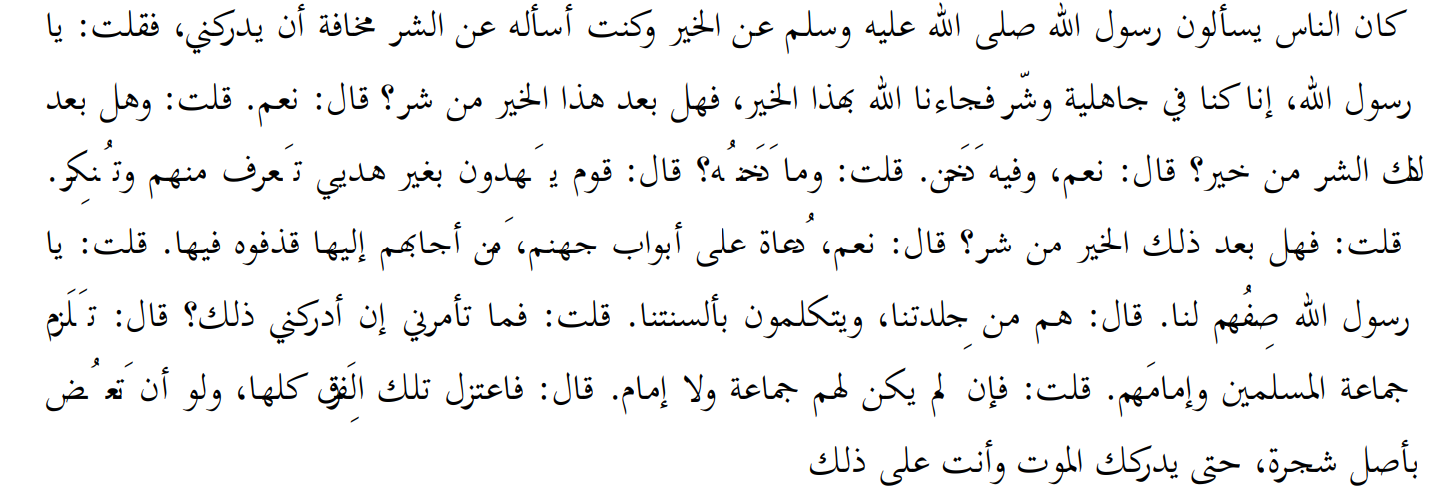
“人们过去常问先知(愿主赐福他并使他平安)关于善的事,而我则问他关于恶的事,唯恐它会降临到我身上。于是我说:安拉的先知啊!我们曾处于蒙昧无知与纷乱的时代,之后安拉将这份善带给了我们,那么在这份善之后还会有纷乱吗?他(愿主赐福他并使他平安)说:会有。我说:在那纷乱之后还会有善吗?他说:会有,但其中带有烟雾(烟)。我说:那烟雾是什么?他说:是一些人以引导者自居,但并非遵循我的引导。你会认出其中一些人,也会否认其中一些人。我说:在那份善之后还会有纷乱吗?他说:会有,会有一些号召者(du'at)站在地狱之门口招人入内。凡接受他们号召的人,他们就把他投入火中。我说:安拉的先知啊,请为我们描述一下他们。他说:他们与我们同类,说着我们的语言。我说:如果那件事降临到我身上,您命令我怎么做?他说:坚守穆斯林的大集体及其伊玛目。我说:如果穆斯林既没有大集体,也没有伊玛目呢?他说:那么就远离所有这些派别,即使你不得不咬住树根,直到死亡降临到你身上,也要如此。”
“The people used to ask the Prophet of Allah (saw) about the good and I used to ask him about the bad in fear that it might catch me. So I said: O Prophet of Allah! We were in times of jahiliyyah and mischief then Allah brought us this good, so is there any mischief after this good? He (saw) said: Yes. I said: Will there be any good after that mischief? He said: Yes, and it has smoke (dukhan). I said: What is its smoke? He said: People guiding but not on my guidance. You recognise some (from them) and deny some. I said: Will there be any mischief after that good? He said: Yes, callers (du’at) who invite at the doors of Hellfire. They throw him into it (hell) whoever accepted their invitation. I said: O Prophet of Allah, describe them to us. He said: They are of our own skin (of our people) and talk our language. I said: What do you order me to do if that (matter) caught me? He said: Adhere to the jama‘ah of Muslims and their Imam. I said: What if the Muslims have no jama‘ah nor an Imam? He said: Then separate from all those groups, even if you (have to) bite the root of a tree till death comes to you as such.”
这段圣训的表述清楚明确:先知(saw)命令穆斯林坚持穆斯林的jama‘ah,服从他们的伊玛目,并远离那些招人走向火狱之门的人。提问者问他,在穆斯林既没有伊玛目、也没有jama‘ah的情况下,他该如何对待那些站在火狱之门的呼吁者;于是先知(saw)命令他与所有这些团体隔绝,既不与穆斯林脱离关系,也不放弃建立伊玛目的努力。因此他的命令很明确:"与所有这些团体隔绝。"他还强调了与这些团体的隔绝,甚至到了这样的程度:即便他与他们隔绝,也要咬住一棵树的树干,直到死亡降临到他身上。其含义是:坚守你的宗教,远离那些站在火狱之门的误导性呼吁者。 在这段圣训中,并没有任何借口或许可(供任何人)放弃建立哈里发的工作;它仅限于要求坚守宗教、抛弃那些站在火狱之门的呼吁者。如果他不努力建立哈里发,罪责仍将落在他身上。因此,他被命令抛弃误导性的团体,以保全自己的宗教,使其免受误导者的侵害,即便他必须咬住树根;但他不应远离穆斯林共同体,也不应放弃建立宗教法律和为穆斯林确立伊玛目的工作。
This hadith is clear in its expression that the Prophet (saw) ordered the Muslims to adhere to the jama‘ah of Muslims and to adhere to their Imam, and to leave those who invite people to the doors of hell. The questioner asked him what he has should do in relation to those callers at the doors of Hellfire in the situation wherein the Muslims have no Imam and no jama‘ah; thereupon the Prophet (saw) ordered him to separate from all these groups, not to disassociate himself from the Muslims nor to abstain from the action for establishing an Imam. So his order is clear “Separate from all those groups”, and he emphasised the separation from those groups even to the extent that his isolation from them would make him clench to the trunk of a tree until death comes to him. Its meaning is to adhere to your deen and keep away from the misguiding callers who are at the doors of Hellfire. In this hadith there is no excuse or permission (for anybody) to abandon the work for establishing a Khalifah, it is, rather, confined to the command of adhering to the deen and abandoning the callers at the doors of hell, and the sin will remain on him if he does not work to establish a Khalifah. So he is ordered to abandon the misguiding groups in order to save his deen from the callers of the misguidance, even if he had to bite the root of a tree, but not to distance himself from the Muslim community and abandon the work for establishing the laws of the deen and establishing an Imam for Muslims.
另一个例子是布哈里从艾布·赛义德·胡德里传述的圣训,他说:
Another example is what al-Bukhari narrated from Abu Said al-Khudri, who said:
真主的使者(ﷺ)说:"将来会有一个时代,穆斯林最好的财产将是羊群,他会把羊群带到山顶和雨水降落之处(山谷),以便带着自己的宗教躲避纷争(fitan)。"
“The Messenger of Allah (saw) said: A time will come that the best property of a Muslim will be sheep which he will take on the top of mountains and the places of rainfall (valleys) so as to flee with his religion from afflictions (fitan)”
这并不意味着人应当与穆斯林群体隔绝、放弃遵行宗教的律法,或在世上没有哈里发国的情况下不为穆斯林建立哈里发制度。这段话的内容,只是说明在考验之时穆斯林最好的财富是什么;它并不鼓励与穆斯林分离,也不鼓励远离众人、与人隔绝。
This does not mean that one should isolate oneself from the Muslim community, abandon practising the laws of the deen and establishing a Khalifah for Muslims when there is no Khilafah on earth. All that it contains is an explanation of what is the best wealth of the Muslim at the times of affliction; it does not encourage separation from the Muslims and isolation from the people.
因此,地球上没有哪位穆斯林有借口放弃建立伊斯兰教(deen)这一由安拉(SWT)所命令的责任,即在地球上已无哈里发国(Khilafah)的情况下,建立穆斯林的哈里发政权(Khalifah);在没有人执行安拉(SWT)的刑罚(hudood)以保护安拉(SWT)的神圣事物的情况下,在没有人执行伊斯兰教的律法、并在“除安拉外没有应受崇拜的主,穆罕默德是安拉的使者”的旗帜下统一穆斯林社区的情况下,建立这一政权乃是责任所在。伊斯兰教中没有任何允许,可以在这一责任真正完成之前放弃为之努力。
Accordingly, no Muslim on the face of this earth has an excuse to abandon the duty of establishing the deen which Allah (swt) has ordered, that is, the establishment of a Khalifah for Muslims when there is no Khilafah on the earth, when there is no one to implement the punishments (hudood) of Allah (swt) to protect the sanctities of Allah (swt), and no one to implement the laws of the deen and unify the Muslim community under the banner of La ilaha illa Allah, Muhammad ur-Rasul Allah. There is no permission in Islam to abandon the work for this duty until it is indeed completed.