9. 科学与文化
9. Science And Culture
在阿拉伯语中,人们说:“这个人获得了(‘alima)知识(‘ilm)。”这意味着他达到了知识(‘ilm)的真实本质。他获得某事的知识,意味着他了解了它,也就是说他被告知了某件事,或者与它有所熟悉。语言中还说:他获得了领悟(thaqifa),意思是他变得精通,因此他受过教育并有文化修养(thaqif)。他理解(thaqifa)了一门语言,意思是他已经掌握并迅速理解了它。这些语言学意义是词语使用的基础。然而,如果这些词语被用来表示与其语言学意义相关的其他含义,那也是允许的,例如语法中采用“fa’il”(主语)一词的情况。词语的语言学意义曾占主导地位,这也是古人将“‘ilm”一词用于一切形式的知识、不区分各门学科的原因。 后来,人们开始认为理智性和自然性的学科对所有人都是通用的,而其他传统(文本性)学科则被视为只属于其传入的民族所有。此后,“科学”(‘ilm)和“文化”(thaqafa)各自根据不同的特定学科加以定义,获得了不同于其语言学含义的术语含义。按照这种术语,它们具有如下含义:科学(‘ilm)是通过观察、实验和教育所获得的知识,如物理学、化学以及其余的经验科学;文化(thaqafa)是通过传承、学习和推理所获得的知识,如历史、语言、教法学(fiqh)、哲学以及其余的非经验性学科。 还有一些非经验性的学科,虽然属于文化(thaqafa)的范畴,却被视为知识(‘ilm)的一部分,例如算术、工程和工业。尽管它们归于文化,但因其对所有人都具有普遍性,而并非专属于某一个民族,所以被视为科学的组成部分。同理,文化中与工业相似的手工技艺,如贸易和航运,也被视为知识的一部分,因为它们同样具有普遍性。至于绘画、雕塑和音乐等艺术,则属于文化。它们遵循某种特定的观点,即一种具体的文化。文化(thaqafa)与知识(‘ilm)之间的区别。
In Arabic language it is said: the man has obtained (‘alima) knowledge (‘ilm). This means that he attained the true reality of knowledge (‘ilm). He gained knowledge of a thing means he became cognisant of it, which means that he became informed of a matter or acquainted with it. Also in the language it is said: He has gained comprehension (thaqifa), which means that he has become proficient, thus he is educated and cultured (thaqif). He has understood (thaqifa) a language (means) he has mastered and understood it swiftly. These linguistic meanings are the basis of the use of words, However if these words were used to indicate other meanings that relate to the linguistic meaning then that is permitted, like in the case of the adoption of the word fa’il (subject) in grammar for example. The linguistic meaning (of the words) was prevailing and this is why the ancients used to apply the word ‘ilm on all forms of knowledge without differentiating between the sciences and disciplines. Then people began to consider intellectual and natural disciplines as being general to all people whilst other traditional (textual) disciplines were considered specific to the nation from which it was transferred. Subsequently, each of science (‘ilm) and culture (thaqafa) began to be defined according to different specific disciplines, acquiring terminological meanings which were different to their linguistic meanings. According to this terminology they have the following meaning: Science (‘ilm) is the knowledge which is acquired through observation, experimentation and education like physics, chemistry and the rest of the empirical sciences and culture (thaqafa) is the knowledge which is acquired by way of transmission, learning and deduction as in (the study of) history, languages, jurisprudence (fiqh), philosophy and the rest of the non-empirical disciplines. And there are other non-empirical disciplines which are included as sciences (‘ilm) even though they come within culture such as arithmetic, engineering and industry; even though they come under culture (thaqafa) they are regarded as part of science because they are universal to all people and not specific to any one nation. In a similar way anything from the culture related to crafts which resemble industry such as trade and shipping; they are considered to be part of science and they are universal. As for the arts such as; painting, sculpture and music they are part of culture. They follow a particular viewpoint; which is a specific culture. The difference between culture (thaqafa) and science (‘ilm)
科学是全人类共有的,并不专属于某一民族而排斥另一民族。至于文化(thaqafa),则可能具有特殊性:它或归属于产生它的那个民族,或成为该民族特有的品性的一部分,例如文学、英雄传记,以及它们对生命的哲学看法;它也可能具有普遍性,例如贸易、航运等。因此,科学应当从所有民族中普遍吸收,因为它是普遍的,并不专属于任何特定民族。至于文化(thaqafa),民族应当从自身的文化开始,待其研习并熟知自身文化,使之在头脑中确立清晰的地位之后,再去研究其他文化。穆斯林过去区分两类学问:一类是人凭自身所获得的学问,另一类是从他人那里接受的学问。伊本·赫勒敦在其著作《历史绪论》(al-Muqaddima)中说道:
is that science is universal to all nations and not specific to any nation to the exclusion of another nation. As for culture (thaqafa) it might be specific, being ascribed to the nation from which it resulted or it may be part of the nation’s specific and particular characteristics such as literature and biographies of heroes, and their philosophy concerning life or they may be universal such as trade, shipping etc. Therefore, science is adopted universally from all nations because it is universal and not specific to any particular nation. As for culture (thaqafa) the nation should begin with its own culture, when she has studied it and is cognisant of it until it becomes focused in their minds then they can study other cultures. The Muslims used to differentiate between the sciences which a person used to attain by himself and the sciences he used to receive from others. Ibn Khaldun says in his book al-Muqaddima:
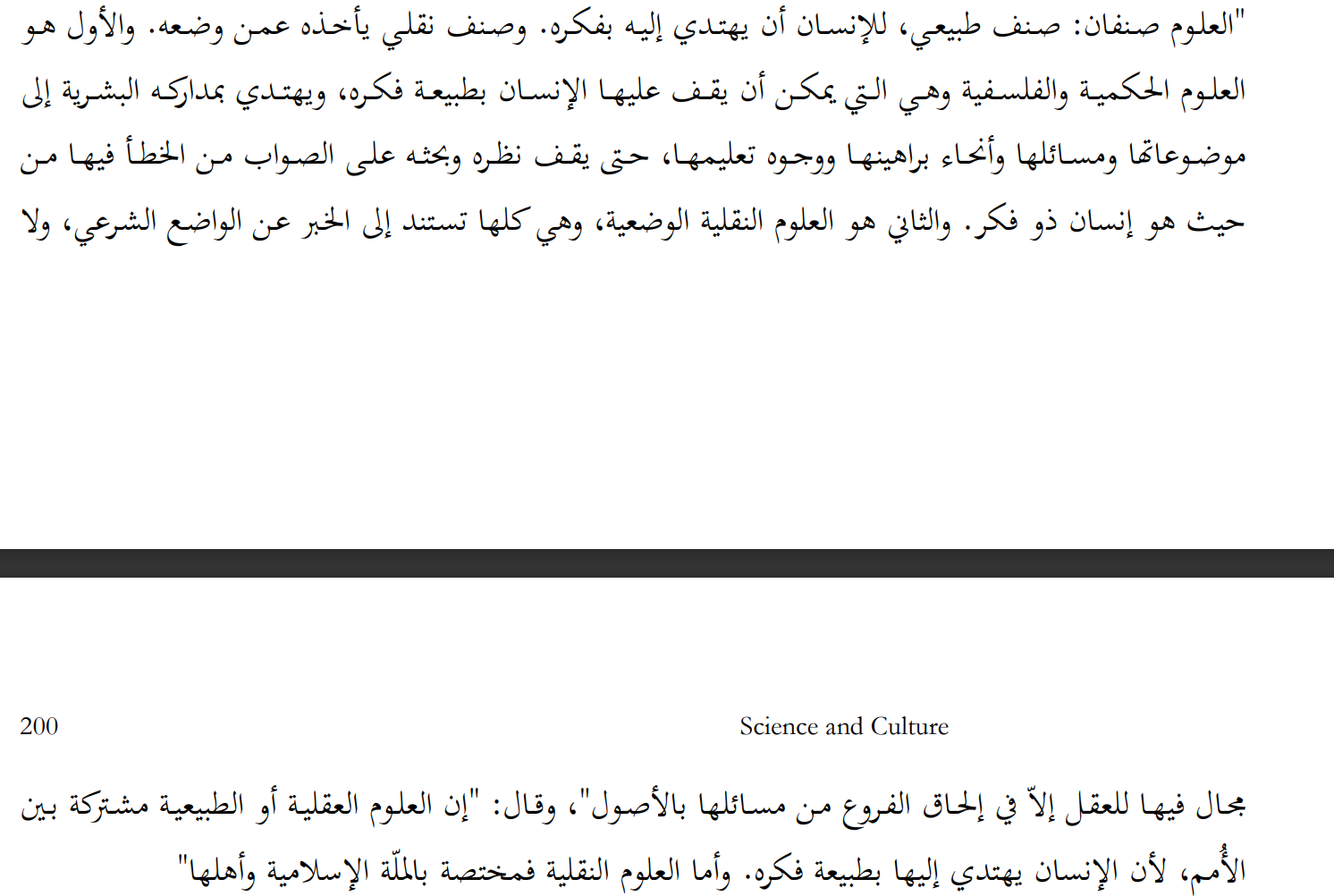
“科学分为两类:一类是自然的科学,人可以通过自己的思考来达到;另一类是述论的科学,人从其作者那里取得。第一类是哲学性和格言式的科学,人可以凭借其思维去探求,并通过人的各种能力得到引导,去认识它的主题、问题、所有决定性的论证以及其教义的各个方面。因此,他在辨别和研究中,能够分辨出正确的见解与错误的见解,这是凭借他作为人所具有的思维能力。第二类是述论和文字记载的科学。它们依赖于来自沙里尔(立法者)渊源的传述。在这方面,理性除了将枝节问题与根本(usul)相联系之外,没有发挥的余地。”
“The sciences are of two types: A natural type which is for man to arrive at through his thinking and a textual type which he takes from the one who authored it. The first are the philosophical and aphoristic sciences which he can seek by his thought and be guided through the human faculties to its subjects and issues and all its decisive proofs and aspects of its teachings. So as in his discernment and study he attains the correct (opinion) from the incorrect, in his capacity as a human being possessing the faculty of thought. The second are the textual and written sciences. They depend on the report coming from a shar’i source. The mind has no scope in this regard except to relate the branch issues to the usul (foundation)”.
他还说:"理性科学或自然科学是各民族共有的,因为人凭借其思维自然而然地获得这些知识。至于经训科学,则是穆斯林宗教及其信徒所特有的。"看来,伊本·赫勒敦以伊斯兰民族(millah)来specify经训科学,只是一个例子,因为伊斯兰民族之外的其他民族同样拥有各自特有的经训科学,例如它们的立法和语言。伊本·赫勒敦的这段论述并不表明他区分了科学与文化,它只表明他区分了经训科学与理性科学。他的评论不能证明穆斯林曾以区分科学与文化的方式来区分学科,反而能证明穆斯林过去只是区分学科。因此,他们将学科分为两大类。然而,他们的划分是依据学科的总体获取方式,而非获取的具体方法。所以他们将其称为理性科学,即通过理智获得的知识;以及经训科学,即从经文中获得的知识。而今天的人们则依据学科的接受方式来区分学科。因此,他们将"科学"('ilm)一词用于任何通过实证方法获得的知识,而将"文化"(thaqafa)一词用于任何通过实证方法之外的途径获得的知识。
He also said “The rational or natural sciences are common to all nations since man arrives at them naturally through his thought. As for the textual sciences they are specific to the Muslim religion and its adherents.” It appears that what Ibn Khaldun meant by specifying the textual sciences with the Islamic millah was only an example because nations other than the Islamic nation as well have textual sciences specific to them such as their legislation and language. Ibn Khaldun’s statement does not indicate that he distinguished between science and culture. It only indicates that he distinguished between textual and rational sciences. His comments are not an evidence to say that the Muslims used to differentiate between science and culture rather they are an evidence to prove that the Muslims used only to differentiate between disciplines. Thus, they divided them into two sections. However their division was in terms of their general acquisition and not in terms of the manner of acquisition. So they designated them as rational sciences i.e, acquired via the mind. And textual sciences acquired from the text. However, people today differentiate between disciplines in terms of the manner in which they were received. Thus, they apply the term ‘science’ (‘ilm) on anything that is acquired through the empirical method and they apply the term ‘culture’ (thaqafa) on anything acquired by means other than the empirical method