21. 战争政策
21. The War Policy
战争策略,是指根据战事的具体情势来处理战争事务,以使穆斯林取得胜利、敌人遭到失败。其直接而实际的意义是显而易见的。伊斯兰教法在战争中允许了在其他情况下被禁止的事,也禁止了在其他情况下被允许的事。例如,它允许在战争中对敌人说谎,而在战争之外这是被禁止的。由此,它为战争策略制定了专属于战争的规则。这些考量中包括与对待敌人有关的规定。其中有些与战争行动本身有关,有些与伊斯兰军队有关,还有些与上述之外的事务有关。
War policy is taking care of the affairs of war upon the position of its matter so as to make the victory for Muslims and defeat for their enemies. The immediate practical aspect is apparent in it. The Shar’a allowed within war things it forbade in other than it, and forbade things within it that it allowed in other than it. It allowed within it lying to the enemy whereas this is forbidden in other than war. In this way, it made for the war policy rules considered specific to war. From these considerations are those related with regards to dealing with the enemy. Of these is what is related to the actions of war itself, others are related to the Islamic army and others related to other than these.
在对待敌人的相关规定中,伊斯兰教规定哈里发和穆斯林对待敌人的方式应与敌人对待穆斯林的方式相似,并允许对敌人采取与敌人对穆斯林所允许的相似之举,即便这些举措涉及被禁止之事。安拉(SWT)说:
Among what is related to dealing with the enemy, Islam ordained for the Khalifah and Muslims to do with the enemy similar to what the enemy did to the Muslims and permit upon the enemy similar to what the enemy allowed upon the Muslims, even if it were from the forbidden things. Allah (swt) said:
“如果你们要惩罚,就用与你们所受的伤害相当的方式去惩罚。如果你们忍耐,那对忍耐的人来说是更好的。”{《古兰经》9:126}
“If you are punished with then punish with similar to what you were punished with. And if you are patient, it is better for the patient ones” [TMQ 9:126].
据传,此节经文降示的原因是:在乌侯德战役之日,多神教徒残害穆斯林,他们剖开他们的腹部,割去他们的隐私部位,并削去鼻尖。他们几乎没有放过任何一人,唯独汉达拉·本·阿尔-拉希卜除外。先知ﷺ站在遭受残害的哈姆扎身旁,他的样子十分可怖,腹部被剖开,鼻子被割去,于是先知ﷺ说道:
It is narrated that the cause for the revelation of this ayah is that the polytheists mutilated Muslims on the day of Uhud; they slit open their stomachs, cut their private parts and slit the tips of their noses. They did not leave anyone without mutilating him except Handhala bin Ar-Rahib. The Messenger of Allah (saw) stood over Hamza who had been mutilated, and he was an evil sight as his stomach had been split and his nose cut so he said:
“以那发誓之主起誓,若真主使我战胜他们,我定会在你们当中残害七十人。”
“By the One who is sworn by, if Allah grants me victory over them I will mutilate seventy in your place”
这节经文是在战争中降示的。虽然它禁止在肢解上过度,但它明确允许穆斯林对敌人做与他们对穆斯林所做相似的事。从这节经文中甚至可以理解:如果不信道者肢解了被杀的穆斯林,那么穆斯林也可以肢解被杀的不信道者,但不得超过他们所做的程度。尽管肢解本是非法的,并且有相关的记载证明了这一点,然而,如果不信道者肢解了被杀的穆斯林,穆斯林便可以这样做。与此类似的还有欺诈和违背盟约:如果敌人这样做,或者担心敌人会这样做,那么我们便可以这样做;否则,我们就不允许这样做。尽管按照战争准则,这些行为本是被禁止的,但我们仍然允许这样做,因为其禁令仅限于敌人没有这样做的情况。如果他们这样做了,穆斯林便可以这样做。安拉(SWT)说:
So this ayah was revealed. The ayat was revealed in war, and even though it prohibits excess in mutilation nevertheless it is explicit in allowing Muslims to do similar to what the disbelievers did to them. It is even understood from the ayah the permissibility of mutilated those killed among the disbelievers who mutilated those killed among the Muslims, except that it is not exceeded in mutilation what they did although mutilation is haram and there came news regarding that. However, the Muslims can do it if disbelievers mutilated those killed among the Muslims. Similar to this is deceit and breaking the covenant if the enemy does that or it is feared from him that he will do it, then it is allowed for us to do it. Otherwise it is not allowed for us to do it. It is allowed for us to do this even though there are prohibitions about it according to the war policy since its prohibition is only where the enemy has not done it. If they do it, it is allowed for Muslims to do it. Allah (swt) said:
“如果你担心某一族民会背叛,那就以同等的方式回报他们(ala siwa)”【古兰经 8:58】。
“If you fear treachery from a people, then throw it against them equally (ala siwa)” [TMQ 8:58].
因此,穆斯林在与敌人的战争中使用核武器是被允许的,即使这发生在敌人先对他们(穆斯林)使用之前,因为所有国家都允许在战争中使用核武器。所以,尽管使用核武器是被禁止的,因为它们毁灭人类,但在此情况下使用又是被允许的,因为圣战是以伊斯兰复兴人类,而不是灭绝人类。
Accordingly it is allowed for Muslims to use nuclear weapons in their war with the enemy, even if this was before the enemy used them against them (Muslims) as all States permit the use of nuclear weapons in war. So it is allowed to use them although it is forbidden to use nuclear weapons since they destroy humanity whereas jihad is to revive humanity with Islam and not to exterminate humanity.
关于与战争行为有关的规定:穆斯林可以焚烧异教徒的树木、他们的食物、农田和房屋,并将其摧毁。真主(SWT)说:
Of what is related to actions of war is that Muslims can burn the trees of disbelievers, their food, farms, and homes and destroy them. Allah (swt) said:
“你们砍伐的棕榈树(leena),或你们让它们留在根上的,都是奉真主的许可,以便使罪人蒙羞。”
“You did not cut any palm-tree (leena) or leave it standing upon its roots except by the permission of Allah and in order to disgrace the transgressors”
使者(愿主赐其平安)确实焚烧过棕榈树,同时他也意识到这种做法可能会被人曲解来对付他。至于耶哈雅·本·赛义德·安萨尔所传的:艾布·伯克尔·赛迪格(愿主喜悦他)对他派往叙利亚的军队统帅所说的话……
The Messenger of Allah (saw) did burn the palm-trees together with his realization that it would be interpreted against him. As for what is narrated by Yahya bin Said Al-Ansar that Abu Bakr As-Siddiq (ra) said to the army leader he sent to Sham:
“不要割断羊或骆驼的腿筋,除非是为了食用;也不要焚烧棕榈树,或用水淹没它们。”
“Do not hamstring sheep or camels except for food nor burn palm-trees or flood them”
所有的圣门弟子都对此表示同意,没有任何人提出异议。在战争中,原则是不得破坏居所、不得砍伐树木。然而,如果哈里发或军队统帅认为取得胜利必须破坏居所或砍伐树木,或者加快取得胜利需要这样做,那么依照战争策略,砍伐树木、破坏居所是被允许的,正如真主的使者ﷺ所做的那样。与此类似的还有宰杀和焚烧牲畜,以及敌人所拥有的一切;如果战争策略需要这样做,即使原本是被禁止的,也可以去做。真主(SWT)说:
Upon which all the Sahabah consented without any one disputing this, this is the origin in war which is not spoiling habitation or cutting trees. However, if the Khalifah or army leader views that gaining the battle necessitates him destroying habitation or cutting trees, or hastening to gain the battle requires this, then it is allowed in war policy to cut trees and destroy habitation as did the Messenger of Allah (saw). Similar to this is killing and burning cattle, and all that the enemy possesses; if the war policy requires this, then he may do it even if it was forbidden. Allah (swt) said:
“他们踏出的每一步,都会激怒不信道者;他们从敌人那里获得的任何东西,也都是如此——除非因此为他们记下一件善功。”{ 9:120 }
“Nor do they tread any foot-print which angers the disbelievers or acquire/obtain (nala) anything from the enemy except that a good deed is written fro them” [TMQ 9:120].
这段讲话在整体上是泛指的,没有其他证据能够限定或具体说明此经文的本义,无论是其他经文还是圣训,因此它仍保持其普遍性。另有经过确认的圣训,允许焚烧房屋,以及砍伐和焚烧树木。传自伊本·欧麦尔的记载如下:
This speech is general in everything and there is no other evidence what would bind or specify this ayah in its essence, whether any other ayah or hadith, so it remains in its generality. There came authenticated ahadith about the permissibility of burning houses, and burning and cutting trees. It has been narrated from ibn Umar:
真的,安拉的使者ﷺ砍伐并焚烧了白努·奈迪尔部落的棕榈树。
“Verily the Messenger of Allah (saw) cut and burnt the palm-trees of Banu Nadhir.”
于是哈桑说:古莱什的贵人们要烧掉布韦拉,那是件容易的事,火星四处飞溅。于是就降示了这段经文:
Upon this Hasan said It was easy for the nobles of Quraish to burn Buwaira whose sparks were flying in all directions, And upon this the ayah was revealed:
“你们砍伐的棕榈树,或让它们立在根上的,都是奉安拉的许可”[《古兰经》59:5]。
“You did not cut any palm-tree or leave it standing upon its roots” [TMQ 59:5].
据贾里尔·本·阿卜杜拉传述,他说:安拉的使者ﷺ说:
It is narrated from Jareer bin Abdullah who said: The Messenger of Allah (saw) said:
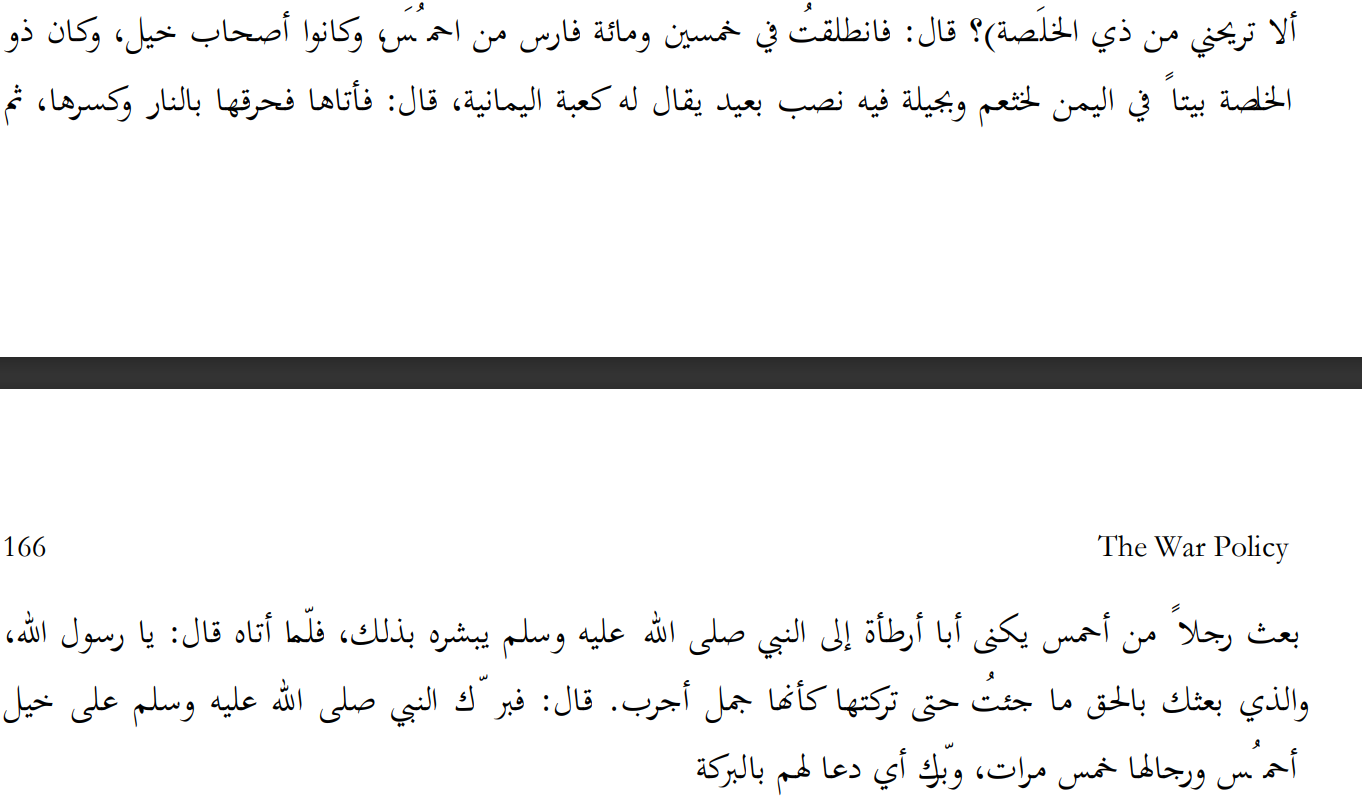
“难道你不让我从Dhu al-Khalsa得到安息吗?”他说:于是我带着一百五十名骑手从Ahnus出发,他们是拴着马匹的人。Dhu al-Khalsa是也门的一座房屋,属于Khath'am和Bujayla,里面供奉着被崇拜的偶像,它被称为“也门的天房”。他说:于是我来到那里,用火焚烧并摧毁了它。之后,一个来自Ahnus、绰号为Abu Arta'a的人被派去见先知ﷺ,向他报告这一喜讯。他到达后说:“真主的使者啊,以派遣您带着真理的那位发誓,我在把它弄得像骆驼一样(残破)之后才离开。”他说:“于是先知ﷺ为Ahnus的马匹和他们的人祝福了五次。”
“Will you not grant me rest from Dhu al-Khalsa. He said: So I departed with one hundred and fifty horsemen from Ahnus, and they were people of tethered horses. Dhu al-Khalsa was a house in Yemen for Khath’am and Bujayla with idols that were worshipped, and it was called the Ka’aba of Yemen. He said: so I came to it, burnt it with fire and destroyed it. Them a man from Ahnus whose epithet was Abu Arta’a was sent to the Prophet (saw) to give him the good news about this. When he reached him, he said: O Messenger of Allah, by the One who sent you with the truth, I did not come until I had left it as if it were camels. He said: ‘So the Prophet (saw) blessed the horses of Ahnus and their men five times’”
“barraka”的意思是为他们祈求祝福。艾哈迈德、艾布·达伍德和伊本·马哲都从乌萨马·本·宰德传述,他说:
And “barraka” means prayed for blessing for them. And Ahmad, Abu Dawud and ibn Majah narrated from Usamah bin Zayd who said:
“安拉的使者ﷺ派我去一个叫伊卜尼的城镇,并说:你们到达那里后就焚烧。”
“The Messenger of Allah (saw) sent me to a town called Ibni and said: Reach it then burn.”
这里的“Ibni”即巴勒斯坦的Yubna。它也出现在欧麦尔(ra)的遗嘱中,马立克在《穆宦塔》中记载了此事。将其与这些圣训相比较可知,砍伐和焚烧树木、摧毁房屋,只有在战争需要时才可以进行。因此,这属于战争策略的范畴。至于伊斯兰军队方面,伊玛目或军队指挥官可以阻止伪信者、违法者、逃跑者、煽动者及其同类上战场,其依据是安拉的经文:
This Ibni is the Yubna of Palestine. It also appears in the testament of Umar (ra) narrated by Malik in Al-Muwatta and its comparision with these ahadith that burning and cutting of trees, and the destruction of homes is only where the battle or war requires this. So it enters into the war policy. Of what relates to the Islamic army is that the Imam or army leader can prevent the hypocrites, transgressors, those put to flight, agitators and their like from going to the battlefield due to Allah’s statement:
但安拉不喜欢他们出征,所以使他们落后,并且有人对他们说:"你们和坐着的人一起坐下吧。"{若他们与你们一同出征,他们只会给你们增添混乱,并且会在你们中间奔走,挑拨离间,在你们中间煽动纷争。} [TMQ 9:47]
“but Allâh was averse to their being sent forth, so He made them lag behind, and it was said (to them): "Sit you among those who sit (at home Had they marched out with you, they would have added to you nothing except disorder, and they would have hurried about in your midst (spreading corruption) and sowing sedition among you” [TMQ 9:47]
尽管如此,伊玛目并不阻止伪信者或犯罪者参与战斗。然而,如果作战策略要求阻止他们参加战斗,或承担、监督某项具体行动,哈里发和军队统帅可以这样做。至于与应对敌人、军事行动或伊斯兰军队无关的事情,就像先知ﷺ从穆萨塔利格战役(Banu Mustaliq)返回时所发生的那样。他与穆斯林们以极快的速度返回,夜以继日地竭尽全力行走,直到抵达麦地那。他使伊斯兰军队疲惫不堪,尽管通常的原则是对军队从宽从易。来自Jabir,他说:
Although the Imam does not prevent the hypocrite or transgressor from participating within it. However, if the war policy requires preventing them from going to battle or undertaking or supervising a specific action, it is allowed for the Khalifah and the army leader to do so. As for what is related to other than dealing with the enemy, the actions of war or the Islamic army, this is what occurred with the Messenger (saw) in his return from the battle of Banu Mustaliq. He returned with the Muslims in surpassing haste. He would walk during the night and day to his utmost effort until he reached Madinah. He exhausted the Islamic army even though the rule is being easy with the army. From Jabir who said:
安拉的使者ﷺ在旅途中会落在后面,温和地催促体弱者,让他们走在前面,并为他们祈祷。
“The Messenger of Allah (saw) would lag behind in travel, gently urge the weak and put him behind him and make du’a for them”
然而,鉴于阿卜杜拉·本·乌拜ّ·本·赛鲁勒所从事的离间穆斯林、即穆哈吉尔与安萨尔之间的挑拨活动,战争的策略要求不按照军中最弱者的行程前进,而是按照最强者的行程前进,以免给人留下议论和争辩的余地。
However the war policy in relation to what Abdullah bin ‘Ubayy bin Salul was doing of creating strife between Muslims, the Muhajireen and Ansar, necessitated not travelling according to the travel of the weakest of the army but travelling the travel of their strongest so as not to leave a place for discussion or debate.
以此类推,战争政策要求伊玛目采取处理战事事务所必需的措施,以便在战斗或战争中取得胜利、击败敌人。然而,这仅限于没有经文针对某一具体行为的情况;如果存在针对具体行为的经文,则不允许以战争政策为借口去实施该行为。相反,必须使自己遵循经文及其所处的语境。如果经文以确定的形式出现且没有理由(illah),则不允许实施该行为;如果经文附有理由(illah),则依据该理由来遵循经文。如果经文中有禁令,并且有记载说先知ﷺ曾在特定情形下做过某事,那么除非处于那些情形,否则不得实施该行为。也有经文涉及沙里阿所禁止的行为,因此应依照经文所载的禁止来遵循。也不应以"战争政策"为由来为其辩护,因为战争政策是一般性的,除非有经文将某事从一般性中排除,此时则依照经文所specified的内容来遵循。 艾哈迈德以萨夫万·本·阿萨勒的传述记载:安拉的使者ﷺ派遣我们出征,并说:
In such manner the war policy requires that the Imam undertake the actions required to take care of the affairs of war so as to gain victory in the battle or war and defeat for the enemy. However, this is restricted to where no text came upon a specific action; if there exists a specific text, it is not allowed to perform this action under the pretext of war policy. Rather it is obliged that one restricts (himself) to the text according to the context in which it came. If the text came in a definite form without reason (illah), then it is not allowed to undertake the action; if the text came with an (illah) reason, then the text is followed according to the reason. If the text came with a prohibition, and it came that the Messenger (saw) did it in specific circumstances, then one cannot undertake the action except in those circumstances. There came texts about actions which the Shar’a prevented so the prevention is followed according to what came. Nor should one say the war policy (allows it) because the war policy is general except where there came a text excluding a matter for the generality so the text is followed in what is specified by it. Ahmad narrated from Safwan bin ‘Asal who said: The Messenger of Allah (saw) sent us in an expedition and said:
“奉安拉之名,行走在安拉的道路上。与不信安拉者作战。不要残害、欺骗或杀害儿童。”布哈里从伊本·欧麦尔那里传述,他说:
“Travel in the name of Allah and in the way of Allah. Fight those who do not believe in Allah. Do not mutilate, deceive or kill a child.” Al-Bukhari narrated from ibn Umar who said:
伊本·欧麦尔之子伊本·欧麦尔(Ibn Umar)说: Note: The user's text was "Al-Bukhari narrated from ibn Umar who said:" — translated as above with name kept as in original. Correction, reply with translation only: 布哈里传述,伊本·欧麦尔说:
Al-Bukhari narrated from ibn Umar who said:
在先知穆罕默德ﷺ的一场战役中发现一名妇女被杀,于是使者ﷺ禁止杀害妇女和儿童。
“A woman was found killed in one of the battles of the Messenger of Allah (saw), so the Messenger of Allah (SAW) prohibited the killing of women and children.”
且据艾哈迈德从阿斯瓦德·本·萨里传述,他说:安拉的使者(ﷺ)说:
And Ahmad narrated from Al-Aswad bin Sar’i who said: The Messenger of Allah (saw) said:
“那些人怎么了,杀戮竟到了这种地步,甚至连孩子也杀?”有人说:“真主的使者啊,他们不过是多神教徒的孩子。”他说:“实际上,你们当中最好的人,正是多神教徒的孩子。”ﷺ
“What is wrong with the people whose killing exceeded today until they killed children? A man said: O Messenger of Allah (saw), they are merely the children of polytheists. He said: Verily the best of you are the children of polytheists.”
阿布·达乌德记录了安赛(Anas)的传述:真主的使者ﷺ说:
Abu Dawud narrated from Anas that the Messenger of Allah (saw) said:
“你们奉安拉之名,依靠安拉,遵循安拉使者的道统出发。不要杀害衰老的老人、孩童和妇女,不要背信弃义。收集你们的战利品,行善,因为安拉喜爱行善的人。”
“Go forth in the name of Allah, with Allah and in the creed of the Messenger of Allah. Do not kill a perishing old man, a child or a woman and do not betray. Gather together your booties and be righteous as Allah loves the righteous.”
这些圣训禁止了战争中的某些具体行为,因此以"先知(saw)"的名义在战争中实施这些行为是不正确的;这些行为只能按照经文原本的方式施行。也有经文允许以大炮和炮弹以及一切从远处用重型武器进行的攻击来实施所有这些事情,即使在无法接近异教徒、只能因其与异教徒混杂而将其杀害的情况下,妇女和儿童也会被杀害。布哈里圣训集载述自阿萨卜·本·哲萨马。
These ahadith prohibited specific actions in war so it is not correct that they be done in war under the pretext of Messenger of Allah (saw); rather they are only done in the way the texts came. There came texts that allowed doing all these matters by shooting cannons and bombshells, and all that strikes from afar with something heavy even if women and children are killed if it is not possible to reach the disbelievers except by killing them due to their mixing with them. Al Bukhari narrated from As-S’ab bin Jithama
有人问及真主的使者ﷺ,关于穆斯林在多神教徒中寻求庇护,以及他们的妇女和孩子在遭受攻击时的情况。他说:“他们也属于那些人。”
“That the Messenger of Allah (saw) was asked about the people taking shelter among the polytheists and their women and children, if they are struck. He said: They are of them.”
“据传,有人问安拉的使者ﷺ关于那些在多神教徒中寻求庇护的穆斯林,以及他们的妻子和孩子,如果他们遭到攻击该怎么办。他说:“他们与他们是一伙的。”
“That the Messenger of Allah (saw) was asked about the people taking shelter among the polytheists and their women and children, if they are struck. He said: They are of them.”
“我问真主的使者ﷺ关于多神教徒的孩子,当我们与他们一同作战时,这些孩子也会被杀,他说:是的,因为他们也属于他们。”
“I asked the Messenger of Allah (saw) about the children of polytheists whom we kill along with them. He said: Yes, for they are of them.”
来自 Thawr bin Yazid 的 At-Tabarani 辑录
At-Tabarani extracted from Thawr bin Yazid
“先知(愿主福安之)曾向塔伊夫的居民架设投石机。” Note: The rules require writing ﷺ after the Prophet, and I've placed it as the honorific rendered in Chinese; the original abbreviation "(saw)" is replaced by the ﷺ symbol per the instructions. Corrected rendering: “先知ﷺ曾向塔伊夫的居民架设投石机。”
“That the Prophet (saw) hoisted a catapult upon the people of Taif.”
当投石器发射时,它不会区分妇女、儿童、树木等,这表明在战争中使用炮火、炮弹等重型武器时,允许借此杀戮、摧毁并毁坏一切。同样,如果除了杀害妇女和儿童之外无法触及不信道者;若因她们与敌人混杂而被击中,则允许杀害她们。至于单独进行这些事情,不借助投石器或其他方式,并且无法区分她们与我们所要对抗的不信道者,对此则有依据经文所述的详细说明。至于儿童,除了前面提到的两种情况之外,杀害他们绝对是哈兰的;同样适用于奴隶,即被迫与某民族共事的雇工,因为他属于弱者之列。这是因为,无任何理由而确定地杀害他们中的任何一方是被禁止的。至于妇女,需要细加考察:若她参战,则允许杀她;若她不参战,则不允许杀她。这是依据艾哈迈德和艾布·达伍德从拉巴赫·本·拉比尔所传的圣训,他曾与安拉的使者(愿主福安之)一同出征,那场战役的前线由哈立德·本·walid指挥。拉巴赫与安拉使者的圣门弟子们经过一名在前线部队攻击中被杀的妇女身边。他们停下来看她,并对她的美貌感到惊讶,直到安拉的使者ﷺ骑着坐骑与他们相遇,他们便为他让出了位置。安拉的使者ﷺ在她身旁停下,并说道:
When the catapult is fired, it does not distinguish between women, children, trees etc which indicates that heavy weapons such as cannons and bombshells when used in war then it is allowed to kill, destroy and spoil everything by them. Similarly if it is not possible to reach the disbelievers except by killing women and children; if they are struck due to their mixing with them, killing them is allowed. As for doing each one of these matters alone without the catapult or other than the situation of not being possible to distinguish them and the disbelievers whom we are fighting, in this there is a detailed statement according to what came in the texts. As for children, it is absolutely haram to kill them in other than the two previously mentioned situations; the same applies to the slave i.e. the employee who is with a people through compulsion as he is among the weak people. This is due to the the prohibition of killing either of them in a definite way without being reasoned by any reason. As for women, it is looked into; if she fights then it is allowed to kill her and if she does not, then it is not allowed to kill her. This is according to what Ahmad and Abu Dawud narrated from Rabah bin Rabi’ that he left together with the Messenger of Allah (saw) in a battle which was fought with Khalid bin Walid at its front. Rabah and the Sahabah of the Messenger of Allah (saw) passed by a woman killed in what the front (group) had struck. They stopped to look at her and were astounded by her beauty, until the Messenger of Allah (saw) met them upon his mount so they made a place for him. The Messenger of Allah (saw) stopped over her and said:
“这不是要去打的人。去见哈立德,并对他说:不要杀害儿童,也不要杀害雇工。”
“This is not someone to fight. Go meet Khalid and say to him: Do not kill children or the hireling.”
所以这段圣训以她不参战作为禁止杀她的理由。这一点也得到了艾布·达伍德所载的一段圣训的加强,该圣训由伊克里玛传述:先知ﷺ
So the hadith made the reason for the prohibition of killing her that she does not fight. This is strengthened by Abu Dawud narrated from ‘Ikrimah that the Prophet (saw)

“路过一个在侯奈因战役日被杀的女子,他说:谁杀了她?一个人说:是我,安拉的使者啊。我把她当作战利品,置于我身后。她看到我们失败,伸手去抓我剑的剑柄想杀我,所以我杀了她。安拉的使者ﷺ没有禁止这样做。”
“Passed by a woman killed on the day of Hunain and said: Who killed this one? A man said: I did, O Messenger of Allah (saw). I took her as booty and placed her behind me. When she saw defeat over us, she extended (her hand) to the hilt of my sword to kill me so I killed her. The Messenger of Allah (saw) did not prohibit (this).”
这说明:如果女子参战,杀她是允许的;如果她不参战,则不允许杀她。至于垂死的老人,如果他濒临死亡,对异教徒已无任何益处,对穆斯林也无任何害处,那么因为禁止杀害他,所以不允许杀他。然而,如果他对异教徒仍有益处,或对穆斯林有害处,则允许杀他。这是依据艾哈迈德和提尔米兹圣训集所载,萨姆拉传述的先知ﷺ所说的话:
This clarifies that when the women fights, killing her is allowed; and if she does not fight then killing her is not allowed. As for the perishing old man, if he is perishing without there remaining any benefit to the disbelievers or harm to Muslims, it is not allowed to kill him due to the prohibition of killing him. However, if there is benefit in him for the disbelievers or harm to Muslims, it is allowed to kill him. This is due to what Ahmad and At-Tirmidhi narrated from Samra that the Prophet (saw) said:
“杀死多神论者中的老人”
“Kill the old men of the polytheists”
因此,又有布哈里所传的阿布·穆萨的圣训:先知ﷺ结束侯奈因战役后,派阿布·阿米尔率领奥塔斯军队。他遇见了杜雷德·萨马,此人已年逾百岁,他们把他带来为他们筹划战事。阿布·阿米尔杀死了他,先知ﷺ并未因此而否定他的行为。据此,安斯(愿安拉喜悦他)的圣训应理解为:这是一个将死的老人,对他既无益处,也无来自他的危害;他就是同一段圣训中所说的那个将死的老人。凡有禁令禁止从事的事项,只能依照经文所述的方式去做,超出此范围则不被允许。穆斯林对其不信道的敌人所采取的任何行动,只要该行动发生在战争情境中,都不应被视为可憎的,无论此行动在战争之外是合法(哈拉姆)还是非法(哈拉姆)的。除非有绝对禁止在战争中进行的行为,否则此原则不排除任何事项。
And also due to what Al-Bukhari narrated from the hadith of Abu Musa that when the Prophet (saw) finished from Hunain, he sent Abu Amir over the army of Awtas. He met Dureed As Sama, and he was one hundred (years) and something, and they had brought him to plan the war for them. Abu Amir killed him and the Prophet (saw) did not reject that from him. Accordingly the hadith of Anas (ra) is taken to mean the perishing old man without being any benefit in him or harm emanating from him; he is the perishing old man as came in the same hadith. These matters for which came prohibition about performing them are not done except according to how the text came with them. Anything beyond that is not allowed. No action done by Muslims to their disbeliever enemy is repulsive as long as this action occurred in the situation of war, whether this action was allowed (halal) or forbidden (haram) outside of war. Nothing is excluded from this except the action for which there has come an absolute prohibition against it in war.