17.3 效忠宣誓(bay'ah)
17.3 The Pledge (bay’ah)
效忠宣誓(Bay'ah)是每一位穆斯林的义务,也是每一位穆斯林——无论男女——的权利。证明其为义务的证据,见于先知(愿主赐福他并使他平安)的众多圣训之中,他曾说:
Bay’ah is an obligation upon all Muslims, and it is a right for every Muslim, man or woman. The evidence for it being an obligation is in many ahadith of the Prophet (saw), in which he said:
“谁死时颈上没有效忠之约(bay'ah),谁就死于jahiliyyah(蒙昧时代)之死。”
“Whosoever dies without having a bay’ah upon his neck dies a death of jahiliyyah.”
“至于它是穆斯林的一项权利,效忠宣誓(bay'ah)本身就表明了这一点,因为效忠宣誓是穆斯林向哈里发作出的,而不是哈里发向穆斯林作出的。穆斯林对先知ﷺ的效忠宣誓在圣训中已有确证。布哈里记录道:‘Ubadah bin as-Samit(愿安拉喜悦他)说:”
As for being a right for Muslims, the bay’ah itself indicates that, because the bay’ah is offered by the Muslims to the Khalifah, and not by the Khalifah to the Muslims. The bay’ah of the Muslims to the Prophet (saw) was confirmed in the ahadith. Al-Bukhari reported that ‘Ubadah bin as-Samit (ra) said:
我们向先知ﷺ宣誓效忠:无论我们喜欢还是不喜欢,都听从并服从;不与执政者争夺权位;无论在何处都说真话;为了真主而行动或发言时,不畏惧任何人的责备。
“We made a bay’ah to the Prophet (saw) to hear and to obey in whatever pleases and displeases us, and that we would not dispute the order of those in charge, that we would speak the truth wherever we are, and that we would not fear the blame of anyone when acting or speaking for the sake of Allah.”
据布哈里转述,他从艾yyub那里,从哈夫萨那里,从乌姆·阿提耶那里,她说:
Al-Bukhari reported from Ayyub from Hafsa from Umm ‘Atiyyah who said:
“我们向先知ﷺ宣誓效忠,他为我诵读了这节经文:{他们不以任何事物与真主同拜}(TMQ 60.12)。他还禁止我们哀号和哭诉死者。我们中有一位妇女伸出手说:‘某某妇女为我家的一位死者哭泣,我要为她的哭泣给予补偿。’先知ﷺ没有回应,她便离开,之后又返回了。”
“We gave a bay’ah to the Prophet (saw) and he recited to me the verse That they will not associate anything in worship with Allah (TMQ 60.12). And he also prevented us from wailing and lamenting over the dead. A woman from us held her hand out and said, "Such-and-such a woman cried over a dead person belonging to my family and I want to compensate her for that crying" The Prophet did not say anything in reply and she left and returned.”
据艾布·胡莱赖(愿主喜悦他)传述,先知ﷺ说:
And in Al-Bukhari from Abu Hurairah (ra) who said: The Prophet (saw) said:
“(有)三种人,安拉在复活日不与他们说话,也不洁净他们,他们将受到严厉的刑罚:一种人在路上有多余的水,却不给过路人饮用;一种人只为了今世的利益而向伊玛目效忠宣誓,若伊玛目给他他所想要的,他便履行誓约,否则便不履行;还有一种人在晡礼之后出售货物,他指着安拉发誓说,有人出价如此如此购买,而实际上并没有,那人相信了他,便购买了这件货物。”
“(There are) three persons to whom Allah will not talk on the Resurrection Day, nor purify them, and for them is a severe punishment: A person who has an excess of water on the road and prevents the wayfarer from it; a person who gives bay’ah to an Imam for his worldly affairs only, so if the Imam gave him that which he wants he fulfilled (the bay’ah) to him, otherwise he would not; and a person trading a commodity to another after asr (late afternoon) and he swore by Allah that he was offered so and so for it, although he was not, and the person believed him and bought it.”
布哈里传述,阿卜杜拉·本·欧麦尔(愿真主喜悦他)说:
Al-Bukhari narrated from ‘Abdullah bin ‘Umar (ra) who said:
“当我们向先知(ﷺ)宣誓听从与服从时,他会对我们说:尽你们所能。”
“When we gave a bay’ah to the Prophet (saw) to hear and obey, he would say to us: As much as you are capable of”
“当我们向先知ﷺ宣誓效忠,承诺听从和服从时,他会对我们说:尽你们所能。”
“When we gave a bay’ah to the Prophet (saw) to hear and obey, he would say to us: As much as you are capable of”
“我向先知ﷺ宣誓效忠,承诺听从与服从,他嘱咐我:尽你所能,并且要真诚地劝告每一位穆斯林。”
“I gave bay’ah to the Prophet (saw) to hear and obey and he instructed me: As much as you are able, and to give good advice to every Muslim.”
布哈里传述,朱纳达·本·阿布·乌麦叶说:
Al-Bukhari narrated from Junada bin Abu Umayyah who said:
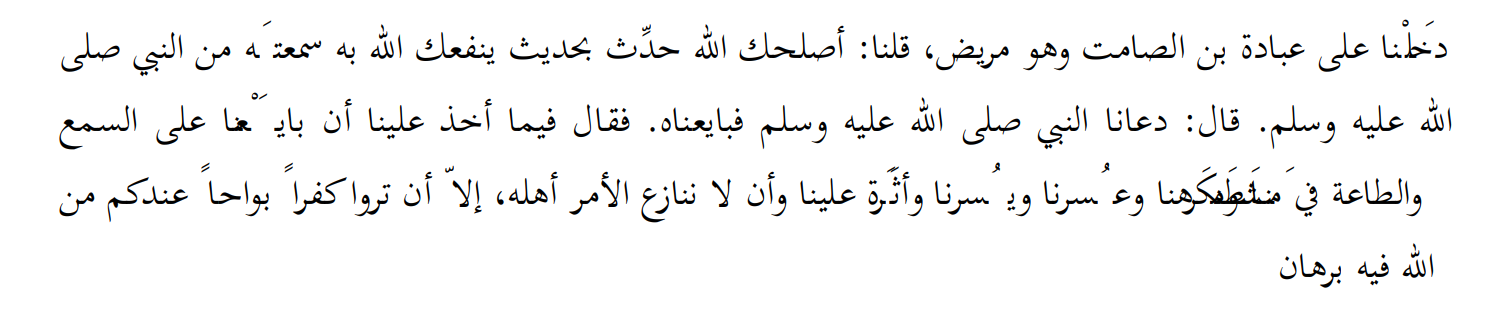
我们进入了‘Ubadah bin as-Samit的家中,当时他正生病,我们说:愿真主使你康复。请告诉我们一段你从先知ﷺ那里听闻的圣训,愿真主借此使你受益。他说:先知ﷺ召集了我们,我们便向他宣誓效忠(bay’ah)。他在要求我们宣誓的条件中包括:无论在我们精力充沛时还是疲惫时,无论在顺境还是逆境时,以及当我们看到别人享有优先待遇时,都要听从并服从(命令);不得与那些被委以权力的人争夺权威,并说:除非你们看到明显的公开的背道(kufr bawah),并且你们对此拥有来自真主的明确证据。
“We entered the house of ‘Ubadah bin as-Samit while he was ill and we said: May Allah make you healthy, inform us of a hadith you heard from the Prophet (saw) by which Allah (swt) may benefit you. He said: The Prophet (saw) invited us and we gave him our bay’ah (pledge of Allegiance). And among the conditions on which he took the pledge from us, was that we were to listen and obey (the orders) both at the time when we were active and when we were tired , and in the times of ease and hardship and when we see preference (for others over us), and not to dispute the authority of those who are entrusted with it saying: Unless you see open disbelief (kufr bawah) upon which you have a clear proof from Allah.”
哈里发的效忠(bay'ah)掌握在穆斯林手中,这是他们的权利;是他们进行效忠,也是他们的效忠使哈里发的任命得以确立。效忠可以通过握手进行,也可以通过书面形式进行。'Abdullah bin Dinar 传述说:
The bay’ah for the Khalifah is in the hands of the Muslims, and it is their right; it is they who give the bay’ah, and it is their bay’ah which makes the Khilafah contracted for a Khalifah. The bay’ah can be by shaking hand or by writing. ‘Abdullah bin Dinar narrated saying:
我曾见到伊本·欧麦尔在人们聚集于阿卜杜勒·马利克·本·marwan周围的场合。他写道:我同意听从并服从安拉的仆人、信士们的长官阿卜杜勒·马利克,遵循安拉的道法和祂的使者ﷺ的圣行,尽我所能。
“I witnessed bin ‘Umar where the people gathered around ‘Abdulmalik bin Marwan. He wrote: I agree to listen and obey to the slave of Allah, ‘Abdulmalik the Amir al-Mu’mineen, according to the Sunnah of Allah and the Sunnah of His Prophet as much as I am able.”
此外,以任何方式进行的宣誓效忠(bay'ah)都是正确的(waseelah)。然而,宣誓效忠必须由成年人作出,因此由未成年人作出是不恰当的。阿布·阿qeel·扎赫拉·本·马巴德(Abu Aqeel Zahra bin Ma‘bed)转述其祖父阿卜杜拉·本·希沙姆(‘Abdullah bin Hisham)的话——他曾亲眼见过先知ﷺ——说,他的母亲宰乃布(Zaynab)是哈米德(Hameed)的女儿,她带他去见先知ﷺ,并说:"安拉的先知啊,请接受他的宣誓效忠。"先知ﷺ说:
Moreover, the bay’ah is correct by any means (waseelah). However, the bay’ah has to be given by the mature person, so it is improper to be given by the young. Abu Aqeel Zahra bin Ma‘bed reported from his grandfather ‘Abdullah bin Hisham--who witnessed the Prophet (saw)--that his mother Zaynab, the daughter of Hameed, took him to the Prophet (saw) and said: O Prophet of Allah, take a pledge from him. The Prophet (saw) said:
“他还是个孩子,”他摸了摸他的头,并为他祈祷。
“He is a child, wiped his head and made a du‘a for him.”
关于效忠誓约(bay'ah)的措辞,并不限于特定的用语。然而,其内容必须包括:哈里发依据安拉的经典和其使者的逊奈(Sunnah)而行事;在困难与顺境中都服从;以及效忠者在其所喜与所恶之事上服从(哈里发)。一旦宣誓者已经向哈里发效忠,或哈里发的任职因其他穆斯林的效忠而确立,那么这份效忠就成为效忠者颈上的一份托付,他不得撤回。它是哈里发任职契约的权利,直到他给予效忠为止;而一旦他给予了效忠,就必须遵守,不得撤回。 布哈里(Al-Bukhari)记载,贾比尔·本·阿卜杜拉(ra)说:一名乡下人向先知ﷺ宣誓归信伊斯兰,后来他身患疾病,便对先知ﷺ说:“请让我撤销我的效忠。”但先知ﷺ拒绝了,那人便离去了。先知ﷺ随后说:
As for the words of the bay’ah they are not restricted to specific terms. However they must include acting according to the Book of Allah (swt) and the Sunnah of His Prophet (saw) by the Khalifah, and obedience in hardship and ease and obedience, and whatever pleases and displeases on the part of the person who gives the bay’ah (to the Khalifah). Whenever the one who pledges has given his bay’ah to the Khalifah or the Khilafah is contracted to the Khalifah by the bay’ah of other Muslims, then the bay’ah has become a trust on the neck of the one who gives the bay’ah and he is not allowed to retract it. It is a right for the contract of the Khilafah until he has given it, and once he has given it he must abide by it. He is not allowed to retract from it. Al-Bukhari narrated from Jabir bin ‘Abdullah (ra) that a Bedouin gave the Prophet (saw) his pledge on Islam, and an illness struck him so he said to the Prophet (saw): “Let me withdraw my bay’ah but the Prophet (saw) refused, and the man left. The Prophet (saw) then said:
“麦地那就像一座熔炉,它会排除杂质,挑选出优良的部分,并使其臻于完美。”
“Medina is like a furnace, it expels out the impurities and selects the good ones and makes them perfect.”
据纳菲尔传述,他说:伊本·欧麦尔(愿真主喜悦他)对我说,他听见先知ﷺ说:
And it is narrated from Nafi‘a who said: Ibn ‘Umar (ra) said to me that he heard the Prophet (saw) saying:
“谁若从服从(埃米尔)中抽回他的手,他在复活日站在安拉面前时,将找不到任何辩解的理由。”
“Whoever withdraws his hand from obedience (to the Amir) will find no argument (in his defense) when he stands before Allah on the Day of Resurrection.”
要废弃哈里发的效忠誓约,就等于从对安拉(SWT)的顺服中收回自己的手。无论其效忠是契约性的效忠,还是对一位已被穆斯林接受并向其效忠的哈里发的顺服,情况都是如此。然而,如果他起初向某位哈里发效忠,但由于穆斯林整体并未接受其为哈里发,这一效忠未能完成,那么他有权撤销该效忠。圣训所提到的禁令,针对的是撤销对一位哈里发的效忠,而非撤销对一位未能完成哈里发职位确立之人的效忠。
To break the bay’ah of the Khalifah is withdrawing of one’s hand from the obedience of Allah (swt). This is the case if his bay’ah to the Khalifah is a bay’ah of contract or it is a bay’ah of obedience to a Khalifah whom the Muslims accepted and gave their bay’ah to. However, if he gave his bay’ah in the beginning to a Khalifah and it was not completed because the Muslims as a whole did not accept him as Khalifah, then he has the right to withdraw from that bay’ah. The prohibition mentioned in the hadith is focused on the withdrawal of a bay’ah to a Khalifah, not to a man for whom the Khilafah was not accomplished