17.8 任命哈里发的方法
17.8 The Method To Appoint The Khalifah
当伊斯兰教法规定乌玛有义务设立一位哈里发时,它同时也规定了任命哈里发的方式。这一方式有《古兰经》、圣训以及圣门弟子的一致公议(ijma')作为证据,这一方式就是效忠誓约(bay'ah)。因此,哈里发的任命是通过向他宣誓效忠来完成的。证明这一方式即为效忠誓约的依据,是穆斯林向先知ﷺ宣誓效忠的事实,以及先知ﷺ命令我们向伊玛目宣誓效忠的训示。穆斯林向先知ﷺ宣誓效忠,并非效忠于他的先知身份;而是效忠于他的统治权,因为这是对行为的效忠,而不是对信仰的效忠。所以,穆斯林是以他作为统治者的身份向他宣誓效忠,而不是以先知和使者的身份。因为承认先知身份和使命属于信仰问题,而非效忠誓约,因此效忠只能是针对他作为国家元首的身份。效忠誓约在《古兰经》和圣训中都有提及。安拉(SWT)说:
When the Shari’ah made it obligatory upon the Ummah to appoint a Khalifah, it also defined the method by which the Khalifah is appointed. This method is proven by the Qur’an, the Sunnah and the Ijma’a of the Sahabah (ra), and this method is the bay’ah. So the appointment of the Khalifah is carried out by the bay’ah to him. The Proof that this method is the bay’ah is confirmed from the bay’ah of the Muslims to the Prophet (saw) and from the order of the Prophet (saw) for us to give bay’ah to the Imam. The bay’ah of the Muslims to the Prophet (saw) was not on his Prophethood; rather it was on ruling, since it was a bay’ah over action and not a bay’ah on belief. So the Prophet (saw) was given the bay’ah in his capacity as a ruler and not as a Prophet and a Messenger. Because the acknowledgement of the Prophethood and the Message is a matter of belief and not a bay’ah, so the bay’ah could only have been for him in his capacity as the head of the State. The bay’ah was mentioned in the Qur’an and the ahadith. Allah (swt) said:
"先知啊!如果信道的女子来向你效忠,保证不以任何事物与真主并列,不偷窃,不通奸,不杀害自己的子女,不捏造诬言于她们手足之间,也不违抗你在善事上的命令,那么你就接受她们的效忠吧。" [TMQ 60:12]
"O Prophet, if the believing women come to give you a bay’ah that they will not associate anything as partners to Allah, not to steal, not to commit adultery, not to kill their children, not to produce any lie that they have devised between their hands and feet, nor disobey you in what is right then give them the bay’ah" [TMQ 60:12]
安拉(SWT)还说:
Allah (swt) also said:
“实在,向你(穆罕默德)宣誓效忠的人,其实是向真主宣誓效忠。真主的手在他们的手之上。”
"Lo! Those who give bay’ah to you (Muhammad) they give bay’ah only to Allah. The hand of Allah is above their hands"
布哈里转述:伊斯马仪向我们转述,马立克向我转述,引自叶哈雅·本·赛义德,他说:"伍巴德·本·瓦利德告诉我,我的父亲告诉我,引自伍巴德·本·萨米特(愿真主喜悦他),他说:"
Al-Bukhari reported: Ismail related to us that Malik related to me from Yahya bin Said who said: “Ubadah bin Waleed informed me that my father informed me from ‘Ubadah bin as-Samit (ra) who said:
我们承诺:无论在精力充沛的时候,还是在疲倦的时候,都要听从并服从他;不与统治者争斗,也不违抗他;无论身在何处,都要坚持真理、直言真理;在安拉的道路上,不畏惧谴责者的谴责。
“that we would listen to and obey him both at the time when we were active and at the time when we were tired and that we would not fight against the ruler or disobey him, and would stand firm for the truth or say the truth wherever we might be, and in the Way of Allah we would not be afraid of the blame of the blamers.
布哈里记载:阿里·本·阿卜杜拉告诉我们,阿卜杜拉·本·叶兹德告诉我们,赛义德(即伊本·穆赛耶卜)说:阿布·阿基勒·宰赫拉·本·马巴德向我叙述,他从其祖父阿卜杜拉·本·希沙姆处听闻,此人曾亲见先知ﷺ。他的母亲宰奈卜(哈米德之女)带他去见安拉的使者ﷺ,并说:"安拉的使者啊,请接受他的宣誓。"先知ﷺ说:
Al-Bukhari reported: Ali bin Abdullah related to us that Abdullah bin Yazeed related to us that Saeed (who is ibn al-Musayyib) who said: Abu ‘Aqeel Zahrah bin Ma’bad narrated to me from his grandfather ‘Abdullah bin Hisham who witnessed the Prophet (saw) that his mother Zaynab, daughter of Hameed, took him to the Messenger of Allah (saw) and said: “O Messenger of Allah, take his pledge. The Prophet (saw) said:
“他是个孩子,于是抚摸(擦拭)他的头,并为他祈祷。”
“He is a child, and rubbed (wiped) his head and said du‘a for him.”
布哈里说:阿卜杜勒·本·阿布·哈姆扎向我们转述,他从阿马什那里听来,阿马什又从阿布·萨利赫那里听来,阿布·萨利赫从阿布·胡莱赖(愿真主喜悦他)那里听来,他说:真主的使者ﷺ说:
Al-Bukhari said: ‘Abdan bin Abu Hamza related to us from Al-‘Amash from Abu Salih from Abu Hurairah (ra) who said: The Messenger of Allah (saw) said:

“(有三种人,真主在复活日既不与他们说话,也不洁净他们的罪过,他们将受到痛苦的刑罚:)(一)一个人在路上拥有多余的水(超过他所需要的),却不给旅客;(二)一个人向伊玛目(统治者)宣誓效忠,但只是为了世俗的利益,如果伊玛目给他想要的,他就遵守誓约,否则他就不履行誓约;(三)一个人在晡礼之后把某物卖给另一个人,并以真主发誓(伪誓),说有人出了这么高的价钱要买它,买者便相信他并购买了它,而实际上卖者并没有人出过这样的价钱。”
“(There will be three types of people whom Allah will neither speak to them on the Day of Resurrection nor will purify them from sins, and they will have a painful punishment: They are, (1) a man possessed superfluous water (more than he needs) on a way and he withholds it from the travelers. (2) a man who gives a pledge of allegiance to an Imam (ruler) and gives it only for worldly benefits, if the Imam gives him what he wants, he abides by his pledge, otherwise he does not fulfill his pledge; (3) and a man who sells something to another man after the `Asr prayer and swears by Allah (a false oath) that he has been offered so much for it whereupon the buyer believes him and buys it although in fact, the seller has not been offered such a price..”
由这三段圣训可以明确看出,效忠誓约(bay'ah)是任命哈里发的方式。'Ubadah的圣训中说,他向先知(saw)宣誓效忠,即听从和服从,这是对统治者的效忠誓约。'Abdullah bin Hisham的圣训中说,先知(saw)拒绝了他的效忠,因为他尚未成年,这表明这是关于统治权的效忠誓约。从Abu Hurairah(ra)所传的圣训可以清楚看出,这是对伊玛目的效忠誓约。圣训中的"伊玛目"一词是不加限定的,即指任何伊玛目。还有其他圣训提到向伊玛目宣誓效忠。穆斯林圣训集中通过'Abdullah bin 'Amru记载,先知(saw)说:
From these three ahadith it is explicit that the bay’ah is the method of appointing the Khalifah. The hadith of ‘Ubadah states that he gave bay’ah to the Prophet (saw) to listen and obey and this is a bay’ah to a ruler. The hadith of ‘Abdullah bin Hisham states that the Prophet (saw) rejected his bay’ah because he was not mature which indicates that it is a bay’ah on ruling. From the hadith reported by Abu Hurairah (ra) it is evident that it is a bay’ah to the Imam. The word ‘Imam’ in the hadith is undefined i.e. any Imam. There are other ahadith which refer to giving bay’ah to the Imam. It is reported in Muslim via Abdullah bin ‘Amru that the Prophet (saw) said:
“谁与一位伊玛目缔结效忠之约,给予他握手与内心的诚意,就应当尽其所能地服从他。如果另有人前来与他争夺权位,就应砍断后者的脖子。”
“Whoever gave bay’ah to an Imam giving him his handshake and the fruit of his heart should obey him as much as he can. If another person comes to dispute with him, strike the neck of the latter”.
穆斯林(愿真主喜悦他)引述艾布·赛义德·胡德里,他说:先知ﷺ说:
Also Muslim narrates from Abu Said al-Khudri who said: The Prophet (saw) said:
“如果有人向两位哈里发宣誓效忠,就杀掉其中后面的那一位。”
“If a bay’ah is given to two Khalifahs kill the latter of them.”
据穆斯林记载,艾布·哈兹姆说:"我陪伴艾布·胡莱赖(愿真主喜悦他)五年,听他讲述先知ﷺ说:"
And Muslim narrated that Abu Hazim who said: “I accompanied Abu Hurairah (ra) for five years and heard him narrate from the Prophet (saw) who said:
“先知们统治以色列的后裔。每当一位先知去世,另一位先知便接替他,但我之后不会再有先知。将会有哈里发,而且他们的数量很多。”他们问道:“那么您命令我们怎么做呢?”他说:“你们要向他们逐一履行效忠之约,并把他们应得的权利交给他们。真主必定会问他们,关于祂所托付给他们的事务。”ﷺ
“The Prophets ruled over the children of Israel. Whenever a Prophet died another Prophet succeeded him, but there will be no Prophet after me. There will be Khulafaa and they will number many. They asked: What then do you order us? He said: Fulfill the bay’ah to them one after the other and give them their due. Surely Allah will ask them about what He entrusted them with.”
所以,《古兰经》和圣训的文本明确表明,任命哈里发的方式是效忠宣誓(bay’ah)。所有的圣门弟子都理解并遵循这一点。因此,艾布·伯克尔(愿真主喜悦他)在巴努·萨伊达的庭院中接受了一次特别的效忠宣誓,随后又在清真寺中接受了公开的效忠宣誓;那些没有在清真寺中向他效忠、而其效忠被认为有效的人,如阿里·本·艾布·塔利卜(愿真主喜悦他),则是之后才效忠的。欧麦尔(愿真主喜悦他)获得了穆斯林的效忠宣誓,奥斯曼(愿真主喜悦他)也获得了穆斯林的效忠宣誓,阿里(愿真主喜悦他)同样获得了穆斯林的效忠宣誓。因此,效忠宣誓是为穆斯林任命哈里发的唯一方式。
So the texts from the Qura'n and the Sunnah are clear that the method of appointing the Khalifah is the bay’ah. All the Sahabah understood this and followed it. So Abu Bakr (ra) was given a special bay’ah in the courtyard of Banu Sa‘ida, and a public bay’ah in the mosque, those who did not give him the bay’ah in the mosque and whose bay’ah is considered gave it later on like ‘Ali bin Abu Talib (ra). ‘Umar (ra) was given the bay’ah from the Muslims, ‘Uthman (ra) also was given the bay’ah by the Muslims and ‘Ali (ra) was given the bay’ah by the Muslims as well. So the bay’ah is the only method to appoint a Khalifah for the Muslims.
关于进行效忠誓约(bay'ah)的具体细节,在先知ﷺ去世之后紧接着出任的四位哈里发的任命中已然清楚可见,他们是阿布·伯克尔(ra)、欧麦尔(ra)、奥斯曼(ra)和阿里(ra)。所有的圣门弟子(ra)都接受并认可了此事。如果这违背沙里亚,他们必定会加以否认,因为这关系到穆斯林的福祉与伊斯兰统治得以延续的最重要之事。考察这几位哈里发的任命经过,便会发现:当时一些穆斯林在巴努·萨伊达的庭院中展开了辩论;被提名的人选只有萨阿德(ra)、阿布·欧拜代(ra)、欧麦尔(ra)和阿布·伯克尔(ra)四人,辩论的结果是阿布·伯克尔(ra)获得了效忠誓约。第二天,穆斯林被召集到清真寺,并向他宣誓效忠。由于这一效忠誓约,阿布·伯克尔(ra)成为穆斯林的哈里发。 当阿布·伯克尔(ra)感到自己的病症将致他死亡时,他召集穆斯林进行协商,以确定谁可以成为下一任哈里发。这些协商中的意见只集中在阿里(ra)和欧麦尔(ra)两人身上。他持续进行了三个月的协商。完成协商并了解到大多数穆斯林的意见之后,他向大家宣布欧麦尔(ra)将在他之后担任哈里发。他去世之后,穆斯林立即来到清真寺,向欧麦尔(ra)宣誓效忠哈里发之位,因此欧麦尔(ra)是凭借穆斯林的这一效忠誓约而成为哈里发的,而不是凭借协商或阿布·伯克尔(ra)的宣布。欧麦尔(ra)遭刺伤后,穆斯林请求他为自己指定继任者,但他拒绝了。众人坚持,他便将此事交给六位圣门弟子来决定。随后,在他去世后,被提名的人选中有人指定了其中一位,即阿卜杜勒·拉赫曼·本·奥夫(ra)作为代表。他参考了穆斯林的意见,并与他们协商。然后,他宣布向奥斯曼(ra)效忠。 穆斯林们起身向‘Uthman(ra)效忠宣誓(bay’ah),因此他是凭借穆斯林的誓约而成为哈里发的,而非凭借‘Abdurrahman(ra)的宣布。后来‘Uthman(ra)被杀,麦地那和库法的大多数穆斯林便向‘Ali bin Abu Talib(ra)效忠宣誓,于是他也凭借穆斯林的效忠宣誓而成为哈里发。
As for the practical details to conduct the bay’ah, they are evident in the appointment of the four Khulafaa who came directly after the death of the Prophet (saw), who are Abu Bakr (ra), ‘Umar (ra), ‘Uthman (ra) and ‘Ali (ra). And all of the Sahabah (ra) accepted this and confirmed it. If it was against the Shari’ah , they would definitely have denied it because it is related to the most important thing upon which the well being of Muslims and perseverance of the Islamic rule depends. Whoever follows what happened in the appointment of these Khulafaa will find that some Muslims had debated in the courtyard of Banu Sa‘ida; the nominees were Sa‘d (ra) , Abu ‘Ubaydah (ra), ‘Umar (ra) and Abu Bakr (ra) only, and as a result of the debate Abu Bakr (ra) was given the bay’ah. On the next day Muslims were called to the mosque and they gave him their bay’ah. As a result of this bay’ah, Abu Bakr (ra) became a Khalifah for the Muslims. When Abu Bakr (ra) felt that his illness carried with it death, he called upon the Muslims to consult them about who could become the next Khalifah. The opinion in these consultations focused on ‘Ali (ra) and ‘Umar (ra) only. He continued in these consultations for three months. When he completed them and knew the majority of the Muslims opinion he announced to them that ‘Umar (ra) would be the Khalifah after him. Immediately after his death Muslims came to the mosque and gave the bay’ah of Khilafah to ‘Umar (ra) so he became the Khalifah by this bay’ah from the Muslims not by the consultations or by the announcement by Abu Bakr (ra). When ‘Umar (ra) was stabbed, the Muslims asked him to appoint a successor for himself but he refused. They insisted, so he left it among six of the Sahabah (ra). Then after his death, the nominees appointed one of them, ‘Abdurrahman bin ‘Auf (ra), as a representative. He referred to the opinion of the Muslims and consulted them. Then he declared the bay’ah to ‘Uthman (ra). The Muslims stood up and gave their bay’ah to ‘Uthman (ra), and thereby he became the Khalifah by the pledge of the Muslims and not by the announcement of ‘Abdurrahman (ra). Later on ‘Uthman (ra) was killed and the majority of Muslims in Madinah and Kufa gave their bay’ah to ‘Ali bin Abu Talib (ra), so he too became the Khalifah by the bay’ah of Muslims.
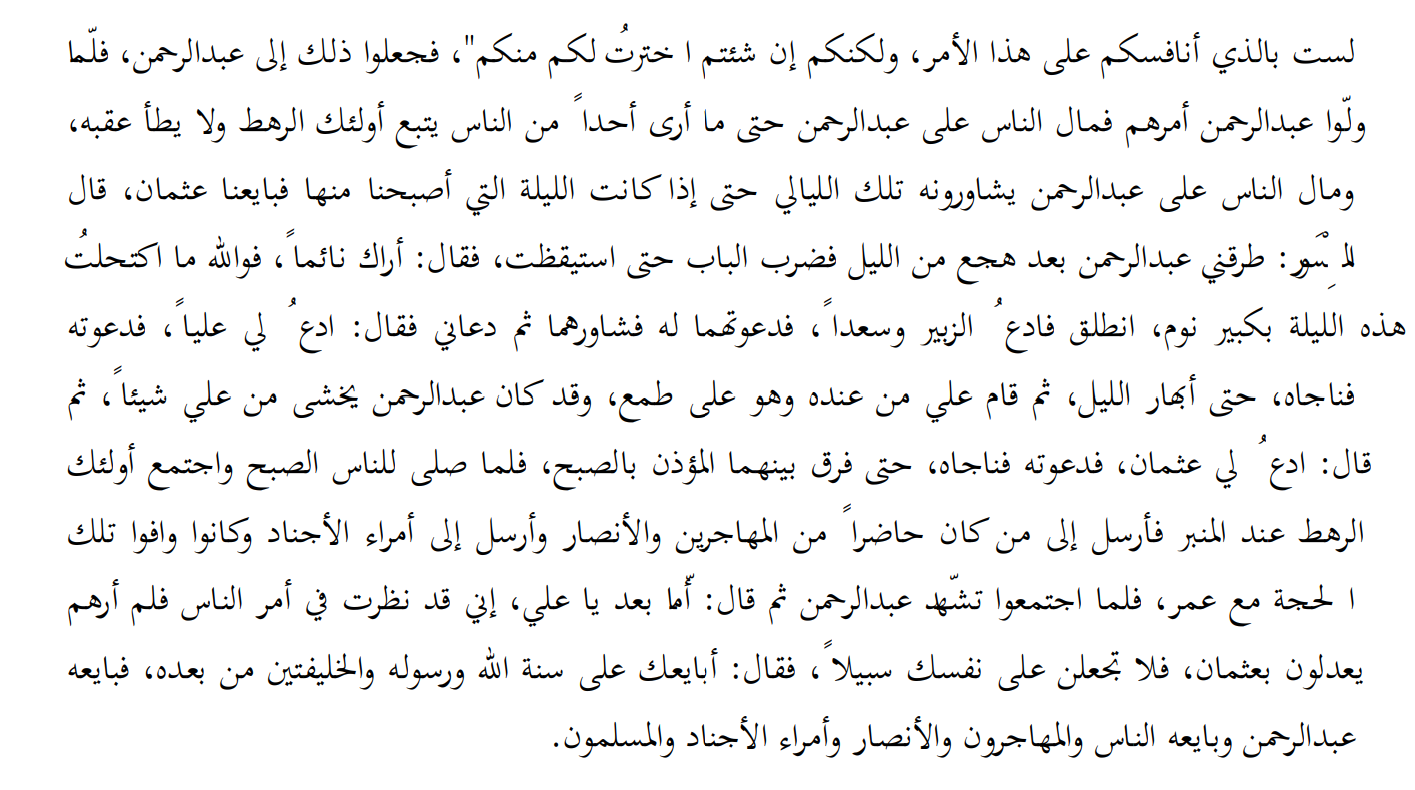
“我并不与你们争夺此事,但如果你们愿意,我可以从你们中间为你们选出一人。”于是他们把此事交给了‘Abdurrahman。当‘Abdurrahman承担此事后,人们纷纷向他靠拢,以至于我没有看到谁跟随那一群人,或落在他们之后。人们不断向‘Abdurrahman请教商议,直到那些夜晚过去,我们在早晨醒来,并向‘Uthman宣誓效忠。 Al-Miswar说:‘Abdurrahman在夜过半后来敲我的门,直到我醒来。他说:“我看你睡着了。以真主发誓,今晚我的眼睛几乎没有合上过。起来,去请Az-Zubair和Sa‘d来。”我把他们请来。他与他们商议。然后他叫我说:“为我请‘Ali来。”我便去请他。他与他私下密谈,直到夜色消散。然后‘Ali带着一些期望离开了他,而‘Abdurrahman对‘Ali的某些方面心存顾虑。接着他说:“为我请‘Uthman来。”我便去请他。他与他私下密谈,直到宣礼员为晨礼呼唤时他们才散去。 ‘Abdurrahman带领众人做完晨礼后,六人小组在讲坛(minbar)旁聚集,他派人召集了当时在麦地那的所有Muhajirs和Ansar,以及那一年随‘Umar主持朝觐的军队将领。众人聚齐后,‘Abdurrahman诵念了两句作证词(shahadah),然后说:“‘Ali啊!我考察了众人的意见,没有看到他们认为有谁能与‘Uthman相比,所以你不要因此而困扰自己。”他又对‘Uthman说:“我以遵循真主之道、其使者之道,以及在他之后的两位哈里发之道,向你效忠。”于是‘Abdurrahman、Muhajirs、Ansar、军队将领以及其余穆斯林都向他宣誓效忠。
“I am not one who competes with you for this matter but if you wish I could choose for you one from among you. So they assigned this to ‘Abdurrahman . When they charged ‘Abdurrahman with this matter, people turned to him to the extent that I did not see any one who followed this group or stepped behind them. The people turned to ‘Abdurrahman consulting him in those nights until the night of which we woke up in the morning and gave our pledge to ‘Uthman. Al-Miswar said: ‘Abdurrahman knocked at my door, after a part of the night had passed, until I woke up. He said: I see you sleeping. By Allah, my eyes did not find much sleep tonight. Set forth and call Az-Zubair and Sa‘d. I invited them to him. He consulted with them. Then he called me and said: Call ‘Ali for me, so I called him. He carried on a whispered conversation with him until the night faded away. Then ‘Ali left him with some expectations, and ‘Abdurrahman was afraid about something from ‘Ali. Then he said call ‘Uthman for me, so I called him. He carried on whispered conversation with him until they departed as the muezzin called for fajr prayer. After he led the people in the fajr prayer, and the group of six persons met near the minbar (pulpit), he sent for all the Muhajirs and Ansar who were present (in Madinah) and sent for the leaders of the army who delivered the pilgrimage that year with ‘Umar. When they met, ‘Abdurrahman recited the two testimonies of faith (shahadahs) and said: O ‘Ali! I viewed the matter of the people and did not see them equalling anyone to ‘Uthman, so do not let anything disturb yourself. And he said (to ‘Uthman): I give you the bay’ah upon the way of Allah, His Messenger and the two Khulafaa who came after him. So ‘Abdurrahman, the Muhajirs, the Ansar, the leaders of the army and rest of the Muslims gave him the bay’ah.”
所以,哈里发的候选人仅限于'Umar(ra)在穆斯林请求他这样做之后所指定的那一群人。'Abdurrahman bin 'Auf(ra)在自己退出哈里发的提名之后,征求穆斯林对于谁应当担任哈里发的意见。在与他们协商之后,他宣布了穆斯林所希望的那个人的名字。他宣布了穆斯林所希望的人的名字之后,便有人向其宣誓效忠,他因此而成为哈里发。因此,关于任命哈里发的沙里亚律例是:将哈里发的候选人限定为代表大多数穆斯林意见的人。然后将他们的名字公布给穆斯林,请他们从候选人中选出一位作为全体的哈里发。接着确定大多数穆斯林所选择的是谁,并向所有穆斯林征集对他的宣誓效忠,无论每个人是否特别选择了他。这种方法的依据是:圣门弟子一致认可'Umar(ra)将哈里发的候选人限定为六个特定的人,并且圣门弟子一致认为'Abdurrahman(ra)应征求所有穆斯林关于谁来担任他们哈里发的意见,而将效忠誓约交给'Abdurrahman(ra)宣布为穆斯林选出的哈里发之人,这一点在他所说的话中表达得很清楚:
So the nominees for the Khilafah were limited to the group named by ‘Umar (ra) after the Muslims had asked him to do so. ‘Abdurrahman bin ‘Auf (ra), after he withdrew himself from the nomination to the Khilafah, took the opinion of the Muslims about who would be the Khalifah. He then announced the name of the person who the Muslims wanted after consulting with them. After he announced the name of the person who the people wanted, the bay’ah was given to him and he became the Khalifah by this bay’ah. Therefore the hukm shari’ concerning the appointment of the Khalifah is to limit the nominees for the Khilafah by those who represent the opinion of the majority of Muslims. Then their names are displayed to the Muslims and they are asked to select one of the nominees to be Khalifah for all. Then it is determined whom the majority of the Muslims have chosen, and the bay’ah from all the Muslims is taken for him, whether each person had specifically chosen him or not. This is the method because of the Ijma’a of the Sahabah about ‘Umar (ra) limiting the nominees for the Khilafah to six specific persons, and the consensus of the Sahabah that ‘Abdurrahman (ra) takes the opinion of all the Muslims about who will be the Khalifah for them, and the consensus to give the bay’ah to the one who ‘Abdurrahman (ra) announced as the person elected by Muslims as a Khalifah is clear when he said:
“我观察了人们的倾向,发现他们认为没有人能与‘Uthman’相提并论。”
“I have looked at the people's tendencies and noticed that they do not consider anybody equal to `Uthman.”
这些要点都阐明了关于哈里发任命的伊斯兰律法判决(hukm shari’)。
All of these points clarify the hukm shari’ concerning the appointment of the Khalifah.
两个问题仍有待探讨。其一是:谁来任命哈里发?是有影响力的人,还是某个特定数量的穆斯林?抑或是所有穆斯林都参与任命哈里发?其二涉及本世纪选举中出现的做法,例如无记名投票、投票箱和计票。这些做法是否符合伊斯兰教?伊斯兰教是否允许它们?
Two issues remain to be examined. One of them is who are the Muslims who appoint the Khalifah? Are they the influential people or a certain specific number of Muslims? Or do all of the Muslims appoint the Khalifah? The second issue concerns the actions occurring in this century in elections such as secret ballots, polling boxes and counting votes. Are these matters consistent with Islam and does Islam allows them or not?
关于第一个问题,安拉(SWT)将权柄赋予了乌玛,并使哈里发的任命成为全体穆斯林的权利与责任;祂没有将此权利赋予某一特定群体而排斥其他群体,也没有赋予某一伊斯兰团体而将另一团体置之度外,因为效忠(bay‘ah)是全体穆斯林的义务。先知ﷺ说:
As for the first issue, Allah (swt), has given the authority to the Ummah and he (swt) made the appointment of the Khalifah a right and duty for all Muslims; and He did not make it a right for one particular group excluding another, nor for a jama‘ah leaving another jama‘ah aside, since the bay’ah is a duty upon all the Muslims. The Prophet (saw) said:
“谁死时颈上没有拥立的盟约,他就死于蒙昧时期(jahiliyyah)的死亡。”
“Whoever dies without having a pledge upon his neck would die the death of jahiliyyah”,
这一点对所有穆斯林都适用。因此,有影响力的人并不拥有任命哈里发的专属权利,也不能无视其余的穆斯林。特定的个人同样没有专属权利。相反,这项权利属于所有穆斯林,毫无例外,甚至包括法斯格者(作恶之人)和伪信者,只要他们是成年的穆斯林,因为在此问题上,沙里亚经文是以一般形式出现的,除了未达到青春期的少年拒绝效忠之外,没有任何经文将其限定于特定人群。因此,经文必须按其普遍含义来理解。
And this is general for every Muslim. Therefore, the influential people do not possess the exclusive right to appoint the Khalifah and cannot ignore the rest of the Muslims. Nor do specific persons have the exclusive right. Rather, this right is for all the Muslims with no exception, it even includes the fajirs (wicked people) and munafiqeen (hypocrites), provided they are mature Muslims because the Shari’ah text came in a general form in this instance and nothing came to limit it (make it specific to certain people) except the refusal of the pledge from the young who have not yet reached the age of puberty. So the text has to be taken generally.
然而,并非所有穆斯林都必须实践这一权利。虽然这是一项责任,因为效忠宣誓(bay'ah)是法定义务(fard),但它属于集体义务(fard kifayah),而非个人义务(fard ain)。因此,如果部分穆斯林履行了这一责任,其余穆斯林的责任便随之解除。但所有穆斯林都必须有能力行使其在选举哈里发方面的权利,无论他们是否实际行使这一权利。换言之,每一位穆斯林都必须能够参与选立哈里发。因此,问题在于使穆斯林能够履行安拉(SWT)为他们规定的建立哈里发的责任,并使这一责任从他们肩上卸下。问题不在于所有穆斯林都实际参与执行这一责任。这是因为安拉(SWT)所规定的责任,是依照穆斯林的同意为他们建立哈里发,而并不要求所有穆斯林都亲自去执行。由此产生两点结果:其一,在建立哈里发的过程中,实现了全体穆斯林的同意;其二,关于任命,并未实现全体穆斯林的同意。然而,在这两种情况下,穆斯林都获得了参与任命的能力。
However, it is not a condition that all Muslims practise this right. While it is a duty, because the bay’ah is fard, it is fard kifayah (obligation of sufficiency) and not fard ain (individual obligation). Thus, if some of the Muslims fulfill it, the duty drops from the rest of the Muslims. But all Muslims must be enabled to practice their right in electing the Khalifah, regardless of whether they use their right or not. In other words, every Muslim must be able to participate in selecting the Khalifah. So the issue is to enable the Muslims to carry out the duty of establishing the Khalifah which Allah (swt) prescribed upon them, in such a way that this duty falls (from their shoulders). The issue is not the actual participation of all the Muslims in conducting this duty. This is because the duty which Allah (swt) has prescribed is to establish the Khalifah for the Muslims by their consent, and it is not a requirement for all Muslims to perform it. Two matters result from this: One of them is that the consent of all the Muslims in the establishment of the Khalifah is achieved. Secondly, the consent of all the Muslims about the appointment is not achieved. The Muslims are however enabled (to participate in the appointment) in both cases.
关于第一个问题,并未规定任命哈里发所需的特定人数。相反,任何数量的穆斯林都可以向哈里发效忠(bay'ah),在这份效忠中,其余穆斯林的同意可以通过他们的沉默、或者通过开始服从他,或者通过任何表示同意的方式来获得;如此,被任命的哈里发便成为所有穆斯林的哈里发。即便只有三个人任命了他,他在法律上也是哈里发,因为集体性是通过执行哈里发的任命而实现的。同意通过沉默、服从或类似的方式达成,前提是这一切是在不受束缚的自由选择下完成,并且在各方面都保障人人都能表达自己的意见。然而,如果未能获得全体穆斯林的同意,那么除非任命是由一个能代表大多数穆斯林同意的群体所完成,否则哈里发的任命便不能成立,而无论这个群体的人数多少。由此,一些法学家提出,哈里发的任命是通过有影响力的人(ahl al-hall wa al-'aqd)对他的效忠而确立的,因为他们将有影响力的人视为通过向任何满足哈里发契约条件的人效忠而达成穆斯林同意的群体。因此,确立哈里发的并不是有影响力的人的效忠,他们的效忠也不是哈里发任命合法性的条件。相反,有影响力的人的效忠是表明穆斯林对效忠已经达成同意的证据,因为有影响力的人被视为穆斯林的代表。 凡是表明穆斯林对效忠某位哈里发的誓约表示同意的证据得以实现,便完成了哈里发的任命,而通过这一效忠誓约任命哈里发便是合法的。
原则上,事物是被允许的,除非存在禁止的证据。
“In Principle things are permitted unless there exists an evidence of prohibition.”
方法(ṭarīqah)与方式(uslūb)的区别在于:方法是一种行为,它本身被视为一个根本,或者是某个没有普遍证据作为根据的行为的分支;其证据是专门针对它的。方式则是一种行为,它是某个行为(即根本)的分支,而该根本没有普遍证据。因此,方法必须依据沙里亚证据,因为它本身就是一条沙里亚律例,所以必须遵守,穆斯林在其上没有选择余地,除非其律例为允许(ibāḥah)。这与方式不同,方式不依赖沙里亚证据,而是被包含在其根本的律例之中。因此,即便先知ﷺ曾经采用某种特定方式,也不必遵循该特定方式。
The difference between method (tareeqah) and style is that the method is an action which is considered by itself as an origin, or a branch to an action that does not have a general evidence for its origin; rather its evidence is specific to it. The style is an action which is a branch to an action—i.e. the origin—upon which there is no general evidence. Therefore, the method must depend upon a Shari’ah evidence because it is a Shari’ah rule, thus it must be adhered to and Muslims have no choice concerning it unless its rule is ibaha (of permissibility). This is different from the style which does not depend on a Shari’ah evidence; rather it is included in the rule of its origin. Therefore, it is not obligatory to follow a particular style even if the Messenger (saw)
然而,穆斯林可以采用任何方式,只要它能促成该行为的履行,从而使其成为该行为的一个分支。因此有人说,方式由行为的类型所决定。
did so. Rather a Muslim is allowed to use any style as long as it leads to the performance of the action, and thus it becomes a branch to the action. Thus it is said that the style is defined by the type of action.