2.7 天命(al-qadā’)与定数(al-qadar)
2.7 Al-qadā’ Wa‘l-qadar
“al-qadā’ wa‘l-qadar”这一名称,通过将两个词连在一起表示一个含义,具有特定所指;也就是说,al-qadā’与al-qadar相连,使二者成为两个相伴相随、不可分割的事物,并且它们具有只属于它们的专门含义。把此含义之外的其他意思纳入其中是不正确的,因为那些意思没有被圣门弟子或再传弟子使用过。通过考察沙里尔(Shar‘i)文本和语言学文献,并研究圣门弟子、再传弟子以及其后的乌莱玛的言论可以清楚看出,“al-qadā’ wa‘l-qadar”二词连用时,圣门弟子和再传弟子都没有将其用作特定的术语(istilāhī)含义;它们在《古兰经》和圣训中也没有以特定的术语含义连用,不过它们在语言意义上曾连用,见于布扎尔(al-Bazzār)以良好(ḥasan)传述链、经贾比尔的圣训所传的记载,即先知ﷺ曾说:
Al-qadā’ wa‘l-qadar, with this name, that is, by connecting two words together for one meaning, has a specific referent; that is, al-qadā’ linked to al-qadar, by making them two concomitant matters whereby one is not separable from the other, and they have a meaning that is exclusive to them. It is not correct to include in it other than this meaning which has not been used by the Sahabah or the Tabi’een. By studying the shar’i and linguistic texts and studying the sayings of the Sahabah, Tabi’een and those who came after them from the Ulama’, it is apparent that the terms al qadā’ wa‘l-qadar together, have not been used with a specific technical [istilāhī] meaning by any of the Sahabah or Tabi’een, nor have they come together with a specific technical meaning in the Qur’ān or the Hadīth; though they have come together in their linguistic meaning in what al Bazzār reported from the hadīth of Jabir with a hasan chain on the authority of the Prophet (PBUH) that he said:
“我的大部分乌玛(Ummah)的人,是在真主的定命(qadā')与前定(qadar)之下,连同他们的灵魂(anfūs)一同死去的。”
“Most of my Ummah die after the qadā’ of Allaah and his qadar with the souls [anfūs].”
因此,这一暗指该名称的术语性含义,只在经院学者(Mutakallimūn)那里才能见到,那是在第一个世纪过去、希腊哲学被翻译之后。它不存在于圣门弟子的时代,也从未有人就这两个词作为一个特定专业术语名称的含义进行过争论或讨论。在整个圣门弟子时代,穆斯林并不知道“al-qadā’ wa‘l-qadar”这一说法,尽管“qadā’”一词曾单独出现,“qadar”一词也曾单独出现于圣训之中,正如这两个词一同出现在上述贾比尔的圣训中一样,但在所有这些情况下,它们都是在语言学的含义上出现的,而非在术语性的含义上。“qadā’”一词出现在关于卡奴特(qunūt)的圣训中。哈桑说:安拉的使者ﷺ教给我一些话,我在witr拜的卡奴特中诵念,然后他提到了卡奴特的祈祷词,其中有:
Therefore this terminological meaning which alludes to this name is not found except from the Mutakallimūn, after the first century had passed and after the translation of the Greek philosophy. It did not exist in the time of the Sahabah nor was there any dispute or discussion of those two terms as one name for a specific technical meaning. Throughout the era of the Sahabah the Muslims did not know of ‘al-qadā’ wa‘l-qadar’ though the word qadā’ had come on its own and the word qadar had come on its own in the ahadīth just as the two had come together in the aforementioned hadīth of Jabir, but in all of these cases they had come in the linguistic meaning. They have not come in the technical meaning. The word qadā’ has come in the hadīth of al-qunut. Al-Hasan said, the Messenger of Allah (PBUH) taught me words I say in the qunut of the witr, then he mentioned the du’a of qunut, of which is,
“……并使我免于你所注定的祸患,因为你是裁定者,而无人能裁定你。” [Reported by al-Darimi , Narrated by al-Hasan ibn Ali]
“...and save me from what You have decreed, for You are the one Who Decrees and you are not decreed upon,” [Reported by al-Darimi , Narrated by al-Hasan ibn Ali]
它的意思是:求你保护我,免受你所判定之事的邪恶侵害,因为你判定你所愿意的事,而没有人能判定于你之上。"Qadar"(定命)一词出现在《吉卜利勒圣训》的一些传述中。他说:
Its meaning is, protect me from the evil of what you have judged, for you judge what you wish and no one judges over you. The word qadar has come in the hadīth of Jibrīl in some of its narrations: He said,
“并信仰前定(al-qadar),无论其善或恶。” [Reported by Muslim, Narrated by Umar ibn al-Khattab]
“And to believe in al-qadar, the good and the bad thereof”, [Reported by Muslim, Narrated by Umar ibn al-Khattab]
以及他的话语
And in his saying
“……若有什么事情临到你,不要说:‘如果我当初这样做了,结果就会是这样那样’,而应当说:‘这是安拉的前定(qaddara),祂做了祂所意欲的。’” [Reported by Muslim, Narrated by Abu Hurairah]
“…If anything befalls you do not say, ‘had I done (this), it would have been such-and-such, but rather say, ‘Allah determined [qaddara] and He did what He willed,’”[Reported by Muslim, Narrated by Abu Hurairah]
在这两段圣训中,"qadar"一词的含义是真主的"定命"(taqdīr)与"前定之知"(ʿilm),即:你应当相信,万事万物都已被真主记录在《被保护的古板》(al-Lawḥ al-Maḥfūẓ)之中,无论善恶,真主在它们存在之前就已知晓;并且应当相信,真主已将此记录在《被保护的古板》中,在事物存在之前已经知道,并且祂按自己的意愿行事。至于"al-qadā’"一词,无论它在这段圣训中,还是在其他任何地方出现时所用的含义,穆斯林都没有异议;他们对它的措辞和含义也没有争论。
The meaning of the word qadar in these two ahadīth is the Determination [taqdīr] and Knowledge of Allah , that is, that you should believe that the things have been written by Allah in the Lawh al-Mahfūdh and He knows of them before they come into existence, whether they be good or bad; and say Allah has written this in the Lawh al-Mahfūdh and he knew it before it came into being and he did what he wished. The word al-qadā’ in the meaning which it came in this hadīth or anywhere else it came was not disputed by the Muslims; they did not have discussions with regards to its wording or its import.
关于那两段圣训中所提到的"加德尔"一词的含义,穆斯林在希腊哲学传入之前,对它的词义或内涵并无分歧,也未曾就此展开讨论。但在希腊哲学传入穆斯林之中以后,库法出现了一个群体,他们说:没有加德尔,也就是说,没有谁在预先决定,万事都在没有任何事先定准的情况下发生;他们被称为"加德里叶派",他们否认加德尔,并且说安拉创造了事物的根本,然后就撇下了它们,因此祂不了解其细节(juz'iyāt)。这与《古兰经》明文所载的内容相悖,经文说安拉是万物的创造者,无论大小、根本或枝节,并且祂在万物存在之前就已经决定了一切,也就是说,祂把它写在了《被保护的录板》(Lawh al-Mahfūdh)上,也就是说,祂在万物出现之前就已经知晓了它们。祂说:
As for the word qadar in the meaning mentioned in those two ahadīth, the Muslims, before the presence of Greek philosophy, did not disagree about it or have discussions with regards to its wording or import. But after the presence of the Greek philosophy amongst the Muslims, a group from Kufa arose and said: there is no qadar, that is, there is no one who (pre)determines and everything occurs without any previous determination; they were called the Qadariyyah and they are the ones who deny the qadar and say that Allah created the fundamentals of things and then left them, so He does not have knowledge of their particulars [juz'iyāt]. This is contrary to what has come in the clear text of the Qur’ān which states that Allah is the Creator of all things, small or big, fundamental or branchial, and that He determined everything before its existence, that is, He wrote it in the Lawh al-Mahfūdh, that is, He knew it before it came to be. He said:
他创造了万物,他是全知万事的。 [TMQ-An’ām: 101]
“He created all things and He is the All-Knower of everything” [TMQ-An’ām: 101]
和
And
“祂知道陆地和海洋中的一切:没有一片树叶落下,祂不知道;地下的黑暗之中,没有一粒种子,也没有任何鲜活或干枯之物,不被记录在明白的典籍之中。” [TMQ-An’ām: 59]
“And He knows whatever there is in the Earth and in the sea: not a leaf falls, but He knows it. There is not a grain in the darkness of the Earth nor anything fresh or dry, but is written in a Clear Record.” [TMQ-An’ām: 59]
然而,这一分歧与讨论仅仅涉及“安拉的定度”就其“安拉的知识”而言。因此,古代盖达利叶派声称,安拉知晓事物的根本,却不知晓其细节;而伊斯兰教则主张,安拉既知晓事物的根本,也知晓其细节。由此可见,关于安拉的定度,即祂的知识,所讨论的是安拉知识的主题。这与“前定与定命”(al-qadā’ wa‘l-qadar)的主题不同。这是一场独立于“前定与定命”讨论之外的另一场辩论。其实际发生的情况亦是如此,即它与“前定与定命”是两个不同的主题。
However, this disagreement and discussion is only with respect to the ‘qadar of Allah’ in terms of His Knowledge. So the Qadariyyah claimed that Allah knows the fundamentals of things but not their partial aspects, whilst Islam states that Allah knows the fundamentals of things as well as their partial aspects. Thus, the discussion with respect to the qadar of Allah , that is, His Knowledge, is about the subject of Allah's Knowledge. It is a subject different to that of al-qadā’ wa‘l-qadar. It is a different discussion, separate from the discussion of al-qadā’ wa‘l-qadar. Its reality that took place is the same, that is, it is a different subject to that of al-qadā’ wa‘l-qadar.
由此可以明显看出,“al-qadā’”(卡达)与“al-qadar”(嘎达尔)这两个词各自独立出现,各有其特定含义。它们与“al-qadā’ wa‘l-qadar”(卡达与嘎达尔)这一课题的研讨并无关联。换言之,无论是单独提及还是合并提及,“al-qadā’”一词在其所有语言学含义和立法者所赋予的沙里亚含义中,以及“al-qadar”一词在其所有语言学含义和立法者所赋予的沙里亚含义中,都与在讨论“al-qadā’ wa‘l-qadar”时所涉及的任何这些术语无关。它们的含义仅限于其所具有的语言学和沙里亚层面的意义。
Thus, it is plainly apparent that the words al-qadā’ and al-qadar have each come on their own with each having a specific meaning. They do not have any relation with the study of al-qadā’ wa‘l qadar. In other words, the word al-qadā’ in all its linguistic and shar’i meanings that have come from the Legislator, and the word al-qadar in all its linguistic and shar’i meanings that have come from the Legislator, have no relation to any of these terms, whether mentioned alone or together, in the discussion of al-qadā’ wa‘l-qadar. They are confined with regards to their meaning, to that what they come with from the linguistic and shar'i meanings.
表明安拉之学识的经文,是那些指示安拉的学识涵盖万物的经文,例如祂的话:
The ayāt which have come in demonstrating the Knowledge of Allah are the ones that indicate the all-encompassing nature of Allah's Knowledge with regards to all things, thus His saying:
“在地上或在你们自己身上,所发生的任何灾难,在我创造它之前,都已记录在一部经典里。这对真主来说确实是容易的。” [TMQ-Hadīd: 22]
“No calamity befalls on the Earth or in yourselves but is inscribed in a Book, before We bring it into existence. Indeed, that, upon Allah, is easy” [TMQ-Hadīd: 22]
而祂的话语,
And His saying,
“说:‘除非安拉为我们所命定的,否则我们必不遭遇任何事。他是我们的保护者。’然后,信士们应当信赖安拉。” [TMQ Tawba: 51]
“Say: ‘Nothing shall ever happen to us except what Allah has ordained for us. He is our Mawla.’ Then in Allah let the believers put their trust” [TMQ Tawba: 51]
而祂的话语,
And His saying,
“即使是天地间一粒微尘的重量,或比它更小或更大的东西,都逃不过祂的知识,它都记载在一部清晰的典籍中。” [TMQ Saba: 3]
“Escapes not from His Knowledge even the weight of an atom, in the Heavens or in the Earth, or less than that, or greater, but it is in a Clear Book” [TMQ Saba: 3]
而祂的话语,
And His saying,
“他就是在夜间取走你们的灵魂,并且知道你们白天所做的一切的主。然后他又让你们醒来,使预定的期限得以完成;然后你们将回归于他。然后他将告诉你们,你们过去所做的一切。” [TMQ An’ām: 60]
“It is He, Who takes your souls by night, and (Who) has knowledge of all that you have done by day, then He raises (wakes) you up again that a term appointed be fulfilled, then unto Him will be your return. Then He will inform you what you used to do” [TMQ An’ām: 60]
这些经文降示给使者(愿主福安之),圣门弟子们背诵并理解了它们,他们并没有想到要去讨论"前定"(al-qadā’ wa‘l-qadar)。此外,这些经文的措辞、含义和所指都表明,它们是对安拉之"知"的阐明,与对前定的研究毫无关系。同样,还有这节经文,
These verses were revealed to the Messenger (PBUH) and they were memorised and understood by the Sahabah, it did not occur to them to discuss al-qadā’ wa‘l-qadar. Furthermore, the wording, understanding and indication of these verses states that they are a clarification about the Knowledge of Allah and have no relation to the study of al-qadā’ wa‘l-qadar. Similarly the ayah,
“如果有好事降临他们,他们说:‘这是从真主那里来的’;如果有坏事降临他们,他们说:‘这是从你那里来的’。你说:‘一切都是从真主那里来的。’这些人到底是怎么了,几乎听不懂任何话语?” [TMQ-Nisā’: 78]
“And if some good reaches them, they say, ‘This is from Allah’, but if some evil befalls them, they say, ‘This is from you’. Say: ‘All things are from Allah’; so what is wrong with these people that they fail to understand any word?’ [TMQ-Nisā’: 78]
这与关于“al-qadā’ wa‘l-qadar”(前定与天命)的讨论无关,因为这段经文是对那些区分善与恶的不信道者的驳斥。他们把恶归于使者ﷺ,把善归于真主。于是真主驳斥了他们,宣告一切都出自真主。这里所讨论的不是人所行的善与他所追求的恶,而是关于战斗与死亡。经文本身以及它前面的内容都说明了这一点。
It has nothing to do with the discussion of al-qadā’ wa‘l-qadar because it is a refutation of the kuffār who differentiated between bad and good. Thus, they made bad to come from the Messenger and good from Allah . So Allah refuted them by declaring that everything is from Allah . The discussion is not about the good that a human being does and the evil that he pursues; rather the discussion is about fighting and death. The ayah itself and that what precedes it clarifies this:
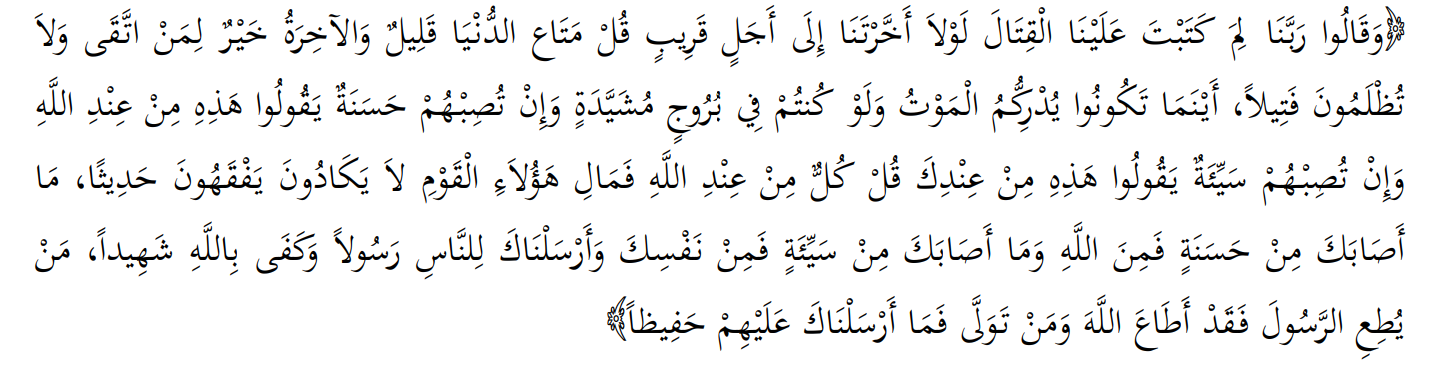
“他们说:我们的主啊!你为什么为我们规定了战斗?你若能让我们稍延一段短暂的时间就好了。”你说:“今世的享受是短暂的,对于敬畏真主的人,后世是更好的,你们丝毫不会受到不公的待遇。你们无论在哪里,即使身处高大坚固的堡垒之中,死亡也必将临到你们。”如果他们遇到一些好事,就说:“这是从真主那里来的。”如果他们遇到一些坏事,就说:“这是从你那里来的。”你说:“一切都是从真主那里来的。”这些人怎么了,竟几乎不懂任何道理?你所遇到的任何好事,都是从真主那里来的;你所遇到的任何坏事,都是由你自己造成的。我已派遣你(穆罕默德ﷺ)作为使者去教化世人,真主足以作证。谁服从使者,谁就是服从了真主;谁背离,我并没有派你去做他们的监护人。 [TMQ-Nisā’: 77-80]
“They say: Our Lord! Why have you ordained for us fighting? Would that you have granted us respite for a short period?’ Say: ‘Short is the enjoyment of this world. The Hereafter is (far) better for him who fears Allah, and you shall not be dealt with unjustly in the least. Wheresoever you may be, death will overtake you even if you are in fortresses built up strong and high! And if some good reaches them, they say, ‘This is from Allah,’ but if some evil befalls them, they say, ’This is from you.’ Say: ‘All things are from Allah’, so what is wrong with these people that they fail to understand any word? Whatever of good reaches you, is from Allah, but whatever of evil befalls you, is from yourself. And We have sent you (O Muhammad) as a Messenger to mankind, and Allah is sufficient as Witness. He who obeys the Messenger, has indeed obeyed Allah, but he who turns away, then we have not sent you as a watcher over them.” [TMQ-Nisā’: 77-80]
所以,这里的主语是他们所遭遇的事情,而不是他们所做的事情。因此,这与对“al-qadā’ wa‘l-qadar”(前定与天命)的研究无关。
So the subject is what befalls them and not what they are doing. Thus it has nothing to do with the study of al-qadā’ wa‘l-qadar.
因此,上文所提及的一切都与对“盖德”(al-qadā’ wa‘l qadar,前定)的研究无关;它们不属于该概念的含义范围,与上文所述也毫无任何关联。毋宁说,“盖德与盖德尔”(al-qadā’ wa‘l-qadar)作为一个概念,源自希腊哲学,由穆尔太齐赖派传入,他们对此提出了自己的见解。逊尼派与札卜利派(Jabriyyah)反驳了他们,逊尼派也反驳了札卜利派。这场讨论局限于同一个概念,并建立在同一前提之上。因此,这一问题是一个源自希腊哲学的概念,它在穆斯林与曾以希腊哲学为武器的异教徒之间的辩论中凸显出来。这一概念与信仰(‘aqīdah)相关,因此所要做的是阐明伊斯兰对此概念的看法。穆尔太齐赖派提出了见解,札卜利派反驳了他们并提出了另一种见解。逊尼派反驳了所有人,并提出了自己的见解,并称其为第三种见解,它是从前两种见解中产生的,他们将其比喻为“从粪便与血液之间流出的纯净乳汁,饮之甘甜”。
Therefore, all that has been mentioned above has nothing to do with the study of al-qadā’ wa‘l qadar; they do not come under its meaning and have no relation whatsoever with what has been mentioned above. Rather, al-qadā’ wa‘l-qadar as a meaning has come from Greek philosophy which was transmitted by the Mu'tazilah who gave an opinion with regards to it. Ahl al-Sunnah and the Jabriyyah refuted them and Ahl al-Sunnah (also) made a refutation of the Jabriyyah. The discussion was confined to the same meaning and preceded upon the same premise. Thus the issue is a meaning/sense that came from Greek philosophy and it came to the fore in the debate which used to take place between the Muslims and the kuffar who used to be armed with the Greek philosophy. It is a meaning which has a relevance to the ‘aqīdah (creed), thus what is desired is to give Islam's opinion regarding this meaning. The Mu'tazilah gave an opinion and the Jabriyyah refuted them and gave another opinion. Ahl al-Sunnah refuted all of them and gave an opinion, and said about it that it is a third opinion which has come out from the two opinions and they described it as ‘the pure milk, sweet to drink, that comes out from between excrement and blood’.
因此,源自希腊哲学的讨论话题便为人所知。由于它与"aqīdah"(信条)相关,穆斯林必须清楚自己在这一问题上的信仰是什么。穆斯林确实表达了各自的观点,于是出现了三个学派。因此,不允许将al-qadā’ wa‘l-qadar(前定与天命)这一问题归结为al-qadā’或al-qadar在语言上和在Sharī’ah(伊斯兰教法)中已有的含义,也不允许凭空臆测、构想或想象出al-qadā’或al-qadar的某种含义。例如,说al-qadā’是对普遍事物的普遍裁定,而al-qadar是对局部事物及其细节的普遍裁定;或者说al-qadar是对万物的永恒规划,而al-qadā’是依照该预定与规划所作的执行和创造,都是不允许的。这是因为这只是纯粹的想象、假设,以及把某些语言和教法术语生硬套用于不相适应之处的失败尝试,因为这些词语所指示的是一般含义。在没有证据的情况下,将这两个词限定于这些特定含义,便是一种武断的行为。
Therefore, the subject of discussion, which came from the Greek philosophy, became known, and since it is related to the ‘aqīdah (creed), the Muslim must be clear as to what his belief is regarding this subject. The Muslims did actually state their opinion and three schools of thought arose. Thus it is not allowed to refer the issue of al-qadā’ wa‘l-qadar to what has come of the meaning of al-qadā’ or al-qadar, linguistically and in the Sharī’ah, nor is it allowed to imagine or conceive for al-qadā’ or ‘al-qadar any meaning from mere supposition, conception or imagination, and to say, for example, that al-qadā’ is the universal judgement on only the universals and al qadar is the universal judgement on the partial aspects and its details, or to say that al-qadar is the eternal plan for things and al-qadā’ is the execution and creation according to that predetermination and plan. Indeed, this is not allowed because this is mere imagination, assumption and a failed attempt of applying certain linguistic and shar’i expressions because they do not apply to it, they rather indicate general meanings; . It would then be an arbitrary action to restrict the two words to these specific meanings without evidence.
“每个灵魂都为自己所得而被抵押”, [TMQ Muddathir: 38]
“Every soul is a pledge for what it earns,” [TMQ Muddathir: 38]