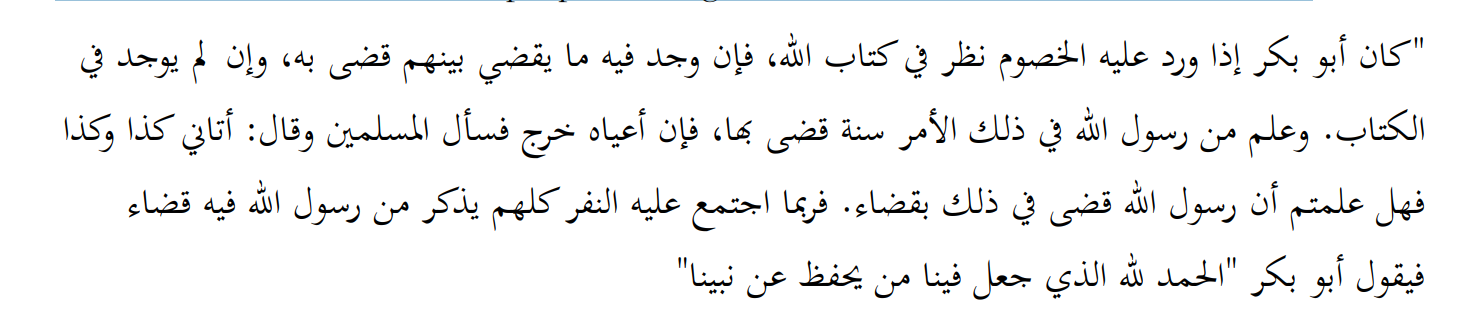
如果他找不到安拉的使者ﷺ的圣训,他就召集人们的首领以及其中最优秀的人,与他们协商。如果他们对某一事务达成共识,他就依据该共识做出裁决。据传,欧麦尔虽然精通教法,仍然与圣门弟子协商,以至于每当有事件提交到他面前时,他会说:“给我请阿里来,请栽德来。”他与他们协商,并以他们所一致同意的意见来解决争端。
由于圣门弟子之间相互参照,他们之间的意见分歧很少,因为每位圣门弟子都向另一位圣门弟子阐述自己的观点以及他所引出的证据。总体而言,他们的见解是正确无误的,并且每个人都会参照他人的意见。尽管他们在某些法律条文上的观点有所不同,但这些分歧很少,而且只存在于他们的理解之中,而非理解的方法之上。
If he failed to find a Sunnah of the Messenger of Allah he gathered the heads of people and the best amongst them and consulted them. If they had a consensus on a matter he would judge with that. It has been reported that ‘Umar used to consult the Sahabah despite his knowledge of fiqh to the extent that when an incident would be refered to him he would say: Call ‘Ali for me, call Zayd. He used to consult them and settle the dispute with whatever they were agreed upon. Due to the Sahabah’s reference to each other differences of opinion between them were rare because each Sahābi expressed to another Sahābi his own perspective and the evidences he educed. Their view on the whole was true and correct and each one referred to the other. And even though their views differed in certain rules but their differences were rare and it was in their understanding and not in the method of understanding.
当征服不断扩大,圣门弟子分散在各个城市,彼此难以会面时,每当出现没有明文依据的事件,每位圣门弟子都会依自己的见解作出判断,不会向他人表达或征询意见,原因一是城市相距遥远、难以会面,二是需要对所在城市发生的事件作出裁决。每一座穆斯林城市中都有一位或多位圣门弟子,他们是人们求取教法裁决的依靠。他们推演出那些没有明文规定的律例,并承担起阐明和解释经文的任务,正如他们承担起向民众教授《古兰经》和圣训的责任一样。当时圣训尚未成文记录,因此圣门弟子们对同一事件的看法有所不同,每人都有其所推断出的依据,并据此作出教法裁决。然而,这些见解都属于沙里亚的律例,彼此都予以接受,因为他们的分歧只在于理解的不同。至于他们的伊斯兰教法推理(Ijtihād)方法,则是共同的:即考察《古兰经》和圣训的经文,审视这些文本,确保所认定的公益(maslahah)确实是沙里亚所指明的,并将类比应用于各种问题和公益之中。推理方法的统一,使得理解上的差异不致产生负面影响。相反,这恰恰是教法学(fiqh)得以成长和拓展的原因之一。他们的教法裁决(fatwā)依据所发生的事件和问题而作出。他们分歧的范围并未扩大,也未逾越枝节问题(furū')的范畴。圣门弟子在枝节问题上的分歧,可归因于两个原因:
When the conquests expanded and the Sahabah became separated in various cities and it became difficult for these Sahabah to meet, every time an incident occurred which had no text, each Sahabah gave his own opinion without expressing it to others or referring to others due to the difficulty in meeting since the cities were distant from each other and also due to the need of giving an opinion on an incident occurring in the city in order pass judgement by it. In every Muslim city there was one or more Sahabah. They were the reference point for rulings. They used to deduce rules which had no text and assume the task of clarifying and explaining the text just as they took the responsibility of teaching the people the Qur’ān and Sunnah. The Sunnah had still not been written down, therefore the opinions of Sahabah differed about a single incident and each one had an evidence for the opinion he had educed and gave legal verdicts with. However, all of these opinions were Sharī’ah rules and were acceptable to all of them since their disagreement was only in their understanding. As for their method of Ijtihād it was one which is to consider the text of the Qur’ān and hadīth and examine the texts, and ensure that the accredited maslahas (benefit) are the ones only indicated by the Sharī’ah and make analogy to issues and maslahas. The unity of the methodology in Ijtihād did not allow the difference in understanding to have any effect. On the contrary it was one of the reasons for the growth and expansion of fiqh. Their legal verdicts (fatwas) were according to the incidents and issues that took place. The range of their disagreement did not widen and nor did it overstep the furu’ (branches of fiqh). The disagreement of the Sahabah in furu’ is attributable to two reasons:
首先:《古兰经》和圣训的大多数文本在指明其含义上并不确定,而是具有推测性的含义(zanniyya al-dalāla)。此外,由于文本兼有两种或多种语言学意义,或文本具有普遍性而可被限定,它们容易指向这种或那种含义。每位穆智台希德都依据其中占优的迹象(qara'in)来尝试理解文本。
First: That most of the texts of the Qur’ān and Sunnah are not definite in indicating what is meant rather they are of speculative meaning (zanniyya al-dalāla). Also they are liable to indicate this or that meaning due to the text sharing two or more linguistic meanings or the text being general such that it is open to specification. Each Mujtahid attempted to understand the text according to what was preponderant from the qara’in (indications).
其次:在当时,圣训尚未以书面形式记录下来。穆斯林之间流传的圣训并没有统一的汇编可供共同参照,圣训是通过口述传授和记忆流传的。或许埃及的一位穆automatically...
Let me restate cleanly:
其次:圣行(Sunnah)当时尚未以书面形式记录下来。穆斯林之间流传的圣训并没有统一的汇编作为共同的参考依据,圣训是通过传述和记忆而流传的。也许埃及的某位穆智塔希德知道某条圣训,而大马士革的另一位穆智塔希德却不知道。许多时候,一些穆智塔希德在得知别人了解某条他们所不知道的圣训后,便会收回自己对某个教法问题的教令。这导致了在教法枝节问题(fiqh的furu')上的分歧,但是,有关这些问题的证据和原则并没有不同,因此他们的伊吉提哈德(Ijtihād)方法也没有不同。
Second: The Sunnah had not yet been recorded in the written form. There was no unanimity on the body of hadīth which had spread among Muslims so as to be a common reference. Rather, the hadīth was circulated via transmission and memory. Perhaps a mujtahid in Egypt would know a hadīth but a mujtahid in Damascus did not know it. Many a times certain mujtahidin would retract from another mujtahid’s fatwa when they came to know that someone else knew of a Sunnah that they did not know. This led to disagreements in furu’ (branches of fiqh) but the evidences and principles concerning them did not differ therefore their method of Ijtihād did not differ.
简而言之,众圣门弟子(愿真主喜悦他们)都是伊斯兰教法的学者。他们学习《古兰经》,掌握圣训,并通过与负有使命的人——我们的主人穆罕默德ﷺ——相处,致力于施行伊斯兰的律例。他们统治民众,在他们之间主持公道,并教导他们的宗教。他们是所居住地区居民的光明,是伊斯兰教法的守护者,在召唤人们归信伊斯兰时,他们是真正的信士。他们为民众诵读《古兰经》,教授其中的法规与准则。在教导民众伊斯兰时,他们遵循一种务实的路径。因此,他们既教导民众伊斯兰及其律例,也教导人们如何借助这些律例解决生活中的问题并从中受益。他们既是统治者,同时也是教师。民众来到圣门弟子面前,从他们那里接受文化,领受伊斯兰并理解其律例。他们所阐明的教法意见被称为"法特瓦"(教法裁决)。据保存下来的记载,约一百三十位真主使者ﷺ的同伴(其中有男子也有女子)曾颁布过法特瓦。其中七人最为博学,提出的意见也最多,被称为"al-mukaththirun"(多发法特瓦者),他们是:欧麦尔、阿里、伊本·麦斯欧德、阿伊莎、宰德·本·萨比特、伊本·阿拔斯和伊本·欧麦尔。哈里发、总督以及其他统治者都是精通教法的法学家、伊斯兰教法的学者,并忙于颁布法特瓦,因此伊斯兰在他们身上得到了体现。他们的头脑中充满了这种文化,他们的思想源于此种文化,他们所信奉的观念也由这些思想而生。他们是执行这些命令、禁令和律例的人。所以,哈里发与总督是同一批人:他们思考、行动、理解并统治。 因此,他们的行为曾经是正确的,他们的事务遵循正道,他们的生活高尚,他们与人交谈时诚实可信,他们的规则以极其精确的方式遵循伊斯兰之道。一群再传弟子坚守圣门弟子,从他们那里学习《古兰经》,从他们那里传述逊奈,记诵他们的教法裁决,并学习他们推演教法律例的方法。在圣门弟子在世时就已经有人发布教法裁决的,如麦地那的赛义德·本·穆塞布,库法的赛义德·本·朱拜尔。因此,我们发现,在所有圣门弟子去世之后,再传弟子在教法学和推论(istinbat)方面接续了他们。他们依据自己的独立判断(Ijtihād)推演律例。他们首先查看安拉的经典和安拉使者ﷺ的逊奈,如果在其中找不到答案,就研究圣门弟子的教法裁决。他们从教法学的角度对圣门弟子的教法裁决持有见解,并权衡一种说法胜过另一种说法。他们有时采纳其中某些人的观点,有时甚至与圣门弟子意见相左。再传弟子推演律例的方法与圣门弟子的方法相同。因此,他们的教法裁决是依据所发生的事件和问题作出的,没有任何先入之见。毋宁说,裁决是随事件而定的。他们之间的分歧范围并未扩大,圣门弟子之间存在分歧的原因,也未超出界限;那些原因多与对经文的理解有关,而非与沙里亚依据有关。因此,穆斯林之间不存在影响生活的分歧。
In short, the Sahabah (may Allah be pleased with them) were scholars of the Sharī’ah. They learnt the Qur’ān and acquired the hadīth and took it upon themselves to implement the rules of Islam by mixing with the one responsible for the Message, our master Muhammad . They used to rule the people, judge between them and teach them their deen. They used to be a light for the inhabitants of the country who lived there and trustees of the Sharī’ah and in calling people to Islam they were true believers. They would recite the Qur’ān to the people and teach them the laws and rules. In teaching people Islam they use to follow a practical course. So they taught the people Islam and its rules and the method by which they would benefit in solving the problems of life with those rules. They were rulers and at the same time they were teachers. The people approached the Sahabah and recieved the culture from them, taking Islam and understanding the rules. The opinions in ahkām that they clarified were termed as ‘legal verdicts’ (fatawa). The fatwa of about one hundred and thirty companions of the Messenger of Allah (among which there are men and women) have been preserved. Seven of them were the most knowledgeable and gave the most opinions. They have been called the al-mukaththirun (those who were prolific in giving opinions). And they are: ‘Umar, ‘Ali, Ibn Mas’ud, ‘A’isha, Zayd ibn Thabit, Ibn ‘Abbas and Ibn ‘Umar. The Khalifahs, Walis and the rest of the rulers were fuqaha in ahkām, scholars of the Sharī’ah and busy in passing fatwa (legal verdicts), that is why Islam was embodied in them. Their minds were filled with its culture and their thoughts originated from this culture and the concepts they believed in emanated from these thoughts. They are the ones who implemented these orders, prohibition and rules. So the Khalifah and the Wali were the same people who thought, acted, understood and ruled. That is why their actions used to be correct and their affairs were on the right path and their lives were elevated and their manner of speaking with the people was honest and their rules adherent to the path of Islam with extreme precision. A group from the Tabi’in stuck to the Sahabah and learnt Qur’ān from them, reported the Sunnah from them, memorised their legal verdicts and underwent their methods of deduction of ahkām. There were those who used to give legal verdicts in the lifetime of the Sahabah like Said ibn al Musayyab in Madinah and Sa’id ibn Jubayr in Kufa. Thus, we find after all the Sahabah had passed away, the Tabi’in succeeded them in fiqh and istinbat (inference of rules). They used to deduce rules according to their own Ijtihād. They used to first look at the Book of Allah and the Sunnah of the Messenger of Allah , if they did not find anything there then they would study the fatwa (legal verdicts) of the Sahabah. They used to have opinions concerning the Fatwas of Sahabah from a jurisprudential perspective and they used to outweigh one statement over another. They used to take the opinions of some of them or sometimes they even differed with the Sahabah. The Tabi’ins method of inferring rules was the same method of the Sahabah. That is why their fatwas were according to the incidents and issues that took place without the presence of any assumptions. Rather it is according to the incident that you will find the fatwas. The range of disagreement did not become wide between them and nor did the reasons for disagreement on which the Sahabah disagreed overstep the mark which used to relate to the understanding of the text and not to the Sharī’ah evidences. Therefore, there were no disagreements amongst Muslims which affected life.