第26章 信士与不信者的交往
26. The Believer's Befriending The Disbelievers
安拉(SWT)说:
Allah (swt) said:
“不要让信道者舍弃信士而以不信道者为盟友,谁这样做,谁就与真主毫无关系,除非你们畏惧他们遭遇某种危险。真主警告你们要敬畏Ta自己,你们终归要归于真主。”[TMQ 3:28]
“Let not the believers take the disbelievers as friends instead of believers, and whoever does that is not of Allah in anything except if you fear from them something to be feared. And Allah warns you against Himself and to Allah is the return” [TMQ 3:28].
雅各布(Ya'qub)和萨哈勒(Sahl)将其读作(taqiyyah),这是哈桑(Al-Hasan)和穆扎希德(Mujahid)的读法,其余读者则读作(tuqat)。《卡穆斯·穆希特》(Al-Qamus Al-Muheet)中说:“(at-tawqiyya)即(al-kalau)和保护。我(taqa)某事,我(taqa)了它,我(taqi)它,(taqa)……他(taqi)它,(tiqa)如(kisa),即我害怕它。”经文中的这段文字明确了其主题,而“taqiyyah”一词的这一语言学含义也明确了它在本节经文中的意义,因为该词并未确立任何沙里亚层面的含义。因此,这就要求以其语言学含义来解释它。仅以此为基础,本节经文的总体和细节才能得到理解。至于圣训中关于其降示背景的记载(若经考证为真实可靠),它们能够指明经文所载细节,但不会改变经文的主题,也不会改变其语句按照语言和沙里亚所表达的含义。经文的主题在其语句中十分清楚,即信士与不信者交友,也就是将他们视为朋友。经文如下:
Ya’qub and Sahl recite it as (taqiyyah) which is the recitation of Al-Hasan and Mujahid, while the rest (recite it) as (tuqat). It is said in Al-Qamus Al-Muheet: ‘(At-tawqiyya) is (al-kalau) and protection. I do (taqa) something and I did (taqa) it and do (taqi) it (taqa) and he (taqi) it (tiqa) like (kisa) is I feared it.’ This text in the ayah specifies its subject and this linguistic meaning of the word (taqiyyah) specifies what this word means in this ayah in meaning since no Shari’ah meaning was established for it. So it specifies interpreting it with its linguistic meaning. Upon this basis alone is the ayah understood in its generality and details. As for what came in the ahadith of the circumstances of its revelation, if authenticated, guides to the details of what came in the ayah but would not change its subject neither the meaning of its sentences according to the language and Shar’a. The subject of the ayah is clear in its sentence which is believers befriending the disbelievers i.e. treating them as friends. The text is:
“不要让信士们舍弃信士而以不信道者为盟友。”{3:28}
“Let not the believers take the disbelievers as friends instead of believers” [TMQ 3:28].
如果某段经文或圣训是针对某一特定事件而降下的,那么它就只针对该事件,不包括其他事情。问题在于信士与不信道者交友,对此经文作出了明确的禁止。而且这并非只有这一节经文论及此事;还有许多经文都谈到了这一点,例如安拉的话:
If the ayah or ahadith came about a specific subject, then it is specific to this subject and does not include anything else. The issue is the issue of believers befriending disbelievers for which came the ayah decisively prohibiting it. Nor is this the only ayah upon this subject; there have come numerous ayahs like Allah’s statement:
“向伪信者报喜:他们必将受到痛苦的刑罚。他们舍弃信士,而以不信道者为盟友。”[TMQ 4:138-139]
“Give tidings to the hypocrites that for them is a painful punishment. Those who take the disbelievers as (awliya) instead of believers” [TMQ 4:138-139].
以及安拉的经文:
And Allah’s statement:
“信道的人们啊!你们不要舍弃信士而以不信道者为盟友。” [TMQ 4:144]
“O you who believe, do not take the disbelievers as (awliya) instead of disbelievers” [TMQ 4:144]
以及祂(SWT)的话语:
And His (swt) statement:
你将不会发现,信仰真主和末日的人会去喜爱那些违抗真主和祂的使者的人。 [TMQ 58:22]
“You will not find a people who believe in Allah and the Day of Judgement loving those who oppose Allah and His Messenger” [TMQ 58:22]
以及祂(SWT)的话语
And His (swt) statement
"不要把犹太教徒和基督教徒当作(awliya)" [TMQ 5:51]
“Do not take the Jews and Christians as (awliya)” [TMQ 5:51]
而祂的这句话:
And His statement:
“不要把我的敌人和你们的敌人当作(Awliya)的朋友” [TMQ 60:1]
“Do not take my enemy and your enemy as (awliya)” [TMQ 60:1]
主题是信士与不信道者结交的问题,这段经文其余的部分是对该主题的详细阐述。安拉(swt)禁止信士以不信道者为友,并以一种明确而决然的措辞将此禁令与一项裁定相连:凡这样做、以不信道者为友的人,安拉便与他无关。然后,安拉在这项决然的禁令中排除了一种情况,即信士害怕不信道者加害自己的情况。在这种情况下,为了防止这种伤害,允许他与不信道者结交。这种情况是指穆斯林处于不信道者的统治之下,在自己的事务上处于劣势,也就是说,对不信道者的恐惧允许他与之结交。若恐惧消失,结交便被禁止。因此,这种情况并非是表面结交、暗中另有所图,而是把信士在处于劣势时对不信道者心怀恐惧的情况,从禁止结交的一般原则中排除出去。 这段经文的含义是:安拉明确禁止信士以不信道者为自己的朋友,禁止他们向其寻求援助、依赖他们、与他们亲近、彼此相爱。经文禁止信士与不信道者结交而不是与信士结交,然后排除了其中一种情况,即当信士处于不信道者的统治之下而心怀恐惧时,允许对他们表示友善、与他们结交,以防御他们的恶行和伤害。也就是说,在信士处于其统治之下并心存畏惧的情况下,允许以他们为友。除此之外,绝对不允许。这一裁定仅限于不信道者与信士的关系,因为这段经文是针对与麦加的多神教徒有友好往来的信士而降示的。 它禁止麦地那的信士与麦加的多神教徒结为朋友,并且禁止所有信士这样做,但被排除在外的是那些身处麦加、在事务上处于劣势的信士。之所以排除他们,是因为他们身边存在对近旁不信道者之伤害的恐惧。这是该节经文的主题,也是它的含义,由此推出的伊斯兰教法规定是:信士禁止与不信道者结为朋友,无论哪种形式的交往,包括支持、友谊、援助等,因为经文中的“awliya”(盟友、朋友)一词是泛指的,涵盖其所有含义;而在恐惧他们的情况下,即恐惧他们的暴力和伤害,当不信道者占上风、穆斯林处于劣势时,则允许这样做,正如麦加穆斯林与多神教徒相处的情形一样。经文中没有其他含义,也没有由此推出的其他规定。至于有人说“塔基亚”(taqiyyah,权宜隐讳)是指穆斯林在所恐惧伤害的人面前,或者担心对方知道其真实情况和内心所想时,表现出与内心隐藏之事相反的样子,无论那人是不信道者还是信士,这种说法纯属谬误。该节经文并不表明这一点,因为“除非你们对他们有所畏惧(tuqat)”的意思是:除非你们对他们有值得害怕的事情而感到畏惧;“atqaytu”的含义即“我畏惧它”,“tuqat”与“taqiyyah”含义相同。这一情形被排除在禁止信士与不信道者结为朋友之外,而非代替信士的排除,因此它仅限于被排除的那一部分。
The subject is the subject of believers befriending disbelievers and the rest of the ayah is detailing the subject. This is because Allah (swt) prohibited the believers from taking the disbelievers as friends, and linked this prohibition with a definite decisiveness that the one who does that and takes the disbelievers as friends then Allah is absolved from him. The he excluded from this decisive prohibition one situation which is the believer fearing harm from the disbeliever, wherein it is allowed for him to befriend the disbelievers to prevent this harm. This is if the Muslim were under the disbelievers’ authority defeated in his affair i.e. the fear of the disbeliever permits his befriending. If the fear disappears then the befriending is forbidden. Accordingly the situation is not displaying befriending and hiding something else, but the issue is excluding the situation of the believer’s fear of the disbeliever when the Muslim is defeated in his affair from the generality of forbidding his befriending him. The meaning of the ayah is the decisive prohibition for the believers from taking the disbelievers as friends for them, and that they seek their assistance and depend upon them, and that they befriend them and there be love between them. So it forbade the believers from befriending disbelievers instead of believers then excluded one situation from this, which is in the situation where there exists fear from them when they are under their authority. Then it is allowed to display love for them and to befriend them to prevent their evil and harm. That is, it is allowed to take them as i.e. friends in the situation where there exists fear from them when they are under their rule. Apart from that, it is absolutely not allowed. This is for the disbelievers only in relation with the believers as the ayah was revealed in the affair of the believers who had relations friendship with the polytheists in Makkah. It prohibited those in Madinah from befriending the polytheists in Makkah and it prohibited all believers but excluded from that the believers who were in Makkah who were defeated in their affair. So it excluded them due to the existence of fear of the harm of the disbelievers near to them. This is the subject of the ayah and this is its meaning, and this is the Shari’ah rule deduced from it which is the forbidding of the believers befriending the disbelievers in all types of befriending, for support, friendship, assistance etc as the word (awliya) came general in the ayah covering all its meanings, and the permission of befriending them in the situation of fearing them i.e. fearing their violence and harm when the disbelievers are victorious over Muslims and the Muslims are defeated in their affair exactly like the situation of the Muslims in Makkah with the polytheists. There does not exist any other meaning in the ayah nor any rule other than this rule deducted from it. As for what some say that “taqiyyah” is that a Muslim displays opposite to what is hidden before any person from whom he fears harm or fears his knowing his reality and what is in his soul whether that person is a disbeliever or believer, this statement is pure error. The ayah does not indicate anything of this since the meaning of: “Except if you fear from them (tuqat)” i.e. except if you fear from them something to be frightened of as the meaning of “atqaytu” something “taqiyyah” is I feared it, and (tuqat) and (taqiyyah) are of one meaning. This is excluded from the prohibition of believers befriending disbelievers instead of believers so it is specific to what is excluded of it.
“你不会看到信仰真主和末日的人,去喜爱那些违抗真主及其使者的人。” [TMQ 58:22]
‘You will not find a people who believe in Allah and the Last Day loving those who oppose Allah and His Messenger’ [TMQ 58:22]
以及祂(SWT)的话语:
And His (swt) statement:
不要把犹太人和基督徒当作朋友。 [TMQ 5:51]
‘Do not take the Jews and Christians as friends’ [TMQ 5:51]
以及祂(SWT)的话语:
And His (swt) statement:
“不要把我的敌人和你们的敌人当作朋友。” [TMQ 60:1]
‘Do not take my enemy and your enemy as friends.’ [TMQ 60:1]
以及祂(SWT)的话语:
And His (swt) statement:
“不要把我的敌人和你们的敌人当作朋友。” [TMQ 60:1]
‘Do not take my enemy and your enemy as friends.’ [TMQ 60:1]
他(SWT)的话:
His (swt) statement:
“代替信士” [TMQ 28:53]
‘Instead of believers’ [TMQ 28:53]
这意味着友谊是应当存在于信士之间的,这也是一项禁令,禁止与不信道者交友,禁止协助他们对抗信士。也有人说,这是禁止以善意和友好的态度对待不信道者。据伊本·阿拔斯传述:“awliya”(朋友)是“waliyy”(朋友)的复数,指的是那种以援助和支持命令自己所喜悦之人的人,这一词有两种用法。第一,作为受委托的支持者,给予支持;另一种是被支持的一方。所以,(真主)的(至尊)经文说:
Means that friendship is obliged with believers, and this is a prohibition from befriending disbelievers and assisting them against believers. And it is said (that it is) a prohibition of treating the disbelievers with kindness and friendliness. It is narrated from ibn Abbas: "friends" (awliya) is the plural of "friend (waliyy) who is the one who commands the one pleased with his action with assistance and support, and it occurs in two ways. Firstly, the designated supporter with support and the other who is the supported. So His (swt) statement:
“真主是信士的保护者”[TMQ 2:257
‘Allah is the friend of those who believe’ [TMQ 2:257
意思是他们的助手和支持者;所谓“祂的支持”,即是指这一点。据说信士是安拉的朋友,也就是得到祂支持的人。 经文中的“凡这样做的人”,是指那些舍弃信士而以不信道者为友的人。“那么他与安拉毫无关系”,即他不属于安拉(SWT)的朋友,安拉(SWT)与他毫无瓜葛。也有人说,他在任何方面都不在安拉的友爱(wilayah)之中。随后,经文做了例外的说明:
Means their helpers and supporters by His support, and it is said that the believer is the friend of Allah i.e. one assisted by His support. His statement: ‘whoever does that’ means whoever takes disbelievers as friends instead of believers ‘then he is not of Allah in anything’ i.e. he is not from the friends of Allah (swt) and Allah (swt) is absolved of him, and it is said he is not from the friendship (wilayah) of Allah in anything. Then He excluded and said:
除非你们担心会遭受某种值得担心的危害。
‘except if you fear from them something to be feared’
除非是异教徒获胜而信士失败,信士因此害怕他们,如果他不表示同意他们或与他们保持友好的关系。在这种情况下,允许他以口头表示对他们的好感,并顺从他们,作为对他们的防备(塔基亚)和自我保护,而并非真的相信那些。这节经文表明,在宗教中,当担心自身安全时,塔基亚是被允许的。我们的同伴认为,在必要时的一切事务中都是允许的,而且为了善意与和解的各种形式,它往往变成必须的;但在杀害信士或已知、或他认为最可能的会破坏宗教(伊斯提斯达德)的行为上,则是不允许的。穆菲德说:它有时是必须的,成为法定义务(法尔德);有时是被允许的,成为可取的;有时是允许但不必须的,有时放弃它反而更好;有时即使行使者可以得到原谅,放弃它反而更好,因为这样不会受到指责。谢赫·艾布·贾法尔·图西说:传述的表面含义表明,在担心生命安全时它是必须的。另有传述,允许在这种情况下明确说出真相。哈桑传述道
means except that if the disbelievers are victorious and the believers defeated so the believer fears them if he does not show his agreement with them or make good his companionship with them. At that time, it is allowed for him to show his affection for them with his tongue and compliance to them as a precaution (taqiyyah) from them and protection for himself without believing that. In this ayah there is an indication that taqiyyah is permitted in the deen when there is fear over oneself and our companions say it is permitted in all matter at times of necessity and often it becomes obligatory for the variety of kindness and reconciliation, but it is not permitted from the actions in killing a believer or what is known or he considers most probable that it is spoiling (istifsad) in the deen. Al-Mufid said that it is obligatory at times and becomes fard, and it is permitted at times and becomes recommended. And it is permitted at time without obligation and it becomes at times better than leaving it; and it could at times be better to leave it even though its performer is excused and forgiven over it by leaving the blame over it. Sheikh Abu Ja’far At-Tusi said that the apparent meaning of the narrations indicate that it is obligatory during fear of one’s life, and it has been narrated that a dispensation in allowing speaking clearly the truth thereupon. Al-Hasan narrated
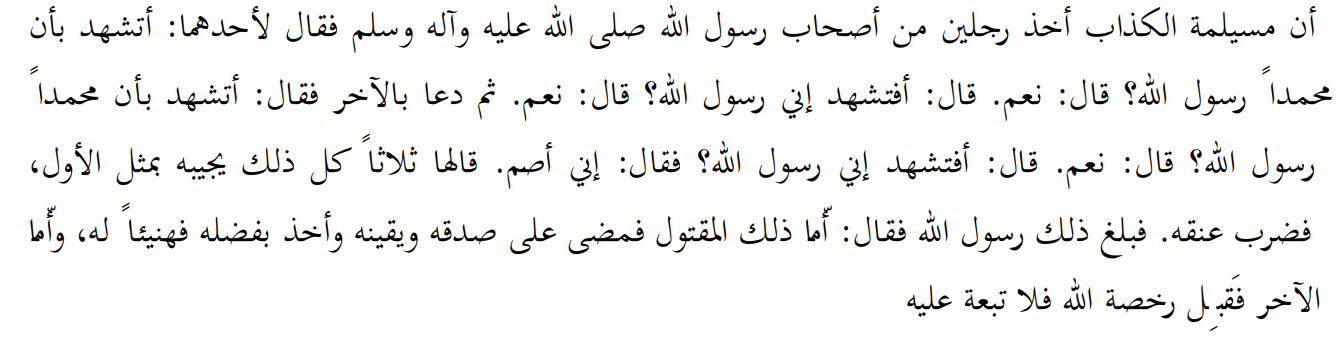
"那个说谎者穆赛莱迈抓住了两名穆罕默德ﷺ的圣门弟子,对其中一人说:'你作证穆罕默德是安拉的使者吗?'他说:'是的。'他说:'那么你作证我是安拉的使者吗?'他说:'是的。'然后他叫来另一人,说:'你作证穆罕默德是安拉的使者吗?'他说:'是的。'然后他说:'那么你作证我是安拉的使者吗?'他说:'我听不见(你说的)。'他每次都重复三遍,对方每次都像第一次那样回答,于是他砍掉了那人的脖子。这件事传到了安拉的使者ﷺ那里,他说:'至于被杀的那人,他践行了自己的真理和信念,并获得了美德,愿这对他是好的。至于另一人,他接受了安拉的恩典,因此他没有任何责任。'"
‘That Musaylimah the liar took two men of the Sahabah of the Messenger of Allah (saw) and said to one of them: Do you bear witness that Muhammad is a Messenger of Allah? He said: Yes. He said: Then do you bear witness that I am a Messenger of Allah? He said: Yes. Then he called for the other and said: Do you bear witness that Muhammad is a Messenger of Allah? He said: Yes. Then he said: Then do you bear witness that I am a Messenger of Allah? He said: I am deaf (to that). He said it thrice each time answering him like the first so he struck off his neck. This was conveyed to the Messenger of Allah who said: As for the one killed, he executed his truth and conviction, and he took his virtue so may it be good for him. As for the other, he accepted the concession of Allah so there is no liability on him.’
因此,塔给亚是一种宽许,而直言真理则是一种美德”(至此,阿特-塔巴尔西的言论结束)。
Accordingly taqiyyah is a dispensation and speaking clearly the truth is a virtue” (At-Tabarsi’s speech ends).
因此,从两位注释家的话中可以看出,即at-Tabari和at-Tabarsi,他们属于两个不同的学派,却一致地解释了这节经文的含义,即它禁止信士与不信者结交,并且将信士畏惧不信者之伤害的情形排除在这一禁令之外。请看at-Tabari的话:“除非你们畏惧他们的某种可畏之事(tuqat)”(即)除非你们处于他们的权势之下,并且你们担心他们会危及你们的生命,于是你们用口头上的言语向他们表示友好。再看at-Tabarisi的话:“然后他排除了例外,说:‘除非你们畏惧他们的某种可畏之事’,其含义是:除非不信者得势而信士失败,于是信士畏惧他们,若他不表示与他们一致,也不与他们修好友谊。在那种情况下,允许他以口头表达对他们的喜爱并顺从他们,作为一种防备,以保护自己的生命。”两位注释家一致认为,此处的主题是排除信士与不信者结交的禁令,并且这一排除仅限于此。然而,at-Tabarisi超出了该主题的范围,将这节经文作为塔给亚(taqiyyah)在宗教中为保全生命而被允许的证据,而这在经文中并不存在,因为经文的主题是禁止信士与不信者结交,并排除在不信者战胜穆斯林时畏惧他们的情形,允许在这种情况下与他们结交。这并非宗教中的塔给亚,也不是专门针对畏惧生命的情形,因为排除是普遍的:“除非你们畏惧他们的某种可畏之事”(即)除非你们畏惧他们可能带来的任何危害。Az-Zamakhshari在《Al Kashaf》中说:
Accordingly it is shown from the words of the two mufasireen, At-Tabari and At-Tabarsi, who are of two different schools of thought, their agreement upon explaining the meaning of the ayah as it came in that it is a prohibition for believers befriending disbelievers and excluding the situation of believers fearing the harm of the disbelievers from this prohibition. Look at the words of At Tabari: “except if you fear from them something to be feared (tuqat)’ (i.e.) except if you are in their authority and you fear them over your lives so you show them friendship with your tongues.” And look at the words of At-Tabarisi: “Then He excluded and said: ‘except if you fear from them something to be feared’ and the meaning is except if the disbelievers are victorious and believers defeated so the believer fears them if he does not show his agreement with them and does not make good his friendship with them. At that time it is allowed for him to show his love for them by his tongue and compliance to them as a precaution and in protection of his soul.” The two mufasireen agree that the subject is excluding the prohibition of believers befriending disbelievers and that it is limited to that. Except that At-Tabarisi followed upon that which is outside the subject and made the ayah an evidence that taqiyyah is permitted in the deen during for one’s life which is not present in the ayah since its subject is the prohibition of believers befriending disbelievers and excluding the situation of fear of the disbelievers when they defeat the Muslims in allowing their friendship in this situation. It is not taqiyyah in the deen nor is it specified to fear over life because the exclusion is general “except if you fear from them something to be feared” (i.e.) except if you fear from them what is to be feared from. Az-Zamakhshari said in Al Kashaf
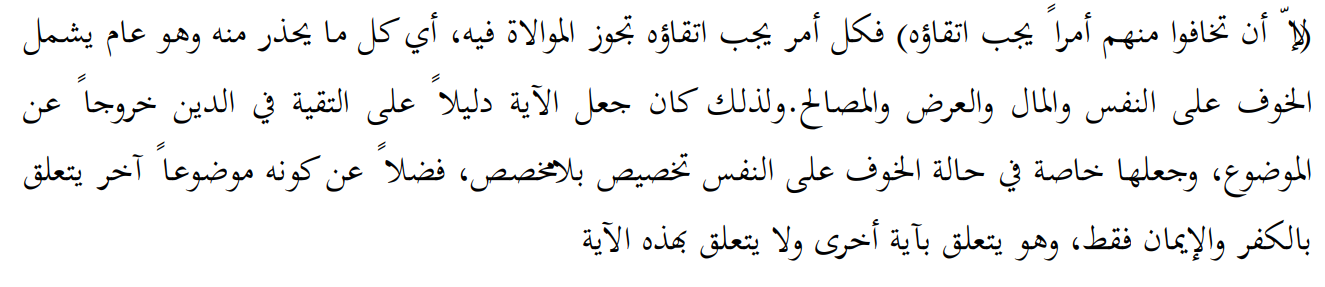
“除非你们对他们有所畏惧,需要自我保护”,因此,凡是需要防备的事情,都允许与他们结交,即凡是你们所畏惧的,包括对生命、财产、名誉和利益的畏惧,都在其内。据此,将此节经文作为在宗教事务中(在本题之外)实行塔基亚(taqiyyah)的证据,而将其限定于对生命的畏惧,则是没有限定依据的随意限定。此外,这属于另一个与信仰和不信仰相关的问题,只与另一节经文有关,与本节经文并无关联。
“Except if you fear from them a matter which requires protection from” so any matter which must be protected from permits befriending it i.e. all that you fear them which is general covering fear over life, wealth, honour and interests. Accordingly making the ayah an evidence for (taqiyyah) in the deen outside the subject, and making it specific in the situation of fear over life is specification without a specifying (evidence). This is besides it being another subject relating to kufr and iman only which is related to another ayah and it is not related to this ayah.
关于At-Tabarisi所说的“我们的同伴说,在必要的情况下,各种事务都是允许的”,以及他引用Al-Mufid关于其是否具有义务性的说法,直到他所提到的最后一点,这些都是缺乏任何证据的抽象言论。即使依据At-Tabarisi自己的注释,这段经文也没有以任何方式表明这一点,他也没有提出来自《古兰经》、圣训或圣门弟子共识的其他证据,因此这一说法应当被驳斥,不具备被考虑的地位。 也不能说,如果在害怕disbelievers的情况下与他们结交是允许的,那么服从掌权的不公正或作恶的统治者就更有优先性。这种说法是不成立的,因为更有优先性的,是言辞的本义,而这并不属于其中,两者之间也没有任何关联可以延伸。这就不同于真主的话语:
As for the statement of At-Tabarisi: “Our companions said (it is) permitted in all matters during necessity” then what he quotes from Al-Mufid of its being obligatory or not obligatory to the last of what he mentioned is abstract speech of any evidence. The ayah does not indicate this in any way even according to At-Tabarisi’s own tafsir, nor did he come with any other evidence neither from the Book or Sunnah or Ijma’a of the Sahabah, hence it is rejected and falls from the rank of consideration. Nor is it said that if befriending disbelievers in the situation of fear of them is allowed then compliance with the unjust or transgressor ruler with power is of greater precedent. This is not said because that which is of greater precedent is the sense of the speech and this is not from it nor is their any extention of any connection with it. It is not like Allah’s statement:
“他们之中有这样一种人:你即使把一枚第纳尔交给他,他也不会还给你。” [TMQ 3:75]
“Among them is one whom if you entrust him with a Dinar would not return it to you” [TMQ 3:75]
也不像安拉的这句经文所说的那样:
Nor is it like Allah’s statement:
“在有经人中,有这样的人:你若把一担黄金托付给他,他会还给你。”(至高的真主说:{在有经人中,有这样的人:你若把一担黄金托付给他,他会还给你}) Note: the verse is quoted in the original with its own citation, so I have kept the verse text and the citation marker as given, in the Chinese form of the translation.
“And of the People of the Book is one whom if you entrusted with a qintar will return it to you” [TMQ 3:75].
这是因为,作恶者并不属于不信道者的范畴,也不属于他们的一类;而本节经文所禁止的友好,是指与信士为友的反面,即与不信道者交友。不义且作恶的掌权者仍属于信士之列,他所犯的不义或所沾染的罪过,并不因此否定他身上的信仰。因此,这一问题不属于大的先例(的研究)范围,所以大的先例也不适用于此,不能以之作为佐证。
This is because the transgressor is not from the category of the disbeliever or from their class, and because the friendship prohibited in this ayah is befriending instead of the believers. The unjust and transgressor ruler with power is among the believers injustice occurring from him or the transgression covering him does not negate the description of iman from him. Hence this subject does not enter in the research of greater precedent, so accordingly the greater precedent does not come into it such that it is used as a witness.
此外,与有权势的不义、作恶的统治者交友,在安全与恐惧两种情况下同样是被允许的,因为他是信士,而与信士交友是绝对允许的,因为他的话“而不以信士为友”中的“信士”一词是泛指所有信士。没有任何经文禁止与不义的统治者或作恶的统治者交友,也没有禁止与罪人和邪恶者(fujjar)交友;相反,经文明确禁止的只是与不信者交友。更重要的是,在不涉及罪恶和圣战的事务上,服从不义的统治者是有义务的;在圣战中,也有义务在他的旗帜下作战;如果伊玛目是作恶者,仍允许跟随他礼拜,这些都是允许与他们交友的最有力证据。被禁止的是对统治者的不义和作恶者的恶行表示满意。据此,当信士表里不一,在有权势的不义或作恶的统治者、反对者或类似之人面前,表面所示与内心所藏相反时,塔吉耶(taqiyyah)是被否定的,这样做是haram(禁止的),因为这是伪善,而一切伪善都是被禁止的。
Moreover the befriending of the unjust and transgressor ruler with power is allowed in the situation of security and the situation of fear equally because he is a believer and befriending believers is definitely allowed because the word “believers” in His statement: “instead of believers” is general covering all believers. There did not come any text prohibiting befriending the unjust or transgressor ruler or befriending transgressors and the wicked (fujjar); rather the texts are specific in prohibiting the befriending of disbelievers. More than that, the obedience to the unjust ruler is obliged in other than sin and jihad is obliged under his banner and it is allowed to pray behind the Imam in prayer if he is a transgressor which are of the greatest indication regarding permitting their friendship. What is prohibited is the pleasure with the injustice of the ruler and the transgression of the transgressor. Accordingly taqiyyah is rejected when it is a believer showing opposite to what he hides in front of powerful unjust or transgressor ruler or opponent in the opinion or similar, and doing it is haram as it is hypocrisy and all hypocrisy is forbidden.
除此之外,对不义统治者的不义行为进行追究是义务性的,不允许因为畏惧统治者而在钱财、利益或伤害方面放弃此事,在此也不允许使用塔基亚(taqiyyah)。若从他身上看到明显的大于小的(kufr bawah)的、在他曾以伊斯兰治理之后出现的明确的كفر(kufr,不信)行为,则向他宣战是义务性的,放弃执行此事是哈拉姆(haram,禁止的)。在统治者或其他暴戾、不义之人面前命令行善、禁止作恶,是真主(SWT)为穆斯林规定的义务。这否定了塔基亚的观点,并与之完全相悖,因为真主(SWT)明确禁止对不义统治者和作恶者保持沉默,而塔基亚在某些时候要求沉默,在另一些时候使沉默成为推荐,在另一些时候又允许沉默,这与命令行善、禁止作恶的经文相矛盾,也与那些反对不义或作恶的统治者和领袖的可靠圣训相矛盾,更与那些关于必须追究他们行为的可靠圣训相矛盾,并且与为了真主(SWT)的缘故、不顾原告申诉而揭示真相的义务相对立。因此,关于不义、作恶的统治者,或强横的篡权者(mutasallit)中的恶人(fujjar),或与你在见解上相对立的人,所采取的塔基亚,有经文和经过考证的圣训文本与之相悖,并鼓励去做与之相反的事,这说明它是哈拉姆,此外它还是伪善,而伪善是穆斯林不允许的。
Above all that, the accounting of the unjust ruler over his injustice is obligatory and it is not allowed to leave it for fear of the ruler over money or interests or harm, not is taqiyyah allowed therein. Announcing war against him if clear disbelief (kufr bawah) is seen from him after he was ruling by Islam is obligatory and it is haram to refrain from performing it. And commanding the good and forbidding the evil before the ruler or others from the people of transgression or injustice has been obliged by Allah (swt) upon the Muslims. This negates the view of taqiyyah and contradicts it completely as He (swt) decisively forbade keeping silent over the unjust ruler and the transgressor, whereas taqiyyah obliges silence over that at certain times and makes it recommended at other times and allows it at other times which contradicts the ayah of commanding good and forbidding evil and contradicts the authentic ahadith which came about rejecting upon the leaders and rulers if they are unjust or transgressors and the authentic ahadith which came regarding the obligation of accounting them over their actions an opposes the obligation of exposing the truth without taking into account, for the sake of Allah (swt), the complaint of a plaintiff. Accordingly, with regard to the taqiyyah of the unjust and transgressor ruler, or the strong usurper (mutasallit) among the wicked (fujjar) or the one opposing you in the opinion, there came ayat and authenticated ahadith texts contradicting that and encouraging the obligation of acting contrary to that, which emphasizes that it is haram, on top of its being hypocrisy which is not allowed for the Muslims.
“除非是被迫的人,而他的心仍安于信仰。”[《古兰经》16:106]
“Except the one who is compelled and his heart is content upon iman” [TMQ 16:106].
一些注释学者将此与经文“除非你们对他们有所畏惧”联系起来,并由此推出:表面显露kufr、隐藏iman,属于友好(al-muwalah)的范畴,并将其纳入所谓的“taqiyyah”(塔给亚);另有一些人由此推出:只有在担心性命受到威胁的情况下才允许与对方友好,其他情况则不允许。这是纯粹的错误,因为经文“除非被迫而内心仍安于信仰”所涉及的情况和主题不同:其主题是在确定、必然会被杀害(而非仅仅是可能)的恐惧存在的情况下,从伊斯兰教中叛教。而经文“除非你们对他们有所畏惧”的主题,则是禁止与不信者结交友好,无论其形式如何,并排除在存在所畏惧之事时此种友好的许可——无论所畏惧的是性命、财产、利益还是任何伤害。经文区分了两种情况与两个主题,因此二者互不包含,也不相互关联,因为情况和主题各不相同。当穆斯林处于不信者的统治之下,在其事务上被对方压制时,他不得为了顺从对方而从伊斯兰教叛教;相反,如果他无法履行宗教的法则,则有义务迁徙,而与对方友好在此并不被允许。然而,如果穆斯林对其性命面临确定的死亡威胁,并被迫陷入kufr,那么他可以表面显露kufr、隐藏iman;除此之外则不被允许,依据的是经文:
Some mufasireen link it with the ayah: “except if you fear from them something to be feared” and deduce from it the entering of showing kufr and hiding iman in the category of friendship and making it to enter what they call (taqiyyah), with some deducing from it that friendship is allowed in the situation of fearing for one’s life only but not in other (situations). This is pure error because the ayah: “except the one who is compelled and his heart is content upon iman” has a different situation and a different subject as its subject is apostasy from Islam in the situation where there exists fear of definite, confirmed killing not probable and the subject of the ayah: “except if you fear from them something to be feared” is prohibiting befriending disbelievers in all its types and excluding the permissibility of this befriending in the situation of there existing what is feared from whether it was fear over life, wealth, interest or any harm. It distinguishes between the two situations and two subjects such that one does not enter into the other nor are they linked with it due to the difference in situation and subject. When the Muslim is under the authority of disbelievers defeated over his matter before them, it is not permitted for him to apostatise from Islam as a show of compliance to them; rather it is obligatory upon him to emigrate if he is unable to perform the rules of his deen contrary to befriending them which is allowed. However if the Muslims fear over his life a confirmed death and he is forced upon kufr then it is permitted for him to show kufr and hide iman, and other than that it is not permitted because of the text of the ayah:
“凡在信仰之后否认真主的人——除非是被迫,而内心仍安于信仰的人——[均不在此列]。”(《古兰经》16:106)
“Whoever disbelieves in Allah after his iman except the one who is compelled and his heart is content upon iman.” [TMQ 16:106].
这里所讨论的主题是伊斯兰教信仰之后的否认信仰,即叛教的问题;所处的情形是害怕死亡的情形。法学家称之为"胁迫之困"(alikrah almulji,即被逼到绝境的胁迫),这是伊斯兰教法在一切情形下唯一被认可的胁迫,凡受此胁迫者,法律条文对其不再适用。伊斯兰教法所排除的胁迫,正是这种走投无路的胁迫,即害怕确定死亡的情形。这一点在关于那些因害怕死亡而叛教的穆斯林的经文启示中得到了加强。据传,这段经文是为阿玛尔·本·雅西尔而降示的。泰伯里说:"穆罕默德·本·萨阿德告诉我,他说:我的伯父告诉我,他说:我的父亲告诉我,他从其父那里,从伊本·阿拔斯处听闻,关于真主的话:'凡在信仰之后不信真主的人,除非是被迫的人而其心仍安于信仰',直到经文的结尾。这是因为多神教徒殴打阿玛尔·本·雅西尔并惩罚他,然后才放开他。于是他回到真主的使者(ﷺ)那里,告知他所遭遇的古莱什人的行为以及他所说的话。于是真主降示了对他托辞的提及:'凡在其信仰之后不信真主的人',直到真主的话'严厉的惩罚'。"巴什尔告诉我们,他说:叶兹德告诉我们,他说:赛义德从格塔德处告诉我们:"'凡在信仰之后不信真主的人,除非是被迫的人而其心仍安于信仰'",并说:有人向我们提到,这段经文是为阿玛尔·本·雅西尔而降示的,当时伯努·穆吉拉俘获了他,把他埋在麦蒙井中,并对他说:不信真主吧。于是他顺从了他们,而他的心却是被迫的。于是真主降示了祂的话:"除非是被迫的人而其心仍安于信仰。" 且阿布·贾法尔·塔巴里说:伊本·阿卜杜·阿拉俄告诉我们,他说:穆罕默德·本·绥尔告诉我们,他引述自穆阿玛尔,穆阿玛尔引述自阿卜杜·卡里姆·朱兹里,阿卜杜·卡里姆引述自阿布·乌拜德·本·穆罕默德·本·阿玛尔·本·雅西尔,他说:
So the subject is the subject of kufr after iman i.e. the subject of apostasy from Islam, and the situation is the situation of fearing death. This is what the fuqaha term as alikrah almulji (compulsion of refuge) which is the only compulsion considered by the Shar’a in all situations in which the rule is lifted from the one compelled. The compulsion which the Shar’a excluded is the compulsion by refuge i.e. the situation of fearing definite death. This is strengthened in the ayah that was revealed about Muslims who apostatised fearing death. It was narrated that this ayah was revealed about Ammar bin Yasir. At-Tabari said: “Muhammad bin S’aad related to me and said: My paternal uncle related to me and said: My father related to me from his father from ibn Abbas that His statement: ‘Whoever disbelieves in Allah after his belief except the one who is compelled and his heart is content upon iman’ to the end of the ayah. This was because the polytheists struck Ammar bin Yasir and punished him then left him. So he returned to the Messenger of Allah (saw) and informed him about what he met with from Quraysh and what he said. So Allah (swt) revealed his mention of his excuse: ‘Whoever disbelieves in Allah after his iman’ until His statement ‘great punishment.’ Bashr related to us and said: Yazid related to us and said: Saeed related to us from Qatadah: ‘Whoever disbelieves in Allah after his belief except the one who is compelled and his heart is content upon iman’ and said: It was mentioned to us that it was revealed about Ammar bin Yasir whom Banu Al-Mughira captured and covered him in the well of Maymun and said: Disbelieve in Allah, so he followed them in that and his heart was compelled. So Allah (swt) revealed His statement: ‘except the one who is compelled and his heart is content upon iman.’ And At-Tabari said: Ibn Abd al-‘Ala related to us and said: Muhammad bin Thawr related to us from Mu’ammar from Abdulkareem Al-Juzri from Abu Ubayd bin Muhammad bin Ammar bin Yasir who said:
多神教徒抓住了阿玛尔·本·亚西尔,严刑拷打他,直到他按他们的要求说了一些话。他把这件事告诉了先知ﷺ,先知ﷺ说:"你的内心是怎样的?"他说:"内心坚定于信仰。"先知ﷺ说:"如果他们再次这样做,你也就再次照说吧。"
The polytheists took Ammar bin Yasir and punished him until he said to them in some of what they wished. He mentioned that to the Prophet (saw) and the Prophet (saw) said: How did you find your heart? He said: Secured upon iman. The Prophet (saw) said: If they repeat, then you repeat.”
这些圣训表明,该经文的降示背景是关于阿玛尔的事件,其主题是背叛伊斯兰教。其特定情境是确定的被杀恐惧,仅此一点便足以证明它与下面这句经文无关:“除非你们对他们有所畏惧。”经文“除非是被迫而内心仍安于信仰的人”是在麦加降示的,论及信仰;而经文“除非你们对他们有所畏惧”是麦地那时期降示的,论及在禁止信士与不信者交友的规定中,排除对可畏之事心存恐惧的情形。因此,这节经文不适用于该主题。
These ahadith indicate that the circumstance of revelation of the ayah is the incident of Ammar and its subject is apostasy from Islam. The situation specific to it is the definite fear of killing which alone is sufficient to strengthen that it has no relationship with the ayah: “except if you fear from them something to be feared.” The ayah: “except the one who is compelled and his heart is content upon iman” was revealed in Makkah on the subject of iman, and the ayah: “except if you fear from them something to be feared” is Madinan revealed on the subject of excluding the situation of fearing what is to be feared from the prohibition of believers befriending disbelievers. Accordingly this ayah is not applicable on that subject.
对于那些受到确定会被杀害威胁的人,还有一条规定:在这种情况下,是表明kufr并隐藏iman以免于死亡更好,还是坚守其iman即使导致死亡更好?答案是:坚守iman即使导致死亡更好,因为表明kufr的许可是一种宽限(rukhsah),用以消除困难,而保全iman则是(‘azeemah),即原则性的规定,因此更为优越。据传(记载)……
There remains the rule regarding the one threatened with confirmed killing: Is it more virtuous to show kufr and hide iman so as to be safe from death or is it better to persevere upon his iman even if it leads to death? The answer is that persevering to iman even if it leads to death is better because the permissibility of showing kufr is a dispensation and lifts difficulty, and preserving the iman is (‘azeemah) which is the principle therefore it is better. It is narrated

“那个叫穆赛里迈的人带来两个人,对其中一人说:你对穆罕默德有什么看法?他说:他是安拉的使者。他说:那你对我有什么看法?你也一样。于是他就放了他。他又对另一人说:你对穆罕默德有什么看法?他说:他是安拉的使者。他说:那你对我有什么看法?他说:我是哑巴。他重复了三次,他也重复了他的回答,于是他把他杀了。这件事传到安拉的使者ﷺ那里,他说:至于第一个人,他接受了安拉的许可。至于第二个人,他说出了真相,因此他是有福的。”
“That Musaylimah took two men and said to one of them: What do you say about Muhammad? He said: A Messenger of Allah. He said: Then what do you say of me? You as well. So he left him free. He said to the other: What do you say of Muhammad? He said: A Messenger of Allah. He said: Then what do you say of me? He said: I am dumb. He repeated it thrice and he repeated his answer, so he killed him. That reached the Messenger of Allah (saw) so he said: As for the first, he took the dispensation of Allah. As for the second, he exposed the truth so blessed be he.”
这明确表明:坚忍并坚持信仰的人,优于接受了真主(SWT)的许可、因担心生命受到确定的杀害而表现出kufr(不信)的人。
This is explicit in preferring the one who was patient and stuck to iman over the one who took the dispensation of Allah (swt) and showed kufr fearing for his life from a confirmed killing.
关于被要求行kufr(不信/背信)之人的情况。至于被要求做比kufr轻的事情,比如放弃伊斯兰的宣教(da’wah),或犯罪,或类似之事,则不能从这段经文中推导出许可。因此不能说:如果真主允许穆斯林表现出kufr,那么比kufr轻的事情就更应被允许。这种说法不成立,因为违抗(ma‘siyah)并不属于kufr的范畴,所以它不能通过“更大优先”(al-awlā)的方式纳入这一探讨。同样,也不能把kufr与罪相类比,因为类比的前提是存在一个成立的“效因”(‘illah),而这里并不存在。 然而,对于那些因确定会被杀而害怕丧失生命,并被要求做罪或做比kufr轻的事情的人,为了保全自己的性命,允许他这样做,他也不因此而犯罪。这是基于先知ﷺ的话语:
This is regarding the one from whom kufr is demanded. As for the one from whom is sought less than that like leaving the Islamic da’wah or performing a sin or something similar; permissibility is not taken from this ayah. Accordingly it is not said that if Allah permitted the Muslim to show kufr, then what is lesser than kufr is of greater precedent. This is not said because disobedience is not from the species of kufr, so it does not enter the research by greater precedent. Similarly an analogy between kufr and sin is not performed since there does not exist a reason until analogy occurs. However as for the one who fears for his life over confirmed killing and it is sought from him sin or doing less than kufr, it is permitted for him to do so to save his life and there is no sin upon him. This is due to his (saw) statement:
“我的乌玛所犯的错误、遗忘,以及被迫所为的事情,已被宽恕。”
“Lifted from my Ummah is the mistake, forgetfulness and what is compelled upon it”
也就是说,罪责被免除,这一条律例也随之解除,即做该事的许可成立。然而,这只限于一种情形,即确定无疑、已经证实的杀害威胁,也就是法学家所称的"迫于避难之胁迫"(alikrah almulji)。这是伊斯兰教法在一切情况下都予以考虑的唯一一种胁迫,受胁迫者因此可免除其后果,如离婚、婚姻、交易以及其他行为和契约。他所说的"被迫所为之事"即指这种"迫于避难之胁迫"(alikrah almulji)。
I.e. the blame and sin is lifted, and the rule is lifted, which means the permissibility of doing it. However (this is) only in one situation which is the situation of definite, confirmed killing which is what the fuqaha called alikrah almulji (compulsion by refuge) which is the only compulsion considered by the Shar’a in all conditions in which there is lifted from the one compelled like divorce, marriage, trade and other actions and contracts. His statement “and what is forced upon it” which is alikrah almulji (compulsion by refuge).