3.1 《古兰经》的汇编
3.1 The Compilation Of The Qur’ān
已有确凿且明确的证据证明:先知ﷺ去世时,整部《古兰经》已被书写在(动物的)肩胛骨、棕榈叶梗和"拉胡夫"(一种薄而宽的白色石片)上。全部经文也都保存在圣门弟子(愿真主喜悦他们)的心中。每当有一节或数节经文降示,先知ﷺ便会下令立即在他面前将其书写下来。他并没有禁止穆斯林以书写者记录启示时所用之外的方式书写《古兰经》。穆斯林在其圣训集中转述了阿布·赛义德·胡德里(愿真主喜悦他)的一段圣训,其中真主的使者ﷺ说:
It has been proven by decisive and definite evidence that when the Prophet died the whole Qur’ān had been written on pieces of shoulder blades (of animals), palm risps and on lukhaf’s (a thin broad white stone). All of it was preserved in the hearts of the Sahabah (may Allah be pleased with them). When an ayah or ayāt would be revealed he would order that they be written down before him at once. He did not prevent the Muslims from writing the Qur’ān in other than what he used to dictate to the scribes who wrote down the revelation. Muslim reported a hadīth from Abu Sa'id al-Khudri that the Messenger of Allah said:
“不要把我说的任何话写下来,凡是写下除《古兰经》以外我所说之话的人,让他抹去它。”
“Do not write down anything from me, whosoever writes anything I have said other than the Qur’ān let him erase it”
所有从启示中记录下来的内容都被收集在纸片上。他说:
What the scribes wrote from the revelation was collected on sheets. He said:
一位来自真主的使者,诵读着经过净化的经页(《古兰经》的经文) [TMQ Bayyinah:2]
“A Messenger from Allah, reciting purified pages (suhuf) (of the Qur’ān)” [TMQ Bayyinah:2]
即,诵读那些洁净于虚妄的经页,确实是亲笔书写、无可置疑的真实与公正。安拉说:
i.e, reciting sheets purified from falsehood, honestly handwritten unequivocally true and just. Allah said:
“不然!这确实是一种劝诫(教诲)。谁愿意,谁就去留心它。 它记载在受尊崇的典籍之中, 崇高而洁净, 在书写者的手中, 尊贵而善良。” [TMQ ‘Abasa: 11-16]
“Nay, indeed it (verses of the Qur’ān) are an admonition (tazkirah). So whoever wills, let him pay attention to it. (It is) in Records held (greatly) in honour. Exalted (in dignity), purified. In the hands of scribes. Honourable and obedient” [TMQ ‘Abasa: 11-16]
即这一训诫载于记录之中,在真主那里备受尊崇、价值崇高,未被腐败之人所染指,且由敬畏真主的抄录者所记录。他留下了一切书写于两块封板之间的内容,那些内容都是在他面前所写下的。阿卜杜·阿齐兹·本·鲁法耶(Abd al-'Aziz b Rufayya)传述说:
i.e this admonition established in the records is held (highly) in honour with Allah and exalted in value, free from the hands of those that are corrupt and that they have been written down by God fearing scribes. He left everything that was written between the two covers of the mushaf which had been written down in front of him. 'Abd al-'Aziz b Rufayya' narrated:
“舍达德·本·马格勒与我进见伊本·阿拔斯。舍达德·本·马格勒问他:‘先知ﷺ是否留下了什么(除了《古兰经》)?’他回答:‘他没有留下任何东西,只留下了两块封面之间的(《古兰经》)。’随后我们拜访了穆罕默德·本·哈奈菲耶,向他提出同样的问题。他回答:‘先知ﷺ没有留下任何东西,只留下了两块封面之间的(《古兰经》)。’”
“Shaddad bin Ma'qil and I entered upon Ibn 'Abbas. Shaddad bin Ma'qil asked him, 'Did the Prophet leave anything (besides the Qur’ān)?' He replied. “He did not leave anything except what is between the bindings (of the Qur’ān).' Then we visited Muhammad bin al-Hanafiyya and asked him (the same question). He replied, 'The Prophet did not leave except what is between the bindings (of the Qur’ān)”
已有学者达成共识(伊吉玛):《古兰经》的每一节经文,连同其所在的章(苏拉),在启示降下时都是在使者面前直接书写下来的,并且写在若干纸片(苏合夫)上。最伟大的使者ﷺ在对《古兰经》感到满意的情况下离世,《古兰经》是他最伟大的神迹,为阿拉伯人和全世界确立了证据。他不担心《古兰经》的经文会遗失,因为真主(SWT)已借明文保存了《古兰经》:
An Ijma' (consensus) has been established on the fact that all of the verses of the Qur’ān in their respective chapters (Sura’s) had been written down directly in front of the Messenger when the revelation was being revealed to him, and that they were written on sheets (suhuf). The greatest of the Messengers died content about the Qur’ān, his greatest miracle which established the proof for the Arabs and the world. He did not fear for the verses of the Qur’ān that they would be lost because Allah has preserved the Qur’ān with an explicit text:
“诚然,是我降示了这部教诫(《古兰经》),我也必定会保护它(使其不被篡改)。” [TMQ Hijr: 9]
“Verily We: It is We who have sent down the Zikr (the Qur’ān) and surely, We will guard it (from corruption)” [TMQ Hijr: 9]
因为这些经文借由在先知生前被书写下来,并保存在圣门弟子的心中,以及穆斯林获准书写《古兰经》而得以永久保存。正因如此,在使者去世之后,圣门弟子并没有感到有必要将《古兰经》汇集成一本书,也没有必要把它写下来,直到许多背诵者(Huffaz,即能够背诵《古兰经》的人)在利ддах战争中牺牲。因此,欧麦尔担心经卷(suhuf)会遗失,担心诵读者(Qurra',即全部《古兰经》都已熟记于心的人)会死去,从而导致部分经文失传。于是他考虑将书写的经卷汇集在一起(编成一部书)。他向艾布·伯克尔提出了这个想法,《古兰经》的汇集工作便由此展开。 据欧拜德·伊本·al-Sibaq转述,宰德·本·萨比特·安萨里说:艾布·伯克尔在(亚玛默战役)中大量战士(阵亡)之后派人召我前去。当时欧麦尔与艾布·伯克尔在一起,艾布·伯克尔说:“欧麦尔来找我,说:‘在亚玛默之日(即亚玛默战役),民众遭受了惨重的伤亡,我担心在其他战场上,诵读者(即熟记《古兰经》的人)还会有更多牺牲,那样大部分《古兰经》可能就会失传,除非你将其收集起来。我认为你应当收集《古兰经》。’”艾布·伯克尔补充道:“我对欧麦尔说,
Because these verses had been preserved permanently via them being written down before him , and being preserved in the hearts of the Sahabah and by the permission granted to the Muslims to write down the Qur’ān. This is why after the death of the Messenger the Sahabah did not feel the need to compile the Qur’ān in one book or the need to write it down until many of the Huffaz (memorisers of the Qur’ān) had been killed in the Riddah wars. So due to this 'Umar feared for the loss of the sheets (suhuf) and the death of the Qurra' (Those who had committed the whole of the Qur’ān to memory), thereby causing some verses to be lost. So he thought about bringing the written sheets together (in one compilation). He presented his idea to Abu Bakr and so the compilation of the Qur’ān was performed. It has been narrated by 'Ubayd ibn al-Sibaq that Zayd b al-Thabit al-Ansari said: Abu Bakr sent for me after the (heavy) casualties among the warriors (of the battle) of Yamama (where a great number of Qurra' were killed). 'Umar was present with Abu Bakr who said, 'Umar has come to me and said, The people have suffered heavy casualties on the day of (the battle of) Yamama, and I am afraid that there will be more casualities among the Qurra' (those who know the Qur’ān by heart) at other battle-fields, whereby a large part of the Qur’ān may be lost, unless you collect it. And I am of the opinion that you should collect the Qur’ān.” Abu Bakr added, “I said to 'Umar ,
“你怎么能做安拉的使者没有做过的事呢?”
'How can you do something which Allah's Apostle did not do?'
欧玛尔说(对我说):
'Umar said (to me),
"以安拉起誓,这确实是件好事。"
'By Allah, it is (really) a good thing.'
于是欧麦尔不断地劝说我、说服我接受他的提议,直到安拉为此开导了我的心,我与欧麦尔的看法一致了。(宰德·本·萨比特补充道:)欧麦尔当时坐在他(即艾布·伯克尔)那里,没有与我说话。(艾布·伯克尔说:)“你是一个有智慧的年轻人,我们不怀疑你(撒谎或健忘);你过去还为安拉的使者ﷺ记录启示(wahy)。因此,你去寻找《古兰经》并将其收集起来(汇编成一册)。”“以安拉起誓,如果他(艾布·伯克尔)命令我搬动一座山,那对我而言,也不会比他命令我收集《古兰经》更难。”我对他们二人说:“你们怎敢做先知ﷺ没有做过的事?”艾布·伯克尔说:“以安拉起誓,这确实是件好事。”于是我不断与他就此事进行辩论,直到安拉为此开导了我的心,正如祂开导了艾布·伯克尔和欧麦尔的心一样。于是我开始搜集《古兰经》的内容,从羊皮纸、肩胛骨、椰枣树叶柄以及背诵者的记忆中进行收集。我找到了《忏悔章》的两节经文,是与艾布·胡capacity·胡宰麦(Abu Khuzaima)在一起时找到的,别人那里没有找到,内容是:
So ‘Umar kept on trying to convince me and persuade me to accept his proposal till Allah opened my heart for it and I had the same opinion as 'Umar.' (Zayd b al-Thabit added:) Umar was sitting with him (i.e Abu Bakr) and was not speaking to me). 'You are a wise young man and we do not suspect you (of telling lies or of forgetfulness): and you used to write the revelation (wahy) for Allah's Apostle . Therefore, look for the Qur’ān and collect it (in one manuscript). 'By Allah, if he (Abu Bakr) had ordered me to shift one of the mountains (from its place) it would not have been harder for me than what he had ordered me concerning the collection of the Qur’ān. I said to both of them, “How dare you do a thing which the Prophet has not done?' Abu Bakr said, 'By Allah, it is (really) a good thing So I kept on arguing with him about it till Allah opened my heart for that which He had opened the hearts of Abu Bakr and Umar . So I started locating the Qur’ānic material and collecting it from the parchments, scapula bones, leaf-stalks of date palms and from the memories of men (who knew it by heart). I found two Verses of Sura at-Tawba with Abu Khuzaima which I did not find with anybody else, (and they were):
{Verily, there has come unto you a Messenger from amongst yourselves. It grieves him that you should receive any injury or difficulty} — this is a Qur'an verse, so it stays in braces as the original quotation. Translation: {诚然,一位从你们自己中间而来的使者已经来到你们中间。你们遭受任何伤害或困难,都使他感到痛苦。} [TMQ Tawba: 128]
“Verily, there has come unto you a Messenger from amongst yourselves. It grieves him that you should receive any injury or difficulty” [TMQ Tawba: 128]
直到《忏悔章》(Bara'ah)末尾。收集《古兰经》时所依据的手稿,先由艾布·伯克尔保管直至去世,之后由欧麦尔在世时保管,最后由欧麦尔的女儿哈福赛保管。 宰德所编纂的《古兰经》,并非来自他从记诵者(Huffaz,即背诵《古兰经》的人)那里所记录的内容,而是汇集了他亲自在安拉的使者ﷺ面前所写下的内容。每一张呈交给他的纸页,只有在两位见证人证明其是在安拉的使者ﷺ面前所写时,他才会将其与其他纸页编排在一起。此外,一张纸页若不满足两个条件,他也不会接受:第一,它必须以书面形式存在于某位圣门弟子那里;第二,它必须有某位圣门弟子能够背诵。当书面形式与记诵的内容与拟编入的纸页相符时,他才予以接受;否则便不予接受。正因如此,他在没有在艾布·胡宰麦(Abu Khuzayma)那里找到《忏悔章》末尾的书面文本之前,宁可不取用它,尽管宰德自己也能够回忆并记住这段经文。 据耶海雅·本·阿卜杜·拉赫曼·本·哈推卜的传述,他说:
until the end of Sura Bara'ah. The manuscript on which the Qur’ān was collected, remained with Abu Bakr till he passed away, and then with 'Umar during his lifetime, and finally it remained with Hafsa bint Umar . Zayd's compilation of the Qur’ān did not consist of what he wrote down from the Huffaz (i.e the memorisers of the Qu’ran). Rather his compilation brought together what he had written himself in front of the Messenger of Allah . He did not place one sheet/page with another sheet in order to compile them unless two witnesses testified, for every sheet that had been presented to him that it was written in the presence of the Messenger of Allah . Furthermore, he did not accept a sheet unless it met two conditions; firstly, that it was present in written form with one of the Sahabah. And second, that it had been memorised by one of the Sahabah. When the written and memorised forms concurred with the sheet that was intended to be compiled, he accepted it. Otherwise he did not accept it. This is why he refrained from taking the end of sura al-Bara'ah until he found it in written form with Abu Khuzayma even though Zayd could himself recall and remember it. It has been narrated via Yahya b 'abd al-Rahman ibn Hatib that he said:

“Umar(ra)站起来说:凡从安拉的使者ﷺ那里接受了《古兰经》中任何内容的人,请将其拿出来。他们过去把经文写在木板、石板和棕榈枝的叶柄上。伊本·哈提卜说:宰德不接受任何人的内容,直到有两名见证人为其作证。这表明,宰德并不满足于仅仅找到书面形式的经文,还要求接受者作证自己确实听过,尽管宰德本人早已熟记。他这样做,是出于极度的谨慎。”
“Umar (ra) stood up and said; whosoever has received anything of the Qur’ān from the Messenger of Allah , let him bring it forth. They used to write that on sheets, tablets and palm risps. Ibn Hatib said: He (Zayd) did not accept anything from anyone until two witnesses had given testimony to it. This shows that Zayd was not satisfied by merely finding something in written form until the one who received it testified that he had heard it despite the fact that Zayd had memorised it already. He used to do this due to his extreme caution”.
因此,汇编的过程无非是将那些在真主的使者ﷺ在场时已经书写的书页汇集到一本装订成册的书中。古时《古兰经》是写在书页上的,但这些书页是分开保存的。于是艾布·伯克尔把它们集中在一处。因此,艾布·伯克尔下令汇编《古兰经》,并不是命令将其誊写成一部穆斯哈夫,而是命令将在使者ﷺ在场时书写的书页汇集到一处,并命令确认它们与当时的形式相同,为此以两位见证人的证言予以佐证,证明它们确实是在真主的使者ﷺ面前书写的,并且圣门弟子们手中持有其书面本,也都能背诵。这些书页在艾布·伯克尔在世时由他保管,之后在他在世时交由欧麦尔保管,欧麦尔去世后,依照欧麦尔的遗嘱,交由信士们的母亲、欧麦尔之女哈福赛保管。由此可见,艾布·伯克尔的汇编《古兰经》之举,只是将在真主的使者ﷺ面前书写的书页汇集起来,并非真正意义上的《古兰经》汇编。所谓背诵,也是针对这些在真主的使者ﷺ面前书写的文献而言,而不是指对《古兰经》的背诵。将这些零散的书页汇集并加以保存,只是出于谨慎,并竭尽全力核实与真主的使者ﷺ所传述的内容完全一致的背诵。至于《古兰经》本身,则保存在圣门弟子们的心中,铭记于他们的记忆之中。在背诵方面,主要依赖于大量的圣门弟子,因为完整或部分背诵《古兰经》的人数众多。
Thus, the (process) of compilation was nothing other than the bringing together of sheets that had already been written in the presence of the Messenger of Allah into one book between two covers. The Qur’ān used to be written down on sheets but they were kept seperately. So Abu Bakr assembled them in one place. That is why Abu Bakr's order to compile the Qur’ān was not an order to write it down in one mushaf, rather it was an order to bring the sheets that had been written in the Messenger's presence together in one place and it was an order to make certain; that they are in the same form as they were by supporting it with the testimonies of two witnesses that they had been written in front of the Messenger of Allah and that they were in the possession of the Sahabah in written form and that they had memorised them. These sheets remained preserved in the possession of Abu Bakr during his life and then with 'Umar during his lifetime and them with Hafsa the daughter of 'Umar , the mother of the Believers in accordance with 'Umar's bequest. From this it becomes clear that Abu Bakr's compilation of the Qur’ān constituted only the bringing together of sheets that had been written in the presence of Allah's Messenger and it was not an actual compilation of the Qur’ān. And the memorisation was in regard to these sheets i.e the documents which were written in front of the Messnegr of Allah and not the memorisation of the Qur’ān. The bringing together of such pieces and their preservation was not done except by way of cautiousness and expending all efforts in examining the memorisation of exactly what had been reported from the Messenger of Allah . As for the Qur’ān itself, it was preserved in the hearts of the Sahabah and memorised in their memory. In memorization, dependence was put on a great multitude of Sahabah because those memorising it completely or partially were many.
关于阿布·伯克尔的汇编,此处略过。至于奥斯曼的汇编:在他哈里发任期的第三年(也有人说是第二年),即伊历25年,胡宰法·本·叶玛尼在麦地那来见奥斯曼,当时叙利亚人和伊拉克人正在征讨亚美尼亚和阿塞拜疆。胡宰法担心他们(叙利亚人和伊拉克人)在诵读《古兰经》时存在分歧。他看到叙利亚人按照乌白伊·本·凯尔布的诵读方式诵读,并带来了伊拉克人从未听说过的读法;他也看到伊拉克人按照阿卜杜拉·本·麦斯欧德的诵读方式诵读,并带来了叙利亚人从未听说过的读法。于是他们开始相互指责对方为不信道。他们在《黄牛章》的一节经文上产生了分歧,一方读道:
This was regarding the compilation of Abu Bakr . As for the compilation of 'Uthman , in the third or (some say) the second year of his Khilafah i.e in the year 25 AH, Huzayfah ibn al-Yaman approached 'Uthman in Madinah at the time when the people of al-Sham and the people of Iraq were waging a war to conquer Armenia and Azerbaijan. Hudhayfa was afraid of their (people of al-Sham and Iraq) differences in the recitation of the Qur’ān. He saw that the people of al-Sham reciting according to the recitation of Ubay ibn Ka'b , and they were coming with recitations the people of Iraq had not heard of. Also he saw the people of Iraq reciting according to the recitation of 'Abd Allah ibn Mas'ud and so they brought recitaions the people of al Sham had not heard of. Thus, they began to charge each other of disbelief. They both disagreed about a verse in sura al-Baqarah. One read:
“你们应当为安拉完整地履行朝觐和副朝”(wa atimmul hajja wal 'umrata lillah) [TMQ Baqarah: 196]
“And perform properly the hajj and 'Umra for Allah (wa atimmul hajja wal 'umrata lillah)” [TMQ Baqarah: 196]
还有另一种读法:
And the other read:
“你们要为了真主,完成朝觐和副朝,以完成朝拜天房(wa atimmul hajja wal 'umrata lil bayt)。”
''And perform properly the hajj and 'Umra to the House (of Allah)(wa atimmul hajja wal 'umrata lil bayt)”
于是Huzayfah愤怒起来,双眼因怒火而变得通红。据传述,Huzayfah曾说:
So Huzayfah became angry and his eyes went red with rage. It has been narrated about Huzayfah that he said:
库法人坚持诵读伊本·麦斯欧德的诵本,巴士拉人坚持诵读艾布·穆萨的诵本。以安拉发誓!如果我去见信士们的长官(Ameer al Mumineen,信士们的领袖),我会命令他把它统一为一种诵本。于是他前往拜见奥斯曼。
The people of Kufah adhere to the recitation of Ibn Mas'ud and the people of Basra adhere to the recitation of Abu Musa . By Allah ! If I go to the Ameer al Mumineen (Leader of the Believers) I will order him to make it a single recitation. So he travelled to 'Uthman .
据伊本·沙哈卜(Ibn Shihab)转述,安斯·本·马立克(Anas ibn Malik)传述:胡宰法·本·叶玛尼(Huzayfa bin al-Yaman)来见奥斯曼(Uthman),当时沙姆人和伊拉克人正在交战,以征服亚美尼亚和阿塞拜疆。胡宰法担心他们(沙姆人和伊拉克人)在《古兰经》诵读上的分歧,于是对奥斯曼说:
It has been reported by Ibn Shihab that Anas ibn Malik narrated: Huzayfa bin al-Yaman came to Uthman at the time when the people of al-Sham and the people of Iraq were waging a war to conquer Armenia and Azerbaijan. Hudhayfa was afraid of their (the people of al-Sham and Iraq) differences in the recitation of the Qur’ān, so he said to 'Uthman ,
"O Amīr Al-Mu'minīn! 拯救这个民族吧,趁他们在《经典》(《古兰经》)上像犹太教徒和基督徒此前那样产生分歧之前。"
'O Ameer Al Mumineen! Save this nation before they differ about the Book (Qur’ān) as Jews and the Christians did before.'
奥斯曼派人向哈芙赛传话说:
So 'Uthman sent a message to Hafsa saying,
请将《古兰经》的手稿寄给我们,以便我们编纂出完美的《古兰经》资料版本,编纂完成后再将手稿归还给您。
Send us the manuscripts of the Qur’ān so that we may compile the Qur’ānic materials in perfect copies and return the manuscripts to you.
哈福萨把它送给了奥斯曼。奥斯曼随后命令宰德·本·萨比特(愿安拉喜悦他)、阿卜杜拉·本·祖拜尔、赛义德·本·阿斯和阿卜杜勒·拉赫曼·本·哈里斯·本·希沙姆,将手抄本誊写成完善的副本。奥斯曼对那三位古莱氏人说:
Hafsa sent it to 'Uthman . 'Uthman then ordered Zaid bin Thabit (ra), 'Abd Allah ibn al Zubair, Said ibn al-'As and 'Abd al-Rahman ibn Harith ibn Hisham to rewrite the manuscripts in perfect copies. 'Uthman said to the three Qurayshi men,
"如果你们在《古兰经》的任何一点上与栽德·本·萨比特(愿安拉喜悦他)意见不一,那就用古莱氏的方言书写,因为《古兰经》是用他们的语言降示的。"
'Incase you disagree with Zaid ibn al-Thabit (ra) on any point in the Qur’ān, then write it in the dialect of Quraysh, the Qur’ān was revealed in their tongue.'
于是他们照办了。在抄写了许多份之后,‘Uthmān 将原本的手稿归还给了 Hafsa。‘Uthmān 将所抄写的每一份副本各送一份到每个穆斯林省份,并下令焚毁其余所有的古兰经资料,无论是零散的手稿还是完整的抄本。所抄写的副本数量为七份。这七部穆斯哈夫被分别送往麦加、沙姆、也门、巴林、巴士拉和库法,另有一份留在麦地那。
They did so, and when they had written many copies, 'Uthman returned the original manuscripts to Hafsa . 'Uthman sent one copy of what they have copies to every Muslim province, and ordered that all the other Qur’ānic materials, whether written in fragmentary manuscripts or whole copies, be burnt. The number of copies made was seven. The seven mushaf’s were sent to Makkah, al-Sham, Yemen, Bahrain, Basra, Kufah, and one copy was kept in Madinah.
因此,奥斯曼的行为并非汇编《古兰经》,而只是对从安拉的使者ﷺ那里所记录的同一内容进行抄写和誊写,使之保持原样。他所做的,无非是从哈芙赛——信士们的母亲——所保存的那一本中抄写出七份副本,使民众统一于这一种书写形式,并禁止除此之外的任何其他书写形式或诵读方式。此事便以这一本作为书写形式和诵读方式而定案。这正是当启示降下时,在安拉的使者ﷺ面前所写下的那些经页所采用的书写形式和诵读方式;这也正是艾布·伯克尔所汇编的那一本。随后,穆斯林开始从这一本抄录副本,而不从其他任何本子抄录。最终只剩下奥斯曼的穆斯哈夫,以其书写形式保存下来。待印刷术出现后,穆斯哈夫便依照这同一本,以相同的书写形式和诵读方式印刷。
Therefore, 'Uthman's action was not the compilation of the Qur’ān rather it constituted in only the copying and transcription of the same thing transcribed from the Messenger of Allah as it was. He did not do anything other than make seven copies from the preserved copy in the possession of Hafsa , the mother of the Believers and unite the people on this single script and forbade any other script or dictation other than it. The matter was settled on this copy as a script and dictation. It is the same script and dictation in which the sheets were written as was written in the presence of Allah's Messenger when the revelation was revealed. And it is the same copy which Abu Bakr had compiled. Then the Muslims began to make copies from this copy and not any other copy. Nothing remained except the mushaf of 'Uthman in its script. When printers came about, the mushaf was printed from this copy with the same script and dictation.
阿布·伯克尔(Abu Bakr)时期的汇编与奥斯曼('Uthman)时期的汇编之间的区别在于:阿布·伯克尔时期的汇编,是出于担心《古兰经》的部分内容会因其背诵者的离世而遗失。原因在于,尽管经文已被书写在纸片上,但尚未被集中在一处,编成一部完整的书册,因此是按页汇集而成。奥斯曼时期的汇编,则是因为在《古兰经》的某些读法上,分歧日益增多:有人按照自己方言的读法诵读,并因此导致有人指责他人读错。人们担心事态会因此扩大,于是将那些纸片抄录成一部《穆斯哈夫》(mushaf,即经卷)。 我们今天手中的这部穆斯哈夫,就是启示给安拉的使者ﷺ的那一部,也是当年书写在使者ﷺ在世时所写下的那些纸片上的内容。它也是阿布·伯克尔汇集纸片成一处时所编成的那一部,同时也是奥斯曼从中抄写出七部副本,并下令焚毁其余(其他版本)的那一部。这部高贵的《古兰经》,无论是其经文之间的先后次序、各章中的排列,还是书写与口述的方式,都是一致的。 至于使者ﷺ口授、从启示中记录下来的那部经文,其纸片曾被汇集在一起并随后被抄录,它一直由信士的母亲哈芙萨(Hafsa)妥善保存,直到麦尔旺(Marwan)出任麦地那总督。他将其撕毁,因为当时经卷的副本已遍布各地,而那原件已不被视为重要。 伊本·舍哈卜(Ibn Shihab)叙述道:萨利姆·伊本·阿卜杜拉·伊本·欧麦尔(Salim ibn 'Abd Allah ibn 'Umar)告诉他说:
The difference between the compilation of Abu Bakr and that of 'Uthman is that the compilation of Abu Bakr took place due to the fear that something would be lost from the Qur’ān if any of its carriers (memorisers) were lost, the reason being that even though it was written on sheets but it had not been collected in one place like a single book. Thus, it was compiled in pages. The compilation of 'Uthman took place because the differences increased regarding certain aspects of the Qur’ān which some read in their own dialects and this led some to accuse others of making an error. It was feared that the matter would escalate therefore those sheets were copied into one mushaf. The mushaf that we now have before us is the same mushaf revealed to the Messenger of Allah and it is the same one which was written in the sheets which were written in the presence of the Messenger of Allah . And it is the same mushaf that Abu Bakr brought together when the sheets were compiled in one place. And it is the same one from which 'Uthman transcribed the seven copies and ordered that the rest be burned. And it is the same Noble Qur’ān in its verse arrangement in relation to each other and their arrangment in their respectives Sura’s, script and dictation. As for the copy dictated by the Messenger of Allah from the revelation, whose sheets were compiled together and then copied it remained protected in the possession of Hafsa , the mother of the believers until Marwan became the Wali (governor) of Madinah and he tore it up since it was not considered important because copies of the mushaf had spread everywhere. Ibn Shihab narrated that Salim ibn 'Abd Allah ibn 'Umar informed him:
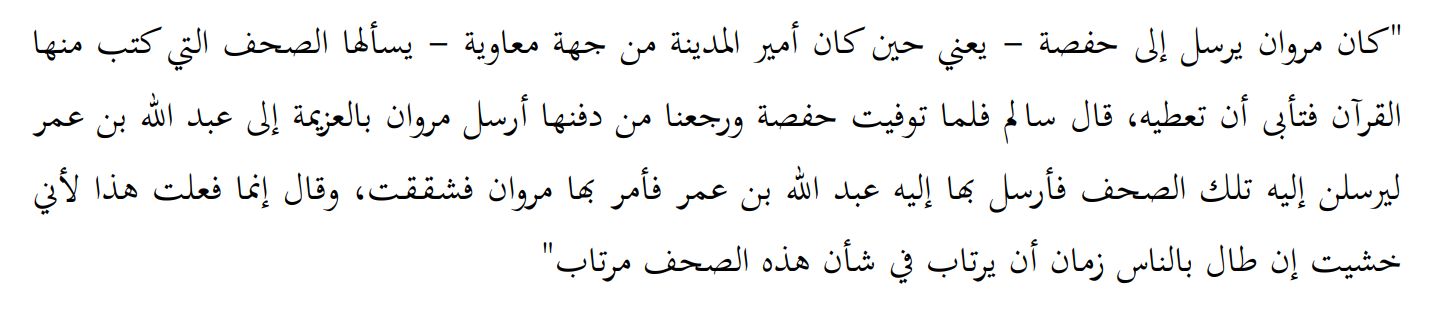
"那时马尔万(Marwan)在穆阿维叶(Mu'awiyya)任命下担任麦地那的长官,他曾派人去向哈福incident(Hafsa)索要用来抄写《古兰经》的那些经页,但她拒绝交给他。" Let me correct that rendering, since I should be faithful to the original's wording: 那时马尔万曾派人去向哈福萨索要《古兰经》的经页,当时他是穆阿维叶任命的麦地那长官,但哈福萨拒绝把经页交给他。 赛利姆(Salim)说:哈福萨去世后,我们从她的葬礼返回时,马尔万把自己坚决的决定告知了阿卜杜拉·伊本·欧麦尔('Abd Allah ibn 'Umar),要求他把那部穆绍夫(mushaf)送给他。于是阿卜杜拉·伊本·欧麦尔把它送给了他。马尔万下令将其销毁。他说:我这样做,是因为我担心,如果它长期留存在人们手中,人们就会对这些经页产生怀疑。
‘That Marwan used to send for Hafsa – i.e when he was the amir of Madinah via Mu'awiyya - asking her for the sheets from which the Qur’ān was written. She refused to give him it. Salim said: When Hafsa died, while we were returning from her burial Marwan communicated his firm decision to 'Abd Allah ibn 'Umar that he send him that mushaf. So 'Abd Allah ibn 'Umar sent it to him. Marwan ordered it to be destroyed. He said: I did this because I feared that if it remained with people for a long time then people will have doubts regarding these sheets’.