21.2 窥探
21.2 Spying
间谍行为是对情报进行侦查。语言中有这样的说法:"侦察消息,侦察它(即)就是对它进行调查",由此也就有了"间谍"一词。如果一个人侦查情报,那么他就是在侦察它,他也就是间谍,无论他侦查的是公开的情报还是隐秘的情报。侦查情报并不以情报必须隐秘即秘密为条件才构成间谍行为;间谍行为就是侦查消息,无论消息是秘密的还是公开的,即秘密的和非秘密的。至于一个人自然地观看事物,既没有经过侦查,他的行为也不是对消息的侦查,或收集情报以便发布,或关注消息,那么这一切都不是间谍行为,只要他的行为不是侦查消息,而侦查消息也不属于他的行为之列。即使他在这些情况下关注消息,也不是间谍行为,因为构成间谍行为的侦查情报,只限于跟踪和审视情报,目的是考察它。至于跟踪情报以便搜集它的人,他并不为考察它而审视它,而是为了把它搜集起来发布给民众。因此,对于跟踪并搜集消息的人,例如报刊和通讯社的记者,不能说他们是间谍,除非他们的工作本身就是间谍活动,并把报刊和通讯社的采访当作掩护工具。在这种情况下,他是间谍,不是因为他作为记者在跟踪新闻,而是因为他的工作就是间谍活动,他把采访当作掩护手段,许多记者的情况正是如此,尤其是其中那些与穆斯林交战的不信道者。至于侦查部门的官员、侦查局及其同类人员,他们侦查消息,他们就是间谍,因为他们的工作就是间谍活动。
Spying is investigating information. It is said in the language “spied the news and spying it (is) investigating regarding it” and from it is the spy. If the man investigates information then he has spied it and he is a spy, whether he investigates open or hidden information. It is not a condition in investigating information that it be hidden i.e. secret so that it is spying; rather spying is investigating news whether secret or open i.e. secret and non-secret. Whereas if he sees things naturally without investigation and without his action being investigation of news, or collection of information to publish it or is concerned with news, all this is not spying as long at it is not investigating news and investigating news is not part of his actions. Even if he follows news in these situations, it is not spying because investigating of information which is spying is only where following and scrutinising it is for the objective of examining it. As for the one who follows information to collect it, he does not scrutinize it for the objective of examining it but rather he collects it to publish it to the people. Accordingly it is not said about the one who follows news and collects it like the correspondents of gazettes and news agencies that they are spies, except if their work is spying and they take the correspondence of gazettes and agencies as a tool. In this situation he is a spy not because of his being a correspondent who is following the news but rather because his work is spying and he takes correspondence as a tool for cover as is the situation with many correspondents and particularly the belligerent disbelievers among them. As for the officers of investigative departments and the investigative office and their like who investigate news, they are spies because their work is spying.
这就是间谍行为的实质,以及间谍的真实状况。至于间谍行为的律例,则因被监视的对象而异。如果是监视穆斯林,或与穆斯林一样的作为公民的迪米人,那么这是哈拉姆,不被允许。如果是监视交战的异教徒,无论他们在事实上还是依据法理上是交战方,这对穆斯林是允许的,并且对哈里发而言是必须的。至于监视穆斯林和伊斯兰国的公民是哈拉姆,这一点在《古兰经》中有明确的规定。安拉(SWT)说:
This is the reality of spying and the reality of the spy. As for the rule of spying, it differs according to those spied upon. If it is spying upon Muslims or dhimmis who are citizens like Muslims, then it is haram and not allowed. If it is spying upon belligerent disbelievers, whether they are belligerent in actual fact or by rule, this is allowed for Muslims and obligatory upon the Khalifah. As for spying upon Muslims and citizens of the Islamic State being haram, this is established by the Qur’an explicitly. Allah (swt) said:
“信道的人们啊!你们应当远避多疑,因为有些疑虑确是罪过;你们不要窥探。” [TMQ 49:12]
“O you who believe avoid much suspicion (dhann) as some suspicion is sin and do not spy” [TMQ 49:12]
所以安拉在这节经文中禁止了窥探。这一禁令是普遍的,涵盖一切窥探行为,无论是为自己窥探还是为他人窥探,无论是为国家还是为个人或团体,也无论进行窥探的人是统治者还是被统治者。这段经文的表述是普遍的,凡符合窥探定义的行为都适用此禁令。
So Allah prohibited spying in the ayah. This prohibition is general covering all spying whether it is spying for himself or anyone, whether it is for the State or individuals or groups, and whether the one performing it i.e. the spying is the ruler or the ruled. The speech is general covering everything applying upon it that it is spying.
这里产生一个问题:穆斯林是否可以在调查部门、侦查部门或其他工作全部或部分涉及间谍活动的部门担任官员?答案要视情况而定。如果该机构是用来监视穆斯林或作为公民的、与穆斯林一样的迪米人,那么根据《古兰经》的明文经文,这是哈拉姆(禁止的)。迪米人在伊斯兰之地同样被禁止这样做,正如穆斯林被禁止一样,因为居住在伊斯兰之地的迪米人有责任在自身事务上遵守伊斯兰律法,除了与信仰和敬拜相关的事务,而这不属于其中。如果该机构是用来监视从我们的领土进入、受到安全保障者之外的交战中的不信道者,或受盟约约束者,那么这是允许的,正如监视交战中的不信道者是允许的一样,无论他们是实际交战还是依法交战,无论他们身处自己的领土还是我们的领土。因此,调查部门及类似机构的存在并不是哈拉姆,而是必要的(瓦吉布的);其中被禁止的,是监视穆斯林或作为穆斯林公民的迪米人。国家不得设立一个监视穆斯林及其他公民的部门,相反,这是对他们的禁止。也不能以国家利益需要掌握公民的信息,以便揭露阴谋并追查罪犯为由,因为国家可以通过警察和夜间巡逻的方式获知这些,而无需通过间谍活动。人的理智是否看到某事有益,并不能成为禁止或允许的理由;只有沙里阿认定为有益的,才是有益。当《古兰经》的经文明确禁止某事时,就不再有讨论的余地,也不能以理智认为其中有益而将其论证为合法,因为在《古兰经》明文面前,这样的说法毫无价值。 《古兰经》说:"{不要侦察}",这是禁止侦察的明文。除了该经文所示的意义及其字面的明确含义之外,别无其他理解的途径。没有任何证据来限定这节经文的普遍性,或将某些事物排除在外,因此它保持其普遍性,涵盖一切侦察行为。所以,对公民进行的一切侦察都是非法的(haram)。
Here a question arises: Is it allowed for the Muslim to work as an officer in an inquiry department or an investigative department or other departments whose work, or some of it, is spying? The response depends. If it is an office to spy upon Muslims or dhimmmis who are citizens like Muslims, then it is haram by the explicit Qur’anic text. It is prevented for the dhimmi like it is prevented for the Muslim as the dhimmi in Dar al-Islam is addressed to implement the Islamic rules upon himself except what relates to creeds and worships, and this is not part of that. If the office is spying upon belligerent disbelievers who enter our lands from the ones who have been granted security or the ones under covenant, then it is allowed as it is allowed to spy upon belligerent disbelievers whether they are belligerent in practice or by the rule and whether they are in their lands or ours. Accordingly the existence of inquiry or investigative departments and their like is not haram but obligatory and what is prohibited (haram) in them is spying upon Muslims or dhimmis who are citizens of Muslims. It is not allowed for the State to have a department to spy upon Muslims and the rest of the citizens; rather this is forbidden against them. Nor is it said that the State’s interest requires knowing the citizens’ information so as to expose conspiracies and lead to criminals because the State can know this via the method of police and night patrol not via the method of spying. Just because the mind sees benefit or not in something it is not a reason for forbiddance or allowance; only what the Shar’a sees as benefit is benefit. When the Qur’anic ayat come explicitly forbidding anything there remains no place for discussion whether there is benefit in it to reason it into making it halal, as there is no value in that in front of the explicit Qur’anic text. The Qur’an says: “Do not spy” meaning prohibition of spying, and there is no way to understand other than what the ayah indicates and the clear meaning of its words. There came no evidence specifying the generality of this ayah or excluding something from it, so it remains in its generality covering all spying so all spying upon the citizens is haram.
“当你们查阅我的这本书时,一直走到麦加与塔伊夫之间的纳赫拉。埋伏等候古莱什人,替我们打探他们的消息。”
“When you look into this book of mine, go until you descend upon Nakhlah between Makkah and Taif. Lie in wait for Quraysh and find out their news for us.”
在这本书中,先知ﷺ命令阿卜杜拉·本·贾赫什去窥探古莱什人,并向他报告他们的消息。然而,他给了同伴们选择是否出发的自由;至于阿卜杜拉本人,则有义务执行此次任务。因此,先知ﷺ要求所有人进行侦察,却强制要求阿卜杜拉,而让其余人自行选择。这证明,对一支队伍的领导者提出的要求是确定性的要求,而对与他同行的其他人而言,则是非确定性的要求。这也证明穆斯林窥探敌人是被允许的。窥探敌人属于伊斯兰军队不可或缺的事务之一。若没有对敌人的间谍工作,就不可能完成作战军队的组建,因此军队中设置间谍便从"事物若不完备则其所依赖之事亦必须具备"的范畴而言,成为国家的义务。
In this book the Messenger (saw) command Abdullah bin Jahsh to spy for him upon Quraysh and to inform him of their news. However he gave a choice to his companions whether to travel or not; as for him (Abdullah), it was obliged upon him to execute the operation. So the Messenger had requested all to perform spying but obliged Abdullah and gave a choice to the rest. This is evidence that the request in relation to the leader of a group is a decisive request, and in relation to the rest together with him it is an indecisive request. It is also evidence that spying by Muslims upon the enemy is allowed. Spying upon the enemy is from the matters which the Islamic army cannot do without. It is not possible to accomplish the formation of an army for war without there being spies for it upon the enemy, so the presence of spying in the army becomes obligatory upon the State from the category (min bab) of
“凡是义务之履行所不可或缺的事物,本身也是义务。”
“That without which an obligation cannot be fulfilled is obligatory.”
关于间谍行为的规定,即它是否为haram(禁止)、允许或是义务的,这一点有其具体的判断。至于对为交战中的敌对异教徒充当间谍之人的惩罚,则因间谍的国籍和其宗教信仰而有所不同。至于交战中的异教徒,当他充当间谍时,其裁决是处死,这是一项明确的判决,除此之外别无其他裁决。只要确知他是间谍,即仅仅证明他是间谍,他就会被处死。这是依据布哈里所传的圣训,即萨拉马·本·阿克瓦尔所述:
This is the rule of spying in relation to it being haram or allowed or obligatory. As for the rule on punishing the spy who spies for the belligerent disbelievers, this differs in relation to the citizenship of the spy and his deen. As for the belligerent disbeliever when he is a spy, his rule is killing as one decisive word and there is no rule for him other than that. He is killed merely upon knowing he is a spy i.e. upon mere proving that he is a spy. This is due to what Al-Bukhari narrated from Salamah bin Al-Akwa’ who said:
一名多神教徒的间谍在先知(愿主赐福他并使他平安)旅途中来到他面前。他坐下来与他的圣门弟子们交谈,然后那人匆匆离去。先知ﷺ说:“去找他,杀了他。”我抢先赶到他那里,杀了他,于是他把他的战利品赏赐给了我。
“There came to the Prophet (saw) a spy of the polytheists while he was travelling. He sat with his (saw) Sahabah discussing then he hastened. The Prophet (saw) said: Seek him and kill him. I preceded them to him and killed him, so he gifted me his booty.”
在《穆斯林圣训实录》中,有传述自伊克里买(Ikrimah)的记载,其措辞如下:
And in Muslim it has been narrated from Ikrimah with the words:
他从骆驼的肚带上取下一条皮革,用它把骆驼拴好,然后开始和众人一起进食,并四处张望。我们当时处境艰难,因为我们中有些人是步行的(没有骑乘的牲畜)。突然,他匆忙地离开了我们。
“He took a strip of leather from its girth and tethered the camel with it and then he began to take food with the people and look (curiously around). We were in a poor condition as some of us were on foot (being without any riding animals). All of a sudden, he left us hurriedy”
而在阿布·努阿伊姆在《Al-Mustakhraj》中的记述里,其传述路线为:经由叶海亚·本·哈马尼,从阿布·阿尔-乌迈斯。
And in the narration of Abu Nu’aym in Al-Mustakhraj via the way of Yahya bin Al-Hamani from Abu Al-‘Umays
“追上他,他是个间谍。”
“Overtake him for he is a spy.”
这一点的依据很明确:使者(愿主赐他平安)仅凭事先确定的情况,就认定他是间谍,并说道。
The is explicit in that the Messenger (saw) on the basis of merely being established before him that he is a spy said
“找到他,杀了他”
“Find him and kill him”
这一说法的含义是:该请求是一项决定性的请求,因此其裁定便是杀死,这是一个决定性的词语,并且它适用于所有交战的异教徒,无论他是否处于盟约之下、持有安全保证,或者不是受约者(mu’ahid)或受保护者(musta’man)。他们都是交战的异教徒,如果他们是间谍,其裁定就是被杀。
This is a connotation that the request is a decisive request. So its rule becomes killing as one decisive word and it is general for all belligerent disbelievers whether he is under a covenant or with a pledge of security or other than a mu’ahid or musta’man. All are belligerent disbelievers whose rule is to be killed if they are spies.
至于作为间谍的归顺异教徒(ahl al-dhimma),需要具体考察。如果在他订立归顺契约时就约定不得进行间谍活动,若进行间谍活动则将被处死,那么就依照该条件执行,即他若成为间谍,便依据此约定被处死。然而,如果没有将此作为条件附加于他,那么哈里发可以将处死作为对他的惩罚,因此,若他成为间谍,便会被处死,其依据是艾哈迈德从弗拉特·本·哈雅尼所传的圣训。
As for the dhimmi disbelievers when he is a spy, then it is looked into. If it was made a condition when he entered into the dhimma that he should not spy and if he spied he will be killed, then the condition is acted upon. So if he became a spy, he is killed according to the condition. However, if that is not made a condition upon him then it is allowed for the Khalifah to make killing as his punishment so he is killed if he becomes a spy due to what Ahmad narrated from Furrat bin Hayyan

“据传先知(愿主福安之)曾下令处死他,而他是一名迪米人。他曾为阿布·苏富扬充当间谍,并且是盟友。他路过一群安萨尔人,说:‘我是穆斯林。’他们说:‘他声称自己是穆斯林。’于是安拉的使者ﷺ说:‘你们中间有些人,我们信任他们的信仰。其中便有富拉特·本·海延。’”
“That the Prophet (saw) commanded his killing and he was a dhimmi. He was a spy for Abu Sufyan and an ally. So he passed by a circle of the Ansar and said: ‘I am a Muslim.’ They said: ‘He claims he is a Muslim’ so the Messenger of Allah (saw) said: ‘There are men among you whom we trust to their belief. Among them is Furrat bin Hayyan.”
这里明确说明,先知ﷺ下令处死一名dhimmi间谍。然而,这种处决只是允许伊玛目执行,而并非对他有强制义务,这与间谍是交战中的不信道者时的情况不同。国家可以处死dhimmi间谍,而非必须处死,其证据在于:该圣训中的命令并没有伴随表示决定性的迹象,因此这是一种非决定性的要求。另有一个表示该要求并非决定性的迹象,即圣训的文本显示,先知ﷺ在仅得知Furrat是间谍之后,并没有急于杀他;而在萨拉玛·本·阿库尔(Salama bin Al-Akwa’)的圣训中所提到的交战中的不信道者,先知ﷺ在仅确认其为间谍之后便下令处死,并对穆斯林说:“去找他并杀了他。”至于先知ﷺ没有急于杀他,证据在于先知ﷺ认识他,这体现在圣训的措辞中:“他是一个dhimmi,并且他是一个间谍”,即他是被认识的;还有先知ﷺ所说的“他们之中有Furrat·本·Hayyan”。此外,先知ﷺ在涉及交战中的不信道者时说:“去找他并杀了他”,而在涉及Furrat·本·Hayyan时,他下令处死,却没有要求穆斯林去找他。由此可见两者的区别:要求杀死交战者是决定性的要求,而要求杀死dhimmi则是非决定性的要求,这表明处死dhimmi间谍是被允许的,不处死他也是被允许的。
This is explicit that the Messenger commanded the killing of a dhimmi spy. However this is allowed for the Imam and not obligatory upon him as is the case when the spy if he is a belligerent disbeliever. The evidence that the killing of a dhimmi spy by the State is allowed and not obligatory is that the hadith is not associated with a connotation indicating decisiveness so it is an indecisive request. There is a connotation which indicates the non-decisiveness in the request which is that the text of the hadith indicates that the Messenger (saw) did not hasten to kill Furrat after the mere knowledge that he is a spy whereas the belligerent disbeliever mentioned in the hadith of Salama bin Al-Akwa’, the Prophet had commanded his killing upon it being merely established before him that he is a spy and he said to the Muslims: “Seek him and kill him.” The evidence that he did not hasten to kill him is that the Messenger (saw) used to know him, which appears in the saying of the hadith “he was a dhimmi and he was a spy” i.e. he was known, and (also) the saying of the Messenger “of them is Furrat bin Hayyan.” In addition to that, the Messenger said in the matter of the belligerent disbeliever: “Seek him and kill him” whereas in the matter of Furrat bin Hayyan he commanded his killing but did not request the Muslims to seek him. It is clear therein the distinction between both of them in that the request to kill the belligerent is a decisive request and the request to kill the dhimmi is an indecisive request which indicates the permissibility of killing the dhimmi spy and the permissibility of not killing him.
至于那个为敌人刺探穆斯林和本地犹太教徒、基督徒(dhimmi)消息的穆斯林间谍,他不被处死,原因在于:先知(saw)曾下令处死那个dhimmi;但当事情在他面前得到证实,即此人已经皈依伊斯兰、成为穆斯林时,他便放弃了对此人的处置。因为先知曾下令处死弗拉特·本·哈say,此人是dhimmi且是间谍;但当人们说:"使者啊,他声称自己是穆斯林。"先知说:
As for the Muslim spy who spies for the enemy upon Muslims and dhimmis, he is not killed because the Messenger (saw) commanded the killing of the dhimmi but when it was established before him that he had embraced Islam and became a Muslim he abstained from him. Since he had commanded the killing of Furrat bin Hayyan who was a dhimmi and a spy but when they said: O Messenger of Allah, he claims he is a Muslim, he said:
“你们中有人,我们信任他的信仰,弗拉特·本·哈扬就是其中之一。”
“Among you are men whom we trust them to their belief, and Furrat bin Hayyan is among them”
所以不杀他的理由('illah)是他已成为穆斯林。布哈里圣训集中记载,阿里·本·阿比·塔利卜(愿安拉喜悦他)说:
So the reason (‘illah) abstaining from killing him is his becoming a Muslim. Al-Bukhari narrated from Ali bin Abu Talib (ra) said:
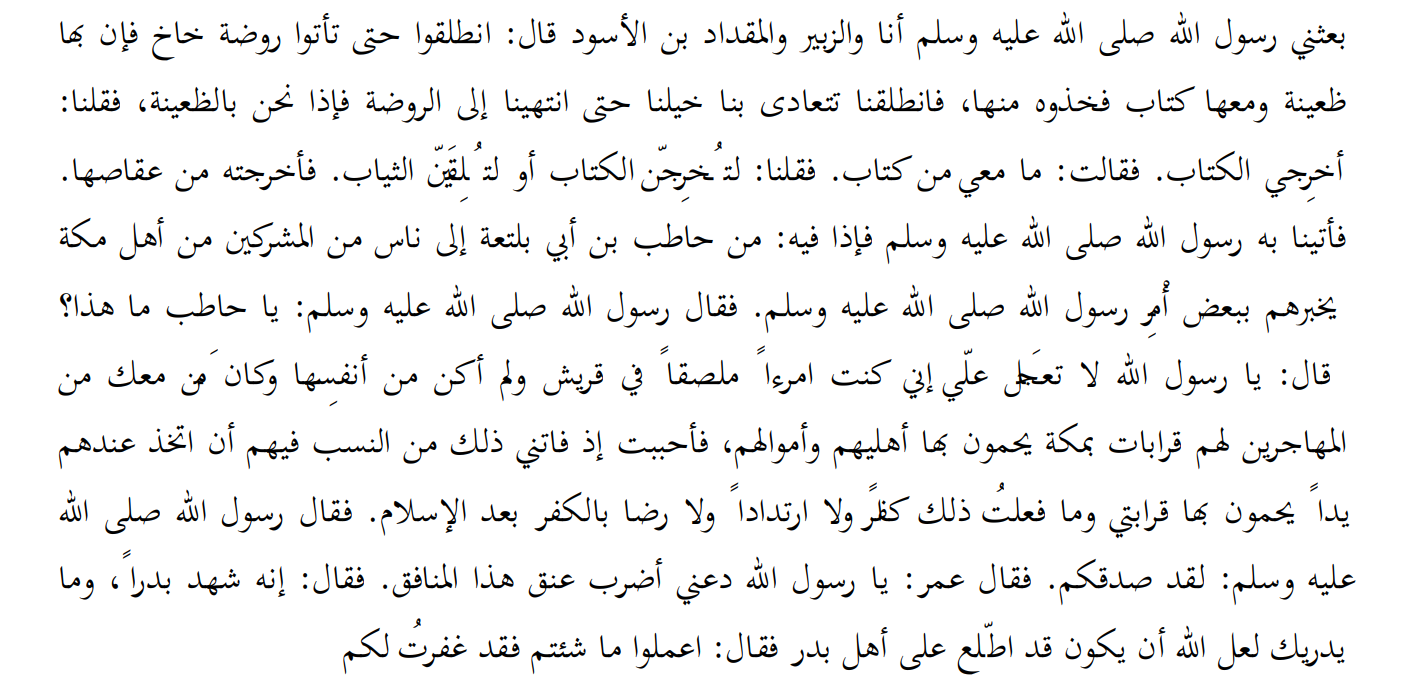
“真主的使者ﷺ派我、祖拜尔·本·阿瓦姆和米克达德·本·阿斯瓦德出发,说:‘你们前去,直到抵达赫赫园。那里会有一位女子乘坐的驼轿,她身上带着一封信,你们把信从她那里拿来。’于是我们骑着马快速前进,直到抵达那座园子,那里果然有一位女子乘坐的驼轿。我们说:‘把信拿出来。’她说:‘我身上没有信。’我们便说:‘你要么拿出信,要么我们就脱掉你的衣服。’她这才从发辫中取出了信。我们把信带给真主的使者ﷺ,信中写道:‘来自哈提布·本·阿比·巴勒塔阿,致麦加的一些人,告知他们真主使者ﷺ的一些事情。’真主的使者ﷺ说:‘哈提布,这是怎么回事?’他说:‘真主的使者,请不要急于怪罪我。我是一个与古莱什人结盟的人,但我并非出自古莱什的血统。与你同在的那些迁士在麦加都有亲属,他们以此保护家人和财产。所以我希望,在与他们的亲缘关系已经断绝的情况下,我能做点什么来保护我的亲属。我并非出于不信或背教而这样做,也不是因为在皈依伊斯兰之后满意于不信。’真主的使者ﷺ便说:‘他对你们说的是实话。’欧麦尔说:‘真主的使者,请让我去砍下这个伪信者的脖子。’他说:‘他参加过白德尔之战。你们怎知真主没有垂顾白德尔的战士,并说:“你们想做什么就做吧,我已经饶恕你们了。”’”
“The Messenger of Allah (saw) sent me, Az-Zubayr bin Al-‘Awwam and Al-Miqdad bin Al-Aswad and said: ‘Go forth until you reach the garden of Khakh. There will be a woman’s litter and with her is a book, so take it from her.’ So we went with our horses in a rapid gait until we ended in the garden where there was a woman’s litter. We said: ‘Remove the book’ and she said: ‘There is no book with me.’ So we said: ‘You will remove the book or we will remove the clothes’ so she removed it from her plaits. We brought it to the Messenger of Allah (saw) and therein was: ‘From Hatib bin Abu Balta’ah to some people of the people of Makkah informing them with some of the matter of the Messenger of Allah (saw). So the Messenger of Allah (saw) said: ‘What is this, O Hatib?’ He said: ‘O Messenger of Allah, do not be hasty with me. I was a man allied to Quraysh, and I was not from her body (i.e. tribe). Those with you from the Muhajirin have relatives in Makkah who protect their families and property. So I wished if the relation with them escaped me that I take a hand with which to protect my relatives. Nor did I commit disbelief or apostasy nor was I pleased with disbelief after Islam. So the Messenger of Allah (saw) said: ‘He has spoken the truth to you.’Umar said: ‘O Messenger of Allah, leave me to strike the neck of this hypocrite.’ He said: “He witnessed Badr, and you do not know but that Allah may have overlooked the people of Badr and said: ‘Do whatever you wish for I have forgiven you.’”
据此圣训中关于哈提卜的记载可以确定,他曾是穆斯林的间谍,而使者ﷺ并未杀他,这表明穆斯林间谍不被处死。不应说此条规定仅适用于白德尔战役的人员,因为该圣训是以他属于白德尔战役人员作为依据(mu'allil)的。也不应这样说:即便经文中包含了需要推理的内容,且其语境使人能够从中理解出推理,但艾哈迈德所传的关于福拉特·本·海扬的圣训中,有人被免除了死刑,因为他在成为受保护的臣民(dhimmi)之后皈依了伊斯兰,这就使该圣训的推理失效,并使其成为对既定事实的描述,因为福拉特·本·海扬并不属于白德尔战役的人员。也不应说,艾布·达乌德所载的福拉特·本·海扬圣训,其传述链中有艾布·哈玛姆·阿德-达拉勒、穆罕默德·本·穆哈巴卜,而他的圣训不被视为证据,且他是从苏夫扬·阿色-色沃里处传述的。这种说法同样不成立,因为艾哈迈德也从苏夫扬·本·布什尔·本·阿-西里·巴士里处传述了这条圣训,而此人正是布哈里和穆斯林共同认可其圣训可作为证据的人之一。因此,该圣训是可靠的,并可据此推演,它证明穆斯林间谍不被处死,而是依据法官或哈里发的判断,给予监禁或其他惩罚。
It was established in this hadith about Hatib that he was a spy against the Muslims and the Messenger did not kill him, which indicates that the Muslim spy is not killed. One should not say that the rule is specific to the people of Badr because the hadith is reasoned (mu’allil) on his being of the people of Badr. This should not be said became even if the text came with what requires reasoning and its context was in a way that reasoning is understood from it; nevertheless (in) the hadith of Ahmad about Furrat bin Hayyan, killing was lifted from him because he became a Muslim after he was a dhimmi which invalidates the reasoning of this hadith and makes it a description of a reality because Furrat bin Hayyan was not from the people of Badr. Nor should one say that the hadith of Furrat bin Hayyan in Abu Dawud has Abu Hammam Ad-Dalal Muhammad bin Muhabbib in its chain and his hadith are not considered as proofs, and he is narrating from Sufyan Ath-Thawri. One should not say this because Ahmad has narrated this hadith from Sufyan bin Bushr bin As-Sirri Al-Basri, and he is from those whom Al-Bukhari and Muslim agreed to consider as proof with his hadith. So the hadith is established and is extrapolated upon, and it is an evidence that the Muslim spy is not killed but is punished with imprisonment or something else according to the view of the judge or Khalifah.
这些内容都是关于为交战的不信道敌人刺探穆斯林和齐穆伊(受保护的非穆斯林)的情况。至于刺探穆斯林但并非为敌人,即不是为交战的不信道者,而是出于刺探本身,或是为了穆斯林或国家的利益;虽然这是哈拉姆(禁止的),但沙里亚并未为此罪规定具体的刑罚,因此其惩罚成为酌定刑(塔兹尔)。
All this is about the spying upon Muslims and dhimmis for the belligerent disbeliever enemy. As for spying upon Muslims (but) not for the enemy i.e. not for the belligerent disbeliever, rather for the sake of spying or for Muslims or the State; although it is haram the Shar’a has not specified a specific punishment for this sin so its punishment becomes a discretionary punishment (ta’zeer).