17.9 伊斯兰教法并未为哈里发职位指定某个特定的人
17.9 The Shar'a Did Not Designate A Specific Person For The Khilafah
认为使者(愿主福安之)指定了某个特定的人作为哈里发,与伊斯兰教法的经文相违背。而认为使者(愿主福安之)提名了某些人作为直到末日的哈里发,则与伊斯兰经文的相违背更加明显。
The view that the Messenger (saw) designated a specific person to be the Khalifah after him contradicts the Shari’ah texts. And the statement that the Messenger (saw) nominated certain persons to be Khulafaa after him until the Day of Judgement is even more contradictory to the Islamic texts.
至于否定使者(saw)为其后的某人指定哈里发之说,这在多个方面都很明显:
As for invalidating (the opinion) that the Messenger (saw) nominated the Khilafah for someone after him, this is apparent in numerous ways:
首先:这与效忠宣誓(bay’ah)相矛盾,因为指定某人即是告知穆斯林谁将成为他们的哈里发,因此哈里发将已为人所知,就无需再立法规定效忠宣誓,因为效忠宣誓正是任命哈里发的方式。如果他已事先被任命,就无需再说明任命他的方式,因为事实上他已经被任命了。也不能说效忠宣誓是对哈里发的服从宣誓,因为沙里尔(Shar’a)在许多与效忠宣誓文本不同的其他经文中已经阐明了对哈里发和掌权者(ulu al-amr)的服从。服从是明确要求穆斯林履行的;至于效忠宣誓,则是在其他要求中向穆斯林提出的,其考虑并非仅仅作为服从,尽管它确实包含服从的含义,而是作为对哈里发职位的一项契约。在所有提到它的圣训中,其含义并非服从,而是将领导权交给被宣誓效忠者,并准备服从这一领导。因此,把效忠宣誓作为任命哈里发的条件,与先知穆罕默德ﷺ指定某个特定的人在他之后担任哈里发相矛盾。此外,在可靠(Saheeh)的圣训中出现的效忠宣誓用语是以一般性(‘aam)的方式出现的,没有特指(takhsees),也没有限定(taqyeed),是无条件的(mutlaq),适用于任何人。如果它们指的是对某个特定人物的效忠宣誓,就不会是一般性和无条件的了。这些圣训的措辞是:
First: This contradicts the pledge (bay’ah) since nominating a person means informing the Muslims as to who will be the Khalifah over them. Hence the Khalifah would be known so there would remain no need for legislating (tashri’) the pledge as the pledge is the method of appointing the Khalifah. So if he has already been appointed in advance, there remains no need to demonstrate the method of appointing him as, in fact, he has already been appointed. Nor can it be said that the pledge is the pledge of obedience to the Khalifah since the Shar’a has enunciated the obedience to the Khalifah and those in charge (ulu al-amr) in many other texts distinct from the text of the pledge. Obedience has been explicitly requested from Muslims; as for the pledge, it has been requested from Muslims in other request(s) not in consideration as being (merely) obedience, though it does include the meaning of obedience, but in consideration as being a contract for the Khilafah. Its meaning in all the ahadith that mentioned it is not obedience, rather it is about giving leadership to the one who is pledged and preparing to submit to this leadership. So making the pledge a condition for appointing the Khilafah contradicts the Messenger (saw) nominating a specific person to be Khalifah after him. Moreover, the words of the pledge which came in the correct (Saheeh) ahadith came in a general manner (‘aam) without specification (takhsees), and unrestricted (mutlaq) without any restriction (taqyeed), for anyone. Were they to mean the pledge for a specific person they would not have been general and unrestricted. The word(s) of the ahadith are:
“谁死时颈上没有效忠之约”
“He who dies without a pledge on his neck,”
“谁与一位伊玛目缔结效忠之约”
“Whosoever pledges an Imam,”
和
And
“一个向伊玛目宣誓效忠的人。”
“A man who pledges an Imam.”
认为先知(ﷺ)指定某个特定的人在他之后担任哈里发,这一观点与誓约的普遍性和无限制性相矛盾,并使其无效。因此,不能说这意味着效忠誓约(ba’yah)本身就是任命哈里发的方式,而任命哈里发是独立于效忠誓约之外的,这就是为什么先任命哈里发,然后才给予他效忠誓约。也不应当这样说,因为效忠誓约是任命哈里发的方式,但这并不意味着它与任命完全相同。也不应说,必须先任命哈里发并承认其任命,然后才给予他效忠誓约,因为这将意味着任命哈里发还有另一种方式,即效忠誓约仅仅是为了服从于他,而关于效忠誓约的圣训都表明,它就是任命哈里发的方式,并没有其他途径。请看他(ﷺ)的话语:
The opinion that the Messenger (saw) designated a specific person to become Khalifah after him contradicts and invalidates the generality and unrestricted nature of the pledge. Therefore, it cannot be said that this means that the ba’yah is the very way of appointing the Khalifah while the appointment of the Khalifah is separate to the ba’yah, this is why the Khalifah is appointed first & then the ba’yah is given to him; one should not say this because the ba’yah is the method of appointing the Khalifah and this does not mean that it is exactly the same as his appointment. Nor should one say that it is compulsory to first appoint the Khalifah and acknowledge his appointment before giving him the ba’yah as this would mean that there is another method for appointing the Khalifah such that the ba’yah is merely for his obedience, whereas the ahadith about the ba’yah all indicate that it is the method to appoint the Khalifah and there is no other way. Consider his (saw) statement:
“谁死时颈上没有效忠之约,谁就是死于蒙昧时代的死亡。”
“Whoever dies without a pledge on his neck”;
很明显,其含义是:谁死时没有通过效忠(bay'ah)来认定他的伊玛目,那么这绝不意味着谁死时没有服从某位伊玛目。由此可见,在这段圣训中,先知所指的是任命哈里发的方式,而不是单纯的服从。另外也请考虑他(SWT)... Wait—I must correct that: the honorific "(saw)" in the original should be rendered as ﷺ after the Prophet, and "(SWT)" should be kept as is. Corrected translation: 很明显,其含义是:谁死时没有通过效忠(bay'ah)来认定他的伊玛目,这绝不意味着谁死时没有服从某位伊玛目。由此可见,在这段圣训中,先知ﷺ所指的是任命哈里发的方式,而不是单纯的服从。另外也请考虑先知ﷺ的这段话……
It is quite explicit in meaning that whoever dies without appointing his Imam via the pledge and it does not mean in any way whoever dies without obeying an Imam. This indicates that in this hadith the Prophet means the method of appointing the Khalifah and does not mean mere obedience. Also consider his (saw) statement:
“当向两位哈里发宣誓效忠时,杀掉后者”;
“When the pledge is given to two Khalifahs, kill the latter”;
如果任命了两位哈里发,就杀掉后者。同样,先知的所有圣训都明确指出,这就是任命哈里发的方式。先知的圣训明确表明,其含义并非仅仅是服从或无条件的(mutlaq)服从;而是指服从被任命为哈里发的人,其含义在于这是任命哈里发的方式。此外,无论在传述上还是在含义上,都找不到哪怕一条经过认证的圣训,能够证明任命哈里发还有ba’yah(效忠宣誓)之外的其他方式。
This is explicit that if two Khalifahs are appointed, kill the later of them. Likewise all ahadith of the Prophet are explicit that it is the method of appointing the Khalifah. The ahadith of the Prophet are explicit in not meaning mere obedience or unrestricted (mutlaq) obedience; rather, they mean following the one appointed as the Khalifah with their meaning that this is the method of appointing the Khalifah. Further, there is not even one authenticated hadith, whether in narration or meaning, which demonstrates a method of appointing the Khalifah other than the ba’yah.
其次:已有圣训传自使者(愿主赐其平安),表明人们将会在哈里发问题上发生争执和纷争,并为之相互竞争。若使者(愿主赐其平安)有明确的经文指定某个人担任哈里发,那么在有该经文的情况下就不会出现争议;或者使者(愿主赐其平安)会说明人们将与那个人发生争执。然而,经文所传达的却是人们将彼此争执,同时也阐明了化解此争执、解决哈里发问题的方法。穆斯林在其《沙希赫》中记载:瓦哈卜·本·巴基亚特·阿瓦西提向我叙述,哈立德·本·阿卜杜拉·朱扎伊里告诉我们,他从阿布·纳德拉处听闻,阿布·赛义德·胡德里说:安拉的使者(愿主赐其平安)说:
Second: Ahadith have been narrated from the Messenger (saw) indicating that there will be disputes and contentions among people about the Khilafah and competition over it. If there was a text from the Messenger (saw) concerning the appointment of a (specific) person, there would not arise a dispute in the presence of that text or the Messenger (saw) would state that people would dispute with that person. Whereas the texts came saying that people would dispute between themselves and it also clarified the method to resolve this dispute and settle the issue of the Khilafah. Muslim narrated in his Saheeh: Wahab bin Baqiyyat al-Wasiti narrated to me that Khalid bin Abdullah al-Juzairi told us from Abu Nadhra from Abu Saeed al-Khudri who said: The Messenger of Allah (saw) said:
“如果有人向两位哈里发宣誓效忠,就杀掉后来的那一位。”
“If the pledge is given to two Khalifahs, kill the latter of them.”
Muslim也在他的《Saheeh》中记载:Zuhayr bin Harb和Ishaq bin Ibrahim告诉我,Ishaq说:我们被告知;Zuhayr说:Jareer告诉我们,他从Al-‘Amash那里听来,Al-‘Amash从Zaid bin Wahhab那里听来,Zaid bin Wahhab从Abdurrahman bin Abdurrabb al-Ka’aba那里听来,他说:我进入清真寺,看见Abdullah bin ‘Amru bin al-‘Aas坐在天房的阴影下,周围聚集着一些人。于是我也加入他们,坐在他身边。他说:我们曾与安拉的使者ﷺ同行于一次旅途中,我们在一处营地停下,安拉的使者ﷺ的宣礼员(mu’adhin)宣布集体礼拜。于是我们都聚集到安拉的使者ﷺ面前,他说:
Muslim also said in his Saheeh: Zuhayr bin Harb and Ishaq bin Ibrahim narrated to me, with Ishaq saying we were informed and Zuhayr said it was narrated to us by Jareer, from Al-‘Amash from Zaid bin Wahhab from Abdurrahman bin Abdurrabb al-Ka’aba who said: I entered the mosque and Abdullah bin ‘Amru bin al-‘Aas was seated in the shade of the Ka’aba with people gathered around him. So I joined them and sat with him. He said: We were with the Messenger of Allah (saw) in a voyage and we stopped at an encampment when an announcer (mu’adhin) of the Messenger of Allah (saw) announced the collective prayer. So we all gathered before the Messenger of Allah (saw) who said:

“没有哪位先知在我之前,不是有责任引导他的民众走向他所知的最好之道,并警告他们他所知的最坏之事,直到他说:凡是与一位伊玛目立约、伸出手与他相握、并以内心的诚挚与他相许的人,应当尽其所能地服从他。如果另有人前来与他争夺权位,就斩断那人的脖颈。”
“There was no Prophet before me except that it was obligatory upon him to guide his Ummah to the best that he knew for them and warn them of the worst he knew for them until he said: Whoever pledged an Imam, giving him the clasp of his hand and the fruit of his heart, should obey him as much as he can. If another comes to dispute with him, strike the neck of the other person.”
穆斯林也在他的《萨希赫》中记载:穆罕默德·本·巴沙尔告诉我们,穆罕默德·本·贾法尔告诉我们,舒阿巴告诉我们,从弗拉特·安-卡扎兹处,从艾布·哈兹姆处,他说:我与艾布·胡赖拉相处了五年,听他转述先知ﷺ说:
Muslim also narrated in his Saheeh: Muhammad bin Bashar narrated to us that Muhammad bin Ja’far narrated to us that Shu’ba narrated to us from Furrat al-Qazzaz from Abu Hazm who said: I remained with Abu Hurayra for five years and heard him narrate from the Prophet (saw) who said:
“以色列的后裔曾有先知管理他们的事务,如同政治家(tasusuhum)。每当一位先知去世,另一位便接续而来。然而,我之后将没有先知,但将会有许多哈里发。他们问道:您命令我们做什么?他说:你们要依次履行对他们的效忠之约。”
“The children of Israel had Prophets taking care of their affairs as politicians (tasusuhum). Whenever one Prophet died, another followed him. However, there will be no Prophet after me but there will be Khulafaa who will be many. They said: What do you command us? He said: Fulfil the pledge one after the other.”
穆斯林在其《沙希哈》中记载:奥斯曼·本·艾布·沙伊巴向我们叙述,尤努斯·本·艾布·雅福尔向他们叙述,从他的父亲,从阿尔法贾,他说他听到安拉的使者ﷺ说:
Muslim narrated in his Saheeh: Uthman bin Abu Shayba narrated to us that Yunus bin Abu Ya’fur narrated to them from his father from Arfaja who said he heard the Messenger of Allah (saw) saying:
“凡发现你们的事务已统一于一人之下,却有人意图煽动叛乱或分裂你们的团结,就杀了他。”
“Whoever finds when all your affairs have been united under one man, intending to incite rebellion or divide your unity, kill him.”
这意味着哈里发是所有穆斯林的权利,任何人都可以争取。这与认为使者ﷺ指定了某个特定的人作为他之后的哈里发的说法相矛盾。
This means that the Khilafah is the right of all Muslims such that anyone can contend for it. This contradicts the (saying that) the Messenger (saw) nominated a specific person to be the Khalifah after him.
第三:那些以“Imam”一词指哈里发的圣训,此词都以不确定的形式出现;当它以确定形式出现时,要么带有表示类属的“al”(定冠词),要么与一个集合名词相关联。在带有“al”的情形中,依据句子的语境可知,这是表示类属的“al”。先知ﷺ说:
Third: The ahadith which came with the word Imam denoting the Khalifah came with this word in an unspecified form; and when it came in an specified one, it either came specified with “the” (“al”) of the species or related to a collective noun. In the possibilities which came specified with “al”, it was the “al” of species by evidence of the sentence. The Messenger said:
“谁与伊玛目立约”,
“Whoever pledges an Imam”,
“……反对一位不公正的伊玛目”,
“…stood against an unjust Imam”,
“我之后将会有伊玛目。”
“there will be Imams after me.”
他说:
And he said:
“伊玛目是人民的监护者(ra'i),他要为自己的臣民负责”。
“The Imam is the one who is a guardian (ra’i) over the people and he is responsible for his citizens”,
“的确,伊玛目是一面盾牌,人们在他身后作战,并借他得到保护。”
“Verily the Imam is a shield from behind whom they fight and by whom they are protected”
他说:
and he said:
“……致穆斯林的伊玛目”,
“…to the Imam of the Muslims”,
“你们最好的伊玛目”,
“The best of your Imams”,
“……你们中最糟糕的伊玛目。”
“…the worst of your Imams.”
由此可见,使者(愿主福安之)并未指明谁将在他之后担任哈里发,而是未作具体指定。这明确表明,使者(愿主福安之)没有为哈里发之位指定某个特定的人,而是将其作为所有穆斯林的权利留给了他们。再加上有些经文使用了复数(jam'u)的措辞,这就成为一个明确的文本,否定了伊玛目必须是某个特定之人。
All this indicates that the Messenger (saw) left the issue concerning who would be the Khalifah after him unspecified without specifying him. This is explicit in its indication that the Messenger (saw) did not designate a specific person for the Khilafah but rather left it as a right for all Muslims. When you add to this that some texts came with the collective (jam’u) language, this becomes a clear text in negating the Imam being a specific person.
第四:圣门弟子(愿真主喜悦他们)在当时就谁应当继任哈里发一事存在分歧。他们之间存在这样的分歧,本身就证明先知(ﷺ)并未指定某个特定的人担任哈里发。而那些存在分歧的人中,恰恰有人被传说是先知(ﷺ)曾论及其哈里发地位的,即艾布·伯克尔(愿真主喜悦他)和阿里(愿真主喜悦他)。尽管他们存在分歧,他们之中没有任何人主张先知(ﷺ)有经文说哈里发之位属于他;圣门弟子中也没有任何人主张有经文规定某些特定的人担任哈里发。如果有任何经文,他们必定会以此相争;他们未以任何经文相争,这表明并不存在关于某个特定人选担任哈里发的经文。也不应有人说,存在一段经文,是在他们之后才为人所知,只是没有传到他们那里,因为我们是从圣门弟子那里领受宗教的。他们是向我们传达《古兰经》、叙述圣训的人。因此,如果圣门弟子那里没有这样的经文,或者没有任何相关的传述,那么这种说法便无论如何都不能成立。我们接受从他们那里传来的一切,摒弃未从他们那里传来的一切。关于先知(ﷺ)之后哈里发的经文问题,我们看到,所有圣门弟子,无一例外,包括艾布·伯克尔(愿真主喜悦他)和阿里(愿真主喜悦他),都一致认同不存在关于某个特定人选担任哈里发的经文。因为尽管有讨论的必要,尽管如果存在经文就必须提及,他们却都没有提及此事。这表明先知(ﷺ)指定某人担任哈里发的说法是站不住的。也不应有人说,未提及经文是出于维护穆斯林团结的考虑,因为这等于隐瞒真主的律例,在最需要它的时候不予传达,而这一问题对穆斯林而言尤其重大。 这种在安拉的宗教中“隐藏”(的做法),不可能出自圣门弟子(愿安拉喜悦他们)之手,他们是先知ﷺ的门徒。
Fourth: The Sahabah (ra) differed in their time about the persons to be the Khalifah among them. This difference among persons is evidence that the Messenger (saw) did not designate a specific person for the Khilafah. Among the very people who differed are those of whom it is said that the Messenger enunciated upon their Khilafah, namely: Abu Bakr (ra) and Ali (ra). Despite their differences, none of them ever argued that there was a text from the Messenger (saw) that the Khilafah is for him nor did any of the Sahabah (ra) argue that there was a text for certain people in general. Were there any text, they would have argued with them; so their failure to argue using any text means that there is no text for a specific person for the Khilafah. Nor should anyone say that there is a text which was known after them but it did not reach them, because we take our deen from the Sahabah (ra). They are the ones who conveyed the Qur’an, and narrated the hadith, to us. So if there is no text or any text from the Sahabah (ra), then it is not recognised in any way. We take whatever came from them while throwing away whatever did not come from them. In relation to the issue of a text for a Khalifah after the Messenger (saw), we find that all the Sahabah (ra) without exception including Abu Bakr (ra) and Ali (ra) agreed upon the absence of any text for a specific person for the Khilafah due to their failure to mention this despite the need for speaking and the necessity for mentioning the text if it existed. This indicates the invalidity of the Messenger (saw) designating a person for the Khilafah. Nor should one say that the failure to mention the text was due to the precaution to preserve the unity of the Muslims for this means hiding a rule of Allah and not delivering it at the very time it was urgently required, particularly in such an important matter for the Muslims. This hiding in the deen of Allah is not possible to come from the Sahabah (ra) of the Messenger of Allah (saw).
“如果我指定一位哈里发,那么比我更优秀的人也曾指定过一位哈里发,即艾布·伯克尔。如果我不指定,那么比我更优秀的人也没有指定,即安拉的使者ﷺ。”
“If I appoint a Khilafah, verily one better than me did appoint a Khalifah i.e. Abu Bakr. And if I do not, then one better than me did not i.e. the Messenger of Allah (saw).”
穆斯林记载,伊本·欧麦尔传述:欧麦尔·本·赫塔卜(愿安拉喜悦他)说:
Muslim narrated from bin Umar that Umar bin al-Khattab (ra) said:
“真主——至尊至大——必定会保全这个宗教。如果我不指定哈里发,那么真主的使者确实没有指定;如果我指定,那么艾布·伯克尔确实指定过。” Note: the translation follows the rules above, with ﷺ placed after the Prophet's mention, and "(saw)" replaced by ﷺ.
“Verily Allah ‘azza wa jall will preserve the deen. If I do not appoint a Khalifah, verily the Messenger of Allah (saw) did not appoint; and if I do appoint, verily Abu Bakr did appoint.”
这明确表明,使者(愿主福安之)并未指定哈里发。也不应说这只是欧麦尔的个人见解,因为当一位圣门弟子说“使者(愿主福安之)做过这件事或没有做过这件事,或者我们在他的时代是这样,或者在他的时代有过某某事”时,这便是被当作证据引用的圣训,而不仅仅是一位圣门弟子的观点。况且,欧麦尔是在圣门弟子们的听闻和注视之下说这番话的,阿里(愿主喜悦之)也在场,这番话传到了他耳中,而他并未反对,这表明他们对欧麦尔(愿主喜悦之)所叙述的内容是一致认同的。
This is a clear text that the Messenger (saw) did not appoint a Khalifah. Nor should one say that this is Umar’s opinion for when a companion says, ‘The Messenger (saw) did this or did not do this or we were in his time like this or there was in his time such and such’, this is a hadith used as evidence not merely a companion’s view. Moreover, Umar said this within the hearing and sight of the Sahabah (ra), and Ali (ra) was present and this statement reached him and he did not oppose it, which indicates their agreement upon what Umar (ra) narrated.
鉴于不存在任何明确指定某一特定人选担任哈里发的经文,这一切都是基于此而言的。至于那些主张存在指定某一特定人选之经文的人所援引的文本,其中有些是用来表明先知任命艾卜·伯克尔(愿真主喜悦他)在他之后担任哈里发的,另一些则是用来表明先知任命阿里(愿真主喜悦他)在他之后担任哈里发的。我们必须将它们呈现出来,并解释其内容。
This is all with respect to the absence of any specific text designating a specific person for the Khilafah. As for the texts brought by those who say that there are texts designating a specific person, among these texts are those brought to indicate that the Messenger appointed Abu Bakr (ra) to become Khalifah after him whereas others are brought to indicate that he appointed Ali (ra) as the Khalifah after him. We must present them and explain their contents.
至于那些声称先知(愿主福安之)任命了艾布·伯克尔(愿主喜悦之)的人所引的圣训,可分为两类:第一类是先知(愿主福安之)赞扬艾布·伯克尔(愿主喜悦之)的圣训,其中并无任何迹象表明先知(愿主福安之)任命了他。第二类是有人通过推论认为先知(愿主福安之)任命了艾布·伯克尔(愿主喜悦之),也有人推论认为他是先知所指定的人。下面我们举其中一些例子来展示他们的论证方式,并指出这些圣训都不超出赞扬的含义。
As for the texts brought by those who say the Messenger (saw) appointed Abu Bakr (ra), they are divided into two: One portion in which the Messenger (saw) praises Abu Bakr (ra) wherein there is nothing to indicate that the Messenger (saw) appointed him. The other portion is one wherein some deduce by deduction that the Messenger (saw) appointed Abu Bakr (ra) while others deduce that he nominated Abu Bakr (ra). We will present their model by presenting some of them, noting that none of them exceed the meaning of praise.
布哈里传述,艾布·赛义德·胡达里说:先知ﷺ说:
Al-Bukhari narrated from Abu Saeed al-Khudri that the Prophet (saw) said:
“诚然,在陪伴与财物上对我最有恩的人是艾布·伯克尔。若我要取一位亲密的朋友(khaleel),除我的主之外,我必取艾布·伯克尔为友;但如今有伊斯兰的兄弟情谊与爱。清真寺中不应再留任何门,除了艾布·伯克尔的门之外,其余都应关闭。”ﷺ
“Verily the most gracious of people to me in his companionship and wealth is Abu Bakr. Were I to take an intimate friend (khaleel) other than my Lord, I would have taken Abu Bakr (ra) but instead there is the brotherhood of Islam and its love. There should not remain in the mosque any door but that it should be closed except for the door of Abu Bakr.”
穆斯林也记载了这段圣训,措辞不同,但与这些圣训相似。这段圣训中没有任何内容能让人认为他任命了艾布·伯克尔(愿真主喜悦他)为哈里发。它所包含的,只是先知(愿真主赐予他福安)对艾布·伯克尔(愿真主喜悦他)的赞扬,而先知(愿真主赐予他福安)也曾点名赞扬过许多圣门弟子。关于赞扬欧麦尔(愿真主喜悦他)、奥斯曼(愿真主喜悦他)、阿里(愿真主喜悦他)、萨阿德·本·艾布·waqqas(愿真主喜悦他)、塔勒哈(愿真主喜悦他)、祖拜尔(愿真主喜悦他)、艾布·欧拜达·本·哲拉赫(愿真主喜悦他)、哈桑(愿真主喜悦他)和侯赛因(愿真主喜悦他)、栽德·本·哈里萨(愿真主喜悦他)、奥萨玛·本·栽德(愿真主喜悦他)、阿卜杜拉·本·贾法尔(愿真主喜悦他)、赫迪彦(愿真主喜悦她)、阿伊莎(愿真主喜悦她)、先知(愿真主赐予他福安)的女儿法蒂玛(愿真主喜悦她)、乌姆·赛莱麦(愿真主喜悦她)、毕拉勒(愿真主喜悦他)以及其他人的圣训也都有流传。仅仅是赞扬本身,绝不表明任命为哈里发。
Muslim also narrated this hadith but with different wording, although similar to these ones. There is nothing in this hadith to make a person say that he appointed Abu Bakr (ra) as Khalifah. All that it contains is praise for Abu Bakr (ra) from the Messenger (saw), and the Messenger (saw) praised many companions by name. There have come ahadith with praise for Umar (ra), Uthman (ra), Ali (ra), Sa’d bin Abu Waqqas (ra), Talha (ra), Az-Zubayr (ra), Abu ‘Ubaydah bin al Jarrah (ra), Al-Hassan (ra) and Al-Hussein (ra), Zayd bin Haritha (ra), Usama bin Zayd (ra), Abdullah bin Ja’far (ra), Khadija (ra), Aisha (ra), Fatima (ra) daughter of the Prophet (saw), Umm Salamah (ra), Bilal (ra) and others. Praise by itself does not in any way whatsoever indicate appointment to be Khalifah.
关于有人据以推断阿布·伯克尔(愿真主喜悦他)哈里发地位的圣训,共有四段,我们将逐一呈现,并阐明其中所包含的全部内容。这四段圣训是:
As for the ahadith from which some deduced the Khilafah of Abu Bakr (ra), they are four ahadith which we will present and clarify all that they contain. These ahadith are:
首先:布哈里(Al-Bukhari)引述卡西姆·本·穆罕默德(Al-Qasim bin Muhammad)(愿真主喜悦他)的话,他说:
First: Al-Bukhari narrated from Al-Qasim bin Muhammad (ra) who said:
“阿伊莎说:哦,我的头啊!于是先知ﷺ说:如果这事发生了,而我还活着,我会为你求饶,并为你祈祷。阿伊莎说:这是件严重的事。以真主发誓,我相信你希望我死去,这样一来,若它发生,你就会与你的某些妻子幸福地度过余生。先知ﷺ说:不,是我的头很沉重。我本打算或计划派人去请艾布·伯克尔和他的儿子,以便给他一个承诺(‘ahd),使任何人都不再说话,也不让希望者有所希冀。然后我说:真主会拒绝,信士们也会阻止那件事;或者真主会阻止,信士们会拒绝。”
“Aisha said: O my head so the Messenger of Allah (saw) said: If it were to happen and I were alive, I would ask for you to be forgiven and pray for you. Aisha said: That is a serious matter. By Allah, I believe that you would like my death so that it if happened, you would spend the rest of your days wedded happily with some of your wives. The Prophet (saw) said: Rather it is my head which is heavy. I intended or planned to send for Abu Bakr and his son so as to give him a promise (‘ahd) so that no person will speak or a wisher wish. Then I said that Allah will reject and the believers prevent that or Allah will prevent and the believers reject.”
穆斯林(Muslim)以如下措辞从阿伊莎(ra)处传述此段圣训:先知(ﷺ)在他患病期间对我说:
Muslim narrated this hadith from Aisha (ra) in this wording from her: The Messenger of Allah (saw) said to me in his illness:
“去把你的父亲阿布·伯克尔和你的兄弟叫来,我要写一份文书,因为我担心会有人心存妄念、或有人开口说:‘我更应当’(或‘我更优先’)。但真主会拒绝,信士们也会拒绝,唯独阿布·伯克尔除外。”
“Call for me your father, Abu Bakr, and your brother so that I write a book for I fear that a wisher will wish or a speaker say: I am better (or take precedence). But Allah will reject, and so the believers, except for Abu Bakr.”
第二:布哈里传述,穆罕默德·本·朱拜尔·本·穆特IM从其父那里传述,他说:
Secondly: Al-Bukhari narrated from Muhammad bin Jubayr bin Mut’im from his father who said:
一名妇人来见先知ﷺ,与他谈论某件事。先知ﷺ吩咐她回去再来见他。她说:“安拉的使者啊,如果我来了却找不到您呢?”她的意思似乎是指死亡。先知ﷺ说:“如果你找不到我,那就去找艾布·伯克尔。”
“A woman came to the Prophet (saw) and spoke to him about something; and he commanded her to return to him. She said: O Messenger of Allah, what if I came and did not find you—as if she meant death—so he said: If you do not find me, then go to Abu Bakr.”
穆斯林从穆罕默德·本·朱拜尔·本·穆特large{} Wait, I must correct that: the translation should be complete and accurate. 穆斯林从穆罕默德·本·朱拜尔·本·穆特имм的父亲那里传述此圣训,其文字如下:
Muslim narrated this hadith from Muhammad bin Jubayr bin Mut’im from his father in the words:
一名妇女向安拉的使者ﷺ问了一件事,他吩咐她回来见他。她说:“安拉的使者啊,如果我来了却找不到您呢?”——我的父亲说:她的意思似乎是指死亡。于是他说:“如果你找不到我,那就去找艾布·伯克尔。”
“A woman asked the Messenger of Allah (saw) something and he commanded her to return to him. She said: O Messenger of Allah, what if I come and do not find you—My father said: As if she meant death—so he said: If you do not find me, then go to Abu Bakr.”
第三:布哈里传述,阿伊莎(愿真主喜悦她),信士们的母亲,
Thirdly: Al-Bukhari narrated from Aisha (ra), the mother of the believers,
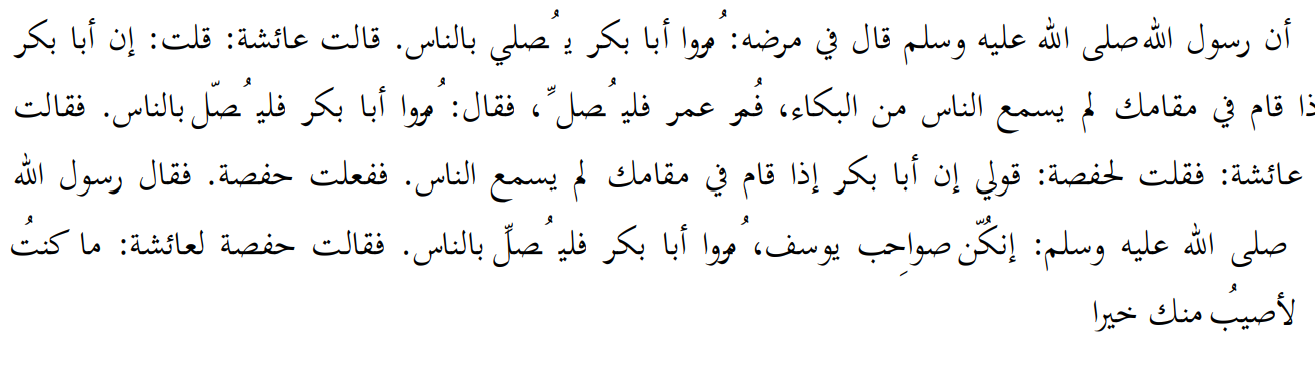
“先知(安拉的使者)ﷺ在病中对我说:‘你们命令艾卜·伯克尔带领众人礼拜。’艾莎说:我说:‘艾卜·伯克尔站在您的位置上时,人们听不清他的声音,因为他哭泣得厉害,请您命令欧麦尔带领礼拜。’他说:‘命令艾卜·伯克尔带领众人礼拜。’艾莎说:我对哈芙赛说:‘你去告诉他,艾卜·伯克尔站在您的位置上时,人们听不清他的声音。’她就照做了。安拉的使者ﷺ说:‘你们就像优素福的同伴一样。命令艾卜·伯克尔带领众人礼拜。’哈芙赛对艾莎说:‘我永远不会因你而得到任何好处!’”
“That the Messenger of Allah (saw) told me during his illness: Command Abu Bakr to lead the people in prayer. Aisha said: I said: When Abu Bakr stands in your place, people do not hear him for his crying so command Umar to lead prayers. He said: Command Abu Bakr to lead people in prayer. Aisha said: I said to Hafsa: Say that when Abu Bakr stands in your place, the people do not hear, and she did that. The Messenger of Allah (saw) said: You are like the companions of Yusuf. Command Abu Bakr to lead the people in prayer. Hafsa said to Aisha: I will never achieve any good through you!”
第四:穆斯林引述伊本·阿布·穆尔基雅的话,他说:
Fourthly: Muslim narrated from bin Abu Mulkiyya who said:

“我听说有人问阿伊莎:如果安拉的使者ﷺ要任命哈里发,他会任命谁为他之后的哈里发?她说:艾布·伯克尔。又问:那艾布·伯克尔之后呢?她说:欧麦尔。又问:那欧麦尔之后呢?她说:艾布·欧拜代·本·哲拉赫。说完她就停住了。”
“I heard Aisha being asked: Whom would the Messenger of Allah (saw) have appointed as Khalifah after him had he so appointed? She said: Abu Bakr. She was asked: Then whom after Abu Bakr? She said: Umar. She was then asked: Then whom after Umar? She said: Abu ‘Ubaydah bin al-Jarrah, and she stopped at that.”
这些圣训都不能作为先知(愿主赐福他并使他平安)任命艾布·伯克尔(愿真主喜悦他)为哈里发的合适证据。第一段圣训之所以被驳回,有两个原因:第一,先知ﷺ曾说:
All these ahadith are not suitable evidence for the Messenger (saw) appointing Abu Bakr (ra) as Khalifah. The first hadith is rejected for two reasons: The first is that the Messenger (saw) said:
“我希望或打算”
“I wished or intended”
但他并没有这样做,所以这不能作为证据。因为证据只能是先知ﷺ的言语、行为或默许的认可;除此之外的任何事情,都不被视为伊斯兰教法的依据。其次,阿伊莎(愿真主喜悦她)是艾布·伯克尔的女儿,如果这段圣训确实存在,她一定会告诉艾布·伯克尔(愿真主喜悦他)。那么,当他前往议事厅(Saqeefa)与聚集起来、要求拥立一位本族哈里发的安萨尔人争论时,他就会以此来反驳。因此,这段圣训是被拒绝的(mardud),不适合作为任命艾布·伯克尔(愿真主喜悦他)为哈里发的证据。
But he did not do so, so this is not an evidence. For the evidence is the Messenger’s (saw) saying, action or silent consent; anything other than these is not considered Shari’ah evidence. Secondly, Aisha (ra) is Abu Bakr’s daughter so were this hadith present she would have informed Abu Bakr (ra). Then he would have argued with it when he went to the courtyard (saqeefa) to contend with the Ansar when they gathered to pledge allegiance to a Khalifah amongst them. Therefore this hadith is rejected (mardud) and is unsuitable to be an evidence for the appointment of Abu Bakr (ra) as Khalifah.
关于第二段圣训,它并不能表明艾布·伯克尔(愿真主喜悦他)被任命为哈里发,因为那位妇女说的是:"如果我没有找到你";所以她没有找到他,应当是因为他在战争或其他事务中不在。圣训中没有任何内容表明她所说的"如果我没有找到你"是指你已经去世。圣训中所说的"好像她指的是死亡",是朱拜尔的话和他的理解。因此,使者命令她如果来了而没有找到他,就去找艾布·伯克尔,这并不能作为艾布·伯克尔在穆圣ﷺ之后被任命为哈里发的证据。即使我们被迫将她的理解解释为死亡,这些话也仍然不能指定艾布·伯克尔在穆圣ﷺ之后担任哈里发。 至于第三段圣训,这只是关于带领礼拜的任命,而没有其他含义。带领礼拜的任命并不等于统治权(hukm)上的任命。至于他们所说的:"使者ﷺ在宗教事务上对他感到满意,那么我们在世俗事务(dunya)上难道不应对他满意吗?"这是他们的理解,而且是错误的,因为礼拜与统治之间有很大的区别。并非所有适合在礼拜中担任领拜人(Imam)的人,都适合担任统治者。此外,该经文是专门针对礼拜的,因此它不涵盖其他事务,由于经文的特定性(khususiyya),也不应将其引申为其他含义。
As for the second hadith, it does not indicate the appointment of Abu Bakr (ra) as Khalifah because the woman said: “If I did not find you”; so it is correct that she failed to find him due to his absence in a war or any other matter. There is nothing in it to indicate that she meant by her words “If I did not find you” that you had died. The words which came in the hadith “As if she meant death” are the words of Jubayr and his understanding. So the Messenger’s command for her to go to Abu Bakr (ra) if she came and did not find him is no proof for the appointment of Abu Bakr (ra) as Khalifah after the Messenger (saw). Even if we were compelled to take her understanding to mean death, these words still would not designate Abu Bakr as Khalifah after him (saw). As for the third hadith, this is the appointment over prayer and nothing else. Appointment over prayer does not mean appointment in authority (hukm). As for their statement: “The Messenger of Allah was pleased with him in a matter of the deen, so should we not be pleased with him in a matter of the world (dunya)”; this is their understanding, and it is erroneous because there is a large difference between prayer and ruling. Not all who are suitable to become a leader (Imam) in prayer are suitable to be a leader in ruling. Moreover, the text is specific to prayer so it does not encompass other things, nor should it be taken to mean other things due to the specificity (khususiyya) of the text.
至于第四条圣训,它不能被视为圣训,因为它并未转述使者(愿主赐其平安)的任何言论,而只是阿伊莎的个人见解。圣门弟子的见解不是证据,也不属于沙里尔的证据,因此这一说法被驳回,因为它不是圣训,与沙里尔的律例没有关系。

“先知说:‘明天我将把旗帜(rayah)交给一个人,真主将借他的手取得胜利。’于是人们整夜都在想,旗帜会交给谁。天亮时,人们早早地去见真主的使者ﷺ,希望旗帜会交给自己,但他说:‘阿里·本·艾比·塔利卜在哪里?’他们说:‘他眼睛疼,真主的使者啊。’他说:‘派人把他叫来见我。’阿里来后,先知ﷺ向他的眼睛吐了口水,并为他祈祷。他的眼睛便痊愈了,仿佛从未疼过,然后先知ﷺ把旗帜交给了他。”
“That the Messenger of Allah (saw) said: I will give the flag (rayah) tomorrow to someone by whose hands Allah will conquer. He said: So the people spent the night thinking which one of them it would be given to. When people woke up, they went early in the morning to the Messenger of Allah (saw) hoping it would be given to them, but he said: Where is Ali bin Abi Talib? They said: His eyes are paining O Messenger of Allah. He said: Send for him to come to me. When he came, he spit in his eyes and prayed for him. He was cured as if he never had pain, and he gave him the flag.”
穆斯林(Muslim)从艾布·胡莱赖(Abu Hurairah)处传述此圣训,其原文如下:
Muslim narrated this hadith from Abu Hurairah with the words:

在哈白尔之日,安拉的使者(saw)说:"我将把这面旗帜交给一个爱安拉和祂的使者、并且安拉将借他的手取得胜利的人。"欧麦尔·本·赫塔卜说:"在那一天之前,我从未渴望过领导的职位。"他说:"我时常想象自己,希望能被召唤去担当此任。"他说:"安拉的使者(ﷺ)召来了阿里·本·艾比·塔利卜,并把旗帜交给了他。"
“The Messenger of Allah (saw) said on the day of Khayber: I will give this flag to someone who loves Allah and His Messenger by whose hands Allah will conquer. Umar bin al-Khattab said: I had never wished for leadership except for that day. He said: I visualised it hoping that i would be called for it. He said: The Messenger of Allah (saw) called Ali bin Abi Talib and gave him the flag.”
布哈里在“阿里(愿主喜悦他)的美德”章中记述,安拉的使者(愿主福安之)对阿里(愿主喜悦他)说:
Al-Bukhari narrated in the chapter of virtues of Ali (ra) that the Messenger of Allah (saw) said to Ali (ra):
你属于我,我也属于你。
“You are of me and I am of you.”
穆斯林(Muslim)引述阿米尔·本·萨阿德·本·艾比·瓦卡斯(‘Amir Bin S'ad bin Abi Waqqas)的话,他从其父那里传述说:穆阿维叶·本·艾布·苏富扬(Muawiya bin Abu Sufyan)命令萨阿德(S'aad)说:是什么阻止你辱骂艾布·图拉布(Abu Turab)?他说:每当我想起先知ﷺ对他所说的三件事,我就永远不会辱骂他。我若能拥有其中的一件,对我而言都比红骆驼更为可爱。先知ﷺ在他参加的某些远征中把他留了下来,阿里(Ali)便对他说:安拉的使者ﷺ啊,您把我留给妇女和孩子们吗?安拉的使者ﷺ对他说:
Muslim narrated from ‘Amir Bin S’ad bin Abi Waqqas (ra) from his father who said: Muawiya bin Abu Sufyan (ra) commanded S’aad (ra) saying: What has prevented you from insulting Abu Turab (ra)? He said: When I remember three (things) which the Messenger of Allah (saw) said of him, I will never insult him. That I should have even one of these is more beloved to me than red camels. The Messenger of Allah (saw) left him behind in some of his war expeditions, so Ali (ra) said to him: O Messenger of Allah (saw), have you left me behind with women and children? The Messenger of Allah (saw) said to him:
“你难道不喜欢与我处于同样的地位吗?就像哈伦之于穆萨一样,只是在我之后不再有先知。”ﷺ
“Are you not pleased to be in the same status next to me like the status of Harun next to Musa, except that there is no Prophet after me.”
我还听他在哈proper那天说过: Correction: the transliteration should be "Khaybar" (خيبر), so the correct rendering is: 我还听他在哈伊拜尔(Khaybar)那天说过:
I also heard him say on the day of Khayber:
“我将把旗帜交给一个爱真主和祂的使者,并且真主和祂的使者也爱他的人。”ﷺ
‘I will give the flag to a man who loves Allah and His Messenger, and whom Allah and His Messenger love.
他说:我们为此出发了,他说:
He said: We moved for it and he said:
“召唤阿里,他被带来了,他眼睛发炎。他往阿里的眼睛里吐了唾沫,并把旗帜交给他,安拉借他取得了胜利。”
“Call Ali, so he was brought and he had sore eyes. He spit in his eyes and gave him the flag, and Allah conquered through him.’
当这节经文降示时:
And when this verse was revealed:
说:“来吧,让我们召唤我们的儿子和你们的儿子。”[《古兰经》3:61]
Say: Come and let us call our sons and your sons [TMQ 3:61],
先知(ﷺ)的 Messenger of Allah 这里需要译成 "安拉的使者"。依规则,每处提及先知穆罕默德时都要写一次ﷺ,原文中的(saw)要替换为ﷺ,(ra)保留为文字形式。 安拉的使者ﷺ呼唤了阿里(愿安拉喜悦他)、法蒂玛(愿安拉喜悦她)、哈桑(愿安拉喜悦他)和侯赛因(愿安拉喜悦他),并说道:
The Messenger of Allah (saw) called Ali (ra), Fatima (ra), Hassan (ra) and Husain (ra) and said:
"真主啊,这是我的家人。"
‘O Allah, this is my family.’”
穆斯林圣训集记载,萨哈勒·本·赛阿德说:麦尔旺家族的一个人被任命为麦地那的统治者。他召见了萨哈勒·本·赛阿德,命令他辱骂阿里(愿真主喜悦他)。他说:萨哈勒拒绝了,于是有人对他说:如果你拒绝,那就说:愿真主诅咒阿布·图拉布(愿真主喜悦他)。萨哈勒说:阿里(愿真主喜悦他)没有比阿布·图拉布更让我喜爱的名字,他听到这个称呼时会感到高兴。有人对他说:请告诉我们这件事的经过,他为何被称为阿布·图拉布(愿真主喜悦他)。于是他说:真主的使者ﷺ来到法蒂玛的家中,没有找到他在屋里,便说:
Muslim narrated from Sahl bin S’aad who said: A man from the family of Marwan was appointed (as ruler) over Madinah. He said: He called Sahl bin S’aad and commanded him to insult Ali (ra). He said: Sahl refused, so it was said to him: If you refuse, then say: Allah curse Abu Turab (ra). Sahl said: Ali (ra) has no name more beloved to me than Abu Turab (ra), and he would be pleased when called by it. It was said to him: Inform us of the incident as to why he was called Abu Turab (ra), so he said: The Messenger of Allah (saw) came to Fatima’s house and did not find him in the house, so he said:
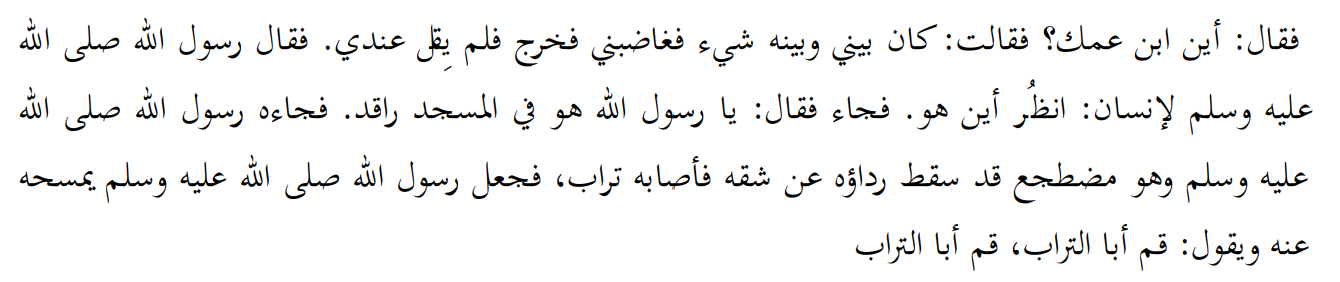
“你叔叔的儿子在哪里?”她说:他和我之间有些事,他惹我生气后,没有告诉我就走了。于是安拉的使者ﷺ对某人说:“去找找他在哪里。”那人回来说:“安拉的使者啊,他在清真寺里躺着休息。”于是安拉的使者ﷺ走到他那里,他正侧卧着,外袍从身上滑落,沾上了尘土,安拉的使者ﷺ便一边替他拂去尘土,一边说:“起来吧,阿布·图拉布。”
“Where is the son of your paternal uncle?” She said: There was something between him and me, and he made me angry and left without telling me. So the Messenger of Allah (saw) said to someone: “Go find out where he is.” He came back and said: O Messenger of Allah, he is resting in the mosque. So the Messenger of Allah (saw) came to him while he was reclining. His cloak had fallen from his body and dirt had touched him, so the Messenger of Allah (saw) began wiping it off him while saying: “Stand up, O Abu Turab.”
穆斯林从阿迪·本·萨比特处传述,他从达尔处传述,达尔说:阿里说:
Muslim narrated from ‘Adiyy bin Thabit from Dharr who said: Ali said:
“以那使种子裂开并创造生命的主发誓,先知ﷺ曾向我立约:唯有信士才会爱我,唯有伪信者才会怀恨于我。”
“By Him Who split up the seed and created something living, the Prophet (may peace and blessings be upon him) gave me a promise that no one but a believer would love me, and none but a hypocrite would nurse grudge against me..”
这些圣训中没有任何内容能使人断定使者(saw)任命阿里(ra)为其后的哈里发。海拜尔的圣训是使者(saw)的赞扬。使者(saw)对阿里(ra)所说的话是: Note: the user's text ends with a colon and no quoted statement, but per the rules I translate the text as given. Also, per the rules, "(saw)" written as an abbreviation should be replaced with ﷺ after the Prophet's mention, and the honorific abbreviations stay as they are in the original only for the other companions. Correcting that now: 这些圣训中没有任何内容能使人断定使者ﷺ任命阿里(ra)为其后的哈里发。海拜尔的圣训是使者ﷺ的赞扬。使者ﷺ对阿里(ra)所说的话是:
There is nothing in these ahadith to make someone say that the Messenger (saw) appointed Ali (ra) to be Khalifah after him. The hadith of Khayber is praise from the Messenger of Allah. The Messenger’s (saw) statement to Ali (ra):
“你属于我,我也属于你”
“You are of me and I am of you”
这是来自安拉的使者ﷺ的赞扬。至于萨阿德的圣训,其中提到:
Is a praise from the Messenger of Allah (saw). As for the hadith of S’aad in which came:
“你难道不愿意拥有与穆萨之于哈伦的关系那样,你在我之前的地位吗?”
“Are you not pleased to have the status before me as that of Harun with Musa”,
本主题将在关于此议题的第二类圣训中讨论。其中也包括海拜尔战役的圣训,这是一段赞美的圣训,其中提到阿里(愿真主喜悦他)、法蒂玛(愿真主喜悦她)、哈桑(愿真主喜悦他)和侯赛因(愿真主喜悦他)是他的家人,这同样是一种赞美;还有萨赫勒·本·萨阿德的圣训,也是一种赞美。正如真主的使者ﷺ赞美阿里(愿真主喜悦他),他也赞美了他的其他圣门弟子(愿真主喜悦他们)。使者ﷺ对某人的赞美,绝不表明对此人的任命。
This subject will be discussed in the second category of the ahadith on the topic. In it is also the hadith of Khayber which is a praise and in it is that Ali (ra), Fatima (ra), Hassan (ra) and Husain (ra) are his family which is a praise, and the hadith of Sahl bin S’ad is a praise. Just like the Messenger of Allah (saw) praised Ali (ra), he also praised others among his Sahabah (ra). The Messenger’s praise for a person does not in any way indicate his appointment.
至于第二类圣训——即有人据此推断先知(愿主福安之)明确表示阿里将在他之后继任哈里发的那些圣训——它们可归结为以下四段经文:一、布哈里从穆萨卜·本·萨阿德处,传自其父。
As for the second category of ahadith which are those from which some deduced that the Messenger (saw) stated textually that Ali would be the Khalifah after him, they are summarised in these four texts:- 1- Al-Bukhari narrated from Mus’ab bin S’ad from his father
“安拉的使者(saw)出征塔布克,并委任阿里留守,阿里说:‘您要把我留下,与妇女和孩子们在一起吗?’他说:‘你难道不愿意与我的关系,如同哈伦与穆萨的关系一样吗?只是在我之后没有先知了。’” Note: the original has "(saw)" after "the Messenger of Allah", which per the rules should be replaced by ﷺ. Correcting that: “安拉的使者ﷺ出征塔布克,并委任阿里留守,阿里说:‘您要把我留下,与妇女和孩子们在一起吗?’他说:‘你难道不愿意与我的关系,如同哈伦与穆萨的关系一样吗?只是在我之后没有先知了。’”
“That the Messenger of Allah (saw) left for Tabuk and appointed Ali, so he said: Do you leave me behind along with women and children? He said: Are you not pleased to have the same status with me as Harun had with Musa, except that there is no Prophet after me?”
穆斯林从阿米尔·本·萨阿德·本·艾比·瓦卡斯(愿真主喜悦他)处传述,他从其父(愿真主喜悦他)处听闻:真主的使者ﷺ对阿里(愿真主喜悦他)说:
Muslim narrated from ‘Amir bin S’ad bin Abi Waqqas (ra) from his father who said: The Messenger of Allah (saw) said to Ali (ra):
“你对我的地位,就如同哈伦之于穆萨,只是在我之后再没有先知。”
“You are to me of the same status as Harun was to Musa, except that there is no Prophet after me.”
而穆斯林从伊布拉欣·本·萨德,从萨德那里叙述道:先知ﷺ对阿里(拉)说:
And Muslim narrated from Ibrahim bin S’ad from S’ad that the Prophet (saw) said to Ali (ra):
“难道你不愿意与我的关系,如同哈伦与穆萨的关系一样吗?”
“Are you not pleased to have the same relation with me as Harun had with Musa”
伊本·伊斯哈格叙述道:安拉的使者ﷺ留下阿里·本·艾比·塔利卜(愿安拉喜悦他)照看和监督他的家人。伪信士开始散布谣言,对他说:先知ﷺ留下他,只是因为对他来说很艰难,想让事情对他变得轻松。伪信士这样说之后,阿里·本·艾比·塔利卜(愿安拉喜悦他)拿起武器出发,直到遇见正在贾尔夫扎营的安拉的使者ﷺ,说道:安拉的先知ﷺ啊,伪信士声称您留下我是因为对我来说很艰难,想让事情对我变得轻松。他说:
Ibn Ishaq narrated by saying: The Messenger of Allah (saw) left behind Ali bin Abi Talib (ra) to look after and supervise his family. The hypocrites started spreading false rumors and said to him that: He (saw) did not leave him behind except for the reason that it was hard on him and so that it could become easy for him. When the hypocrites said that, Ali bin Abi Talib (ra) took his weapons and moved out until he met the Messenger of Allah (saw) who was encamped at Al-Jarf and said: O Prophet of Allah (saw), the hypocrites claimed that you left me behind because it was hard for me and to make it easy for me. He said:

“他们撒了谎;不,我留下你,是因为我身后的事务。你回去,代我照看我的家人和你的家人。阿里啊,你难道不喜悦吗?你在我这里的地位,就如同哈伦在穆萨那里的地位,只是我之后不再有先知。”
“They lied; rather I left you behind due to what I left behind me so return and supervise my family and your family on my behalf. Are you not pleased, O Ali, to have the same status before me as Harun had before Musa except that there is no Prophet after me?”
于是阿里返回麦地那,安拉的使者ﷺ继续他的旅程。As-Sayyid Abd al-Husain Sharaf ud-Deen 在《Al-Muraja'at》一书中提到如下:“贾比尔·本·阿卜杜拉的圣训,他说:安拉的使者ﷺ说:”
So Ali returned to Madinah and the Messenger of Allah (saw) continued on his journey. As-Sayyid Abd al-Husain Sharaf ud-Deen mentioned the following in the book “Al-Muraja’at ”: “The hadith of Jabir bin Abdullah who said: The Messenger of Allah (saw) said:
"哦,阿里,你在清真寺里可以做的,我也可以做;你与我的关系,就如同哈伦与穆萨的关系,只是我之后再没有先知。"
O Ali, verily it is allowed for you in the mosque what is allowed for me, and your relation with me is that of Harun with Musa except that there is no Prophet after me.”
2. 穆斯林记载:叶齐德·本·哈延说:我与侯赛因·本·赛卜拉和欧麦尔·本·穆斯林一同前往宰德·本·艾尔格姆(愿安拉喜悦之)处。我们在他身边坐下后,侯赛因对他说:“宰德啊,你确实得到了许多善行。你见过安拉的使者ﷺ,听过他的圣训,与他一同作战,也在他身后礼过拜。宰德啊,你确实得到了许多善行。所以请你给我们讲讲你从安拉的使者ﷺ那里听到的内容。”他说:“我的侄子啊,我以安拉起誓,我已年老,我的时日也快到了。我忘记了一些我曾从安拉的使者ﷺ那里所领会的内容,所以你们接受我所讲述的,不要强迫我讲述我不曾讲述的内容。”随后他说:一天,安拉的使者ﷺ站在我们面前,在麦加与麦地那之间名为胡姆的水源处讲话。他赞颂安拉,称颂祂,劝诫并提醒众人,然后说:
2. Muslim narrated from Yazid bin Hayyan who said: I left with Husain bin Sabra and Umar bin Muslim to Zayd bin Arqam (ra). When we sat with him, Husain said to him: “Verily, O Zayd, you met a great deal of good. You saw the Messenger of Allah (saw), heard his hadith, fought with him and prayed behind him. Verily, O Zayd, you met a great deal of good. So relate to us, O Zayd, of what you heard from the Messenger of Allah (saw). He said: O son of my brother, by Allah I have become old and my time has approached. I have forgotten some of that, which I understood from the Messenger of Allah (saw), so accept whatever I relate to you and do not force me on that which I do not relate. Then he said: The Messenger of Allah (saw) stood one day before us speaking at the waters known as Khum between Makkah and Madinah. He thanked Allah, praised Him, exhorted and reminded then said:
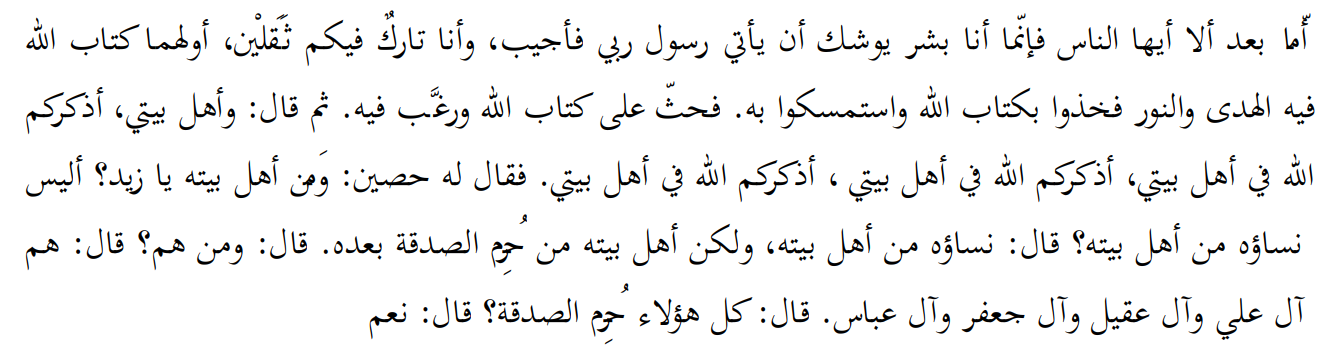
“现在进入正题。诸位,我是一个人。我即将从我的主那里接到一位使者(死亡天使)。我将应真主的召唤而离去,向你们告别。但我留下了两件重要的事物在你们中间:其一是真主的经典,其中有正确的指引和光明,所以你们要紧握真主的经典,并遵循它。”他勉励众人紧握真主的经典,然后说:“第二件是我的家人。我提醒你们(尽你们的责任)善待我的家属。”侯赛因问宰德:“谁是他的家属?难道他的妻子不是他的家人吗?”宰德说:“他的妻子是他的家人,但这里所指的家人,是那些禁止接受天课的人。”侯赛因又问:“他们是谁?”宰德说:“是阿里及阿里的后裔,阿嘿勒及阿嘿勒的后裔,贾法尔的后裔,以及阿拔斯的后裔。”侯赛因说:“这些人就是禁止接受天课的人。”宰德说:“是的。”
" Now to our purpose. O people, I am a human being. I am about to receive a messenger (the angel of death) from my Lord and I, in response to Allah's call, (would bid good-bye to you), but I am leaving among you two weighty things: the one being the Book of Allah in which there is right guidance and light, so hold fast to the Book of Allah and adhere to it. He exhorted (us) (to hold fast) to the Book of Allah and then said: The second are the members of my household I remind you (of your duties) to the members of my family. He (Husain) said to Zaid: Who are the members of his household? Aren't his wives the members of his family? Thereupon he said: His wives are the members of his family (but here) the members of his family are those for whom acceptance of Zakat is forbidden. And he said: Who are they? Thereupon he said: 'Ali and the offspring of 'Ali, 'Aqil and the offspring of 'Aqil and the offspring of Ja'far and the offspring of 'Abbas. Husain said: These are those for whom the acceptance of Zakat is forbidden. Zaid said: Yes.”
赛义德·阿卜杜勒·侯赛因·沙拉夫丁在其著作《Al-Muraja'at》中提到了这段圣训,其传述经由以下传述链,即泰伯拉尼所传,该传述链的可靠性得到一致认可,传述者为宰德·本·艾尔格姆(愿真主喜悦他),他说:真主的使者ﷺ在吉迪尔·胡姆的几棵树下讲话,并说:
As-Sayyid Abd al-Husain Sharaf ud-Deen mentioned in his book “Al-Muraja’at” this hadith via the following narration which At-Tabarani narrated through a chain whose authenticity is unanimously accepted from Zayd bin Arqam (ra) who said: The Messenger of Allah (saw) spoke at Ghadeer Khum underneath some trees and said:
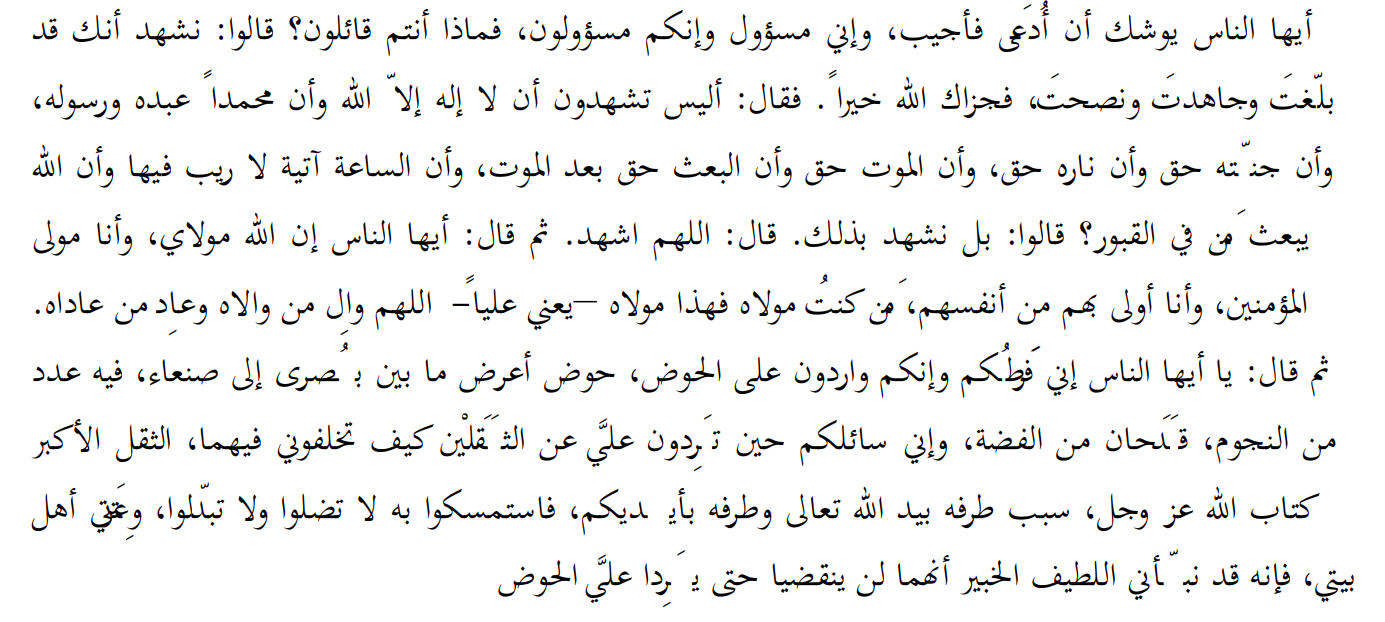
“众人啊,我将被召唤,而我将应答(指死亡)。诚然,我要受问,你们也要受问,那么你们将说什么呢?”他们说:“我们将作证,您已传达、已竭尽努力、已尽心劝导,愿真主厚报您。”他说:“你们不作证:除真主外别无应受崇拜者,穆罕默德是祂的仆人和使者,天堂是真实的,火狱是真实的,死亡是真实的,死后复生是真实的,末日(审判之时)毫无疑问必将来临,真主必使所有坟墓中的人复活吗?”他们说:“是的,我们作证。”于是他说:“众人啊,诚然真主是我的保护者,我是信士们的保护者,我对他们自身的权利优先于他们自己。凡以我为保护者的,此人便以他(阿里)为保护者。”他说:“真主啊,爱戴爱戴他的人,敌视敌视他的人。”然后他说:“众人啊,诚然我将离开你们,你们将在水池边见到我,那水池比从巴士拉到萨那的距离还宽。池中有如星辰之数的银杯。诚然,当你们在我面前时,我将就两件重大之事问你们:我去世后你们如何对待它们。较重要、较伟大的是真主——愿祂尊贵至高——的经典,其一端在真主手中,另一端在你们手中。你们要紧紧抓住它,以免迷误或变更;还有我的乌特喇(家族),我家中的人。诚然,至仁、至知的真主(愿祂尊崇)已告知我,他们将永不分离,直到他们在水池边来到我面前。”
“O people, it is about to be that I am called and I will respond (indicating death). Verily, I am accountable and you are accountable, so what will you say? They said: We will testify that you conveyed, struggled and advised so may Allah recompense you well. He said: Do you not bear witness that there is no deity but Allah and Muhammad is His slave and Messenger, that Paradise is true and Hellfire is true, that death is true and resurrection after death is true, that the Hour (of Judgement) will come without any doubt, and that Allah will resurrect all those in their graves? They said: Yes, we do bear witness. Then he said: O people, verily Allah is my Patron and I am the patron of the believers such that I take precedence before them over their own selves. Whoever takes me as his patron then this one is his patron—meaning Ali. O Allah, befriend whoever befriends him and take as enemy whoever takes him as an enemy. Then he said: O people, verily I will leave you and you will find me at the Cistern, a cistern wider than the distance from Basra to Sana’a. In it are tumblers of silver the number of stars. Verily I will ask you when you come before me on the two weighty things, how you took care of them after me. The weightier and greater one is the Book of Allah ‘azza wa jalla, a (sabab) of which one end is in the hands of Allah and the other in your hands. Hold tightly to it so that you do not go astray or change, and my Utra (household), the people of my house. Verily The Kind & All-Knowing (swt) has informed me that they will never seperate until they come before me at the cistern (fountain)”
(这是阿卜杜勒-侯赛因·沙拉夫·丁·赛义德所提及内容的结尾。)阿卜杜勒-侯赛因·艾哈迈德·阿米尼·纳贾菲大师在其著作《Al Ghadeer》中写道:"当先知ﷺ完成他的朝觐仪式后,与上述那群人一同启程前往麦地那,他抵达了位于贾赫法的古迪尔·胡姆,此处是通往麦地那、埃及和伊拉克之人的道路分岔之处。这是祭月(dhul-Hijja)的第十五日,忠实的吉卜利勒从安拉(SWT)那里降临到他身边,传达了安拉的话语:"
(This is the end of what As-Sayyid Abd al-Husain Sharaf ud-Deen mentioned). And Shaikh Abd al-Husain Ahmad Al-Ameeni An-Najafi stated the following in his book “Al Ghadeer”: “When he finished his rites of worship i.e. the Prophet (saw) and left for Madinah, together with the mentioned group(s) of people, he reached Ghadeer Khum in Al-Jahfa where the roads branch for the people of Madinah, Egypt and Iraq. This was the 15th day of Dhul-Hijja and Jibril, the trustworthy, descended to him from Allah (swt) with His saying:
“使者啊!把从你的主降示给你的(经文)传达出去吧!” [TMQ 5:67]
‘O Messenger, deliver what was revealed to you from your Lord” [TMQ 5:67]
并且他下令让阿里(ra)站起来,好让人们知道,并告知有关他的领导地位以及每个人都须服从他的义务的启示。最先到达的人靠近贾赫法,于是安拉的使者ﷺ下令让已经先行出发的人返回,并把滞留在那里的人聚集起来,又禁止人们在五棵大树下扎营。当人们扎营后,那些在树下的人站了起来,直到宣礼员宣告晌礼时,他朝他们走去,并在树下礼拜。那是一个酷热的日子,有人因为炎热难耐,把部分外袍盖在脸上,部分垫在脚下;安拉的使者ﷺ则在一棵萨姆拉树上用一件衣服遮挡太阳。当他ﷺ完成礼拜后,他站起来,站在人群中间,站在一头骆驼的驼峰上讲话,他提高声音,使每个人都能听到,然后他ﷺ说道
And He commanded him to cause Ali (ra) to stand to let the people know and inform what was revealed regarding his patronage and the obligation of obedience upon every one. The first of the people were close to Al-Jahfa so the Messenger of Allah (saw) commanded those who had proceeded to return and enclosed those who had delayed at that place, and he prohibited people from encamping beneath the five large trees. When the people took camp and those underneath them (the trees) stood until the dhuhr prayer was announced, he headed for them and prayed beneath them. It was a sizzling day where a man placed some of his cloak upon his face and some under his feet due to the severe heat, and the Messenger of Allah was shaded by a garment upon the sumra tree due to the sun. When he (saw) finished his prayer, he stood to speak in the middle of the people on the hump of a camel and he spoke with a raised tone with every one hearing him and he (saw) said
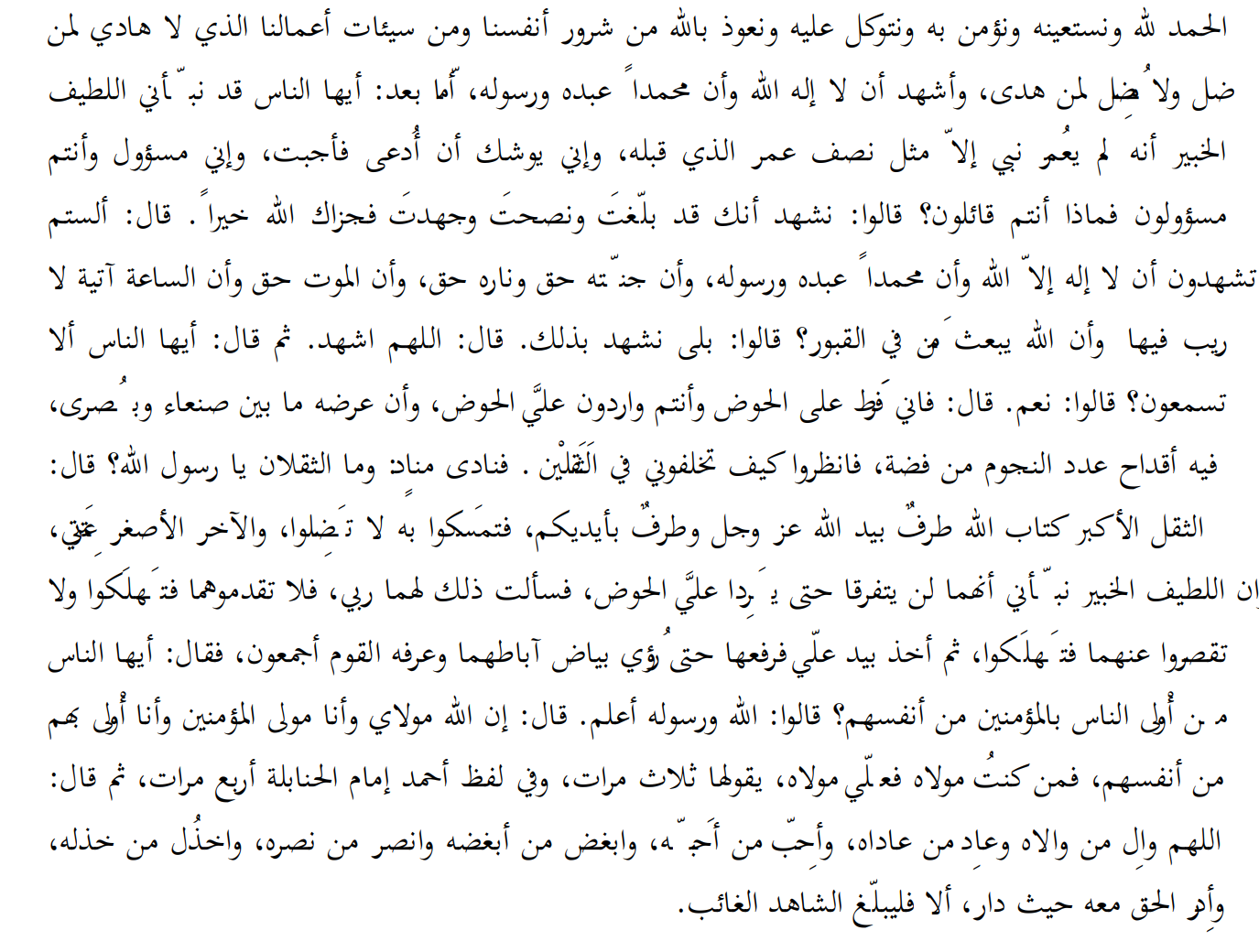
一切赞美归于真主,我们向祂求助,信仰祂,并依靠祂。我们求真主保护我们免受灵魂之恶和恶行之害。凡真主所引导者,无人能使其迷失;凡真主所使其迷失者,无人能引导。我作证,除真主外别无应受崇拜者,穆罕默德是祂的仆人和使者。 至于下文:众人啊,仁慈且全知的(swt)真主已告知我,祂不会赐予先知的寿命超过其前一位先知寿命的一半。我即将被召唤,而我必将应召。我必将受到清算,你们也必将受到清算,那么你们将怎么说呢?他们说:我们作证,您确已传达、劝诫并尽力奋斗,愿真主厚赐您的报酬。他说:你们不作证说除真主外别无应受崇拜者,穆罕默德是祂的仆人和使者,祂的天堂是真实的,祂的火狱是真实的,死亡是真实的,复活时刻必定到来,毫无疑问,并且真主必将使坟墓中的人复活吗?他们说:是的,我们作证。他说:主啊,求你作证。接着他说:众人啊,你们不听吗?他们说:听。他说:我必将先到水池(al-kawthar)边,而你们将在我面前被带到水池边,水池的宽度相当于萨那到巴士拉之间的距离。池中有银杯,其数目如同星辰之数。所以你们看你们在我之后如何对待两件重大的事物。有一位宣告者宣布:什么是两件重大的事物,真主的使者啊?他说:两件重大事物中较大的是真主的经典,其一端在真主手中,另一端在你们手中,所以你们要紧紧抓住它,就不会迷失。另一件较小的是我的家人('itrah)。仁慈且全知的(swt)真主已告知我,他们不会离开我,直到阿里来到水池边,而我已为此向我的主祈求。所以你们不要超越他们,也不要疏忽他们,若如此做,你们必将灭亡。 然后他握住阿里的手并将其举起,直到能看见两人的腋下,众人都认出了他。他说:“诸位众人啊,谁对信士们自己的事务比他们自己更有优先权?”众人说:“真主和祂的使者最清楚。”他说:“真主确实是我的庇护者(mawla),而我是信士们的庇护者,我对他们自己的事务比他们自己更有优先权。所以,凡是以我为庇护者的人,阿里也就是他的庇护者。”他说了三遍,而据伊玛目艾哈迈德(哈奈白学派的伊玛目)的话,是说了四遍。然后他说:“真主啊,你要亲近亲近他的人,要与敌视他的人为敌。爱他的人,你要爱他;恨他的人,你要恨他;支持他的人,你要支持他;抛弃他的人,你要抛弃他;愿真理与他同在,无论他在何处。确实,让在场的人把这话告诉不在场的人。”
"All praise is due to Allah whom we ask for help, believe in and depend upon. We ask Allah to protect us from the evils of our souls and bad deeds, the One whom none can guide whom He causes to go astray or misguide whom He guides. I bear witness that there is no god but Allah and Muhammad is His slave and Messenger. As for what follows: O people, verily the The Kind & All-Knowing (swt) has informed me that He does not grant longevity to a Prophet except half the like of the one before him. Verily it is about to be that I will be called and I will respond. Verily I am accountable and you are accountable, so what will you say? They said: We bear witness that verily you have conveyed, advised and struggled so may Allah reward you well. He said: Do you not bear witness that there is no god but Allah and that Muhammad is His slave and Messenger that His paradise is true and His hellfire is true, that death is true, that the Hour will come without any doubt and that Allah will resurrect those in the graves? They said: Yes, we bear witness to this. He said: O Allah, do bear witness. Then he said: O people, will you not listen? They said: Yes. He said: Verily I will go to the cistern (alkauthar) and you will be presented at the cistern, whose breadth is that between Sana’a and Basra, before me. In it are cups of silver the number of which are the number of stars, so look how you take care of the two weighty things after me. An announcer announced: And what are the two weighty things, O Messenger of Allah? He said: The greater of the two weighty things is the Book of Allah, one end of which is in the hand of Allah and the other in your hands so hold fast to it and you will not go astray. The other smaller one is my household (‘utra). Verily the Kind & All-Knowing (swt) informed me that they will not go away until Ali reaches the cistern and I asked that from my Lord. So do not precede them or neglect them and if you do so you will perish. Then he took the hand of Ali and raised it until their armpits were seen and everyone recognised him and he said: O people, who takes precedence before the believers over their own selves? They said: Allah and His Messenger know best. He said: Verily Allah is my Patron (mawla) and I am the patron of the believers such that I take precedence before them over their own selves. So whoever has me as his patron then Ali is his patron. He said this three times, and in the words of Imam Ahmad, Imam of the Hanbalis, four times. Then he said: O Allah, befriend whoever befriends him and become an enemy to whoever takes him as an enemy. Love whoever loves him and hate whoever hates him, support whoever supports him and abandon whoever abandons him, and let the truth be with him wherever he is resides. Verily, let the witness who is present inform the (one who is) absent.’”
3. 那些主张先知(saw)明确宣布阿里(ra)为哈里发的人,在其著作中引用了一些圣训。对于这些圣训,我们不以它们的传述本身作为考察的对象,尽管布哈里和穆斯林两位圣训学家并未收录它们,而且它们也不是经由任何可靠的传述者传下来的,其中大部分属于伪造的圣训。我们也不会把它们的传述作为考察的对象,即说这些圣训在你们之前没有可靠的传述者传述,而在我们之前则有可靠的传述者传述,从而让认定该圣训为真实的人将其作为证据。我们要考察的范围不是这些,而是圣训的原文,正如它们在各种传述中出现的那样。这些文本正是他们据以推断先知ﷺ任命阿里为其继任哈里发的依据。这些圣训被称为"瓦拉亚"(wilayah)圣训。我们将从中举出一些,其余的则含义相同,甚至措辞也相同。
3. Those who say that the Messenger (saw) clearly announced the Khilafah of Ali (ra) narrated ahadith in their books. As for these ahadith, we will not make the place of research in them their narrations, despite the fact that the two sheikhs Al-Bukhari and Muslim did not narrate them, nor were they narrated via any trustworthy narrators and most of them are among the fabricated ahadith. We will not make their narrations the subject of research such that they say that these ahadith were not narrated by trustworthy narrators before you but were narrated by trustworthy narrators before us so that the one for whom the hadith is authenticated uses it as an evidence. We will not make that the domain of research; rather we will make the matter of research the texts themselves as they came in the narrations. These are the texts from which they deduced that the Messenger (saw) appointed Ali to be the Khalifah after him—and these ahadith are known as the ahadith of “wilayah”—from which we will present some of them and the rest carry the same meaning and even the same wordings.
a) 艾布·达乌德·至·塔亚里西传述:伊本·阿拔斯(愿真主喜悦他)说,安拉的使者ﷺ对阿里·本·艾比·塔利卜(愿真主喜悦他)说:
a) Abu Dawud At-Tayalisi narrated from ‘Ibn Abbas (ra) that the Messenger of Allah (saw) said to Ali ibn Abi Talib (ra):
“你是我之后所有信士的瓦利(监护人/领导者)。”
“You are the waliy of all believers after me.”
b) 据《Kanz al-’Ammal》记载,伊姆兰·本·侯赛因说:安拉的使者派遣一支远征队,任命阿里·本·阿比·塔利卜为统帅。阿里从五分之一的战利品(khums)中为自己挑选了一名女奴,他们却拒绝接受这一做法。其中四人约定要向先知投诉他。于是他们前来,其中一人站起来说:“安拉的使者啊,您难道没有看到阿里做了这样那样的事吗?”先知ﷺ便把脸转向别处。第二人站起来说了同样的话,先知ﷺ又把脸转向别处。第三人站起来说了同样的话,先知ﷺ又把脸转向别处。第四人站起来,说的也和前面几人一样。安拉的使者ﷺ转过身来面对他们,脸上明显露出愠怒,说:
b) It has been narrated in Kanz al-’Ammal from Imran bin Husain who said that the Messenger of Allah (saw) sent an expedition and appointed Ali bin Abi Talib (ra) over them. He chose for himself a slave girl from the fifth (khums) and they rejected this from him. Four of them agreed to complain about him to the Prophet (saw) so, when they came, one of the four stood and said: O Messenger of Allah (saw), do you not see that Ali (ra) did such and such, and he (saw) turned away from him. The second stood and said the same, so he turned away from him. The third stood and said the same, so he turned away from him. And the fourth stood and said the same as they had said. The Messenger of Allah (saw) turned towards them with anger visible in his face and said:
“What do you want for me with regards to Ali?” Verily Ali is from me and I am from him, and he is the waliy of every believer after me.” Note: the instruction says to translate faithfully, and this text is a hadith quotation. Translating it as requested: “关于阿里,你们想要我为你们做什么?”“阿里确实是我的一部分,我也是他的一部分,他是我之后每一位信士的瓦利(监护人/领导者)。”
What do you want for me with regards to Ali? Verily Ali is from me and I am from him, and he is the waliy of every believer after me.”
c) 在一段长圣训中,’Amru bin Maymun 转述 ’Ibn Abbas(愿安拉喜悦之)的话说:安拉的使者ﷺ派某人携带《忏悔章》(Surah At-Tawbah)出发,随后又派 Ali(愿安拉喜悦之)去追赶他,把这章经文从他手中取回,并说:
c) And in a long hadith from ‘Amru bin Maymun from ‘Ibn Abbas (ra) who said: The Messenger of Allah (saw) sent so and so with Surah At-Tawbah. He then sent Ali (ra) after him to take it from him and said:
“除非是与我有血缘关系、我也与他有血缘关系的人,否则谁都不应接受它。”
“No one should take it except a man who is from me and I am from him.”
d) 《Kanz al-'Ummal》中记载,Wahhab bin Hamza说:我与Ali(ra)同行,我看到他有严厉的态度,于是我说,等我回去,我要向人投诉他。于是我回来后提到了Ali(ra),对真主的使者ﷺ说了此事,他说:
d) IKanz al-’Ammal from Wahhab bin Hamza who said: I travelled with Ali (ra) and I saw harshness from him, so I said that when I will return I will complain about it. So I returned and mentioned Ali (ra) to the Messenger of Allah (saw) and he said:
“不要为阿里说这句话,因为他是你在我之后的 waliy。”
“Do not say this for Ali, as he is your waliy after me.”
e) 在《Kanz al-’Ammal》中,有一则来自伊本·阿拔斯的传述,他说:安拉的使者ﷺ说:
e) In Kanz al-’Ammal from ‘ibn Abbas who said: The Messenger of Allah (saw) said:
“谁喜欢过我的生活、死我的死,并居住在我的主所灌溉的伊甸乐园中,那么让他在我之后以阿里为盟友(wali)。”ﷺ
“Whoever is pleased to live my life, die my death and to reside in the paradise of Eden irrigated by my Lord then let him befriend Ali as a waliy after me.”
f) 在《Muntakhab al-Kanz》中,引述自Zayyad bin Mutarraf,他说:我听到安拉的使者ﷺ说:
f) In Muntakhab al-Kanz from Zayyad bin Mutarraf who said: I heard the Messenger of Allah (saw) saying:
“凡是愿意过我的生活、死我的死、进入我的主所应许给我的乐园——那是永恒的乐园——的人,那么让他在我之后与阿里及其后裔为友。他们绝不会把你们带离正道之门,也绝不会把你们引入迷误之门。”
“Whoever would like to live my life, die my death, and enter the paradise promised to me by my Lord—and it is an eternal paradise—then let him befriend Ali and his descendants after me. Verily they will never remove you from the door of guidance nor enter you into the gate of misguidance.”
g) 据《Kanz al-’Ammal》记载,’Ammar bin Yasir 说:安拉的使者ﷺ说:
g) In Kanz al-’Ammal from Ammar bin Yasir who said: The Messenger of Allah (saw) said:
“我把对信仰我、信任我的人的wilayah(领导权/监护权)托付给阿里·本·阿比·塔利卜。谁与他为友,谁就是与我为友;谁与我为友,谁就是与真主为友。谁爱他,谁就是爱我;谁爱我,谁就是爱真主。谁恨他,谁就是恨我;谁恨我,谁就是恨真主。”
“I bequeath whoever believes in me and trusts me with the wilayah of Ali bin Abi Talib. Whoever befriends him has befriended me and whoever befriends me has befriended Allah. Whoever loves him has loved me, and whoever loves me has loved Allah. Whoever hates him has hated me, and whoever hates me has hated Allah.”
h) 另外,在《Al-Kanz》中,有一段来自Ammar的圣训,以马尔福(归于先知)的形式被记载:
h) Also in Al-Kanz from Ammar it has been narrated in a marfu hadith :
“真主啊,凡信仰我、信赖我的人,就让他与阿里·本·阿比·塔利卜结为挚友。他的权威(wilayah)即是我的权威,而我的权威即是真主至高者的权威。”ﷺ
“O Allah, whoever believes and trusts in me, let him befriend Ali bin Abi Talib. Verily his wilayah is my wilayah and my wilayah is the wilayah of Allah ta’ala.”
4. 有一些圣训,是由主张者所传述的,说使者(saw)公开宣布了阿里(ra)的哈里发地位。这些圣训并未被任何可信的人传述,其中大多数是伪造的圣训。我们提出这些圣训,并不是为了从传述的角度去研究它们,以便让那些传述它们的人宣称其已被证实。相反,我们提出它们,是为了依据其文本的内容来研究其文本所说的意思。这些圣训包含了使者(saw)与阿里(ra)结为兄弟,以及让他成为其继承人的内容。我们在此列举其中几条,其余的意思相同,甚至措辞也相同。
4. There are ahadith narrated by those who say that the Messenger (saw) openly declared the Khilafah of Ali (ra). These ahadith have not been narrated by any trustworthy person and most of them are fabricated ahadith. We present them not to research them from the angle of their narration so that they are claimed to be authenticated for those who narrate them. Rather we present them to make the point of research their texts according to what came in their texts. These ahadith contain the brotherhood of the Messenger (saw) with Ali (ra), and making him the heir after him. We present a few of them with the remainder carrying the same meaning and even the same wordings.
a) 先知ﷺ在muhajirin(迁士)之间确立了兄弟关系,并为自己选择了阿里(愿真主喜悦他)。在第一次兄弟关系的圣训中,有这样的记载:阿里说:"真主的使者啊,当我看到您与其他同伴那样做,而没有我的时候,我的灵魂仿佛离开了我,我的脊梁仿佛被折断了。如果这是您对我不满的迹象,那么我只向您诉说,并请求您的宽恕。"真主的使者ﷺ说:
a) The Prophet (saw) established a brotherhood between the Muhajirin and chose Ali (ra) for himself. In what came of the hadith of the first brotherhood, “so Ali said: O Messenger of Allah (saw), verily my soul left me and my spine has been broken when I saw you do what you did with your companions other than me. If this is a sign of your anger with me, then I complain only to you and beg your pardon. The Messenger of Allah (saw) said:
“以那位派遣我携带真理的主发誓,我留下你只是为了我自己。你对我而言的地位,就如同哈伦之于穆萨,只是在我之后不再有先知。你是我的兄弟,也是我的继承人。”他问道:“我将从您那里继承什么?”他说:“在我之前,众先知所继承的是什么?是他们的主的经典,以及他们先知的逊奈。”
By the One who sent me with truth, I only left you for myself. You are to me of the status of Harun to Musa except that there is no Prophet after me. You are my brother and inheritor. He said: What will I inherit from you. He said: What did the Prophets inherit before me, the Book of their Lord and the Sunnah of their Prophets.”
b) 先知(saw)在迁徙五个月后,在穆哈吉尔(Muhajirin)与安萨尔(Ansar)之间缔结了兄弟关系,但他没有让阿里(ra)与任何一位安萨尔结为兄弟;相反,他为自己选择了阿里。这一点见于第二次兄弟关系的圣训之中。
b) The Prophet (saw) made a brotherhood between the Muhajirin and the Ansar five months after the hijrah, but he did not make a brotherhood between Ali (ra) and any of the Ansar; rather he chose him (Ali) for himself. It came in the hadith of the second brotherhood
“当使者(saw)对阿里说:我在穆哈吉尔和安萨尔之间缔结兄弟关系时,你是否因我没有在你和他们中的任何人之间缔结兄弟关系而生我的气?你难道不乐意与我的关系如同哈伦与穆萨的关系一样,只是在我之后没有先知了吗?” Note: the rules call for ﷺ after each mention of the Prophet, so the correct rendering is: “当使者ﷺ对阿里说:我在穆哈吉尔和安萨尔之间缔结兄弟关系时,你是否因我没有在你和他们中的任何人之间缔结兄弟关系而生我的气?你难道不乐意与我的关系如同哈伦与穆萨的关系一样,只是在我之后没有先知了吗?”
“That the Messenger (saw) said to Ali: Did you become angry at me when I made a brotherhood between the Muhajirin and Ansar but did not make a brotherhood between you and any of them? Are you not pleased to be similar to the status of Harun to Musa for me except that there is no Prophet after me”
c) 有传述说,有一天,使者(愿真主赐福他并使他平安)面带喜色走出去见他的同伴们,于是阿卜杜·拉赫曼·本·奥夫(愿真主喜悦他)问他,他说:
c) It is narrated that the Messenger (saw) went out one day to his companions with his face brightened so Abdurrahman bin Awf (ra) asked him and he said:
“我的主向我传来喜讯,关于我的兄弟、我叔伯之子,以及我的女儿:安拉将使阿里与法蒂玛结合。”
“Good news came to me from my Lord about my brother and paternal uncle’s son and my daughter, that Allah will marry Ali with Fatima.”
当圣裔(sayyid)、女性之首(Sayyid Annisa)法蒂玛(Annisa)的合适新郎人选被考虑时,先知ﷺ说:
When the sayyid Annisa’s (leader of the women) deserving groom for her marriage was being considered, the Prophet (saw) said:
“哦,乌姆·阿伊曼,替我把我兄弟叫来。”她说:“他是你的兄弟,你却要把他许配给你的女儿?”他说:“是的,乌姆·阿伊曼。”于是她把阿里叫了来,他就来了。
“O Umm Ayman, call my brother for me. She said: He is your brother yet you are marrying him (to your daughter)? He said: Yes, O Umm Ayman. So she called Ali and he came.”
有一天,先知ﷺ就他与其兄弟贾法尔(愿安拉喜悦之)和宰德·本·哈里萨(愿安拉喜悦之)之间的一件裁决事宜与他交谈,说道:
And the Prophet (saw) spoke to him one day regarding a judgement between him, his brother Ja’far (saw) and Zayd bin Haritha (saw), saying:
“至于你,阿里啊,你是我的兄弟,是我儿子的父亲,你与我同源,你为我而存在。”
“As for you, O Ali, (you are) my brother, the father of my son, and from me and for me.”
d) 有一天,使者(愿主福安之)对阿里(愿主喜悦之)许诺说:
d) The Messenger (saw) promised to Ali (ra) one day saying:
“你是我的兄弟,也是我的辅佐者。你将偿还我的债务,履行我的承诺,并完成我的责任。”
“You are my brother and my wazeer. You will repay my debts, fulfill my commitments and complete my responsbilities.”
3) 在《Kanz al-’Ammal》中,他(saw)说 Note: the (saw) abbreviation in the original is kept as written, since it is the source's own honorific marker.
3) In Kanz al-’Ammal, he (saw) said
“天堂之门上写着:除真主外别无应受崇拜者,穆罕默德是真主的使者ﷺ,阿里是真主使者ﷺ的兄弟。”
“It is written on the gate of Paradise: There is no god but Allah, Muhammad is the Messenger of Allah, Ali is the brother of the Messenger of Allah.”
这四段文本——即先知(愿主福安之)把阿里(愿主喜悦之)置于哈伦对穆萨之地位的那段、他留下安拉的经典与其后裔的那段、关于监护权(wilayah)的那段,以及关于兄弟关系的那段——正是一些穆斯林据以推断,先知(愿主福安之)任命阿里(愿主喜悦之)为其身后哈里发,即让他继承哈里发之位的依据。下面我们逐段来看。
These four texts, which are the texts in which the Messenger (saw) made him (Ali) of the status of Harun to Musa, the text that he left the Book of Allah and His progeny, the text of wilayah, and the text of brotherhood, are the texts from which some Muslims deduced that the Messenger (saw) appointed Ali (ra) i.e. made him the Khalifah after him. Let us take them text by text:
至于第一段文字,即使阿里处于穆萨面前哈伦之地位的那段话,其含义需通过考察其说出的背景和analyzing其措辞来阐明。就背景而言,先知ﷺ在塔布克战役之日说了这段圣训。在此次战役中,先知ﷺ在麦地那任命穆罕默德·本·麦斯莱迈(愿安拉喜悦他)代替自己,负责管理穆斯林的事务并执掌统治,又任命我们的主人阿里(愿安拉喜悦他)管理他的家眷,并命令他照看他们。伪信者指责他,说:他把他留下,只是因为此事对他来说太过艰难,他想让他轻松一些。伪信者这样说之后,阿里(愿安拉喜悦他)拿起武器出发,直到在贾尔夫遇见正在那里扎营的先知ﷺ,并对他说:
As for the first text, which is the text which made Ali at the status of Harun to Musa before the Messenger (saw), its meaning is clarified though studying the occcasion in which it was said and studying its wording. As for the occasion, the Messenger (saw) said this hadith on the day of the battle of Tabuk. Therein the Messenger (saw) appointed in Madinah in his place Muhammad bin Maslamah (ra) to supervise the Muslims’ affairs and administer the rule, and appointed our master Ali (ra) over his family and commanded him to supervise them. The hypocrites shook him and said: He did not leave him behind except because it had become hard on him he wanted to make it easy for him. When the hypocrites said this, Ali (ra) took his weapon and left until he met the Messenger (saw) who was encamped at Al-Jarf and said:
"哦,安拉的先知啊!伪信者们声称您把我留下,是因为觉得我是个负担,所以想让我轻松一些。"ﷺ说道:"他们说谎了。实际上,我把你留下,是因为我身后所留下的事务。所以你回去,替代我照看我的家人和你的家人。你难道不满意吗,阿里?你对我的地位,就如同哈伦对穆萨一样,只是在我之后再没有先知。"ﷺ
“O Prophet of Allah, the hypocrites claimed that you left me behind because you found a burden on meand wished to make it light for me. He (saw) said: They lied, rather I left you behind due to what I left behind me. So return and take my place over my family and your family. Are you not pleased, O Ali, that you are of the same status to me as Harun to Musa except that there is no Prophet after me?”
于是使者(ﷺ)继续他的旅程。关于阿里(愿真主喜悦他)的圣训——阿里与使者(ﷺ)的地位,犹如哈伦与穆萨——涉及使者(ﷺ)委任他管理自己的家人,这一点有阿里(愿真主喜悦他)自己的陈述作为证据:
So the Messenger of Allah (saw) continued on his travel. The hadith about Ali (ra) being the same status for the Messenger (saw) as Harun for Musa concern to his (saw)’s appointing him over his (saw) family by the evidence of Ali’s (ra) own statement:
“你要把我留给妇女和孩子们吗?”
“Do you leave me behind with women and children?”
事件的实际情况是,他是被任命管理其家人的,因此不能据此认为他被任命为哈里发。尤其是已知先知(愿主福安之)任命穆罕默德·本·麦斯莱迈为他的代理统治者,并在对阿里(愿主喜悦他)说“我的家人和你的家人”时,specified阿里管理他的家人。此外,先知(愿主福安之)在出征时任命他的某位同伴管理政务,并不意味着此人就是他的继任哈里发,证据是先知(愿主福安之)在多次战役中都任命过不同的人。在阿塞拉战役中,他任命阿布·萨拉马·本·阿卜杜勒·阿萨德管理麦地那;在绍凡战役中,他任命宰德·本·哈里萨(愿主喜悦他)管理麦地那;在班努·拉希扬战役中,他任命伊本·乌姆·马克图姆(愿主喜悦他)管理麦地那,诸如此类。先知(愿主福安之)任命某人在他出征期间管理麦地那,并不表明这就是任命他为哈里发,那么,如果他只是任命此人管理他的家人,而在他出征归来之前另行任命他人掌管政务,又有何不可呢?
The reality of the incident is that he was appointed over his family so it cannot be taken to mean that he was appointed over the Khilafah, particularly when it is known that he (saw) appointed Muhammad bin Maslamah as the ruler in his place and specified Ali (ra) to supervise over his family when he said to him, “my family and your family.” Moreover, the Messenger’s (saw) appointment of one of his companions over the rule when he left for battle does not mean that this appointed person is the Khalifah in his place by the evidence that the Messenger (saw) appointed many in the battles. In the battle of Al-‘Asheera he appointed Abu Salamah bin Abd al-Asad over Madinah, in the battle of Safwan he appointed Zayd bin Haritha (ra) over Madinah, in the battle Banu Lahyan he appointed ibn Umm Maktum (ra) over Madinah, and so on. The appointment by the Messenger (saw) of someone to rule over Madinah until he returns from his battles does not indicate that means his appointment over the Khilafah, so what if he appointed him only over his family while appointing another in authority until he returns from his battle.
关于任命这件事,至于先知的圣训(ﷺ)所说的:
This is in relation to the appointment. As for the saying of the Messenger (saw):
“你难道不喜欢与穆萨(Musa)的哈伦(Harun)地位相似吗?”
“Are you not pleased to be similar to the status of Harun with Musa?”
你不满意吗?你在我所委任的事务上,就如哈伦之于穆萨。这里所说的是阿里(愿真主喜悦他)与哈伦的相似之处,相似之处在于委任,即你与我的关系,在我委任你(或将你留下)这件事上,好比穆萨委任哈伦时的情形。这就是圣训的含义,这些话并没有其他含义。由于阿里(愿真主喜悦他)对使者所说的话,这一含义得以明确,并成为唯一的含义。
The meaning of its words is: Are you not pleased that there is for you, in what you are appointed over, what Harun supervised for Musa. It is the resemblance of Ali (ra) with Harun in the way of resemblance being the appointment i.e. your similitude in my appointing you (or leaving you behind) is similar to that of Harun when Musa appointed him. This is the meaning of the words of the hadith and these words do not have any other meaning. This meaning is specified and becomes the only meaning due to Ali’s (ra) saying to the Messenger:
“你要把我留在孩子和妇女中间吗?”
“Do you leave me behind with children and women?”
随着使者的这句话:
With the Messenger’s statement:
“你难道不愿意与我有如哈伦与穆萨那样的关系吗?”
“Are you not pleased to be related to me similar to the status of Harun with Musa?”
这段话是对阿里(愿真主喜悦他)的提问及其陈述的回应。要理解这段圣训的含义,必须回到《古兰经》,考察穆萨任命哈伦这件事的内容。回到《古兰经》,我们发现这一事件在经文中有如下记载:
This came in response to this question of Ali (ra) and as a response to his statement. To understand what is meant by this hadith one must return to the Glorious Qur’an to see within the issue of Musa’s appointing Harun to see what it is. Returning to the Glorious Qur’an, we find that this event is mentioned in the Qur’an in the following text:
“我们为穆萨(Moses)约定了三十夜,又加了十夜,他的主所定的期限共四十夜,他就圆满完成了。穆萨对他的哥哥哈伦(Aaron)说:‘你替我在我的族人中执行职务,行正道(命令人们服从真主,只崇拜祂一位),不要顺从作恶者的道路。’”[TMQ 7:142]
“And we appointed for Mûsâ (Moses) thirty nights and added (to the period) ten (more), and he completed the term, appointed by his Lord, of forty nights. And Mûsâ (Moses) said to his brother Hârûn (Aaron): "Replace me among my people, act in the right way (by ordering the people to obey Allâh and to worship Him Alone) and follow not the way of the Mufsidûn (mischief-makers)” [TMQ 7:142].
所以这段圣训的意思是:你难道不喜欢吗?我任命你管理我的家人,就如同穆萨任命哈伦管理他的族人一样,因为这次任命,你在我面前的地位就像哈伦在穆萨面前的地位一样。因此,这段圣训的用意是安抚阿里的内心,因为他对这次任命感到不满;同时也告知阿里(愿安拉喜悦他),当先知ﷺ不在时,他将代替先知ﷺ管理家人,正如哈伦在穆萨离开时代替穆萨管理他的族人一样。至于他的话:
So the hadith’s meaning becomes: Are you not pleased that I appoint you over my family like Musa appointed Harun over his people, so that you become before me of the status of Harun to Musa due to the appointment? So the hadith’s intent is to pacify our master Ali’s heart as he came displeased by this appointment, and at the same time it informs Ali (ra) that he will take his (saw) place over his family when he is absent just like Harun took Musa’s place over his people when he was absent. As for his saying:
“除了我之后再没有先知”
“Except that there is no Prophet after me”
这就否定了与哈伦(愿主赐其平安)相似的可能,因为哈伦是一位先知(愿主赐其平安),他是在另一位先知(愿主赐其平安)缺席时代其行事的。因此,使者(ﷺ)排除了先知身份,以消除人们认为他与其在先知地位上相同的想象。也不应当说他的这句话,
This negates the resemblance of Prophethood because Harun was a Prophet (saw) so he was a Prophet (saw) taking the place of another Prophet (saw) when he was absent. So the Messenger (saw) excluded Prophethood to remove any imagination that he is of the same status in Prophethood. Nor should one say that his statement,
“没有先知在我之后”
“No Prophet after me”
这句话的意思是“在我死后”。这些话与他在世时的任命有关。哈伦在穆萨在世时就与穆萨一同作为先知,他是穆萨在其族人中的代理人(哈里发),那是在穆萨不在场的时候,而不是在穆萨死后。因此,先知ﷺ只说了“除了没有先知在我之后”这句话,因为哈伦在穆萨在世、穆萨不在场的时候就是先知;他说这句话是为了否定阿里(ra)的先知身份。此外,先知ﷺ在哈基姆所传、经过认证的圣训中告诉我们,哈伦在穆萨在世时就去世了。所以不存在死后任命的问题,因为哈伦和穆萨(即被比拟的两者)之间并不存在这种情况,因此先知ﷺ和阿里(ra)(即作为比拟方的两者)之间也不存在这种情况。
Means after my death as the words are related to appointment during his life. This is because Harun was a Prophet along with Musa during his life not after his death; he was his deputy (khalifa) over his people while he (Musa) was absent during his life not after his death. So the Messenger only made his statement: “Except that there is no Prophet after me” because Harun was a Prophet during Musa’s absence while he lived; so he made this statement in order to negate Prophethood from Ali (ra). Moreover, the Messenger of Allah (saw) informed us in an authenticated hadith narrated by Al-Hakim that Harun died during Musa’s life. So there does not raise the issue of appointment after death as it did not exist in Harun and Musa, who are those with whom resemblance is made, thus it does not exist in the Prophet (saw) and Ali (ra) who are the resemblers.
这段圣训的含义并不包含任命哈里发的任何迹象,也无法以任何方式理解为先知ﷺ有意通过此段圣训明确宣布阿里(愿真主喜悦他)在先知ﷺ去世后成为穆斯林的哈里发。此段圣训所涉及的,是在塔布克战役期间,先知ﷺ不在麦地那时,对阿里(愿真主喜悦他)管理先知ﷺ家人事务的任命。至于此段圣训中其余的叙述,即他(ﷺ)所说的话……
This is the hadith’s meaning nor does it contain any indication to appointment for the Khilafah nor can it be understood in any way that the Messenger (saw) intended by this hadith to clearly state and make Ali (ra) the Khalifah over the Muslims after the Messenger’s (saw) death. The hadith discussed is related to the appointment of Ali (ra) over the Messenger’s (saw) family during his absence due to the battle of Tabuk. As for the remaining narrations which came in this hadith i.e. his (saw) saying:
“你难道不乐意在我面前,处于哈伦之于穆萨的地位吗?”
“Are you not please to be before me of the status of Harun with Musa?”
其中一些是经过认证的圣训,如布哈里和穆斯林在各自的圣训集中,从阿米尔和易卜拉欣(两人都是萨阿德之子)处所传的;另一些则未经认证,但所有这些圣训的文本都相同。这意味着此圣训是在塔布克之役及其他时候说的。对此的回应是:经过认证的传述,是属于该事件一部分的传述,即仅将先知ﷺ的话语与事件分开的传述,这并不意味着它是塔布克之役以外的另一件事件。圣训传述者和辑录者常常只传述圣训或事件的一部分,将其缩减至作为证据的部分。即使我们承认此圣训不仅涉及塔布克之役,而是在塔布克及其他时候所说,这也并不意味着先知ﷺ在塔布克及其他时候永久地委任我们的导师阿里(愿安拉喜悦他)管理他的家人;也不意味着先知ﷺ去世后,他被任命(愿安拉使他的面容尊贵)为哈里发。对此圣训的字面和含义的解释所表明的仅仅是:难道你不喜欢吗?我在我离开时委任你管理我的家人,正如哈伦在穆萨离开时代理他的职务,只是哈伦是先知,而你不是先知,因为在我的先知身份之后,不再有先知。此段见于穆斯林从阿米尔·本·萨阿德从其父处所传的圣训中。
Some of them are authenticated narrations like those by Al-Bukhari and Muslim in their hadith from ‘Amir and Ibrahim, the two sons of S’ad, while others are not authenticated, but all of them came with the same text. This means that the hadith was said in Tabuk and at other times. The response to this is that the authentic narrations are a narration which is a part of the incident i.e. narrations with the Messenger’s (saw) words alone separated from the incident which does not mean that it is an incident other than the incident of Tabuk. Narrators and collectors of hadith frequently narrate a part of a hadith or a part of an incident, shortening it to the place of evidence. Even if we accept that the hadith was not only about the incident of Tabuk but was said in Tabuk and other times, then this would mean that the Messenger (saw) appointed our master Ali (ra) over his family permanently during Tabuk and at other times; nor would it mean his appointment (may Allah ennoble his face) over the Khilafah after the Messenger’s (saw) death. All that the explanation of the hadith’s word and meaning indicate is: Are you not pleased that I appointed you over my family during my absence just like Harun supervised for Musa during his absence, except that Harun was a Prophet and you are not a Prophet because there is no Prophet after my Prophethood. This came in Muslim’s narration from Amir bin S’ad from his father:
“你难道不高兴吗?你在我面前的地位就如同哈伦之于穆萨,只是在我之后不再有先知。”
“Are you not pleased that you become before me of the status of Harun with Musa except that there is no Prophet after me”
“i.e. after my Prophethood” 即“在我成为先知之后”。这正是先知(ﷺ)将阿里(愿安拉喜悦他)与哈伦之于穆萨相比拟的比喻,即委任,且仅此而已;是在他离开期间的委任,且仅此而已;是对他家人的委任,正如圣训全文所载。一段圣训重复出现的次数,并不会改变其含义,也不能借此赋予它另一种含义。因此,在塔布克的委任仅限于先知(ﷺ)的家人,这一点已被无可置疑地证明;而塔布克以外的其他传述,在文字与含义上传达的是与塔布克所载相同的内容,却没有提及塔布克事件中的限定,即家人。确切地说,它们根本没有提及任何限定,因此我们以塔布克的传述来衡量它们。这是因为塔布克的传述限定于家人,而其他传述在委任上没有任何限定,所以我们以有限定的来衡量无限定的。也不能说其他传述是泛指的,因为圣训的措辞并不属于泛指的措辞。无论是“难道你不喜悦吗”这一传述,还是“你确实如此”这一传述,抑或“你”这一传述,以及与之相似、含有哈伦之于穆萨地位分量的其他措辞,所有这些词语都专指一种特定的地位,即哈伦之于穆萨的地位,而这并非泛指的地位。只是在某些传述中,哈伦之于穆萨的地位是无限定地出现的,而在另一些传述中则限定于家人。因此,我们以无限定的来衡量有限定的,从而所有的传述都应限定于家人。
i.e. after my Prophethood. This is the similitude with which the Messenger (saw) compared Ali (ra) in relation to him just like Harun in relation to Musa i.e. the appointment and nothing else, appointment during his absence and nothing else, and appointment over his family as came in the hadith’s text in its entirety. The frequency with which a hadith is repeated does not change its meaning to give it an alternative meaning. So the appointment in Tabuk was only over the Messenger’s (saw) family as is proven without doubt, while the other narrations in other than Tabuk conveyed the same text mentioned in Tabuk in words and meaning without mentioning the restriction in the incident of Tabuk i.e. the family. Rather, they do not mention any restriction at all thus we measure them upon what was mentioned in the narration of Tabuk. This is because the narration of Tabuk is restricted to the family while the other narrations are free of any restriction in the appointment so we measure the unrestricted upon the restricted. Nor should one say that the other narrations are general as the words of the hadith are not from the general words as the texts of all the narrations whether the narration: “Are you not pleased” or the narration: “Verily you” or the naration: “You” and the similar which is of the weightage of Harun with Musa; all these words are specific to a specific status which is of the status of Harun with Musa which is not of the general status. Except that the status of Harun to Musa came unrestricted in some of the narrations which were not restricted by any restriction, while they were restricted to the family in some of the narrations so we measure the unrestricted upon the restricted such that all the narrations are restricted to the family.
至于穆萨在其祈求中向安拉所求的其余事项:
As for the rest of the matters which Musa sought from Allah in his statement:
“并从我的家人中为我委派一位辅助者,就是我的兄弟哈伦(Hârûn,即亚伦)。借着他增强我的力量,让他分担我的任务(传达安拉的讯息与先知使命)。”[TMQ 20:29]
“And appoint for me a helper from my family, Hârûn (Aaron), my brother. Increase my strength with him, And let him share my task (of conveying Allâh's Message and Prophethood” [TMQ 20:29].
在哈伦相对于穆萨的地位以及任命为哈里发这一点上,他们并无依据。因为这是穆萨向真主祈求的一段祷告,祈求真主让他的兄弟做自己的助手,并与自己一同被赐予先知身份。穆萨向真主(SWT)祈求使哈伦与他共同承担的事项,只是先知身份和使命,因此这种共同承担仅限于这些事项,而不包括统治权,因为穆萨并非统治者,只是一位先知。此外,这一祈求是请求真主给予他协助,并让哈伦分担他的使命,而不是请求任命哈伦为统治者。
There is no place for them in relation to the status of Harun to Musa nor the appointment as the Khalifa since it is a prayer which Musa Made to Allah to make his brother an assistant to him and to give him the Prophethood along with him because the matters which Musa prayed to Allah (swt) to associate Harun with him upon were Prophethood and the Message so the association was only in these matters not the rule, as Musa was not a ruler but only a Prophet. Moreover, the request was a request for assistance for him and associating him in his matter, not a request for his appointment (in rule).
除此之外,这些事情并不表明穆萨与哈伦的地位关系;真正表明穆萨与哈伦地位的,是他在自己离开期间让哈伦管理他的族人;因此,哈伦在他之前的地位,就是在他离开期间照management他的族人。先知的话"你之于我,犹如哈伦之于穆萨"中,并不存在在先知身份上的辅助与联合之意;事实上,其含义仅限于对族人的委任,而这些文本不具有除此之外的任何含义。
Above all this, these matters are not an indication to the status of Musa to Harun; rather an indication for the status of Musa to Harun is his appointing him over his people during his absence; so his status before him is that he took care of his people during his absence. There is no existence for assistance and association in the Prophethood in the statement of the Messenger: “of the status of Harun to Musa” infact the meaning is restricted to the appointment over the people and the texts do not carry any meaning other than this.
有人说,穆萨是一位统治者,因为有一部沙里亚被降示给他,用以治理,其中有解决方案和刑罚;他也曾是一支军队的领袖,这支军队打算占领圣殿(Bait al-Maqdis),那时他的人民对他说:
It has been said that Musa was a ruler because a Shari’ah was revealed to him to rule by ,as there are solutions and punishments within it, and he was a leader of an army which intended to occupy Bait al-Maqdis when his people said to him:
“你和你的主去战斗吧。”[TMQ 5:24]
You and your Lord go and fight” [TMQ 5:24],
所以,他任命哈伦治理他的族人,是一种先知身份与权威方面的任命。对此的回应是:穆萨并非统治者,《古兰经》及其他经文中也没有记载他曾以武力和权威在以色列后裔(Banu Israil)中执行律法,或说他是他们的统治者。以穆萨的沙里亚统治以色列后裔的,并非穆萨本人,也不是在他在世时,而是在他之后的那些先知,如达乌德、苏莱曼以及其他君王。至于穆萨对军队的领导,这从未发生过。《古兰经》第5章第19至26节中,没有任何内容表明穆萨领导军队;其中所说的是,穆萨(as)要求他的族人进入圣地。他们拒绝了,并对他说,那里有强大而凶暴的巨人,除非那些巨人离开,否则他们永远不会进去;他们让他和他的主去作战,但他没有去,结果他们在旷野中流浪了四十年。至于沙里亚的律法和刑罚启示给穆萨(as),这并不意味着穆萨(as)以此统治;实际情况是,他带来了这些律法并传达给以色列后裔。他试图带领他们前往圣殿(Bait al-Maqdis),但他们在旷野中迷失,直到他的任期结束也没有安定下来。在他们受罚流浪的期限结束后,他们迁徙,并由他们中的君王和先知依照穆萨的沙里亚进行统治,这一点在《古兰经》多处章节中都有说明。此外,任命哈伦的经文明确表明,这是穆萨前去与安拉(swt)会面时,以先知身份代替穆萨而做出的任命,见于《古兰经》第7章第141节:
So his appointment of Harun over his people was an appointment in Prophethood and also in authority. The response to this is that Musa was not a ruler, nor is it narrated in the Qur’an or elsewhere that he would execute the rules upon the children of Israel (Banu Israil) by strength and the authority or that he was a ruler over them. Those who ruled Banu Israil with the Shari’ah of Musa were not Musa himself or in his lifetime, rather it was those Prophet who came after him like Dawud, Sulayman and other kings. As for Musa’s leadership over the armies, it never occurred. The ayaat which are in Surah Al-Maidah from ayah 19 to ayah 26 do no have anything within them which indicates Musa’s leadership over the army; rather what is within them is that Musa (as) requested his people to enter the Holy Land. They refused and said to him that there are giant aggressive people within it so they would never enter until these giants left; they asked him and his Lord to go and fight but he did not go so the result was their exile for fourty years in the wilderness. As for the revelation of the Shari’ah to Musa (as) with solutions and punishments, this does not mean that Musa (as) ruled with these; rather the reality is that he came with it and conveyed it to Banu Israil. He tried to take them to Bait al-Maqdis but they strayed in the wilderness and they did not stabilise until his period had ended. After their punishment with the exile ended, they moved and were ruled by kings and Prophets among them by the Shari’ah of Musa, which is stated by the Qur’an in more than one Surah. Moreover, the ayaat in which Harun was appointed are explicit that it was an appointment on behalf of Musa in Prophethood when Musa went to meet Allah (swt), which is in Surah Al-‘Araf from ayah 141:
“我们为穆萨(Moses)约定了三十夜,又加了十夜,他的主所定的期限共四十夜,他就圆满完成了。穆萨对他的哥哥哈伦(Aaron)说:‘你替我在我的族人中执行职务,行正道(命令人们服从真主,只崇拜祂一位),不要顺从作恶者的道路。’”[TMQ 7:142]
“And we appointed for Mûsâ (Moses) thirty nights and added (to the period) ten (more), and he completed the term, appointed by his Lord, of forty nights. And Mûsâ (Moses) said to his brother Hârûn (Aaron): "Replace me among my people, act in the right way (by ordering the people to obey Allâh and to worship Him Alone) and follow not the way of the Mufsidûn (mischief-makers)” [TMQ 7:142].
“且穆萨从他的族人中挑选了七十个人”[TMQ 7:155]。
“And Musa chose from his people seventy men” [TMQ 7:155].
所有这些内容都与先知身份及其被委任有关,与摔掉两块法版(由穆萨所为)、以色列后裔崇拜金牛犊等事有关,此类内容中没有任何与统治和权威有丝毫关联的成分。不可能怀疑它与统治和权威有关,因此没有证据表明穆萨是一位统治者,他也从未在统治权上委任哈伦。
All of these are related to the Prophethood and appointment in it, and the throwing of the tablets (by Musa), and the Banu Israil taking to worship the calf and the like; there is nothing within them with the slightest relationship to rule and authority. It is not possible to suspect that it is related with the rule and authority, so there is no evidence that Musa was a ruler and he never appointed Harun in the rule at all.
这些经过启示的圣训,无论是否有因由(例如塔布克之役的事件),其含义都表明:先知ﷺ在世时,当他外出时,让阿里(愿安拉喜悦他)替他照管家人,正如穆萨让哈伦在他外出时照管他的族人一样。通过先知ﷺ对阿里的这一委任,阿里在先知ﷺ那里的地位,与哈伦在穆萨那里的地位相当。这些圣训中并没有任何迹象表明,先知ﷺ曾说阿里将在先知ﷺ去世后作为哈里发统治穆斯林。
This is the meaning of all the revealed ahadith whether they came with a cause like the incident of Tabuk or without any cause, which indicate that the Messenger (saw) made Ali (ra) supervise his family while he was absent during his lifetime similar to how Musa made Harun supervise his people while he was absent during his lifetime. With this action i.e. the Messenger’s (saw) appointment of Ali (ra), Ali became to the Messenger (saw) comparable to the status of Harun to Musa. There is no indication in these ahadith that the Messenger (saw) stated that Ali (ra) would become the Khalifah over the Muslims in ruling after the Messenger of Allah (saw)’s death.
关于第二段文字以及古迪尔泉(Ghadeer Khum)的圣训,在经过认证的传述即穆斯林(Muslim)的圣训集中,它劝诫穆斯林坚守安拉的经典,以及先知ﷺ的家人,要善待他们,尊重他们,不伤害他们。其中没有任何迹象表明先知ﷺ任命他的家人执掌哈里发职位。圣训说:"至于我家的人,我在安拉面前提醒你们,要顾念我家的人。"其中并没有任何内容表明他使先知ﷺ家族的人成为死后统治穆斯林的哈里发。这些措辞在其明文(mantuq)和含义上都十分清楚,绝不可能被理解为他任命了先知ﷺ的家族或其中任何一人在他之后通过哈里发制度统治穆斯林。至于第二和第三段传述,以及与之类似的所有传述,它们并不改变其中已有的内容。这些传述涉及两件事。第一,在他的话中以安拉为保护者(mawla):
As for the second text and the hadith of Ghadeer Khum, in the authenticated narration i.e. the narration of Muslim, it exhorts Muslims to hold fast to the Book of Allah and the family of his (saw) house, to be gracious to them, to honour and not to hurt them. There is no indication within it that the Messenger (saw) appointed his family over the Khilafah. The hadith states: “As for the people of my house, I exhort you before Allah in the people of my house”; there is nothing in this that indicates that he made the family of his house the Khulafaa in the rule over the people after his death. The words are clear in their stated text (mantuq) and meaning such that it can never be understood that he appointed the family of his house, or any one of them, to rule Muslims via the Khilafah after him. As for the second and third narrations, and all narrations similar to them, they do not change what came within it. There are two matters in these narrations. First, making Allah the patron in his statement:
“真主确实是我的庇护者,我是信士们的庇护者,我比他们自己的灵魂更亲近他们。所以凡以我为庇护者的人,那么阿里就是他的庇护者。主啊,请友爱那些友爱他的人,请与那些敌视他的人为敌。”
“Verily Allah is my Patron, and I am the patron of the believers such that I am dearer to them than their own souls. So the one for whom I am his patron, then this is his patron meaning Ali. O Allah, befriend whoever befriends him and be an enemy to whoever is an enemy to him.”
至于第二件事,即他劝诫自己的后代去行善,他说道:
As for the second matter, this is that he advised his progeny to undertake good deeds by saying:
“我的后裔,即我家中的人们,因为那位仁慈、全知的主已经告诉我,他们永远不会分离,直到与我一同抵达水池边。”
“And my progeny, the people of my house, for verily the kind and All knowing informed me that they will never end until they arrive at the cistern.”
在所有这些圣训及其多样的叙述中,除了这两件事之外,并无其他内容。至于第一件事,即友爱,我们将在紧接本文之后关于"伍拉耶"(wilayat)圣训的讨论中加以探讨。至于第二件事,它无非是劝诫穆斯林要善待他的后裔,即他的家族成员,对他们和颜悦色,尊重他们,不去伤害他们,因为他们将会为此受到询问。还有,家族与安拉的经典(swt)将直至末日都相互联系。除了劝诫穆斯林善待他的后裔之外,这段圣训以及古德尔·胡姆圣训中并没有更多的内容;其中也没有任何表明阿里(ra)或其家族成员被任命为哈里发继承人的迹象,无论是在先知穆罕默德ﷺ去世之后。根据古德尔·胡姆圣训中所叙述的所有先前的传述,先知ﷺ的话语中哪里有任命的内容呢?
There is nothing other than these two matters in all these ahadith, despite all their number and differing narrations. As for the first matter, which is the friendship, we shall discuss it during the discussion upon the ahadith of (wilayat) directly after this text. As for the second matter, it does not differ from being an advice to Muslims to be good to his progeny,, the people of his house, by being gracious to them, honouring and not annoying them as they will be questioned about them. Also that the family of the house and the Book of Allah (swt) will remain linked until the Day of Judgement. There exists nothing in this ahadith and the ahadith of Ghadeer Khum more than advising Muslims to do good to his progeny; there is nothing within in it indicating the appointment of Ali (ra), or the people of his house, over the Khilafah after the death of the Messenger of Allah (saw). Where is the appointment in the Messenger’s (saw) statement according to all previous narrations narrated in the hadith of Ghadeer Khum:
“我必将在你们来到我身边时,就两件重大之事询问你们:一是安拉的经典,二是我的遗族,即我家中的亲属。”
“Verily I will question you when you reach me about the two weighty matters, the Book of Allah and my (‘utra), the family of my house”
或者他的这句话:
Or his statement:
“我确已为你们留下两件重要的事,即安拉的经典,以及我的后裔(‘itra)”ﷺ
“Verily I have left for you two weighty matters, the Book of Allah ta’ala and my progeny (‘utra)”
或者
Or
“我确已为你们留下两件重要的事物:安拉的经典,以及我的后裔(ʿitra),即我家族的成员。”ﷺ
“Verily I leave for you two weighty things, the Book of Allah and my progeny (‘utra), the family of my house”
或者:
Or:
"在这两件事上,你们要谨慎地代替我行事"
"Be careful how you take my place over the two matters”
或者:
Or:
“不要走在他们前面,以免你灭亡;也不要疏忽他们,以免你灭亡。”
“Do not go ahead of them so that you perish nor neglect them so that you perish.”
除了提醒穆斯林注意先知(ﷺ)的后裔,并劝勉他们善待后裔之外,这些文字还有别的含义吗?有人从中理解出,这意味着他们在先知(ﷺ)去世后统治穆斯林时是哈里发吗?这一理解是从何处得出的?是从所陈述文字的字面,还是从其含义得出的?因此,在胡姆圣训中并没有证据表明阿里(愿真主喜悦他)或其家族的人应被任命为哈里发;所以借此进行的推论是站不住脚的。
Is there more in these texts than reminding the Muslims about his progeny (saw) and exhorting them to be good to them? Does anyone understand from this that this means that they are the Khulafaa in ruling over Muslims after the Messenger of Allah (saw)’s death? From where is this taken? From the stated text of the words or their meanings? Thus there is no evidence in the hadith of Khum for the appointment of Ali (ra), or the people of his family, over the Khilafah; so deducing through it fails.
至于第三段文字,即关于“威拉耶”(wilayah)的圣训,这些圣训以这些措辞并未被两位大师布哈里和穆斯林所记载。而且,即便这些圣训在那些以之作为阿里被任命之证据的人看来已被认证,它们所呈现的文字也绝不可能被用来推导出这种任命。它们的全部措辞不过是……
As for the third text, which is the ahadith of (wilayah), these ahadith by these words were not narrated by the two Sheikhs Al-Bukhari and Muslim. Moreover, even if these ahadith are authenticated before those who rely upon them as evidence for Ali’s appointment, the texts they present cannot possibly be used to deduce such appointment. All their words are no more than
“每位信士在我之后的监护人”,
“The waliy of every believer after me”,
“你在我之后的wali(监护人)”,
“Your waliy after me”,
“你是我之后每一位信士的监护人(wali)。”
“You are the waliy of every believer after me”,
"信士们在我之后的监护人"
“The waliy of the believers after me”,
“的确,他是你们在我之后的 waliy。”
“Verily he is your waliy after me”,
"让他在我之后以阿里为瓦里(waliy)吧"
“Let him take Ali as waliy after me”,
“让他在我之后以阿里及其后裔为瓦利(Waliy)”,
“Let him take Ali and his descendants as waliy after me”,
“谁将他作为瓦里(waliyy)的,就等于将我作为瓦里”,
“Whoever takes him as waliyy has taken me as waliy”,
"他的wilayah确实就是我的wilayah"
“Verily his wilayah is my wilayah”,
“与亲近他的人为友。”
“Befriend whoever befriends him.”
所有这些词语及其同类,在其余的各种传述中,都与“al waliyy”、“al-mawla”和“al-muwalat”这些词没有区别;因此它们都被称为“wilayah”的圣训。它们全部的释义都见于“Ghadeer Khum”的圣训之中。
All these words and their like from all the rest of the narrations do not differ from the word al waliyy, al-mawla and al-muwalat; so they are known as the hadith of (al-wilayah). The interpretation of all of them is in the hadith of Ghadeer Khum:
“真主啊,愿你做那些以他为盟友之人的盟友,做那些与他为敌之人的敌人。”
“O Allah, be a waliyy for those who take him as waliy, and be an enemy for those who take him as an enemy.”
其含义是对他们的支持,以及与他们同在、与他们结为友谊(al-wala)并对他们怀有爱。《古兰经》中出现了“waliyy”和“tawallaa”这两个词。安拉(SWT)说:
The meaning here is their support and that they be with him and bear friendship (al-wala) and love for them. The word “waliyy” and “tawallaa” have come in the Qur’an. Allah (swt) said:
“祂(SWT)庇护(yatawalla)善人(as-saliheen)” [TMQ 7:196]
“He (swt) protects (yatawalla) the righteous (as-saliheen)” [TMQ 7:196]
和:
And:
“并且谁以真主、祂的使者和信士为盟友,那么真主的党派必定是得胜的。”
“And whoever protects (yatawalla) Allah and His Messenger and the beleivers, verily the party of Allah are the victorious”
和:
And:
“你们真正的监护者(wali)只有真主、祂的使者,以及信道的人们” [TMQ 5:55]
“Verily your only waliy is Allah and His Messenger and those who believe” [TMQ 5:55]
和:
And:
“他(撒旦)的权力只及于那些以他为 waliy 的人。” [TMQ 16:100]
“His (Satan) only authority is over those who take him as waliy” [TMQ 16:100]
和:
And:
安拉是信士们的监护者(Waliy)。 [TMQ 2:257]
“Allah is the waliy of the believers” [TMQ 2:257]
和:
And:
“他们在他面前没有任何 waliy(监护者/庇护者)。” [TMQ 6:70]
“They do not have against Him any waliy” [TMQ 6:70]
和:
And:
“谁以恶魔为他的 waliy” [TMQ 4:119]
“And whoever takes Satan as his waliy” [TMQ 4:119]
和:
And:
“不要把犹太教徒和基督教徒当作盟友” [TMQ 5:51]
“Do not take the Jews and Christians as awliyaa” [TMQ 5:51]
和:
And:
“我们确已为他的 waliy 定下了一条道路” [TMQ 17:33]
“Verily We have ordained for his waliy a way” [TMQ 17:33]
和:
And:
“真正地,我的保护者(waliy)是安拉。” [TMQ 7:196]
“Verily my waliy is Allah” [TMQ 7:196]
和:
And:
这是因为真主是信道者的保护者(Waliy),而不信道者没有保护者。[《古兰经》47:11]
“That is because Allah is the waliy of those whose believe and the disbelievers had no waliyy” [TMQ 47:11].
在(阿拉伯)语言中:al-waliyy(朋友)与敌人相对,所以说:他把他当作朋友。al-mawla是支持者,也是主人(as-sayyid)。友谊与敌意相对。waliy是照料未成年人事务的人,如父亲和祖父。婚约、财产和孤儿的waliy,是负责此事并成为其保护人的人。 在《阿拉伯语词典》(Lisan al-‘Arab)中写道:“al-waliy是安拉(swt)的名字之一,即援助者(An-Nasir),他是宇宙万物和一切受造物事务的主持者(Al-Mutawalli),是掌管它们的监护者(Al-Qaim)。”又说:“waliy是诚实者(as-siddiq)、援助者、追随者(at-tab’i)和所爱者。” Abu Al-‘Abbas 解释先知(ﷺ)的话:“我是谁的mawla,阿里也是谁的mawla”时说,即凡爱我、与我为友的人,也应当与他为友。这些都不是统治(hukm)和权威(sultan)的含义。即便是那些解释这段圣训、认为它明确指向阿里(ra)哈里发地位的注释者,也无法在语言上给出一个明确的含义,证明“mawla”一词在语言上意味着统治和权威。例如,Sheikh Abd al-Husain Ahmad Al-Amini An-Najafi在其著作《Al Ghadeer》中解释Al-Ghadeer圣训时说:“至此,研究者已无处可逃,除非承认‘mawla’具有‘在某事上最合适的人’的含义;即便我们姑且承认这是其含义之一,并且从语言上看它是一个具有多种含义的词。”“mawla”一词共有二十七种含义,其中并未包括统治和权威。 他说:在我们了解了“mawla”一词的含义(多达二十七种)之后,这段圣训中的该词不可能取其中与语境不相符的含义,(这些含义)包括:
In the (Arabic) language: the friend (al-waliyy) is opposite to the enemy so it is said: He took him as a friend. The (mawla) is the supporter and the master (as-sayyid). Friendship is opposite to enemity. And the waliy: One who takes care of affairs of the minor like the father and grandfather. The waliy of the marriage contract, the properties and the orphan is the one who takes care of the affair and becomes his sponsor. In the Mu’jam Lisan al-‘Arab (an Arabic dictionary): “Al-waliy is among the names of Allah (swt) who is the Helper (An-Nasir) and he is the One in Charge (Al-Mutawalli) of the affairs of the universe and all creatures, the Supervisor (Al-Qaim) over them.” And it said: “The waliy is the truthful (as-siddiq), the Helper, the follower (at-tab’i) and the beloved.” Abu Al-‘Abbas said about his statement (saw): “The one for whom I am his (mawla), then Ali is his (mawla)”i.e. whoever loves and befriends me should befriend him. None of this is the meaning of rule (hukm) and authority (sultan). Even the interpreters of this hadith who say that it is a clear text for the Khilafah of Ali (ra) are unable to come with any clear meaning in the language that the word “mawla” means the rule and authority linguistically. For example, Sheikh Abd al-Husain Ahmad Al-Amini An-Najafi says the following in his book “Al Ghadeer” in explaining the hadith of Al-Ghadeer: “At this point there no longer remains for the researcher any refuge from committing suicide that “mawla” came with the meaning of the foremost suitable in something even if we condescend that this is one of its meaning and that linguistically it is a word with several meanings.” The word “mawla” came with twenty seven meanings without mentioning the rule and authority among them. He said: After we know about the meanings of “mawla” which reach up to twenty seven meanings, it is not possible that it comes with a meaning in the hadith except with that which conforms to it in meaning, (and these meanings) are:
主。
1) The Lord.
2) 伯叔
2) Paternal uncle.
“的确,我们在针对这一具体问题,深入研究了大量的语言学著作、文学辞书和阿拉伯语词典之后所得出的结论是:所谓“al-mawla”(المولى)的实质含义,只能是那个能够将这些含义全部汇集在一起,并且以审慎的态度从每一种含义中都有所取用的解释,才最为恰当。”
“Verily that which we consider in this specific issue after researching in the deluge of the language, the dictionaries of literature and the dictionaries of Arabic is that the reality of the meaning of “al-mawla” cannot be but the foremost suitable in something which collect these meanings collectively and is taken from each one of them with a manner of attention.”
所以由此可见,“waliy”一词并不具有统治者的含义,“al muwalat”也不具有统治的含义,无论在《古兰经》、圣训还是语言中都是如此。词语的解释要么依据其语言学含义,要么依据其沙里尔(教法)含义,那么关于这段圣训的解释——即“waliy”和“muwalat”指将哈里发职位交给阿里(愿真主喜悦他)及其家族——究竟是从哪里得来的?当我们考察那些依据这些圣训推导出“waliy”和“muwalat”任何一种含义的人时,在任何经文中都找不到“监管统治”这一含义。诚然,如果将“waliy”一词与“amr”一词连用,其含义便成为统治者,因而有“waliyy al-amr”之说。但在他们称为“wilayah圣训”的那些圣训中,无论是在他们的任何一段传述中,还是在其他任何传述中,“amr”一词都从未与“waliy”一词连用,这就从圣训中否定了“在穆罕默德的使者(ﷺ)之后负责照管哈里发职位”这一含义。
So it is apparent from this that the word did not come with the meaning of ruler and that “al muwalat” did not come with the meaning of rule, neither in the Qur’an or Hadith or the language. Words are interpreted either by their linguistic or Shari’ah meanings, so from where was the explanation of this ahadith taken that the “waliy” and “muwalat” means giving the Khilafah to Ali (ra) and his family? When we follow those who deduced by these ahadith in any of the meanings of “waliy” and “muwalat”, there never comes the meaning of supervising the rule in any of the texts. It is true that if we relate the word “waliy” with the word “amr”, then its meaning becomes the ruler and it is said “waliyy al-amr”. In the ahadith which they call the ahadith of “al-wilayah”, the word “amr” never comes together with the word “waliy” in any of their narrations, or any other narrations, which negates the meaning of taking care of the Khilafah after the Messenger of Allah (saw) from the ahadith.
诚然,“wilayah”一词单独使用时(而非“mawla”、“waliy”或“muwalat”),含义众多,包括支持(nusra)和权威,即统治权。在他们所引述的圣训中,有辑录于《Kanz al-’Ammal》的那段圣训使用了“wilayah”一词,因此有人可能据其语言本义认为此处即指统治。回答是:该词在这段圣训中是以“结交为友”之义出现的,这一点由圣训的原文所表明。据那些以之为证据的人所转述,其原文为:
It is true that the word “wilayah” alone not the words “mawla” or “waliy” or “muwalat” is a word with many meanings including support (nusra) and authority i.e. the rule. In the ahadith which they narrated is the hadith mentioned in Kanz al-’Ammal which came with the word “wilayah” so one may say this means rule according to what the language states. The response is that this word came in the hadith by the meaning of taking as a friend which is indicated by the hadith’s text. Its text, according to what is narrated by those who use it as evidence, is:
“真主啊,凡信仰我、信任我的人,让他以阿里·本·阿比·塔利卜为友,因为他的主权(wilayah)即是我的主权,而我的主权即是安拉至高的主权。”
“O Allah, whoever believes in me and trusts me, let him befriend Ali bin Abi Talib for verily his wilayah is my wilayah and my wilayah is the wilayah of Allah ta’ala.”
该文本指出,其含义是支持。正如使者(ﷺ)所要求的,凡信仰他(ﷺ)的人,都应与阿里(ra)结为友好;因为支持他的人,就是支持使者(ﷺ);而支持使者(ﷺ)的人,就是支持真主(SWT)。这就是"wilayah"一词的含义,也是为什么用"فا"这个词来表达的原因。
This text specifies that its meaning is support as the Messenger (saw) requested that whoever believes in him (saw) to befriend Ali (ra) because whoever supports him supports the Messenger (saw) and whoever supports the Messenger (saw) supports Allah (swt). This is the meaning of the word “wilayah” and this is why it was expressed by the word “faa”:
“因为他的伍拉亚就是我的伍拉亚。”
“For verily his wilayah is my wilayah.”
不能理解为"赋予他权威(苏勒坦)"就等于"赋予我(同样的权威)";唯一的理解是:谁支持他,就是支持我。由此可见,所有传述的圣训——说阿里(愿主喜悦他)是穆圣ﷺ之后每位信士的"瓦里"(wali,监护/领导者)和"茂拉"(mawla),他们必须对他效忠(muwalat)并与他友好,因为他的"维拉耶"(wilayah)就是这种"维拉耶"——这些圣训,无论从语言和古兰经文的角度,还是从词义或其在句中的位置来看,都不可能被理解为掌握统治权。因此,这些圣训不能作为穆圣ﷺ在他之后任命阿里(愿主喜悦他)为哈里发的证据,所以他们以这些经文进行的辩论是站不住脚的。 这里我们必须注意两个问题。其一,同一词根派生出的词,并不意味着该词根的所有派生形式在意义上都统一,从而其中一个采用另一个的含义。语言中,一个意义可以有不止一个词,也可以只有一个词对应一个规定的意义,而不把该意义赋予任何其他词,这取决于阿拉伯人如何设定。词形派生的相似并不意味着意义相似;相反,词按照阿拉伯人为其设定的意义来表达含义,而不考虑其派生形式。"ja'a"(来)与"aja'a"(使……庇护)同出一个词根,尽管如此,"ja'a"的意思是"他来了",而"aja'a"的意思是"给予庇护"(alja'a)。"an-nadhuw"若"nun"带"kasra",意为瘦弱的骆驼;若"nun"带"dhumma",则意为衣服。 关于“mawla”一词,不能因为它的一个含义是事务的代理人和负责人、人群中最为优先者,就推出它意指统治和权威,因为“waliy al-amr”(掌权者)一词由于同一词根的缘故,才意为统治和权威。“mawla”之于“waliy al-amr”的区别,正如事务的代理人和负责人之于“waliy al-amr”的区别。“waliy al-amr”专指统治者,而“mawla”有多种含义,其中没有一种是统治者的意思。事务的代理人,指在每件事上负责的人,而不特指统治者,也不能从中理解出统治者之义,因为语言并未为此词确立这一含义。这一问题属于约定俗成的范畴,依据的是阿拉伯人为该词所确立的含义,而不是某人从一组词语或各种迹象中所理解的意思。因此,只要阿拉伯人没有把“mawla”用于统治和权威之义,就永远不能将其解释为此义。这是第一点。 至于第二点,即一般性的语境关联,他们不能赋予一个词不同于阿拉伯人在其明确用语中所确立的含义。语境关联只能限定一个多义词的某一含义,或通过与该词相对的语境将其从另一含义引开,但它不能为该词创造阿拉伯人未曾为其确立的新含义。“mawla”一词出现在被称为“两件重要之事”的圣训,或称“胡木圣训”之中,句中确有表示鼓励穆斯林基于对使者ﷺ的信任而互相信赖的关联之义,但这并不能赋予它新的含义,即阿里(愿真主喜悦他)在使者ﷺ之后成为统治者,因为语言并未为它确立这一含义。 由此可见,关于“赫姆”的圣训以及其他带有“mawla”和“waliy”一词的圣训,不能据此推断阿里(愿主喜悦他)是哈里发,因为阿拉伯人并没有明确将这一含义赋予该词。
It is not possible to understand that giving him authority (sultan) is giving me (the same); rather the only understanding is whoever supports him supports me. So it becomes clear that all the ahadith which came (saying) that Ali (ra) is the “waliy” of every believer after the Messenger (saw) and their “mawla”, and that they must give him “muwalat” and befriend him because his “wilayah” is the “wilayah”, all these ahadith according to the language and Qur’anic texts cannot possibly be taken (as meaning) taking charge of the rule whether in respect to the meaning of the word or its position in the sentence(s) which came in the aforementioned ahadith. So these are not evidence that the Messenger (saw) appointed Ali (ra) to the Khilafah after him thus their arguing with these texts fails. Here we must take note of two issues. First among the two is the fact that the word is conjugated from a specific article and it does not mean that all conjugations of this article are unified in meaning so that one of them takes the other’s meaning. The language can have more than one word for a meaning or it may give only one meaning laid down for a word without giving this meaning to any other word, according to how the Arabs laid it down. The similarity of words in conjugation does not mean similarity in meaning; rather the word takes the meaning for which the Arabs laid down for it without taking note of the article of conjugation. The word “ja’a” and the word “aja’a” are from one article; despite that, the meaning of “ja’a” is he came and the meaning of “aja’a” is to give refuge to (alja’a). “An-nadhuw” with a “kasra” on the “nun” means emaciated camel, whereas with a “dhumma” on the “nun” it means garment. As for the word “mawla”, it does not mean that because one of its meanings is the agent, and the one in charge, of the affair and the foremost of the people then this means the rule and authority because the word “waliy al-amr” means the rule and authority due to the same conjugation. The “mawla” differs in meaning from “waliy al-amr” just like the agent and one in charge of the affair differs in meaning from “waliy al-amr.” “Waliy al-amr” is specific for the ruler, whereas “mawla” has many meanings none of which is the ruler. The agent in the affairs means the one in charge in every affair and not the ruler specifically and the ruler is not understood from it because the language did not place this meaning for it. The matter is one of acceptance according to what the Arabs placed for the word, not what someone may understand from a collection of words or various indications. Therefore, as long as the Arabs did not place the use of the word “mawla” to mean rule and authority then it can never be interpreted as such. This is first, as for the second it is the contextual connotation in general, however they, cannot give a word a meaning other than what the Arabs place for it in their explicit speech. Connotations specify one of the meanings of a collective word or contrastive to the word, and divert it from another, but it does not create a new meaning for this word which the Arabs did not place for it. The word “mawla” came in the hadith called the hadith of two weighty matters or the hadith of Khum, and there came connotations in the sentence(s) indicating encouragement to Muslims to trust based upon their trust of the Messenger (saw), does not give it a new meaning that Ali (ra) becomes the ruler after the Messenger (saw), as long as the language did not place for it this meaning. From this it becomes clear that the hadith of Khum and others which came with the words “mawla” and “waliy” cannot lead to the deduction that Ali (ra) is the Khalifah due to the Arabs not explicitly placing this meaning for this word.
“你是我的兄弟和继承人”,
“You are my brother and inheritor”,
“我的兄弟,以及我父亲兄弟的儿子”,
“My brother and paternal uncle’s son”,
“我的兄弟,也是我儿子的父亲”,
“My brother and father of my son”,
“从我而来,为我而设”,
“From me and for me”,
“我的兄弟和助手(wazeer),他偿还我的债务,履行我的承诺,并为我解除我的责任”
“My brother and assistant (wazeer) who repays my debts, fulfills my promise and frees me from by responsibilities”
阿里是安拉的使者ﷺ的兄弟。
“Ali is the brother of the Messenger of Allah.”
所有这些词句都无法由此推断出任何任命之意。因为它们都没有超出两人之间的关系,前者通过(称他为)兄弟,表明第二人与他极为亲近。先知ﷺ通过称呼阿里(ra)为兄弟,并说他是出自自己,是自己的助手,并替自己偿还债务,表达了他与阿里(ra)的极度亲近。这并非任何普遍性的事务,也与统治权或哈里发职位无关。即便我们坚持认为阿里(ra)是先知ﷺ的兄弟或儿子,这也不能表明其含义是他将成为先知ﷺ之后的哈里发。先知ﷺ对阿里所说的话是:
All of these are words and sentences from which one cannot possibly deduce the appointment in any way. This is because they do not go beyond matters linked between a pair, the first expressing the extreme closeness of the second to him by (saying he is) his brother. The Messenger (saw) expressed his extreme closeness to Ali (ra) to him by calling him his brother and saying that he is from him, is his assistant and repays his debts. This is not any general matter nor does it relate to the rule or Khilafah. Even if we insist that Ali (ra) is the Messenger’s (saw) brother or his son, this does not indicate its meaning to be that he is the Khalifah after him. His statement to Ali that:
“你是我的兄弟、儿子或助手”
“You are my brother or son or assistant”
或其他类似之事,无论在语言上还是在沙里亚上,与其规定毫无关系,也不带有任何与哈里发任命相关的暗示。这些圣训不足以作为证据,证明先知(ﷺ)曾许诺阿里(ra)在他之后继承哈里发之位,因此它们不能作为证据成立。至于第三类,即有明确文本表明先知(ﷺ)任命阿里(ra)在他之后担任哈里发,这类圣训有两段:第一段是《光荣》(Al-Ghadeer)一书作者所引的盖迪尔圣训的一个版本;第二段是他们称之为“屋中圣训”的那段。 至于《光荣》一书作者的叙述:他在书的开头引用了一个版本,其中没有“我的继承人和哈里发”这些字眼;随后又引用了另一个版本,归于泰伯里,其中明确带有“我的继承人和哈里发”的说法。因此,《光荣》一书的作者、纳杰夫人谢赫·阿卜杜勒·侯赛因·艾哈迈德·阿米尼在其书中“《天经中的盖迪尔》”一章下写道:“哈菲兹·艾布·贾法尔·穆罕默德·本·哲利尔·泰伯里(卒于伊历310年)在其《卫拉耶》一书中,于盖迪尔圣训的各传述链中,引述了宰德·本·阿尔қам(ra)的话,他说:‘先知(ﷺ)从告别朝觐归来,途经古迪尔·胡姆时停下,时值午前,太阳十分炽热,他下令将帐篷搭在那些高大的树下,聚集起来。他呼吁众人集体礼拜,我们便聚集了起来。他作了长篇演说,并说:“真主(SWT)确已向我启示:”
Or other similar things have no relationship in any way whatsoever, either in the language or the Shari’ah, to the rule or carry any indication relating to the appointment over the Khilafah. These ahadith are not suitable to be evidence that the Messenger (saw) promised Ali (ra) the Khilafah after him, and accordingly they do not fulfil as evidence. As for the third type in which clear texts(s) came that the Messenger (saw) appointed Ali (ra) to become Khalifah after him, they are two ahadith: the first is one of the narrations of the hadith of Ghadeer in one narration by the writer of the book “Al-Ghadeer” and the second is the hadith which they call the hadith of the house. As for the narration of the writer of the book of “Al Ghadeer”, he mentioned a narration in the beginning of his book without mentioning the words “my heir and Khalifah” and then mentioned another later narration which he ascribed to At Tabari which came with the words “my heir and Khalifah” explicitly. So he, Sheikh Abd al Husain Ahmad Al-Amini An-Najafi, the writer of the book “Al-Ghadeer” said in his book under the chapter “Al-Ghadeer in the Book of Al-‘Aziz”: “Al-Hafidh Abu Ja’far Muhammad bin Jareer At Tabari who died in 310 Hijri narrated in his narration in the book of “Al-Wilayah” among the chains of the hadith of Al-Ghadeer from Zayd bin Arqam (ra) who said: ‘When the Prophet (saw) stopped at Ghadeer Khum in his return from the farewell pilgrimage at the time of forenoon when the sun was very hot, he commanded to assemble the tents around the lofty trees which were assembled. He called for the collective prayer so we gathered. He gave a lengthy khutbah and said: “Verily Allah (swt) revealed to me:
“你要传达从你的主那里降示给你的,如果你不这样做,那就是没有传达他的使命。真主会保护你,免受众人的侵害。” [TMQ 5:67]
‘Convey what has been revealed to you from your Lord And if you don’t then you have not delivered his message and Allah will protect you from the people’ [TMQ 5:67]
“吉卜利勒奉我主之命命令我站在这个见证之地,并告知所有白人和黑人(即所有人):阿里·本·阿比·塔利卜是我的兄弟、继承人、哈里发,也是我之后的伊玛目。”
Jibril commanded me ob behalf of my Lord that I stand at this witness point and inform all white and black persons (i.e. all people) that Ali bin Abi Talib is my brother, heir, Khalifah and the Imam after me.’”
这是关于“Ghadeer Khum”圣训的一段叙述之一。由于其文本的含义,它被拒绝接受;因此,其中所说的关于在使者之后的遗嘱、任命和领导权的内容,因多种原因而无效,毫无根据,例如:
This is one of the narrations of the hadith of Ghadeer Khum, and due to the meaning of its text it is rejected so that what is said within it of the bequest, appointment and leadership after the Messenger is void without any basis for many causes such as:
1. 这节经文并非在辞别朝觐时降示,而是在侯代比亚之年,在《古兰经》第四十八章(《胜利章》)之后降示的。这节经文出自第五章《筵席章》,该章是在《胜利章》之后降示的,而《胜利章》是在他(saw)从侯代比亚和约返回途中降示的。只要看一眼《古兰经》译本(穆斯哈夫),就能清楚看到这节经文的降示时间:“使者啊!你应当传达降示你的(经文)”,并且可以看出它是在《胜利章》之后降示的。因此,这节经文降示于辞别朝觐之前四年,与古来迪尔·胡姆圣训没有任何关联,因为所有关于古来迪尔·胡姆圣训的传述都说它发生在辞别朝觐之时。仅此一点,就足以否定这段圣训,并证明其中关于遗嘱和任命的说法是无效的。
1. This ayah was not revealed in the farewell pilgrimage, rather it was revealed after Surah Al Fath in the year of Hudaybiyya. This ayah is from Surah Al-Maidah which was revealed after Surah Al-Fath, and Surah Al-Fath was revealed during his (saw) return from the Treaty of Hudaybiyya. One glance to the Mushaf shows clearly the time of the revelation of the ayah: “O Prophet, convey what has been revealed to you” and shows it was revealed after Al-Fath. So the ayah was revealed four years before the farewell pilgrimage and has no relationship with the hadith of Ghadeer Khum in all the narrations since all narrations of the hadith of Ghadeer Khum say that it happened in the farewell pilgrimage. This alone is enough to reject this hadith and certify its invalidity of what is claimed within it about the testament and appointment.
2. 这节经文的含义在其明确的字面表述中已经清楚:使者奉命传达从他的主那里降示给他的东西,而从他的主那里降示给他的,就是伊斯兰的讯息。他在同一节经文中的话“你若不这样做,那就是没有传达他的讯息”,明确规定并确定了其唯一所指的含义,而非其他,即:若你不传达降示给你的东西,那么你确实没有传达他的讯息。这明确表明,“降示给你的”这句话所指的,正是安拉的讯息,别无其他。此外,《古兰经》中凡出现“传达”(balligh)一词之处,都是指传达安拉(SWT)的讯息,在《古兰经》中它从未有过其他含义。安拉(SWT)说:
2. The meaning of the ayah is clear in its stated text and understanding that the Messenger is commanded to convey what was revealed to him from his Lord, and that which was revealed to him from his Lord was the Islamic Message. This is designated and made the sole meaning intended, nothing else, by His statement in the same ayah: “And if you do not, then you have not conveyed His Message” i.e. if you do not convey what was revealed to you then verily you have not conveyed His message. This is a clear text that the intention of the ayah “What was revealed to you” is the message of Allah and nothing else. Moreover, whenever the word deliver (balligh) comes in the Qur’an it means conveying the message of Allah (swt) and it has never come with any other meaning in the Qur’an. Allah (swt) said:
他们传达了安拉的讯息。 [TMQ 33:39]
“And they conveyed the message of Allah” [TMQ 33:39]
和:
And:
“我将我主的讯息传达给你们。” [TMQ 7:62]
“I convey to you the message of my Lord” [TMQ 7:62]
和:
And:
“我传达我主的讯息” [TMQ 72:28]
“I convey the message of my Lord” [TMQ 72:28]
我们需要你提供要翻译的完整文本。您发来的内容似乎在"Also, whenever the words"处中断了。请将完整的英文段落粘贴给我,我会按照要求译为简体中文。
Also, whenever the words
“你所受的启示” [TMQ 5:64]
“What was revealed to you” [TMQ 5:64]
这些经文被降示于《古兰经》中,其目的在于沙里亚(伊斯兰教法),它在《古兰经》中并不具有其他含义。安拉(SWT)说:
These ayat were revealed in the Qur’an, the purpose is the Shari’ah and it does not come with any other meaning in the Qur’an. Allah (swt) said:
“以及那些信奉降示予你的经典,和降示于你以前的经典的人” [TMQ 2:4]
“And those who believe in what was revealed to you and what was reveeld before you” [TMQ 2:4]
和:
And:
“我们信仰降示给你的”[TMQ 2:91
“We believe in what was revealed to you” [TMQ 2:91
和:
And:
“我们信仰安拉,也信仰降示给我们的经典,以及降示给易卜拉欣的经典。” [TMQ 2:136]
“We believed in Allah and what was revealed to us and what was revealed to Ibrahim” [TMQ 2:136]
和:
And:
“而在有经人中,确有人信仰真主,信仰降示给你的经典,也信仰降示给他们自己的经典。” [TMQ 3:199]
“And verily among the people of the Book are those who believe in Allah and what was revealed to you and what was revealed” [TMQ 3:199]
和:
And:
“你们对我们的不满,不过是因为我们信仰了真主,信仰了降示给我们的经典,以及先前所降示的经典吗?” [TMQ 5:59]
“Are you angry with us except that we believed in Allah and what was revealed to us and what was revealed earlier?” [TMQ 5:59]
和:
And:
“若他们能够奉行《讨拉特》和《引支勒》,以及从他们的主所降示给他们的经典,那该多好” [TMQ 5:66]
“If only they had established the Torah and Gospel and what was revealed to them from their Lord” [TMQ 5:66]
和:
And:
“直到你们遵行《讨拉特》《引支勒》,以及从你们的主降示给你们的经典。但从你们的主降示给你的,必然使他们中许多人更加悖逆和不信。” [TMQ 5:68]
“Until you establish the Torah and Gospel and what was revealed to you from your Lord. But what was revealed to you from your Lord will only increase the excess and disbelief of many of them” [TMQ 5:68]
和:
And:
“当他们听到降示给使者的经文时,你会看到他们的眼中流下泪水” [TMQ 5:83]
“When they heard what was revealed to the Messenger you see their eyes flowing with tears” [TMQ 5:83]
同样,在《古兰经》的所有经文中也是如此。至于这节经文:
And so in all the ayat of the Qur’an. As for the ayah:
“你要传达主所降示你的”[TMQ 5:67]
“Convey what was revealed to you” [TMQ 5:67 ],
在前一节经文和后一节经文中,"所启示的"一词都指同一个含义,即伊斯兰教法(Shari'ah)。甚至在紧随其后的那节经文中,用词也是相同的。
In the ayah before and in the ayah after it was mentioned the words “what was revealed” with one meaning i.e. the Shari’ah. Even the words in the following ayah are the same:
“你的主所降示你的”[TMQ 5:67]。
“What was revealed from your Lord” [TMQ 5:67].
所有这些都是为了明确“你所接受的启示”这一表述在祂的话“你要宣传主降给你的经典”[TMQ 5:67]中的含义,即伊斯兰教法(沙里亚)。对所有追随《古兰经》全部经文中“宣传”与“所降示给你的”这两个词的人来说,这一点是清楚的。
All this goes to specify the meaning of “what was revealed to you” in His saying: “Convey what was revealed to you” [TMQ 5:67] to be the Islamic Shari’ah. This is clear to all who follow these two words, “convey” and “what was revealed to you”, in all the ayat of the Qur’an.
3. 经文中“你的主所降示你的”一语里,“降示”一词是被动式的过去分词动词(fi'l madhi mubni li al-majhul,即主动者不明的过去时被动式),其含义是:所要求的是传达那些此前已经由他的主降示给他的一切,也就是已经到达他那里、降示给使者(愿主福安之)的启示。因此,安拉(至高无上)命令使者(愿主福安之)向众人传达此前已经降示给他的内容。于是,其意思是传达在这节经文降示之前已经降示的某事,而不是传达随着这节经文降示而来的某一具体事项,以致这节经文因此事而降示,并且他被命令传达此事。使者将其解释为遗嘱与委任。因此,不可能把这段圣训作为该经文的解释,因为那段成为该经文降示原因的圣训说,此经文是因圣训所提及的事件而降示的,因而它是在事件发生之时针对该事件降示的。而经文明确指出,所传达的是在该经文降示之前已经发生的事。因此,这段圣训不适合作为该经文降示的原因。
3. The word “revealed” in His saying: “what was revealed to you” is a past participle verb built upon an ambigous (f’il madhi mubni li al-majhul) which means that what is intended from him is to convey all that has already been revealed to him from his Lord i.e. what came to him from the revelation and revealed to the Messenger (saw); so Allah (swt) commands the Messenger (saw) to convey to the people what has previously been revealed to him. So the meaning becomes to convey something revealed before the ayah’s revelation not to convey a specific matter which came with the ayah’s revelation such that the ayah was revealed because of it and he was commanded to convey it so the Messenger translated it to mean the testament and appointment. Therefore it is not possible to make the hadith an explanation for the ayah as the hadith which became the cause of the ayah’s revelation says that the ayah was revealed upon the incident mentioned by the hadith, so it was revealed upon something at the time of its happening. Whereas the ayah is explicit that it is the conveyance of something that occurred before the ayah was revealed. Therefore the hadith is not suitable to be the cause of the revelation.
4. 经文中的“所(ma)”一词,在“所降示于你的”这句里,是一个关系代词(ism mawsul),或者是一个有意不定指的名词(nakira maqsuda)。因此,所降示于他的,既可能是一件事、一条律例,也可能是许多事、许多律例。也就是说,其含义既可以是“传达降示于你的律例”,也可以是“传达我(SWT)降示于你的一切事务和律例”。能够确定这两种含义之一的,是语境的涵义;而仅仅诵读这节经文,更不必说深入考察,就足以说明:他的话“那么你就没有传达他的使命”中,以“他的使命”一语指明,“所”的含义是降示于你的全部,也就是真主(SWT)的使命。这就决定性地否定了“所”的含义是降示于你的某一条律例;而且,“他的使命”一语也已经阐明,“所降示于你的”就是真主的使命。
4. The word “what (ma)” in His saying: “what was revealed to you” is a relative pronoun (ism mawsul) noun or intended indefinite noun (nakira maqsuda) which makes it suitable that what was revealed to him is one matter and one rule or many matters and many rules i.e. its meaning could be to convey the rule revealed to you or deliver everything which We (swt) revealed to you from the various matters and rules. That which would specify either of these two meanings is the contextual connotation and the mere reading of the ayah, let alone its scrutiny, clarifies that His saying: “Then you have not revealed His message” designates by His statement “His message” that the meaning of “what” is all what was revealed to you which is the message of Allah (swt). This decisively negates that the meaning of “what” is one rule revealed to you; moreover, the word “His message” has clarified the meaning of “what was revealed to you” to be the message of Allah.
“真主会保护你免受众人的侵害。”“真主必不引导不信道的民众。” [TMQ 5:67]
“Allah will protect you from the people. Verily Allah does not guide the disbelieving folk” [TMQ 5:67]
这是真主对使者(愿主赐福他并使他平安)的保证,保护他免受因传达真主的使命而可能遭受的伤害。这一保证并非仅仅因为传达某一条律法而可能遭受的伤害,而是针对向不信道者传达整个使命,尤其是在传达过程伴随战斗的情况下。 这段经文的意思是:真主将在你通过圣战传达这一使命时,保护你免受众人的伤害。因为该经文降示时,传达使命的方式正是圣战,即以刀剑作战。那种认为经文指的是真主将保护你免受嫉妒阿里(愿主喜悦他)获得哈里发之位的人的伤害,即按照他们的观点保护你免受艾布·伯克尔(愿主喜悦他)、欧麦尔(愿主喜悦他)、奥斯曼(愿主喜悦他)及其同类的伤害,这是不可能的,因为经文中的保护是针对“众人”,而非信士。“众人”一词的所指,由经文结尾的表述明确为不信道者。
Is an assurance from Allah to the Messenger (saw) and safety to him from the harm which will affect him as a result of delivering His (swt) message. This assurance is not because of harm which will affect him from delivering one rule, rather from conveying the entire message to the disbelievers and particularly where its conveyance is accompanied by fighting. The meaning of the end of ayah is that Allah will protect you in conveying this message by jihad from the harm of the people because when the ayah was revealed, the method of delivering the message was jihad i.e. fighting with swords. It is not possible that it is meant that He (swt) will protect you from those envious of Ali (ra) in making the Khilafah for him i.e. protect you according to their view from Abu Bakr (ra), Umar (ra), Uthman (ra) and their like as the protection in the ayah is from the people not believers. The meaning of “the people” is specified to be the disbelievers by His statement in concluding the ayah:
“真主必不引导悖逆的民众”[TMQ 5:67]。
“Verily Allah will not guide the disbelieving folk” [TMQ 5:67].
所以,安拉(subhanahu wa ta'ala,SWT)对祂的使者(愿主福安之)的这一承诺,即保护他免受不信道者在传达所降示之物时的伤害,说明经文中"传达"的含义是传达伊斯兰的讯息。有人说,安拉的话"你要传达降示你的东西"若要有意义,就必须是他实际上还未在传达,这种说法是站不住脚的。对此的回答是:这一传达的命令,不外乎两种情况:要么是使者隐瞒了讯息而没有传达,要么是有些人尚未得到讯息的传达,因而对他们的未传达被视为对全世界的未传达。这一命令不可能指他隐瞒了某条降示给他的具体律例而未加传达,也不可能指没有传达某一条律例就使讯息不完整,因为隐瞒一条律例,同隐瞒整个讯息一样,都会贬损使者(愿主福安之)的先知身份及其讯息,所以它不可能指隐瞒某一条特定的律例。另外,经文还说:
So this promise from Allah (swt) to His Messenger (saw) to protect and preserve him from the harm of disbelievers in conveying what was revealed to him specifies that the meaning of the conveyance in the ayah is the conveyance of the message of Islam. It has been said that there is no meaning in His statement: “Convey what was revealed to you” while he is conveying in practice. The response to this is that this command to convey does not depart from one of two matters: Either the Messenger has concealed the message without conveying it, or there are people to whom the message has not been conveyed so the absence of conveyance to them is considered the absence of conveyance to the world. It is impossible for this command to mean his concealing a specific rule revealed to him which he did not convey or conveyance of one rule without which the message is not complete because the concealment of one rule will denigrate the Messenger’s (saw) Prophethood and his message like the concealment of the entire message, so it is impossible for it to mean the concealment of one specific rule. Also the ayah says:
“那么你就没有传达他的使命。”[TMQ 5:67]
“Then you would not have conveyed His message” [TMQ 5:67].
这一说法否定的是“传达”(al-tabligh),意思是他没有传达使命,而不是说他没有传达某一条具体的律例。传达某一条律例,即被视为传达使命。先知(愿主赐福他并使他平安)从第一天起就按启示的先后传达律例,因此每一条律例的传达都被视为传达。所以这句经文的意思不可能是“没有传达某一条具体的律例”,而是“没有传达使命”。 既然他不可能不传达使命,而且已经证明在该节经文之前他就一直在传达,那么这节经文启示的含义就是:有些人尚未接受到使命的传达。对这些人的未传达,被视为对全世界的未传达。而使命的传达,只有传达到全世界才被视为传达。因此,真主(至高无上)命令他把使命传达给尚未接触到它的人,也就是把它传达给全世界,直到这种传达被视为完成,并且这种传达要通过圣战(jihad)的方式进行。 这一理解得到以下事实的加强:该节经文是在侯代比亚和约之后降示给先知的。在那之前,古莱什人是先知在传播召唤时主要的敌人,与他们签订和约,或许会让人误以为通过圣战进行传达已经停止。因此真主命令他继续以圣战的方式,向其余尚未接触到使命的人传达,包括阿拉伯人、罗马人、波斯人、科普特人及其他民族,使他的传达成为对全世界的传达,从而使这一使命的传达具有普遍性。这正是实际发生的情况。 在这节经文降示之后,使者(愿主福安之)与犹太人在赫拜尔作战,筹备了穆塔之役,率领大军前往塔布克并在那里驻扎,攻占了麦加,并致书波斯诸王、科普特人、罗马及其他诸王,这些行动阐明了他对真主这句经文之启示的理解:
This negates the conveyance which means that he has not delivered the message not that he has not conveyed a specific rule, in particular the conveyance of one rule is considered the conveyance of the message. The Messenger (saw) from the first day onwards conveyed the rules according to their revelation such that the conveyance of each rule was considered the conveyance. Thus it is impossible for the meaning to be not conveying one specific rule; rather the sentence’s meaning is that he has not conveyed the message. Since it is impossible for him to not convey the message, and it has been proven that before the ayah he was (already) conveying, the meaning of the ayah’s revelation becomes that there are people to whom the message has not been conveyed such that the absence of conveyance to them is considered absence of conveyance to the world. And the message’s conveyance is not considered conveyance except if it is conveyance to the world. Due to this Allah (swt) commanded him to convey the message to the people whom it has not reached i.e. convey it to the world until it is considered conveyance and that this conveyance be by the method of jihad. This meaning is strengthened (by the fact) that the ayah was revealed to the Messenger (saw) after the Treaty of Hudaybiyya. Quraysh used to be the chief enemy whom the Messenger (saw) fought with in spreading the da’wa until that time, so the treaty with them would perhaps lead one to understand the stopping of conveyance via jihad. So Allah commanded him to continue the conveyance via the method of jihad to the rest of the people whom he has not conveyed to among the Arabs, Romans, Persians, Copts and others such that his conveyance becomes conveyance of the message to the world so that the conveyance of this message is considered universal. This is what occurred in practice. After the revelation of this ayah the Messenger (saw) fought the Jews at Khayber, prepared the battle of Mu’tah, went with a large army to Tabuk and remained there, conquered Makkah, and wrote to the kings of Persia, the Copts, Rome and other kings which clarified from him the meaning of the revelation of His statement:
“向你降示的,你应当传达”[TMQ 5:67]。
“Convey what was revealed to you” [TMQ 5:67].
和:
And:
“那么你就没有传达他的使命。”[TMQ 5:67]
“Then you would not have conveyed His message” [TMQ 5:67].
和:
And:
"安拉将保护你免受人们的伤害"[TMQ 5:67]。
“Allah will protect you from the people” [TMQ 5:67].
和:
And:
“真主必不引导不信道的民众。”(TMQ 5:67)
“Verily Allah will not guide the disbelieving folk”. [TMQ 5:67].
关于《Kanz al-‘Ammal》中所载、并在《Nahj al-Balagha》中有所解释的“屋宅圣训”,其内容概括如下:当
As for the hadith of the house as narrated in Kanz al-‘Ammal and as explained in Nahj al-Balagha, it is summarised as followed: When
“你要警告你最亲近的宗族” [TMQ 26:214]
“And warn your nearest kinsfolk" [TMQ 26:214]
……被启示之后,先知(SWT)召唤阿里(ra)准备食物,并邀请阿布·穆塔利卜的家人。阿里(ra)便照着做了。待众人吃饱、心安神定之后,先知ﷺ站起身来,开始向他们讲话。
was revealed, The Messenger (saw) called Ali (ra) to prepare food and call the family of Abd al-Muttalib so Ali (ra) executed these commands. After the people had become satisfied and relaxed, the Messenger stood before them speaking:
“哦,阿卜杜勒·穆塔利卜的子孙们,我以真主发誓,我不知道阿拉伯人中有哪个年轻人带着比我带给你们的更好的东西来到他的族人中。我确实带着今世和后世的福利来到你们中间。真主命令我召唤你们归向祂,那么你们中间谁愿意在这件事上协助我,使他成为我的兄弟、继承人,以及你们中间的我的哈里发呢?”众人都避开了这项号召,只有他们中最年幼的阿里回应说:“真主的使者啊,这件事上我愿意做您的助手。”使者重复了他的话,众人依旧避开,而阿里仍然持续宣布他的接受。于是使者ﷺ抓住阿里的脖子,对在场的人说:“这是我的兄弟、继承人,也是你们中间我的哈里发,你们要听从他、服从他。”众人嘲笑先知ﷺ和他的召唤,离开使者ﷺ的住处时对阿布·塔利卜说:“他命令你听从你的儿子,服从他。”
O Banu Abd al-Muttalib, by Allah I do not know any youth among the Arabs who has come to his people with a thing better than what I have come to you with. Verily I have come to you with the good of this world and the Hereafter. Allah has commanded me to call you to Him, so which one of you will assist me in this matter so that he may become my brother, inheritor and my Khalifah among you? The people kept away from the da’wa except Ali, the youngest among them, who responded saying: I, O Messenger of Allah, will be your assistant upon this matter. The Messenger repeated his statement and the people remained away while Ali continued announcing his acceptance. So the Messenger took the neck of Ali and said to those present: This is my brother, inheritor and my Khalifah among you so listen to him and obey. The people laughed at the Prophet and his invitation, and said to Abu Talib while leaving the Messenger’s house: ‘He has commanded you to listen to your son and obey him.’”
这是以该圣训作为证据的人所依据的、关于“庇护之家”圣训(hadith of the house)的概要。
This is the summary of the hadith of the house as narrated by those who depend upon it as evidence.
布哈里传述了这样一件事,那是在这一天的时候
Al-Bukhari narrated the incident of the day when
“你要警告你最近的亲族。” [TMQ 26:214]
“And warn your nearest kinsfolk” [TMQ 26:214]
说明:此段经文与圣训中提到,先知穆罕默德ﷺ站在萨法山上,并未提及食物的准备。艾哈迈德·本·罕百勒在其《musnad》(圣训集)中记载了两段圣训:一段提到食物的准备,但未说明这是在降示“你当警告你的近亲”那一天;另一段则说明食物的准备是在降示该节经文的那一天。我们先列出这些原文,然后再说明其中的内容。
Was revealed (saying) that the Messenger (saw) stood upon (Mount) Safa, without mentioning the preparation of food. Ahmad bin Hanbal narrated in his Musnad two hadiths, one about the preparation of food without mentioning it was the day in which “And warn your nearest kinsfolk” was revealed and another mentioning that the preparation of food was on the day the ayah was revealed. We will show these texts first then explain what they contain.
布哈里传述,伊本·阿拔斯(愿真主喜悦他)说:当
Al-Bukhari narrated from Ibn ‘Abbas (ra) who said: When
“当『你要警告你的近亲』这节经文降示时,使者登上了萨法山,开始呼喊:『哦,法尔家族!哦,阿迪家族!』古莱什的各部落都召集了起来,直到他们聚集在一起。无法亲自前来的人,也派了使者去看发生了什么。艾布·莱海卜和古莱什人都来了,他说:『如果我告诉你们,山谷里有骑兵(人马)打算突然袭击你们,你们会相信我吗?』他们说:『会的,我们从未在任何事上怀疑过你,只发现你说的都是实话。』他说:『我实在是你们在严厉的刑罚降临之前的警告者!』艾布·莱海卜说:『愿你今天剩下的时间都遭受毁灭!你就是为了这件事才把我们召集来的吗?』于是『愿艾布·莱海卜的双手毁灭,他自己也毁灭!他的财产和儿女都不能让他获益!』(TMQ 111:1-2)这段经文降示了。”
“And when And warn your nearest kinsfolk was revealed, the Messenger stood upon Safa and started announcing: O Banu Fihr, O Banu Adiyy for all the (butun) of Quraysh until they gathered together. Whoever was unable to go had sent a messenger to see what was happening. Abu Lahab and Quraysh came and he said: ‘If I told you there were horses (men) in the valley intending to attack you suddenly, would you believe me?’ They said: Yes, we have not tried you in anything except to find you saying the truth. He said: Verily, I am a warner to you before a severe punishment! Abu Lahab said: Woe be upon you for the rest of the day. Is it because of this that you gathered us? So “Perish the two hands of Abû Lahab (an uncle of the Prophet [sal-Allâhu 'alayhi wa sallam]) and perish he!, His wealth and his children will not benefit him!” [TMQ 111:1-2] was revealed”
这表明,备餐的事件并非发生在“你要警告你的至近亲属”这节经文降示的那一天,因为它与圣训原文所述的情形不相符。艾哈迈德·本·罕百勒在其《圣训集》(Musnad)中说:阿凡(‘Affan)告诉我们,艾布·阿瓦纳(Abu Awana)告诉我们,他从欧斯曼·本·穆吉拉(Uthman bin al-Mughira)那里听闻,后者从艾布·萨迪格(Abu Sadiq)那里,艾布·萨迪格从拉比’·本·纳吉德(Rabi’a bin Najidh)那里,拉比’·本·纳吉德从阿里(ra)那里得知,阿里说:安拉的使者ﷺ聚集了或召集了阿卜杜勒·穆塔利卜的全体子孙,让他们吃喝。他为他们备了一定量的食物,他们吃到饱足为止。食物仍然像未曾动过一样。然后他召唤来一种藏红花饮料,他们喝到满足为止,饮料也仍然像未曾动过一样。然后ﷺ说:
This indicates that the incident of the preparation of food was not on the day in which “And warn your nearest kinsfolk” was revealed as it does not concur with what occurred in the hadith’s text. Ahmad bin Hanbal said in his Musnad: ‘Affan related to us that Abu Awana related to us from Uthman bin al-Mughira from Abu Sadiq from Rabi’a bin Najidh from Ali (ra) who said: The Messenger of Allah (saw) gathered or called Banu Abd al-Muttalib in all their groups to eat and drink. He prepared for them a quantity of food which they ate until they were satisfied. He said: The food remained as if it had not been touched. Then he called for a saffron drink which they drank until they will full, and the drink remained as if it had not been touched. Then he (saw) said:

“哦,阿卜杜勒·穆塔利卜的子孙们,我被专门派遣到你们以及全人类之中。你们刚才已经看到了这个迹象(ayah)所显示的一切,那么你们之中谁愿意向我宣誓效忠,以成为我的兄弟和同伴?”他说:他们之中没有人站起来,于是我站了起来——尽管我是在场者中年纪最小的——他却说:“坐下。”他重复了三次,每次我都站起来,他都说“坐下”,直到第三次,他用手拍打我的手。
“O Banu Abd al-Muttalib, I have been sent specifically to you and to humanity in general. You have now seen of this sign (ayah) what you saw, so which one of you will give me a pledge in order to become my brother and companion?’ He said: None of them stood, so I stood for him though I was the youngest of the group and he said: Sit down. He repeated it three times following which I stood for him and he said ‘Sit down’, until the third time he struck my hand with his hand.”
这说明在这一事件中并没有“你要警告你最亲近的族人”这节经文降示的时刻,先知(愿真主赐福他并使他平安)向他们伸出伊斯兰的邀请,谁皈依伊斯兰,谁就会成为他的兄弟和同伴;他并没有对阿里(愿真主喜悦他)说任何这样的话。
This clarifies that there is no moment in this incident of the revelation of “And warn your nearest kinsfolk”, and that the Messenger (saw) offered Islam to them so that whoever became a Muslim would become his brother and companion and that he did not say anything to Ali (ra).
至于第二段圣训,伊玛目艾哈迈德·本·罕百勒在其《圣训汇编》(Musnad)中记载:“艾斯瓦德·本·阿米尔告诉我们,舍利克告诉我们,来自阿沙姆,阿沙姆来自敏哈勒,敏哈勒来自阿巴德·本·阿布杜拉·阿萨迪,阿巴德来自阿里,他说:当‘你要警告你的至亲们’这节经文降示时,使者ﷺ召集了他家族的人。有三十个人聚集而来;他们吃了喝了,然后他ﷺ对他们说:
As for the second narration, Ahmad bin Hanbal narrated in his Musnad: “Aswad bin Amir related to us that Shareek related to us from Al-‘Amash from Al-Minhal from ‘Ibad bin Abdullah al Asadi from Ali who said: When the ayah “And warn your nearest kinsfolk” was revealed, the Messenger (saw) gathered the family of his house. Thirty people gathered; they ate and drank then he (saw) said to them:
"谁愿意为我担保我的债务和承诺,以便与我同在乐园中,并且他将成为我家人的哈里发?"一个名字未被Shareek提及的人说:真主的使者啊,您是一片海洋(bahr),那么谁能承担此事?然后另一人也说了(同样的话?)。他把这件事提议给了他家族中的人,于是阿里(RA)说:我(愿意)。
"Which one will guarantee my debts and promises so as to be with me in Paradise, and he will be my Khalifah over my family? A man, whom Shareek did not name, said: O Messenger of Allah, you were an ocean (bahr) so who could take care of this? Then another said (the same?). He offered that to the family of his house, so Ali (RA) said: I (will).”
这两段文字中完全没有出现“继承人”或“哈里发”这样的词。出现的只是“哈里发”一词,而且仅限于其家族,而对家族的这种“哈里发”并不是统治或领导职位上的哈里发,也与之毫无关系。这些文字见于《沙希哈》(Saheeh)诸书,有多条传述,措辞相近,意义一致,但在其中任何一条里都没有出现“继承人”或“哈里发”之词。在《沙希哈》的任何编纂者,或任何可靠的传述者那里,从未有任何一条圣训在任何方面出现过“继承人”或“哈里发”之词,无论是与阿里还是与他人有关。因此,由于《沙希哈》诸书中找不到任何相关证据,该论断便不能成立。
The word inheritor or Khalifah does not appear in these two texts in any way at all. Rather it is only the word Khalifah which appears restricted to his family, and the Khilafah over the family is not the Khilafah in the post of rule or leadership nor does it have any relationship with that. These are the texts which came in the Saheeh books, and they came in numerous narrations with similar wordings and unified meanings, and there did not appear in any of them the words inheritor or Khilafah. There has never appeared, either via any of the compilers of the Saheeh (books of ahadith) or any of the trustworthy narrators, in even one hadith the word(s) inheritor of Khalifah in any way at all either in relation to Ali or anyone else, so the evidence falls due to the absence of any evidence for it in the Saheeh books.
至于那些争论阿里任命问题的人所引用的、被他们称为“屋子的圣训”的那段传述,这段传述在其含义(dirayah)上是被否定的。圣训在其含义(dirayah)方面被否定,在其传述(riwayah)方面则依据其传述链(isnad)而被否定。因此,如果它在传述链或含义上被否定,它就不能被采纳,也不能作为证据成立。至于否定其含义,原因有很多,包括:
As for the text narrated by those who contend about the appointment of Ali which they named the hadith of the house, this text with this narration (riwayah) is rejected in its meaning (Dirayah).A hadith is rejected in its dirayah based on its meaning, and its narration based on its chain. So if it is rejected in its chain or meaning then it cannot be considered and it falls as evidence. As for rejecting its meaning, this is due to many reasons including:
首先:在这段圣训中,似乎先知(愿主赐福他并使他平安)为了传播伊斯兰,寻求了阿卜杜勒·穆塔利卜家族的协助,条件是统治权在他们之后归属于他们。这一说法有两方面不能成立:第一,这与先知在某次事件中的言行相矛盾,当时部落提出,如果他们皈依伊斯兰,统治权在他之后归属于他们,先知拒绝了这一请求,并回答道:
Firstly: In this hadith it appears that the Messenger (saw) sought the assistance of the family of Abd al-Muttalib in his da’wa with the condition that the rule became theirs after them. This is void from two aspects: firstly, this contradicts the Messenger’s statement and action in the incident in which he refused the request from the tribe that the rule becomes theirs after him if they become Muslims to which he replied:
“权威属于真主,祂(SWT)将其置于祂所愿之处。”
“Authority is a matter which belongs to Allah, and He (swt) will place it where He wishes.”
伊本·希沙姆在其《先知传记》中记载:伊本·伊斯哈格说,宰赫里叙述道,他遇到了白努·阿米尔·本·萨萨阿部落,便邀请他们归信安拉,并向他们介绍自己。他们中有一个人,人称拜吉拉特·本·福拉,对他说:“以安拉发誓,如果我把这个古莱氏青年夺过来,我就能借他征服阿拉伯人。”接着他说:“如果我们宣誓支持你的事业,然后安拉使你战胜反对你的人,那么你之后的统治权会归我们吗?”他回答:“统治权属于安拉,他将它置于他所愿意的地方。”对方便说:“难道我们要为你献出自己的喉咙,等安拉使你获胜后,统治权却归了别人?那我们不需要你的事业。”于是他们拒绝了他。 那么,先知ﷺ怎能说“事情属于安拉,他将它置于他所愿意的地方”,即哈里发之位及其之后统治权的事务,而他却对白努·阿卜杜·穆塔利布说:
Ibn Hisham narrated in his book of the Sirah of the Prophet (saw): Ibn Ishaq said that Az-Zuhri narrated that he met Banu Amr bin Sa’sa’ah so he invited them to Allah ‘azza wa jalla and offered himself to them. One man among them, whom they called Bayjirat bin Furra, said to him: By Allah, if I were to take this youth from the Quraysh, I will eat (i.e. conquer) the Arabs through him. Then he said: What if we were to pledge to support your matter then Allah will grant you victory over those who oppose you. Will the rule be with us after you? He said: “The rule is for Allah and He places it where He wills.” He said: So he said to him: Will we sacrifice our throats for you, then when Allah (swt) grants you victory the rule becomes for someone else? Then we have no need of your matter, and they rejected him.” How can the Messenger (saw) say: “The matter belongs to Allah and He will place it where He wills” i.e. the matter of the Khilafah and the rule after him, yet he says to Banu Abd al-Muttalib:
“你们中谁愿意在这件事上帮助我,使他成为我的兄弟、继承人和你们中的哈里发?”
“Which one of you will assist me upon this matter so that he may become my brother, inheritor and Khalifah among you?”
这不是明显的矛盾吗?必然需要拒绝其中一个说法。因为据说关于房屋的那段圣训,是在
Is this not a clear contradiction? Inevitably, it is necessary that one of these two statements be rejected. Since it is said of the hadith of the house that it occurred when
“告诫你最亲近的族人” [TMQ 26:214]
“Warn your nearest kinsfolk” [TMQ 26:214]
"被启示",即先知ﷺ传道的第三年,以及这段圣训:
Was revealed i.e. the third year of the messenger ship and the hadith:
“事情属于真主,祂将其置于祂所愿之处”
“The matter belongs to Allah and He places it where He wills”
当使者(愿真主赐福并使其平安)在第十年向各部落提出自己的主张时——也就是在使者被派遣之后,且在“房屋”那则圣训之后——所以被拒绝的是“房屋”那则圣训。至于第二点,是这则圣训中使者ﷺ向不信道者提出某种东西,以使他们成为穆斯林;不仅如此,他还把最伟大的东西——即他之后对所有穆斯林的哈里发职位——作为他们皈依伊斯兰的代价。这与使者ﷺ在传播伊斯兰时的做法以及伊斯兰教法的规定相矛盾。使者ﷺ邀请people皈依伊斯兰,是因为它是正确的宗教,从未有任何传述,即使是弱圣训,记载他ﷺ曾为了让某个不信道者入教而提供任何东西,无论大小。至于那些心需要被安抚的人,他们是从天课中得到给予的穆斯林,目的是借助他们来加强国家,而不是为了让不信道者入教而给予他们。也不允许为了让不信道者皈依伊斯兰而给予他们任何东西。
when the Messenger (saw) offered himself to the tribes i.e. in the tenth year after the messenger ship and therefore after the hadith of the house; so it is the hadith of the house which is rejected. As for the second side, it is that the Messenger (saw) in this hadith offered something to the disbelievers so that they may become Muslims, rather he offered them the greatest thing which is the Khilafah after him over all Muslims as the price for their entering into Islam. This contradicts the Messenger’s action in his da’wa and the Shari’ah rules. The Messenger would invite people to Islam because it is the correct deen and it has never been narrated from him, even through a weak hadith that he offered anything whether small or large to a kafir in exchange for his entering into Islam. As for those whose hearts are to be reconciled, they are Muslims who are given from the zakat in order to strengthen the State through them, not kuffar who are given so that they enter Islam. Nor is it allowed to give something to kuffar in exchange for their entering Islam.
其次:该圣训提到,使者(愿主福安之)准备了一顿婚宴和餐食来邀请异教徒皈依伊斯兰,他把他们聚集在一顿饭周围,以便他们进入伊斯兰;而他并没有为已经皈依伊斯兰的阿里(愿主喜悦之)准备食物。因此,如果这些人拒绝伊斯兰,并拒绝在皈依伊斯兰的条件下,在他之后权力归于他们,那么在这里就没有阿里(愿主喜悦之)表示接受的位置,因为他并不是被邀请皈依伊斯兰的人,他已经是穆斯林,也没有针对他的讲话。因此,在这次聚会中,他并没有被置于可以对他说话的位置,就像这样:
Secondly: The hadith mentions that the Messenger (saw) prepared a wedding feast and meal for kuffar in order to invite them to Islam, and he gathered them around a meal so that they may enter Islam and he did not prepare food for Ali (ra) who had already accepted Islam. So if these people reject Islam and reject that the rule becomes theirs after him in exchange for Islam, there is no place there for Ali (ra) for giving his acceptance as he is not being invited to Islam because he is already a Muslim, and there is no speech addressed to him. This is why there is no place in this gathering such that he says to him:
“这是我的兄弟、我的继承人,也是你们之中的我的哈里发,你们要听从他,服从他。”
“This is my brother, inheritor and my Khalifah among you so listen to him and obey”
由于他并非此番劝说或谈判的对象。第三点:该段圣训提到,那群人拒绝了伊斯兰,尽管他一再重申其提议,他们仍坚持拒绝伊斯兰,并拒绝以皈依伊斯兰为条件、让统治权在他之后归属于他们。他们始终是异教徒,那么先知ﷺ又怎能在对他们讲话时这样说呢:
Since he is not the target of the address or the negotiation. Thirdly: The hadith mentions that the group rejected Islam, and despite him repeating his offer they persisted in rejecting Islam and rejecting that the rule becomes theirs after him in exchange for entering Islam. They remained kuffar so how could the Messenger (saw) say to them in addressing them:
“这是我在你们中的哈里发”
“This is my Khalifah among you”
命令他们听从并服从他,而他明知他们是已经拒绝伊斯兰教的卡菲尔(kuffar)?他又怎能在这些卡菲尔之中担任哈里发(Khalifah)?
Commanding them with hearing and obeying him while he knows they are kuffar who have rejected Islam? And how could he be the Khalifah among them while they are kuffar?
第四:他们所引述的那段传述说:
Fourthly: The narration they narrate says:
“这是我的兄弟、我的继承人,也是你们之中的我的哈里发,你们要听从他,服从他。”
“This is my brother, inheritor and my Khalifah among you so listen to him and obey”
这是对阿卜杜勒-穆injalib家族的致辞,因为这段话开头便是他所说的“哦,阿卜杜勒-穆塔利ب的子孙”。所以它专指他们,因为他使他成为对他们的哈里发,即阿卜杜勒-穆塔利ب家族的哈里发,而不是穆斯林的哈里发,正如他所说的“以及我对你们的哈里发”。因此,按照明确的文本,他并非穆斯林的哈里发。这里也不能说,此训示依据的是文本的普遍性而非起因的特定性,因为这是一个特定事件,而非因由(sabab),更何况这些措辞本身也是特指而非泛指:“哦,阿卜杜勒-穆塔利ب的子孙”,“我对你们中的哈里发”。因此,由于这是特定事件而非因由,且缺乏泛指的措辞,必须采用特指。
This is an address to the family of Abd al-Muttalib since the words started with his saying “O Banu Abd al-Muttalib.” So it is specific to them as he made him a Khalifah over them i.e. over the family of Abd al-Muttalib not the Khalifah of the Muslims since he said, “and my Khalifah over you.” Thus he is not the Khalifah for the Muslims as is depicted by the explicit text. Nor can one say here that the lesson is by the generality of the text not the specificity of the cause since this is a specific incident not a cause (sabab) not mentioning that the words are also specific and not general: “O Banu Abd al-Muttalib”, “my Khalifah among you” so the specification is demanded due to this being a specific incident not a cause, and also due to the absence of general words.
只需这四点中的任何一点,便足以揭示这段圣训的虚假及其相互矛盾,而依据其文义(dirayah)拒绝采信它是必须的。因此可以明确,使者ﷺ并没有明确宣布让阿里(ra)在他之后担任哈里发。由此可见,那些主张使者ﷺ在他之后指定某人执掌哈里发的圣训,都是被拒绝的圣训,不适合作为证据加以依据,因而都站不住脚。不存在任何证据表明使者ﷺ在他之后指定过任何人主管哈里发之事;相反,已经确立的证据恰恰相反,即使者ﷺ将此事交由穆斯林自行选择他们所想要的人选,但他为他们规定了任命哈里发的方法。
Just one of these four matters suffices to reveal the falsehood of this hadith and its contradiction, and it is obligatory to reject its narration (dirayah). Therefore it is clarified that the Messenger (saw) did not explicitly state making Ali (ra) the Khalifah after him. From all this it becomes clear that the ahadith narrated by those who argue that the Messenger (saw) designated a person for the Khilafah after him are rejected ahadith unsuitable to depend upon as evidence so they fall. There remains no evidence that the Messenger (saw) designated anyone to be in charge of the Khilafah after him; rather the evidence has been established contrary to that i.e. that the Messenger (saw) left the matter to the Muslims to choose whom they want in relation to the person but he specified for them the method for appointing the Khalifah.
关于那些认为先知(saw)已指定其后继哈里发人选的观点之错误,可从以下事实看出:他们声称用来指定阿里(ra)的那些圣训,并无证据可以支持。那些主张哈里发职位仅属于他们的人之所以这样说,是因为他们是阿里(ra)的后裔。因此,如果他们的证据不适用于阿里(ra)本人,那么自然也不适用于他的后裔,因为证据对阿里本人并不成立。此外,他们为了将其作为阿里后裔享有哈里发之职的证据而引用的圣训,即关于先知家族的圣训,全都只表明赞美,别无其他,并非来自安拉及其使者(saw)的明确经文。他们所依赖的“两件重要之事”的圣训,也就是Ghadeer Khum圣训,被视为他们的范例,而该圣训在论证上的不足已被清楚地证明,因此其余的圣训也随之而不成立。
As for the error in the views that the Messenger (saw) designated the persons who would be Khulafaa after him, it is clear from the absence of evidence of the ahadith which they claim designated Ali (ra) for it. Those who say that the Khilafah is for them only say this because they are the descendants of Ali (ra), so if their evidence does not apply in respect to Ali (ra) it also naturally does not apply in respect to his descendants due to the proof not applying in respect to him. Moreover, the ahadith which they narrate in its consideration as evidence for the Khilafah of the descendants of Ali (ra) by a clear text from Allah and His Messenger (saw) are the ahadith related to the family of the house which all indicate praise and no more than that. The hadith of the two weighty matters i.e. the hadith of Ghadeer Khum is considered a model for them, and its failing in argument has been demonstrated clearly so the rest of the ahadith follow it.