This chapter was translated automatically from English and may contain mistakes. Read the original
Capítulo dos: Zakat sobre el ganado
3.2 Chapter Two Zakah On Livestock
by Dr. Yusuf al Qardawi41 min readViewed 135 times
El reino animal tiene muchas especies. La humanidad ha aprovechado solo algunas de ellas. Esto es lo que los árabes conocen como al an'am. Los camellos, las vacas, los búfalos, las ovejas y las cabras forman parte de lo que Dios concedió a Sus siervos. Sus beneficios se mencionan en varios lugares de Su Libro Sagrado. En la sura al Nahl, a veces llamada sura al An'am (el ganado), Dios dice: {Y el ganado lo ha creado para vosotros; en él hay abrigo y muchos beneficios, y de su carne coméis. Y tenéis en ellos belleza y orgullo cuando los hacéis volver a casa por la tarde y cuando los lleváis a pastar por la mañana. Y cargan con vuestras pesadas cargas hacia tierras a las que no podríais llegar sino con grandes fatigas, pues vuestro Señor es ciertamente Compasivo, Misericordioso.}1 Y también: {Y en el ganado tenéis una lección: os damos de beber de lo que hay en sus vientres, entre excrementos y sangre, leche pura y agradable para quienes la beben.}2 {Y de las pieles de los animales hizo para vosotros tiendas de habitación, que encontráis tan ligeras y manejables cuando viajáis y cuando acampáis, y de su lana, su pelo y su vello, muebles y objetos de uso para vuestra conveniencia durante un tiempo.}3 En la sura Ya-Sin: {¿No ven que hemos creado para ellos, entre lo que Nuestras manos han hecho, ganado que está bajo su dominio? Y se lo hemos sometido: de ellos algunos les sirven de montura y de otros comen, y obtienen de ellos otros provechos, y beben su leche. ¿No serán agradecidos?}4 Dios creó este ganado para la humanidad, y se lo sometió para que los hombres lo monten y se aprovechen de su piel y de su pelo. No es de extrañar que Dios pida a las personas que sean agradecidas.
The animal kingdom has many species. Mankind has made use of only a few of them. This is what is known by Arabs as al an'am. Camels, cows, buffalo, sheep, and goats, are all part of what God bestowed on His servants. Their benefits are mentioned in several places in His Holy Book. In sura al Nahl - sometimes called sura al An'am (livestock) - God says "and cattle He has created for you, from which ye derive warmth, and numerous benefits, and of their meat ye eat. And ye have a sense of pride and beauty in them as ye drive them home in the evening, and as ye lead them forth to pasture in the morning, And they carry your heavy loads to lands that ye could not otherwise reach except with souls distressed, for your Lord is indeed most kind, moat merciful,"1 Also "and buried in cattle will ye find an instructive sign, from what is within their body between excretions and blood, we produce for your drink, milk, pure and agreeable to those who drink it,"2 "and made for you, out of the skins of animals, tents for dwellings, which ye find so light and handy when in travel and when ye stop, and out of their wool, and their soft fibers, and their hair, furniture and articles for all convenience to serve you for a time"3. In sura Yasin, "See they not that we have created for them among the things which our hands have fashioned, cattle which are under their domination. And that we have subjected them to their use: of them some do carry them and some they eat, and they have other profits from them besides, and they get milk to drink. Will they not then be grateful?".4 God fashioned this livestock for mankind, and He subjects then to humans to ride and to make use of their skin and hair. It is not surprising that God asks people to be thankful.
La forma más evidente y práctica de agradecimiento que exhorta el Sagrado Corán y la tradición purificada del Profeta ﷺ es la obligación del zakat. Se determinan su nisab y sus tasas, se envían recaudadores cada año a los dueños de ganado y se advierte a quienes se niegan a pagarlo. El ganado, especialmente los camellos, era el bien más útil para los árabes en tiempos del Profeta ﷺ. En consecuencia, la Sunnah determinó con gran claridad su nisab y sus tasas. En muchos países actuales, especialmente los países musulmanes, el ganado sigue representando uno de los activos nacionales y fuentes de ingresos más importantes.
The most obvious and practical thankfulness urged by the Holy Qur'an and the purified tradition of the Prophet (p) is the obligation of zakah. Its nisab and rates are determined, collectors are sent every year to owners of cattle, and warning to those who refuse its payment is put forth. Livestock, especially camels, were the most useful asset for the Arabs at the time of the Prophet (p). Consequently, Sunnah determined their nisab and rates very clearly. In many countries today especially Muslim countries, livestock still represent one of the most important national assets and source of income.
Las siguientes secciones intentan ofrecer un relato completo de la zakat sobre el ganado.
The following sections attempt to provide full account of zakah on livestock.
SECCIÓN PRIMERA: CONDICIONES GENERALES PARA LA ZAKAT SOBRE EL GANADO
SECTION ONE GENERAL CONDITIONS FOR ZAKAH ON LIVESTOCK
La zakat no se impone sobre el ganado de cualquier cantidad y clase. Hay ciertas condiciones que deben cumplirse para que el ganado sea sujeto de zakat, las cuales se enumeran a continuación:
Zakah is not imposed on livestock of all quantity and kind. There are certain conditions that should be fulfilled for the zakatability of livestock which are ennumerated here:
1. El mínimo para la zakat (Nisab)
1. The minimum for zakatability (Nisab)
La primera condición es el nisab, ya que el zakat solo recae sobre los ricos, y no todo dueño de ganado es rico. Siempre debe haber un límite por encima del cual se considera rica a una persona. Ese límite es el nisab. Para los camellos es de cinco, por consenso unánime de los musulmanes desde hace siglos. No hay zakat obligatorio por nada que esté por debajo de cinco camellos. El nisab para las ovejas es de cuarenta ovejas, también por consenso unánime. El nisab se determina por los dichos del Profeta ﷺ, por su práctica real y por la aplicación de sus sucesores. El nisab para las vacas varía entre cinco, treinta y dos o cincuenta, según la escuela de jurisprudencia que se adopte.
The first condition is nisab, since zakah is only on the rich, and not every owner of livestock is rich. There always should be a limit above which persons are considered rich. This limit is nisab. It is five camels by unanimous agreement of Muslims for centuries. There is no obligated zakah for anything below five camel, nisab for sheep is forty sheep, also unanimous. Nisab is determined by sayings of the Prophet (p), by his actual practice and by the application of his successors. Nisab for cows varies from five to thirty-two to fifty, depending upon the school of jurisprudence one adopts.
2. El transcurso de un año (anual)
2. The passage of a Year (Annual)
Esto se relata de forma auténtica del Profeta (ﷺ) y de sus sucesores. Solían enviar a los recaudadores de zakat una vez al año para contar el ganado. Se mostró en el capítulo anterior que la condición de que transcurra un año lunar completo para los bienes no derivados del trabajo es aceptada por unanimidad. Cabe añadir aquí que la mayoría de quienes afirman esta condición para los ingresos provenientes del trabajo no la exigen para las crías del ganado que nacen por reproducción durante el año, y aceptan que el año zakatable de las crías sea el de sus madres.
This is reported authentically from the Prophet (p) and his successors. They used to send zakah collectors once every year to take the count on livestock. It was shown in the previous chapter that the condition of the passage of one full lunar year for non-earned assets is accepted unanimously. One can add here that the majority who assert this condition on earned income do not require it on the offspring of livestock that result from reproduction during the year, and accept the zakatable year for offspring to be that of their mothers.
3. Deben pastar de forma natural.
3. They should be pastured naturally
El ganado en pastoreo es aquel que pasta en tierras de pastos naturales y sin costo durante la mayor parte del año, con el fin de reproducción, ordeño y engorde.5 Lo contrario del pastoreo natural es la compra de forraje.
Pastured livestock are those that are grazed on natural and cost-free pasture land during the major part of the year for the purpose of breeding, milking, and putting on weight.5 The opposite of natural grazing is buying feed.
La condición se cumple si el ganado pasta de forma natural la mayor parte del año.
The condition is satisfied if livestock is pastured naturally most of the year.
El pastoreo debe hacerse con el propósito de crecimiento, reproducción y ordeño; por lo tanto, si se hace con el propósito de montar o comer personalmente, estos animales no están sujetos a zakat, ya que tal asignación saca a los animales de la categoría de bienes de crecimiento y los coloca en la categoría de uso personal, que no está sujeta a zakat, como se mostrará en la siguiente subsección.
Pasturing should be made for the purpose of growth, reproduction, and milking; thus if it is made for the purpose of personal riding or eating, these animals are not zakatable, since such allocation removes animals from being growth assets and put them in the category of personal use which is not zakatable as shall be shown in the next subsection.
La razón de esta condición es que la zakat es obligatoria sobre el excedente, aquello que resulta fácil para las personas pagar, de acuerdo con el versículo: "Tomad el excedente"6 y el versículo: "Te preguntan qué deben gastar; di: el excedente"7, es decir, sobre aquello que no cuesta mucho y crece rápidamente. Esto solo puede cumplirse si los animales pastan sin costo, ya que los animales alimentados artificialmente tienen un alto costo, lo que dificulta que las personas los entreguen como zakat.
The reason for this condition is that zakah is obligated on the surplus, what is easy for persons to pay, in accordance to the verse, "take the surplus"6 and the verse "when they ask you what to spend, say the surplus"7, that is, on what does not cost much and grows rapidly. This can only be fulfilled if the animals pastured cost-free, since artificially fed animals have high cost, which makes it hard for people to give then away as zakah.
Esta condición se deriva de lo que narran Ahmad, al-Nasa'i y Abu Daud, de Bahz bin Hakim, de su padre, de su abuelo, quien dijo: escuché al Mensajero de Dios ﷺ decir sobre los camellos que pastan en libertad (sin costo alguno) que por cada cuarenta hay uno como zakat... etc. Un grupo de destacados eruditos ha calificado este dicho como correcto. El adjetivo "que pastan en libertad, sin costo alguno" implica aquí que los camellos alimentados artificialmente no están sujetos a la zakat; de lo contrario, añadir tal adjetivo carecería de sentido, y el Profeta ﷺ no habla en vano. Es evidente por este dicho que los camellos caracterizados como de pastoreo libre y sin costo se diferencian de aquellos que no lo son.
4. El ganado sujeto a la zakat no debe ser ganado de trabajo.
4. Zakatable livestock should not be working animals
Esta es la cuarta y última condición para que el ganado sea objeto de zakat. Significa que no deben utilizarse para el cultivo, para transportar agua o cargas, ni para montar, etc. Esta condición se aplica únicamente a los camellos y las vacas. Abu Ubaid relata de 'Ali que: "No hay sadaqah sobre las vacas de labor."
También hay un relato de Jabir bin 'Abd Allah que dijo: "Los animales que trabajan en el cultivo no son objeto de zakat."
Abu Daud, en su Sunan, relata de Zuhair: "Nos lo transmitió Abu Ishaq, de 'Asem bin Damurah y al Harith, de 'Ali (Zuhair dijo: «Creo que del Profeta ﷺ»), que dijo: «Traedme una cuarta parte de la décima parte, es decir, por cada cuarenta dírhams, un dírham...», y continuó: «y no hay nada obligatorio sobre los animales de trabajo»." Esto también lo recoge Ibn Abi Shaibah, atribuyéndolo al Profeta ﷺ, y 'Abd Al Razzaq, en su Musannaf, a través de al Thawri y Mamar, como procedente solo de 'Ali.12
This is the fourth and last condition for zakatability of livestock. It means that they should not be used for cultivation, carrying water or loads or riding, etc. This condition only applies to camels and cows. Abu Ubaid reports from 'Ali, that " There is no sadaqah on working cows."There is also a report that Jabir bin 'Abd Allah said "Animals working in cultivation are not zakatable."11 Abu Daud, in his Sunan, reports from Zuhair "We are told by Abu Ishaq from 'Asem bin Damurah and al Harith from 'Ali, (Zuhair said "I think from the Prophet") that he said, "Bring me one-fourth of a tenth, i.e. on each forty dirhams one dirham..." and he continued, "and there is nothing due on working animals." This is reported also by Ibn Abi Shaibah linked to the Prophet, and by 'Abd Al Razzaq, in his Musannaf, via al Thawri and Mamar as from 'Ali only.12
Reportes similares existen como procedentes de Ibrahim, Mujahid, al Zuhri, Umar bin 'Abd al Aziz y algunos otros Seguidores.13 Es también la opinión de Abu Hanifah, al Thawri, al Shafi'i y los Zaidíes. Es la opinión de al Layth en lo que respecta a las vacas.
Similar reports exist as coming from Ibrahim, Mujahid, al Zuhri, Umar bin 'Abd al Aziz, and some other Followers.13 It is also the view of Abu Hanifah, al Thawri, al Shafi'i, and the Zaidis. It is the opinion of al Layth as far as cows are concerned.
Dos cosas respaldan estas narraciones y este punto de vista. La primera es el principio de que los bienes destinados al uso y servicio personal no están sujetos a zakat, y por la misma razón los animales destinados al cultivo o al transporte personal no deberían estar sujetos a zakat. Es evidente que tales animales no forman parte de los bienes invertidos para el crecimiento.
SECCIÓN DOS: EL ZAKAT SOBRE LOS CAMELLOS
SECTION TWO ZAKAH ON CAMELS
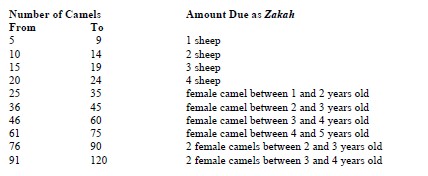
El consenso unánime de los musulmanes, así como varios dichos auténticos del Mensajero de Dios ﷺ y relatos de sus Compañeros, indican el nisab de los camellos, y las tasas del nisab sobre ellos son las siguientes:
The unanimous agreement of Muslims, as well as several correct sayings of the Messenger of God (p) and reports from his Companions indicate nisab of camels and the rates of nisab on them are as follows:
Existe ijma sobre este calendario, l9 salvo por un informe de 'Ali según el cual por cada 25 camellos corresponden cinco ovejas, y por 26 camellos corresponde una camella de entre uno y dos años.20 Ibn al-Mundhir dice: la unanimidad no queda rota, porque lo transmitido de 'Ali no es auténtico. La afirmación de Anas sobre estas cantidades y cuantías es correcta, y existe un acuerdo unánime sobre su contenido.21 Para más de 120 camellos, la opinión de la mayoría es que por cada 50 camellos adicionales la cuantía adicional de zakat es una camella de entre tres y cuatro años, mientras que por cada 40 camellos adicionales la cuantía adicional de zakat es una camella de entre dos y tres años.22 Esto se muestra en la siguiente tabla:
There is ijma on this schedule,l9 except for a report from 'Ali that on 25 camels there is five sheep and on 26 camels there is one female camel between one and two years old.20 Ibn al Mundhir says. The unanimity is net broken, because what is reported from 'Ali is not authentic. The saying of Anas on these quantities and amounts is correct and there is a unanimous agreement on its content.21 For more than 120 camels the majority's view is that for each additional 50 camels the additional amount of zakah is a female camel between three and four years old while on each additional 40 camels the additional amount of zakah is a female camel between two and three years old.22 This is shown in the following table :
Se ve en la tabla que, para números grandes, un aumento de menos de diez camellos no afecta a la cuantía de la zakat. Una vez que aumenta en diez, se pasa un escalón más en la cuantía de la zakat debida, según la misma regla mencionada anteriormente. Es obvio a partir de estas dos tablas que, si el número de camellos que se posee es inferior a cinco, no hay zakat. Cuando llegan a cinco, la cantidad debida es una oveja.
El autor de al Mabsut cita a un erudito que dice: "esto significa que se considera el valor del ganado. Los camellos de entre uno y dos años solían tasarse en cuarenta dirhams y una oveja en cinco dirhams, por lo que cinco camellos equivalen a 200 dirhams, también a 40 ovejas. Esto implica que el mínimo para que los camellos, las ovejas y el dinero en plata estén sujetos a zakat es el mismo". Ibn al Humam en al Fath e Ibn Nujaim en al Bahr responden que existe un dicho que establece: "Quien esté obligado a dar como zakat un camello de una determinada edad, pero no posea ninguno de esa edad, puede pagar en sustitución, según el promedio de 10 dirhams por una oveja, si no tiene una oveja". Este es un texto explícito que contradice la explicación de al Sarakhsi.24 El dicho al que se hace referencia es transmitido por al Bahr de Anas.
It is seen from the table that for big numbers, an increase of less than ten camels does not affect the amount of zakah. Once it is increased by ten, then you go one step higher in the amount of zakah due according to the same rule mentioned above. It is obvious from these two tables that if the number of camels owned is less than five then there is no zakah. Once they reach five , the amount due is one sheep. The author of al Mabsut quotes a scholar as saying, "this means that the value of the livestock is considered. Camels between one and two years old used to be priced at forty dirhams and a sheep at five dirhams, so five camels equal 200 dirhams also equal 40 sheep. This implies that the minimum for zakatability of camels, sheep, and silver money is the same. Ibn al Humam in al Fath and Ibn Nujaim in al Bahr reply, there is a saying that states "Whoever is obliged to give as zakah a camel of a certain age group, but does not own any in that age, can pay in substitution on the average of 10 dirhams for a sheep, if he does not have a sheep. This is an explicit text that contradicts the explanation of al Sarakhsi.24 The saying referred to is reported by al Bahr from Anas.
La Shari'ah establece que se paguen ovejas como zakat sobre los camellos cuando el número de camellos sujetos a zakat es menor de 25, aunque generalmente el zakat se paga con el mismo tipo de los bienes sujetos a zakat.
Shari'ah obligates sheep as zakah on camels if the number of zakatable camels is lees than 25, though usually zakah is paid out of the same kind of the zakated assets.
Anas narró que Abu Bakr, el Veraz, escribió este mensaje cuando lo envió a Bahréin:
Anas narrated that Abu Bakr, the Truthful wrote this message when he sent him to Bahrain:
En el nombre de Dios, el Compasivo, el Misericordioso. Esta es la obligación de la sadaqah impuesta a los musulmanes por el Mensajero de Dios ﷺ, tal como Dios se la ordenó.
In the name of God, most merciful, most gracious. This is the obligation of sadaqah imposed on Muslims by the Messenger of God (P), as ordained to him by God.
Quien sea requerido a pagarla según estas reglas debe darla, y quien sea requerido a pagar más debe negarse. Por cada 24 camellos o menos, el zakat se paga en ovejas. Por cada cinco camellos, se requiere una oveja. Al llegar a 25 y hasta 35, se requiere una camella hembra de uno a dos años. De 36 a 45, se requiere una camella de dos a tres años.
Whoever is asked to pay it according to these rules must give it, and whoever is asked to pay more should refuse. On each 24 camels or less, zakah is due in sheep. On each five camels, one sheep is required. Once they reach 25 and up to 35 one female camel, one to two years old, is required. From 36 to 45, there is one she-camel two to three years old.
Si llegan a 46 a 60, corresponde una camella de tres a cuatro años, que pueda ser montada para la cría. Si llegan a 61 a 75, corresponde una camella de cuatro a cinco años.
If they reach 46 to 60, there is one she-camel three to four years old due, one that can be bred. If they reach 61 to 75, one she-camel four to five years old is due. If they reach 76
Hasta 90, hay dos camellas de dos a tres años de edad como zakat. Si llegan a 91 hasta 120, hay dos camellas de tres a cuatro años de edad. Si son más de 120, por cada 40
to 90, there is two she-camels two to three years old due. If they reach 91 to 120, there are two she-camels, three to four years old due. If they are more than 120, for each 40
Hay una camella de dos a tres años, y por cada 50 hay una camella de tres a cuatro años. Quien posea hasta cuatro camellos no está obligado a pagar zakat, salvo que lo haga voluntariamente; pero si llegan a cinco camellos, se debe una oveja como zakat. En la sadaqah sobre las ovejas, si pastan libremente y sin costo, y su número está entre 40 y 120 ovejas, se debe una oveja. Por más de 120 y hasta 200, se deben dos ovejas.
there is one she-camel two to three years old, and for each 50 there is one she-camel three to four years old. A person who owns [up to] four camels is not zakatable unless he volunteers, but if they reach five camels, one sheep is due on them as zakah. In the sadaqah on sheep, if they are naturally, cost-free pastured, and number between 40 and 120 sheep, there is one sheep due. For more than 120 and up to 200, there are two sheep.
Variaciones en las tasas después de 120 camellos
Variance on the Rates after 120 Camels
Señalé anteriormente que existen distintas opiniones entre los juristas sobre la zakat de los camellos por encima de 120. Malik, al-Shafi'i, Ahmad y la mayoría consideran que la tasa es una camella de tres a cuatro años por cada 50 adicionales, y una camella de dos a tres años por cada 40 adicionales, según aparece en el escrito de Abu Bakr y 'Umar, transmitido sucesivamente por Anas e Ibn 'Umar. Lo mismo aparece en los escritos de Ibn Hazm y Ziad bin Labid a los habitantes de Hadramut, en las palabras del Profeta ﷺ: "Si superan los 120, entonces por cada 40 una camella de dos a tres años, y por cada 50 una camella de tres a cuatro años". Algunas versiones de este último dicho son resumidas por ese narrador como "Por cada 50 una camella..." sin mencionar la tasa por cada 40 adicionales, pero las distintas versiones se complementan entre sí.
I pointed out earlier that there are varying views among jurists on zakah on above 120 camels. Malik, Shafi'i, Ahmad, and the majority consider the rate to be one female camel, three to four years old for each additional 50, and one female camel, two to three years old, for each additional 40,39 as mentioned in the message of Abu Bakr and 'Umar narrated successively by Anas and Ibn 'Umar. The same also appears in the messages of Ibn Hazm and Ziad bin Labid to the people of Hadramut,40 in the words of the Prophet (p) "If they exceed 120, then for each 40 one female camel two to three years old, and for each 50 one female camel three to four years old". Some versions of the last saying are summarized by that narrator, as "In each 50 one female camel ..." without mentioning the rate for each additional 40, but the different versions complete each other.
La opinión de Abu Hanifah
Abu Hanifah's view
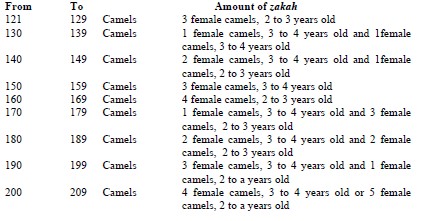
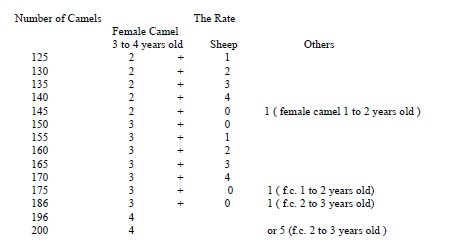
Al-Nakha'i, Al-Zuhri y Abu Hanifah41 dicen que «por lo que exceda de 120, comenzamos las tasas desde el principio, es decir, por cada cinco camellos adicionales hasta 24, la tasa es una oveja por cada 5 camellos, y por cada 25 camellos adicionales el zakat debido es una camella hembra, de uno a dos años, etc.». La siguiente tabla muestra la cantidad debida según esta opinión:
Al Nakha'i, Al Thawri, and Abu Hanifah41 say that "for what is above 120, we start the rates from the beginning, i,e., for an additional five to 24 camels, the rate is one sheep for each 5 camels, and for an additional 25 camels zakah due is one female camel, one to two years old, etc."The following table shows the amount due according to this opinion:
Después de 200, la tasa se repite: una oveja por cada cinco camellos adicionales, y cada vez que los camellos adicionales sujetos a zakat alcanzan los cincuenta, la cantidad de zakat debida por ellos es una camella de entre tres y cuatro años.
After 200 the rate repeats itself, one sheep for each additional five camels, and each time the additional zakatable camels reach fifty, the amount of zakah due on it is one female camel three to four years old.
Los hanafíes argumentan que Abu Daud relata, como mursal [dicho en cuya cadena no se menciona el nombre del Compañero que transmite], que Ishaq en su Musnad y al-Tahawi en su Mushkel lo transmiten de Hammad bin Salamah, quien dijo: "Le dije a Qais bin Sa'd que me consiguiera el mensaje de Muhammad bin Hazm, y él me dio una carta que dijo haber tomado de Abu Bakr bin Muhammad bin Hazm, quien dijo que el Profeta ﷺ la escribió para mi abuelo. La leí y encontré en ella las tasas de la zakat sobre los camellos..." y narró el dicho hasta: "Una vez que superen los 120, se debe una hembra de camello de tres a cuatro años por cada 30. Para los incrementos, se reinician las tasas desde el principio, y para lo que sea menos de 25 camellos adicionales, la cantidad de zakat se debe en ovejas, una oveja por cada cinco." Esto se recoge en Nasb al-Rayah de al-Zaila'i. Una versión similar es narrada por 'Asem bin Damurah de Ali, vinculada también al Profeta ﷺ y terminando en 'Ali, y se relata que Ibn Mas'ud dijo cosas similares. Según Ibn Rushd, los hanafíes sostienen que un asunto así no puede decidirse sino mediante instrucciones del Profeta ﷺ, porque no es algo que pueda deducirse por analogía.44
The Hanafites argue that Abu Daud reports as mursal [saying in whose chain the name of the reporting Companion is not mentioned], Ishaq in his Musnad and al Tahawi in his Mushkel from Hmmad bin Salamah, who said, "I told Qais bin Sa'd to get me the message of Mohammad bin Hazm, so he gave me a letter which he said he took from Abu Bakr bin Mohammad bin Hazm, who said that the Prophet (p), wrote it to my grandfather. I read it and found in it the rates of zakah on camels... " and he narrated the saying until, "Once they exceed 120 make due on each 30 one female camel three to four years old. For the increments, restart the rates from the beginning, and for what is less than 25 camel increments, the amount of zakah is due in sheep, one sheep for each five." This is reported in Nasb Al Rayah by al Zaila'i.42 A similar version is narrated by 'Asem bin Damurah from Ali, linked to the Prophet as well as ending at 'Ali,43 and Ibn Mas'ud is reported to have said similar things. The Hanafites are said by Ibn Rushd to have argued that such a thing cannot be decided but by instructions from the Prophet, because it is not anything that can be deducted by analogy.44
La opinión de Al Tabari
The view of Al Tabari
Abu Ja'far al Tabari expresa una tercera opinión conciliadora, según la cual ambas opiniones son aceptables y corresponde a la agencia recaudadora de zakat elegir cuál de las dos aplicar.52 En mi opinión, este enfoque es preferible, pues no debe considerarse que el contenido de un dicho ha sido derogado y anulado mientras exista la más mínima posibilidad de conciliar todos los relatos del Profeta ﷺ. La conciliación propuesta por al Tabari es, sin duda, aceptable si tenemos en cuenta que la determinación de las edades y de la cantidad de camellos debidos como zakat tiene por objeto facilitar el cálculo, el pago y la recaudación de la zakat, y simplificar los procedimientos para que la agencia recaudadora pueda ejercer cierta discreción.
Abu Ja'far al Tabari expresses a third, reconciling view, stating that both opinions are acceptable, and it is up to the zakah collection agency to select which view to apply.52 In my opinion this is a better approach, since one should not consider the content of a saying superseded and annulled if there is the slightest chance of a reconciliation of all the reports from the Prophet (p). The reconciliation proposed by al Tabari is undoubtedly acceptable if we keep in mind that the determination of ages and quantity of camels due as zakah is meant to facilitate zakah calculation, payment, and collection, and to simplify the procedures so that the zakah collecting agency can exercise some discretion.
Las ligeras diferencias en las letras de la zakat
The slight differences in the letters of zakah
Al observar las distintas versiones de los mensajes sobre el zakat transmitidos del Mensajero de Dios (p) y de sus sucesores bien guiados, se encuentran algunas diferencias menores. Un ejemplo es si la diferencia de valor entre camellos de distinta edad es de diez dirhams (o dos ovejas) o de veinte dirhams (o dos ovejas)53. ¿Cómo puede explicarse la diferencia entre la carta de 'Ali y las de Abu Bakr y 'Umar? Se sabe que el relato de 'Ali es incorrecto en cuanto a su atribución al Profeta ﷺ, pero también se sabe que la versión que afirma que se trata de una opinión del propio 'Ali es correcta. ¿Cómo pudo 'Ali discrepar de la carta del Profeta ﷺ? ¿Cómo podía él, que vivió la época de Abu Bakr y 'Umar, desconocer sus cartas y su aplicación? ¿Creyó que tenía información que superaba la contenida en la otra carta?
Looking at the different versions of messages about zakah reported from the Messenger of God (p), and his Wise Successors, one would find some minor differences. An example is whether the difference in value between different age camels is ten dirhams (or two sheep) or twenty dirhams (or two sheep)53. How can the difference between the letter of 'Ali and those of Abu Bakr and 'Umar be explained? It is known that the report of 'Ali is incorrect as linked to the Prophet (p), but it is also known that the version stating that it is a saying of 'Ali himself is correct. How could 'Ali differ with the letter of the Prophet (p)? How could he, who lived the era of Abu Bakr and 'Umar not be aware of their letters and application? Did he believe that he had information which superseded that contained in the other letter?
En mi opinión, todas estas preguntas se responden negativamente, y me parece que esas pequeñas diferencias requieren otra interpretación. Creo que algunas de estas equivalencias, como el valor de la oveja en plata, fueron fijadas por el Profeta (ﷺ) en su calidad de jefe del Estado. Sus precios en su época eran tales que una oveja equivalía aproximadamente a diez dirhams. Es sabido que los precios varían con el tiempo, y cuando el Profeta (ﷺ) dio la proporción de veinte dirhams por dos ovejas, estaba citando los precios corrientes de su período. En la época del califato de 'Ali, los precios de las ovejas eran distintos, y su cita de esos precios fue de diez dirhams por dos ovejas. Esto no es una violación del dicho del Profeta (ﷺ), sino más bien una aplicación de la regla que empleó el Profeta (ﷺ) a lo que convenía al tiempo de 'Ali. Esta interpretación es, en mi opinión, mejor que cualquier intento de desestimar cualquiera de los textos divergentes, como lo que hizo Yahya bin Ma'in al afirmar que nada correcto se transmite sobre la determinación de las tasas y cantidades del zakat. Ibn Hazm reprendió con gran dureza tal afirmación y preguntó cómo alguien como Ibn Ma'in podía decir semejante cosa sin siquiera la menor evidencia que la sustentara. Un orientalista como Schacht abusa al máximo de esa afirmación en su intento de rechazar todos los dichos correctos sobre el zakat.
SECCIÓN TERCERA: LA ZAKAT SOBRE LAS VACAS
SECTION THREE ZAKAH ON COWS
Las vacas, utilizadas por la humanidad para el cultivo de la tierra, la carne y la leche, son otra de las bendiciones de Dios sobre Sus siervos. La utilidad de esta especie fue en ocasiones tan grande que algunos pueblos, como los antiguos egipcios y los hindúes contemporáneos, llegaron a adorar a este animal.
Cows, used by mankind for land cultivation, meat and milk, are another bounty of God on His servants. The usefulness of this species was so great at times that some peoples, such as the ancient Egyptians and contemporary Hindus worshiped this animal.
El búfalo es contado con las vacas por todos los juristas musulmanes, según lo afirma Ibn al Mundhir.
Buffalo is counted with the cows by all Muslim jurists, as stated by Ibn al Mundhir.
La zakat sobre las vacas es obligatoria por la Sunnah y el Ijma. Al-Bujari, en su colección auténtica, relata de Abu Dharr: "Llegué al Profeta ﷺ y dijo: 'Juro por Aquel que tiene mi alma en Su mano', o 'Juro por Aquel junto al cual no hay dios'. Ningún hombre que tenga camellos, vacas u ovejas y no pague su derecho debido morirá sin que en el Día del Juicio sea pisoteado por ellos en su mayor tamaño y peso. Le pisotearán con sus pezuñas y le embestirán con sus cuernos, y cuando el último termine con él, el primero volverá a él hasta que se haya juzgado a todos los hombres." El Imam al-Bujari dijo: "También lo narra Bakir de Abu Saleh, de Abu Hurairah, del Profeta ﷺ." El "derecho debido" mencionado en el dicho significa la zakat antes que cualquier otra cosa. La zakat es el derecho debido sobre la riqueza, tal como lo definió Abu Bakr en el momento de combatir a quienes rechazaron la zakat; esta definición fue aprobada por Umar y por todos los demás Compañeros (relatado por al-Bujari y Muslim). En la versión narrada por Muslim se usa la palabra "zakat" en lugar de "derecho debido". Además, los musulmanes de todas las generaciones han confirmado unánimemente que la zakat es obligatoria sobre las vacas. Ni un solo erudito discrepa.59 Sin embargo, existen diferencias en la determinación del nisab y de las tasas de zakat sobre las vacas.
Zakah on cows is obligated by Sunnah and Ijma. Bukhari, in his correct collection, reports from Abu Dharr "I came to the Prophet (p)58 and he said 'I swear by He who holds my soul in His hand,' or 'I swear by the one beside whom there is no God. No man who has camels, cows or sheep and does not pay their right due but on the Day of Judgement will be trampled by them at their largest and heaviest. They will be stepping on him with their hooves and ramming him with their horns, and when the last one is done with him the first is brought back until judgement has been given to all people." Imam al Bukhari said "It is also narrated by Bakir from Abu Saleh from Abu Hurairah from the Prophet (p). The "right due" mentioned in the saying means zakah before any other thing. Zakah is the right due on wealth as defined by Abu Bakr at the time of fighting those who rejected zakah, this definition was approved by 'Umar and all other Companions, (reported by al Bukhari and Muslim). In the version reported by Muslim the word "zakah" is used in place of the word "right due", moreover, Muslims through all generations have unanimously confirmed that zakah is obligated on cows. Not a single scholar disagrees.59 There are however, differences in determining nisab and zakah rates on cows.
Nisab y tasas de la zakat sobre las vacas
Nisab and rates of zakah on cows
No existe ningún dicho correcto que nos proporcione el nisab y las tasas de la zakat sobre las vacas, como sí lo tenemos para los camellos. Esto puede deberse a que las vacas eran escasas en la zona del Hiyaz (alrededor de La Meca y Medina); también puede deberse a que las vacas son similares en tamaño y valor a los camellos, por lo que el Profeta ﷺ no determinó sus tasas partiendo de su evidente semejanza. Pero el hecho de que no exista ningún dicho correcto sobre la cuestión llevó a los juristas a sostener opiniones diversas sobre la determinación del nisab y de las tasas.
There is no correct saying that provides us with the nisab and rates of zakah on cows as we have seen on camels. This may be because cows were rare in the area of Hijaz (around Makkah and Madinah); it may be also because cows are close in size and value to camels, so the Prophet did not determine their rates on the assumption of their obvious similarity. But the fact that there is no correct saying on the issue left the jurists with varying views on the determination of nisab and rates.
La opinión popular: el nisab es de 30 vacas
The popular opinion: Nisab is 30 cows
La postura reconocida que sostienen las cuatro escuelas de jurisprudencia es que el nisab es 30
The reputed position upheld by the four schools of jurisprudence is that nisab is 30
cows, and there is no obligated zakat on fewer than 30 cows. For 30 cows, a one-year-old cow is due, and for 40 to 59 cows, one two-year-old cow is due. For 60 cows, two one-year-old cows are due; for 70 cows, a one-year-old and a two-year-old; for 80
cows, and there is no obligated zakah on less than 30 cows. For 30 cows, a one-year old cow is due, and for 40 to 59 cows there is one cow, two years old, due. For 60 cows, two one-year-old cows are due; for 70 cows, a one-year-old and a two-year-old; for 80
vacas, dos de dos años; por 90 vacas, tres de un año; por 100 vacas, una de dos años y dos de un año; por 110, dos vacas de dos años y una vaca de un año, y por 120 vacas, tres de dos años o cuatro de un año.
cows, two two-year olds; for 90 cows, three one- year-olds; for 100 cows, one two-year old and two one-year-olds; for 110, two cows two year olds and one cow one year old, and for 120 cows, three two-year olds or four one-year olds.
Esta opinión se basa en el dicho narrado por Ahmad y en los cuatro libros de Sunan de al-Tirmidhi, al-Nasa'i, Abu Daud e Ibn Maya, de Masruq, de Mu'adh bin Jabal, quien dijo: "El Mensajero de Dios ﷺ me envió a Yemen. Me ordenó cobrar, por cada 30 vacas, una vaca de un año, y por cada 40 vacas, una de dos años"60. Al-Tirmidhi calificó este dicho como bueno, e Ibn Habban y al-Hakim lo consideraron correcto. Ibn 'Abd al-Barr comenta: "Su cadena es correcta, continua y auténtica", y una afirmación similar hace Ibn Battal. Ibn Hajar dijo en al-Fath: "Debemos examinar cualquier dictamen sobre la corrección de este dicho, porque Masruq [el tabi'i] no se encontró con Mu'adh". Al-Tirmidhi lo considera bueno porque existen otros dichos que lo corroboran, como el que se encuentra en al-Muwatta, de Taus, de Mu'adh, pero Taus tampoco se encontró con Mu'adh.61
This opinion relies on the saying reported by Ahmad and the four books of Sunan al Tirmidhi, al Nasa'i, Abu Daud and Ibn Majah from Masruq from Mu'adh bin Jabal who said "The Messenger of God, (p) sent me to Yemen. He instructed me to collect on each 30 cows, a one year-old cow, and on each 40 cows one two-year-old"60. This saying is graded as good by al Tirmidhi and as correct by Ibn Habban and al Hakim, Ibn 'Abd al Barr comments "Its chain is correct, continuous and authentic" and similar statement is made by Ibn Battal. Ibn Hajar said in al Fath "We need to scrutinise any ruling about the correctness of this saying, because Masruq [The follower] did not meet Mu'adh." al Tirmidhi considers it good because there are other sayings that testify with it, such as the one in al Muwatta, from Taus from Mu'adh, but Taus did not meet Mu'adh either.61
La opinión de al-Tabari de que el nisab es 50
The view of al Tabari that nisab is 50
Ibn Jarir al Tabari sostiene que el nisab debe ser de 50 vacas, que existe unanimidad indudable en que por cada 50 vacas hay una zakat obligatoria de una vaca. Cualquier cantidad inferior a 50 es controvertida y no está respaldada por un texto claro.69 Ibn Hazm, en al Muhalla, apoya esta opinión por las mismas razones que al Tabari. Comenta: "Todo aquello que es controvertido y sobre lo que no existe un texto que lo haga obligatorio no debe imponerse a las personas, porque supone confiscar una parte de la riqueza de un musulmán sin tener certeza de su obligatoriedad en virtud de un texto correcto de Dios o de Su mensajero (ﷺ)".70 Continuó citando, a través de su propia cadena de transmisión, a 'Amr bin Dinar: "Los recaudadores de Ibn al Zubair, así como los de Ibn 'Auf, solían cobrar una vaca por cada 50 vacas,71 dos vacas por cada 100 y, por encima de eso, la proporción era una vaca por cada 50".72 Estos recaudadores desempeñaban sus funciones en presencia de muchísimos Compañeros en Medina, y esta práctica no fue objetada.
Ibn Jarir al Tabari argues that nisab must be 50 cows, that if is undoubtedly unanimous that for each 50 cows there is an obligatory zakah of one cow. Anything below 50 is controversial and not supported by a clear text.69 Ibn Hazm in al Muhalla supports this opinion on the same grounds as al Tabari. He comments "Anything that is controversial and on which there is no text making it obligatory must not be imposed on people, because it means confiscating a part of a Muslim's wealth without being certain about its requirement by virtue of a correct text from God or His messenger (p).70 He went on to quote, through his own chain, from 'Amr bin Dinar, "The commissioners of Ibn al Zubair as well as Ibn 'Auf used to collect one cow from each 50 cows,71 2 cow from each 100 and for more than that, the rate was one cow out of each 50.72 These commissioners were performing their duties in the presence of many, many Companions in Madinah, and this performance was not objected to.
Pero esta opinión puede refutarse por dos motivos:
But one may disprove this opinion on two grounds:
A. Desde el punto de vista del texto. El largo dicho de 'Amr bin Hazm sobre la zakat dice: "y de cada 30 vacas, tomar una vaca de un año, y de cada 40 vacas, una vaca". Este dicho es calificado como bueno por un puñado de eruditos destacados, y al-Tabari lo utilizó contra la opinión de Taqiy al-Din bin Daqiq al-'Id en su libro Al Imam.
La opinión de Ibn al-Musayyib y de Al-Zuhri
The opinion of Ibn al Musayyeb and Al Zuhri
Dos destacados eruditos, Said bin al Musayyeb y Muhammad bin Shehab al Zuhri, junto con Abu Qulabah y otros, sostienen que el nisab de las vacas es el mismo que el de los camellos, y que la tasa de zakat de los camellos es la misma para las vacas, con un único cambio menor, es decir, sin tener en cuenta las edades de los camellos. Una opinión similar se transmite como parte de una versión de la carta de 'Umar bin Al Khattab sobre la zakat, de Jabir bin 'Abd Allah y otros que pagaron la zakat en tiempos del Profeta ﷺ. Abu 'Ubaid transmitió, a través de Mohammad bin 'Abd al Rahman, que las instrucciones que 'Umar bin al Khattab escribió sobre la zakat incluían: "de las vacas se debe tomar lo mismo que de los camellos". Abu 'Ubaid continúa: "Se preguntó a otros sobre la zakat de las vacas y la respuesta fue que es lo mismo que en los camellos".
Two leading scholars, Said bin al Musayyeb and Muhammad bin Shehab al Zuhri, along with Abu Qulabah and others view nisab on cows to be the same as nisab on camels, and the zakah rate of camels to be the same for cows with only a minor change, that is, disregarding the ages of camels. A similar opinion is reported as a version of the letter of 'Umar bin Al Khattab on zakah, from Jabir bin 'Abd Allah and others who paid zakah at the time of the Prophet (p). Abu 'Ubaid reported from Mohammad bin 'Abd al Rahman that the instructions 'Umar bin al Khattab wrote on zakah included "from cows one should take the same as from camels." Abu 'Ubaid continues "Others were asked about zakah on cows and the answer was it is the same on camels".
Ibn Hazm narra con su propia cadena de transmisión, a través de al-Zuhri y Qatadah, ambos de Jabir bin 'Abd Allah, que dijo que «por cada cinco vacas se debe una oveja, por diez, dos ovejas, por quince, tres ovejas, y por veinte, cuatro ovejas». Al-Zuhri dice: «La zakat sobre las vacas es como la zakat sobre los camellos, salvo en las edades. Es decir, si el número de vacas estuviera entre 25 y 75».
Ibn Hazm reports with his own chain from al Zuhri and Qatadah, both from Jabir bin 'Abd Allah his saying that "in each five cows there is one sheep due, in ten two sheep, in 15, three sheep, and in 20, four sheep due." Al Zuhri says "zakah on cows is like zakah on camels except for the ages. That is, if the number of cows were between 25 and 75
el monto de la zakat que se debe por ellas es una vaca, entre 76 y 120 dos vacas. Por encima de 120, por cada 40 vacas adicionales hay una vaca adicional. Se nos dijo que la afirmación de que «por cada 30 vacas se debe una vaca de un año, y por cada 40 vacas se debe una vaca» era solo una simplificación y una reducción de las tasas para la gente de Yemen, la cual fue posteriormente descartada.
«76» También se informa de 'Ikrimah bin Walid, quien dijo: más tarde fui encargado de la zakat de 'Ikk y me encontré con algunos ancianos que pagaban zakat en tiempos del Mensajero de Dios ﷺ. Discreparon: algunos de ellos dijeron que se aplicara a las vacas la misma zakat que a los camellos, otros dijeron que por cada 30 vacas se tomara una vaca de un año, mientras que otros más dijeron que por cada 40 vacas se debía tomar una vaca de dos años.
«76» Ibn Hazm transmite, mediante su propia cadena, de Ibn al Musayyib, Abu Qulabah y otro erudito, una opinión similar a la de al Zuhri. También transmite de 'Umar bin 'Abd al Rahman bin Khildah al Ansari: «La zakat sobre las vacas es igual que la zakat sobre los camellos, salvo en las edades».
Pruebas que respaldan esta postura
Evidence supporting this view
A. Esta opinión se apoya en un reporte de Abu Ubaid, con su propia cadena de transmisión, desde Muhammad bin 'Abd al Rahman: "Está en la carta del Profeta ﷺ sobre la zakat y en la carta de 'Umar bin al Jattab que de las vacas se debe tomar lo mismo que de los camellos."78
A. This opinion is supported by a report of Abu Ubaid with his own chain from Muhammad bin 'Abd al Rahman, "It is in the Prophet's letter on zakah and in the letter of 'Umar bin al Khattab that from cows, one should take the same as from camels."78
Asimismo, esta postura se apoya en lo transmitido por 'Abd al-Razzaq, de Ma'mar, quien dijo: "Sammak bin al-Fadl me entregó una carta del Profeta ﷺ dirigida a Malik bin Kuflanis al-Mus'abiyn, en la que leí: 'y sobre las vacas se debe lo mismo que sobre los camellos.'"79
Also, this view is supported by what is reported by 'Abd al Razzaq from Ma'mar, who said, " Sammak bin al Fadl gave me a letter from the Prophet, to Malik bin Kuflanis Al Mus'abiyn, in which I read, 'and on cows is due the same as on camels.'"79
B. Esto queda confirmado por lo que menciona al-Zuhri, según el cual fue el último informe del Mensajero de Dios (ﷺ), y que tomar un becerro de un año por cada 30 vacas fue, al principio, una concesión para los pueblos del Yemen. Este informe es mursal, pero está respaldado por el dicho anterior y por declaraciones de algunos Compañeros.
B. This is confirmed by what is mentioned by al Zuhri that it was the latest report from the Messenger of God (p), and that taking a one-year-old cow of each 30 cows was, at the beginning, a matter of favor for the peoples of Yemen. This report is mursal, but it is supported by the previous saying and by statements from some Companions.
Ibn Hazm comenta: "Si un dicho mursal fuera aceptado de cualquiera, merece ser aceptado de al-Zuhri, porque era muy versado en la Sunnah y se encontró con varios de los Compañeros".80
Ibn Hazm comments "If a mursal saying would be accepted from anyone, it deserves to be accepted from al Zuhri because he was well versed in Suunah and met a number of the Companions".80
C. Esta opinión también está respaldada por la regla general que se desprende del dicho mencionado al inicio de la Sección 3: "Y a todo aquel que posea vacas y no pague lo que les corresponde, se le tenderá en el suelo para que las vacas lo pisoteen el Día de la Resurrección". Se argumenta que este es un texto general que incluye vacas de cualquier cantidad, salvo las restricciones establecidas por un texto o por algún Ijma'. Se argumenta además que el dicho según el cual se debe una vaca de un año por cada 30, y una vaca de dos años por cada 40, también respalda esta opinión, porque no exime de la zakat a las vacas por debajo de 30. Es solo una declaración de la tasa de la zakat.
Una cuarta opinión
A fourth opinion
Ibn Rushd ofrece otra opinión más sin proporcionar el nombre de su autor ni su argumento: Por cada diez vacas se debe una oveja, hasta alcanzar las 30 vacas, por las que se debe una vaca de un año.84 Encuentro que Ibn Abi Shaibah atribuye esta opinión a Shahr bin Haushab en su al Musannaf. Este dice: "La zakat debe ser una oveja por cada diez vacas, dos ovejas por cada veinte vacas, y una vaca de un año por cada 30".
Ibn Rushd gives yet another opinion without providing the name of its author nor its argument: On each ten cows there is one sheep due, until they reach 30 cows, on which there is a one-year-old cow due.84 I find that Ibn Abi Shaibah attributes this view to Shahr bin Haushab in his al Musannaf. The latter says "zakah should be one sheep due on each ten cows, two sheep on each twenty cows, and one cow, one year old, on 30
cows."85 Esto significa que el nisab de las vacas es de diez, en comparación con cinco en la opinión mencionada anteriormente. Ibn Abi Shaibah no ofrece ninguna evidencia de apoyo. Podría pensarse que este argumento puede sustentarse con el dicho que fija la compensación por la pérdida de una vida en 100 camellos o 200 vacas. Esto se narra como dicho por 'Umar, así como vinculado al Profeta ﷺ.86 Ello implica que un camello equivale a dos vacas. Si el nisab para los camellos es de cinco, el de las vacas debe ser de diez, y si por cada cinco camellos la cantidad de zakat debida es una oveja, debería corresponder una oveja por cada diez vacas.
cows."85 This means that nisab of cows is ten as compared to five in the previously mentioned opinion. No evidence of support is given by Ibn Abi Shaibah. It may come to mind that this argument can be supported by the saying that estimates the compensation for the loss of life at 100 camels or 200 cows. This is reported as said by 'Umar, as well as linked to the Prophet (p).86 This implies that one camel equals two cows. If nisab for camels is five, that of cows must be ten, and if for each five camels the amount of zakah due is one sheep, there should be one sheep due for each ten cows.
Análisis y ponderación
Analysis and weighing
Después de enumerar todas estas opiniones,87 me parece que la postura de la mayoría sobre la cuantía por cada 30 y 40 vacas es la que tiene más peso, sobre la base del dicho de Mu'adh y de Amr bin Hazm. Sin embargo, cabe señalar que estos dos dichos no dan información sobre lo que hay por debajo de 30 vacas, ni en sentido negativo ni positivo, sino que solo determinan la tasa de la zakat y no su nisab, salvo por contraste. Curiosamente, el dicho de Ibn Hazm continúa afirmando: "Y por cada 40 dinares (de oro) se debe un dinar". La mayoría de los juristas coinciden en que el nisab del oro es de 20 dinares y no de 40, lo que indica que este dicho se dio para determinar la tasa de la zakat y no necesariamente su nisab, ya que la tasa sobre el oro es del dos y medio por ciento, es decir, un cuarentavo.
After listing all these opinions,87 it seems to ms the view of the majority about the rate on each 30 and 40 cows is the one that carries more weight, on the basis of the saying of Mu'adh and Amr bin Hazm. However, it is notable that these two sayings do not give information about what is below 30 cows, whether negative or positive, but only determine the rate of zakah rather than its nisab, except by contrast. Interestingly enough, the saying of Ibn Hazm goes on to state, "And on each 40 dinars (of gold) there is due one dinar". The majority of jurists agree that nisab on gold is 20 dinar and not 40, which indicates that this saying was given to determine the rate of zakah and not necessarily its nisab, since the rate on gold is two-and-half percent or one-fortieth.
Es posible combinar esta opinión con la de Ibn al-Musayyib, al-Zuhri y su grupo de seguidores al fijar el nisab de las vacas en cinco, especialmente porque se fija en cinco en una versión de la carta de 'Umar sobre el zakat, como informe de Jabir bin 'Abd Allah, un Compañero, y a veces se atribuye a la carta del Profeta ﷺ. Abu 'Ubaid comenta que esta opinión no era conocida por la gente, pero se mostró antes que en realidad era conocida por varios Compañeros y Seguidores. Además, puede argumentarse que la analogía entre las vacas y los camellos es sólida, y que la objeción de Ibn Hazm puede desestimarse por basarse en su opinión personal de que toda analogía es inválida. La mayoría de los eruditos coinciden en el principio de que la analogía correcta es una fuente de deducción en la Shari'ah.
It is possible to combine this opinion with that of Ibn al Musayyib, al Zuhri and their group of followers in putting nisab on cows at five, especially since it is put at five in a version of 'Umar's letter on zakah, as a report from Jabir bin 'Abd Allah, a Companion, and is sometimes attributed to the letter of the Prophet (p). Abu 'Ubaid comments that this opinion was not known by people, but it was shown earlier that it was in fact known to a number of Companions and Followers. Additionally, one can argue that the analogy of cows and camels is a strong one and the objection of Ibn Hazm can be disregarded as based on his personal view that all analogy is invalid. The majority of scholars are in accord on the principle that the correct analogy is a source of deduction in Shari'ah.
SECCIÓN CUATRO: LA ZAKAT SOBRE LAS OVEJAS
SECTION FOUR ZAKAH ON SHEEP
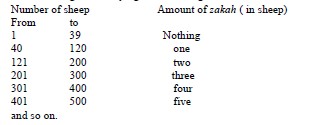
El zakat sobre las ovejas es obligatorio en virtud de la Sunnah y del Ijma'. En cuanto a la Sunnah, Anas narra en la carta de instrucciones de Abu Bakr mencionada anteriormente: "En cuanto a la sadaqah sobre las ovejas que pastan libremente en el campo, por cada cuarenta hay una oveja debida, hasta llegar a ciento veinte."
Zakah on sheep is obligating by virtue of Sunnah and Ijma'. In Sunnah, Anas narrates in the letter of instruction of Abu Bakr mentioned earlier that "As for sadaqah on sheep, naturally cost-free pastured, out of each 40 there is one sheep due, up to 120.
Si el número aumentaba, entonces se deben dos ovejas hasta 200, y si el número aumenta en uno hasta 300, son debidas tres ovejas. Si supera los 300, por cada 100 adicionales se toma una oveja. Si las ovejas que pastan naturalmente sin costo son menos de 40, aunque sea por una sola, no hay sadaqah obligatoria sobre ellas, a menos que el dueño desee ofrecerla voluntariamente. En concepto de zakat no se debe aceptar la oveja vieja, la defectuosa ni el carnero, salvo cuando los dueños la ofrezcan voluntariamente. Declaraciones similares aparecen en el dicho de Ibn 'Umar y en varios otros.
If the number increased, then two sheep are due up to 200, and if the number increases by one up to 300, there are three sheep due. If it is above 300,90 then one sheep is taken for each additional 100. If naturally, cost-free pastured sheep are less than 40, even by only one, there is no obligatory sadaqah on it unless the owner wishes to volunteer, As zakah one should not accept the old, the damaged, or the ram except when volunteered by the owners." Similar statements appear in the saying from Ibn 'Umar and in several others.
Los juristas coinciden unánimemente en que el zakat es obligatorio sobre las ovejas. También existe una opinión unánime en que la palabra "ghanam" incluye tanto ovejas como cabras, de tal manera que ambas se combinan como una sola categoría.91
Jurists unanimously agree that zakah is obligatory on sheep. There is also unanimous opinion that the word "ghanam" includes both sheep and goats in such a way that they are combined together as one item.91
Según este dicho puede elaborarse la siguiente tabla:
According to this saying the following table can be drawn:
Analizaremos en la sección 6 la descripción del animal que debe tomarse como zakat en cuanto a su tamaño, edad y sexo.
We will discuss in section 6 the description of what animal should be taken as zakah as for its size, age and sex.
Discusión sobre la tasa del ganado ovino
Discussion of the rate on sheep
Es notable que la Shari'ah redujo la tasa sobre las ovejas a medida que aumenta su número. Del programa anterior se observa que, cuando el número supera los 120, la tasa se estabiliza en un uno por ciento, en contraste con el habitual dos y medio por ciento sobre los bienes comerciales, el dinero y otros activos. ¿Cuál es la razón de esta reducción? Algunos investigadores contemporáneos92 intentan explicar esta reducción con el argumento de que la Shari'ah pretende fomentar la cría de animales mediante esta reducción, ya que la tasa sobre las 40
It is notable that Shari'ah reduced the rate on sheep as their number increases. From the previous schedule it is observed that as the number grows above 120 the rate stabilizes at one percent in contrast with the usual two-and-half percent on business assets, money and other assests. What is the rationale for this reduction? Some contemporary researchers92 attempt to explain this reduction with the argument that Shari'ah intends to encourage animal breeding by this reduction, since the rate on 40
La oveja paga el dos y medio por ciento y disminuye hasta el uno por ciento al llegar a doscientas, pero uno se pregunta: si esta explicación es correcta, ¿por qué no se aplica lo mismo a la zakat de otros tipos de ganado? La tasa tanto de los camellos como de las vacas se estabiliza en torno al dos y medio por ciento con números elevados, lo cual es coherente con la tasa general de la zakat. Si la interpretación mencionada anteriormente es correcta, debería aplicarse también a otros animales.
sheep is two-and-half percent and it regresses at 200, going clean to one percent. But one wonders, if this explanation is correct, why the same is not applied on zakah on other kinds of livestock. The rate on both camel and cows stabilizes around two-and half percent on big numbers, which is consistent with the general rate of zakah. If the above-mentioned interpretation is correct, it should apply to other animals as well.
A mi juicio —Dios sabe más— , una vez que aumenta el número de ovejas, el total de bienes en ovejas contendrá muchos corderos, porque la mayoría de las ovejas paren más de una vez al año. Estas crías se cuentan en el número de ovejas, pero no se aceptan como pago de la zakat, como se mostrará en las dos secciones siguientes. Me parece que la justicia exige cierta reducción en la tasa por esta razón. Si la tasa se mantiene en una de cada 40 mientras el rebaño contiene muchas crías, la tasa real resulta mucho más alta. En cuanto a las primeras 40, la tasa es del dos y medio por ciento, porque se espera que las crías no se cuenten entre las primeras 40, como se explicará en la sección cinco.
The way I see it --God knows best-- is that once the number of sheep grows, the total assests of sheep shall contain many baby lambs because most sheep give birth more than once a year, These babies are counted in the number of sheep but not accepted as payment of zakah, as shall be shown in the following two sections. It seems to me that the justice requires certain reduction in the rate for this reason. If the rate is kept at one out of each 40 while the herd contains many babies, the actual rate becomes much higher. As for the first 40, the rate is two-and-half percent because it is expected that babies would not be counted in the first 40, as will be explained in Section five.
SECCIÓN CINCO ¿SON LOS ANIMALES BEBÉS SUJETOS A LA ZAKAT?
SECTION FIVE ARE BABY ANIMALS ZAKATABLE ?
Ahmad, Abu Dawud y al-Nasa'i relatan de Suaid bin Ghaflah que "el recaudador de zakat del Mensajero de Dios ﷺ llegó hasta nosotros. Nos sentamos cerca de él y lo oí decir: 'En mis instrucciones se me ordena que no tome de los animales lactantes'.94 Esto indica que las crías del ganado no son zakatables, y esta es la opinión de un grupo de destacados eruditos. Sin embargo, la cadena de transmisión de este dicho es objeto de controversia. Por otra parte, Malik, en al-Muwatta, relata que 'Umar le dijo a su recaudador, Sufyan bin 'Abd Allah al-Thaqafi, que "contara las crías que hubiera en ellos, incluso las que el pastor llevara en sus brazos, pero que no las aceptara como pago".95 Esto también lo recogen al-Shafi'i y Abu 'Ubaid.96 Este relato de 'Umar contradice el anterior e indica que las crías de los animales se cuentan para el nisab y, en consecuencia, son zakatables. Es la postura que adopta un grupo de juristas, hasta el punto de que, si todos los animales zakatables fueran crías, se aceptaría una de ellas como pago,"97 aunque otros dicen que se le debe pedir al propietario que compre fuera un animal más adulto para cumplir con el pago de la zakat.98
Ahmad, Abu Daud, and al Nasa'i report from Suaid Bin Ghaflah that "the zakah commissioner of the Messenger of god (p), came to us. We sat close to him and I heard him saying 'In my instructions it is pleased that I should not take from nursing animals'.94 This indicates that baby livestock are not zakatable, and this is the opinion of a group of leading scholars. But the chain of this saying is contested. On the other hand, Malik in al Muwatta reports that 'Umar told his commissioner, Sufian bin 'Abd Allah al Thaqafi, to "Count the babies in them, even those carried by the shephered in his hands, but do not accept them in payment."95 This is also reported by al Shafi'i and 'Abu Ubaid.96 This report of 'Umar contradicts the previous report and indicates that baby animals are counted in nisab and consequently zakatable. This is what a group of jurists adopt, to the extent that if all the zakatable animals were babies, one of them would be acceptable as payment,"97 though others say the owner should be asked to buy an older animal from outside to fulfil the payment of the zakah.98
Algunos eruditos intentan conciliar el relato de 'Umar con la declaración de Suaid no obligando la zakat sobre las crías de animales cuando estas constituyen la totalidad de la cabaña sujeta a zakat, afirmando que ahí es donde se aplica la declaración de Suaid, mientras que se cuentan las crías cuando están con sus madres. Sin embargo, algunos juristas consideran que las crías de animales se cuentan en el total del rebaño sujeto a zakat solo si los animales adultos constituyen el nisab requerido para que sea zakatable. Esta es la opinión de Abu Hanifah, al-Shafi'i, Ibn Hazm y otros. Es, en mi opinión, la más cercana a la justicia islámica y parece prevalecer sobre las demás opiniones. Viola el principio de justicia eximir de la zakat a una persona que posee, por ejemplo, cuatro camellos adultos y cobrarla a una persona que posee cinco camellos jóvenes o cuatro corderos, ya que esta última es menos rica que la primera. Una vez que el nisab se cumple contando solo los animales adultos, entonces las crías pueden contarse para determinar el número total sujeto a zakat. Para cantidades mayores, la estructura de tarifas es en sí misma flexible, pues toma tramos de cantidades y aplica la misma tasa tanto en el extremo inferior como en el superior de cada tramo. Así, cinco camellos son zakatables a razón de una oveja, lo mismo que nueve camellos.
SECCIÓN SEIS: CONDICIONES DE LOS ANIMALES DADOS COMO ZAKAT
SECTION SIX CONDITIONS OF ANIMALS GIVEN AS ZAKAH
Se requieren algunas condiciones en los animales que pueden pagarse como zakat, entre ellas:
A few conditions are required of the animals that can be paid as zakah, which include:
1. Libre de defectos y daños. El animal debe estar libre de enfermedad, fractura ósea, vejez, defectos de nacimiento o defectos y daños accidentales. El Corán dice: "y no tratéis de dar lo malo, para gastar de ello" {100}, y el Profeta ﷺ afirmó: "No se debe dar un animal viejo ni defectuoso, ni el recaudador debe aceptar un carnero a menos que el que paga desee ofrecerlo voluntariamente". Esto forma parte del hadiz transmitido por Anas. Aceptar animales dañados como pago de la zakat no es justo con los pobres y otros beneficiarios merecedores; supone un favoritismo hacia el propietario, lo cual es impropio.
1. Free of defects and damage. The animal should be free of illness, bone fracture, old age, or birth and accidental defects or damages. The Qur'an says "and do not aim at getting anything which is bad, in order that out of it ye may spend "100 and the Prophet (p) states "and one should not give an old or defective animal, nor should a collector accept a ram unless the payer wishes to volunteer it". This is part of the saying from Anas. Accepting damaged animals as zakah payment is not fair to the poor and other deserving recipients; it is a bias in favor of the owner, which is improper.
En cuanto a la definición de defecto o daño, la mayoría de los juristas opina que es la misma definición que se utiliza en los contratos de compraventa, aunque algunos sostienen que todo animal no aceptable para el sacrificio tampoco es aceptable como zakat.[10] Cabe mencionar un caso único en el que un animal defectuoso o dañado sí se acepta como zakat: cuando todos los animales sujetos a zakat presentan el mismo defecto o daño, como una enfermedad común. Esto se debe a que la ley de la zakat exige el pago a partir de lo que posee la persona obligada, sin obligarla a comprar fuera un animal sano únicamente para pagar la zakat.[1]02
As for the definition of defect or damages, the majority are of the view that it is the same definition used in sales contracts, though some say that anything not accepted for sacrifice is not accepted as zakah.l0l One should mentions unique case where a defected or damaged animal is accepted as zakah, which is if all the animals being zakated have the same defect or damage, such as a common disease. This is because the ordinance of zakah asks payment from what the zakatable person owns without forcing him or her to purchase from outside a good animal only for the payment of zakah.l02
Zakat sobre el ganado 101
Zakah on Livestock 101
4. La media El recaudador de zakat no debe tomar ni lo mejor ni lo peor en calidad, sino la media de los animales debidos. Ibn 'Abbas narra que el Profeta ﷺ le dijo a Mu'adh: "Evita lo mejor de la riqueza de la gente, y teme la súplica del oprimido, pues no hay velo entre ella y Dios." Ibn Abi Shaibah relata que el Profeta ﷺ vio entre los camellos recogidos como sadaqah una camella excelente. Se enfureció con el recaudador y dijo: "¿Qué es esto?". El recaudador respondió: "Lo cambié por dos camellos de menor calidad". El Profeta ﷺ dijo: "Entonces está bien".115
4. The average The zakah collector should not take the best or the worst in quality, but the average of the animals owed. Ibn 'Abbas narrates that the Prophet (p) said to Mu'adh, "Avoid the best of people's wealth, and be fearful of the prayer of the oppressed, for there is no curtain between it and God." Ibn Abi Shaibah reports that the Prophet (p) saw among the camels collected as sadaqah, an excellent she-camel. He was furious at the collector and said, "What is this?" The collector answered "I exchanged it for two lesser quality camels". The Prophet said, "Then it is all right."115
Esto se debe esencialmente a que la zakat se basa en la equidad entre las dos partes, quienes pagan y quienes reciben, y tomar lo mejor o lo peor implicaría favorecer a una de ellas. Sin embargo, es evidente que lo peor o lo mejor puede tomarse sobre la base del valor, a elección del dueño del ganado. Abu Daud relata, a través de su propia cadena de transmisión, que el Profeta ﷺ dijo: "Hay tres cosas que, quien las cumple, saboreará la dulzura de la fe: adorar solo a Dios, reconociendo que no hay más dios que Dios; dar la zakat de tu riqueza con el alma complacida al pagarla, año tras año... y no dar lo viejo, lo enfermo ni lo pequeño, ni el animal defectuoso que da poca leche, sino dar del promedio de tu riqueza. Dios no te pide que des lo mejor de ella, ni te ordena que des lo peor de ella".116 Como pago de zakat, el recaudador no debe tomar el animal que amamanta a sus crías, ni las hembras preñadas, ni el carnero de los ovinos, ni el animal destinado a proveer carne para la familia del que paga la zakat.117 Malik relata en al-Muwatta, a partir de 'Aisha, que 'Umar bin al-Jattab pasó junto a las ovejas tomadas como sadaqah, y vio una con las ubres grandes, y preguntó: "¿Qué es esta oveja?". Le respondieron: "Una tomada como sadaqah". Él replicó: "Sus dueños no la dieron de buen grado, así que no obliguéis a la gente a dar la vuelta, y no toméis lo mejor de la riqueza de los musulmanes".118
SECCIÓN SIETE: EL EFECTO DE LA MEZCLA Y LA SOCIEDAD SOBRE LA ZAKAH DEL GANADO
SECTION SEVEN THE EFFECT OF MIXING AND PARTNERSHIP ON ZAKAH ON LIVESTOCK
Es común que los ganaderos reúnan sus ganados para ahorrar en gastos generales. ¿Debe considerarse todo el ganado reunido como una sola unidad para determinar el nisab y la tasa de la zakat, o debe considerarse por separado para cada propietario?
It is common for livestock owners, to put together their cattles in order to save on overhead expenses. Should all gathered livestock be treated as one unit in determining the nisab and rate of zakah? or should they be considered for each owner alone?
Para abordar esta cuestión, conviene señalar que existen dos formas principales de cría colectiva. Una consiste en mantener la propiedad por separado y compartir ciertos gastos, y la otra es aquella en la que el ganado es propiedad común de los socios. En esta última forma, la parte de cada propietario no se determina en número, sino únicamente como una proporción del total, mientras que en la primera los animales de cada persona se distinguen. Estas dos formas de invertir en común no tienen necesariamente el mismo efecto en cuanto a su sujeción a la zakat.
To deal with this question one should note that there are two leading forms of collective breeding. One involves keeping the ownership separate and sharing in certain expenses, and the other is when the cattle is owned commonly among the partners. In the latter form, the share of each owner is not determined in number but only as a proportion of the total, whereas in the former each person's own animals are distinguished. These two forms of investing together need not have the same effect on zakatability.
Ibn Rushd, en Bidayat al Mujtahid, resume las opiniones de los juristas de acuerdo con lo siguiente:
Ibn Rushd in Bidayat al Mujtahid, summarizes the views of jurists according to the following:
La mayoría de los juristas consideran que la mezcla de animales afecta a la zakatabilidad, excepto Abu Hanifah y sus discípulos, quienes creen que la mezcla de animales no tiene ningún efecto sobre el nisab ni sobre la tasa aplicable. Malik, al-Shafi'i y la mayoría de los juristas coinciden en que el grupo de ganaderos que mezclan sus rebaños se trata como si fueran un solo propietario. Sin embargo, esos juristas difieren en dos aspectos: la determinación del nisab y la definición de mezcla efectiva.
Most jurists view mixing animals as affecting the zakatability except for Abu Hanifah and his disciples, who believe that mixing together of animals does not have any effect on nisab or on the applicable rate. Malik, al Shafi'i, and most jurists agree that the group of breeders who mix their cattles together are treated as if they were one owner. Those jurists however differ in two areas: the determination of nisab and the definition of effective mixing together.
SECCIÓN OCHO: LA ZAKAT SOBRE LOS CABALLOS
SECTION EIGHT ZAKAH ON HORSES
Los caballos utilizados para el transporte personal y para la lucha están exentos de la zakat.
Horses used for personal transportation and fighting are exempt from zakah.
Es acordado entre los musulmanes que los caballos poseídos para el uso personal de montar, para transportar cargas personales y para combatir por la causa de Dios están exentos, ya sea que pasten de forma natural o que se alimenten en ranchos, pues son para uso personal y del hogar y no son bienes de crecimiento en exceso de las necesidades personales.126 Por otra parte, todos los musulmanes, excepto los zahiríes, han acordado que los caballos utilizados como mercancía de comercio, propiedad de los mercaderes de caballos, son sujetos a zakat, ya sea que pasten de forma natural o que se alimenten manualmente, con el argumento de que los caballos destinados a la mercancía comercial son mercancías, como otros bienes comerciales.127 También es acordado que los caballos que son alimentados por sus dueños la mayor parte del año, y que no son poseídos para ninguno de los propósitos mencionados anteriormente, están exentos de zakat, porque el pastoreo libre y natural es una condición para la zakatabilidad de los animales, según la mayoría de los sabios.128
It is agreed upon among Muslims that horses owned for the purpose of personal riding, carrying personal loads, and fighting for the sake of God are exempt whether they are naturally pastured or fed in ranches, because they are for personal and household use and are not growing assets in excess of personal needs.126 On the other hand, all Muslims except Zahirites have agreed that horses used as business inventory owned by horses' merchants, are zakatable whether they are naturally pastured or manually fed on the grounds that horses designed for business inventory are commodities, like other business asset.127 It is also agreed upon that horses that are fed by owners most of the year, which are not owned for any of the previously mentioned purposes, are exempt from zakah, because natural free pasturing is a condition for zakatability of animals, according to the majority of scholars.128
Zakatabilidad de los caballos de pastoreo natural destinados a la reproducción
Zakatability of naturally pastured horses designated for breeding
Hay dos opiniones sobre si los caballos que pastan libremente sin costo alguno y que están destinados a la reproducción y la cría son zakatables. Abu Hanifah opina que son zakatables, siempre que no todos los caballos que se poseen sean machos, pues en ese caso no pueden reproducirse. La mayoría de los juristas considera que estos caballos están exentos de zakat, opinión que narra Ibn al Mundhir de 'Ali, Ibn 'Amr al Sha'bi, 'Ata, al Husain al Abdi, 'Uamar bin 'Abd al Aziz, al Thawri, Abu Yusuf, Muhammad (los dos discípulos de Abu Hanifah), Abu Thawr, Abu Khaithamah y Abu Bakr bin Shaibah. Otros atribuyen esta opinión a 'Umar, Malik, al Awza'i, al Laith y Daud.130
There are two opinions on the zakatability of naturally cost-free pastured horses that are designated for breeding and growth. Abu Hanifah believe they are zakatable, provided that not all horses owned are males since in this case they cannot breed.129 The majority of jurists consider these horses exempt from zakah, and this is narrated by Ibn al Mundhir from 'Ali, Ibn 'Amr al Sha'bi, 'Ata, al Husain al Abdi, 'Uamar bin 'Abd al Aziz, al Thawri, Abu Yusuf, Muhammad (the two disciples of Abu Hanifah) Abu Thawr, Abu Khaithamah, and Abu Bakr bin Shaibah. Others attribute this opinion to 'Umar, Malik, al Awza'i, al Laith and Daud.130
Evidencia de la mayoría sobre la no obligatoriedad de la zakat en los caballos
Evidence of the majority for the non-zakatability of horses
1. Se relata en los dos libros auténticos y en otros, de Abu Hurairah, que el Profeta ﷺ dijo: "No se impone sadaqah a los musulmanes sobre sus esclavos ni sobre sus yeguas."131 Esta exención incluye a todos los caballos, pastoreados de forma natural o no, hembras o machos, porque la formulación es general.
1. It is reported in the two correct books and in others from Abu Hurairah that the Prophet (p) said " There is no sadaqah obligated on Muslims on their slaves and mares."131 This exemption includes all horses, naturally pastured or not, female or male because it is general.
2. La narración de Ahmad, Abu Daud y al-Tirmidhi, de Ali, de el Profeta ﷺ
2. The report of Ahmad, Abu Daud, and al Tirmidhi from Ali from the Prophet (p)
«Te exoneré de la sadaqah sobre los caballos y los esclavos. Paga la sadaqah sobre el dinero de plata: un dírham por cada 40.» ﷺ132
"I waived for you sadaqah on horses and slaves. Pay sadaqah on silver money, one dirham for each 40."132
3. Las acciones del Profeta (p) no incluyeron la recaudación de zakat sobre los caballos, aunque sí se recaudaba sobre los camellos, las vacas y las ovejas. El Mensajero de Allah ﷺ es quien detalla la obligación señalada en el Corán, y sus palabras y acciones indican que los caballos no están sujetos a zakat.
3. The actions of the Prophet (p) did not include collecting zakah on horses, even though it was collected on camels, cows and sheep. The Messenger is the one who gives the details of the obligation outlined in the Qur'an, and his word and deed indicate that horses are not zakatable.
4. También argumentan que el ganado sujeto a zakat es evidentemente muy distinto de los caballos, y que los caballos no pueden hacerse sujetos a zakat por analogía, debido a las diferencias fundamentales en su uso y en el propósito de poseer estos distintos tipos de animales. Los caballos se obtienen para usarlos en la lucha, para establecer esta religión y para la defensa contra los enemigos, por lo que la gente debe ser animada a obtenerlos y mantenerlos con tales fines. Dios dice: "Preparad contra ellos cuanta fuerza podáis, incluidos los caballos de guerra.133" Los caballos de guerra son equipo de combate, al igual que las armas y otras herramientas de combate, y no están sujetos a zakat mientras no se utilicen como mercancía para el comercio.134
La opinión de Abu Hanifah y su evidencia
Abu Hanifah's opinion and its supporting evidence
Abu Hanifah, quien considera que los caballos que pastan de forma natural son sujetos de zakat, presenta los siguientes argumentos:
Abu Hanifah, who believes that naturally pastured horses are zakatable, provides the following arguments:
Firstly, al Bukhari reports in his correct collection from Abu Hurairah that the Prophet ﷺ said "Steeds are for a person a source of reward, for another they are a source of sustenance, and for yet another they are a source of sin. He for whom they are a source of reward is the man who owns horses for the purpose of fighting for the sake of God, to ride it in battle or to give it to someone else to ride in battle. That is why they are a source of reward. For one who keeps horses for personal transportation so he does not need others, and does not forget God's right on the horses or the right of people to be given lifts on their backs, they are source of sustenance. And for the person who keeps steeds as a matter of pride and to fight against the people of Islam, they are a source of sin."135 This saying indicates that there is a right of God on horses, zakah and giving lifts on their backs.136 Other jurists argue that what is meant by the right on horses is the use of horses in fighting.
Spanish translation:
En primer lugar, al-Bujari relata en su colección auténtica, de Abu Hurairah, que el Profeta ﷺ dijo: "Los caballos son para una persona una fuente de recompensa, para otra una fuente de sustento y para otra más una fuente de pecado. Aquel para quien son una fuente de recompensa es el hombre que posee caballos con el propósito de combatir por la causa de Dios, para montarlos en la batalla o para dárselos a otro para que los monte en la batalla. Por eso son una fuente de recompensa. Para quien mantiene caballos para su transporte personal, para no depender de otros, y no olvida el derecho de Dios sobre los caballos ni el derecho de las personas a que se les dé un paseo sobre sus lomos, son una fuente de sustento. Y para la persona que mantiene caballos por orgullo y para luchar contra el pueblo del Islam, son una fuente de pecado."135 Este dicho indica que existe un derecho de Dios sobre los caballos, el zakat, y el de dar un paseo sobre sus lomos.136 Otros juristas sostienen que lo que se entiende por el derecho sobre los caballos es el uso de los caballos en la lucha.137
Firstly, al Bukhari reports in his correct collection from Abu Hurairah that the Prophet (p) said "Steeds are for a person a source of reward, for another they are a source of sustenance, and for yet another they are a source of sin. He for whom they are a source of reward is the man who owns horses for the purpose of fighting for the sake of God, to ride it in battle or to give it to someone else to ride in battle. That is why they are a source of reward. For one who keeps horses for personal transportation so he does not need others, and does not forget God's right on the horses or the right of people to be given lifts on their backs, they are source of sustenance. And for the person who keeps steeds as a matter of pride and to fight against the people of Islam, they are a source of sin."135 This saying indicates that there is a right of God on horses, zakah and giving lifts on their backs.136 Other jurists argue that what is meant by the right on horses is the use of horses in fighting.137
Nisab y tasas de la zakat sobre los caballos
Nisab and rates of zakah on horses
Abu Hanifah no determina un nisab para los caballos. El autor de al-Durr al-Mujtar escribe: "Es bien sabido que Abu Hanifah no estima un nisab para los caballos; no tenemos ningún reporte de él al respecto."146 Ibn 'Abidin, en su comentario, cita a al-Qahastani diciendo: "Algunos indican un nisab de tres y otros lo indican en cinco."147 Parece que la estimación de cinco es más correcta por su semejanza con la de los camellos. El número cinco se usa con frecuencia en el nisab: el nisab es de cinco camellos, cinco uqiyyah de plata [equivalentes a 200 dirhams] y cinco wasq de grano.
Abu Hanifah does not determine a nisab for horses. The author of al Durr al Mukhtar writes "It is best known that Abu Hanifah does not estimate nisab for horses; we have no report from him about that."146 Ibn 'Abidin in his commentary quotes al Qahastani as saying "Some indicate nisab at three and others indicate it at five."147 It seems that the estimation of five is mare correct because of its similarity to that of camels. The number five is often used in nisab . nisab is five camels, five 'uqiyyah of silver [equals 200 dirhams] and 5 wasq of grain.
La tasa es explicada por Ibn Abidin de Abu Hanifah: a los dueños de caballos árabes se les da la opción de pagar un dinar por cada uno, o de valorar sus caballos y pagar el 5
The rate is explained by Ibn Abidin from Abu Hanifah: Owners of Arabian horses are given the choice of paying one dinar on each or evaluating their horses and paying 5
dirhams por cada 200 dirhams de valor: la tasa es solo dos y medio. Para los caballos no árabes, solo se considera el valor.148
dirhams for each 200 dirhams of value - the rate is just two-and-half. For non-arabian horses, only the value is considered.148
Análisis
Analysis
Después de discutir los dos argumentos, me parece que el Mensajero (ﷺ) no negó de manera clara la existencia de la zakat sobre los caballos, pero tampoco la hizo obligatoria de forma clara. El dicho de Abu Hurairah, "No hay sadaqah sobre el esclavo y la yegua de un musulmán", no alude a nada más que al caballo utilizado para el transporte personal y como montura para la guerra. Esta explicación queda respaldada por la interpretación de Zaid bin Zaid Thabit y de 'Abbas, transmitida correctamente de él. Las mismas palabras "su esclavo y su yegua" en el dicho parecen indicar este sentido. Además, existe consenso (ijma') entre los juristas, con excepción de los zahiríes, en que la zakat es obligatoria sobre los caballos y los esclavos cuando forman parte del inventario comercial. Abu Hurairah tendía a atenerse a la letra de los textos y era conocido entre los Compañeros por su memoria precisa, pero no tenía fama de analizar y elaborar como Zaid y Ibn 'Abbas. El dicho de 'Ali, "Te he eximido de la sadaqah sobre los caballos y los esclavos", es considerado correcto por al-Daraqutni cuando termina en 'Ali y no se vincula al Profeta. Es bien sabido que al-Daraqutni es el experto en estos asuntos. Sin embargo, las palabras "te he eximido" implican que estos bienes deberían, en principio, estar sujetos a zakat, pero el Profeta (ﷺ) la eximió en ellos por cierta razón. Esta podría ser la necesidad apremiante de caballos de guerra o el hecho de que los caballos no constituían un bien de riqueza sustancial en Arabia.
After discussing the two arguments, it seems to me that the Messenger (p) did not negate the existence of zakah on horses in a clear way, but neither did he obligate it clearly. The saying from Abu Hurairah, "There is no sadaqah on a Muslim's slave and mare" does not touch on anything other than the horse used for personal transportation and as a mount for war. This explanation is supported by the interpretation from Zaid bin Thabit and 'Abbas, correctly reported to him. The very words "His slave and his mare" in the saying seem to indicate this meaning. Also, that it is unanimous by Ijma' among jurists -- except Zahirites-- that zakah is obligatory on horses and slaves when they are part of business inventory. Abu Hurairah was inclined to hold to the letters of texts, and was known among the Companions for his precise memory, and did not have a reputation of analyzing and elaborating like Zaid and Ibn 'Abbas. The saying from 'Ali, "I have waived for you the sadaqah on horses and slaves" is noted by al Daraqutni as correct when it ends at 'Ali and is not linked to the Prophet. It is well known that al Daraqutni is the expert on such matters. However the words "waived for you" imply that these assets should be in principle zakatable but the Prophet (p) waived the zakah are them for certain reason.l49 This could be the desperate need for steeds of war or the fact that horses were not a substantial item of wealth in Arabia.
Digresión: La distinción entre las órdenes del Profeta como mensajero de Dios y sus órdenes como jefe temporal de un Estado.
Digression: The distinction between orders of the Prophet as a messenger of God orders as a temporal head of state.
Siguiendo la discusión anterior, conviene dedicar algunos párrafos a este punto importante. Siempre hay que atender a las circunstancias que rodean una declaración del Profeta ﷺ y al tema de la misma, para determinar si se relaciona con asuntos temporales, políticos, económicos, militares o administrativos, o con los principios del modo de vida islámico. A veces puede existir otro texto que indique el principio permanente de una aplicación temporal particular, o bien puede ocurrir que hechos similares hayan sido tratados de forma distinta, lo que indica que ese tratamiento puede ser temporal más que religioso.
The previous discussion leads us to devote a few paragraphs to deal with this important point. One should always look at the circumstances that surround a statement made by the Prophet (p) and the subject matter of the saying to see whether it relates to temporal, political, economic, military, or administrative affairs, or to the principles of the Islamic way of life. There may exist sometimes another text that indicates the enduring principle of a special temporal application, or similar events may have been differently treated, which indicates this treatment may be temporal rather than religious.
Un ejemplo lo ofrece al-Qarafi en su al-Ihkam sobre el dicho: "Quien mate a un soldado enemigo tendrá sus bienes personales". Malik sostiene que esta es una decisión del Profeta ﷺ en calidad de jefe de Estado, y no una regla general. Si los líderes del Estado islámico declaran tal regulación al comienzo de una guerra, entonces debe aplicarse; de lo contrario, sigue vigente el principio general de que el botín de guerra se reparte según el texto del Corán en la sura ocho (al-Anfal). Malik ofrece los siguientes argumentos para respaldar esta postura:
An example is give by al Qarafi in his al Ihkam about the saying "One who kills an enemy soldier shall have his personal property". Malik says this is a decision by the Prophet (p) as a head of state and is not a general rule. If the leaders of the Islamic state declare such a regulation at the beginning of a war, then it should apply, but otherwise, the general principle that war booty is distributed according to the text of the Qur'an in sura eight (al Anfal) remains applicable. Malik gives the following arguments to support this view:
1. El versículo sobre la distribución del botín de guerra en la sura (Al-Anfal) contradice este dicho.
1. The verse about the distribution of war booties in sura (al Anfal) contradicts this saying.
2. Tal regulación podría interferir con las intenciones de los combatientes y desviarlas de ser por el bien de Dios hacia el deseo de obtener los bienes del enemigo.
2. Such a regulation may interfere with, and divert the intentions of the fighters from being for the sake of God to being the desire for the enemy's property.
SECCIÓN NUEVE: OTROS ANIMALES DOMÉSTICOS QUE PASTAN NATURALMENTE
SECTION NINE OTHER NATURALLY PASTURED DOMESTIC ANIMALS
Esta sección trata del caso general de los animales domésticos que pastan libremente sin coste alguno y que se mantienen con fines de lucro. ¿Podemos generalizar el caso de la zakat a todos estos animales o no? Dicho de otra manera, ¿debe limitarse la zakat a las cuatro especies mencionadas anteriormente o debe incluir a todos los animales domésticos? Algunos de los principales profesores actuales de estudios islámicos, entre ellos Muhammad Abu Zahra, 'Abd al 'Wahab Khallaf y 'Abd al Rahman Hasan, deducen de la práctica de 'Umar que se puede aplicar la analogía en materia de zakat.
This section deals with the general case of naturally cost-free pastured domestic animals maintained for profit. Can we generalize the case of zakah on all such animals or not? In other words should zakah be restricted to the four previously mentioned species or should it include all domestic animals? Some of today's leading professors of Islamic studies, including Muhammad Abu Zahra, 'Abd al 'Wahab Khallaf, and 'Abd al Rahman Hasan, deduct from the practice of 'Umar that one can apply analogy on zakah.
'Umar bin al Khattab obligó el pago de zakat sobre los caballos por analogía, en la creencia de que los caballos se estaban convirtiendo en bienes de gran valor. Esta postura es respaldada por Abu Hanifah, maestro en la aplicación de la analogía. Quienes no obligan el pago de zakat sobre los caballos no lo hacen por negar la analogía, sino porque consideran que el carácter comestible del ganado es una razón importante para que sea zakatable. Como los caballos no son comestibles, se niegan a extender la zakatabilidad a los caballos. El autor de al Mughni escribe: "La analogía entre los caballos y el ganado es incorrecta, porque este último es riqueza en crecimiento que se utiliza para la leche y la carne, y puede usarse para el sacrificio". La mayoría de los eruditos no considera que el carácter de crecimiento por sí solo sea la razón de la zakatabilidad.
'Umar bin al Khattab obligated zakah on horses by analogy, on the grounds that horses were becoming valuable assets. This is upheld by Abu Hanifah, the master in the application of analogy. Those who do not obligate zakah on horses do not do so in denial of analogy, but because they consider the edible character of livestock an important reason for their zakatability. Since horses are not edible, they refuse to extend zakatability to horses. The author of al Mughni writes "The analogy of horses and livestock is incorrect, because the latter are growing wealth that is used for milking and meat and can be used for sacrifice." The majority of scholars does not consider the character of growth alone the reason for zakatability.
Estos tres profesores añaden: Si el sabio sucesor 'Umar consideró el crecimiento como el requisito esencial para la zakatabilidad, y siguió a Abu Hanifah, entonces podemos extender su aplicación a otros animales y declarar que todos los animales que crecen y pastan de forma natural, sin costo, son zakatables, si alcanzan el mínimo para la zakatabilidad (nisab), que equivale a veinte dinares, a razón de 2,5%. El nisab se estima en relación con el oro, porque 'Umar aceptó el principio de evaluar los caballos para determinar la zakat, y el valor se estima actualmente en oro.158
SECCIÓN DIEZ PRINCIPIOS GENERALES DERIVADOS DE LAS SECCIONES ANTERIORES
SECTION TEN GENERAL PRINCIPLES DERIVED FROM THE PREVIOUS SECTIONS
La discusión en las secciones anteriores de este capítulo ha sido extensa porque la Sharí'ah misma dicta muchos principios y dictámenes sobre el zakat del ganado que pueden no ser tan detallados en otras áreas del zakat, y porque el análisis extenso de este tema revela principios importantes que serán de gran beneficio para comprender la esencia del zakat en general. Entre estos principios se encuentran los siguientes:
The discussion in the previous sections of this chapter has been lengthy because Shari'ah itself dictates many principles and rulings about zakah on livestock that may not be as detailed in other areas of zakah, and because the lengthy analysis of this issue uncovers important principles that will be of great benefit in understanding the essence of zakah in general. Among these principles are the following:
1. La zakat, aunque es un acto de adoración, también es una institución pública supervisada por el Estado islámico. Nombrar y enviar a los recaudadores de la zakat es deber del Estado islámico.
1. Zakah, although a worship, is also a public institution supervised by the Islamic state. Appointing and sending zakah commissioners is the duty of the Islamic state.
2. Las normas de la zakat equilibran, por una parte, los intereses de los pobres y, por otra, los de los ricos, de modo que pequeñas cantidades de riqueza quedan exentas de zakat y solo se aceptan como pago de zakat bienes de calidad media.
2. Zakah regulations balance the concerns of the poor on one hand and the interests of the rich on the other hand, so that small quantities of wealth are exempted from zakah and average quality assets only are accepted as zakah payment.
3. El costoso mantenimiento de un bien reduce la zakat o la exime sobre ese bien. Por esa razón, la mayoría de los juristas destacados consideran exentos de zakat los animales alimentados manualmente, con el argumento de que su costo es igual a la ganancia que producen para el dueño.
3. The expensive upkeep of an asset reduces zakah or waives it on that asset. For that reason, the majority of leading jurists consider manually fed animals exempt from zakah on the ground that they cost as much as they profit the owner.
4. Una transformación de un bien en crecimiento, pasando de su uso para obtener ganancias a su uso personal, lo exime de la zakat, según la mayoría de los eruditos en lo que respecta a las vacas y los camellos empleados para regar, para el cultivo y para transportar cargas personales.
4. A transformation of a growing asset from its use for profit to personal use exempts it from zakah, according to the majority of scholars with regard to cows and camels used for watering, cultivation, and carrying personal loads.
1. Sura al Nahl, 16:5-7.
1. Sura al Nahl, 16:5-7.
2. Ibid.
2. Ibid.
3. Ibid.
3. Ibid.
4. Sura Yasin: 36:71-73.
4. Sura Yasin: 36:71-73.
5. Al Durr al Mukhtar y su comentario, Rad al Muhtar, Vol. 2, pp. 20-21.
5. Al Durr al Mukhtar and its commentary, Rad al Muhtar, Vol. 2, p. 20-21.
This condition is derived from what is reported by Ahmad, al Nasa'i, and Abu Daud from Bahz bin Hakim from his father from his grandfather, who said: I heard the Messenger of God (p) saying about naturally ( cost-free ) postured camels, for each forty, there is one as zakah ... etc. "This saying is graded correct by a group of leading scholars. The adjective "naturally, cost-free pastured" here implies that artificially fed camels are not subject to zakah; otherwise adding such an adjective becomes meaningless, and the Prophet (p) does not speak in vain. It is obvious from this saying that camels characterised, as naturally, cost-free pastured are unlike those that are not.
Al Jattabi comenta: "Cuando algo puede tener una de dos características, y una norma de la Sharia se aplica a una de ellas, entonces la norma opuesta se aplica a la otra característica, por implicación".8 También aceptan los eruditos de la metodología del derecho islámico (usul al-fiqh) que mencionar una característica específica en una norma implica que, cuando esa característica está ausente, la norma no se aplica,9 es decir, los camellos alimentados con pienso comprado se tratan de manera distinta.
Al Khattabi comments, "When something may have either of two characteristics, and a ruling of Shari'ah is applied to one of them, then the opposite ruling applies to the other characteristic, by implication".8 It is also accepted by scholars of the methodology of jurisprudence that giving a specific characteristic in a ruling implies that when the characteristic is absent the ruling does not apply9 i.e., camels fed by purchased feed are treated differently.
Este dicho se ve reforzado además por un hadiz recogido de manera correcta por al-Bujari y otros, de Anas, según el cual "si las ovejas pastan libremente (sin coste) y llegan a cuarenta en número, hay una oveja como zakat". Si la condición de pasto natural libre se exige para las ovejas, también debe exigirse, por analogía, para los camellos y las vacas, pues no debe haber distinción entre ellos. Los dichos sin tal restricción deben entenderse en referencia a aquellos que vinieron con la restricción de pastoreo natural libre.
This saying is further supported by a report is the correct collection of al Bukhari and others from Anas, that "if sheep are naturally (cost-free) pastured, and reach 40 in number, there is one sheep as zakah". If the condition of natural free pasture is required on sheep it should also be, by analogy, required on camels and cows, since there should be no distinction between them. Sayings without such restriction should be taken with reference to those that came with the restriction of natural free grasing.
Esta es la opinión de la mayoría de los eruditos. Rabi'ah, Mālik y al-Layth discrepan en ese punto. Ellos obligan a pagar zakat sobre el ganado alimentado manualmente de la misma forma que sobre el que pasta en libertad, tal como se desprende de los dichos que no tienen esa restricción. Su explicación de los dichos que sí la contienen es que la expresión "pastoreo natural o sin coste" es una descripción general, porque esta era una característica común del ganado en tiempos del Profeta ﷺ.10
This is the opinion of the majority of scholars, Rabi'ah, Mlaik and al Layth differ on that. They obligate zakah on manually fed livestock the same way it is on naturally pastured, as implied by the sayings that do not have the restriction. Their explanation of the restricting sayings is that the word "natural or cost-free pasture" is a general description because this was a common adjective of livestock at the time of the Prophet (p).10
En segundo lugar, el informe de Abu 'Ubaid, de al-Zuhri, según el cual las vacas y los camellos utilizados para transportar jinetes no están sujetos a zakat, como tampoco lo están las vacas empleadas en el cultivo.
Todos estos son como herramientas para la agricultura. Sa'id bin Abd al-Aziz al-Tanukhi dice: "Las vacas utilizadas en el cultivo no están sujetas a zakat, porque lo que se grava con zakat es el grano producido, y en él interviene el trabajo de las vacas".
Si los animales empleados en el proceso agrícola estuvieran sujetos a zakat, la zakat recaería dos veces sobre la agricultura: una vez sobre los medios de producción y otra sobre el producto, como acertadamente señala Abu 'Ubaid. Malik discrepa de la mayoría en este dictamen; según él, la zakat es obligatoria sobre las vacas y los camellos, estén trabajando o no, y pastando libremente o no. Cuando se le mencionó la opinión de Malik a al-Zuhri, este respondió: "No creía que nadie fuera a decir eso".
Por justicia, cabe añadir que algunos juristas malikíes se inclinan por la opinión de la mayoría.
Two things support these narrations and this point of view. The first is the principle that assets designated for personal use and service are not zakatable, and by the same token livestock designated for cultivation, or personal transportation should not be zakatable. It is apparent that such animals are not part of the assets invested for growth.14 Secondly, the report of Abu 'Ubaid from al Zuhri, that cows and camels used for carrying riders are not zakatable, and neither are cows used for cultivation.15 All these are like tools for agriculture, Sa'id bin Abd al Aziz al Tanukhi says "Cows used in cultivation are not zakatable, because the grain produced is being zakated, and it involves the work of cows.16 If animals used in the process of farming were to be zakated, zakah would then be double on agriculture, taken once on the means of production and again on the produce, as rightly stated by Abu 'Ubaid. Malik disagrees with the majority on this ruling, and according to him zakah is obligated on cows and camels, working or not, naturally pastured or not. When the view of Malik was mentioned to al Thawri he replied "I did not think that anyone would say that".17 In fairness, one should add that some Malikite jurists lean toward the view of the majority.
Ibn Naji cita a Ibn 'Abd al Salam diciendo: "En este asunto, la opinión de la mayoría es aquella con la que uno se siente más cómodo." Abu 'Umar bin 'Abd al Barr muestra que la postura de los malikíes sobre los animales de trabajo entra en contradicción con su posición sobre las joyas destinadas al uso personal; según ellos, estas últimas no están sujetas a zakat.18
Ibn Naji quotes lbn 'Abd al Salam as saying "In this regard, the view of the majority is the one that one feels more comfortable with." Abu 'Umar bin 'Abd al Barr shows that Maliketes' view on working animals is in conflict with their position on jewelry designated for personal use; the latter is not zakatable, according to them.18
La razón es, obviamente, que la cantidad debida es menor que un camello, pero al mismo tiempo la Sharía considera que cinco camellos son suficientes para definir quién es rico.25
The reason is obviously that the amount due is less than one camel, but at the same time Shari'ah considers five camels to sufficiently define who is rich.25
Los números y las cantidades de las dos tablas anteriores provienen de las acciones del Mensajero de Dios (ﷺ). Al-Nawawi, en al-Majmu', dice que las cantidades y montos de la zakat sobre el ganado provienen de los dos dichos narrados por Anas e Ibn 'Umar.26
Numbers and amounts in the above two tables come from the actions of the Messenger of God (p). Al Nawawi in al Majmu' says that the quantities and amounts of zakah on livestock come from the two saying narrated by Anas and Ibn 'Umar.26
Por más de 200 y hasta 300 hay tres ovejas. Por más de 300, la cantidad de zakat es una oveja por cada 100 o fracción de ella. Si una persona posee menos de 40
For more than 200 up to 300 there are three sheep. For more than 300, the amount of zakah is one sheep for each 100 or a fraction therein. If a person owns less than 40
Las ovejas que pastan libremente y no cuestan nada no están sujetas a la zakat; no hay sadaqah obligatoria a menos que la persona decida dar voluntariamente. Sobre la moneda acuñada se debe un cuarto de un décimo. Si una persona posee solamente 190 dirhames, no hay nada que pagar sobre ellos, salvo por la iniciativa voluntaria del dueño.
naturally cost-free pastured sheep, there is no sadaqah unless the person wishes to volunteer. On mint currency there is one-fourth of one-tenth due . If a person own only 190 dirhams27 there is nothing on them except by the voluntary initiative of the owner".
La carta añade además: "Quien deba como zakat una camella hembra de uno a dos años, y no tenga ninguna de esa edad, pero tenga una de la siguiente categoría de edad superior, es aceptable, y el recaudador de zakat le devuelve la diferencia, veinte dirhams o dos ovejas. Si debe una camella hembra de uno a dos años pero no la tiene, se acepta en su lugar un camello macho de entre dos y tres años. Quien deba como zakat una camella hembra de cuatro a cinco años y no tenga ninguna en esa franja de edad, pero tenga una camella hembra un año menor, puede pagar la más joven junto con dos ovejas, si las tiene, o veinte dirhams. Quien deba como zakat una camella hembra de tres a cuatro años y no tenga ninguna en esa franja puede pagar una camella hembra de la siguiente categoría de edad superior, y el recaudador le devuelve 20 dirhams o dos ovejas. Tampoco, si una persona debe pagar como sadaqah una camella hembra de tres a cuatro años y solo tiene una camella hembra del grupo de dos a tres años, se puede aceptar de ella, junto con dos ovejas o 20 dirhams. Para quien deba como sadaqah una camella hembra de dos a tres años y tenga una de un año más, es un sustituto aceptable: el recaudador de zakat le devuelve 20 dirhams o dos ovejas. Si una persona debe como sadaqah una camella hembra de dos a tres años y no la tiene, pero tiene una de un año menos, es aceptable como zakat junto con 20 dirhams o dos ovejas.28 Un animal viejo, dañado o defectuoso no se acepta como zakat, ni el recaudador debe tomar un carnero, a menos que el pagador de zakat lo ofrezca voluntariamente como sadaqah adicional. Lo que está dividido no debe sumarse, ni lo que forma una unidad sujeta a zakat debe dividirse para evitar el zakat.29 Para el ganado que pertenece a socios,30 los socios ajustarían cuentas entre ellos en proporción a sus participaciones. Al Nawawi dice: "Esta carta la recoge al Bujari en su colección auténtica, dispersa a lo largo del capítulo sobre el zakat." Lo volví a armar."31 También lo narran Ahmad, Abu Daud, al-Nasai y al-Daraqutni.
The letter further states, "The person whose zakah is a female camel, one to two years old, and who has none of that age , but one in the next higher age bracket, it is acceptable, and the zakah collector returns to him the difference, twenty dirhams or two sheep. If he owes a she-camel one to two years old but does not have it, a male camel between two and three years old is accepted in its place. A person who owes as zakah one she-camel four to five years old and has none in that age group, but has a she-camel one year younger, may pay the younger along with two sheep if available, or twenty dirhams. A person who owes as zakah one female camel three to four years old and does not have any in that age bracket can pay one female camel in the next higher age bracket and the collector then returns to him 20 dirhams or two sheep. Nor a person who is required to pay sadaqah in the amount of one female camel three to four years old and has only a female camel in the age group of two to three years old, it can be accepted from him, along with two sheep or 20 dirhams. For a person whose sadaqah should be one female camel two-three years old who has one a year older, it is an acceptable substitute the zakah collector returns to him 20 dirhams or two sheep. If a person sadaqah is one female camel two to three years old and he does not have it, but has one a year younger, it is acceptable as zakah along with 20 dirhams or two sheep.28 An old, damaged or defected animal is not accepted as zakah, nor should the collector take a ram unless it is volunteered as extra sadaqah by the zakah payer. What is divided should not be added together, and what is together a zakatable unit must not be divided in order to avoid zakah.29 For cattle owned by partners,30 partners would settle the account among themselves in proportion to their shares. Al Nawawi says "this letter is reported by al Bukhari in his correct collection, scattered throughout the chapter on zakah. I put it back together."31 It is also reported by Ahmad, 'Abu Daud, al Nasai and al Daraqutni.
El último añade: «La cadena es correcta y todos los narradores son dignos de confianza», como en al Muntaqa.32 Al Shaukani dice: «También lo reportan al Shaukani, al Baihaqi y al Hakim; Ibn Hazm dice que este mensaje es el máximo en corrección. También lo califican como correcto Ibn Habban y otros.33
The latter adds "The chain is correct and the narrators are all trustworthy," as in al Muntaqa.32 Al Shaukani says "It is also reported by al Shaukani, al Baihaqi, and al Hakim, Ibn Hazm says this message is maximum in correctness. It is also graded correct by Ibn Habban and others.33
El dicho de Ibn 'Umar, narrado por Sufian bin Husain de al Zuhri, de Salim, de su padre, 'Abdullah bin 'Umar: El Mensajero de Dios ﷺ escribió el documento sobre la sadaqah, pero no lo envió a sus comisionados hasta su muerte. Lo ató a su espada, y cuando murió, Abu Bakr lo aplicó hasta su muerte, y luego 'Umar, hasta su muerte. La carta contiene: "Por cinco camellos se debe una oveja, por diez, dos ovejas..", etc., continuando con las mismas tasas que aparecen en el dicho de Anas. Al Nawawi dijo que es narrado por Abu Daud y al Tirmidhi, quien lo califica de buen dicho.34 Al Shaukani añade: "Este dicho también es narrado por al Daraqutni, al Hakim y al Baihaqi".35
The saying from Ibn 'Umar, is narrated by Sufian bin Husain from al Zuhri from Salim from his father, 'Abdullah bin 'Umar: The Messenger of God (p) wrote the message on sadaqah but did not send it to his commissioners until he died. He tied it to his sword, and when he died, Abu Bakr applied it until he died, and then 'Umar, until he died. The letter contains "For five camels there is one sheep due, for ten, two sheep.."etc, continuing with the same rates listed in the saying from Anas. Al Nawawi said it is reported by Abu Daud and al Tirmidhi, who marks it a good saying.34 Al Shaukani adds "This saying is reported also by al Daraqutni, al Hakim and al Baihaq".35
Ibn Hazm dice en su comentario sobre el dicho de Anas: «Este dicho es de máxima corrección. El Veraz, Abu Bakr, lo aplicó en presencia de todos los Compañeros, y no se sabe que ninguno de ellos discrepara en absoluto, aunque suele alegarse el consenso (ijma') con una unanimidad mucho menor que esta».36 La gran mayoría de los eruditos de esta comunidad han recibido estos mensajes con aceptación y los aplican en la práctica, aunque algunos de los principales eruditos del hadiz, como Yahya bin Ma'in, dudan en considerarlos correctos, en coherencia con su enfoque particular al escrutar a los transmisores y los vínculos entre ellos.
Ibn Hazm says in his commentary on the saying from Anas "This saying is maximum in correctness. The Truthful Abu Bakr applied it in the presence of all the Companions, and none of them is known to have disagreed at all, although ijma' is usually claimed in much lees unanimitty than this."36 The great majority of scholars of this nation have received these messages with acceptance, and practically apply them, although some of the leading scholars of hadith, such as Yahya bin Ma'in hesitate in considering them correct, in consistency with his special approach in scrutinising narrators and the links among them.
Parece que el orientalista Schacht abusa de la postura de Ibn Ma'in para arrojar dudas sobre todos los dichos relativos a la zakat y sobre la institución misma. Afirma que las opiniones de los juristas sobre la cuestión han dejado su sello en el propio dicho, y añade: «Observamos, a este respecto, que el sistema detallado de la zakat comúnmente atribuido a Abu Bakr a veces se atribuye al Profeta ﷺ, a 'Umar bin al Jattab o a 'Ali bin Abi Talib».37 Schacht es conocido por su hostilidad hacia las tradiciones del Profeta ﷺ.
It seems that the Orientalist Schacht abuses the stand of Ibn Ma'in in order to shed doubt on all the sayings on zakah and the whole institution itself. He claims that the jurists' opinions on the issue have their stamp on the saying itself, and adds "we note, in this respect, that the detailed system of zakah commonly attributed to Abu Bakr is sometimes attributed to the Prophet (p), to 'Umar bin al Khattab, or 'Ali bin Abi Taleb".37 Schacht is known for his hostility toward the traditions of the Prophet (p).
Con frecuencia él inventa razones para sembrar dudas sobre ellos y para desorientar al lector acerca de los mismos. En sus libros reúne todas las malinterpretaciones y afirmaciones engañosas, así como las falsas tergiversaciones fabricadas contra la Sunnah. Doy gracias a Dios porque mi querido y respetado colega, el Dr. Muhammad Mustafa al Azami, devolvió estas falsedades a la cara de su autor en su extenso estudio sobre los hadices, escrito en inglés y presentado en la Universidad de Cambridge como tesis doctoral.38 Dicho estudio demostró que, para ser justo y razonable, el orientalista debería haberse dado cuenta de que es sumamente improbable que el Profeta (p) dejara un asunto tan importante como la zakat sobre los camellos, las ovejas, etc., sin determinar sus mínimos y sus tasas, puesto que en ellos radicaba la mayor parte de la riqueza de los árabes de su tiempo. El Profeta envió recaudadores y comisionados de zakat a los oasis y a las zonas desérticas para recolectarla y distribuirla cada año entre las tribus dispersas. Existen numerosos relatos sobre el envío de esos recaudadores y sobre la manera en que se les indicaba tratar a las personas sujetas a zakat, qué debían tomar, qué no debían tomar, cuál debía ser la respuesta de los propietarios de ganado y cómo debían tratar a los recaudadores. Ningún investigador justo y razonable puede afirmar que todos estos dichos hayan sido fabricados en nombre del Mensajero (p).
Very often he fabricates reasons to shed doubt on them and to disorient the reader about them. In his books he collects all the misinterpretations and misleading statements and the fabricated and false misrepresentations against the Sunnah. I thank God that my dear and respected colleague, Dr. Muhammad Mustafa al Azami threw these falsehoods back in the face of their author in his extensive study on hadith in English, which was submitted to Cambridge University as his Ph.D. dissertation.38 It showed that to be fair and reasonable, the Orientalist should have realised that it is extremely unlikely that the Prophet (p) would leave such an important issue like zakah on camels, sheep, etc., without determining its minimums and its rates, since this was where the majority of the wealth of the Arabs at his time lay. The zakah collectors and commissioners were sent by him to oasis and deserted areas to collect and distribute zakah every year from the scattered tribesman. There are many reports about sending those collectors and the way they were told to treat zakatable individuals, what to take, what not to take, what the response of cattle owners should be and how they should treat the collectors. No fair and reasonable researcher can claim that all these sayings are fabricated on behalf of the Messenger (p).
No es de extrañar que el Profeta (p) enviara instrucciones que determinaban los nisabs y las tasas de zakat sobre el ganado y otros bienes de riqueza en crecimiento que eran más dominantes en su tiempo y en su entorno. Esto lo atestigua el mensaje de instrucción de Abu Bakr, así como el de 'Umar, y ambos están vinculados al Profeta ﷺ. En el mensaje de Abu Bakr citado anteriormente se mostraba que "Esta es la obligación de la sadaqah que el Profeta de Dios ﷺ impuso a los musulmanes...". La carta escrita por 'Umar, y narrada por su hijo, Abd Allah, dice: "En verdad, el Mensajero de Dios ﷺ escribió la carta de instrucciones sobre la sadaqah...". En cuanto a la carta de instrucciones de 'Ali bin Abi Talib, no hay acuerdo entre los eruditos sobre si estaba o no vinculada al Profeta ﷺ.
It is no surprise that the Prophet (p) sent instructions determining nisabs and rates of zakah on cattle and other growing items of wealth that were most dominant at his time and within his environment. This is testified by the message of instruction of Abu Bakr as well as in that of 'Umar, and both of them are linked to the Prophet (p). It was shown in the previously quoted message of Abu Bakr that "This is the obligation of sadaqah that the Prophet of God (p) imposed on Muslims..,". The letter written by 'Umar, and narrated by his son, Abd Allah reads "Verily the Messenger of God (p) wrote the letter of instructions on sadaqah..." As for the letter of inetruction of 'Ali bin Abi Talib, there is no agreement among scholars about whether or not it was linked up to the Prophet (p).
Esto, de todos modos, no es tan famoso como las cartas de Abu Bakr o de 'Umar, ni tiene la misma fuerza de cadena de transmisión que ellas. Cabe señalar que estas no fueron las únicas cartas de instrucciones que detallan la zakat sobre el ganado; existen varios otros mensajes, como el de 'Amr bin Hazm, dirigido a la gente de Najran, sobre los detalles de la zakat obligatoria, y sobre las diyas que compensan las muertes accidentales o la pérdida de partes del cuerpo. También tenemos el mensaje de Mu'adh, que delinea la sadaqah sobre las vacas, y varias otras cartas.
This anyhow is not as famous as the letters of Abu Bakr or 'Umar, nor does it have the same strength of chain they do. It should be noted that these were not the only letters of instructions that provide details of zakah on livestock, There are several other messages, such as that of 'Amr bin Hazm which was addressed to the people of Najran, about the details of obligated zakah, and ransoms compensating accidental deaths or the loss of parts of the body. We have also the message of Mu'adh that delineates sadaqah on cows, and several other letters.
Vale la pena observar que todas estas instrucciones no difieren en ciertos puntos principales, tales como:
It is worth observing that all these instructions do not differ on certain major points, such as:
1. No hay zakat obligatoria sobre nada que sea menos de cinco camellos.
1. There is no zakah obligated on anything less than five camels.
2. No hay zakat sobre ningún número de ovejas inferior a 40.
2. There is no zakah on any number of sheep lees than 40.
3. No hay zakat sobre menos de 200 dirhames de plata.
3. There is no zakah on less than 200 dirham of silver.
4. La cantidad de zakat que se debe pagar por menos de 25 camellos se calcula en ovejas.
4. The amount of zakah that is obligated on less than 25 camels is calculated in sheep.
5. La zakat sobre hasta 25 camellos es una oveja por cada cinco camellos.
5. Zakah on up to 25 camels is one sheep for each five camels.
6. Están de acuerdo en las edades y el número de camellos que se deben pagar como zakat sobre la riqueza de 25 a 120 camellos.
6. They agree on the ages and number of camels due as zakah on the wealth of 25 to 120 camels.
7. También coinciden en la tasa de la zakat sobre las ovejas desde 40 hasta 300, y que la tasa posteriormente es una por cada 100.
7. They also agree on the rate of zakah on sheep from 40 to 300, and that the rate afterward is one for each 100.
8. La tasa sobre la plata y el dinero de plata es de una cuarta parte de un décimo.
8. The rate on silver and silver money is one-fourth of one-tenth.
9. Ni los animales defectuosos ni los de la mejor calidad se toman como zakat.
9. Both damaged animals and the top quality animals are not taken as zakah.
Lo que se requiere son animales de calidad promedio.
What is required is animals of about average quality.
Estas instrucciones no concuerdan, sin embargo, en ciertos detalles menores y secundarios, como la tasa sobre los camellos después de 120. Las instrucciones de Abu Bakr fijan la tasa en una hembra de camello de dos a tres años por cada 40, y una hembra de camello de tres a cuatro años por cada 50, mientras que las instrucciones contenidas en las cartas de 'Ali y de Amr bin Hazm vuelven a comenzar con la misma tasa que la que rige entre cinco y 125. Además, estas instrucciones no mencionan otros bienes de riqueza, como el dinero en oro y las vacas. Me parece que esto mismo nos proporciona una prueba adicional de que estos textos se atribuyen correctamente al Profeta (ﷺ), y de que no fueron influidos por las opiniones de los juristas, como sostiene Schacht, pues muchas ideas detalladas de los juristas no aparecen en estas instrucciones.
Those instructions do not agree, however, on certain minute and secondary details such as the rate on camels after 120. The instructions of Abu Bakr put the rate at one female camel two to three years old for each 40, and one female camel three to four years old for each 50, while the instructions in the letters of 'Ali and Amr bin Hazm start again with the same rate as that between five and 125. Also, these instructions do not mention some other items of wealth, such as gold money and cows. It seems to me that this itself provides us with some additional proof that these texts are rightly attributed to the Prophet (p), and that they were not influenced by the jurists' opinions as Schacht claims, because many detailed thoughts of jurists do not appear in these instructions.
El Profeta ﷺ redactaba instrucciones prácticas para distintas personas según sus necesidades y circunstancias. No mencionó el oro acuñado porque los árabes de su tiempo no lo usaban con frecuencia, y no mencionó las vacas porque no eran comunes en Medina. Solo en sus instrucciones a Mu'adh, que iba a ser enviado al Yemen, mencionó las vacas, porque eran comunes en el Yemen.
The Prophet (p) was writing practical instructions to different people according to their needs and circumstances, he did not mention gold money because Arabs of his time did not frequently use it and did not mention cows because they were not common in Madinah. Only in his instructions to Mu'adh, who was being sent to Yemen, did the Prophet mention cows, because they were common in Yemen.
La mayoría de los eruditos desaprueba los argumentos de los hanafíes y ve debilidad en sus conclusiones. Al-Bayhaqi muestra que todo lo que se transmite de Ibn Mas'ud en este asunto no es correcto.45 La versión del dicho de 'Ali que se atribuye al Profeta ﷺ también es incorrecta, y hay además opiniones divergentes sobre la versión que se atribuye a 'Ali. En una versión se transmite de manera coherente con las cartas de Abu Bakr y 'Umar, mientras que en otra versión se transmite de forma distinta. La regla habitual aplicable en tal caso es que demos más peso a la versión que es coherente con otros dichos correctos que no están en disputa. Así lo señaló al-Hazimi.46 Además, la misma versión del dicho (de 'Asem) contiene una frase que todos los eruditos acuerdan desechar por su debilidad. Es la afirmación de que por cada 25 camellos, el zakat debido es de cinco ovejas en lugar de una camella de uno o dos años. Por otro lado, es posible interpretar esas versiones divergentes de modo que resulten coherentes con los demás dichos correctos.
The majority of scholars disapprove of the arguments of the Hanafites and see weakness in their findings. Al Baihaqi shows that whatever is reported from Ibn Mas'ud in this matter is not correct.45 The version of the saying of 'Ali which is linked to the Prophet (p) is also incorrect, and there are also differing opinions on the version that is attributed to 'Ali. In one version it is reported in a consistent manner with the letters of Abu Bakr and 'Umar, while in another version it is reported differently. The usual applicable rule in such a case is that we give more weight to the version that is consistent with other correct sayings which are not disputed. This was noted by al Hazimi.46 Moreover, the same version of the saying (from 'Asem) contains a sentence all scholars agree to disregard because of its weakness. That is the statement that for each 25 camels the zakah due is five sheep instead of a one to two years old she-camel. On the other hand, it is possible to interpret those differing versions in a way that make then consistent with the other correct sayings.
En cuanto a la opinión de Ibn Hazm, algunos eruditos interpretan que el reinicio de las tasas se refiere al cálculo de las tasas sobre los camellos adicionales de 40 o 50, como se menciona en los dos dichos de Abu Bakr y 'Umar.47 Sin embargo, la mayoría de los eruditos opinan que esta versión es débil por las siguientes razones:
As for the saying of Ibn Hazm, some scholars interpret the starting over of the rates as a reference to the calculation of the rates on additional 40 or 50 camels as mentioned in the two sayings of Abu Bakr and 'Umar.47 However, the majority of scholars are of the opinion that this version is weak because of the following reasons:
A. Contradice lo que se transmitió correctamente en un dicho auténtico de Anas.
A. It contradicts what came correctly in an exact saying from Anas.
B. Se opone a otras versiones del mismo dicho, y esas otras versiones son coherentes con las dos cartas de Abu Bakr y 'Umar. Esas otras versiones están respaldadas por al Baihaqi y otros.48
B. It is in opposition to other versions of the same saying, and those other versions are consistent with the two letters of Abu Bakr and 'Umar. Those other versions are sustained by al Baihaqi and others.48
C. Esta versión discrepante no es coherente con la regla general en la recaudación del zakat, según la cual el zakat se paga en la misma clase del bien sujeto a zakat, salvo por necesidad. El caso de los camellos por debajo de 25 es una necesidad evidente, pero no es necesario tomar ovejas cuando el número de camellos sujetos a zakat supera los 120. Otra incoherencia de esta versión es que el aumento de cinco camellos, de 145 a 150, exige que el zakat pase de una hembra de camello de uno a dos años a una hembra de camello de tres a cuatro años, lo que hace que la proporción en este nivel sea superior a la de los demás niveles.49
C. This differing version is not consistent with the general rule in zakah collection, that zakah is due in the same kind of the zakatable asset except out of necessity. The case of camels below 25 is an obvious necessity, but it is not necessary to take sheep when the number of zakatable camels is above 120. Another inconsistency in this version is that the increase of five camels from 145 to 150 requires an increase in zakah from a one to two years old female camel to a three to four year old female camel, which makes the rate at this level more than the ratio at other levels.49
Otros eruditos consideran que el informe de Ibn Hazm ha sido superado por los de Abu Bakr y 'Umar. Ibn Taimiyah respalda esta última postura sobre la base de que Ibn Hazm recibió estas instrucciones cuando fue nombrado gobernador de Najran, algún tiempo antes de la muerte del Profeta ﷺ, mientras que el mensaje de Abu Bakr el veraz fue escrito por el Profeta ﷺ justo antes de morir y, como no tuvo oportunidad de enviarlo a sus gobernadores, fue enviado por Abu Bakr después de sucederle.50 Así, parece que Ibn Taimiyah tiende a coincidir con quienes consideran que las instrucciones de Ibn Hazm quedaron anuladas por las instrucciones posteriores de Abu Bakr y 'Umar, puesto que se sabe que las primeras precedieron cronológicamente a las segundas.
Other scholars consider the report of lbn Hazm superseded by those of Abu Bakr and 'Umar. Ibn Taimiyah supports this last view an the basis that Ibn Hazm was given these instructions when he was appointed governor of Najran, some time before the death of the Prophet (p), while the message of Abu Bakr the truthful was written by the Prophet (p), just before he died, and since he did not have a chance to send it to his governors it was sent by Abu Bakr after he succeeded him.50 Thus it seems that Ibn Taimiyah tends to go along with these who consider the instructions of Ibn Hazm cancelled by the later instructions of Abu Bakr and 'Umar, since it is known that the former preceded chronologically the latter.
La opinión de la mayoría, que incluye a Ahmad, al-Shafi'i y al-Awza'i, es mucho más sólida y está mejor respaldada por pruebas que la de los hanafíes. Algunos hanafíes justos incluso dan más peso a la opinión de la mayoría, como el difunto 'Abd al-'Alyy al-Laknawi, conocido como el "Océano del conocimiento", de la India. En su Rasa'il al-Arkan al-Arba'ah, pp. 170-171, dice: "Lo que parece más fuerte es la opinión de al-Shafi'i y Ahmad."51
The view of majority, including; Ahmad, al Shafi'i and al Awza'i, is much stronger and better supported by proofs than that of the Hanafites. Some fair Hanafites even give more weight to the majority view, such as the late 'Abd al 'Alyy al Laknawi, known as the "Ocean of knowledge", from India. In his Rasa'il al Arkan al Arba'ah, pp, 170-171, he says: "What seems to be stronger is the view of al Shafi'i and Ahmad.51
In my opinion all these questions are answered negatively and it seems to me that another interpretation of those minor differences is due. I believe that some of these equalities, like the value of sheep in silver, are given by the Prophet (p), in his capacity as the head of the state. Their prices at his time were such that a sheep equaled approximately ten dirhams. It is known that prices vary from time to time, and when the Prophet (p), gave the ratio as twenty dirhams for two sheep he was quoting his period's current prices. At the time of 'Ali's caliphate, prices of sheep were different, and his quotation of those prices were ten dirharms for two sheep. This is not a violation of the Prophet's saying, but rather an application of the rule used by the Prophet (p), to what suits the time of 'Ali. This interpretation is, in my opinion, better than any attempt to disregard any of the differing texts, like what Yahya bin Ma'in did in claiming that nothing correct is reported on the determination of rates and quantities of zakah.55 Ibn Hazm came down very hard on such a claim and asked how a person like Ibn Ma'in could state such a thing without even the slightest supporting evidence.56 An Orientalist like Schacht abuses to the utmost that claim in his attempt to reject all the correct sayings on zakah.
Abu Daud tiene un dicho similar de 'Ali.62 Ibn al Qattan comenta sobre la narración de Masruq a partir de Mu'adh: "Es probable; debe considerarse conectada de acuerdo con la opinión de la mayoría.63 Ibn Hazm consideró inicialmente débil este dicho con el argumento de que Masruq no conoció a Mu'adh, pero luego se corrigió y dijo: «Encontré que Masruq solo mencionó la práctica de Mu'adh en el Yemen con respecto al zakat sobre las vacas; no hay duda de que vivió en la época de Mu'adh, presenció su gobierno y reconoció sus prácticas bien conocidas. En consecuencia, su cita de Mu'adh es aceptada, porque cita a muchas personas que presenciaron la misma práctica, una práctica que reflejaba las instrucciones del Mensajero de Dios ﷺ, por lo que debemos aceptar ese relato»64.
Abu Daud has a similar saying from 'Ali.62 Ibn al Qattan comments on the narration of Masruq from Mu'adh, "It is probable; it should be considered connected in accordance with the majority's view.63 Ibn Hazm first considered this saying weak on the ground that Masruq did not meet Mu'adh, but he later corrected himself and said. "I found that Masruq merely mentioned the practice of Mu'adh in Yemen regarding zakah on cows; there is no doubt that he lived in Mu'adh's era, witnessed his governorship, and recognized his well-known practices. Consequently his quotation of Mu'adh is accepted, because he is quoting many people that witnessed the same practice, a practice that reflected the instructions of the Messenger of God (p), so we must accept that report"64.
Al Hafiz Ibn Hajar, en su al Talkhis, cita a Ibn 'Abd Al Barr de su al Istidhkar: "Hay disputa entre los sabios sobre si la tradición sobre la zakat de las vacas es lo que existe en el dicho de Mu'adh. Ese es el nisab acordado"65. El dicho de Mu'adh está respaldado por la carta del Profeta ﷺ a 'Amr bin Hazm, que dice: "y por cada 30 vacas se debe un becerro de un año, y por cada 40 vacas se debe una vaca".
Al Hafiz Ibn Hajar in his al Talkhis quotes Ibn 'Abd Al Barr from the latter's al Istidhkar, "There is dispute among scholars that the tradition about zakah on cows is what exists in the saying from Mu'adh. That is the agreed upon nisab"65. The saying of Mu'adh is supported by the letter of the Prophet (p) to 'Amr bin Hazm, which says "and on each 30 cows, one cow one-year-old is due, and on each 40 cows, one cow is due".
Varios eruditos del hadiz consideran buena esta última.66
Several scholars of hadith consider this last one good.66
Sin embargo, debe señalarse que ninguno de estos dos dichos establece explícitamente el mínimo de bienes sujetos a la zakat en treinta cabezas de ganado, y que la redacción de ambos no impide la posibilidad de imponer la zakat sobre menos de treinta vacas. Por tanto, cualquier afirmación de ijma como la de Ibn 'Abd al Barr queda rechazada, pues se sabe que Ibn al Musayyeb, al Zuhri, Abu Qulabah, al Tabari y otros discrepan, como se mostrará más adelante. Ibn Hayar cita al Hafiz 'Abd al Haqq diciendo: "No existe dicho alguno sobre el nisab del ganado vacuno en cuya corrección haya acuerdo".67
It should be noted, however, that both of these sayings do not explicitly set the minimum for zakatability at 30, and that the wording of these two sayings does not prevent the possibility of imposing zakah on less than 30 cows. Thus any claim of Ijma as that of Ibn 'Abd al Barr is rejected, because it is known that Ibn al Musayyeb, al Zuhri, Abu Qulabah, al Tabari and others disagree, as will be shown later. Ibn Hajar quotes al Hafiz 'Abd al Haqq as saying "There is no saying, about nisab of cows on whose correctness there is agreement."67
El dicho de Mu'adh también indica que no hay zakat adicional entre 40
The saying of Mu'adh also indicates that there is no additional zakah on between 40
y 59 vacas, y esto también está respaldado por el relato según el cual se trajo a Mu'adh zakat adicional sobre las vacas y él se negó a tomarla con esta cantidad, como se menciona en al-Muwatta' y otras obras. Esta es la opinión de las tres escuelas de jurisprudencia, Abu Yusuf, Muhammad y la mayoría de los eruditos. Abu Hanifah discrepa y expresa la opinión de que lo que excede de 40 vacas está sujeto a zakat a razón de dos y medio por ciento del precio de una vaca de dos años, por cada vaca adicional por encima de 40. Al-Hasan transmite otro relato de Abu Hanifah según el cual la zakat adicional solo es debida cuando el número alcanza 50, momento en el que la zakat debida pasa a ser una vaca y un cuarto. Existe aún un tercer relato de Abu Hanifah que coincide con la opinión de la mayoría.68
and 59 cows, and this is also supported by the report that Mu'adh was brought additional zakah on cows and refused to take it on this number, as mentioned in al Muwatta' and other works. This is the opinion of the three schools of jurisprudence, Abu Yusuf, Mohammad, and the majority of scholars. Abu Hanifah disagrees and expresses the view that what is above 40 cows is zakatable at the rate of two-and-half percent of the price of a cow, two years old, for each additional cow above 40. Al Hasan has another report from Abu Hanifah that additional amounts of zakah are due only when the number reaches 50, whereby one-and- one-quarter cow becomes the due zakah. There is still a third report from Abu Hanifah that goes along with the majority's view.68
A. From the point of view of the text. The long saying of 'Amr bin Hazm on zakah says "and from each 30 cows, take one cow one-year-old, and from each 40 cows, one cow". This saying is graded good by a handful of leading scholars and it was used by al Tabari against the view of Taqiy al Din bin Daqiq al 'Id in his book Al Imam.73
Además, el dicho de Mu'adh según el cual la zakat debe recaudarse sobre 30
Additionally, the saying of Mu'adh according to which zakah should be collected on 30
y 40 vacas se considera correcto según un grupo de los principales eruditos. Es en virtud de este dicho que Ibn Hazm se corrigió a sí mismo y volvió a la opinión de la mayoría.74
and 40 cows is graded correct by a group of the leading scholars. It is by virtue of this saying that Ibn Hazm corrected himself and reverted to the view of the majority.74
B. Desde el punto de vista de la razón, es muy improbable que la Sharía, que es la más justa y sabia, obligara a pagar la zakat con cinco camellos o cuarenta ovejas, y dejara el mínimo para que las vacas sean zakatables en cincuenta. Las vacas puede que no sean tan grandes como los camellos, pero ciertamente son más grandes, más útiles y de mayor valor que las ovejas.
B. From the point of view of the rationale. It is very unlikely that Shari'ah, which is most just and wise, would obligate zakah on only 5 camels or 40 sheep and leave the minimum for zakatability on cows to be 50. Cows may not be as huge as camels, but they certainly are bigger, more useful, and more valuable than sheep.
the amount of zakah due on it is one cow, between 76 and 120 two cows. Above 120, for an additional 40 cows there is one additional cow. We were told that the statement 'in each 30 cow there is one cow due one year old, and in each 40 cows there is due one cow ' was only a simplification and reduction in the rates for the people of Yemen which was disregarded later."76 It is also reported from 'Ikrimah bin Walid his saying: later I was commissioned on the zakah of 'Ikk and I met some old people who paid zakah at the time of the Messenger of God (p). They disagreed: some of them said make zakah on cows like zakah on camels, and some said from each 30 cows you take one cow, one year old, while yet some others said from each 40 cows you should take one two-year-old cow."76 Ibn Hazm reports through his own chain from Ibn al Musayyib, Abu Qulabah, and another scholar a view similar to that of al Zuhri. He also report from 'Umar bin 'Abd al Rahman bin Khildah al Ansari, "Zakah on cows is the same as zakah on camels except for the ages.77
C. This view is also supported by the general rule implied in the saying mentioned at the beginning of Section 3 "And for anyone who owns cows and who does not pay their right due, he would be laid down for the cows to trample on the Day of Resurerction" It is argued that this is a general text that includes cows of any number except for restrictions brought in by a text or any Ijma'. It is further argued that the saying stating that there is one cow, one year old, due, on each 30, and a two-year-old due on each 40 also supports this opinion because it does not waive zakah from cows below 30. It is only a statement of the rate of zakah.
D. También se argumenta, por analogía, que las vacas son similares a los camellos. En el sacrificio de 'Id, por ejemplo, una vaca basta para siete personas, igual que un camello. Asimismo, en las ofrendas de agradecimiento a Dios tras la peregrinación, la proporción entre camellos y vacas es la misma, por lo que la zakat sobre las vacas debería regirse como la de los camellos.81
D. It is further argued, by analogy, that cows are similar to camels. In 'Id sacrifice, for example, a cow is sufficient for seven individuals, just as a camel. Also in the gifts of thanks to God after pilgrimage , the rate of camels and cows is the same, so zakah on cows should be like that on camels.81
Sin embargo, Ibn Hazm refuta estos argumentos sobre la base de que los dichos atribuidos al Profeta ﷺ no están completamente vinculados a él, y que solo se puede presentar como prueba un dicho cuya cadena de transmisión esté completamente vinculada al Profeta ﷺ. Señala que el argumento según el cual el dicho sobre la zakat de las vacas es general para cualquier número de vacas solo es vinculante para los hanafíes y malikíes, que obligan la zakat sobre los bienes comerciales basándose únicamente en la generalidad de los textos, pero no para quienes exigen un texto específico para imponer cualquier disposición de la Shari'ah. En cuanto al argumento de que la zakat sobre las vacas debe asemejarse a la de los camellos por analogía, digo que, si la analogía se acepta como herramienta para deducir disposiciones de la Shari'ah, entonces esta aplicación de ella es correcta, ya que no tengo conocimiento de ninguna diferencia acordada entre los camellos y las vacas. Por tanto, esta conclusión debe ser vinculante para quienes aceptan la analogía: los hanafíes, malikíes y shafi'íes, pero no para mí.82
However, Ibn Hazm disproves these arguments on the basis that the sayings attributed to the Prophet (p) are not completely linked to him and one can only give as evidence a saying whose chain is completely linked to the Prophet. He notes that the argument that the saying about zakah on cows is general for any number of cows is binding only an the Hanafites and Malikites who obligate zakah on business assests by generality of texts alone, but not those who require specific text for obligating any ruling in Shari'ah. As for the argument that zakah on cows should be similar to that on camels by analogy, I say that if analogy is accepted as a tool in deducting rulings in Shari'ah, then this application of it is a correct one, since I am aware of no agreed-upon difference between camels and cows. Thus, this conclusion must be binding to those who accept analogy--the Hanafites, Malikites and Shafi'ites, but I do not.82
Por otra parte, los eruditos de las escuelas conocidas de jurisprudencia sostienen que el nisab no debe deducirse por analogía; el nisab solo debe provenir de un texto, y es evidente que no hay ningún texto sobre el nisab de las vacas. Ibn Qudamah añade que tal analogía es incorrecta, ya que en el sacrificio y en la peregrinación, 35 ovejas equivalen a cinco camellos, pero 35 ovejas no son el nisab en el zakat.83
On the other hand, scholars of the known schools of jurisprudence argue that nisab should not be deducted by analogy; nisab should only come from a text, and it is evident that there is no text on nisab of cows. Ibn Qudamah adds that such an analogy is incorrect, since in sacrifice and pilgrimage, 35 sheep equal five camels, but 35 sheep are not nisab in zakah.83
Dios sabe mejor, pero me parece que el Mensajero de Dios (p) dejó intencionadamente indefinidos e indeterminados ciertos aspectos del zakat, con el fin de que su aplicación fuera flexible ante las circunstancias cambiantes. Corresponde al Estado islámico y a su institución del zakat elaborar esos detalles de tiempo en tiempo. Las vacas pueden llegar a ser más caras y más útiles que los camellos. En ese caso, el nisab podría fijarse en cinco, y podría aplicarse la proporción de una oveja por cada cinco vacas; y cuando el número de vacas llegue a treinta o cuarenta, podría aplicarse la norma de Mu'adh. Esta opinión puede volverse más práctica y clara cuando la cría de vacas se convierta en un negocio grande y rentable. En algunos países o épocas, las vacas pueden tener menos valor que los camellos, hasta el punto de que cinco de ellas no constituyan una riqueza lo bastante sustancial como para alcanzar el mínimo sujeto a zakat, en cuyo caso el nisab podría fijarse en treinta. Esta flexibilidad tiene su raíz en el comentario de al-Zuhri según el cual el nisab de treinta vacas se estableció solo para facilitar las cosas a la gente de Yemen. Dado lo que dijo al-Zuhri, la secuencia temporal entre las cartas que fijaban el nisab en treinta y las que lo fijaban en cinco no implica necesariamente que las últimas anulen a las primeras, sino que puede interpretarse como aplicaciones distintas, dictadas por el Profeta (p) en dos circunstancias diferentes, en su calidad de jefe de Estado y no solo como Mensajero. En consecuencia, ante circunstancias distintas, él pudo incluso tener otra opinión.89
God knows best, but it seems to me that the Messenger of God (p), intentionally left certain issues in zakah undefined and undetermined in order to make its application flexible with changing circumstances. It is left to the Islamic state and its zakah institution to draw up those details from time to time. Cows may become more expensive and useful than camels. In this case nisab may be set at five, and the rate of one sheep for each five cows could be applied, and when they number 30's and 40's, the saying from Mu'adh could be applied. This opinion may become more practical and clear when cow raising becomes big and profitable business. In some countries or times, cows may carry lesser value than camels, to the extent that five of them would not be such substantial wealth as to stand as a minimum zakatable, in which case nisab could be put at 30. This flexibility has its root in the comment of al Zuhri that 30 cows as nisab was made only to make things easier for the people of Yemen. Given what al Zuhri said, the sequence in time between letters setting the nisab at 30 and at five does not necessarily imply that the latter annuls the former, but can be interpreted as different applications in two different circumstances by the Prophet (p), in his capacity as head of state and not just as a Messenger. Consequently, for different circumstances he may have even another opinion.89
Esto muestra que la tasa de la zakat es, en efecto, más bien constante, ni progresiva ni regresiva, lo cual será tratado extensamente en la última parte de este libro. En el comentario a al-Risalah, el difunto jeque malikí Zarruq escribe sobre la disminución de la tasa de zakat sobre las ovejas entre 40 y 200: «una vez que el número de ovejas crece, su costo aumenta, y también aumenta el deseo de acumulación; por ello, la tasa sobre los activos monetarios es tan baja como una cuarta parte del diez por ciento, mientras que sube al diez por ciento sobre otros activos».93 No pude apreciar este argumento, porque cuando la riqueza aumenta, sus costos disminuyen. Quizás por eso a los dueños de ganado les gusta pastar juntos a gran escala, para repartir el costo del refugio y del pastoreo. Esto es hoy conocido como la economía de escala. Si la explicación dada por Zarruq fuera correcta, debería aplicarse a todos los ganados, pero vemos que la tasa no se reduce para grandes cantidades de camellos y vacas.
This shows that the rate of zakah is in fact about constant, not progressive or regressive, which will be discussed at length in the last part of this book. In the commentary on al Risalah, the late Malikkite Sheikh Zarruq writes on the declining rate of zakah on sheep between 40 and 200" once the numbers of sheep grows their cost increases, and the desire for accumulation increases too, therefore, the rate on cash assets is as low as one fourth of ten percent, while it goes up to ten percent on other assets."93 I could not appreciate this argument because when wealth increases its costs decline. This is perhaps why owners of cattle like to pasture together on a large scale, to diffuse the cost of shelter and shepherding. This is known now as the economy of large scale. If the explanation given by Zarruq is correct it should have applied to all cattles but we see the rate not reduced for large quantities of camel and cows.
Some scholars attempt to reconcile the report of 'Umar with the saying of Suaid by not obligating zakah on baby animals if they comprise the entire zakatable, saying that is where the saying of Suaid applies, while counting baby animals if they are with their mothers. However, some jurists consider that baby animals are counted in the total number of the zakatable herd only if older animals make up the nisab required for zakatability. This is the view of Abu Hanifah, al Shafi'i, Ibn Hazm and others.99 It is, in my opinion, the closest to Islamic justice and it seems to outweigh other views. It violates the principle of justice to exempt from zakah a person who owns, for example, four old camels and collect it from a person who owns five baby camels or four baby lambs, since the latter is less rich than the former. Once nisab is fulfilled by counting adult animals alone, then baby animals can be counted in determining the total number subject to zakah. For larger quantities, the rate structure itself is flexible because it takes stratas of quantities and applies the same rate on the lower and the higher ends of each layer. Thus five camels are zakatable at the rate of one sheep, the same as nine camels.
Me parece que esto fue establecido intencionadamente por el Profeta (p) para dar margen a la presencia de crías de animales. Parece que esto se hace más evidente en las ovejas, especialmente en las cabras, que paren más de una vez al año. Quizás por eso la tasa de las ovejas es menor en cantidades mayores, y pasa a ser del uno por ciento cuando las ovejas alcanzan las 200 cabezas.
It seems to me that this was purposefully set up by the Prophet (p) in order to give leeway for the presence of baby animals. It seems that this becomes more apparent in sheep, especially goats, which give birth more than once a year. This is perhaps why the rate of sheep is lower at larger quantities, and becomes one percent after the sheep reach 200 in number.
2. Especificación del sexo del animal: El animal entregado como zakat debe ser una hembra de la especie. Esto se aplica solo a los camellos, salvo en los casos mencionados en el dicho de Anas, según el cual se acepta un macho de un grupo de edad superior en lugar de la hembra debida.
2. Specification of the animal's sex, The animal given as zakah must be a female of the species. This applies only to camels, except in the cases mentioned in the saying from Anas, whereby a male of a higher age group is accepted instead of the due female.
Los hanafíes aceptan el pago de animales machos sobre la base de estimar su valor,103
Hanafites accept the payment of male animals on the basis of estimating their value,103
porque, según ellos, el valor del artículo debido puede pagarse en lugar de este, como se tratará, Dios mediante, en la Parte Cinco.
because according to them, the value of the due item can be paid instead of it as shall be discussed, God willing, in Part Five.
En cuanto a las vacas, el texto exige una res macho o hembra de un año por cada 30, lo cual no está en disputa. Sin embargo, existe una divergencia sobre si se acepta un toro de dos años por cada 40. La mayoría no lo aprueba, mientras que los hanafíes lo aceptan con el argumento de que las reses macho y hembra son similares en valor. Los hanafíes también se apoyan en un dicho transmitido por al-Tabarani de Ibn 'Abbas: "Por cada 30 vacas se debe una vaca de un año, y por cada 40 una de mayor edad, macho o hembra".104
As for cows, the text requires male or female, one year old, out of each 30, which is not disputed. However, there is a variation on whether to accept a two-year-old male cow, out of each 40. The majority do not approve of that, while the Hanafites accept it on the grounds that male and female cows are similar in value. Hanafites are also supported by a saying reported by al Tabarani from Ibn 'Abbas "For each 30 cows there is due one cow one year old, and for each 40 one older, male or female".104
Con respecto a las ovejas, los hanafíes no distinguen entre machos y hembras, debido a la similitud en precio y uso, y también porque el texto menciona una oveja como obligatoria, sin distinguir entre macho y hembra.105 Los malikíes coinciden con los hanafíes en cuanto a la zakat de las ovejas, mientras que los hanbalíes no aprueban tomar el macho como zakat mientras haya hembras en el rebaño. Esto se toma por analogía con los camellos.107
With regard to sheep, Hanafites do not distinguish between male and female because of the similarity in price and use and also because the text mentions a sheep due, without distinguishing between male and female.105 Malikites go along with the Hanafites on zakah on sheep, while the Hanbalites do not approve of taking the male sheep as zakah as long as there are females in the herd. This is taken in analogy to camels.107
Además, Malik y al-Shafi'i dejan en manos de los recaudadores de zakat la elección entre el animal macho o la hembra, según cuál sea mejor para los beneficiarios de la zakat.108 Al-Nawawi escribe: "Si se da como zakat una oveja macho, está bien, según la mayoría de los shafi'itas". "Es también la opinión del propio al-Shafi'i. Algunos shafi'itas no aprueban esta postura por el informe de 'Umar mencionado anteriormente, que dice: "y toma la oveja hembra de más de un año".109 Tras presentar la opinión contraria, elijo la postura de los hanafíes con respecto a las vacas y las ovejas, porque creo que tiene más peso y pruebas más convincentes que las demás.
Furthermore, Malik and al Shafi'i leave it to zakah collectors to select the male or the female animal, depending on which is better for zakah recipients.108 Al Nawawi writes, ''If the male sheep is given as zakah, it is alright, according to the majority of Shafi'ites "It is also Shafi'i's opinion himself. Some Shafi'ites do not approve of this view because of 'Umar's report mentioned earlier, which states "and take the female sheep more than one year old".109 After presenting the different opinion, I select the Hanafite's view with regard to cows and sheep because I think it carries more weight and has more convincing evidence than the others.
3. Requisito de edad. Los dichos del Profeta ﷺ señalan edades específicas para el zakat de los camellos y las vacas, las cuales deben cumplirse, pues tomar menos o más resulta injusto tanto para quienes pagan el zakat como para quienes lo reciben. Esto es unánimemente aceptado. En cuanto a las ovejas, existe variedad de opiniones. Según Malik, las ovejas aceptadas como zakat deben tener al menos un año, conforme al dicho: "Nuestro derecho es al menos una oveja o cabra de un año". Al-Shafi'i y Ahmad sostienen que lo que se paga como zakat debe tener al menos un año para las cabras y seis meses para las ovejas. Esto también lo transmiten Abu Daud y Muhammad, mientras que Abu Hanifah coincide con Malik, aunque permite entregar ovejas de seis meses sobre la base de su valor.112 Yo me inclino por la opinión de Ahmad, al-Shafi'i, Abu Yusuf y Muhammad, porque cuenta con pruebas sólidas.
3. Age requirement. Sayings give specific ages for zakah on camels and cows which must be complied with, on the ground that taking less or more is unfair with either payers or recipients of zakah. This is agreed upon. As for sheep, there is a variation of opinion. According to Malik, sheep accepted in zakah should be at least one-year-old sheep or goat, in compliance with the saying "our right is at the least one-year-old sheep or goat". Shafi'i and Ahmad believe that what is paid as zakah should be at least one year old for goats and six months old for sheep. This is also reported by Abu Daud and Muhammad, while Abu Hanifah agrees with Malik, although he allows giving of six-month-old sheep on the basis of value.112 I select the view of Ahmad, al Shafi'i, Abu Yousuf and Muhammad, because it has strong proofs.
Si no se dispone de la edad necesaria para el pago y sí de otras edades, ¿cómo debe pagarse la zakat? Ibn Rushd resume las distintas opiniones: "Según Malik, la persona que paga la zakat está obligada a comprar el animal necesario. Otros dicen que el pagador debe entregar un animal de menor edad más una compensación de 20 dirhams o 2 ovejas por cada año de diferencia en la edad de los camellos, tal como se menciona en la carta de Abu Bakr sobre la zakat, y no debe haber diferencias al respecto. Esta es también la opinión de al-Shafi'i y Abu Zawr. Algunos juristas dicen que el pago debe hacerse con la edad disponible y que debe abonarse una compensación por la diferencia.113 Según Abu Hanifa, se debe el valor del animal necesario. Sin embargo, me parece que la opinión de Abu Hanifa también concuerda con el dicho, porque el Profeta ﷺ estimó la diferencia de edad en su calidad de jefe de Estado y no como precepto religioso, y tal estimación varía con el tiempo. 'Ali estimó las ovejas a precios distintos de los que estimó el Profeta ﷺ."114
If the age necessary for payment is not available and other ages are available, how should zakah be paid? Ibn Rushd summarizes the several opinions, "according to Malik the zakah payer is required to buy the necessary animal. Others say the payer should pay a lower-age animal plus compensation at the rate of 20 dirhams or 2 sheep for each one year difference in the age of camels, as mentioned in the letter of Abu Bakr on zakah, and there should be no differences about it. This is also the view of al Shaifi'i and Abu Thawr. Some jurists say that payment must be made of the available age and a compensation for the difference should be paid.113 According to Abu Hanifah, the value of the necessary animal is due. It seems to me, however, that Abu Hanifah's view is also consistent with the saying, because the Prophet (p) estimated the difference in age in his capacity as head of state rather than as religious ordinance, and such estimation varies with time. 'Ali estimated sheep at different prices than the estimation of the Prophet (p).114
This is essentially because zakah is based on fairness to the two parties, payers and recipients, and taking the best or the worst means favoring one of them. However, it is obvious that the worst or the best can be taken on the basis of value at the option of the livestock owner. Abu Daud reports, through his own chain, from the Prophet (p) "There are three things, which whoever fulfills them will taste the sweetness of faith: to worship God alone, realizing that there is no deity but God, to give zakah on your wealth with your soul pleased at paying it year after year... and to give not the old, or the ill or the baby, or the defective animal that give little milk, but to give from the average of your wealth. God does not ask you to give the best of it, nor does He ordain you to give the worst of it."116 As zakah payment, the collector must not take the animal that nurses babies, nor pregnant animals, nor the ram out of sheep, nor the animal that is meant to provide meat for the household of the zakah payer.117 Malik reports in al Muwatta from 'Aishah that 'Umar bin al Khattab passed by the sheep taken as sadaqah, and saw one with big udders and asked, "What is this sheep? "He was answered, "One taken as sadaqah." He replied, "Its owners did not give it pleasantly, so do not force people to turn back, and do not take the best of the wealth of Muslims."118
Como aplicación de esta condición, las crías de animales no se aceptan como zakat. Cuando 'Umar bin al Khattab encargó a Sufian bin 'Abd Allah al Thaqafi la recaudación de la zakat, este empezó a contar los corderos pequeños, y se le preguntó: "¿Estás contando estos corderitos cuando no los aceptas como pago?". Cuando regresó a 'Umar y le contó lo sucedido, 'Umar dijo: "Sí, cuenta los corderos pequeños, incluso aquellos tan jóvenes que el pastor debe cargar, pero no los aceptes como pago, ni tomes lo que es para la carne de la familia, las ovejas lactantes, las ovejas preñadas ni el carnero. Toma solamente ovejas o cabras de un año".
Ahmad, Abu Daud y al Nasa'i transmiten de una persona llamada Si'r, de los dos hombres encargados por el Mensajero de Allah ﷺ de recaudar la zakat, que dijeron: "El Mensajero de Allah ﷺ nos prohibió tomar un animal preñado". Y de Suaid bin Ghafalah: "Un recaudador de zakat enviado por el Mensajero de Allah ﷺ llegó a nosotros, y lo oí decir: 'En las instrucciones que se me dieron por escrito figuraba que no debía contar las crías de los animales'... y cuando un hombre quiso darle una camella preñada, se negó a aceptarla".120
As an application of this condition, baby animals are not accepted as zakah. When 'Umar bin al Khattab commissioned Sufian bin 'Abd Allah al Thaqafi on zakah, he started counting the baby sheep and was asked "Are you counting these babies while you don't accept them in payment? "When he came back to 'Umar and told him that, 'Umar said, " Yes, count baby sheep, even those which are so young that they must be carried by the shepherd, but do not accept them in payment, nor should you take that which is meant for meat of the household, nursing mother sheep, pregnant sheep, nor the ram. Take only sheep or goat which are one year old." Ahmad, Abu Daud, and al Nasa'i report from a person named Si'r from the two men commissioned by the Messenger of God (p) to collect zakah. They said "The Messenger of God (p) prevented us from taking a pregnant animal". And from Suaid bin Ghafalah "A zakah collector sent by the Messenger of God (p) came to us end I heard him saying 'In the pledged instructions given to me it was written I should not count baby animals'.. and when a man wanted to give him a pregnant she-camel, he refused to accept it".120
Cabe señalar que la razón de estas diferentes opiniones es la distinta interpretación del dicho del Profeta ﷺ. En la carta sobre la sadaqah, el Profeta ﷺ
It should be noted that the reason for these different opinions is the different interpretation of the saying of the Prophet (p). In the letter on sadaqah the Prophet (p)
Él dijo: «Lo que está separado no debe contarse junto, y lo que está junto no puede contarse por separado para evitar la sadaqah; y en cuanto a lo que pertenece a dos personas, deben saldar sus cuentas en proporción a su propiedad». Quienes sostienen que la mezcla no afecta a la zakat interpretan esto en el sentido de que el recaudador de zakat no debe dividir los rebaños de un mismo dueño de manera que se aumente la zakat.
said, "What is separate should not be counted together, and what is together may not be counted separately in order to avoid sadaqah, and as far what belongs to two persons, they must settle their account in proportion to their ownership". Those who say that mixing together does not affect the zakah interpret this to mean that the zakah collector should not divide herds owned by one person in such a way that would increase zakah.
Por ejemplo, 120 ovejas pertenecientes a una sola persona no deben dividirse en tres grupos de 40 para que el zakat sea de tres ovejas en lugar de una. También dicen que lo que pertenece a una persona no debe sumarse a lo que pertenece a otra para completar el nisab, como agrupar los rebaños de dos personas, cada uno con 20 ovejas, para que sean sujetos a zakat por alcanzar el nisab. Al-Shafi'i y sus discípulos interpretan este dicho en el sentido de que el ganado reunido se trata como si perteneciera a una sola persona, tanto en la aplicación del nisab como en la determinación de la tasa del zakat. Por otro lado, Malik y sus discípulos lo interpretan en el sentido de que, si cada propietario por separado tiene el mínimo del nisab, la tasa aplicable es la del total y no la que corresponde a lo que pertenece a cada propietario por separado.122
For instance, 120 sheep owned by one person should not be divided into three groups of 40 to make zakah three sheep instead of one. They also say that what is owned by one person should not be added to what is owned by another in order to make nisab, such as grouping the herds of two peoples, each with 20 sheep, to make them zakatable as nisab. Al Shafi'i and his disciples interpret this saying to mean that cattle put together are treated as if they were owned by one person, both in the application of nisab and in the determination of the zakah rate. On the other hand, Malik and his students interpret it to mean that if each owner alone has the minimum of nisab then the applicable rate is that of the total and not that which applies on what belongs to each owner alone.122
En cuanto a la variación en la definición de la mezcla (khultah), al-Shafi'i opina que mezclar animales significa que compartan el pastoreo, el ordeño, el refugio y el abrevadero, hasta el punto de que juntar los animales equivale a una sociedad. En consecuencia, el nisab se aplica al total y no a cada propietario por separado. Malik considera que la mezcla efectiva es aquella en la que son comunes el abrevadero, el pastoreo, el refugio y el cuidado de los pastores.123
As for the variation on the definition of mixing together, al Safi'i is of the opinion that mixing animals together means in pasturing, milking, sheltering and watering, to the extent that putting animals together is like partnership. Accordingly, nisab is applied on the total and not on each owner alone. Malik sees effective mix together as where watering, pasturing, sheltering and shepherding are common.123
Ibn Hazm, en al-Muhalla, critica con firmeza la opinión de que la mezcla de animales afecta al zakat, argumentando que esa opinión termina, en realidad, vulnerando los textos esenciales sobre el zakat. Por ejemplo, una persona que posee menos del nisab está exenta de pagar zakat; entonces, ¿cómo se le podría cobrar zakat si mezcla su ganado con el de otros? Según Ibn Hazm, esto contradice el principio de responsabilidad individual y de propiedad privada, al hacer que la propiedad de una persona afecte a los deberes y obligaciones de otras personas. Esto constituye una violación del Corán y de la Sunna.124
Cabe señalar, por último, que la opinión de los shafiíes es la de mayor alcance respecto al efecto de la mezcla de la riqueza de varios propietarios sobre el zakat. Llegan al extremo de considerar que afecta al zakat no solo del ganado, sino también de los cultivos, las frutas, la plata y el oro monetario que se mezclan.125 Esta opinión puede servir de base para el tratamiento de las corporaciones contemporáneas, en la forma que la agencia del zakat considere más conveniente, pues facilita la simplicidad de los procedimientos y la economía en los gastos de recaudación.
Ibn Hazm in al Muhalla strongly criticizes the opinion that mixing animal, together affects zakah, on the grounds that this ends up in fact violating the essential texts of zakah. For example, a person who owns less than nisab is exempt from paying zakah, so how could such a person be zakated if he puts his cattle with others? This, according to Ibn Hazm, contradicts the principle of individual responsibility and private ownership, making one person's property affect other persons duties and obligations. This is a violation of the Qur'an and Sunnah.124 It should be noted at last that the view of the Shafites has widest concept of the effect on zakah of mixing the wealth of several owners. They go as far as affecting zakah not only on livestock but also on crops, fruits, silver, and gold money that are mixed.l25 This view may serve as a basis for the treatment of contemporary corporations as the zakah agency may find best, because it provides for simplicity in procedures and thrift in collection expenses.
4. They also argue that livestock that are zakatable are obviously very different from horses and that horses cannot be made zakatable by analogy because of the basic differences in use and in the purpose of owning these different kinds of animals. Horses are obtained for use in fighting, in establishing this religion, and in defense against enemies, so people should be encouraged to obtain them and keep them for such purposes. God says "Against them make ready your strength to the utmost of your power, including seeds of war.133 Horses of war are fighting equipment, like weapons and like other fighting tools are not zakatable as long as they are not used as a commodity for trade.134
Secondly, it is reported from Jabir from the Prophet (p) ﷺ, "On each naturally pastured mare there is due one diner or ten dirhams." It is reported by al-Daraqutni and al-Baihaqi, and they grade it weak. For this reason, the majority of jurists argue that it cannot stand against the correct saying of zakah waiving off horses: "There is no zakah on the slaves and mares of Muslims."
Thirdly, by analogy to camels, both are growing and useful animals, and in both the condition for zakatability, natural cost-free pasturing, is fulfilled. The claimed differences between horses and other livestock are no more than those among the other kinds of livestock, since each animal has its unique characteristics. There are many differences between camels and sheep, yet both are zakatable. Abu Hanifah holds to this argument on the basis that the reason for the obligation of zakah is a matter that can be rationalized and not a matter of worship only. This reason is growth or growth potential, and once growth exists in another asset, zakatability must be extended to it.
Secondly, it is reported from Jabir from the Prophet (p), "On each naturally pastured mare there is due one diner or ten dirhams." It is reported by al Daraqutni and al Baihaqi, and they grade it weak. For this reason, the majority of jurists argue that it can not stand against the correct saying of zakah waiving off horses." There is no zakah on the slaves and mares of Muslims." Thirdly, by analogy to camels, both are growing and useful animals, and in both the condition for zakatability, natural cost-free pasturing, is fulfilled. The claimed differences between horses and other livestock are no more than those among the other kinds of livestock, since each animal has its unique characteristics. There are many differences between camels and sheep yet both are zakatable. Abu Hanifah holds to this argument on the basis that the reason for the obligation of zakah is a matter that can be rationalized and not a matter of worship only. This reason is growth or growth potential and once growth exists in another asset zakatability must be extended to it.
Cuarto, al-Tahawi y al-Daraqutni narran, con una cadena de transmisión correcta, de al-Sa'ib bin Yazid: "Fui testigo de cómo mi padre evaluaba sus caballos y pagaba su sadaqah a 'Umar bin al-Jattab".138 'Abd al-Razzaq y al-Bayhaqi narran de Ya'la bin Umayya que 'Abd al-Rahman, hermano de Ya'la, compró una yegua a un hombre en Yemen por el precio de 100
Fourthly, al Tahawi and al Daraqutni report, with a correct chain, from al Sa'ib bin Yazid "I witnessed my father evaluating his horses and paying its sadaqah to 'Umar bin al Khattab,138 'Abd al Razzaq and al Bai'aqi report from Ya'la bin Umayah that 'Abd al Rahman, brother of Ya'la, bought a mare from a man in Yemen for the price of 100
camellos. El vendedor se sintió apenado y fue a ver a 'Umar para quejarse: "Ya'la y su hermano me obligaron a vender mi yegua". 'Umar pidió a Ya'la que viniera a reunirse con él, y este le contó la verdad. 'Umar se preguntó: "¿Alcanzaría un caballo un precio tan alto en tu región? Nunca pensé que una yegua llegara a ese valor. ¿Sería justo tomar una oveja de cada cuarenta y no tomar nada de los caballos? Cobra un dinar por cada caballo".
camels. The seller felt sorry and went to 'Umar complaining "Ya'la and his brother forced me to sell my mare. 'Umar asked Ya'la to come and meet with him, and he gave 'Umar the true story. 'Umar wondered "Would a steed reach that high a pries in your area? I never realized that a mare would reach that value. Would it be just to take one sheep out of each 40 and not take anything from horses? Collect one dinar per horse".
Luego impuso el zakat sobre los caballos, a razón de un dinar por cada uno.139 Ibn Hazm relata, con su propia cadena de transmisión, que Ibn Shihab al Zuhri dijo que al Sa'ib bin Yazid le contó que solía llevar a 'Umar bin al Jattab el zakat de los caballos. Ibn Shihab añade: "'Umar solía recaudar el zakat de los caballos".140 Anas bin Malik narra que "'Umar solía cobrar diez dírhams por cada yegua y cinco por cada caballo macho".141 Zaid bin Zabit tenía opiniones similares a las de 'Umar. Durante el reinado de Marwan bin al Hakam, los juristas discutieron si los caballos que pastaban libremente y sin coste alguno estaban sujetos al zakat. Cuando Marwan consultó al compañero Abu Hurairah, este narró el dicho: "No hay sadaqah sobre el esclavo de uno ni sobre su yegua". Marwan se volvió hacia Zaid bin Zabit y le preguntó: "¿Qué dices tú, oh Abu Sa'id?". Abu Hurairah dijo: "Me asombra Marwan. Le transmito el dicho del Mensajero de Dios ﷺ y él me pregunta: '¿Qué dices tú, oh Abu Sa'id?'". Zaid respondió: "El Mensajero de Dios ﷺ dijo verdaderamente la verdad, pero se refería al caballo del combatiente por la causa de Dios".
He then imposed zakah on horses at the rate of one dinar each.139 Ibn Hazm reports, with his own chain, from Ibn Shihab al Zuhri that al Sa'ib bin Yazid told him that he used to bring 'Umar bin al Khattab zakah on horses. Ibn Shiab adds, "'Umar used to collect zakah on horses."140 Anas bin Malik narrates that "'Umar used to collect ten dirhams on each mare and five on each male horse.141 Zaid bin Thibit had similar views to that of 'Umar. During the reign of Marwan bin al Hakam, jurists disputed the zakatability of naturally cost-free pastured horses, and when Marwan consulted the Companion, Abu Hurairah, he narrated the saying "There is no sadaqah on one's slave and one's mare." Marwan turned to Zaid bin Thabit and asked "What do you say, O Abu Said?" Abu Hurairah said, "I wonder at Marwan. I tell him the saying of the Messenger of God (p) and he asks 'What do you say O Abu Sa'id?" Zaid answered "The Messenger of God (p) verily said the truth, but he meant the horse of a fighter for the sake of God.
Para un comerciante que cría caballos para la reproducción, estos son zakatables." Marwan preguntó: "¿Cuánto?" Él respondió: "Un dinar o diez dirhams por cada caballo".142 Ibn Zanjawaih, en Kitab al Amwal, transmite con su cadena de transmisores de Taus: "Le pregunté a Ibn 'Abbas: '¿Son zakatables los caballos?', y él respondió: 'No hay sadaqah sobre el caballo del combatiente por el camino de Dios'",143 lo que implica que los demás caballos sí son zakatables. Ibrahim al Nakha'i, un Seguidor, tenía la misma opinión que 'Umar y Zaid. Dijo: "Los caballos criados para la reproducción que pastan de forma natural son zakatables a razón de un dinar o diez dirhams por cada caballo, o bien se evalúan y se paga diez dirhams por cada 200 dirhams de su valor". Mencionado por Muhammad en al 'Athar, Abu Yusuf transmite una declaración similar,144 también de Hamad bin Abu Sulaiman, quien dijo: "y los caballos son zakatables".145
For a merchant who keeps horses for breeding, they are zakatable." Marwan asked "How much?" He replied "One dinar or ten dirhams on each horse".142 Ibn Zanjawaih in Kitab al Amwal reports with his chain from Taus "I asked Ibn 'Abbas, 'are horses zakatable?' and he answered "There is no sadaqah on the horse of the fighter for the sake of God,"143 which implies that other horses are zakatable. Ibrahim al Nakha'i, a Follower, had the same view as 'Umar and Zaid. He said "Naturally pastured horses raised for breeding are zakatable at one dinar or ten dirhams on each horse, or else evaluate them and pay ten dirhams for each 200 dirhams of their value." Mentioned by Muhammad in al 'Athar, Abu Yusuf reports a similar statement,l44 also from Hamad bin Abu Sulaiman that he said and horses are zakatable."145
Fiqh al-Zakah (Vol. I), Dr. Yusuf al-Qaradawi 108
Figq al Zakah (Vol. I), Dr. Yusuf al Qardawi 108
De todos modos, la falta de un texto que obligue claramente el zakat sobre los caballos no significa necesariamente que no sean sujetos a zakat. No se relata que el Profeta ﷺ haya dicho nada que obligue el zakat sobre el oro. Es evidente que la mayoría de las monedas utilizadas en su época eran de plata, y la norma sobre el oro se deriva por analogía debido a la aparente similitud en el uso de los dos metales. El relato de 'Umar con Yala bin Umayah tiene, en mi opinión, un peso sumamente importante. La acción tomada por 'Umar indica que la analogía y el ijtihad ocupan una posición importante en el zakat. El hecho de que el Profeta ﷺ tomara zakat de ciertos tipos de bienes no significa que los musulmanes posteriores no puedan tomarlo de otros tipos similares. De hecho, todo bien sustancial de crecimiento debe ser sujeto a zakat.
Anyhow, the lack of a text clearly obligating the zakah on horses does not necessarily mean that they are not zakatable. The Prophet (p) is not reported to have said anything about obligating zakah on gold. It is apparent that most coins used at his time were silver and the ruling on gold is derived by analogy because of the apparent similarity in use of the two metals. The story of 'Umar with Yala bin Umayah has, in my opinion, extremely important weight. The action taken by 'Umar indicates that analogy and ijtihad have an important position in zakah. The fact that the Prophet (p) took zakah from certain kinds of assets does not mean that Muslims after him may not take it from other kinds that are similar. In fact every substantial growing asset must be zakatable.
Las tasas, en los casos en que no exista un texto, están sujetas al ijtihad.
The rates, wherever there is no text, are subject to ijtihad.
La mayoría de los juristas consideran que la actuación de 'Umar fue fruto de su propio ijtihad, que no es vinculante. Además, sostienen que 'Umar impuso la zakat sobre los caballos después de que un grupo que representaba a la gente de Siria se lo pidiera, diciéndole: "Hemos adquirido cierta riqueza, incluidos caballos y esclavos, y quisiéramos que fuera purificada y santificada." 'Umar respondió: "¡Cómo podría hacer yo algo que no hicieron mis dos predecesores antes que yo!" Consultó entonces a los Compañeros de Muhammad ﷺ. 'Ali sugirió: "Es una buena idea, siempre que no se convierta en un tributo regular impuesto por los gobernantes después de vosotros."150 Me parece que este incidente precede a la historia mencionada anteriormente sobre la gente de Yemen. La historia de Yemen explica el razonamiento de 'Umar, que se vio impulsado por los altos precios que los caballos habían alcanzado en Yemen. Sus palabras fueron: "¿Vamos a tomar una oveja de cada cuarenta y no tomar nada de los caballos?" Lo razonable es pensar que la historia con los yemeníes tuvo lugar después de la de los sirios, pues con estos últimos él dudó y consultó a los Compañeros, mientras que con los yemeníes se mostró decidido porque ya había tomado su decisión tras la consulta.
The majority of jurists consider the action of 'Umar as his own ijtihad, which is not binding. They also argue that 'Umar obligated zakah on horses after it was requested from him by a group representing the people of Syria who said to him, "We have acquired certain wealth, including horses and slaves, and we would like it to be purified and sancitified." "Umar replied "How could I do a thing which was not done by my two predecessors before me!" He consulted the Companions of Muhammad (p). 'Ali suggested, "It is a good idea as long as it does not become a regular due enforced by rulers after you."150 It seems to me that this incident preceds the above-mentioned story about the people from Yemen. The story of Yemen explains the reasoning of 'Umar, which was spurred by the high prices horses had assumed in Yemen. His words were, "Should we take one sheep out of each forty and take nothing on horses?" What seems reasonable is that the story with the Yemenites took place after that with the Syrians, since with the latter he was hesitant and consulted the Companion, while with the Yemenites he was determined because he had already made up his mind after consultation.
Por otro lado, la tasa impuesta por 'Umar (un dinar por caballo) no parece ser vinculante para nosotros debido a los cambios en el poder adquisitivo del dinar, así como en los precios de los caballos, tanto en el tiempo como en el lugar. Prefiero, en nuestra época, volver a la opinión de al-Nakha'i y Abu Hanifah, quienes sugieren la valoración de los caballos y la aplicación de la tasa del 2,5%. Evidentemente, esta es la tasa exigida sobre el dinero y los bienes comerciales, y también se aproxima a la tasa sobre el ganado. Parece muy probable que el Profeta ﷺ dejara intencionadamente ciertos aspectos sin determinar en el zakat, con el fin de hacer las cosas más flexibles para los musulmanes después de él, y para dejar la libertad de decisión a la autoridad competente en materia de zakat.
On the other hand, the rate imposed by 'Umar (one dinar per horse) does not seem to be binding on us because of changes in the purchasing power of the dinar as well as in the prices of horses in both time and place. I prefer at our time to revert to the opinion of al Nakha'i and Abu Hanifah, who suggest the evaluation of horses and the application of the rate 2.5%. Obviously, this is the required rate on money and business assets, it also approximates the rate on livestock. It seems most likely that the Prophet (p) intentionally left certain undetermined areas in zakah in order to make things more flexible for Muslims after him, and in order to leave the freedom of decision to the proper zakah authority.
La razón por la que el Profeta ﷺ pronunció este dicho fue animar a los combatientes en una batalla en particular.51
3. The reason why this saying was given by the Prophet (p) was to encourage the fighters in a particular battle.l51
El difunto Shaikh al Dahlawi, en Hujjah Allah al Balighah152, menciona que lo transmitido del Profeta (p) es de dos categorías. La primera es lo que dijo como Mensajero para explicar el mensaje de Dios, según el versículo "Y lo que el Mensajero os dé, tomadlo, y lo que os prohíba, dejadlo"153. Esta categoría incluye todos los dichos sobre lo oculto. La segunda categoría incluye lo que dijo en su calidad de ser humano y jefe de estado, como él mismo afirmó: "Yo solo soy un hombre. Si ordeno algo como parte de vuestra religión, debéis tomarlo; si os doy algo como mi opinión personal, entonces solo soy un hombre"154. Forman parte de esta categoría sus dichos sobre medicina, porque se basan en experimentos y costumbres de su tiempo, y no son una forma de obediencia a Dios ni de adoración. También pertenece a esta categoría lo que hizo por azar y accidente, y no por intención y determinación. Dahlawi continúa diciendo que también en esta categoría se encuentran aquellos dichos que reflejan asuntos temporales que no conciernen a todas las generaciones de esta nación, como las órdenes que dio al preparar ejércitos y al seleccionar emblemas. Muchos dichos que contienen regulaciones de este tipo se consideran dentro de esta categoría, como sus dichos: "Quien mate a un soldado enemigo tendrá sus bienes personales"155, y "Quien revive una tierra muerta la poseerá"156. Según los malikíes, el soldado que mata a un enemigo sí merece sus bienes, a menos que los líderes musulmanes lo prohíban antes o durante la batalla; y según los hanafíes, la rehabilitación de una tierra muerta requiere permiso previo del gobierno islámico.
The late Shaikh al Dahlawi in Hujjah Allah al Balighah152 mentions that what is reported from the Prophet (p) is of two categories. The first is what he said as a Messenger to explain the message of God, according to the verse "So take what the Apostle assigns to you and deny yourself that which he withholds from you"153 This category includes all sayings about the unseen. The second category includes what he said in his capacity as a human being and a head of state, as he himself stated: "I am only a man. If I ordain something as your religion, you should take it: If I give you something as my personal opinion, then I am merely a man."154 Part of this category are his sayings on medicine, because they are based on experiments and customs of his time, and are not a form of obedience to God or worship. Also in this category is what he did by chance and accident and not by intention and determination. Dahlawi continues that also in this category are those sayings that reflect temporal concerns which do not relate to all generations of this nation, such as the commands he gave in preparing armies and selecting emblems. Many sayings that contain regulations of this kind are considered in this category, such as his sayings" One who kills an enemy soldier shall have his personal property,"155 and, "One who revives a dead land shall own it."156 According to Malikites, the soldier that kills an enemy does deserve his property unless Muslims leaders prohibit that before or during the battle, and according to Hanafites, the rejuvenation of dead land requires prior permission from the Islamic government.
Me parece que la exención que el Profeta (p) concedió sobre la zakat de los caballos, si la narración es correcta, también forma parte de esta categoría, porque está relacionada con un beneficio temporal, es decir, con el fomento de la posesión de caballos para combatir por la causa de Dios. Las propias palabras de esa exención también indican que puede tener únicamente carácter temporal, pues implican que la zakat debería haberse exigido, pero fue eximida «para vosotros». Esto significa que el Estado islámico tiene la potestad de imponer la zakat sobre los caballos o no, según lo exija el interés público. Si los caballos representan una riqueza sustancial, pueden someterse a zakat para aplicarla a todos los que son ricos, mientras que si no son un bien de importancia pueden quedar exentos. Esta interpretación concilia la actuación de 'Umar con el dicho del Profeta (ﷺ), y Dios sabe más en todos los casos.
It seems to me that the waiver the Prophet (p) gave of zakah on horses--if correctly reported--is also part of this category, because it is related to temporal benefit, i.e. the encouragement of owning steeds for fighting for the sake of God. The very words of that waiver also indicate that it may only be temporal, because they imply that zakah should have been there but was waived "for you". This means that the Islamic state has the choice of imposing zakah on horses or not according to the public interests. If horses represent substantial wealth, they may be zakated in order to apply zakah on all those who are wealthy, while if they are not an important item of wealth they may be exempted. This interpretation reconciles the action of 'Umar with the saying of the Prophet (p), and God knows best in all cases.
These three professors add: If the Wise Successor 'Umar considered growth the essential requirement for zakatability, and was followed Abu Hanifah, then we can extend their application to other animals and declare that all animals that are growing and naturally, cost-free pastured are zakatable, if they reach the minimum for zakatability (nisab), which equals twenty dinars, at the rate of 2.5%. Nisab is estimated in relation to gold, because 'Umar accepted the principle of evaluating horses to determine zakah, and value is currently estimated in gold.158
Esto se ve respaldado por el hecho de que el Mensajero de Dios ﷺ, cuando le preguntaron sobre el zakat de los asnos, no negó la obligación del zakat mediante una afirmación clara, sino que dijo: "Dios no me ha revelado nada sobre este asunto, salvo este versículo comprensivo y preciso: {Y quien haya hecho el peso de un átomo de bien, lo verá; y quien haya hecho el peso de un átomo de mal, lo verá}".159 La proporción del 2,5% está respaldada por el dicho de Bahz bin Hakim, de su padre y de su abuelo, quien dijo que el Profeta ﷺ dijo: "De cada cuarenta camellos que pastan libremente, se debe un camello de dos a tres años". Esta es una tasa general para los camellos que superan los 130 y para las vacas que superan las 40.
This is supported by the fact that the Messenger (p) when asked about zakah on donkeys did not negate the obligation of zakah in a clear statement but said "God did not send upon me anything on this matter except this comprehensive and precise verse 'Then shall anyone who has done an atom's weight of good see it, and anyone who has done an atom's weight of evil see it'.159 The ratio of 2.5% is supported by the saying from Bahz bin Hakim from his father from his grandfather that the Prophet (p) said "Out of all naturally pastured camels, on each forty there is due one camel, two-three years old". This is a general rate for camels exceeding 130 and for cows exceeding 40.
Aplicar esta tasa a todos los demás animales adquiridos para la cría con fines de lucro es, sin duda, un ijtihad correcto, basado en la analogía entre bienes productivos similares. En consecuencia, los mulos, los renos y otros animales quedarían incluidos en este concepto.
Applying this rate on all other animals acquired for breeding for profit is undoubtedly a correct ijtihad, based on analogy between similar growing assets. Consequently, mules, reindeers, and other animals would be included in this concept.
No estoy de acuerdo con estos profesores en la estimación del nisab para estos animales en 20.
I disagree with these professors on the estimation of nisab on these animals at 20
dinares de oro, sobre la base de que la equiparación del nisab de los animales con el nisab del dinero no es, en mi opinión, válida. He citado anteriormente de al-Mabsut que cinco camellos equivalen a 40
gold dinars, on the basis that the equalization of nisab on animals and nisab on money is not, in my opinion, valid. I have quoted earlier from al Mabsut that five camels equal 40
Se establece que una oveja equivale a 200 dirhams, y se señala que Ibn al-Humam e Ibn Nujaim objetan esta equivalencia, porque existen dichos correctos que indican que dos ovejas equivalen a 20 dirhams, lo que significa que 40 ovejas = 400 dirhams; es decir, el nisab del ganado es el doble del nisab del dinero. Por tanto, si tomamos como referencia el nisab del dinero, el nisab del ganado debería calcularse como el doble del de este, ya que los propietarios de dinero tienen más libertad de elección que los propietarios de ganado.
sheep equal 200 dirham, and noted that Ibn al Humam and Ibn Najaim object to this equation because there are correct saying indicating that two sheep equal 20 dirham, which means that 40 sheep = 400 dirhams, i.e. the nisab on livestock is twice as much as the nisab on money. Thus, if we take nisab on money as a reference, nisab on animals should be estimated at twice as much as that on money, since money owners have more freedom of choice than animal owners.
Prefiero determinar el nisab de los animales como bienes de crecimiento por dos motivos. En primer lugar, esta cifra no debe ser inferior a cinco, porque la Shari'ah no obliga al pago de la zakat sobre ninguna cantidad menor de cinco camellos, cinco wasq de grano ni cinco uqiyyah de moneda de plata. Esto indica que cinco debe ser la cantidad mínima considerada sujeta a zakat. En segundo lugar, que el valor del nisab debe ser igual al de cinco camellos o 40
I prefer to determine nisab on animals as growing assets on two grounds: Firstly, that this number should not be less than five, because Shari'ah does not obligate zakah on any amount less than five camels, five wasq of grain, or five uqiyyah of silver currency. This indicates that five should be the lowest quantity considered for zakatability. Secondly, that the value of nisab should equal that of five camels or 40
ovejas en una zona donde los precios están cerca del promedio. Estimar el valor sobre la base del valor de camellos u ovejas es preferible a estimarlo sobre la base del dinero, porque (a) el poder adquisitivo del dinero suele ser volátil, y (b) es mucho más correcto establecer una analogía entre dos animales que entre animales y dinero; asimismo, es preferible estimar el nisab de los animales nuevos tomando como referencia los animales viejos que tomando como referencia el dinero.
sheep in an area where prices are close to average. Estimating value on the basis of the value of camels or sheep is better than estimating on the basis of money, because (a) the purchasing power of money is usually volatile, and (b) it is much more correct to draw an analogy between two animals than between animals and money; likewise it is better to estimate nisab on new animals with reference to old animals than with reference to money.
5. La Shari'ah trata la propiedad común de las sociedades como una sola unidad, lo cual puede constituir una base para tratar las corporaciones contemporáneas.
5. Shari'ah treats the common property of partnerships as one unit, which may constitute a foundation for handling contemporary corporations.
6. La Sharía rechaza cualquier escapatoria en el zakat y no permite juntar ni separar bienes con el propósito de reducir el zakat.
6. Shari'ah refuses to accept any loopholes in zakah and does not allow the combination or separation of assets for the purpose of decreasing zakah.
7. El análisis por analogía (qiyās) puede aplicarse en el zakat, porque sus normas tienen una razón lógica detrás. Si esas razones existen en otro bien, el zakat puede extenderse a él. Por eso 'Umar obligó el zakat sobre los caballos. Yo defiendo que se imponga el zakat sobre todos los animales de pastoreo naturales y sin costo, aunque no fueran conocidos en tiempos del Profeta ﷺ ni de los Tabi'în.
7. Analogy can be used in zakah because its rulings have rational reasoning behind them. If these reasons exist in another asset, zakah can be extended. That is why 'Umar obligated zakah on steeds. I advocate obligating zakah on all naturally, cost-free pastured animals, even though they may not have been known at the time of the Prophet or the Successors.
8. Algunas disposiciones dadas por el Profeta ﷺ pueden clasificarse como regulaciones emanadas del jefe del Estado islámico, y no como principios religiosos que provienen de su condición de Profeta. Estos dos tipos de disposiciones deben conocerse y distinguirse con claridad. Esto explica, por ejemplo, las pequeñas diferencias que existen entre las cartas de instrucciones dadas por el Profeta ﷺ y las de sus Sucesores.
8. Some rulings given by the Prophet (p) can be categorized as regulations coming from the head of the Islamic state and not religious principles coming from within his capacity as a Prophet. These two types of rulings must be clearly known and distinguished. This, for example, explains the slight differences among the letters of instructions given by the Prophet (p) and his Successors.
9. El nisab para los animales es el doble del nisab para el dinero. Según la opinión correcta, dos ovejas se estiman en 20 dirhams, por lo que 40 ovejas equivalen a 400 dirhams. Es unánimemente conocido que el nisab para el dinero es de 200 dirhams.
9. Nisab for animals is twice as much as nisab for money. In correct saying , two sheep are estimated at 20 dirhams, so 40 sheep equal 400 dirhams. It is unamiously known that nisab for money is 200 dirhams.
10. La Zakat, incluso sobre el ganado, es un tributo proporcional. No es regresivo, como erróneamente han entendido algunos escritores contemporáneos. La reducción de la tasa para cantidades mayores de ovejas se hace por una razón específica que se explicó anteriormente.
10. Zakah -- even on livestock -- is a proportional due. It is not regressive as wrongly understood by some contemporary writers. The reduction of the rate for larger quantities of sheep is done for a specific reason explained earlier.
11. La tasa de zakat sobre los animales es aproximadamente una cuarta parte de un diezmo (2,5%), como resulta evidente en el caso de los camellos y las vacas, y teniendo en cuenta la explicación dada anteriormente en el caso de las ovejas. La tasa de zakat sobre los animales es similar a la que se aplica al dinero y a los bienes de comercio.
11. The rate of zakah on animals is approximately one-fourth of one-tenth (2.5%) as is obvious in the case of camels and cows and taking into consideration the explanation given earlier in the case of sheep. The rate of zakah on animals is similar to that on money and business asset.
Estos principios merecen ser recordados, pues ayudarán, si Dios quiere, a la comprensión de los capítulos siguientes.
These principles are worthy of being remembered, for they will help, God willing, the understanding of the following chapters.
19. Este ijma' es citado por Ibn al-Mundhir y al-Nawawi en al-Majmu', vol. 4, p. 400, y también por Abu 'Ubaid en al-Amwal, p. 363, Ibn Qudamah en al-Mughni, al-Sarakhsi en al-Mabsut, y por al-'Aini. Véase al-Mirqat, vol. 3, p. 49.
19. This ijma' is quoted by Ibn al Mundhir and al Nawawi in al Majmu', Vol. 4, p. 400, and also by Abu 'Ubaid in al Amwal, p. 363, Ibn Qudamah in al Mughni, al Sarakhsi in al Mabsut, and by al 'Aini. See al Mirqat, Vol. 3, p. 49.
20. Al Majmu', Vol. 5, p. 400. Al Nawawi comenta: "Está respaldado por un dicho de 'Asim bin Damurah, de 'Ali, transmitido hasta el Profeta ﷺ, pero se acuerda que su debilidad es evidente."
21. Ibid.
20. Al Majmu', Vol. 5, p. 400. Al Nawawi comments, "It is supported by a saying from 'Asim bin Damurah from 'Ali, linked up to the Prophet (p), but its weakness is agreed upon." 21. Ibid.
22. Los hanafíes, al-Nakh'i y al-Zuhri son excepciones, como se mostrará más adelante.
22. Hanafites, al Nakh'i and al Thawri are exceptions, as will be shown later.
23. Al Sarakhsi, en al Mabsut, vol. 2, p. 150.
23.. Al Sarakhsi, in al Mabsut, Vol. 2, p. 150.
24. Al Bahr al Ra'iq, Vol. 2, p. 230, y Fath al Qadir, Vol. 1, p. 495.
24. Al Bahr al Ra'iq, Vol. 2, p. 230, and Fath al Qadir, Vol. 1, p. 495.
27. Véase más adelante, capítulo o zakat sobre el dinero.
27. See later, chapter or, zakah on money.
28. An-Nawawi dice en al-Maŷmu', tomo 5, p. 409, citando a al-Jattabi: "Parece que el Profeta ﷺ estableció que dos ovejas o 20 dírhams equivalían a la diferencia de un año de edad en los camellos, debido a la dificultad de acudir a un tribunal o a tasadores para determinar el valor exacto de camellos de diferentes edades en los lugares remotos donde se recaudaba la zakat sobre los camellos. El Profeta ﷺ no quiso dejar esta valoración en manos del recaudador de zakat. Al-Jattabi opina que esta estimación de dos ovejas o 20 dírhams es vinculante, como una norma religiosa. Esta es la opinión de al-Shafi'i, Ahmad y la escuela de los hadices."
28. Al Nawawi says in al Majmu', Vol. 5, p. 409, quoting al Khattabi, "It seems that the Prophet (p) made two sheep or 20 dirhams equal the difference in one year of age for camels, because of the difficulty of going to court or to appraisers to determine the exact worth of different age camels in the remote places where zakah was collected on camels. The Prophet (p) did not want to leave this value for the zakah collector to decide. Al Khattabi thinks that this estimation of two sheep or 20 dirhams is binding, like a religious rule. This is the opinion of al Shafi'i, Ahmad, and the school of hadith.
El autor de al-Fath escribe que se transmite de al-Thawri que la diferencia es de diez dirhames; también se transmite una versión de Ishaq. Al-Shawkani cita a Zaid bin 'Ali diciendo: "La diferencia de un año de edad equivale a una oveja o a diez dirhames". Según Malik, el dueño de los camellos está obligado a comprar un camello de la edad necesaria para cumplir con la zakat, mientras que según Abu Hanifah deben recurrir a la tasación. Véase al-Fath, vol. 4, p. 62, edición de al-Halabi, y Nail al-Awtar, vol. 4, p. 109, edición de al-Halabi.
The author of al Fath writes that it is reported from al Thawri that the difference is ten dirhams; a version is also reported from Ishaq. Al Shawkari quotes Zaid bin 'Ali as saying, "The difference of one year of age equal one sheep or ten dirhams." According to Malik, the owner of camels is required to buy a camel of the necessary age to fulfill zakah, while according to Abu Hanifah, they should resort to evaluation. See al Fath, Vol. 4, p. 62, al Halabi Print, and Nail al Awtar, Vol. 4, p. 109, al Halabi Print.
29. Al Hafiz cita a Malik en al Muwata diciendo: «El significado de este dicho es que si hay tres personas, cada una de las cuales posee cuarenta ovejas, pagan la zakat por la cantidad de una oveja cada una; pero si juntan sus rebaños, solo se debe una oveja por las 120. Asimismo, cuando dos individuos juntos poseen 202 ovejas, pagan la zakat por la cantidad de tres ovejas; pero si dividen el rebaño en dos mitades, cada uno de ellos paga la zakat por la cantidad de una oveja». Según esta interpretación, este dicho se dirige a quien paga la zakat. Al Shafi'i, por el contrario, considera que este dicho se dirige tanto a quienes pagan como a los recaudadores; a cada uno de ellos se le ordena no juntar ni separar bienes para influir en la cuantía de la sadaqah. Quien paga tendría interés en reducirla, mientras que los recaudadores querrían aumentarla. Parece más lógico que las palabras del dicho se dirijan a quien paga, pero Dios sabe más.
29. Al Hafiz quotes Malik in al Muwata as saying, "The meaning of this saying is that if you have three people, each owning forty sheep, they are zakated in the amount of one sheep each, but if they add their herds together, there will be only one sheep due on the 120. Also, when two individuals together own 202 sheep, they are zakated the amount of three sheep, but if they divide the herd into two halves, each one of them is zakated in the amount of one sheep." According to this interpretation, this saying is addressed to the zakah payer. Al Shafi'i, on the other hand, considers this saying addressed to both payers and collectors; each of them is ordered not to combine or separate assets in order to influence the amount of sadaqah. The payer would be interested in reducing it, while the collectors would like to increase it. It seems more logical that the words of the saying are addressed to the payer, but God knows best.
36. Ibn Hazm sostiene que todos los narradores de este dicho son dignos de confianza, y critica la opinión de Yahya bin Ma'in, que lo considera débil, comentando: "Las palabras de Yahya bin Ma'in u otros pueden aceptarse cuando hablan de narradores que no son generalmente reconocidos por su confiabilidad. Pero su afirmación de que un dicho cuyos narradores son dignos de confianza es débil, sin respaldo en una prueba, se rechaza por falta de evidencia. Dios dice: 'Di: traed vuestra prueba si sois veraces'". Véase al Muhalla, vol. 5, pp. 20-21.
La afirmación de Ibn Hazm se acepta bajo dos condiciones. Primera, que todos los narradores sean reconocidos por su honestidad y precisión; segunda, que el dicho no tenga una razón poderosa para ser rechazado. En el dicho mencionado encontramos a 'Abd Allah bin al Muthanna, a quien los críticos discuten. Yahya bin Ma'in lo describió en una ocasión como justo y en otra como "nada". Abu Zar al Hatim y al 'Ujali lo consideran un eslabón fuerte, mientras que al Nasa'i dice que no es muy fiable. Al 'Aqili comenta: "la mayor parte de lo que narra no tiene cadena de corroboración (otras cadenas que respalden su narración)". El Hafiz Ibn Hajar dice: "Le sigue en este dicho Hamad bin Salamah, quien narra de Thumamah que este le entregó a aquel una carta, afirmando que Abu Bakr la escribió para Anas y que lleva el sello del Mensajero (p). Este es el relato de Ahmad en su Musnad: 'Me informó Abu Kamil, quien fue informado por Mammad, quien dijo: "Tomé esta carta de Thumamah bin 'Abu Allah bin Anas, de Anas, que Abu Bakr..."', y narra el dicho. Ishaq escribe en su Musnad: 'Al Nadr bin Shumail me dijo que Hammad bin Salamah le contó: "Tomé esta carta de Thumamah, narrándola de Anas, del Profeta (p)", y repitió todo el dicho'". El Hafiz dice: "Es evidente que Hammad lo oyó de Thumamah y leyó la carta, por lo que quedan refutadas tanto la afirmación de que solo se transmitió por escrito como la de que 'Abd Allah bin al Muthanna no tenía otras cadenas que lo respaldaran". Véase Fath al Bari, capítulo sobre el zakat, sección sobre el zakat de las ovejas, Vol. 4, p. 59. Este dicho también se apoya en el hecho de que cita una famosa carta conservada por los descendientes de Anas bin Malik, sellada con el sello del Mensajero de Dios ﷺ, transmitida por al Bujari en su colección a través de una cadena de transmisores de los descendientes de Anas.
36. Ibn Hazm upholds that all narrators of this saying are trustworthy, and criticizes the view of Yahya bin Ma'in as weak, commenting, "The words of Yahya bin Ma'in or other may be accepted when they tell about narrators who are not commonly reputed for their trustworthiness. But his claim that a saying whose narrators are trustworthy is weak, unbacked by proof, is rejected for lack of evidence. God says, "Say, bring your proof if you are truthful." See al Muhalla, Vol. 5, p. 20-21. The affirmation of Ibn Hazm is accepted under two conditions. One, that all narrators are well-reputed for their honesty and precision, and two, that the saying must not have a strong reason for being rejected. In the above-mentioned saying, we have 'Abd Allah bin al Muthanna, who is disputed by critics. He is described once by Yahya bin Ma'in as righteous, and once as "nothing." Abu Zar al Hatim, and al 'Ujali consider him a strong link, while al Nasa'i says he is not very reliable. Al 'Aqili comments, "most of what he narrates has no witnessing chain (other chains supporting his narration)." Al Hafiz Ibn Hajar says, "He is followed in this saying by Hamad bin Salamah, who narrates from Thumamah that the latter gave the former a letter, claiming that Abu Bakr wrote it for Anas and it has the seal of the Messenger (p) on it. This is the report by Ahmad in his Musnad: "I am informed by Abu Kamil who is informed by Mammad, who said, "I took this letter from Thumamah bin 'Abu Allah bin Anas, from Anas, that Abu Bakr . . .'" and he narrates the saying. Ishaq writes in his Musnad, "Al Nadr bin Shumail told me that Hammad bin Salamah told him "I took this letter from Thumamah, narrating it from Anas from the Prophet (p), and repeated the whole saying." Al Hafiz says, "It is obvious Hammad heard it from Thumamah and read the letter, so the claim that it was only transmitted in writting and the claim that 'Abd Allah bin al Muthanna was not supported by other chains are both refuted." See Fath al Bari, chapter on zakah, section on zakah on sheep, Vol. 4, p. 59. This saying is also supported by the fact that it quotes a famous letter preserved by the descendents of Anas bin Malik, sealed with the seal of the Messenger of God (p) reported by al Bukahari in his collection through a chain of the descendants of Anas.
37. Encyclopedia of Islam, Vol. 10, p. 258, Arabic Translation.
Traducción: 37. Encyclopedia of Islam, vol. 10, p. 258, traducción al árabe.
37. Encyclopedia of Islam, Vol. 10, p. 258, Arabic Translation.
39. Existe una ligera diferencia en cuanto a la cantidad entre 121 y 129. Según Malik, el recaudador puede elegir entre tomar dos camellos de tres años o tres camellos de dos años, mientras que según Shafi'i debe tomar únicamente tres camellos de dos años. Una tercera opinión, dada por Ibn al Majashaw, discípulo de Malik, es que el recaudador debe tomar solamente dos camellos de entre tres y cuatro años. Una vez que los camellos alcanzan la cifra de 130, todos coinciden en el resto de la tabla. Véase Bidayat al Mujtahid, vol. 1, p. 221; Bulghat al Salik con comentario, vol. 1, p. 208; y al Mirqat sobre al Mishkat, vol. 3, pp. 49-50. 40
39. There is a slight difference on the quantity between 121 and 129. According to Malik, the collector has a choice of taking two camels that are three years old, or three camels that are two years old, while according to Shafi'i it must be three of the two year old camels only, A third view given by Ibn al Majashaw, a disciple of Malik, is that the collector must only take two camels that are three to four years old. Once the camels reach 130 in number, all agree on the rest of the table. See Bidayat al Mujtahid, Vol. 1, p. 221, and Bulghat al Salik with commentary, Vol. 1, p. 208, and al Mirqat on al Mishkat, vol, 3, p, 49-50. 40
40. Al Zaila'i, en Nasb al Rayah, ofrece un relato completo de estas cartas, vol. 2, pp. 535-345.
40. Al Zaila'i, in Nasb al Rayah, gives ull account of these letters, Vol. 2, pp. 535-345.
Los tres primeros son narrados por al-Daraqutni, pp. 208-210, y al-Hakim en al-Mustadrak, vol. 1, pp. 390-397, y al-Baihaqi en su Sunan, vol. 4, pp. 85-92. Véase al-Mirqat, comentario de al-Mishkat, vol. 3, p. 50.
The first three are reported by al Daraqutni, pp. 208-210, and al Hakim in al Mustadrak, vol, 1, pp. 390-397, and al Baihaqi in his Sunan, Vol. 4, pp. 85-92. See al Mirqat, commentary on al Mishkat, Vol. 3, p. 50.
41. También lo narran al-Mahdi en Al-Bahr, de 'Ali, Ibn Mas'ud, Hammad, al-Hadi, Abu Talib, al-Mu'ayad bin Allah y Abu al-'Abbas. Véase Nayl al-Awtar, vol. 4, p. 109, y al-Majmu', vol. 5, p. 400, al-Hidayah, con comentario, vol. 1, p. 495, y epílogo, y al-Durr al-Mujtar con su comentario, Radd al-Muhtar, vol. 2, pp.
41. It is narrated also by al Mahdi in Al Bahr, from 'Ali, Ibn Mas'ud, Hammad, al Hadi, Abu Talib, al Mu'ayad bin Allah, and Abu al 'Abbas. See Nail al Awtar, Vol. 4, p. 109, and al Majmu', Vol. 5, p. 400, al Hidayah, with commentary, Vol. 1, p. 495, and afterword, and al Durr al Mukhtar with its commentary, Radd al Muhtar, Vol. 2, pp.
22-23.
22-23.
42. Al Mirqat, vol. 3, p. 51; al Sunan al Kubra, vol. 4, p. 94, y su comentario de Ibn al Turkumani; y al Muhalla, vol. 6, pp. 33-34, con comentario de Ahmad Shakir en las pp. 34 y 36.
42. Al Mirqat, Vol. 3, p. 51, al Sunan al Kubra, Vol. 4, p. 94, and its commentary by Ibn al Turkumani, and al Muhalla, Vol. 6, pp. 33-34, with commentary by Ahmad Shakir on pp. 34 and 36.
43. Véase al Sunan al Kubra, vol. 4, pp. 92-94, y al Muhalla, vol. 6, pp. 38-39, y al Mirqat, vol. 3, p. 52.
43. See al Sunan al Kubra, Vol. 4, pp. 92-94, and al Muhalla, Vol. 6, pp. 38-39, and al Mirqat, Vol. 3, p. 52.
54. Entre estas ligeras variaciones, puede incluirse la diferencia sobre las cantidades por encima de 120 camellos, es decir, si se vuelve a empezar la tabla de tasas como si fuera desde cinco camellos, o si se sigue la tabla de la página 178.
54. Among these slight variations, one may include the differences about quantities above 120 camels, that is, whether we start the rate again as if it were from five camels, or we follow the table on page 178.
55. Ibn Hajar, al Talkhis, p. 143.
55. Ibn Hajar, al Talkhis, p. 143.
56. Al Muhalla, vol. 6, p. 21.
56. Al Muhalla, Vol. 6, p. 21.
57. Al Mughni, vol. 2, p. 594.
57. Al Mughni, Vol. 2 p. 594.
58. Así es como aparece registrado en al-Bujari y en la copia con el comentario de al-Qastallani, mientras que en la copia impresa con el comentario de Ibn Hayar se lee lo siguiente: Dijo: "Fui a verlo", es decir, al-Ma'rur habló sobre Abu Dharr, lo que implica que el dicho termina en Abu Dharr y no está unido al Profeta ﷺ. Sin embargo, tanto Muslim como el propio al-Bujari confirman que el dicho sí está unido al Profeta ﷺ. Véase al-Fath, vol. 4, pp. 66-67.
58. This is the way it is recorded in al Bukhari and in the copy with commentary by al Qastallani, whereas in the copy printed with the commentary of Ibn Hajar, it reads as follows: He said, "I came to him," i.e. al Ma'rur talked about Abu Dharr, which implies the saying ends at Abu Dharr and is not linked up to the Prophet (p). However, it is confirmed by Muslim and al Bukhari himself that the saying is linked up to the Prophet (p). See al Fath, Vol. 4, pp. 66-67.
59. Al Mughni, Vol. 2, p. 591, y al Amwal, p. 379.
59. Al Mughni, Vol. 2, p. 591, and al Amwal, p. 379.
61. Al Shafi'i dice: "Taus conocía muy bien el hecho de Mu'adh, aunque no se encontró con él, porque se encontró con muchas personas que conocieron a Mu'adh." Esto no es objeto de disputa con nadie, que yo sepa.
Al Baihaqi dice: "Taus no se encontró con Mu'adh, pero, como yemení, estaba muy familiarizado con los detalles de la biografía de Mu'adh, que era de conocimiento común en Yemen." Véase al Mirqat, vol. 3, p. 71.
61. Al Shafi'i says, "Taus was well aware of Mu'adh action, even though he did not meet with him, because he met many people who knew Mu'adh." This is not--to the best of my knowledge--disputed with anyone. Al Baihaqi says, "Taus did not meet Mu'adh, but as a Yemeni he was very familiar with details about the biography of Mu'adh, which is commonly known in Yemen." See al Mirqat, Vol. 3, p. 71.
62. Al Fath, Vol. 4, pp. 65-66, Nail al Awtar, Vol. 4, p. 122, 'Uthmaniyah Print. Nasb al Rayah, Vol. 2, p. 346, and afterword. Este dicho tiene seguimientos de apoyo además del de 'Ali. Entre ellos están los relatos de Ibn Mas'ud, Ibn 'Abbas y Anas, y también el dicho largo de 'Amr bin Hazm. Véase Sunan al Baihaqi, vol. 4, pp. 98-99, y Mirqat, Vol. 3, p. 71.
62. Al Fath, Vol. 4, pp. 65-66, Nail al Awtar, Vol. 4, p. 122, 'Uthmaniyah Print. Nasb al Rayah, Vol. 2, p. 346, and afterword. This saying has supporting follow-up other than that from 'Ali. Among them are reports from Ibn Mas'ud, Ibn 'Abbas, and Anas, and also the long saying from 'Amr bin Hazm. See Sunan al Baihaqi, vol, 4, pp. 98-99, and Mirqat, Vol. 3, p. 71.
63. Porque, según la mayoría de los críticos, no es necesario que exista un informe que afirme que un narrador se encontró con aquel de quien narra. Basta con la información de que fueron contemporáneos y con la posibilidad de que se hayan reunido. Véase Nail al Awtar, ibid., y al Mirqat, ibid. Por otra parte, al Bujari, junto con su maestro, Ibn al Madini, exige el conocimiento de que los narradores se han encontrado al menos una vez.
63. Because according to the majority of critics it is not necessary that a report must exist to the effect that a narrator met the person from whom he narrates. Information of them being contemporaries and the possibility of having met together is sufficient. See Nail al Awtar, Ibid, and al Mirqat, Ibid. On the other hand, al Bukhari, along with his teacher, Ibn al Madini, require the knowledge that narrators have met at least once.
Esta es la razón por la cual al-Bujari no recoge en su colección de hadices auténticos nada sobre el nisab de las vacas. Esto está citado de Zain bin al-Munir. Véase al-Fatah, tomo 4, p.
This is the reason why al Bukhari does not report in his correct collection anything about nisab of cows. This is quoted from Zain bin al Munir. See al Fatah, Vol. 4, p.
71. Se trata de Talhah bin 'Abd Allah bin 'Awf, sobrino de 'Abd al Rahman bin 'Awf, y es uno de los principales Tabi'un de Medina, según Ibn Hazm, al Muhalla, ibid.
71. He is Talhah bin 'Abd Allah bin 'Awf, nephew of 'Abd al Rahman bin 'Awf, and is one of the leading Followers in Madinah, according to Ibn Hazm, al Muhalla, Ibid.
85. Al Musannaf, vol. 3, p. 221, edición de Hyderabad.
85. Al Musannaf, Vol. 3, p. 221, Hyderabad Print.
86. Relatado por Abu Daud en su Sunan, capítulo sobre los rescates, sección sobre la cuantía del rescate. De 'Amr bin Shu'aib, de su padre, de su abuelo, quien dijo: "El rescate solía ser, en tiempos del Mensajero de Dios ﷺ, de 800 dinares o 8000 dirhams... Esto siguió vigente hasta que 'Umar asumió el califato, y anunció: Los camellos se han encarecido; entonces 'Umar ordenó que los rescates fueran de 1000 dinares de oro o 12000 dirhams de plata, o 200 vacas o 2000 ovejas o 200 prendas de vestir..."
Abu Daud relata de 'Ata bin Aba Rabah: "El Mensajero de Dios ﷺ dictó su sentencia sobre los rescates. Para quienes poseen camellos son 100 camellos, para quienes poseen vacas son 200 vacas, ..." etc. Este es mursal [no aparece el nombre del Compañero en la cadena de transmisión]. En otra versión, 'Ata narra de Jabir bin 'Abd Allah: "El Mensajero de Dios ﷺ impuso..." etc.
86. Reported by Abu Daud in his Sunan, chapter on ransoms, section on the amount of ransom. From 'Amr bin Shu'aib, from his father his grandfather, who said, "The ransom used to be at the time of the Messenger of God (p) 800 dinars or 8000 dirhams . . . this remained in effect until 'Umar took over as Khalifah, and he announced, Camels have become expensive, then 'Umar ordered ransoms to be 1000 dinars of gold or 12000 dirhams of silver, or 200 cows or 2000 sheep or 200 garments . . . " Abu Daud reports from 'Ata bin Aba Rabah, "The Messenger of God (p) gave his judgement on ransome. For those who own camels it is 100 camels, for those who own cows, it is 200 cows, . . " etc. This is mursal [the name of the Companion does not appear in the chain]. In another version, 'Ata narrates from Jabir bin 'Abd Allah, "The Messenger of God imposed . . .etc.
87. Schacht menciona en la Encyclopedia of Islam, vol. 10, p. 359, traducción árabe, que el nisab es de 20 vacas. No conozco ningún lugar del que pudiera haber tomado esta cifra.
87. Schacht mentions in the Encyclopedia of Islam, vol, 10, p. 359, Arabic translation, that nisab is 20 cows. I am aware of no place where he might have got this figure from.
88. Al Amwal, p. 379.
88. Al Amwal, p. 379.
89. Volveremos a este asunto al final de la sección octava de este capítulo.
89. We shall return to this issue at the end of section eight of this chapter.
90. El autor de Sharh al Sunnah escribe: "Esto significa que se aumenta otros 100 hasta que el número de ovejas alcance 400. Entonces se requieren cuatro ovejas." Esta es la opinión de la mayoría de los juristas. Al Hasan bin Saleh indica que si la cantidad llega a 301, entonces se requieren cuatro ovejas. Esta es también la opinión de al Nakha'i. Véase al Mirqat, Vol. 4, pp.
90. The author of Sharh al Sunnah writes, "This means increase of another 100 until the number of sheep reaches 400. Then four sheep are required." This is the opinion of the majority of jurists. Al Hasan bin Saleh indicates that if the quantity becomes 301, then four sheep are required. This is also the view of al Nakha'i. See al Mirqat, Vol. 4, pp.
144-145, Multan Print.
144-145, Multan Print.
91. Véase el capítulo sobre la zakat de las ovejas en al-Majmu', vol. 5, p. 417, y a continuación, al-Mughni, vol. 2, p. 472, y a continuación, Bidayat al-Mujtahid, vol. 1, p. 224, y Sunan al-Baihaqi, vol. 4, p. 99, y a continuación.
91. See the chapter on zakah of sheep in al Majmu , Vol. 5, p. 417, and afterward, al Mughni, Vol. 2, p. 472, and afterward, Bidayat al Mujtahid, Vol. 1, p.. 224, and Sunan al Baihaqi, Vol. 4, p. 99, and afterward.
92. Se trata de Shawqi Isma'il, en un artículo titulado "El sistema contable de la Zakat", publicado en al Iqtisad wa al Siyasah fi Daw' al Islam, una revista editada por la Facultad de Comercio de la Universidad de El Cairo hace más de 15 años.
92. He is Shawqi Isma'il, in an article titled, "The Accounting System of Zakah" in al Iqtisad wa al Siyasah fi Daw' al Islam, a review published by the Faculty of Commerce at the University of Cairo more than 15 years ago.
94. Mencionado en al Muntaqa. Al Shawkani comenta: "Narrado por al Daraqutni y al Baihaqi. Hilal bin Khabbab es uno de los eslabones de la cadena, y es considerado digno de confianza por más de un erudito, mientras que algunos hablan críticamente de él. Véase Nail al Awtar, Vol. 4, p. 133.
94. Mentioned in al Muntaqa. Al Shawkani comments, "Reported by al Daraqutni and al Baihaqi, Hilal bin Khabbab is one of the links of the chain, and he is graded trustworthy by more than one scholars, while some speak critically of him. See Nail al Awtar, Vol. 4, p. 133.
95. Al Muwatta, Vol. 1, p. 265, edición de al-Halabi.
97. Al-Shawkani comenta: «Esto se hace partiendo de la base de que restringir el significado de un texto se valida por la opinión de un Compañero, pero esta es una base incorrecta». Ibid.
97. Al Shawkani comments, "This is done on the basis that restricting the meaning of a text is validated by the opinion of a Companion, but this is an incorrect basis." Ibid.
104. El autor de Majma' al Zawa'id, vol. 3, p. 75, escribe: "Laith bin Abu' Salim está en la cadena de transmisión; es confiable, pero mudallis [puede omitir intencionadamente algún nombre en la cadena]."
104. The author of Majma' al Zawa'id, Vol. 3, p. 75. writes "Laith bin Abu' Salim is in the chain, and he is trustworthy but mudallis [he may intentionally delete some name in the chain].
109. Al Majmu', Vol. 5, p. 397. La declaración de 'Umar es transmitida por Malik con una cadena correcta, según la cita de al Nawawi. La trataremos en detalle más adelante en esta sección.
109. Al Majmu', Vol. 5, p, 397. The statement of 'Umar is reported by Malik with a correct chain as quoted by al Nawawi. We will discuss it in detail latter in this section.
110. Al Mughni, Vol. 2, p. 479.
110. Al Mughni, Vol. 2, p. 479.
111. Al Durr al Mujtar con su comentario Radd al Muhtar, vol. 2, p. 25.
111. Al Durr al Mukhtar with its commentary Radd al Muhtar, Vol. 2, p. 25.
131. El autor de al-Muntaqa es citado por al-Shawkani: «Esto lo relata todo el grupo». Véase Nail al-Awtar, vol. 4, p. 156.
131. The author of al Muntaqa is quoted by al Shawkani, "This is reported by all the group." See Nail al Awtar, Vol. 4, p. 156.
132. Ibid, p. 137. Al Tirmidhi mencionó que al Bujari califica este dicho como correcto, al Hafiz lo califica como bueno, y al Daraqutni dice: "La versión correcta termina en 'Ali."
133. Sura al Anfal, 8:60.
132. Ibid, p. 137. Al Tirmidhi mentioned that al Bukhari grades this saying correct, al Hafiz grades it good, and al Daraqutni says "The correct version ends at 'Ali." 133. Sura al Anfal, 8:60.
134. Al Rawd al Nadir, comentario sobre el Majmu' al Fiqh al Kabir acerca de la jurisprudencia comparada zaidí, vol. 2, pp. 408-409.
134. Al Rawd al Nadir, commentary on Majmu' al Fiqh al Kabir on comparative Zaidi jurisprudence, Vol. 2, pp. 408-409.
135. Estas son las palabras de al-Bujari en el capítulo sobre compartir el agua, en la sección sobre beber de los ríos por parte de las personas y el ganado. Al-Bujari, con el comentario de al-Sindi, Vol. 2, p. 33. El dicho también lo narran Ahmad y Muslim. Véase Nail al-Awtar, Vol. 4, p. 117.
135. These are the words of al Bukhari in the chapter on sharing water, section on drinking from rivers by people and Livestock. Al Bukhari, with commentary by al Sindi, Vol. 2, p. 33. The saying is also reported by Ahmad and Muslim. See aNail al Awtar Vol. 4, p. 117.
149. Al Tibi explica: «"Lo he eximido" significa que lo he retirado o pasado por alto para no cobrarle zakat, en referencia al hecho de que originalmente debería haber estado sujeto a zakat». Al Qari comenta: «Implícitamente significa que el asunto quedó a cargo del Profeta ﷺ». Véase al Mirqat, vol. 4, p. 149.
149. Al Tibi explains, "I waived' means, I removed or over-looked from taking zakah, refering to the fact that it should originally have been zakatable." Al Qari comments, "It implicitly means that the matter was left to the Prophet (p)." See al Mirqat, Vol. 4, p. 149.
150. Narrado por Ahmad y al-Tabarani en al-Mu'yam al-Kabir. El autor de Maŷma' al-Zawā'id, vol. 3, p. 69, dice: «Los hombres de su cadena son de confianza». Véase también Nayl al-Awṭār, vol. 4, p. 156.
150. Reported by Ahmad and al Tabarani in al Mu'jam al Kabir. The author of Majma' al Zawa'id, Vol. 3, p. 69, says, "Men of its chain are trustworthy." See also Nail al Awtar, Vol. 4, p. 156.
151. Al Ihkam de al-Qarafi, págs. 106-108.
151. Al Ihkam by al Qarafi, pp. 106-108.
152. Hujjat Allah al Balighah, vol. 1, págs. 271-272. Véase también el jeque Mahmud Shaltut, al Islam 'Aqidah wa Shari'ah, Tercera Parte, sección titulada "Sunnah, una legislación y no una legislación". 153. Sura al Hashr, 59:7.
152. Hujjat Allah al Balighah, Vol. 1, pp. 271-272. See also Shaikh Mahmud Shaltut, al Islam 'Aqidah wa Shari'ah, Part Three, section entitled "Sunnah, a Legislation and Not a Legislation." 153. Sura al Hashr, 59:7.
155. Relatado por Bujari, Muslim y otros, de Abu Qatada al-Ansari: El Profeta ﷺ
155. Reported by Bukhari, Muslim and other from Abu Qatadah al Ansari: The Prophet (p)
Lo dijo en la batalla de Hunain.
said this in the battle of Hunain.
156. Narrado por Abu Dawud y al-Tirmidhi, quien lo califica como hasán (bueno).
156. Reported by Abu Daud and al Tirmidhi, who grades is good.
157. Para más detalles, véase al-Qarafi, al-Ihkam fi Tamyiz al-Fatawa min al-Ahkam, pregunta número 25 y sus respuestas, pp. 86-108. Al final de su exposición, comenta: "Hay varios otros casos similares a estos en la Shari'ah. Uno debe buscarlos, pues una vez encontrados son una fuente abundante de conocimiento y profundidad para quienes se esfuerzan en ello."
158. Seminario sobre estudios sociales, Tercera Sección, pp. 246-247.
157. For details, see al Qarafi, al Ihkam fi Tamyizal Fatawa min al Ahkam, question number 25 and its replies, pp. 86-108. At the end of his discussion, he comments, "There are several other cases similar to these in Shari'ah. One should search of them, for once found, they are abundant source of knowledge and depth for those who exert their efforts." 158. Seminar on social studies, Third Section, pp. 246-247.
159. Narrado por Ahmad y Muslim. Véase Nail al Awtar, Vol. 4, p. 117.
159. Reported by Ahmad and Muslim. See Nail al Awtar, Vol. 4, p. 117.