第3.2章 第2節 家畜のザカート
3.2 Chapter Two Zakah On Livestock
動物の世界には多くの種がありますが、人類が利用してきたのはそのうちのわずかです。アラブ人が「アル・アンアーム」と呼ぶのはこれのことです。ラクダ、牛、水牛、羊、山羊は、神がご自身の僕たちに与えられたものすべての一部です。その利点は、神の聖典の複数の箇所で言及されています。 スーラ・アン・ナハル(「蜜蜂の章」)、時にスーラ・アル・アンアーム(「家畜の章」)とも呼ばれる章で、神はこう仰せられています。「また神は家畜を創り給うた。そこにはお前たちのための暖かさと多くの効用があり、その肉を食べもする。夕方に家へ連れ帰り、朝に放牧へ連れ出す時、お前たちはそれらに誇りと美しさを感じる。また、お前たちが苦労しなければ到達できなかった土地へ、それらは重い荷を運んでくれる。まことに、あなたがたの主は慈悲深く、慈愛深くあられる。」{1} また、「家畜の中にもお前たちへの教訓となる印がある。その体内にある排泄物と血液の間から、飲む者にとって清らかで美味な乳をお前たちの飲み物として与えている。」{2} さらに、「また、家畜の皮から、旅の時にも停まる時にも軽く扱いやすい住居用の天幕をお前たちのために作り給い、その羊毛、柔らかい繊維、毛から、一時の間お前たちに役立つ家財や諸々の便利な品を作り給うた。」{3} スーラ・ヤー・シーンでは、「彼らは、我らが手で作ったもののうちに、家畜を創ったことを見ないのか。それは彼らが支配するものである。我らはそれらを彼らの用に供し、そのうちには乗用にするものもあれば、食べるものもあり、さらにその他の利益もあり、乳を飲むこともできる。それなのに彼らは感謝しないのか。」{4}と仰せられています。 神は人類のためにこの家畜をお造りになり、人がそれに乗り、その皮や毛を利用できるよう服従させられたのです。神が人々に感謝することを求められるのは当然のことです。
The animal kingdom has many species. Mankind has made use of only a few of them. This is what is known by Arabs as al an'am. Camels, cows, buffalo, sheep, and goats, are all part of what God bestowed on His servants. Their benefits are mentioned in several places in His Holy Book. In sura al Nahl - sometimes called sura al An'am (livestock) - God says "and cattle He has created for you, from which ye derive warmth, and numerous benefits, and of their meat ye eat. And ye have a sense of pride and beauty in them as ye drive them home in the evening, and as ye lead them forth to pasture in the morning, And they carry your heavy loads to lands that ye could not otherwise reach except with souls distressed, for your Lord is indeed most kind, moat merciful,"1 Also "and buried in cattle will ye find an instructive sign, from what is within their body between excretions and blood, we produce for your drink, milk, pure and agreeable to those who drink it,"2 "and made for you, out of the skins of animals, tents for dwellings, which ye find so light and handy when in travel and when ye stop, and out of their wool, and their soft fibers, and their hair, furniture and articles for all convenience to serve you for a time"3. In sura Yasin, "See they not that we have created for them among the things which our hands have fashioned, cattle which are under their domination. And that we have subjected them to their use: of them some do carry them and some they eat, and they have other profits from them besides, and they get milk to drink. Will they not then be grateful?".4 God fashioned this livestock for mankind, and He subjects then to humans to ride and to make use of their skin and hair. It is not surprising that God asks people to be thankful.
聖クルアーンと清浄なる預言者(ﷺ)の伝承が促す、最も明白で実践的な感謝の形は、ザカートの義務である。そのニサーブ(最低限度額)と率は定められており、家畜の所有者のもとへは毎年徴収者が派遣され、その支払いを拒む者への警告も示されている。家畜、とりわけラクダは、預言者(ﷺ)の時代のアラブにとって最も有用な財産であった。したがってスンナは、そのニサーブと率を非常に明確に定めている。今日でも多くの国、特にイスラム諸国では、家畜は依然として国の最も重要な財産の一つであり、収入源である。
The most obvious and practical thankfulness urged by the Holy Qur'an and the purified tradition of the Prophet (p) is the obligation of zakah. Its nisab and rates are determined, collectors are sent every year to owners of cattle, and warning to those who refuse its payment is put forth. Livestock, especially camels, were the most useful asset for the Arabs at the time of the Prophet (p). Consequently, Sunnah determined their nisab and rates very clearly. In many countries today especially Muslim countries, livestock still represent one of the most important national assets and source of income.
以下の節では、家畜のザカート(喜捨)について詳しく説明することを目指しています。
The following sections attempt to provide full account of zakah on livestock.
第一章 家畜のザカートに関する一般的条件
SECTION ONE GENERAL CONDITIONS FOR ZAKAH ON LIVESTOCK
ザカート(ザカー)は、あらゆる数や種類の家畜に課されるわけではありません。家畜にザカートが義務となるためには、満たされるべき一定の条件があり、それらを以下に列挙します。
Zakah is not imposed on livestock of all quantity and kind. There are certain conditions that should be fulfilled for the zakatability of livestock which are ennumerated here:
1. ザカートの対象となる最低額(ニサーブ)
1. The minimum for zakatability (Nisab)
ザカートは富裕な者にのみ課されるため、第一の条件はニサーブです。家畜を所有しているからといって、誰もが富裕であるとは限りません。したがって、人が富裕と見なされる基準の額が常に定められている必要があります。この基準額がニサーブです。ラクダについては、何世紀にもわたるムスリムの全会一致の合意により、ニサーブは五頭です。五頭未満のラクダにはザカートの義務はありません。羊のニサーブは四十頭であり、これも全会一致です。ニサーブは、預言者ﷺの言行、実際の実践、そして後継者たちの適用によって定められています。牛のニサーブは、従う法学派によって五頭から三十二頭、さらには五十頭まで異なります。
The first condition is nisab, since zakah is only on the rich, and not every owner of livestock is rich. There always should be a limit above which persons are considered rich. This limit is nisab. It is five camels by unanimous agreement of Muslims for centuries. There is no obligated zakah for anything below five camel, nisab for sheep is forty sheep, also unanimous. Nisab is determined by sayings of the Prophet (p), by his actual practice and by the application of his successors. Nisab for cows varies from five to thirty-two to fifty, depending upon the school of jurisprudence one adopts.
2. 一年の経過(年次)
2. The passage of a Year (Annual)
これは預言者(ﷺ)とその後継者たちから真正な伝承として伝えられている。彼らは毎年一度、家畜の数を数えるためにザカート徴収人を派遣していた。前章で示したとおり、非稼得資産については一年の経過という条件が全員一致で認められている。ここで付け加えると、稼得収入についてこの条件を主張する大多数の学者は、年内の繁殖によって生まれた家畜の子には同じ条件を求めず、子のザカート年は母親のそれに従うと認めている。
This is reported authentically from the Prophet (p) and his successors. They used to send zakah collectors once every year to take the count on livestock. It was shown in the previous chapter that the condition of the passage of one full lunar year for non-earned assets is accepted unanimously. One can add here that the majority who assert this condition on earned income do not require it on the offspring of livestock that result from reproduction during the year, and accept the zakatable year for offspring to be that of their mothers.
3. それらは自然の中で放牧されるべきである。
3. They should be pastured naturally
放牧家畜とは、一年の大部分にわたって、自然の、費用のかからない牧草地で、繁殖、搾乳、肥育を目的として放牧される家畜のことである。5 自然放牧の反対は、飼料を購入することである。
Pastured livestock are those that are grazed on natural and cost-free pasture land during the major part of the year for the purpose of breeding, milking, and putting on weight.5 The opposite of natural grazing is buying feed.
家畜が年の大半を自然放牧されていれば、その条件は満たされます。
The condition is satisfied if livestock is pastured naturally most of the year.
放牧は、成長、繁殖、搾乳を目的として行われるべきである。したがって、個人的な騎乗や食用を目的として放牧される場合、それらの家畜はザカートの対象とはならない。そのような割り当ては、家畜を成長のための資産から外し、個人的使用の範疇に置くことになるからであり、個人的使用はザカートの対象ではない。これは次の小節で示す通りである。
Pasturing should be made for the purpose of growth, reproduction, and milking; thus if it is made for the purpose of personal riding or eating, these animals are not zakatable, since such allocation removes animals from being growth assets and put them in the category of personal use which is not zakatable as shall be shown in the next subsection.
この条件の理由は、ザカートが余剰、すなわち人々が容易に支払える分に課されるからである。これは「余剰を取れ」という節6と、「何を施すべきかと人々が尋ねたら、余剰と答えよ」という節7に従うものである。つまり、費用がかからず、速やかに増える物に課されるということである。これは家畜が自然の牧草で放牧されている場合にのみ満たされる。人工的に飼料を与えられた家畜は費用が高く、それをザカートとして手放すことが人々にとって難しくなるからである。
The reason for this condition is that zakah is obligated on the surplus, what is easy for persons to pay, in accordance to the verse, "take the surplus"6 and the verse "when they ask you what to spend, say the surplus"7, that is, on what does not cost much and grows rapidly. This can only be fulfilled if the animals pastured cost-free, since artificially fed animals have high cost, which makes it hard for people to give then away as zakah.
この条件は、アフマド、アン=ナサーイー、アブー・ダーウードが、バフズ・ビン・ハキームから、その父から、その祖父から伝えたハディースに基づいています。祖父はこう述べました。「私は神の使徒(ﷺ)が、自然放牧された(費用のかからない)らくだについて、『四十頭につき一頭をザカートとして(納める)……』と言われるのを聞きました。」…… 「このハディースは、有力な学者の一団によって正しいと評価されています。ここでの『自然放牧された(費用のかからない)』という形容詞は、人工的に飼料を与えられたらくだはザカートの対象とならないことを示唆しています。そうでなければ、そのような形容詞を加える意味がなくなり、預言者(ﷺ)が無意味な言葉を発せられることはないからです。このハディースから明らかなのは、自然放牧されたものとして特徴づけられたらくだは、そうでないらくだとは異なる、ということです。」
This condition is derived from what is reported by Ahmad, al Nasa'i, and Abu Daud from Bahz bin Hakim from his father from his grandfather, who said: I heard the Messenger of God (p) saying about naturally ( cost-free ) postured camels, for each forty, there is one as zakah ... etc. "This saying is graded correct by a group of leading scholars. The adjective "naturally, cost-free pastured" here implies that artificially fed camels are not subject to zakah; otherwise adding such an adjective becomes meaningless, and the Prophet (p) does not speak in vain. It is obvious from this saying that camels characterised, as naturally, cost-free pastured are unlike those that are not.
4. ザカートの対象となる家畜は、使役用の家畜であってはならない。
4. Zakatable livestock should not be working animals
これは家畜がザカートの対象となるための第四の条件である。すなわち、耕作に用いられていないこと、水や荷物を運ぶのに用いられていないこと、騎乗に用いられていないことなどを意味する。この条件はラクダと牛にのみ適用される。 アブー・ウバイドは、アリーから「使役される牛には、サダカはない」と伝えている。 また、ジャービル・ブン・アブド・アッラーが「耕作に使われる家畜にはザカートはかからない」と述べたという伝承もある。 アブー・ダーウードは『スナン』において、ズハイルを通じて次のように伝えている。「アブー・イスハークがアーシム・ブン・ダムラとアル・ハーリスから、アリーを通じて我々に伝えた(ズハイルは『私の考えでは預言者ﷺから』と言った)。彼は『私に四十分の一の四分の一、すなわち四十ディルハムごとに一ディルハムを持ってきなさい……』と言い、さらに『使役される家畜には何も課されない』と続けた。」これはイブン・アビー・シャイバによって預言者ﷺに遡る形でも伝えられており、またアブド・アッラッザークが『ムサンナフ』において、アッ=サウリーとマアマルを経由して、アリーのみからの伝承として伝えている。12
This is the fourth and last condition for zakatability of livestock. It means that they should not be used for cultivation, carrying water or loads or riding, etc. This condition only applies to camels and cows. Abu Ubaid reports from 'Ali, that " There is no sadaqah on working cows."There is also a report that Jabir bin 'Abd Allah said "Animals working in cultivation are not zakatable."11 Abu Daud, in his Sunan, reports from Zuhair "We are told by Abu Ishaq from 'Asem bin Damurah and al Harith from 'Ali, (Zuhair said "I think from the Prophet") that he said, "Bring me one-fourth of a tenth, i.e. on each forty dirhams one dirham..." and he continued, "and there is nothing due on working animals." This is reported also by Ibn Abi Shaibah linked to the Prophet, and by 'Abd Al Razzaq, in his Musannaf, via al Thawri and Mamar as from 'Ali only.12
同様の伝承は、イブラーヒーム、ムジャーヒド、アル・ズフリー、ウマル・ブン・アブドゥル・アズィーズ、そして他のタービイーンからも伝えられている。13 これはアブー・ハニーファ、アル・サウリー、アッ・シャーフィイー、そしてザイド派の見解でもある。牛に関しては、アル・ライスの意見でもある。
Similar reports exist as coming from Ibrahim, Mujahid, al Zuhri, Umar bin 'Abd al Aziz, and some other Followers.13 It is also the view of Abu Hanifah, al Thawri, al Shafi'i, and the Zaidis. It is the opinion of al Layth as far as cows are concerned.
二つの伝承と、この見解を裏付ける根拠があります。第一は、個人的な使用や奉仕のために充てられた資産はザカートの対象とならないという原則であり、同じ理由から、耕作や個人の輸送のために充てられた家畜もザカートの対象とすべきではありません。そのような動物は成長のために投資された資産の一部ではないことは明らかです。14 第二に、アブー・ウバイドがアル・ズフリーから伝えた報告によれば、騎乗や荷役に用いられる牛やラクダはザカートの対象とならず、耕作に用いられる牛も同様です。15 これらはすべて農業の道具のようなものです。サイード・ビン・アブドゥル・アズィーズ・アル・タヌヒーは次のように述べています。「耕作に用いられる牛はザカートの対象とならない。なぜなら、ザカートは生産された穀物に対して課されており、その生産には牛の労働が関わっているからである。」16 もし農作業に用いられる動物にもザカートを課すならば、農業に対して二重のザカートが課されることになり、生産手段に一度、生産物にもう一度課税されることになります。これはアブー・ウバイドが正しく指摘したとおりです。マーリクはこの点について多数派と見解を異にし、彼の見解によれば、牛やラクダは使役されているか否か、自然放牧されているか否かにかかわらず、ザカートの義務があります。マーリクの見解がアル・サウリーに伝えられたとき、彼は「そのように言う者がいるとは思わなかった」と答えました。17 公正を期すために付け加えるならば、マーリク派の一部の法学者は多数派の見解に傾いていることも述べておくべきでしょう。
Two things support these narrations and this point of view. The first is the principle that assets designated for personal use and service are not zakatable, and by the same token livestock designated for cultivation, or personal transportation should not be zakatable. It is apparent that such animals are not part of the assets invested for growth.14 Secondly, the report of Abu 'Ubaid from al Zuhri, that cows and camels used for carrying riders are not zakatable, and neither are cows used for cultivation.15 All these are like tools for agriculture, Sa'id bin Abd al Aziz al Tanukhi says "Cows used in cultivation are not zakatable, because the grain produced is being zakated, and it involves the work of cows.16 If animals used in the process of farming were to be zakated, zakah would then be double on agriculture, taken once on the means of production and again on the produce, as rightly stated by Abu 'Ubaid. Malik disagrees with the majority on this ruling, and according to him zakah is obligated on cows and camels, working or not, naturally pastured or not. When the view of Malik was mentioned to al Thawri he replied "I did not think that anyone would say that".17 In fairness, one should add that some Malikite jurists lean toward the view of the majority.
第2節 ラクダのザカート
SECTION TWO ZAKAH ON CAMELS
ムスリムの全会一致の合意、ならびに神の使徒(ﷺ)の数々の正しい言葉と、その教友たちからの伝承が示すところによれば、ラクダのニサーブとそのニサーブに対する率は次のとおりである。
The unanimous agreement of Muslims, as well as several correct sayings of the Messenger of God (p) and reports from his Companions indicate nisab of camels and the rates of nisab on them are as follows:
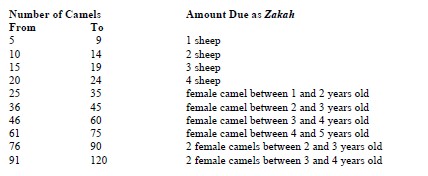
ラクダの数に応じたこの徴収基準については、'Aliから伝えられた報告を除き、合意(イジュマーウ)が成立している。その報告によれば、ラクダ25頭につき羊5頭、ラクダ26頭につき生後1年から2年の雌のラクダ1頭とされている。19 20 Ibn al-Mundhirは次のように述べている。この合意は破られていない。なぜなら'Aliから伝えられたものは真正ではないからである。Anasによるこれらの数量と分量についての言葉は正しく、その内容については全員の一致した同意がある。21 ラクダが120頭を超える場合、多数派の見解では、追加のラクダ50頭ごとに、ザカートの追加分として生後3年から4年の雌のラクダ1頭が課され、追加のラクダ40頭ごとに、生後2年から3年の雌のラクダ1頭が課される。22 これを示したのが次の表である。
There is ijma on this schedule,l9 except for a report from 'Ali that on 25 camels there is five sheep and on 26 camels there is one female camel between one and two years old.20 Ibn al Mundhir says. The unanimity is net broken, because what is reported from 'Ali is not authentic. The saying of Anas on these quantities and amounts is correct and there is a unanimous agreement on its content.21 For more than 120 camels the majority's view is that for each additional 50 camels the additional amount of zakah is a female camel between three and four years old while on each additional 40 camels the additional amount of zakah is a female camel between two and three years old.22 This is shown in the following table :
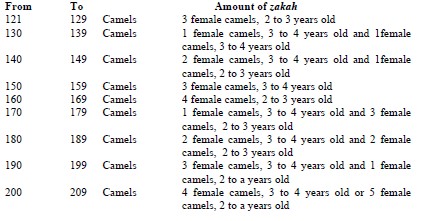
表から、多数のラクダの場合、十頭未満の増加はザカートの額に影響しないことが分かる。十頭増えると、上記と同じ規則に従ってザカートの額が一段階上がる。これら二つの表から明らかなように、所有するラクダが五頭未満であればザカートはない。五頭に達すると、納めるべき額は羊一頭である。 アル・マブスートの著者は、ある学者の言葉を引用している。「これは家畜の価値が考慮されることを意味する。一歳から二歳のラクダは一頭四十ディルハム、羊は一頭五ディルハムで価値づけられていたので、ラクダ五頭は二百ディルハム、また羊四十頭に相当する。これは、ラクダ、羊、銀貨のザカート対象となる最低限度が同じであることを意味する。」 これに対し、イブン・アル・フマームはアル・ファトでイブン・ヌジャイムはアル・バフルで次のように答えている。ある言い伝えには「特定の年齢のラクダをザカートとして納める義務がある者が、その年齢のラクダを所有していない場合、羊を所有していなければ、羊一頭の平均十ディルハムで代替して支払うことができる」とある。これはアル・サラクシーの説明に矛盾する明確な典拠である。24 この言い伝えはアル・バフルがアナスから伝えたものである。
It is seen from the table that for big numbers, an increase of less than ten camels does not affect the amount of zakah. Once it is increased by ten, then you go one step higher in the amount of zakah due according to the same rule mentioned above. It is obvious from these two tables that if the number of camels owned is less than five then there is no zakah. Once they reach five , the amount due is one sheep. The author of al Mabsut quotes a scholar as saying, "this means that the value of the livestock is considered. Camels between one and two years old used to be priced at forty dirhams and a sheep at five dirhams, so five camels equal 200 dirhams also equal 40 sheep. This implies that the minimum for zakatability of camels, sheep, and silver money is the same. Ibn al Humam in al Fath and Ibn Nujaim in al Bahr reply, there is a saying that states "Whoever is obliged to give as zakah a camel of a certain age group, but does not own any in that age, can pay in substitution on the average of 10 dirhams for a sheep, if he does not have a sheep. This is an explicit text that contradicts the explanation of al Sarakhsi.24 The saying referred to is reported by al Bahr from Anas.
シャリーアは、ザカートの対象となるラクダの数が25頭未満の場合、ザカートとして羊を課している。ただし通常、ザカートは課税対象となる資産と同じ種類のものから支払われる。
Shari'ah obligates sheep as zakah on camels if the number of zakatable camels is lees than 25, though usually zakah is paid out of the same kind of the zakated assets.
その理由は明らかに、支払うべき額が一頭のラクダにも満たないからです。しかし同時に、シャリーアは五頭のラクダによって誰が裕福であるかを十分に定めていると見なしています。25
The reason is obviously that the amount due is less than one camel, but at the same time Shari'ah considers five camels to sufficiently define who is rich.25
上記の二つの表にある数量と分量は、神の使徒(ﷺ)の行いに由来する。アル・ナワウィーは『アル・マジュムゥ』の中で、家畜に対するザカートの数量と分量は、アナス(ﷺ)とイブン・ウマル(ﷺ)が伝えた二つの言葉に由来すると述べている。26
Numbers and amounts in the above two tables come from the actions of the Messenger of God (p). Al Nawawi in al Majmu' says that the quantities and amounts of zakah on livestock come from the two saying narrated by Anas and Ibn 'Umar.26
アナスの伝えるところによると、アブー・バクル、すなわち「真実を告げる者」は、彼をバハレーンへ派遣した際にこの書状を書いた。
Anas narrated that Abu Bakr, the Truthful wrote this message when he sent him to Bahrain:
慈悲深く、慈愛あまねき神の御名において。これは、神がムハンマドに命じられたとおり、神の使徒ﷺがムスリムに課された喜捨(サダカ)の義務である。
In the name of God, most merciful, most gracious. This is the obligation of sadaqah imposed on Muslims by the Messenger of God (P), as ordained to him by God.
これらの規則に従って支払いを求められた者は、それを納めなければならず、それ以上の支払いを求められた者は拒否すべきである。ラクダ24頭以下の場合、ザカートは羊で支払われる。ラクダ5頭ごとに羊1頭が必要である。25頭から35頭までに達すると、1歳から2歳の雌ラクダ1頭が必要である。36頭から45頭までは、2歳から3歳の雌ラクダ1頭が必要である。
Whoever is asked to pay it according to these rules must give it, and whoever is asked to pay more should refuse. On each 24 camels or less, zakah is due in sheep. On each five camels, one sheep is required. Once they reach 25 and up to 35 one female camel, one to two years old, is required. From 36 to 45, there is one she-camel two to three years old.
もし数が46から60に達した場合、三歳から四歳の雌らくだ一頭が義務となります。それは繁殖可能な雌らくだです。もし数が61から75に達した場合、四歳から五歳の雌らくだ一頭が義務となります。もし数が76に達した場合は、
If they reach 46 to 60, there is one she-camel three to four years old due, one that can be bred. If they reach 61 to 75, one she-camel four to five years old is due. If they reach 76
もし数が90まで(90を含む)であれば、2歳から3歳の雌ラクダ2頭が義務となります。91から120までに達した場合は、3歳から4歳の雌ラクダ2頭が義務となります。120頭を超える場合は、40頭ごとに…
to 90, there is two she-camels two to three years old due. If they reach 91 to 120, there are two she-camels, three to four years old due. If they are more than 120, for each 40
2〜3歳のメスのラクダが1頭、そして50頭ごとに3〜4歳のメスのラクダが1頭となります。ラクダを4頭まで所有している者は、自発的に差し出す場合を除き、ザカートの対象にはなりません。しかし5頭に達した場合、ザカートとして羊1頭が課せられます。羊のサダカについては、自然放牧され、飼料費がかからない羊が40頭から120頭の間であれば、羊1頭が課せられます。120頭を超えて200頭までは、羊2頭が課せられます。
there is one she-camel two to three years old, and for each 50 there is one she-camel three to four years old. A person who owns [up to] four camels is not zakatable unless he volunteers, but if they reach five camels, one sheep is due on them as zakah. In the sadaqah on sheep, if they are naturally, cost-free pastured, and number between 40 and 120 sheep, there is one sheep due. For more than 120 and up to 200, there are two sheep.
200を超えて300まで(200~300頭)の場合は羊3頭です。300頭を超える場合、ザカート(喜捨)の額は100頭ごとに羊1頭、そして端数もそれに含まれます。所有する羊が40頭未満の場合は、
For more than 200 up to 300 there are three sheep. For more than 300, the amount of zakah is one sheep for each 100 or a fraction therein. If a person owns less than 40
120頭のラクダを超えた場合の率の違い
Variance on the Rates after 120 Camels
先に私が指摘したように、120頭を超えるラクダのザカートについては、法学者の間で見解が分かれています。マーリク、シャーフィイー、アフマド、そして多数派は、追加の50頭ごとに3歳から4歳の雌ラクダ1頭、追加の40頭ごとに2歳から3歳の雌ラクダ1頭という基準を支持しています。これはアナスとイブン・ウマルが順に伝えた、アブー・バクルとウマルの書簡にある内容で、39という数字も含まれています。同じ内容は、イブン・ハズムとズィヤード・ブン・ラビードがハドラマウトの人々に宛てた書簡にも見られ、さらに預言者ﷺの言葉として「120を超えた場合、40ごとに2歳から3歳の雌ラクダ1頭、50ごとに3歳から4歳の雌ラクダ1頭」とも伝えられています。この最後の言葉の一部の伝承では、伝達者が要約しており、追加の40頭についての基準には触れず「50ごとに雌ラクダ1頭……」とだけ述べています。しかし、異なる伝承は互いに補い合っています。
I pointed out earlier that there are varying views among jurists on zakah on above 120 camels. Malik, Shafi'i, Ahmad, and the majority consider the rate to be one female camel, three to four years old for each additional 50, and one female camel, two to three years old, for each additional 40,39 as mentioned in the message of Abu Bakr and 'Umar narrated successively by Anas and Ibn 'Umar. The same also appears in the messages of Ibn Hazm and Ziad bin Labid to the people of Hadramut,40 in the words of the Prophet (p) "If they exceed 120, then for each 40 one female camel two to three years old, and for each 50 one female camel three to four years old". Some versions of the last saying are summarized by that narrator, as "In each 50 one female camel ..." without mentioning the rate for each additional 40, but the different versions complete each other.
アブー・ハニーファの見解
Abu Hanifah's view
アル・ナハイー、アル・サウリー、そしてアブー・ハニーファ41は、「120頭を超えるものについては、最初から割合を数え直す」と述べている。すなわち、さらに5頭から24頭が加わるごとに羊1頭が5頭ごとに課され、さらに25頭が加わると、1歳から2歳の雌のラクダ1頭などが課される。 次の表は、この見解に従って課される額を示している。
Al Nakha'i, Al Thawri, and Abu Hanifah41 say that "for what is above 120, we start the rates from the beginning, i,e., for an additional five to 24 camels, the rate is one sheep for each 5 camels, and for an additional 25 camels zakah due is one female camel, one to two years old, etc."The following table shows the amount due according to this opinion:
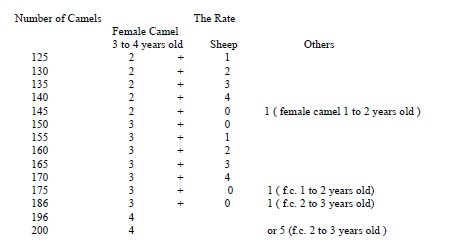
200頭を超えると、そのあとは5頭の駱駝が増えるごとに羊1頭という割合が繰り返されます。また、課税対象の駱駝がさらに50頭増えるたびに、その分の天課として、3歳から4歳の雌駱駝1頭が課されます。
After 200 the rate repeats itself, one sheep for each additional five camels, and each time the additional zakatable camels reach fifty, the amount of zakah due on it is one female camel three to four years old.
ハナフィー学派は、アブー・ダーウードが「マルサル」(伝承者の列に教友の名が挙がっていない伝え)として伝えたものを根拠としています。さらに、イスハークが『ムスナド』に、またタハーウィーが『ムシュケル』に、ハンマード・ブン・サラマから伝えたものも挙げています。ハンマードは次のように語りました。「私はカイス・ブン・サアドに、ムハンマド・ブン・ハズムの書状を手に入れてくれるよう頼んだ。すると彼は一通の手紙を渡してくれた。それは彼がアブー・バクル・ブン・ムハンマド・ブン・ハズムから受け取ったもので、アブー・バクルは、預言者ﷺが私の祖父にこれを書き送ったと言った。私はそれを読み、そこにラクダのザカートの率が書かれているのを見た……」。そして彼は、「ラクダが120頭を超えたなら、30頭ごとに三歳から四歳の雌ラクダ一頭を納めること。その後の増加分については、率を最初から改めて適用すること。25頭未満の分については、5頭ごとに羊一頭をザカートとして納めること」という箇所まで語り続けました。これはザイラーイーの『ナスブ・アル=ラーヤ』に伝えられています。また、アースィム・ブン・ダムラがアリーから伝えた、同様の内容を持つ伝承もあり、それは預言者ﷺに遡るとされるものの、アリーで終わる形でも伝えられています。さらに、イブン・マスウードも同様の趣旨のことを語ったと伝えられています。イブン・ルシュドによれば、ハナフィー学派は、このような事柄は預言者ﷺからの指示によってのみ定めうるのであって、類推によって導き出せるものではないと論じたとされています。44
The Hanafites argue that Abu Daud reports as mursal [saying in whose chain the name of the reporting Companion is not mentioned], Ishaq in his Musnad and al Tahawi in his Mushkel from Hmmad bin Salamah, who said, "I told Qais bin Sa'd to get me the message of Mohammad bin Hazm, so he gave me a letter which he said he took from Abu Bakr bin Mohammad bin Hazm, who said that the Prophet (p), wrote it to my grandfather. I read it and found in it the rates of zakah on camels... " and he narrated the saying until, "Once they exceed 120 make due on each 30 one female camel three to four years old. For the increments, restart the rates from the beginning, and for what is less than 25 camel increments, the amount of zakah is due in sheep, one sheep for each five." This is reported in Nasb Al Rayah by al Zaila'i.42 A similar version is narrated by 'Asem bin Damurah from Ali, linked to the Prophet as well as ending at 'Ali,43 and Ibn Mas'ud is reported to have said similar things. The Hanafites are said by Ibn Rushd to have argued that such a thing cannot be decided but by instructions from the Prophet, because it is not anything that can be deducted by analogy.44
大多数の学者は、ハナフィー派の論拠に反対し、その結論に弱点があると見ている。アル=バイハキーは、この件についてイブン・マスウードから伝えられているものはいずれも正しくないことを示している。45 預言者(ﷺ)に結び付けられているアリーの言葉の伝承も誤りであり、アリーに帰せられる伝承についても見解が分かれている。ある伝承はアブー・バクルとウマルの書簡と一致する形で伝えられているが、別の伝承では異なる形で伝えられている。このような場合に通常適用される原則は、争いのない他の正しい言葉と一致する伝承により重きを置くことである。これはアル=ハズィミーが指摘している。46 さらに、(アーシムからの)同じ伝承には、その弱さのゆえに学者全員が退けることで一致している一文が含まれている。それは、二十五頭のラクダごとに、一歳から二歳の雌ラクダの代わりに五匹の羊をザカートとして納めるべきだという記述である。一方で、それら相異なる伝承は、他の正しい言葉と整合するように解釈することも可能である。
The majority of scholars disapprove of the arguments of the Hanafites and see weakness in their findings. Al Baihaqi shows that whatever is reported from Ibn Mas'ud in this matter is not correct.45 The version of the saying of 'Ali which is linked to the Prophet (p) is also incorrect, and there are also differing opinions on the version that is attributed to 'Ali. In one version it is reported in a consistent manner with the letters of Abu Bakr and 'Umar, while in another version it is reported differently. The usual applicable rule in such a case is that we give more weight to the version that is consistent with other correct sayings which are not disputed. This was noted by al Hazimi.46 Moreover, the same version of the saying (from 'Asem) contains a sentence all scholars agree to disregard because of its weakness. That is the statement that for each 25 camels the zakah due is five sheep instead of a one to two years old she-camel. On the other hand, it is possible to interpret those differing versions in a way that make then consistent with the other correct sayings.
アル・タバリーの見解
The view of Al Tabari
アブー・ジャアファル・アル=ターバリーは、両見解がいずれも認められるとし、どちらの見解を適用するかはザカート徴収機関の判断に委ねるという、第三の調和的な見解を示している。52 私の考えでは、これはより良い方法である。なぜなら、預言者(ﷺ)からの伝承のすべてを調和させる可能性がわずかでもある限り、ある言葉の内容を廃止され無効とされたものとみなすべきではないからである。アル=ターバリーの提案する調和は、ラクダの年齢の区分とザカートとして納めるべき頭数の決定が、ザカートの計算、納付、徴収を容易にし、手続きを簡素化して、ザカート徴収機関がある程度の裁量を行使できるようにすることを目的としていることを念頭に置けば、疑いなく受け入れられるものである。
Abu Ja'far al Tabari expresses a third, reconciling view, stating that both opinions are acceptable, and it is up to the zakah collection agency to select which view to apply.52 In my opinion this is a better approach, since one should not consider the content of a saying superseded and annulled if there is the slightest chance of a reconciliation of all the reports from the Prophet (p). The reconciliation proposed by al Tabari is undoubtedly acceptable if we keep in mind that the determination of ages and quantity of camels due as zakah is meant to facilitate zakah calculation, payment, and collection, and to simplify the procedures so that the zakah collecting agency can exercise some discretion.
ザカートの文字表記におけるわずかな違い
The slight differences in the letters of zakah
ザカートに関して、神の使徒(p)とその正統な後継者たちから伝えられるメッセージの様々なバージョンを見ると、いくつかの些細な違いに気づくでしょう。その一例は、異なる年齢のラクダの間の価値の差が10ディルハム(または羊2頭)なのか、20ディルハム(または羊2頭)なのか、という点です53。アリーの書簡と、アブー・バクルおよびウマルの書簡との違いは、どのように説明できるでしょうか。アリーの伝承が預言者(p)に遡るものとしては誤りであることは知られていますが、それがアリー自身の言葉であるとするバージョンは正しいことも知られています。アリーは、どうして預言者(p)の書簡と異なることがあり得たのでしょうか。アブー・バクルとウマルの時代を生きた彼が、どうして両者の書簡とその適用について知らなかったはずがあるでしょうか。彼は、他方の書簡に含まれるものに優先する情報を自分が持っていると信じていたのでしょうか。
Looking at the different versions of messages about zakah reported from the Messenger of God (p), and his Wise Successors, one would find some minor differences. An example is whether the difference in value between different age camels is ten dirhams (or two sheep) or twenty dirhams (or two sheep)53. How can the difference between the letter of 'Ali and those of Abu Bakr and 'Umar be explained? It is known that the report of 'Ali is incorrect as linked to the Prophet (p), but it is also known that the version stating that it is a saying of 'Ali himself is correct. How could 'Ali differ with the letter of the Prophet (p)? How could he, who lived the era of Abu Bakr and 'Umar not be aware of their letters and application? Did he believe that he had information which superseded that contained in the other letter?
私の見解では、これらの問いにはいずれも否定的な答えが出ると思われ、それらの小さな相違については別の解釈が必要だと考えます。羊と銀の価値の等価関係などの一部は、預言者(ﷺ)が国家の指導者としての立場から定めたものだと私は考えています。その時代の価格では、羊一頭はおよそ十ディルハムに相当しました。価格は時代によって変動することが知られており、預言者(ﷺ)が羊二頭を二十ディルハムとする比率を示したとき、それはその時代の現行価格を示していたのです。アリーのカリフ時代には羊の価格が異なっており、彼は羊二頭を十ディルハムとして示しました。これは預言者(ﷺ)の言葉に反するものではなく、預言者(ﷺ)が用いた原則を、アリーの時代に適合させて適用したものです。この解釈は、私の考えでは、異なる伝承のいずれかを退けようとするどのような試みよりも優れています。たとえば、ザカートの割合と分量について何も正しく伝えられていないと主張したヤヒヤー・ブン・マアイーンのやり方はその例です。イブン・ハズムはそのような主張に強く反発し、イブン・マアインのような人物が、わずかな裏付けさえないままにどうしてそのようなことを述べられるのかと問いかけました。シャハトのような東洋学者は、ザカートに関する正しい言い伝えをすべて退けようとする試みの中で、その主張を極端に濫用しています。
In my opinion all these questions are answered negatively and it seems to me that another interpretation of those minor differences is due. I believe that some of these equalities, like the value of sheep in silver, are given by the Prophet (p), in his capacity as the head of the state. Their prices at his time were such that a sheep equaled approximately ten dirhams. It is known that prices vary from time to time, and when the Prophet (p), gave the ratio as twenty dirhams for two sheep he was quoting his period's current prices. At the time of 'Ali's caliphate, prices of sheep were different, and his quotation of those prices were ten dirharms for two sheep. This is not a violation of the Prophet's saying, but rather an application of the rule used by the Prophet (p), to what suits the time of 'Ali. This interpretation is, in my opinion, better than any attempt to disregard any of the differing texts, like what Yahya bin Ma'in did in claiming that nothing correct is reported on the determination of rates and quantities of zakah.55 Ibn Hazm came down very hard on such a claim and asked how a person like Ibn Ma'in could state such a thing without even the slightest supporting evidence.56 An Orientalist like Schacht abuses to the utmost that claim in his attempt to reject all the correct sayings on zakah.
第三節 牛のザカート
SECTION THREE ZAKAH ON COWS
牛は、耕作、肉、そして乳のために人類に利用されており、神がそのしもべたちに与えた、もう一つの恵みです。この種の有用性は時として非常に大きく、古代エジプト人や現代のヒンドゥー教徒など、一部の民族はこの動物を崇拝しました。
Cows, used by mankind for land cultivation, meat and milk, are another bounty of God on His servants. The usefulness of this species was so great at times that some peoples, such as the ancient Egyptians and contemporary Hindus worshiped this animal.
水牛は、イブン・アル=ムンズィルが述べているように、すべてのイスラム法学者によって牛と同じ類に数えられている。
Buffalo is counted with the cows by all Muslim jurists, as stated by Ibn al Mundhir.
牛に対するザカートは、スンナとイジュマー(合意)によって義務づけられている。ブハーリーは、その正しいハディース集の中で、アブー・ザッルから次のように伝えている。「私は預言者(p)のもとに来た。すると預言者は言われた。『その魂が彼の御手にある御方に誓って』、あるいは『その御方の他に神はない御方に誓って』。ラクダ、牛、羊を所有しながら、その権利(義務)を果たさない者は、審判の日に、それらの最も大きく最も重い姿で踏みつけられる。それらは蹄で彼を踏み、角で彼を突く。そして最後の一頭が彼を終えると、最初の一頭が再び連れ戻され、すべての人々に裁きが下されるまでそれが続く。」 イマーム・アル=ブハーリーは、さらに次のように述べている。「これはバキールからアブー・サーレフを通じ、アブー・フライラから預言者(p)に伝えられたものとしても語られている。この言葉にある『権利(義務)』とは、他の何よりも先にザカートを指す。ザカートとは、アブー・バクルが、ザカートを拒んだ者たちと戦った際に定めた、財産に対する義務の権利であり、この定義は、ウマルおよび他のすべての教友たちによって承認された(アル=ブハーリーとムスリムが伝えている)。ムスリムの伝承では、『権利(義務)』という語の代わりに『ザカート』という語が用いられている。さらに、ムスリムは全世代を通じて、牛にザカートが義務であることで一致してきた。この点について異を唱えた学者は一人もいない。ただし、牛のニサーブ(最低基準額)とザカートの率の決定については相違がある。」
Zakah on cows is obligated by Sunnah and Ijma. Bukhari, in his correct collection, reports from Abu Dharr "I came to the Prophet (p)58 and he said 'I swear by He who holds my soul in His hand,' or 'I swear by the one beside whom there is no God. No man who has camels, cows or sheep and does not pay their right due but on the Day of Judgement will be trampled by them at their largest and heaviest. They will be stepping on him with their hooves and ramming him with their horns, and when the last one is done with him the first is brought back until judgement has been given to all people." Imam al Bukhari said "It is also narrated by Bakir from Abu Saleh from Abu Hurairah from the Prophet (p). The "right due" mentioned in the saying means zakah before any other thing. Zakah is the right due on wealth as defined by Abu Bakr at the time of fighting those who rejected zakah, this definition was approved by 'Umar and all other Companions, (reported by al Bukhari and Muslim). In the version reported by Muslim the word "zakah" is used in place of the word "right due", moreover, Muslims through all generations have unanimously confirmed that zakah is obligated on cows. Not a single scholar disagrees.59 There are however, differences in determining nisab and zakah rates on cows.
牛のニサーブとザカートの割合
Nisab and rates of zakah on cows
ウシの zakah(ザカート)の nisab(ニサーブ)と率について、ラクダの場合のように確実なハディースは伝わっていません。これは、ヒジャーズ地方(マッカとマディーナの周辺)ではウシが珍しかったためかもしれません。また、ウシはその大きさや価値がラクダに近いため、預言者ﷺがそれらの明白な類似を前提として、その率を定めなかったのかもしれません。しかし、この問題について確実なハディースがないことから、ニサーブと率の決定については、法学者たちの間でさまざまな見解が生じることになりました。
There is no correct saying that provides us with the nisab and rates of zakah on cows as we have seen on camels. This may be because cows were rare in the area of Hijaz (around Makkah and Madinah); it may be also because cows are close in size and value to camels, so the Prophet did not determine their rates on the assumption of their obvious similarity. But the fact that there is no correct saying on the issue left the jurists with varying views on the determination of nisab and rates.
世間一般の意見:ニサーブは30頭の牛である
The popular opinion: Nisab is 30 cows
法学の四大学派が支持する通説では、ニサーブは30である。
The reputed position upheld by the four schools of jurisprudence is that nisab is 30
牛について、30頭未満では義務のザカートはありません。30頭の場合は1歳の牛1頭が義務となります。40頭から59頭までは、2歳の牛1頭が義務となります。60頭の場合は1歳の牛2頭、70頭の場合は1歳の牛1頭と2歳の牛1頭、80頭の場合は
cows, and there is no obligated zakah on less than 30 cows. For 30 cows, a one-year old cow is due, and for 40 to 59 cows there is one cow, two years old, due. For 60 cows, two one-year-old cows are due; for 70 cows, a one-year-old and a two-year-old; for 80
牛の場合、40頭につき2歳の雌牛1頭、 90頭につき1歳の雌牛3頭、 100頭につき2歳の雌牛1頭と1歳の雌牛2頭、 110頭につき2歳の雌牛2頭と1歳の雌牛1頭、 120頭につき2歳の雌牛3頭または1歳の雌牛4頭。
cows, two two-year olds; for 90 cows, three one- year-olds; for 100 cows, one two-year old and two one-year-olds; for 110, two cows two year olds and one cow one year old, and for 120 cows, three two-year olds or four one-year olds.
この見解は、アフマドおよびスナン・アッ=ティルミズィー、アン=ナサーイー、アブー・ダーウード、イブン・マージャのの四書に伝えられた次のハディースに依拠している。マスルーク(タービイー)がムアーズ・ブン・ジャバルから伝えたもので、ムアーズは言った。「神の使徒ﷺは私をイエメンに遣わされた。そして、牛三十頭ごとに一歳の雌牛一頭を、四十頭ごとに二歳の雌牛一頭を徴収するように命じられた」。このハディースは、アッ=ティルミズィーによって良(ハサン)と評価され、イブン・ハッバーンとアル=ハーキムによって正しいものとされた。イブン・アブドゥル・バッルは「その伝承経路は正しく、途切れることなく、真正である」と述べ、イブン・バッタールも同様の見解を示している。イブン・ハジャルは『ファトフ・アル=バーリー』で次のように述べている。「このハディースの正しさについてのいかなる判断も精査する必要がある。なぜなら、タービイーであるマスルークはムアーズと会ったことがないからである」。アッ=ティルミズィーがこれを良と見なしたのは、『ムワッtaʾ』に伝えられた、タウスからムアーズに至るハディースなど、それを裏付ける他のハディースがあるからである。しかし、タウスもまたムアーズと会ったことがない。61
This opinion relies on the saying reported by Ahmad and the four books of Sunan al Tirmidhi, al Nasa'i, Abu Daud and Ibn Majah from Masruq from Mu'adh bin Jabal who said "The Messenger of God, (p) sent me to Yemen. He instructed me to collect on each 30 cows, a one year-old cow, and on each 40 cows one two-year-old"60. This saying is graded as good by al Tirmidhi and as correct by Ibn Habban and al Hakim, Ibn 'Abd al Barr comments "Its chain is correct, continuous and authentic" and similar statement is made by Ibn Battal. Ibn Hajar said in al Fath "We need to scrutinise any ruling about the correctness of this saying, because Masruq [The follower] did not meet Mu'adh." al Tirmidhi considers it good because there are other sayings that testify with it, such as the one in al Muwatta, from Taus from Mu'adh, but Taus did not meet Mu'adh either.61
アル=タバリーの見解では、ニサーブは50である。
The view of al Tabari that nisab is 50
イブン・ジャリール・アル=タバリーは、ニサーブは50頭の牛でなければならないと論じている。50頭ごとに牛1頭のザカートが義務となることは、疑いなく全員の一致した見解である。50頭未満の場合は議論のあるところで、明確な典拠によって裏付けられていない、と彼は述べている。 イブン・ハズムは『アル=ムハッラー』において、アル=タバリーと同じ根拠からこの見解を支持している。彼はこう述べる。「議論の余地があり、義務であることを示す明確な典拠がないものは、人々に課されてはならない。神または神の使徒(ﷺ)からの正しい典拠によって義務であることが確実でないまま、ムスリムの財産の一部を没収することになるからである。」 彼はさらに、自身の伝承経路を通じて、アムル・ブン・ディーナールからの伝承を引用している。「イブン・アル=ズベイルの徴収官たちと、イブン・アウフの徴収官たちは、50頭ごとに牛1頭を徴収していた。100頭ごとには2頭、それ以上の場合も50頭ごとに1頭の割合であった。」これらの徴収官たちは、マディーナにいた非常に多くの教友たちの面前で職務を行っていたが、その行為に異議を唱える者はいなかった。
Ibn Jarir al Tabari argues that nisab must be 50 cows, that if is undoubtedly unanimous that for each 50 cows there is an obligatory zakah of one cow. Anything below 50 is controversial and not supported by a clear text.69 Ibn Hazm in al Muhalla supports this opinion on the same grounds as al Tabari. He comments "Anything that is controversial and on which there is no text making it obligatory must not be imposed on people, because it means confiscating a part of a Muslim's wealth without being certain about its requirement by virtue of a correct text from God or His messenger (p).70 He went on to quote, through his own chain, from 'Amr bin Dinar, "The commissioners of Ibn al Zubair as well as Ibn 'Auf used to collect one cow from each 50 cows,71 2 cow from each 100 and for more than that, the rate was one cow out of each 50.72 These commissioners were performing their duties in the presence of many, many Companions in Madinah, and this performance was not objected to.
しかし、この見解は二つの根拠から反証することができる。
But one may disprove this opinion on two grounds:
A. テキストの観点から見ると、アムル・ブン・ハズムによるザカートに関する長いハディースには、「三十頭の牛ごとに一歳の牛一頭を、四十頭の牛ごとに一頭の牛を取る」とあります。このハディースは、数人の著名な学者によってハサン(良)と評価されており、タバリーは著書『アル=イマーム』において、タキー・アッディーン・ブン・ダキーク・アルイードの見解に反論する際にこれを用いています。73
A. From the point of view of the text. The long saying of 'Amr bin Hazm on zakah says "and from each 30 cows, take one cow one-year-old, and from each 40 cows, one cow". This saying is graded good by a handful of leading scholars and it was used by al Tabari against the view of Taqiy al Din bin Daqiq al 'Id in his book Al Imam.73
ムアーズの言葉として伝えられるもので、ザカート(喜捨)は牛の場合、三十頭ごとに一歳の子牛を徴収すべきである、という内容について。
Additionally, the saying of Mu'adh according to which zakah should be collected on 30
そして40頭の牛は、主要な学者たちの一団によって正しいと評価されています。この言葉に基づいて、イブン・ハズムは自らの見解を改め、大多数の見解に立ち返ったのです。74
and 40 cows is graded correct by a group of the leading scholars. It is by virtue of this saying that Ibn Hazm corrected himself and reverted to the view of the majority.74
B. 理性の観点から見ると、最も公正で賢明なシャリーアが、ラクダなら5頭、羊なら40頭で zakah を課すにもかかわらず、牛については課税の最低基準を50頭とするとは考えにくい。牛はラクダほど大きくはないかもしれないが、羊よりも確実に大きく、有用で、価値がある。
イブン・アル=ムサイイブとアル=ズフリーの見解
The opinion of Ibn al Musayyeb and Al Zuhri
二人の著名な学者、サイード・ビン・アル・ムサイイブとムハンマド・ビン・シェハブ・アル・ズフリー、そしてアブー・クラーバとその他の人々は、牛のニサーブをラクダのニサーブと同じと見なし、ラクダのザカートの率も、ラクダの年齢を考慮しないという小さな変更を除いて、牛にも同じであるとしている。同様の見解は、ジャービル・ビン・アブドゥッラーや、預言者(ﷺ)の時代にザカートを支払っていた他の人々から伝えられた、ザカートに関するウマル・ビン・アル・ハッターブの書簡の一つの版として報告されている。アブー・ウバイドは、ムハンマド・ビン・アブドゥッラフマーンから、ウマル・ビン・アル・ハッターブが書いたザカートに関する指示には「牛からは、ラクダから取るのと同じものを取るべきである」という内容が含まれていたと伝えている。アブー・ウバイドはさらに続けて、「牛のザカートについて他の人々に尋ねたところ、答えは、ラクダと同じであるというものだった」と述べている。
Two leading scholars, Said bin al Musayyeb and Muhammad bin Shehab al Zuhri, along with Abu Qulabah and others view nisab on cows to be the same as nisab on camels, and the zakah rate of camels to be the same for cows with only a minor change, that is, disregarding the ages of camels. A similar opinion is reported as a version of the letter of 'Umar bin Al Khattab on zakah, from Jabir bin 'Abd Allah and others who paid zakah at the time of the Prophet (p). Abu 'Ubaid reported from Mohammad bin 'Abd al Rahman that the instructions 'Umar bin al Khattab wrote on zakah included "from cows one should take the same as from camels." Abu 'Ubaid continues "Others were asked about zakah on cows and the answer was it is the same on camels".
イブン・ハズムは、自身の伝承経路によって、アル=ズフリーとカターダが、ジャービル・ブン・アブドゥッラーから伝えた言葉を報告している。それによれば、「牛五頭につき羊一頭、十頭につき羊二頭、十五頭につき羊三頭、二十頭につき羊四頭が義務となる」とのことである。アル=ズフリーは次のように述べている。「牛のザカートは、年齢の違いを除けば、ラクダのザカートと同じである。すなわち、牛の数が二十五頭から七十五頭の間であれば」
Ibn Hazm reports with his own chain from al Zuhri and Qatadah, both from Jabir bin 'Abd Allah his saying that "in each five cows there is one sheep due, in ten two sheep, in 15, three sheep, and in 20, four sheep due." Al Zuhri says "zakah on cows is like zakah on camels except for the ages. That is, if the number of cows were between 25 and 75
その牛に対して課されるザカートの額は、牛1頭である。76頭から120頭の間は牛2頭、120頭を超えると、さらに40頭ごとに牛1頭が加算される。 「30頭ごとに満1歳の牛1頭、40頭ごとに牛1頭が課される」という記述は、イエメンの人々に対する簡略化と軽減の措置にすぎず、後に撤回されたものであると我々は教えられている。 76 また、イクリマ・ブン・ワリードは次のように述べている。「その後、私は『イック』のザカートの徴収を任じられ、神の使徒(ﷺ)の時代にザカートを納めていた年配の人々に会った。彼らの意見は分かれていた。ある者は、牛のザカートもラクダのザカートと同じように課すべきだと言い、ある者は、30頭ごとに満1歳の牛1頭を取り、また別の者は、40頭ごとに満2歳の牛1頭を取るべきだと言った。」 76 イブン・ハズムは、自身の伝承経路を通じて、イブン・アル・ムサイイブ、アブー・クラーバ、そして別の学者から、アル・ズフリーの見解と同様の見解を伝えている。さらに彼は、ウマル・ブン・アブドゥルラフマーン・ブン・ヒルダ・アル・アンサーリーから次のように伝えている。「牛のザカートは、年齢の違いを除けば、ラクダのザカートと同じである。」77
the amount of zakah due on it is one cow, between 76 and 120 two cows. Above 120, for an additional 40 cows there is one additional cow. We were told that the statement 'in each 30 cow there is one cow due one year old, and in each 40 cows there is due one cow ' was only a simplification and reduction in the rates for the people of Yemen which was disregarded later."76 It is also reported from 'Ikrimah bin Walid his saying: later I was commissioned on the zakah of 'Ikk and I met some old people who paid zakah at the time of the Messenger of God (p). They disagreed: some of them said make zakah on cows like zakah on camels, and some said from each 30 cows you take one cow, one year old, while yet some others said from each 40 cows you should take one two-year-old cow."76 Ibn Hazm reports through his own chain from Ibn al Musayyib, Abu Qulabah, and another scholar a view similar to that of al Zuhri. He also report from 'Umar bin 'Abd al Rahman bin Khildah al Ansari, "Zakah on cows is the same as zakah on camels except for the ages.77
根拠となる証拠
Evidence supporting this view
A. この見解は、Abu Ubaidがみずからの伝承経路によって、Muhammad bin 'Abd al Rahmanから伝えた報告に支えられている。その報告は次のとおりである。「ザカートに関する預言者の文書と、'Umar bin al Khattabの文書の中に、牛からは、ラクダから取るのと同じものを取るべきである、とある。」ﷺ78
A. This opinion is supported by a report of Abu Ubaid with his own chain from Muhammad bin 'Abd al Rahman, "It is in the Prophet's letter on zakah and in the letter of 'Umar bin al Khattab that from cows, one should take the same as from camels."78
また、この見解は、アブドゥル・ラッザークがマアマルから伝えたものによって裏付けられている。マアマルは次のように述べた。「サンマーク・ビン・アル・ファドルが私に、預言者ﷺからマリク・ビン・クフランス・アル・ムスアビーンに宛てた手紙を渡してくれた。その中には次のように書かれていた。『牛にも、ラクダと同じ義務が課される』」79
Also, this view is supported by what is reported by 'Abd al Razzaq from Ma'mar, who said, " Sammak bin al Fadl gave me a letter from the Prophet, to Malik bin Kuflanis Al Mus'abiyn, in which I read, 'and on cows is due the same as on camels.'"79
B. これは、アル=ズフリーが伝えたこと、すなわちそれが神の使徒(ﷺ)からの最後の伝承であったこと、そして三十頭の牛ごとに一歳の牛を一頭取ることは、当初イエメンの人々に対する恩恵であったことによっても裏付けられる。この伝承はムルサル(伝達者の欠落した伝承)であるが、前述の言葉や一部の教友の言葉によって支持されている。
B. This is confirmed by what is mentioned by al Zuhri that it was the latest report from the Messenger of God (p), and that taking a one-year-old cow of each 30 cows was, at the beginning, a matter of favor for the peoples of Yemen. This report is mursal, but it is supported by the previous saying and by statements from some Companions.
イブン・ハズムはこう述べている。「もし何者かのマルサル(伝承者の脱落した伝承)が受け入れられるとすれば、それはアル・ズフリーから受け入れられるに値する。彼はスンナに精通しており、多くの教友に会っていたからである。」80
Ibn Hazm comments "If a mursal saying would be accepted from anyone, it deserves to be accepted from al Zuhri because he was well versed in Suunah and met a number of the Companions".80
C. この見解は、第3節の冒頭で言及されている言葉に含まれる一般的な原則によっても支持される。すなわち、「牛を所有していながらその権利(ザカート)を支払わない者は、審判の日に、牛に踏みつけられるために横たえられるであろう」という言葉である。これは、テキストやイジュマー(合意)によって設けられた制限を除き、いかなる数の牛も含む一般的なテキストであると論じられている。さらに、30頭ごとに1歳の牛一頭、40頭ごとに2歳の牛一頭が義務となるという言葉も、この見解を支持すると論じられている。なぜなら、それは30頭未満の牛からザカートを免除するものではなく、ザカートの率を述べたものにすぎないからである。
C. This view is also supported by the general rule implied in the saying mentioned at the beginning of Section 3 "And for anyone who owns cows and who does not pay their right due, he would be laid down for the cows to trample on the Day of Resurerction" It is argued that this is a general text that includes cows of any number except for restrictions brought in by a text or any Ijma'. It is further argued that the saying stating that there is one cow, one year old, due, on each 30, and a two-year-old due on each 40 also supports this opinion because it does not waive zakah from cows below 30. It is only a statement of the rate of zakah.
第四の見解
A fourth opinion
イブン・ルシュドは、さらに別の見解を挙げているが、その見解の提唱者の名も、その論拠も示していない。すなわち、「牛十頭ごとに羊一頭が義務となり、三十頭に達すると、一歳の子牛一頭が義務となる」というものである。84 私は、イブン・アビー・シャイバーがその著『al-Musannaf』において、この見解をシャフル・ビン・ハウshabの説として伝えていることを見出した。シャフルは次のように述べている。「ザカートは、牛十頭ごとに羊一頭、牛二十頭ごとに羊二頭、そして三十頭で一歳の子牛一頭とすべきである」。
Ibn Rushd gives yet another opinion without providing the name of its author nor its argument: On each ten cows there is one sheep due, until they reach 30 cows, on which there is a one-year-old cow due.84 I find that Ibn Abi Shaibah attributes this view to Shahr bin Haushab in his al Musannaf. The latter says "zakah should be one sheep due on each ten cows, two sheep on each twenty cows, and one cow, one year old, on 30
cows."85 これは、先に述べた見解では牛の最低限度(ニサーブ)が五頭であったのに対し、ここでは十頭になることを意味する。イブン・アビー・シャイバは、この見解を支持する証拠を挙げていない。ここで、人命の損害賠償を百頭のラクダまたは二百頭の牛と定める言い伝えによって、この主張を裏付けられるのではないかと考える人もいるかもしれない。これは、ウマルが語ったものとして伝えられ、また預言者(ﷺ)に帰せられている。86 これは、ラクダ一頭が牛二頭に相当することを示している。ラクダのニサーブが五頭であれば、牛のニサーブは十頭でなければならず、ラクダ五頭ごとに義務となるザカートが羊一頭であるならば、牛十頭ごとに羊一頭が義務となるはずである。
cows."85 This means that nisab of cows is ten as compared to five in the previously mentioned opinion. No evidence of support is given by Ibn Abi Shaibah. It may come to mind that this argument can be supported by the saying that estimates the compensation for the loss of life at 100 camels or 200 cows. This is reported as said by 'Umar, as well as linked to the Prophet (p).86 This implies that one camel equals two cows. If nisab for camels is five, that of cows must be ten, and if for each five camels the amount of zakah due is one sheep, there should be one sheep due for each ten cows.
分析と比較検討
Analysis and weighing
以上の諸見解を挙げた上で、私には、牛30頭および40頭ごとの率に関する多数派の見解の方が、ムアーズとアムル・ブン・ハズムの言葉に基づくため、より重みがあると思われる。しかしながら、この二つの言葉は、30頭未満の場合について、肯定的にも否定的にも何も述べておらず、対比による場合を除き、ザカートのニサーブではなくザカートの率を定めているにすぎない点に注目すべきである。 興味深いことに、イブン・ハズムの言葉はさらに、「金40ディナールごとに1ディナールが義務となる」と述べている。多数の法学者は、金のニサーブは40ディナールではなく20ディナールであることで一致しており、これはこの言葉がザカートの率を定めるために述べられたもので、必ずしもそのニサーブを定めるものではないことを示している。金に対するザカートの率は2.5パーセント、すなわち40分の1だからである。
After listing all these opinions,87 it seems to ms the view of the majority about the rate on each 30 and 40 cows is the one that carries more weight, on the basis of the saying of Mu'adh and Amr bin Hazm. However, it is notable that these two sayings do not give information about what is below 30 cows, whether negative or positive, but only determine the rate of zakah rather than its nisab, except by contrast. Interestingly enough, the saying of Ibn Hazm goes on to state, "And on each 40 dinars (of gold) there is due one dinar". The majority of jurists agree that nisab on gold is 20 dinar and not 40, which indicates that this saying was given to determine the rate of zakah and not necessarily its nisab, since the rate on gold is two-and-half percent or one-fortieth.
このような見解を、イブン・ル・ムサイイブ、アル・ズフリーおよびその一派の従う見解、すなわち牛のニサーブを五頭とする見解と組み合わせることは可能である。とりわけ、ウマルのザカートに関する書簡のある版では五頭とされており、それは教友ジャービル・ビン・アブドゥッラーからの伝承として伝えられ、時には預言者(p)の書簡に帰せられることもあるからである。アブー・ウバイドは、この見解は人々に知られていなかったと述べているが、先に示したように、実際には多くの教友やタービウーンの何人かに知られていたのである。さらに、牛とラクダの類推は強固なものであり、イブン・ハズムの異議は、類推はすべて無効だとする彼個人の見解に基づくものとして退けてよい、と論じることもできる。学者の大多数は、正しい類推がシャリーアにおける導出の典拠であるという原則に同意している。
It is possible to combine this opinion with that of Ibn al Musayyib, al Zuhri and their group of followers in putting nisab on cows at five, especially since it is put at five in a version of 'Umar's letter on zakah, as a report from Jabir bin 'Abd Allah, a Companion, and is sometimes attributed to the letter of the Prophet (p). Abu 'Ubaid comments that this opinion was not known by people, but it was shown earlier that it was in fact known to a number of Companions and Followers. Additionally, one can argue that the analogy of cows and camels is a strong one and the objection of Ibn Hazm can be disregarded as based on his personal view that all analogy is invalid. The majority of scholars are in accord on the principle that the correct analogy is a source of deduction in Shari'ah.
神はよくご存じです。しかし私には、預言者(p)が、社会の状況の変化に応じてザカートの適用を柔軟にするために、ザカートに関する特定の事柄をあえて未定かつ不確定のままにしておかれたように思われます。それらの細目を時々定めるのは、イスラーム国家とそのザカート機関の役割です。牛はラクダより高価で有用になることもあります。その場合、ニサーブを五頭に定め、五頭の牛につき羊一頭という割合を適用してもよく、牛が三十頭や四十頭になったときには、ムアーズの言葉を適用してもよいでしょう。この見解は、牛の飼育が大規模で利益の大きい事業になったときに、より実際的で明確になるかもしれません。国や時代によっては、牛の価値がラクダより低く、五頭では課税対象となる最低限の富とはみなせないこともあります。その場合には、ニサーブを三十頭に定めることができます。この柔軟性の根拠は、ザフリーの「牛三十頭をニサーブとしたのは、ただイエメンの人々に便宜を図るためだった」という言葉にあります。ザフリーの言葉に照らせば、ニサーブを三十頭とする書簡と五頭とする書簡の時間的な前後関係は、後者が前者を無効にしたことを必ずしも意味しません。むしろ、預言者(p)が使徒としてではなく国家元首としての立場から、二つの異なる状況に応じて異なる適用をされたものと解釈できます。したがって、状況が異なれば、預言者(p)はさらに別の見解を示されたかもしれません。89
第四節 羊のザカート
SECTION FOUR ZAKAH ON SHEEP
ヒツジに対するザカートは、スンナとイジュマー(合意)によって義務となっている。スンナについては、先に言及されたアブー・バクルの指示の書簡の中で、アナスが次のように伝えている。「放牧されて自然に育つヒツジへのサダカは、四十頭ごとに一頭が義務となり、百二十頭までである。」
Zakah on sheep is obligating by virtue of Sunnah and Ijma'. In Sunnah, Anas narrates in the letter of instruction of Abu Bakr mentioned earlier that "As for sadaqah on sheep, naturally cost-free pastured, out of each 40 there is one sheep due, up to 120.
数が増えた場合、200頭までは羊2頭が義務となり、300頭までは数が1頭増えるごとに羊3頭が義務となります。300頭を超えた場合は、100頭ごとに羊1頭が取られます。自然に放牧され、費用のかからない羊が40頭未満、たとえ1頭でも少ない場合、所有者が自発的に喜捨を望まない限り、それに対する義務的なサダカはありません。ザカートとしては、老いた羊、傷ついた羊、雄羊は、所有者が自発的に差し出した場合を除き、受け取ってはなりません。」イブン・ウマルの言葉や、他のいくつかの伝承にも同様の記述が見られます。
If the number increased, then two sheep are due up to 200, and if the number increases by one up to 300, there are three sheep due. If it is above 300,90 then one sheep is taken for each additional 100. If naturally, cost-free pastured sheep are less than 40, even by only one, there is no obligatory sadaqah on it unless the owner wishes to volunteer, As zakah one should not accept the old, the damaged, or the ram except when volunteered by the owners." Similar statements appear in the saying from Ibn 'Umar and in several others.
法学者たちは、羊に対してザカートが義務であることで一致している。また、「ガナム(ghanam)」という語が羊と山羊の両方を含み、両者を一つのものとしてまとめて扱うことについても、全員の見解が一致している。91
Jurists unanimously agree that zakah is obligatory on sheep. There is also unanimous opinion that the word "ghanam" includes both sheep and goats in such a way that they are combined together as one item.91
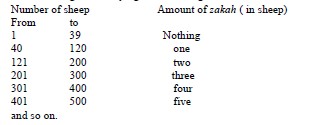
この言葉に基づいて、次の表を作成することができます。
According to this saying the following table can be drawn:
第6節では、ザカートとして取るべき家畜の種類について、その大きさ、年齢、性別とともに説明します。
We will discuss in section 6 the description of what animal should be taken as zakah as for its size, age and sex.
羊の税率についての議論
Discussion of the rate on sheep
シャリーアが羊の数の増加に応じて料率を引き下げたことは注目に値する。前の表からは、羊の数が120を超えると料率が1パーセントで安定することが分かる。これは、商業資産、現金、その他の資産に対する通常の2.5パーセントとは対照的である。この引き下げの根拠は何か。現代の研究者の中には、92この引き下げによって、シャリーアは家畜の繁殖を奨励しようとしているのだと論じ、この引き下げを説明しようとする者がいる。40
It is notable that Shari'ah reduced the rate on sheep as their number increases. From the previous schedule it is observed that as the number grows above 120 the rate stabilizes at one percent in contrast with the usual two-and-half percent on business assets, money and other assests. What is the rationale for this reduction? Some contemporary researchers92 attempt to explain this reduction with the argument that Shari'ah intends to encourage animal breeding by this reduction, since the rate on 40
羊のザカートは二・五パーセントで、二百頭を超えると減少し、きれいに一パーセントになります。しかし、この説明が正しいのであれば、なぜ他の家畜のザカートにも同じことが適用されないのか、疑問に思われるでしょう。ラクダと牛のレートは、大きな数において二・五パーセント前後で安定しており、これはザカートの一般的な割合と一致しています。上述の解釈が正しいのであれば、他の動物にも当てはまるはずです。
sheep is two-and-half percent and it regresses at 200, going clean to one percent. But one wonders, if this explanation is correct, why the same is not applied on zakah on other kinds of livestock. The rate on both camel and cows stabilizes around two-and half percent on big numbers, which is consistent with the general rate of zakah. If the above-mentioned interpretation is correct, it should apply to other animals as well.
私の考えでは――神が最もよくご存じですが――羊の数が増えると、羊の総資産には多くの子羊が含まれることになります。というのも、ほとんどの羊は年に一度以上出産するからです。これらの子羊は羊の数には数えられますが、以下の二つの節で示すとおり、ザカートの支払いとしては受け入れられません。したがって、この理由から、公正の観点では一定の税率の引き下げが求められると思われます。もし群れに多くの子羊がいるのに税率を四十頭に一頭のままにしておくと、実際の税率はずっと高くなってしまいます。最初の四十頭については、五番目の節で説明するとおり、子羊は最初の四十頭には数えられないと想定されるため、税率は二・五パーセントです。
The way I see it --God knows best-- is that once the number of sheep grows, the total assests of sheep shall contain many baby lambs because most sheep give birth more than once a year, These babies are counted in the number of sheep but not accepted as payment of zakah, as shall be shown in the following two sections. It seems to me that the justice requires certain reduction in the rate for this reason. If the rate is kept at one out of each 40 while the herd contains many babies, the actual rate becomes much higher. As for the first 40, the rate is two-and-half percent because it is expected that babies would not be counted in the first 40, as will be explained in Section five.
このことは、ザカートの税率が実際には概ね一定であり、累進的でも逆進的でもないことを示している。これについては本書の最後の部分で詳しく論じる。マーリク派の故シェイフ・ザッルーク(Zarruq)は、アル=リサーラの注釈書の中で、羊に対するザカートの税率が40頭から200頭の間で下がっていくことについて次のように書いている。「羊の数が増えるにつれ、その飼育費用も増し、また蓄財への欲求も強まる。そのため現金資産に対する税率は10分の1の4分の1にまで低くなる一方、その他の資産では10パーセントとなる。」93 私はこの議論に納得できなかった。富が増えれば、その維持費はむしろ減るからである。おそらくこれが、家畜の所有者たちが大規模に一緒に放牧したがる理由でもあろう。そうすれば、囲いや羊飼いの費用を分散できる。これは今日「規模の経済」として知られている。もしザッルークの説明が正しいのであれば、それはすべての家畜に当てはまるはずである。しかし実際には、大量のラクダや牛に対しては税率が引き下げられていない。
第5節 子畜にはザカートが課されるか
SECTION FIVE ARE BABY ANIMALS ZAKATABLE ?
アフマド、アブー・ダーウード、そしてアル・ナサーイーは、スアイド・ビン・ガフラから次のように伝えている。「神の使徒(p)の徴税官が私たちのところに来た。私たちは彼のそばに座った。そして私は彼がこう言うのを聞いた。『私の指示では、乳を飲ませている家畜からは取らないことが認められている』」。94 これは、子家畜はザカートの対象とならないことを示しており、これは有力な学者の一団の見解である。しかし、この言い伝えの伝承経路は異論のあるものである。他方で、マーリクは『ムワッタア』において、ウマルが自分の徴税官であるスフヤーン・ビン・アブドゥッラー・アル・サカフィーに次のように命じたと伝えている。「その中の子家畜も数えよ。羊飼いが手で抱えているものでさえも。ただし、それを支払いとして受け取ってはならない」。95 これはアル・シャーフィイーとアブー・ウバイドも伝えている。96 このウマルの伝承は前の伝承と矛盾しており、子家畜もニサーブに数えられ、したがってザカートの対象となることを示している。これは一部の法学者が採る見解であり、ザカートの対象となる家畜がすべて子家畜であった場合には、そのうちの一頭を支払いとして受け入れることができるとするほどである。97 もっとも、他の者たちは、所有者に対して、ザカートの支払いを果たすために外部から年長の家畜を購入するよう求めるべきだと述べている。98
Ahmad, Abu Daud, and al Nasa'i report from Suaid Bin Ghaflah that "the zakah commissioner of the Messenger of god (p), came to us. We sat close to him and I heard him saying 'In my instructions it is pleased that I should not take from nursing animals'.94 This indicates that baby livestock are not zakatable, and this is the opinion of a group of leading scholars. But the chain of this saying is contested. On the other hand, Malik in al Muwatta reports that 'Umar told his commissioner, Sufian bin 'Abd Allah al Thaqafi, to "Count the babies in them, even those carried by the shephered in his hands, but do not accept them in payment."95 This is also reported by al Shafi'i and 'Abu Ubaid.96 This report of 'Umar contradicts the previous report and indicates that baby animals are counted in nisab and consequently zakatable. This is what a group of jurists adopt, to the extent that if all the zakatable animals were babies, one of them would be acceptable as payment,"97 though others say the owner should be asked to buy an older animal from outside to fulfil the payment of the zakah.98
一部の学者は、'Umar の報告と Suaid の言葉を両立させようとして、ゼカートの対象となる家畜の全体が子畜だけで構成される場合には、その子畜にゼカートを課さない、と解釈します。そしてその場合にのみ Suaid の言葉が当てはまり、母畜と共にいる子畜は数に含める、というのです。しかし一部の法学者は、子畜がゼカート対象の群れの総数に数えられるのは、ゼカートの義務となるニサーブを成人の家畜が満たしている場合に限られると考えます。これはアブー・ハニーファ、シャーフィイー、イブン・ハズムなどの見解です。私の考えでは、これはイスラームの公正に最も近く、他の見解よりも優れていると思われます。成人の駱駝を四頭所有する者はゼカートを免除され、子の駱駝を五頭、あるいは子の羊を四頭所有する者からはゼカートを徴収するというのは、後者が前者より裕福でないにもかかわらず、公正の原則に反します。成人の家畜だけでニサーブが満たされれば、子畜もゼカートの対象となる総数の算定に含めることができます。より多い数については、料率の体系そのものが柔軟であり、数量を段階に区切り、それぞれの段階の下限と上限に同じ料率を適用します。したがって、駱駝五頭は九頭の場合と同じく羊一頭の料率でゼカートの対象となります。
Some scholars attempt to reconcile the report of 'Umar with the saying of Suaid by not obligating zakah on baby animals if they comprise the entire zakatable, saying that is where the saying of Suaid applies, while counting baby animals if they are with their mothers. However, some jurists consider that baby animals are counted in the total number of the zakatable herd only if older animals make up the nisab required for zakatability. This is the view of Abu Hanifah, al Shafi'i, Ibn Hazm and others.99 It is, in my opinion, the closest to Islamic justice and it seems to outweigh other views. It violates the principle of justice to exempt from zakah a person who owns, for example, four old camels and collect it from a person who owns five baby camels or four baby lambs, since the latter is less rich than the former. Once nisab is fulfilled by counting adult animals alone, then baby animals can be counted in determining the total number subject to zakah. For larger quantities, the rate structure itself is flexible because it takes stratas of quantities and applies the same rate on the lower and the higher ends of each layer. Thus five camels are zakatable at the rate of one sheep, the same as nine camels.
第六節 ザカートとして与えられる家畜の条件
SECTION SIX CONDITIONS OF ANIMALS GIVEN AS ZAKAH
ザカートとして支払うことができる家畜には、いくつかの条件が必要である。それには次のようなものが含まれる。
A few conditions are required of the animals that can be paid as zakah, which include:
1. 欠陥と損傷がないこと。家畜は、病気、骨折、老齢、あるいは生まれつきの欠陥や事故による損傷がないものでなければならない。クルアーンには「あなたがたが、そこから施しをするために、悪いものを目指してはならない」{100}とあり、預言者ﷺは次のように述べられている。「老いた家畜や欠陥のある家畜を与えてはならない。ただし、支払う者が自発的に差し出すのであれば別である。また徴収者は、雄羊を受け取ってはならない」。これはアナスからの伝承の一部である。損傷のある家畜をザカートの支払いとして受け入れることは、貧しい人々や他の正当な受給者に対して公平ではなく、所有者に有利に偏るものであり、不適切である。
1. Free of defects and damage. The animal should be free of illness, bone fracture, old age, or birth and accidental defects or damages. The Qur'an says "and do not aim at getting anything which is bad, in order that out of it ye may spend "100 and the Prophet (p) states "and one should not give an old or defective animal, nor should a collector accept a ram unless the payer wishes to volunteer it". This is part of the saying from Anas. Accepting damaged animals as zakah payment is not fair to the poor and other deserving recipients; it is a bias in favor of the owner, which is improper.
欠陥や損傷の定義について、多数派は売買契約で用いられるものと同じ定義だとしている。ただし、いけにえとして認められないものはザカートとしても認められないとする見解もある。l0l 注目すべき例外として、ザカートの対象となるすべての動物が同じ欠陥や損傷、たとえば共通の病気を抱えている場合には、欠陥のある動物や損傷のある動物もザカートとして認められる。これは、ザカートの規定が、ザカートの対象者に、ザカートの支払いのためだけに外から良質の動物を購入することを強いることなく、その人が所有しているものから支払いを求めているからである。l02
As for the definition of defect or damages, the majority are of the view that it is the same definition used in sales contracts, though some say that anything not accepted for sacrifice is not accepted as zakah.l0l One should mentions unique case where a defected or damaged animal is accepted as zakah, which is if all the animals being zakated have the same defect or damage, such as a common disease. This is because the ordinance of zakah asks payment from what the zakatable person owns without forcing him or her to purchase from outside a good animal only for the payment of zakah.l02
家畜のザカー 101
Zakah on Livestock 101
2. 動物の性別の指定 ザカートとして与える動物は、その種の雌でなければならない。これは、ラクダにのみ当てはまる。ただし、アナスの伝承に述べられている場合には、求められる雌の代わりに、より上の年齢区分の雄を受け入れることができる。
2. Specification of the animal's sex, The animal given as zakah must be a female of the species. This applies only to camels, except in the cases mentioned in the saying from Anas, whereby a male of a higher age group is accepted instead of the due female.
ハナフィー派は、雄の家畜を(その価値を見積もる方法に基づいて)支払うことを認めています。103
Hanafites accept the payment of male animals on the basis of estimating their value,103
4. 平均的なもの ザカート徴収人は、最上質のものも最下質のものも取ってはならず、支払うべき家畜の平均的なものを取らなければならない。イブン・アッバースの伝えるところによれば、預言者ﷺはムアーズに次のように言われた。「人々の財産の中で最良のものを避けなさい。そして、虐げられた者の祈りを恐れなさい。なぜなら、それと神との間には覆いがないからである。」 イブン・アビー・シャイバは次のように伝えている。預言者ﷺは、サダカとして集められたラクダの中に一頭の優れた雌ラクダがいるのを見られた。ﷺは徴収人に激怒し、「これは何か」と言われた。徴収人は「これを二頭の劣った質のラクダと交換しました」と答えた。預言者ﷺは言われた。「それなら、よい。」115
4. The average The zakah collector should not take the best or the worst in quality, but the average of the animals owed. Ibn 'Abbas narrates that the Prophet (p) said to Mu'adh, "Avoid the best of people's wealth, and be fearful of the prayer of the oppressed, for there is no curtain between it and God." Ibn Abi Shaibah reports that the Prophet (p) saw among the camels collected as sadaqah, an excellent she-camel. He was furious at the collector and said, "What is this?" The collector answered "I exchanged it for two lesser quality camels". The Prophet said, "Then it is all right."115
これは、ザカートが支払う側と受け取る側の双方にとっての公平さに基づいているためです。最良のもの、あるいは最悪のものを取ることは、どちらか一方に有利になることを意味します。しかしながら、最良または最悪のものを、家畜の所有者の選択によって価値に基づいて取ることができることは明らかです。 アブー・ダーウードは、自身の伝承経路を通じて預言者(ﷺ)から次のように伝えています。「これらのことを行う者は信仰の甘美さを味わうであろう。それは、唯一の神を崇拝し、神以外に神はないと悟ること、毎年、心から喜んで自分の財産のザカートを支払うこと……そして、老いた家畜、病気の家畜、幼い家畜、乳の少ない欠陥のある家畜を与えるのではなく、自分の財産の平均的なものから与えること。神は、あなたがたにその最良のものを与えることを求めず、また最悪のものを与えることも命じておられない。」116 ザカートの支払いとして、徴収者は子に乳を与えている家畜、妊娠している家畜、羊の雄羊、またはザカートを支払う者の家族の肉を提供することを意図されている家畜を取ってはなりません。117 マーリクは『ムワッタア』において、アーイシャから次のように伝えています。ウマル・ブン・アル=ハッターブが、サダカとして集められた羊の群れのそばを通りかかり、乳房の大きな一匹を見て、「これは何の羊か」と尋ねた。「サダカとして取られたものです」と答えられると、彼は言った。「その持ち主は喜んで差し出したわけではない。だから、人々に無理に引き返させてはならず、ムスリムの財産の最良のものを取ってはならない。」118
This is essentially because zakah is based on fairness to the two parties, payers and recipients, and taking the best or the worst means favoring one of them. However, it is obvious that the worst or the best can be taken on the basis of value at the option of the livestock owner. Abu Daud reports, through his own chain, from the Prophet (p) "There are three things, which whoever fulfills them will taste the sweetness of faith: to worship God alone, realizing that there is no deity but God, to give zakah on your wealth with your soul pleased at paying it year after year... and to give not the old, or the ill or the baby, or the defective animal that give little milk, but to give from the average of your wealth. God does not ask you to give the best of it, nor does He ordain you to give the worst of it."116 As zakah payment, the collector must not take the animal that nurses babies, nor pregnant animals, nor the ram out of sheep, nor the animal that is meant to provide meat for the household of the zakah payer.117 Malik reports in al Muwatta from 'Aishah that 'Umar bin al Khattab passed by the sheep taken as sadaqah, and saw one with big udders and asked, "What is this sheep? "He was answered, "One taken as sadaqah." He replied, "Its owners did not give it pleasantly, so do not force people to turn back, and do not take the best of the wealth of Muslims."118
第七節 家畜のザカートに対する混合と共有の影響
SECTION SEVEN THE EFFECT OF MIXING AND PARTNERSHIP ON ZAKAH ON LIVESTOCK
家畜の所有者が、経費を節約するために自分たちの家畜を一つにまとめることはよくあります。ザカートのニサーブと料率を算定する際、集められたすべての家畜を一つの単位として扱うべきでしょうか、それとも所有者ごとに個別に考えるべきでしょうか。
It is common for livestock owners, to put together their cattles in order to save on overhead expenses. Should all gathered livestock be treated as one unit in determining the nisab and rate of zakah? or should they be considered for each owner alone?
この問題に取り組むにあたっては、共同で家畜を飼育する主要な形態が二つあることに留意すべきです。一つは所有を分けたまま、特定の経費を分担する形態であり、もう一つは家畜を共有の所有とする形態です。後者では、各所有者の持分は頭数で定められるのではなく、全体に対する割合としてのみ定められます。一方、前者では各人の家畜が区別されています。これら二つの共同投資の形態は、ザカート(天課)の対象となるかどうかに同じ影響を与えるとは限りません。
To deal with this question one should note that there are two leading forms of collective breeding. One involves keeping the ownership separate and sharing in certain expenses, and the other is when the cattle is owned commonly among the partners. In the latter form, the share of each owner is not determined in number but only as a proportion of the total, whereas in the former each person's own animals are distinguished. These two forms of investing together need not have the same effect on zakatability.
イブン・ルシュドは『ビダーヤト・アル=ムジュタヒド』において、法学者たちの見解を次のように要約している。
Ibn Rushd in Bidayat al Mujtahid, summarizes the views of jurists according to the following:
ほとんどの法学者は、家畜の混合がザカートの対象に影響を与えると見なしているが、アブー・ハニーファとその弟子たちは例外である。彼らは、家畜を混ぜ合わせても、ニサーブ(最低限度額)や適用される税率には影響しないと考えている。マーリク、シャーフィイー、そしてほとんどの法学者は、家畜を混ぜ合わせる牧畜業者の集団は、一人の所有者であるかのように扱われることで一致している。ただし、それらの法学者は二つの点で意見が分かれる。すなわち、ニサーブの決定方法と、効果的な混合の定義である。
Most jurists view mixing animals as affecting the zakatability except for Abu Hanifah and his disciples, who believe that mixing together of animals does not have any effect on nisab or on the applicable rate. Malik, al Shafi'i, and most jurists agree that the group of breeders who mix their cattles together are treated as if they were one owner. Those jurists however differ in two areas: the determination of nisab and the definition of effective mixing together.
それにしても、これらの異なる見解の理由は、預言者(ﷺ)の言葉の解釈の違いにあることを記しておくべきである。サダカに関する書簡において預言者(ﷺ)は
It should be noted that the reason for these different opinions is the different interpretation of the saying of the Prophet (p). In the letter on sadaqah the Prophet (p)
「分かれているものは一つにまとめて数えてはならず、一つにまとまっているものは分けて数えてはならない。サダカ(喜捨)を逃れるためである。また、二人の人に属するものについては、それぞれの所有の割合に応じて互いに清算しなければならない」と言われた。混ぜ合わせることはザカートに影響しないと主張する人々は、この文を、ザカートの徴収者が一人の所有者に属する家畜の群れを、ザカートが増えるような形で分割してはならない、という意味に解釈している。
said, "What is separate should not be counted together, and what is together may not be counted separately in order to avoid sadaqah, and as far what belongs to two persons, they must settle their account in proportion to their ownership". Those who say that mixing together does not affect the zakah interpret this to mean that the zakah collector should not divide herds owned by one person in such a way that would increase zakah.
第八節 馬のザカート
SECTION EIGHT ZAKAH ON HORSES
個人の移動や戦闘に用いられる馬は、ザカート(喜捨)の対象から除外されます。
Horses used for personal transportation and fighting are exempt from zakah.
イスラーム教徒の間では次のことで合意が成立している。個人的な騎乗、私的な荷物の運搬、神の道のための戦いを目的として所有される馬は、自然放牧されていようと牧場で飼料を与えられていようと、ザカートの対象外となる。これらは個人と家庭の用途のためのものであり、個人の必要を超えて増殖する資産ではないからである。126 一方、ザーヒル派を除くすべてのイスラーム教徒は、馬の商人が所有する商品在庫としての馬については合意している。それらは自然放牧されていようと人手で飼料を与えられていようと、ザカートの対象となる。商品在庫として用意された馬は、他の商業資産と同様に商品だからである。127 また、所有者が一年の大半にわたって飼料を与えて飼育し、前述のいずれの目的でも所有されていない馬は、ザカートの対象外であることでも合意している。多数の学者によれば、家畜がザカートの対象となるための条件は自然な放牧だからである。128
It is agreed upon among Muslims that horses owned for the purpose of personal riding, carrying personal loads, and fighting for the sake of God are exempt whether they are naturally pastured or fed in ranches, because they are for personal and household use and are not growing assets in excess of personal needs.126 On the other hand, all Muslims except Zahirites have agreed that horses used as business inventory owned by horses' merchants, are zakatable whether they are naturally pastured or manually fed on the grounds that horses designed for business inventory are commodities, like other business asset.127 It is also agreed upon that horses that are fed by owners most of the year, which are not owned for any of the previously mentioned purposes, are exempt from zakah, because natural free pasturing is a condition for zakatability of animals, according to the majority of scholars.128
自然放牧され繁殖用に指定された馬のザカート義務性
Zakatability of naturally pastured horses designated for breeding
自然放牧で費用をかけずに飼育され、繁殖と成育のために充てられる馬の、ザカートの対象となるかどうかについては二つの見解がある。アブー・ハニーファは、所有する馬がすべて雄ではない場合に限り、これらの馬はザカートの対象になるとした。これは繁殖ができないからである。129 多数派の法学者は、これらの馬をザカートから免除されるとみなしており、これはイブン・アル・ムンズィルが、アリー、イブン・アムル・アル・シャアビー、アター、アル・フサイン・アル・アブディー、ウマル・ブン・アブドゥルアズィーズ、アス・サウリー、アブー・ユースフ、ムハンマド(アブー・ハニーファの二人の弟子)、アブー・サウル、アブー・ハイサマ、アブー・バクル・ブン・シャイバから伝えたものである。また、この見解をウマル、マーリク、アル・アウザーイー、アル・ライス、ダーウドに帰する者もいる。130
There are two opinions on the zakatability of naturally cost-free pastured horses that are designated for breeding and growth. Abu Hanifah believe they are zakatable, provided that not all horses owned are males since in this case they cannot breed.129 The majority of jurists consider these horses exempt from zakah, and this is narrated by Ibn al Mundhir from 'Ali, Ibn 'Amr al Sha'bi, 'Ata, al Husain al Abdi, 'Uamar bin 'Abd al Aziz, al Thawri, Abu Yusuf, Muhammad (the two disciples of Abu Hanifah) Abu Thawr, Abu Khaithamah, and Abu Bakr bin Shaibah. Others attribute this opinion to 'Umar, Malik, al Awza'i, al Laith and Daud.130
馬の喜捨義務がないことに関する多数派の論拠
Evidence of the majority for the non-zakatability of horses
1. 信頼できる二つの書(『サヒーフ』)をはじめ、他の書にも、アブー・フライラがこう伝えている。預言者ﷺは仰った。「ムスリムにとって、奴隷と雌馬に対するサダカは義務ではない。」(131) この免除は、放牧されているかどうか、また雌か雄かを問わず、すべての馬に及ぶ。なぜなら、この言葉は一般的な表現だからである。
1. It is reported in the two correct books and in others from Abu Hurairah that the Prophet (p) said " There is no sadaqah obligated on Muslims on their slaves and mares."131 This exemption includes all horses, naturally pastured or not, female or male because it is general.
2.アリーからの伝承として、預言者(ﷺ)から伝えられた、アフマド、アブー・ダーウード、アッ=ティルミズィーによる報告
2. The report of Ahmad, Abu Daud, and al Tirmidhi from Ali from the Prophet (p)
「私は馬と奴隷についてのサダカをあなたがたに免除した。銀貨には、四十につき一ディルハムのサダカを支払いなさい。」132
"I waived for you sadaqah on horses and slaves. Pay sadaqah on silver money, one dirham for each 40."132
3. 預言者(p)の実践では、ラクダ、牛、羊からはザカートが徴収されていたにもかかわらず、馬からは徴収されていませんでした。使徒ﷺはクルアーンに示された義務の詳細を明らかにする者であり、その言葉と行いは、馬にはザカートが課されないことを示しています。
3. The actions of the Prophet (p) did not include collecting zakah on horses, even though it was collected on camels, cows and sheep. The Messenger is the one who gives the details of the obligation outlined in the Qur'an, and his word and deed indicate that horses are not zakatable.
4. また彼らは、課税対象となる家畜が馬とは明らかに異なることを論じ、用途や所有の目的が根本的に異なるため、馬を類推によって課税対象とすることはできないと主張する。馬は戦いに用いるため、この宗教を確立するため、そして敵からの防衛のために入手されるものであり、人々はそのような目的のために馬を入手し保有するよう奨励されるべきである。神は言われる。「それゆえ、あなたがたは力の及ぶ限り、彼らに対して力と、軍馬の備えを整えなさい」133。戦いの馬は、武器や他の戦闘用の道具と同様に戦闘用具であり、商品として取引に用いられない限り、課税の対象とはならない。134
4. They also argue that livestock that are zakatable are obviously very different from horses and that horses cannot be made zakatable by analogy because of the basic differences in use and in the purpose of owning these different kinds of animals. Horses are obtained for use in fighting, in establishing this religion, and in defense against enemies, so people should be encouraged to obtain them and keep them for such purposes. God says "Against them make ready your strength to the utmost of your power, including seeds of war.133 Horses of war are fighting equipment, like weapons and like other fighting tools are not zakatable as long as they are not used as a commodity for trade.134
アブー・ハニーファのご見解とその根拠
Abu Hanifah's opinion and its supporting evidence
アブー・ハニーファは、放牧されている馬にザカートが課されると考えており、次のような論拠を挙げています。
Abu Hanifah, who believes that naturally pastured horses are zakatable, provides the following arguments:
まず、アル・ブハーリーは、その正しい選集の中で、アブー・フライラの伝えとして、預言者(p)が次のように述べたと伝えている。「馬は、ある人にとっては報奨の源であり、別の人にとっては生計の源であり、またある人にとっては罪の源である。報奨の源となるのは、神の道のために戦うことを目的として馬を所有し、戦場でそれに乗り、あるいは戦場で他の者に乗らせるために与える人である。それゆえそれは報奨の源となる。生計の源となるのは、他人を必要としないように自分の移動のために馬を飼い、馬における神の権利や、その背に乗せてもらう人々の権利を忘れない人である。そして罪の源となるのは、誇示のために馬を飼い、イスラムの民に敵対して馬を用いる人である」。135 この言葉は、馬には神の権利があり、それにはザカート(喜捨)と、その背に人を乗せてやることが含まれることを示している。136 他の法学者たちは、馬における神の権利とは、戦闘において馬を用いることを指すと論じている。137
Firstly, al Bukhari reports in his correct collection from Abu Hurairah that the Prophet (p) said "Steeds are for a person a source of reward, for another they are a source of sustenance, and for yet another they are a source of sin. He for whom they are a source of reward is the man who owns horses for the purpose of fighting for the sake of God, to ride it in battle or to give it to someone else to ride in battle. That is why they are a source of reward. For one who keeps horses for personal transportation so he does not need others, and does not forget God's right on the horses or the right of people to be given lifts on their backs, they are source of sustenance. And for the person who keeps steeds as a matter of pride and to fight against the people of Islam, they are a source of sin."135 This saying indicates that there is a right of God on horses, zakah and giving lifts on their backs.136 Other jurists argue that what is meant by the right on horses is the use of horses in fighting.137
第二に、ジャービルから預言者(p)が伝えたとされる、「自然放牧される雌馬一頭につき、一ディーナールまたは十ディルハムを納める義務がある」という伝承がある。これはダーラクトニーとバイハキーが伝えており、両者はこれを弱い伝承と評価している。このため、大多数の法学者は、馬にはザカートがないという正しい言い伝え、「ムスリムの奴隷と雌馬にはザカートはない」に対してこれが成立しないと主張している。 第三に、ラクダになぞらえて考えると、どちらも成長し役に立つ家畜であり、ザカートの対象となる条件である自然放牧による無償の飼育という条件を満たしている。馬と他の家畜との間に主張される違いは、家畜の種類同士の間にある違い以上のものではなく、それぞれの動物にはそれぞれ独自の特徴がある。ラクダと羊には多くの違いがあるが、どちらもザカートの対象である。アブー・ハニーファはこの論拠を、ザカートの義務の理由は合理的に説明できるものであり、単なる崇拝行為ではないという根拠に基づいて支持している。この理由とは成長、あるいは成長の可能性であり、成長が別の資産に存在するならば、ザカートの対象もそれに及ぼされなければならない、というものである。
Secondly, it is reported from Jabir from the Prophet (p), "On each naturally pastured mare there is due one diner or ten dirhams." It is reported by al Daraqutni and al Baihaqi, and they grade it weak. For this reason, the majority of jurists argue that it can not stand against the correct saying of zakah waiving off horses." There is no zakah on the slaves and mares of Muslims." Thirdly, by analogy to camels, both are growing and useful animals, and in both the condition for zakatability, natural cost-free pasturing, is fulfilled. The claimed differences between horses and other livestock are no more than those among the other kinds of livestock, since each animal has its unique characteristics. There are many differences between camels and sheep yet both are zakatable. Abu Hanifah holds to this argument on the basis that the reason for the obligation of zakah is a matter that can be rationalized and not a matter of worship only. This reason is growth or growth potential and once growth exists in another asset zakatability must be extended to it.
ニサーブとウマに対するザカートの税率
Nisab and rates of zakah on horses
アブー・ハニーファは馬に対してニサーブを定めない。『ダッル・アル=ムフタール』の著者は次のように書いている。「アブー・ハニーファが馬のニサーブを定めないことはよく知られている。彼からそれについての伝えは我々に残っていない」146。イブン・アービディーンは注釈の中で、アル=カハスターニーの言葉として「三頭とする者もいれば、五頭とする者もいる」147と引用している。ラクダとの類似から、五頭とする見解の方がより正しいように思われる。五という数字はニサーブにおいてしばしば用いられる。ニサーブは、ラクダ五頭、銀五ウキーヤ[200ディルハムに相当]、穀物五ワスクである。
Abu Hanifah does not determine a nisab for horses. The author of al Durr al Mukhtar writes "It is best known that Abu Hanifah does not estimate nisab for horses; we have no report from him about that."146 Ibn 'Abidin in his commentary quotes al Qahastani as saying "Some indicate nisab at three and others indicate it at five."147 It seems that the estimation of five is mare correct because of its similarity to that of camels. The number five is often used in nisab . nisab is five camels, five 'uqiyyah of silver [equals 200 dirhams] and 5 wasq of grain.
イブン・アービディーンは、アブー・ハニーファからの伝承として、その割合を次のように説明している。アラビア馬の所有者には、馬一頭につき一ディーナールを支払うか、馬を評価して五パーセントを支払うかの選択が与えられる。
The rate is explained by Ibn Abidin from Abu Hanifah: Owners of Arabian horses are given the choice of paying one dinar on each or evaluating their horses and paying 5
200ディルハムの価値ごとに(ディルハム)、率は二・五パーセント。アラブ種ではない馬については、その価値だけが考慮される。148
dirhams for each 200 dirhams of value - the rate is just two-and-half. For non-arabian horses, only the value is considered.148
分析
Analysis
以上の二つの論拠を検討した結果、私には次のように思われる。預言者(p)は馬の喜捨(ザカート)の存在を明確に否定したわけではないが、明確に義務づけたわけでもない。アブー・フライラの「ムスリムの奴隷と牝馬には喜捨はない」という言葉は、個人の移動手段や戦争用の乗用馬以外には触れていない。この解釈は、ザイド・ブン・サービトとイブン・アッバースの解釈によって裏付けられており、その解釈は彼に正しく伝えられている。さらに、この言葉にある「彼の奴隷と彼の牝馬」という表現そのものが、この意味を示しているように思われる。また、法学者の間では、ザーヒル派を除いて、馬と奴隷が商業の在庫に含まれる場合にはザカートが義務となることで合意(イジュマー)が成立している。アブー・フライラは文言を字義どおりに保持する傾向があり、教友の間では正確な記憶力で知られていたが、ザイドやイブン・アッバースのように分析し詳述する評判はなかった。アリーの言葉「私はあなたがたのために、馬と奴隷の喜捨を免除した」について、アッ=ダーラクトニーは、それがアリーで終わり預言者に結びつけられていない場合は正しいと評価している。アッ=ダーラクトニーがこの分野の専門家であることはよく知られている。しかし「あなたがたのために免除した」という言葉は、原則として、これらの資産はザカートの対象となるべきものであったが、預言者(p)が何らかの理由によりそのザカートを免除したことを意味している。その理由としては、戦争用の馬への切実な必要性や、アラビアでは馬が重要な財産ではなかったことが考えられる。
After discussing the two arguments, it seems to me that the Messenger (p) did not negate the existence of zakah on horses in a clear way, but neither did he obligate it clearly. The saying from Abu Hurairah, "There is no sadaqah on a Muslim's slave and mare" does not touch on anything other than the horse used for personal transportation and as a mount for war. This explanation is supported by the interpretation from Zaid bin Thabit and 'Abbas, correctly reported to him. The very words "His slave and his mare" in the saying seem to indicate this meaning. Also, that it is unanimous by Ijma' among jurists -- except Zahirites-- that zakah is obligatory on horses and slaves when they are part of business inventory. Abu Hurairah was inclined to hold to the letters of texts, and was known among the Companions for his precise memory, and did not have a reputation of analyzing and elaborating like Zaid and Ibn 'Abbas. The saying from 'Ali, "I have waived for you the sadaqah on horses and slaves" is noted by al Daraqutni as correct when it ends at 'Ali and is not linked to the Prophet. It is well known that al Daraqutni is the expert on such matters. However the words "waived for you" imply that these assets should be in principle zakatable but the Prophet (p) waived the zakah are them for certain reason.l49 This could be the desperate need for steeds of war or the fact that horses were not a substantial item of wealth in Arabia.
『フィクフ・アッ=ザカート』(第1巻)、ユースフ・アル=カルダーウィー博士 108
Figq al Zakah (Vol. I), Dr. Yusuf al Qardawi 108
結局のところ、馬にザカートを義務づける明確な本文がないからといって、馬がザカートの対象でないとは必ずしも言えない。預言者(p)は金にザカートを課すことについて何も伝えられていない。当時用いられていたコインのほとんどは銀であったことは明らかであり、金についての規定は、両金属の用途が明らかに似ていることから類推によって導かれたものである。私の考えでは、ヤーラー・ビン・ウマイヤとのウマルの逸話は極めて重要な意味を持つ。ウマルが取った行動は、ザカートにおいて類推とイジュティハードが重要な地位を占めることを示している。預言者(p)が特定の種類の資産からザカートを取ったという事実は、その後のムスリムが、それと似た他の種類の資産からザカートを取ってはならないということを意味しない。実際、十分な量があり増えていくあらゆる資産はザカートの対象とならなければならない。
Anyhow, the lack of a text clearly obligating the zakah on horses does not necessarily mean that they are not zakatable. The Prophet (p) is not reported to have said anything about obligating zakah on gold. It is apparent that most coins used at his time were silver and the ruling on gold is derived by analogy because of the apparent similarity in use of the two metals. The story of 'Umar with Yala bin Umayah has, in my opinion, extremely important weight. The action taken by 'Umar indicates that analogy and ijtihad have an important position in zakah. The fact that the Prophet (p) took zakah from certain kinds of assets does not mean that Muslims after him may not take it from other kinds that are similar. In fact every substantial growing asset must be zakatable.
脱線:預言者が神の使徒として下した命令と、国家の世俗的な指導者として下した命令との区別。
Digression: The distinction between orders of the Prophet as a messenger of God orders as a temporal head of state.
前回の議論を踏まえ、この重要な点について数段落を割く必要があります。預言者(p)の発言をめぐる状況と、その言葉の主題を常に見極めなければなりません。それが、世俗的、政治的、経済的、軍事的、あるいは行政的な事柄に関わるものなのか、それともイスラームの生き方の原則に関わるものなのかを判断するためです。また、特定の時代的適用を示す永続的な原則を示す別の文章が存在する場合もあれば、同様の出来事が異なる扱いを受けていた場合もあり、その扱いが宗教的ではなく時代的なものであることを示唆することがあります。
The previous discussion leads us to devote a few paragraphs to deal with this important point. One should always look at the circumstances that surround a statement made by the Prophet (p) and the subject matter of the saying to see whether it relates to temporal, political, economic, military, or administrative affairs, or to the principles of the Islamic way of life. There may exist sometimes another text that indicates the enduring principle of a special temporal application, or similar events may have been differently treated, which indicates this treatment may be temporal rather than religious.
例として、アル=カラーフィーは『アル=イフカーム』の中で、「敵兵を殺した者は、その者の所持品を得る」という言葉について論じている。マーリクは、これはムハンマド ﷺ が統治者(国家の指導者)としてなした判断であり、一般的な規則ではないと述べている。イスラム国家の指導者が戦争の開始時にそのような規定を宣言した場合には適用されるべきであるが、そうでなければ、戦利品は『クルアーン』第8章(アル=アンファール)の文言に従って分配されるという一般原則が引き続き有効である。マーリクは、この見解を支持する根拠として次のように述べている。
An example is give by al Qarafi in his al Ihkam about the saying "One who kills an enemy soldier shall have his personal property". Malik says this is a decision by the Prophet (p) as a head of state and is not a general rule. If the leaders of the Islamic state declare such a regulation at the beginning of a war, then it should apply, but otherwise, the general principle that war booty is distributed according to the text of the Qur'an in sura eight (al Anfal) remains applicable. Malik gives the following arguments to support this view:
1. アル・アンファール章の、戦利品の分配に関する節は、この言葉と矛盾している。
1. The verse about the distribution of war booties in sura (al Anfal) contradicts this saying.
2. そのような規定は、戦う者の意図を妨げ、神のためにという意図から、敵の財産を求める欲望へと逸らしてしまう恐れがある。
2. Such a regulation may interfere with, and divert the intentions of the fighters from being for the sake of God to being the desire for the enemy's property.
3. このお言葉が預言者ﷺによって述べられた理由は、ある特定の戦いにおいて戦士たちを奮い立たせるためでした。51
3. The reason why this saying was given by the Prophet (p) was to encourage the fighters in a particular battle.l51
故アッ=シャイフ・アル・ダフラウィーは『ヒジャト・アッラー・アル・バーリガ』の中で、預言者(p)から伝えられるものは二つの部類に分かれると述べている。第一は、神のメッセージを説明するために使徒として語ったことであり、「使徒があなたがたに与えるものを受け取り、彼があなたがたに差し控えるものから身を慎め」という節に従うものである。この部類には、見えざるものに関するすべての言葉が含まれる。第二は、人間として、また国家の元首として語ったことを含む部類である。預言者ご自身も次のように述べている。「私はただの人間にすぎない。私が何かをあなたがたの宗教として命じたなら、それを受け入れなさい。私が個人的な意見として何かを与えたなら、私はただの人間にすぎない。」ﷺ この部類の一部は医学に関する言葉である。それらは当時の経験と慣習に基づくものであり、神への服従や崇拝の形ではないからである。また、この部類には、意図や決意からではなく、偶然や成り行きによって行ったことも含まれる。ダフラウィーは続けて、この部類には、この共同体のすべての世代には関係しない、時代的な関心を反映した言葉もまた含まれるという。たとえば、軍隊の準備や旗印の選定について与えた命令がそれにあたる。このような規定を含む多くの言葉がこの部類に含まれると考えられている。たとえば、預言者ﷺの「敵兵を殺した者は、その持ち物を得る」という言葉や、「死んだ土地を生き返らせた者は、それを所有する」という言葉である。マーリク派によれば、敵を殺した兵士は、戦いの前または最中にイスラームの指導者がそれを禁じた場合を除き、その持ち物を得る権利がある。ハナフィー派によれば、死んだ土地を蘇らせるには、イスラーム政府による事前の許可が必要である。
第九節 その他の自然に放牧される家畜
SECTION NINE OTHER NATURALLY PASTURED DOMESTIC ANIMALS
このセクションは、利益を得る目的で飼育され、自然に生えた草で放牧される家畜全般の一般的なケースを扱います。このようなすべての家畜にザカートを一般化できるでしょうか。言い換えれば、ザカートは前述の四種の家畜に限られるべきか、それとも家畜すべてを含めるべきか。現代の著名なイスラーム学者の一部、すなわちムハンマド・アブー・ザフラ、'アブド・アル=ワッハーブ・ハッラーフ、'アブド・アル=ラフマーン・ハサンは、'ウマルの実践から、ザカートに類推を適用できると導き出しています。
This section deals with the general case of naturally cost-free pastured domestic animals maintained for profit. Can we generalize the case of zakah on all such animals or not? In other words should zakah be restricted to the four previously mentioned species or should it include all domestic animals? Some of today's leading professors of Islamic studies, including Muhammad Abu Zahra, 'Abd al 'Wahab Khallaf, and 'Abd al Rahman Hasan, deduct from the practice of 'Umar that one can apply analogy on zakah.
ウマル・ブン・アル=ハッタブは、馬が貴重な財産になりつつあったことを理由に、類推によって馬に対してザカートを義務づけた。これはアブー・ハニーファが支持している。彼は類推の適用に秀でた学者である。馬にザカートを義務づけない人々は、類推を否定しているのではなく、家畜の食用性がザカートの対象となる重要な理由だと考えているのである。馬は食用ではないため、馬にまでザカートの対象を広げることを拒んでいる。『アル・ムギニー』の著者は次のように書いている。「馬と家畜を類推させるのは誤りである。なぜなら家畜は、乳や肉のために用いられ、いけにえに供することもできる、増殖する財産だからである。」多くの学者は、増殖という性質だけをザカートの対象となる理由とは考えていない。
'Umar bin al Khattab obligated zakah on horses by analogy, on the grounds that horses were becoming valuable assets. This is upheld by Abu Hanifah, the master in the application of analogy. Those who do not obligate zakah on horses do not do so in denial of analogy, but because they consider the edible character of livestock an important reason for their zakatability. Since horses are not edible, they refuse to extend zakatability to horses. The author of al Mughni writes "The analogy of horses and livestock is incorrect, because the latter are growing wealth that is used for milking and meat and can be used for sacrifice." The majority of scholars does not consider the character of growth alone the reason for zakatability.
これら三人の教授は付け加えて言う。賢明なカリフ「ウマル」が成長を、ザカートの対象となるための本質的な条件と見なし、アブー・ハニーファがそれに従ったのであれば、その適用を他の動物にも広げることができ、成長しており、自然に、費用をかけずに放牧されている動物はすべて、最低限の額(ニサーブ)に達していれば、2.5%の率でザカートの対象になると宣言できる。そのニサーブは二十ディナールに相当する。ニサーブは金を基準に見積もられる。なぜなら、ウマルはザカートを決定するために馬を評価する原則を受け入れたからであり、現在は価値が金で見積もられるからである。158
These three professors add: If the Wise Successor 'Umar considered growth the essential requirement for zakatability, and was followed Abu Hanifah, then we can extend their application to other animals and declare that all animals that are growing and naturally, cost-free pastured are zakatable, if they reach the minimum for zakatability (nisab), which equals twenty dinars, at the rate of 2.5%. Nisab is estimated in relation to gold, because 'Umar accepted the principle of evaluating horses to determine zakah, and value is currently estimated in gold.158
これは、預言者(p)がロバについてのザカートを尋ねられた際、そのことについてザカートの義務を明確な言葉で否定せず、「神は、この件について、この包括的で正確な節『だから、原子の重さほどの善を行った者はそれを見るであろう。原子の重さほどの悪を行った者もそれを見るであろう』159 以外に、私に何も下されなかった」と言われたことによって裏付けられる。2.5%という割合は、バフズ・ビン・ハキームが父から、その祖父から伝えた、預言者(p)が「放牧されるラクダのうち、四十頭ごとに二歳から三歳のラクダ一頭が義務となる」と言われたという言葉によって裏付けられる。これは、百三十頭を超えるラクダと、四十頭を超える牛に対する一般的な割合である。
第十節 前の各節から導かれる一般原則
SECTION TEN GENERAL PRINCIPLES DERIVED FROM THE PREVIOUS SECTIONS
この章の前の節における議論が長くなったのは、シャリーアが家畜のザカートについて、他の分野のザカートほど詳しくはないかもしれない多くの原則や判断を定めていること、そして、この問題の長い分析がザカート全般の本質を理解する上で大きな益となる重要な原則を明らかにするためである。その原則は次のとおりである。
The discussion in the previous sections of this chapter has been lengthy because Shari'ah itself dictates many principles and rulings about zakah on livestock that may not be as detailed in other areas of zakah, and because the lengthy analysis of this issue uncovers important principles that will be of great benefit in understanding the essence of zakah in general. Among these principles are the following:
1. ザカートは礼拝であると同時に、イスラム国家が監督する公的制度でもある。ザカートの徴収官を任命し派遣することは、イスラム国家の責務である。
1. Zakah, although a worship, is also a public institution supervised by the Islamic state. Appointing and sending zakah commissioners is the duty of the Islamic state.
2. ザカートの規定は、一方では貧しい人々の懸念に配慮し、他方では富裕層の利益にも配慮してバランスを取っている。そのため、少額の財産はザカートの対象から除外され、ザカートの支払いには平均的な品質の資産のみが受け入れられる。
2. Zakah regulations balance the concerns of the poor on one hand and the interests of the rich on the other hand, so that small quantities of wealth are exempted from zakah and average quality assets only are accepted as zakah payment.
3. 資産の維持にかかる多額の費用は、その資産に対するザカートを減らすか、免除することになる。そのため、主要な法学者の大多数は、手で飼料を与える家畜について、飼い主にもたらす利益と同じだけの費用がかかることを理由に、ザカートを免除されると考えている。
3. The expensive upkeep of an asset reduces zakah or waives it on that asset. For that reason, the majority of leading jurists consider manually fed animals exempt from zakah on the ground that they cost as much as they profit the owner.
4. 利益を得るために飼育・使用されていた成長する資産を、個人の用途に転換した場合、大多数の学者の見解によれば、灌漑、耕作、個人的な荷物の運搬に使われる牛やラクダについては、ザカートが免除される。
4. A transformation of a growing asset from its use for profit to personal use exempts it from zakah, according to the majority of scholars with regard to cows and camels used for watering, cultivation, and carrying personal loads.
5. シャリーアは、パートナーシップの共有財産を一つのまとまりとして扱う。これは、現代の企業を取り扱うための基礎となりうるものである。
5. Shari'ah treats the common property of partnerships as one unit, which may constitute a foundation for handling contemporary corporations.
6. シャリーア(イスラーム法)は、ザカートにおける抜け道を認めず、ザカートを減らす目的で資産を合わせたり分けたりすることを許しません。
6. Shari'ah refuses to accept any loopholes in zakah and does not allow the combination or separation of assets for the purpose of decreasing zakah.
スーラ・アン・ナフル、16:5-7。
1. Sura al Nahl, 16:5-7.
2. 同上
2. Ibid.
3. 同上。
3. Ibid.
4. ヤー・スィーン章:36:71-73。
4. Sura Yasin: 36:71-73.
5. Al Durr al Mukhtar と、その注釈である Rad al Muhtar、第2巻、20〜21ページ。
5. Al Durr al Mukhtar and its commentary, Rad al Muhtar, Vol. 2, p. 20-21.
6. スーラ・アル=アアラーフ、7:199。
6. Sura al A'raf, 7:199.
7. 雌牛の章、2:219。
7. Sura al Baqarah, 2:219.
8.. Al Rawd al Nadir, Vol. 2, p. 399. Note: The text is a bibliographic citation (author/book reference). Translating the title as given in the original ("Al Rawd al Nadir") while keeping it as the original writes it. 8.. Al Rawd al Nadir、第2巻、399ページ。
8.. Al Rawd al Nadir, Vol. 2, p. 399.
9. 同書、400ページ。
9. Ibid, p. 400.
10. 同書、399ページ。
10. Ibid, p.399.
11. 『アル・アムワール』、380ページ。
11. Al Amwal, p. 380.
12. Nasb al Rayah、第2巻、360ページ。
12. Nasb al Rayah, Vol. 2, p. 360.
13. アル・アムワール、380〜382頁、およびアル・ラウド・アン・ナディール、第2巻、408頁。
13. Al Amwal, pp. 380.382, and al Rawd al Nadir, Vol. 2, p. 408.
14. アル・ラウド・アル・ナディール、同書。
14. Al Rawd al Nadir, Ibid.
15. アル・アムワール、381ページ。
15. Al Amwal, p. 381.
16. 同書、382ページ。
16. Ibid, p. 382.
17. 同書、381ページ。
17. Ibid, p. 381.