10.2 Mbinu za Ufafanuzi za Wafasiri (Mufassirun)
10.2 The Exegetical Approaches Of Mufassirun
Maswahaba walifanya tafsīr ya aya za Qur’ani Tukufu kwa ijtihadi yao wenyewe katika tafsīr au kwa kuisikia kutoka kwa Mtume wa Allah ﷺ. Mara nyingi walieleza sababu ya kushuka kwa aya, au kueleza aya hiyo ilishushwa kuhusu nani. Katika kufafanua aya, walijizuia kubainisha maana ya kilugha waliyoielewa kutoka katika aya hiyo kwa maneno mafupi kabisa, kama kauli yao: ghayr mutajanif li ithm (si mwenye kuelekea dhambi), yaani, si mwenye kuwa tayari kwa dhambi (ghayr muta'arrid li ma'siyya). Vivyo hivyo kauli yao kuhusu kauli Yake:
The Sahabah made tafsīr for the verses of the Noble Qur’ān either as their own Ijtihād in tafsīr or by hearing it from the Messenger of Allah . Many a time they would explain the cause of revelation for a verse or explain with respect to whom it had been revealed. In explaining a verse they would restrict themselves to elucidating the linguistic meaning which they understood from the verse with the most concise of words like their saying: ghayr mutajanif li ithm (not inclined to sin) i.e, not predisposed to sin (ghayr muta'arrid li ma'siyya). Similarly their statement regarding His saying:
"(Haramu) pia ni kutumia mishale ya kutafuta bahati au kuamua jambo." [TMQ Mā’idah: 3]
“(Forbidden) also is to use arrows seeking luck or decision” [TMQ Mā’idah: 3]
Watu wa jahiliyya, mmoja wao alipotaka kutoka kwenda safari, alichukua mshale na kusema: Huu unaniamuru niende nje. Kwa hiyo akitoka katika safari yake atakutana na bahati nzuri. Kisha alichukua mshale mwingine na kusema: Huu unaniamuru nibaki, kwa hiyo hatakuwa na bahati katika safari yake. Mshale wa bahati mbaya ni mmoja kati ya mishale miwili. Hivyo Allah alikataza tabia hii. Mfano wake ni kile kilichosimuliwa kutoka kwa Ibn 'Abbas kuhusu kauli Yake:
The people of jahiliyya when one of them wanted to go out (on a journey) he would take an arrow and say: This one orders me to go out. So if he goes out on his journey will meet good luck. And he will take another arrow and say: This one orders me to stay, so he will not be lucky in his journey. The unlucky arrow is one of the two arrows. So Allah forbade them from this practice. An example would be what has been narrated about Ibn 'Abbas regarding His saying:
"Hakika Yeye atakurudisha kwenye ma'ad (mahali pa kurudi)." [TMQ Qasas: 85]
“ He will surly bring you back to the ma'ad (place of return)” [TMQ Qasas: 85]
Alisema: kuelekea Makkah. Kama wangeongeza chochote juu ya hilo, ingekuwa ni yale yaliyosimuliwa kuhusu sababu ya kuteremka (Asbab al-Nuzul) na kuhusu nani aya husika iliteremshwa. Imesimuliwa kutoka kwa Abu Hurairah kuhusu kauli Yake:
He said: to Makkah. If they added anything to that it would be what has been narrated about the cause of revelation and with regards to whom the verse in question was revealed. It has been narrated about Abu Hurairah regarding His saying:
Hakika wewe (Ee Muhammad ﷺ) hukumwongoa umpendaye. [TMQ Qasas: 56]
“Verily ! You (O Muhammad (saw)) guide not whom you like” [TMQ Qasas: 56]
alisema kwamba aya hiyo ilishushwa kuhusu Mjumbe wa Allah ﷺ alipojaribu kumshawishi mjomba wake Abu Talib asilimu. Kisha wakaja Tabi'un baada ya Masahaba, ambao walipokea kila kitu alichotaja Masahaba kwa njia hii. Miongoni mwa Tabi'un kulikuwa na wale waliofafanua aya za Qur'ani Tukufu au kubainisha sababu ya kushuka kwake, ama kwa ijtihadi yao wenyewe katika tafsiri au kwa kuisikia kutoka kwa wengine. Baada ya Tabi'un wakaja Ulama waliopanua tafsiri na kunukuu simulizi kutoka kwa Mayahudi na Wakristo. Wafasiri waliendelea kufuatana katika kila zama na kizazi, wakiifafanua Qur'ani na kupanua tafsiri katika kila zama juu ya yale yaliyotangulia. Wafasiri walianza kuelekeza umakini wao kwenye aya ili kutoa hukumu kutoka kwake na kueleza madhehebu yao kwa mtazamo wa hiari (ikhtiyar) na kadari (jabr). Wakaanza kufafanua aya zinazothibitisha maoni yao kulingana na mielekeo yao katika sheria, elimu ya kalam ('ilm al-Kalam), balagha, sarf na nahau, n.k. Kinachodhihirika kutokana na kuchunguza tafsiri za zama mbalimbali tangu zama za Masahaba hadi sasa ni kwamba tafsiri ya Qur'ani katika kila zama iliathiriwa na harakati za kielimu za wakati huo; iliwasilisha picha iliyoakisi maoni, nadharia na madhehebu ya wakati huo. Ni nadra kupatikana tafsiri zilizoepuka ushawishi wa maoni, mawazo na kanuni za wakati huo.
that he said the verse had been revealed concerning the Messenger of Allah when he tried to win over his uncle Abu Talib to Islam. Then came the Tabi'un after the Sahabah who reported everything the Sahabah mentioned in this manner. From among the Tabi'un there were those who explained the verses of the Noble Qur’ān or stated the cause of revelation, either as their own Ijtihād in tafsīr or by hearing it from (other authorities). After the Tabi'un the 'Ulama came and expanded the tafsīr and quoted reports from the Jews and Christians. The mufassirun succeeded one after another in every age and generation, who explained the Qur’ān and expanded the tafsīr in each age on what had come before. The mufassirun began to give their attention to the verses to deduce rulings from them and explain their schools of thought in terms of freewill (ikhtiyar) and predestination (jabr). And they began to explain verses proving their opinions according to their inclinations in legislation, scholasticism ('ilm al-Kalam), rhetorics (balaagha), declension (sarf) and grammar etc. What is apparent from an examination of the tafaseers through the different ages since the time of the Sahabah until now is that the tafsīr of the Qur’ān in every age was influenced by the scholarly movement of the time, it presented a picture which reflected the views, theories and schools of thought of the time. Seldom were there tafsīrs that were free from the influence of opinions, thoughts and rules of the time.
Hata hivyo, tafsīr hizi zote hazikuandikwa katika vitabu tangu siku ya kwanza mufassirun walipoanza kuwepo, yaani tangu wakati wa Masahaba. Badala yake, zilibadilika kutoka hali moja hadi nyingine kwa karne nyingi. Mwanzoni, tafsīr ilikuwa sehemu ya hadīth na mojawapo ya sura zake. Hadīth ilikuwa mada pana iliyojumuisha taaluma zote za Kiislamu. Kwa hiyo, mpokezi wa hadīth, kama vile alivyosimulia hadīth yenye hukumu ya kisheria, pia alisimulia hadīth yenye tafsīr ya aya ya Qur’ān. Kisha waandishi, mwanzoni mwa enzi ya Abbasi na mwishoni mwa enzi ya Umayyad, yaani mwanzoni mwa karne ya pili hijria, walianza kukusanya pamoja hadīth zote zinazofanana na zinazohusiana chini ya mada moja, na kuzitenganisha na mada nyingine. Hivyo, taaluma kama tafsīr na fiqh zilizomo katika hadīth zilitenganishwa kutoka kwa nyingine. Kilichotokea katika elimu hizo ndicho kilichotokea kwa hadīth, Sīrah, fiqh na tafsīr. Hivyo, elimu ya tafsīr ilianza kuwepo na ikawa elimu huru iliyosomwa yenyewe. Hata hivyo, tafsīr hazikuwa na mpangilio maalum, kwani aya za Qur’ān hazikutajwa kwa mpangilio kama ulivyo katika mushaf (Qur’ān), kisha zikifuatiwa na tafsīr yake. Badala yake, tafsīr zilizosimuliwa zilitawanyika huku na huko. Zilikuwa tafsīr za aya mbalimbali, kama ilivyokuwa kwa hadīth. Hali hii iliendelea hadi tafsīr ilipotenganishwa na hadīth na kuanza kusimama kama elimu inayojitegemea. Tafsīr iliandikwa kwa kila aya ya Qur’ān au sehemu ya aya, zikipangwa kufuatana na mpangilio wa mushaf. Wa kwanza kuchukua jukumu la kufasiri Qur’ān akinukuu aya baada ya aya na kuzifafanua moja baada ya nyingine alikuwa al-Farra' (d.207 A.H.). Ibn al-Nadim anaripoti katika kitabu chake al-Fihirst kwamba:
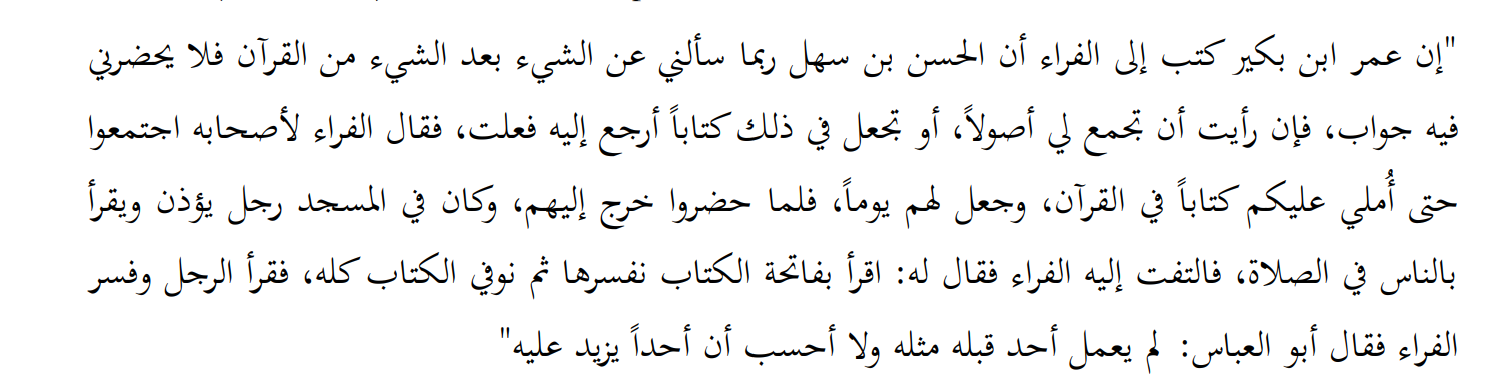
"Umar ibn Bukayr aliandikia al-Farra' kwamba al-Hasan ibn Sahl huenda akaniuliza jambo moja baada ya jingine kuhusu Qur'ani, lakini sitaweza kukumbuka majibu yote. Nadhani unapaswa kukusanya mambo muhimu na kuyaweka pamoja katika kitabu nitakachokirejelea." Hivyo al-Farra' akawaambia wanafunzi wake: "Kusanyikeni ili niwaandikishe kitabu kuhusu Qur'ani." Akawapa siku moja. Walipofika, alikwenda kwao msikitini. Huko kulikuwa na mtu akitoa adhana na kusoma Qur'ani pamoja na watu katika sala. Al-Farra' alimgeukia na kusema: "Soma sura ya kwanza ya Qur'ani (Fatihatul Kitab), nasi tutaifafanua, kisha tutazungumzia kikamilifu kitabu chote." Yule mtu alisoma, na al-Farra' akatoa tafsiri. Abu al-'Abbas alisema: "Hakuna aliyewahi kufanya kama yeye kabla, na sidhani kama mtu yeyote anaweza kuongeza chochote juu ya hilo."
“Umar ibn Bukayr wrote to al-Farra' that al-Hasan ibn Sahl perhaps may ask me one thing after another from the Qur’ān but I will not be able to recall all the answers. I think you should bring together the essential points and compile them in a book I will refer to it, so al-Farra' said to his students; gather together so that I can dictate to you a book about the Qur’ān. He gave them a day. When they came he went to them, in the mosque there was man giving azan and reciting the Qur’ān with the people in prayer. Al-Farra' turned to him and said: recite the opening chapter of the Qur’ān (fatihatul kitab), we will explain it and then we will speak fully about the whole book. The man recited and al-Farra' made tafsīr. Abu al-'Abbas said: no one did anything like him before and I don't think anyone can add to that.'
Kisha baada yake alikuja Ibn Jarir al-Tabari (d.310 A.H.) ambaye aliandika tafsīr yake maarufu. Kabla ya tafsīr ya Ibn Jarir zilikuwepo tafsīr kadhaa zilizojulikana sana, kama tafsīr ya Ibn Jurayj. Hali yake ilikuwa ni hali ya muhaddithīn wa mwanzo waliokusanya kila kilichowafikia bila kutofautisha kati ya riwaya sahihi (Sahih) na zisizo sahihi. Walisema: 'Lengo la Ibn Jurayj halikuwa usahihi; bali aliripoti kila kilichoripotiwa kuhusu kila aya, iwe sahihi (Sahih) au dhaifu (saqim).' Pia miongoni mwa tafsīr hizi ni tafsīr ya al-Suddi (d.127 A.H.) na tafsīr ya Muqatil (d.150 A.H.). 'Abd Allah ibn al-Mubarak alisema kuhusu tafsīr ya Muqatil: Tafsīr yake ni bora kiasi gani, lau tu angekuwa mwaminifu (thiqa).' Miongoni mwao pia ni tafsīr ya Muhammad ibn Ishaq. Yeye alikuwa akinukuu kutoka kwa Mayahudi na Wakristo, na alikuwa akinukuu kauli za Wahb ibn Munabbih, Ka'b al-Ahbar na wengineo, waliosimulia mambo kutoka katika Taurati, Biblia na tafsiri zao. Tafsīr hizi hazijatufikia, ingawa Ibn Jarir al-Tabari amekusanya sehemu kubwa yake na kuiingiza katika kitabu chake. Kisha wakaja wafasiri mmoja baada ya mwingine, wakieleza Qur’ān kwa njia kamili na yenye mpangilio mzuri, katika vitabu vilivyokamilika na vyenye utaratibu.
Then, after him came Ibn Jarir al-Tabari (d.310 A.H.) who wrote his famous tafsīr. A number of tafsīrs before the tafsīr of Ibn Jarir became well known such as the tafsīr of Ibn Jurayj. His situation was the situation of the first muhaddithin who compiled everything that reached them without differentiating between the correct (Sahih) and incorrect reports. They said 'that Ibn Jurayj's aim was not authenticity; rather he reported everything that was reported about every ayah whether it was correct (Sahih) or weak (saqim).' Also from these tafsīrs is the tafsīr of al-Suddi (d.127 A.H.) and the tafsīr of Muqatil (d.150 A.H.). 'Abd Allah ibn al-Mubarak said about the tafsīr of Muqatil: How excellent is his tafsīr, if only he were reliable (thiqa).' Amongst them is also the tafsīr of Muhammad ibn Ishaq. He used to transmit from the Jews and Christians and he used to quote sayings of Wahb ibn Munabbih, Ka'b al-Ahbar and others, who reported thing from the Torah, Bible and their commentaries. These tafsīrs have not reached us, although Ibn Jarir al-Tabari has collected most of it and included it in his book. Then came mufassirun one after another explaining the Qur’ān in an complete and well-ordered manner in books that were complete and systematic.
Hata hivyo, yeyote atakayechunguza tafsiri atakuta kwamba wafasiri (mufassirun) waliikaribia tafsiri kutoka mitazamo mbalimbali. Baadhi yao walivutiwa kuangalia mitindo na maana za Kitabu na kila kilichomo ndani yake kwa upande wa aina za balagha, ili kujua aina za juu na za kipekee za usemi ikilinganishwa na aina nyingine za usemi. Kwa hiyo upande wa balagha ulitawala katika tafsiri zao. Mmoja wa watu hao ni Muhammad ibn al-Zamakhshari katika tafsiri yake iitwayo al-Kashaf. Walikuwepo pia wale waliochunguza misingi ya imani, kupambana na wadanganyifu na kujadiliana na wale waliopingana (na Uislamu) kama Fakhr al-Din al-Razi katika tafsiri yake maarufu: al-Tafsir al-Kabir. Na baadhi yao walisoma kanuni za Sharia na walivutiwa kuzitoa kutoka katika aya. Basi wakaelekeza shauku yao kwenye aya za hukmu, kama Abu Bakr al-Razi, anayejulikana kwa jina la al-Jassas, katika tafsiri yake maarufu Ahkam al-Qur'an. Walikuwepo wale waliofuatilia hadithi na kuongeza kwenye hadithi za Qur'an kutoka vitabu vya historia na israiliyyat (Yahudi-simulizi), wakaanza kukusanya kila walichosikia, iwe kidogo au kingi, bila kuhakiki yale yaliyopingana na Sharia, yasiyokubaliana na akili, au yaliyopingana na aya za Qur'an zenye maana isiyo na shaka. Mmoja wa watu kama hao ni 'Ala' al-Din 'Ali ibn Muhammad al-Baghdadi, Sufi anayejulikana kwa jina la al-Khazin, aliyefanya hivyo katika tafsiri yake Bab al-Ta'wil fi Ma'ani al-Tanzil. Pia walikuwepo wale waliojishughulisha na kuunga mkono madhehebu yao na kueleza aya kulingana na kile kinachounga mkono kundi lao, kama tafsiri al-Bayan ya Shaykh al-Tibrisi na tafsiri al-Tibyan ya Shaykh al-Tusi. Wote wawili waliunga mkono maoni ya Shi'a na madhehebu yao kuhusu imani ('aqa'id) na hukmu. Na walikuwepo wale waliojishughulisha tu na tafsiri ili kueleza aya na hukumu za Qur'an bila kujali mtazamo wowote. Hao ni wafasiri ambao tafsiri zao zinachukuliwa kuwa kiini cha vitabu vya tafsiri. Pia wanachukuliwa kuwa maimamu wa tafsiri na mada nyinginezo. Mfano ni tafsiri ya Ibn Jarir al-Tabari, tafsiri ya Abu 'Abd Allah Muhammad al-Qurtubi, na tafsiri ya al-Nasafi na wengineo. Kuhusu tafsiri zilizoandikwa katika zama hizi na karibu na mwisho wa kipindi cha kudorora, kama tafsiri ya Muhammad 'Abduh, tafsiri ya Tantawi Jawhari na tafsiri ya Ahmad Mustafa al-Muraghi na wengineo, hazichukuliwi kuwa sehemu ya fasihi ya tafsiri, wala hakuna imani inayowekwa ndani yake. Hii ni kwa sababu kuna hatari kwa dini ya Allah katika ufafanuzi wa aya nyingi, kama tafsiri ya Muhammad Rasheed Ridha ya aya:
However, anyone who inspects the tafaseer will find that the mufassirun approached the tafsīr from various perspectives. Some were interested in looking at the styles and meanings of the Book and whatever it included in terms of the forms of rhetorics (balaagha) to know the highest and distinguished forms of speech as compared to other types of speech. So the rhetorical aspect prevailed in their tafsīrs. One of those people is Muhammad ibn al-Zamakhshari in his tafsīr entitled al-Kashaf. There were those who looked into the foundations of belief, the fighting of pretenders and debating those who disagreed (with Islam) like Fakhr al-Din al-Razi in his famous tafsīr: al-Tafsīr al-Kabir. And some of them studied the Sharī’ah rules and were interested in deducing them from the verses. So they channelled their interest towards the verses of ahkām like Abu Bakr al-Razi commonly known as al-Jassas in his well known tafsīr Ahkām al-Qur’ān. There were those who went after stories and added to the Qur’ānic stories from the books of history and israiliyyat (Judaica) and began to collect everything they heard however meagre or abundant without revising the things that contradicted the Sharī’ah, did not agree with the mind or contradicted Qur’ānic ayāt which are definite in meaning. One such person is 'Ala' al-Din 'Ali ibn Muhammad al-Baghdadi, the sufi otherwise known as al-Khazin who did this in his tafsīr Bab al ta'weel fi ma'ani al-tanzeel. And there were those that concerned themselves with supporting their mazhab (school) and explaining the verses in accordance with whatever supports their faction like the tafsīr al-Bayan of al-Shaykh al-Tibrisi and the tafsīr al-Tibyan of al-Shaykh al-Tusi. Both of them supported the views of the Shi'a and their mazhab regarding belief ('aqaid) and ahkām. And there were those that were only concerned with the tafsīr in order to explain the verses and rulings of the Qur’ān regardless of any perspective. They are the mufassirun whose tafsīrs are considered the essence of the books of tafsīr. And they are considered the imams of tafsīr and other topics. Like the tafsīr of Ibn Jarir al-Tabari, the tafsīr of Abu 'Abd Allah Muhammad al-Qurtubi, and the tafsīr of al-Nasafi and others. As for the tafsīrs written in this age and towards the end of the period of decline like the tafsīr of Muhammad 'Abduh, the tafsīr of Tantawi Jawhari and the tafsīr of Ahmad Mustafa al-Muraghi and others, they are not considered part of the tafsīr literature and nor is there any trust put in them. This is because there is a risk in the deen of Allah in the explanation of many verses like Muhammad Rasheed Ridha’s tafsīr of the verse:
"Na yeyote asiyehukumu kwa yale aliyoteremsha Allah, basi hao ndio Fasiqun (wafasiki)." [TMQ Mā’idah: 44]
“And whosoever does not judge by what Allahhas revealed, such are the Fasiqun (transgressors)” [TMQ Mā’idah: 44]
Aliwaruhusu Waislamu wa India kufuata sheria za Kiingereza na kutii maamuzi ya majaji wa Kiingereza. Shaykh Muhammad Rasheed Ridha alitaja katika juzuu ya sita ya Tafsīr ya Qur'ani Tukufu inayojulikana sana kama al-Manar, katika tafsiri ya sura al-Mā'idah, alipofafanua kauli Yake:
He permitted the Muslims of India to adopt English laws and submit to the rulings of English judges. Shaykh Muhammad Rasheed Ridha mentioned in volume six of the Tafsīr of the Noble Qur’ān widely known as al-Manar in the tafsīr of sura al- Mā’idah when he explained His saying:
"Na yeyote asiyehukumu kwa yale aliyoyateremsha Mwenyezi Mungu, basi hao ndio Mafasiki (waasi)" [TMQ Mā’idah: 44]
“And whosoever does not judge by what Allah has revealed, such are the Fasiqun (transgressors)” [TMQ Mā’idah: 44]
Katika kurasa 406-409 aliulizwa:
In pages 406-409 he was asked:
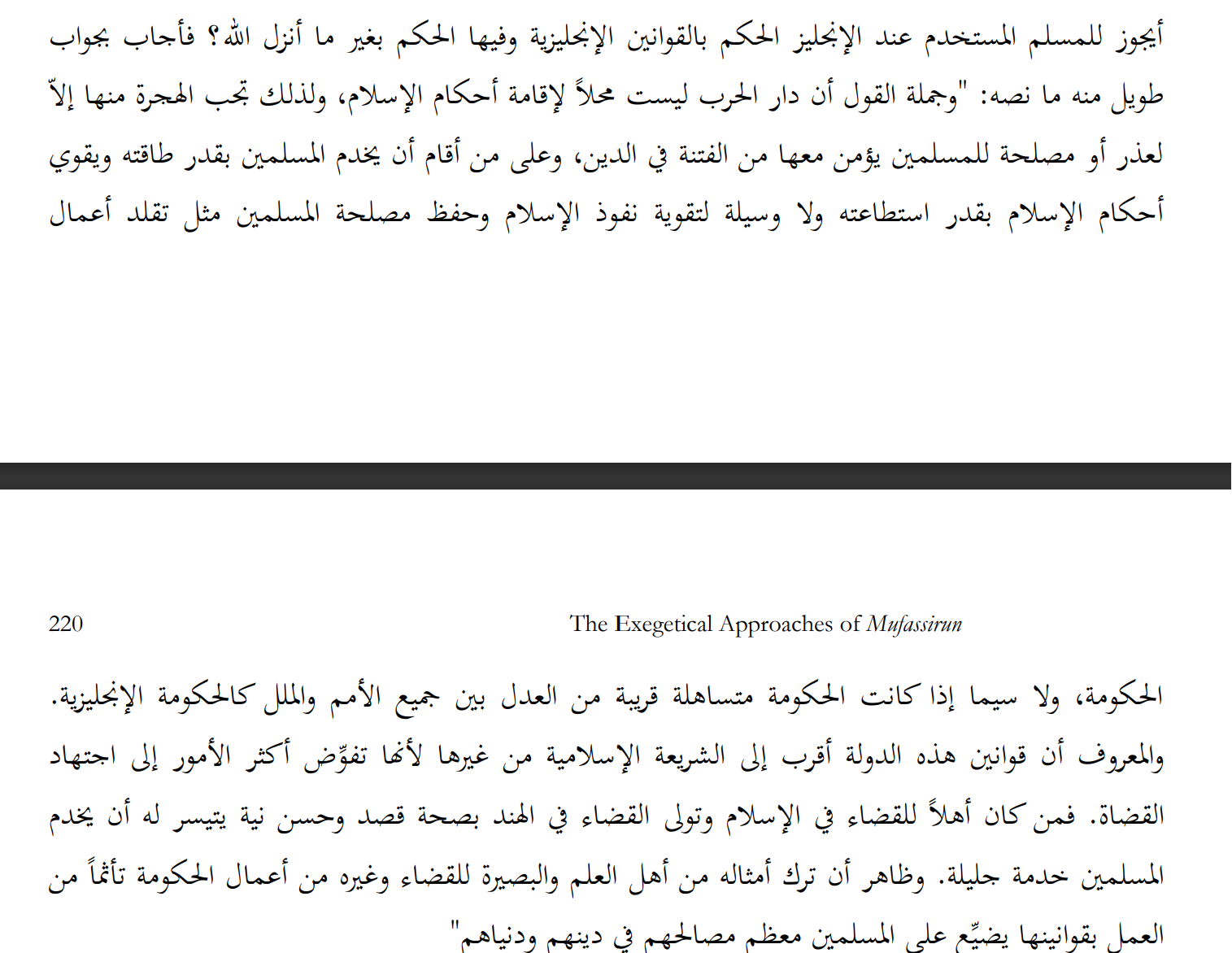
Je, Muislamu anaruhusiwa kuajiriwa na Waingereza ili kutawala kwa sheria za Kiingereza, ambazo baadhi yake zinajumuisha kutawala kwa yale ambayo Allah hakuteremsha? Alitoa jibu refu: "Kwa kifupi, dar al-harb (nchi ya vita) si mahali pa kuweka kanuni za Uislamu, hivyo ni wajibu kufanya hijra isipokuwa kuna udhuru au manufaa kwa Waislamu ambayo kwayo atakuwa salama kutokana na fitna (mtihani) juu ya dini yake. Ni wajibu kwa anayeishi (nchini India) kuwahudumia Waislamu kwa kadiri ya uwezo wake na kuimarisha kanuni za Uislamu kadiri awezavyo. Na hakuna njia ya kuimarisha ushawishi wa Uislamu na kulinda maslahi ya Waislamu isipokuwa kwa kushika nyadhifa za serikali, hasa ikiwa serikali ni yenye huruma na yenye haki kwa kiasi kati ya watu wote na dini zote, kama serikali ya Kiingereza. Inajulikana kwamba sheria za nchi hii zi karibu zaidi na Sharīʿah ya Kiislamu kuliko nyingine kwa sababu inakabidhi mambo mengi kwa Ijtihād ya majaji. Basi, yeyote anayestahiki kuwa jaji katika Uislamu na akachukua wadhifa katika mahakama nchini India kwa lengo sahihi na nia njema, inawezekana kwake kutoa huduma kubwa kwa Waislamu. Ni dhahiri kwamba kuacha mahakama na nyadhifa nyingine za serikali kwa watu wa elimu na busara kwa sababu ya kuonekana wenye dhambi kwa kufanya kazi kwa mujibu wa sheria zao (yaani za Waingereza) kutapoteza maslahi ya Waislamu katika dini yao na dunia yao."
Is it permitted for a Muslim to be employed by the English to rule by English laws some of which constitutes ruling by other than what Allah has revealed ? He gave a long reply: 'In short, the abode of war (dar al-harb) is not a place for the establishment of the rules of Islam, therefore it is obligatory to make hijra unless there is an excuse or benefit for the Muslims due to which he will be safe from the fitna (test) on his deen. It is incumbent on the one who resides (in India) to serve the Muslims according to the best of his abilities and to strengthen the rules of Islam as much as he can. And there is no means of strengthening the influence of Islam and protecting the interests of the Muslims except by assuming the government posts especially if the government is lenient and fairly just between all people and religions like the English government. It is well known that the laws of this country are closer to the Islamic Sharī’ah than others because it delegates most matters to the Ijtihād of judges. So whoever is qualified to be a judge in Islam and takes up a post in the judiciary in India with the correct aim and good intention, it is possible for him to do a great service for the Muslims. It is obvious that the abandonment of the judiciary and other government posts by the people of knowledge and insight due to being sinful for working according to their (i.e The English) laws will forfeit the interests of the Muslims in their deen and dunya.'
Kisha akasema:
Then he said:
Ni dhahiri kutokana na haya yote kwamba Muislamu kukubali kufanya kazi katika serikali ya Kiingereza nchini India "na kazi nyingine yoyote kama hiyo" na kuhukumu kwa kufuata sheria zao ni ruhusa (rukhsa) inayoingia chini ya kanuni ya kuchagua uovu mdogo zaidi endapo hakuna 'azeema ambayo lengo lake ni kuunga mkono Uislamu na kulinda maslahi ya Waislamu…
“It is obvious from all of this that the Muslim's acceptance to work in the English government in India 'and any other similar work' and his ruling according to their laws is a dispensation (rukhsa) which comes under the principle of doing the lesser of two evils if there is no 'azeema by which support of Islam and protecting the interests of Muslims is intended…”
Vivyo hivyo, tafsiri ya Tantawi Jawhari, ambapo alitaja kwamba kuna sayansi na taaluma za kisasa katika Qur'ani, na akaijaza tafsiri yake kwa picha za ndege na wanyama ili kuonyesha kwamba Qur'ani ilieleza mambo kama hayo. Pia tafsiri ya Mustafa Zayd, ambamo alifasiri na kukataa kuwepo kwa Malaika na Mashetani. Kwa tafsiri yake hiyo, alitenda kufuru na kujitoa nje ya Uislamu. Tafsiri hizi na zinazofanana nazo hazichukuliwi na Waislamu kuwa vitabu vya tafsiri, wala maelezo yao hayapewi uzito wowote.
Much similar is the tafsīr of Tantawi Jawhari where he mentioned that there are modern sciences and disciplines in the Qur’ān and he filled his tafsīr with pictures of birds and animals to demonstrate that the Qur’ān did explain such things. And the tafsīr of Mustafa Zayd in which he interpreted and rejected the existence of angels and Shayateen. So he committed kufr by his tafsīr and took himself outside of Islam. These tafsīrs and their likes are not considered books of tafsīr by the Muslims and nor are their explanations given any consideration