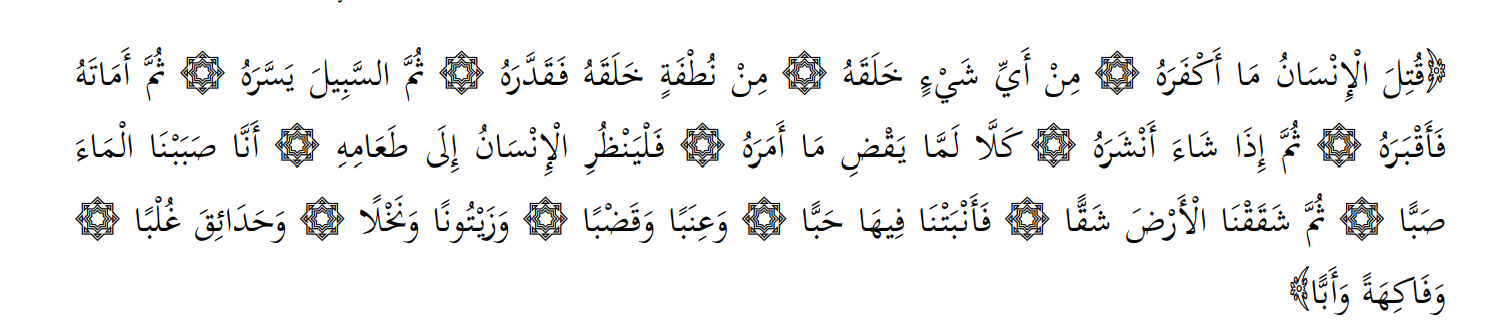
Utoaji wa maana ulikuwa ukiambatana na namna hii ya usemi inayoonyesha maana, ukitilia mkazo maneno yenye mdundo wa kuvutia nafsi wakati wa kufahamu maana na kuzielewa. Ndiyo maana huibua kwa msikilizaji anayeelewa, kutokana na kina cha maana zake na ufasaha wa usemi wake, hisia kubwa ya heshima na unyenyekevu, hadi baadhi ya wanafikra mahiri wa Kiarabu karibu wakasujudu mbele yake, licha ya ukafiri wao na ukaidi wao.
The rendering of meaning had been accompanied with this manner of expression which depicts the meanings, giving attention to words which have the rhyme that moves the soul when conceiving the meanings and comprehending them. That is why it evokes in the listener who comprehends, due to the depth of its meanings and the eloquence of its expression a deep sense of awe humility until some of the eloquent Arab thinkers almost prostrated before it despite their disbelief and obstinacy.
Kisha, mtu atakayechunguza kwa makini maneno ya Qur’ani na sentensi zake ataona kwamba Qur’ani inazingatia, wakati wa kuunganisha herufi, sauti zinazotoka katika mahali pa kutamkia kwake. Hivyo herufi zilizo karibu katika mahali pa kutamkia huwekwa karibu katika neno au sentensi. Na pale ambapo kuna pengo kati ya mahali pa kutamkia, hutenganishwa kwa herufi inayoondoa ugeni wa mpito huo. Wakati huohuo, herufi hiyo hufanya herufi fulani kuwa nyepesi kutamkwa na yenye kupendeza masikioni inapojirudia, kama kiitikio katika muziki. Haisemi ‘kal ba'iq a-mudfiq’ bali ‘kasayyib’. Wala haisemi ‘al-hu'khu'’ bali ‘sundusu khudrin’. Na inapohitajika kutumia herufi zilizowekwa mbali mbali na nyingine katika maana inayoendana nayo, na ambayo hakuna kingine kinachotoa maana hiyo kama neno ‘deeza’, basi hakuna haja ya kutumia neno ‘zalima’ au ‘ja'ira’ mahali pake, ijapokuwa maana ni moja. Mbali na usahihi huu katika matumizi, herufi inayojirudia kama kiitikio inaonekana wazi katika aya nyingi kwa kiasi fulani. Aya ya Kiti (Ayatul Kursiyy) kwa mfano ina herufi lam ikijirudia mara 23 kwa namna ya kupendeza yenye athari masikioni, kiasi kwamba huwafanya watu wasikilize kwa makini na kutamani kusikia zaidi.
Then, indeed the one who scrutinises the words of the Qur’ān and its sentences will find that the Qur’ān gives attention to, when placing letters together, the sounds that come out from their places of articulation. So the letters close to each other in articulation are placed close to each other in a word or sentence. And when there is a gap betwen the points of articulation, they are separated with a letter which eliminates the strangeness of the transition. And at the same time it makes a letter pleasant in articulation and light on the ears to be repeated like the chorus in music. It does not say 'kal ba'iq a-mudfiq' but 'kasayyib'. Nor does it say 'al-hu'khu'' but 'sundusu khudrin'. And when it is necessary to use letters which are placed distanced from each other in a meaning which befits it and nothing else gives that meaning like the word 'deeza', there is no point in using the word 'zalima' or 'ja'ira' in its place even though the meaning is one. In additon to this precision in usage, the letter which is in chorus is clearly found in verses with some frequency. The Verse of the Throne (ayatul kursiyy) for example has the letter lam repeated in it 23 times in a pleasant manner which has an impact on the hearing such that it makes people prick up their ears and want to hear more.
Kwa njia hii, utaona kwamba Qur'ani ni aina ya kipekee ya usemi. Utaona kwamba inadhihirisha maana zake zote kwa namna inayolingana nayo, kupitia maneno yanayoizunguka na maana zilizomo ndani yake. Hutapata kasoro hiyo katika aya yoyote ile. Uajabu wake (i'jaz) uko wazi katika mtindo wake, kwani ni aina maalum ya usemi isiyofanana na usemi wowote wa binadamu, wala binadamu hawawezi kufanana nao. Pia uko wazi katika matumizi ya maana ndani ya maneno na sentensi zinazolingana nazo, na katika athari ya maneno hayo kwenye masikio ya yule anayeelewa ufasaha wake na kuangalia kwa kina maana zake, hata akanyenyekea hadi karibu kusujudu mbele yake. Na athari yake kwa masikio ya yule asiyeelewa ufasaha wake ni kwamba mlio na sauti ya maneno haya humvutia na kumshika kwa nguvu, kwa namna isiyoweza kupingwa, hata msikilizaji akajinyenyekeza kwa nguvu, ingawa huenda hakuelewa maana zake. Kwa hiyo, ni muujiza utakaobaki kuwa muujiza hadi Siku ya Qiyama.
In this manner, you will find that the Qur’ān is a special genre. And you will find it reveals all of its meanings in the expression that befits it, in the words around it and the meanings with it. You will not find that missing in any of its ayat. Its miraculousness (i'jaz) is clear in its style in terms of being a special genre of speech which does not resemble any speech of human beings or vice versa, and in terms of the application of meanings in words and sentences which befit them and in terms of the effect/impression of the words on the hearing of the one who comprehends its eloquence and looks deeply into its meanings, so he becomes humble to the point of almost prostating to it. And the effect it has on the hearing of the one who does not comprehend its eloquence, the ring and sound of these words captivate him and hold him spellbound in an incapacitating manner to which the listener humbles himself by force even though he may not understand its meanings. Therefore, it is a miracle which will remain a miracle until the Final Hour.