20. Jihad
20. Jihad
Jihad ni kutumia juhudi zako katika kupigana vita kwa ajili ya njia ya Allah (SWT), moja kwa moja au kwa kusaidia kwa mali, kwa maoni, kwa kuongeza idadi ya wapiganaji, au kwa mambo mengine zaidi ya hayo. Kupigana ili neno la Allah (SWT) lipewe nafasi ni jihad. Kuhusu jihad kwa kuzungumza katika njia ya Allah (SWT), hii ni jihad ikiwa maneno hayo yanahusiana moja kwa moja na kupigana katika njia ya Allah (SWT). Ikiwa hayahusiani nayo moja kwa moja, hayo si jihad ya kisheria, hata kama yanahusisha ugumu na hata kama matokeo yake yananufaisha katika kuinua neno la Allah (SWT). Hii ni kwa sababu jihad katika Shariah inahusu kupigana pekee, hivyo kinachoingia ndani yake ni kila kitu kinachohusiana moja kwa moja na kupigana. Maoni yanayofanana na hilo ni uandishi na usemaji; ni jihad ikiwa yanahusiana moja kwa moja na kupigana katika njia ya Allah (SWT), kama vile hotuba kwa jeshi ili kulihimiza lipigane moja kwa moja, au maneno yanayochochea kupigana dhidi ya maadui. Kama hayahusiani, basi hii si jihad. Wala mapambano ya kisiasa wala kuwakemea watawala hayaitwi jihad, ingawa thawabu zake ni kubwa na faida yake kwa Waislamu ni kubwa. Jambo si ugumu wala faida, bali ni maana ya kisheria ambayo neno hili lilikuja nayo. Maana ya kisheria ya jihad ni kupigana vita na yote yanayohusiana nayo katika maoni, maneno, maandishi, mikakati na mambo mengine.
Jihad is expending (one’s) effort in fighting in the way of Allah (swt) directly or assisting by wealth or opinion or increasing numbers or other than that. The fighting to raise the word of Allah is jihad. As for jihad by speaking in the path of Allah (swt), this is jihad if the speech relates directly to fighting in the way of Allah. If it does not relate directly to it, it is not Shar’i jihad even if it involves difficulty and even if the results benefit in raising the word of Allah (swt). This is because jihad in Shar’a is specific to fighting, so there enters within it everything related directly to fighting. Similar to the opinion is writing and speaking; they are jihad if they are related directly to fighting in the way of Allah (swt) like the speech to the army to encourage it to fight directly or words inciting fighting the enemies. If not, this is not (jihad). Neither political struggle nor rebuking the rulers is termed jihad though their reward is high and their benefit to the Muslims great. The issue is neither difficulty nor the benefit, but rather it is the Shar’i meaning with which it came for this word. The Shari’ah meaning is fighting and all that it relates to from opinion, speech, writing, strategy and other things.
Sababu ya jihadi si jizya, ingawa tunasimama kuwapiga vita watu hao wanapokubali kulipa jizya. Badala yake, sababu ya jihadi ni kwamba wale tunaowapigania ni makafiri (kuffar) waliokataa da'wah. Allah (SWT) amesema:
The cause of jihad is not jizyah even though we stop (fighting) them when they accept the jizyah. Rather, the cause of jihad is that those whom we fight are disbelievers (kuffar) who rejected the da’wah. Allah (swt) said:
"Pigeni vita dhidi ya wale wasiomwamini Allah wala Siku ya Mwisho, wala wasiozuia yale ambayo Allah na Mtume Wake wameyakataza, wala wasiofuata dini ya haki miongoni mwa Watu wa Kitabu, mpaka watoe jizya kwa mikono yao wakiwa wamedhalilika" [TMQ 9:29].
Fight those who do not believe in Allah nor the Last Day, nor forbid what Allah and His Messenger have forbidden, nor follow the deen of truth among the People of the Book until they pay the jizyah from their hands while they are humiliated” [TMQ 9:29].
Amri ya kupigana nao ni kwa sababu ya sifa yao ya kukufuru, yaani, wapigwe vita kwa sababu hawamwamini Allah na Siku ya Mwisho n.k. Kwa hiyo maelezo haya ni kizuizi, na katika hatua hii yanakuwa sababu. Hivyo sababu ya kupigana ni kukufuru. Imekuja pia katika aya nyingine:
The command to fight them is (due to) their attribute of disbelief i.e. fight them because they do not believe in Allah and the Last Day etc. So this description is a restriction and at this point it becomes a cause. So the cause of fighting is disbelief. It came in another ayah:
"Enyi mlioamini, piganeni na wale makafiri walio karibu nanyi kijiografia, na wao na wakute ukali ndani yenu." [TMQ 9:123]
“O you who believe, fight those who encircle you (close to you geographically) of the disbelievers and let them find harshness in you” [TMQ 9:123]
Kwa hiyo amri ya kupigana nao inatokana na sifa ya kufuru. Kuna aya nyingi zinazofanana na hizo, kama vile:
So the command to fight them is due to the attribute of disbelief. There are many similar ayat such as:
"Pigana na washirika wa Shetani" [TMQ 4:76]
“Fight the allies of Satan” [TMQ 4:76]
Na
And
"Pigana viongozi wa kufuru" [TMQ 9:12]
“Fight the leaders of disbelief” [TMQ 9:12]
Na
And
"Piganeni na washirikina wote kwa pamoja" [TMQ 9:36]
“Fight the polytheists altogether” [TMQ 9:36]
Aya hizi zote zinaamuru kupigana kwa sababu ya sifa maalumu ambayo ndiyo chanzo cha kupigana, nayo ni kufuru. Kuhusu kulipa jizya, Qur'ani imeiunganisha na udhalilishaji kama sababu ya kusimamisha kupigana, si kama sababu ya kupigana. Kutokana na hili inafahamika kwamba chanzo cha jihadi ni kufuru. Wale tunaowapigana wakikubali da'wah, wanakuwa Waislamu; wakikataa kukubali Uislamu (lakini) wakikubali kulipa jizya na kutawaliwa na Uislamu, inakubaliwa kutoka kwao na hawapigwi vita kwa kuwa haijuzu kuwalazimisha kukubali Uislamu. Mradi wanakubali kutawaliwa nao na kulipa jizya, wameinyenyekea da'wah hata kama hawajakubali Uislamu. Kwa hiyo, si halali kuwapiga vita baada ya kukubali kutawaliwa nao na kulipa jizya. Hata hivyo, wakikubali kulipa jizya lakini wakikataa kutawaliwa na Uislamu, haijuzu kukubali hili kutoka kwao, kwa sababu chanzo cha kupigana, ambacho ni kwamba wao ni makafiri waliokataa kukubali da'wah, bado kipo, hivyo kuwapiga vita kunabaki kuwa wajibu, wajibu ambao haujaondoka shingoni mwa Waislamu. Kuhusu mikataba ya dharura ambayo Khalifah anakubali kutoka kwao jizya huku akiwaacha wajitawale kwa mfumo wa kufuru, kutokana na kukosekana kwa mazingira ya nje na ya ndani yanayoruhusu hilo, Shari'ah ilitoa ruhusa katika hali hii ya dharura katika hali za lazima, kwa hiyo hakuna kulinganisha (qiyas) kunakofanywa juu yake. Basi chanzo cha jihadi ni kwamba wale tunaowapigana ni makafiri waliokataa kukubali da'wah, na hakuna chanzo kingine cha jihadi. Kuhusu jizya pamoja na udhalilishaji kuwa sababu ya kusimamisha kupigana, hili ni kwa Waarabu wasio washirikina pekee. Kuhusu Waarabu washirikina, haikubaliwi kutoka kwao isipokuwa Uislamu au kupigana, kwa kauli ya Allah:
All these ayat command the fighting due to a specific attribute which is the cause of fighting i.e. disbelief. As for the payment of jizyah, the Qur’an combined it with humiliation as the cause of stopping the fighting not the cause of fighting. From here it is understood that the cause of jihad is disbelief. If those whom we fight accept the da’wah they become Muslims; if they refuse to accept Islam (but) accept to pay the jizyah and be ruled by Islam, it is accepted from them and they are not fought as it is not permitted to force them to accept Islam. As long as they accept to be ruled by it and pay the jizyah, they have submitted to the da’wah even if they have not accepted Islam. Accordingly, it is not allowed to fight them after they accept to be ruled by it and pay the jizyah. However, if they accept to pay the jizyah but refuse to be ruled by Islam, it is not allowed to accept this from them because the cause of fighting which is that they are disbelievers who have refused to accept the da’wah remains standing so fighting them remains obligatory, an obligation which has not fallen from the Muslims’ necks. As for the emergency treaties in which the Khalifah accepts from them the jizyah while leaving them to rule themselves by the system of disbelief, due to the absence of compliance of the external and internal circumstances for it, the Shar’a gave concession to this emergency situation in the situations of necessity so no analogy is done upon it. Therefore the cause of jihad is that those whom we fight are disbelievers who refused to accept the da’wah and there is no other cause for jihad. As for jizyah together with humiliation being a cause to stop fighting, this is only with non polytheist Arabs. As for polytheist Arabs, it is not accepted from them except Islam or fighting due to Allah’s statement:
"Mtapigana nao au watasilimu" [TMQ 48:16].
“You will fight them or they will become Muslims” [TMQ 48:16].
Jihad ni wajibu kwa mujibu wa maandiko wazi ya Qur'an na Hadith. Allah (SWT) amesema:
Jihad is obligatory by the explicit text of the Qur’an and Hadith. Allah (swt) said:
"Piganeni nao hadi kusiwepo na (fitnah), na dini iwe ni ya Allah peke yake." [TMQ 8:39]
“Fight them so that there remains no (fitnah) and the deen becomes only for Allah” [TMQ 8:39]
Na Yeye (SWT) akasema:
And He (swt) said:
"Piganeni na wale wasioamini Allah wala Siku ya Mwisho, wala wasiharamishe yale yaliyoharamishwa na Allah na Mtume Wake, wala wasifuate dini ya haki miongoni mwa Watu wa Kitabu, mpaka watoe jizya kwa mikono yao wakiwa wamedhalilika." [TMQ 9: 29 ]
“Fight those who don’t believe in Allah nor the Last Day, nor forbid what Allah and His Messenger have forbidden, nor follow the deen of truth among the People of the Book until they pay the jizyah from their hands while they are humiliated” [TMQ 9: 29 ]
Na Allah (SWT) akasema:
And Allah (swt) said:
"Msipotoka (kwenda katika jihadi), Yeye atakuadhibu kwa adhabu chungu." [TMQ 9: 39]
“If you do not go out (for jihad), He will punish you with a painful punishment” [TMQ 9: 39]
Na Yeye (SWT) akasema:
And He (swt) said:
"Enyi mliomwamini, pigeni vita dhidi ya wale wanaokuzunguka miongoni mwa makafiri, na wasikie ukali ndani yenu." [TMQ 9: 123].
“O you who believe, fight those who encircle you of the disbelievers and let them find harshness in you” [TMQ 9: 123].
Imepokewa kutoka kwa Anas (ra) aliyesema: "Mtume wa Allah ﷺ alisema:
It is narrated from Anas (ra) who said: “The Messenger of Allah (saw) said:
"Piganeni washirikina kwa mali yenu, mikono yenu na ndimi zenu" (imepokewa na An-Nisai).
“Fight the polytheists with your wealth, your hands and your tongues” (narrated by An-Nisai).
Pia kutoka kwa Anas kwamba Nabii ﷺ alisema:
Also from Anas that the Prophet (saw) said:
"Hakika! Kuondoka asubuhi na mapema au jioni kwa lengo la kupigana katika njia ya Allah ni bora kuliko dunia na vyote vilivyomo ndani yake." (imesimuliwa na Al-Bukhari).
“Verily! Setting out in the early morning or in the evening in order to fight in Allah's way is better than the world and what it contains.” (narrated by Al-Bukhari).
Alisimulia pia kwamba yeye alisema ﷺ:
He also narrated that he (saw) said:
"Niliamriwa kupigana na watu mpaka waseme: 'Hakuna mungu isipokuwa Allah.'"
“I was commanded to fight the people until they say ‘There is no god but Allah”
Imam Ahmad na Abu Dawud wamepokea kutoka kwa Anas aliyesema: Mtume wa Allah ﷺ amesema:
Imam Ahmad and Abu Dawud narrated from Anas who said: The Messenger of Allah (saw) said:
"…jihadi itaendelea kufanywa bila kukoma tangu siku ambayo Mwenyezi Mungu alinituma kuwa nabii hadi siku ambayo mwanachama wa mwisho wa umma wangu atapigana na Dajjal (Masihi wa uongo). Dhulma ya dhalimu yeyote wala uadilifu wa mtawala yeyote mwadilifu hautabatilisha hilo."
“…jihad will be performed continuously since the day Allah sent me as a prophet until the day the last member of my community will fight with the Dajjal (Antichrist). The tyranny of any tyrant and the justice of any just (ruler) will not invalidate it.”
Imepokewa kutoka kwa Zayd bin Khalid aliyesema: Mtume wa Allah ﷺ alisema:
It has been narrated from Zayd bin Khalid who said: The Messenger of Allah (saw) said:
"Yeyote anayemwandalia mpiganaji njia ya Allah, amekwisha pigana, na yeyote anayewatunza familia yake kwa wema (khayr) baada yake, amekwisha pigana" (imesimuliwa na Ahmad).
“Whoever prepares a warrior in the way of Allah has (also) fought, and whoever takes care of his family in goodness (khayr) after him has (also) fought” (narrated by Ahmad).
Ilisemwa: Ee Mtume wa Allah, ni nani miongoni mwa watu aliye bora zaidi? Mtume wa Allah ﷺ akasema: “Ni muumini anayefanya jihadi katika njia ya Allah kwa mwili wake na mali yake” (amepokewa na Al-Bukhari).
“It was said: O Messenger of Allah, which of the people is better? The Messenger of Allah (saw) said: ‘A believer who does jihad in the way of Allah by his body and wealth” (narrated by Al-Bukhari).
Na yeye (ﷺ) alisema:
And he (saw) said:
"Yeyote anayekufa bila kupigana, wala nafsi yake isiwaze kupigana, amekufa juu ya tawi moja la unafiki."
“Whoever dies without fighting or his soul thinking of fighting has died upon a branch of hypocrisy.”
Imepokewa kutoka kwa Abi Awfa (ra) kwamba Mjumbe wa Allah ﷺ alisema:
It has been narrated from Abi Awfa (ra) that the Messenger of Allah (saw) said:
"Jueni kwamba pepo iko chini ya kivuli cha panga" (amesimulia Al-Bukhari).
“Know that paradise is beneath the shade of swords” (narrated by Al-Bukhari).
Imepokewa kutoka kwa Abu Hurayra (ra) aliyesema:
It is narrated from Abu Hurayra (ra) who said:

"Mmoja wa Masahaba wa Mjumbe wa Allah ﷺ alipita katika bonde lenye mito ya maji matamu ndani yake, akastaajabishwa na uzuri wake, hivyo akasema: Je, itakuwaje nikijitenga na watu na kukaa katika bonde hili? Lakini sitalifanya kamwe mpaka nipate ruhusa kutoka kwa Mjumbe wa Allah ﷺ. Basi akamtajia hilo Mjumbe wa Allah ﷺ, ambaye alisema: Usifanye (hivyo), kwa sababu kusimama kwa mmoja wenu katika njia ya Allah ni bora kuliko kwake kuswali nyumbani kwake kwa miaka sabini," (imesimuliwa na At-Tirmidhi).
“One of the Sahabah of the Messenger of Allah (saw) passed by a ravine with rivers of sweet water in it and was astounded by its beauty, so he said: What if I separated from the people and stayed in this ravine? But I will never do it until I seek permission from the Messenger of Allah (saw) so he mentioned that to the Messenger of Allah who said: Do not do (so) for the standing of one of you in the way of Allah is better than his praying in his house for seventy years” (narrated by At-Tirmidhi).
Jihad ni wajibu wa kutosheleza (fard kifayah) kwa njia ya kushambulia, na ni wajibu wa kila mtu mmoja mmoja (fard ‘ayn) dhidi ya adui anayewashambulia, huku ikiwa wajibu wa kutosheleza kwa wengine waliobaki. Wajibu huo hauondoki mpaka adui afukuzwe na ardhi ya Kiislamu ikombolewe kutoka uchafu wao. Maana ya jihad kuwa wajibu wa kutosheleza kwa njia ya kushambulia ni kwamba tunaanza kupigana na adui hata kama wao hawajaanza kupigana nasi. Iwapo hakuna Muislamu yeyote atakayefanya mapigano ya kushambulia katika kipindi chochote, basi watakuwa wenye dhambi kwa kuliacha. Iwapo watu wa Misri watafanya jihad ya kushambulia, basi (wajibu wake) unaondoka kwa watu wa Indonesia, kwa kuwa kuna mapigano ya vitendo ya Waislamu dhidi ya makafiri wenye uadui, hivyo wajibu wa jihad umetimia. Lakini iwapo mapigano yatazuka kati ya Waislamu na makafiri, lakini kutosheleza (kifayah) hakujatimia kwa watu wa Misri kupigana na makafiri peke yao, basi wajibu wake hauondoki kwa watu wa India na Indonesia kwa utendaji wa watu wa Misri na Iraq. Bali ni wajibu kwa aliye karibu zaidi (Muislamu), kisha aliye karibu zaidi na adui, mpaka kutosheleza kutimie; iwapo kutosheleza hakutatimia isipokuwa kwa Waislamu wote, basi jihad inakuwa wajibu kwa Waislamu wote mpaka adui ashindwe. Jihad ni wajibu wa kutosheleza (fard kifayah) iwapo Khalifah hajamwambia aende mbele; kwa yule ambaye Khalifah amemwambia ashiriki, basi jihad imekuwa wajibu juu yake kwa sababu ya kauli ya Allah:
Jihad is an obligation of sufficiency (fard kifayah) offensively, and an individual obligation (fard ‘ayn) against the enemy who attacks them while being a obligation of sufficiency upon the rest. The obligation does not fall until the enemy is expelled and the Islamic land liberated from their filth. The meaning of jihad being an obligation of sufficiency offensively is that we start fighting the enemy even if they do not start (fighting) us. If no Muslim performs the fighting offensively at any period then they will be sinful for leaving it. If the people of Egypt perform the offensive jihad then (its obligation) falls from the people of Indonesia, as there exists practical fighting by Muslims against belligerent disbelievers therefore the obligation of jihad has occurred. However if fighting broke out between Muslims and disbelievers but the sufficiency (kifayah) has not occurred by the people of Egypt fighting the disbelievers alone, then its obligation does not fall from the people of India and Indonesia by the performance of the people of Egypt and Iraq. Rather it is obligatory upon the nearest (Muslim) then the nearest to the enemy until sufficiency occurs; if sufficiency does not occur except with all the Muslims, then jihad becomes obligatory upon all the Muslims until the enemy is subdued. Jihad is an obligation of sufficiency (fard kifayah) if the Khalifah has not told him to advance; as for the one whom the Khalifah has told him to take part, then jihad has become obligatory upon him due to Allah’s statement:
"Enyi mlioamini, mna nini hata mnapoambiwa: ‘Tokeni mwende katika njia ya Allah,’ mnashikamana na ardhi?"
“O you who believe, what is wrong with you that when it is said: ‘Go forth in the way of Allah’ you hold firm to the earth”
Na kauli yake ﷺ:
And his (saw) statement:
"Na mkiambiwa kusonga mbele, basi songeni mbele." (Imepokewa na Bukhari na Muslim)
“And if you are asked to advance, then advance.” (Narrated by Bukhari & Muslim)
Maana ya kutosheleza katika jihadi ndani ya Dola ya Kiislamu ni kwamba yanaibuka makundi ya watu kwa ajili ya jihadi ambayo mapigano yao yanatosha; ama wawe jeshi ambalo kwa ajili yake kuna vitabu vya hesabu (dawawin), kama ilivyokuwa katika zama za Umar (ra), au wawe wamejiandaa kwa jihadi kwa hiari yao, kama ilivyokuwa katika zama za Abu Bakr (ra). Ni sawa iwe wale wa kwanza, au wa baadaye, au wote wawili pamoja, kiasi kwamba adui akiwalenga wanaweza kujilinda; hivyo basi ni wajibu wa kutosheleza kwao. Iwapo hawawezi kujilinda, basi Khalifah huandaa wengine kwa ajili ya jihadi, na kadhalika. Jihadi ya kushambulia haimaanishi kwamba sisi tunaanzisha mapigano dhidi ya adui moja kwa moja; bali ni lazima kwanza tuwaite kwenye Uislamu.
The meaning of the sufficiency in jihad in the Islamic State is that there arise for jihad a people whose fighting is sufficient; whether they are an army for whom there are books of accounts (dawawin) for this as was the case in the time of Umar (ra), or they had prepared themselves for jihad freely as was the case in the time of Abu Bakr (ra). It is the same whether the first ones or the latter ones or both of them together such that if the enemy targets them they are able to defend so it is a obligation of sufficiency upon them. If they are unable to defend, then the Khalifah prepares others for jihad and so on. Offensive jihad does not mean that we initiate fighting the enemy directly; rather we must first call them to Islam.
Si halali kwa Waislamu kupigana na wale ambao da'wah ya Kiislamu haijawafikia; badala yake, makafiri lazima kwanza waitwe kwenye Uislamu. Wakikataa, basi wanaombwa kulipa jizya; na wakikataa, tunapigana nao. Muslim amesimulia kutoka kwa Sulayman bin Buraydah, kutoka kwa baba yake:
If is not allowed for Muslims to fight those whom the Islamic da’wah has not reached; rather, the disbelievers must first be called to Islam. If they reject, then they are asked to pay the jizyah; and if they reject, we fight them. Muslim narrated from Sulayman bin Buraydah from his father:
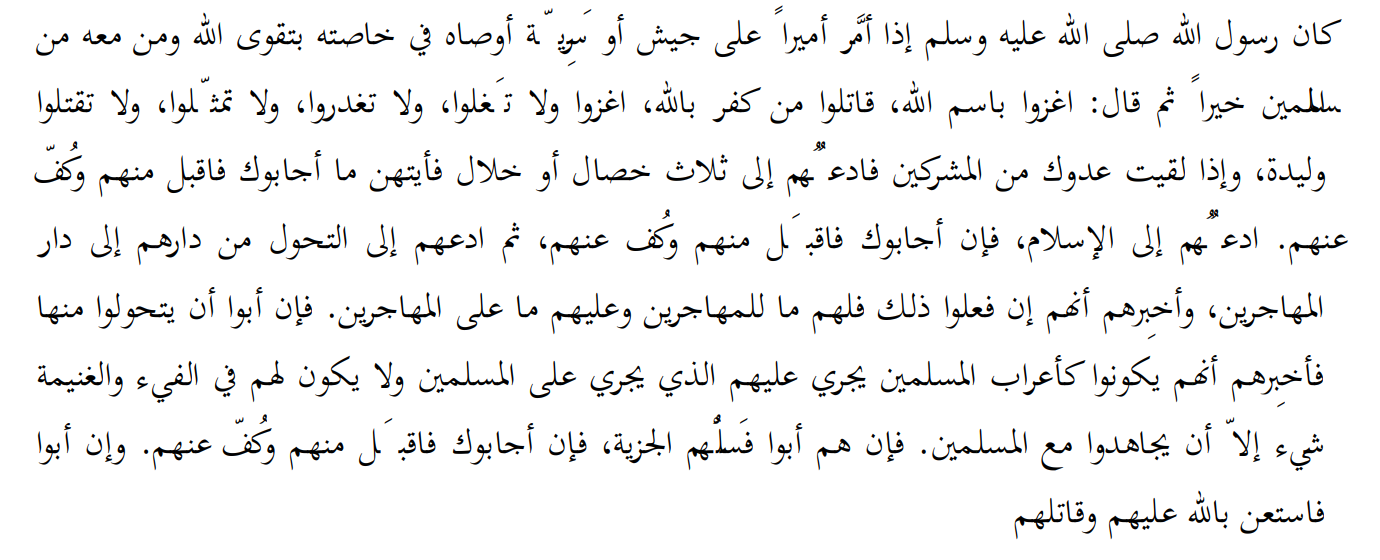
Kila alipomteua mtu kuongoza kikosi cha jeshi, Mjumbe wa Mwenyezi Mungu ﷺ alikuwa akimwusia hasa amche Mwenyezi Mungu na kuwatendea mema Waislamu walio pamoja naye. Alisema ﷺ: “Piganeni kwa Jina la Mwenyezi Mungu na katika njia ya Mwenyezi Mungu. Pigeni wale waliomkataa Mwenyezi Mungu. Pigeni, lakini msifanye hiana, msiibe chochote katika ngawira, msiwakatilie viungo, na msiwaue watoto. Mtakapokutana na adui yenu miongoni mwa washirikina, waiteni kwenye mambo matatu. Lolote kati ya hayo watakalolikubali, lipokeeni kutoka kwao na jiepusheni kupigana nao. Waiteni wakubali Uislamu, na wakikubali, basi pokeeni kutoka kwao na jiepusheni kupigana nao. Kisha waiteni wahame ardhi yao na kuhamia ardhi ya washirikina. Waambieni kwamba wakifanya hivyo, watakuwa na haki na wajibu sawa na washirikina. Wakikataa, waambieni kwamba watakuwa kama Waarabu wa jangwani Waislamu, watakaotawaliwa na hukumu za Mwenyezi Mungu sawa na waumini. Lakini hawatakuwa na sehemu yoyote ya Fay’ au ngawira ya vita, isipokuwa wakipigana pamoja na Waislamu. Wakikataa kuingia Uislamu, basi waombeni walipe kodi ya kura. Wakifanya hivyo, pokeeni kutoka kwao na jiepusheni kupigana nao. Lakini wakikataa, basi tafuteni msaada wa Mwenyezi Mungu dhidi yao na pigeni nao.”
“Whenever he appointed a man to lead a military detachment, the Messenger of Allah (saw) would advise him especially to fear Allah and treat the Muslims with him well. He (saw) said: ‘Fight in the Name of Allah and in the cause of Allah. Fight those how disbelieve in Allah. Fight but do not be treacherous, do not steal from the spoils of war, do not mutilate and do not kill children. When you meet your enemy from among the polytheists, call them to one of three things. Whichever of them they respond to, accept it from them and refrain from fighting them. Invite them to accept Islam, and if they respond then accept it from them and refrain from fighting them. Then invite them to leave their land and move to the land of the polytheists. Tell them that if they do that, then they will have the same rights and duties as the polytheists. If they refuse, then tell them that they will be like the Muslim Bedouins (who live in the desert), subject to the same rulings of Allah as the believers. But they will have no share of Fay’ or war spoils, unless they fight alongside the Muslims. If they refuse to enter Islam, then ask them to pay the Poll-tax. If they do that, then accept it from them and refrain from fighting them. But if they refuse, then seek the help of Allah against them and fight them”
Na kutoka kwa Ibn Abbas (ra):
And from ibn Abbas (ra):
"Mtume wa Allah ﷺ hakuwahi kupigana isipokuwa alikuwa amewaalika kwanza" (Imepokewa na Ahmad).
“The Messenger of Allah (saw) never fought except that he invited them” (Narrated by Ahmad).
Na kutoka kwa Furwat bin Maseek, aliyesema:
And from Furwat bin Maseek who said:
Nilimwambia Mjumbe wa Allah ﷺ, je, nipigane na wale wa watu wangu wanaosonga mbele (dhidi ya) wale wao wanaokimbia? Akasema: Ndiyo. Nilipogeuka kwenda, akaniita na kusema: Usipigane nao mpaka uwalinganie kwenye Uislamu.
“I said to the Messenger of Allah, should I fight with those of my people advancing (against) those of them fleeing? He said: Yes. When I turned (to go), he called me and said: Do not fight them until you invite them to Islam.”