26. Muumini Kuwafanya Makafiri Kuwa Marafiki
26. The Believer's Befriending The Disbelievers
Allah (SWT) alisema:
Allah (swt) said:
"Waumini wasiwafanye makafiri kuwa marafiki badala ya waumini, na yeyote atakayefanya hivyo hayuko kwa Mwenyezi Mungu kwa lolote isipokuwa mnapoogopa kutoka kwao jambo la kuogopwa. Na Mwenyezi Mungu anakuonyeni juu ya nafsi yake, na kwa Mwenyezi Mungu ndiyo marejeo" [TMQ 3:28].
“Let not the believers take the disbelievers as friends instead of believers, and whoever does that is not of Allah in anything except if you fear from them something to be feared. And Allah warns you against Himself and to Allah is the return” [TMQ 3:28].
Yaʻqub na Sahl wanaisoma neno hili kama (taqiyyah), ambayo ni usomaji wa Al-Hasan na Mujahid, wakati wengine wote wanalisoma kama (tuqat). Imesemwa katika Al-Qamus Al-Muheet: ‘(At-tawqiyya) ni (al-kalau) na ulinzi. Ninafanya (taqa) kitu, nimekifanya (taqa), na ninakifanya (taqi), (taqa), naye (taqi) kitu, (tiqa), kama (kisa), yaani niliogopa.’ Maandishi haya katika aya yanabainisha mada yake, na maana hii ya kilugha ya neno (taqiyyah) inabainisha kile neno hili linamaanisha katika aya hii, kwa kuwa hakuna maana ya kisheria ya Shariʻah iliyowekwa kwake. Kwa hiyo, inabainisha kuitafsiri kwa maana yake ya kilugha. Kwa msingi huu peke yake ndipo aya inaeleweka kwa ujumla wake na kwa undani wake. Kuhusu yale yaliyokuja katika hadithi za sababu ya kushuka kwake, ikiwa zimethibitishwa, zinaelekeza kwenye maelezo ya yale yaliyokuja katika aya, lakini hazibadilishi mada yake wala maana ya sentensi zake kulingana na lugha na Shariʻa. Mada ya aya iko wazi katika sentensi yake, ambayo ni waumini kufanya urafiki na makafiri, yaani kuwachukulia kama marafiki. Maandishi ni:
Ya’qub and Sahl recite it as (taqiyyah) which is the recitation of Al-Hasan and Mujahid, while the rest (recite it) as (tuqat). It is said in Al-Qamus Al-Muheet: ‘(At-tawqiyya) is (al-kalau) and protection. I do (taqa) something and I did (taqa) it and do (taqi) it (taqa) and he (taqi) it (tiqa) like (kisa) is I feared it.’ This text in the ayah specifies its subject and this linguistic meaning of the word (taqiyyah) specifies what this word means in this ayah in meaning since no Shari’ah meaning was established for it. So it specifies interpreting it with its linguistic meaning. Upon this basis alone is the ayah understood in its generality and details. As for what came in the ahadith of the circumstances of its revelation, if authenticated, guides to the details of what came in the ayah but would not change its subject neither the meaning of its sentences according to the language and Shar’a. The subject of the ayah is clear in its sentence which is believers befriending the disbelievers i.e. treating them as friends. The text is:
"Wasiwafanye waumini kuwa marafiki wa makafiri badala ya waumini" [TMQ 3:28].
“Let not the believers take the disbelievers as friends instead of believers” [TMQ 3:28].
Ikiwa aya au hadithi imekuja kuhusu somo maalum, basi ni mahsusi kwa somo hilo na haijumuishi kitu kingine chochote. Suala hapa ni suala la waumini kuwa marafiki wa makafiri, ambalo aya ya wazi kabisa imelikataza. Wala hii si aya pekee kuhusu somo hili; zimekuja aya nyingi kama kauli ya Allah:
If the ayah or ahadith came about a specific subject, then it is specific to this subject and does not include anything else. The issue is the issue of believers befriending disbelievers for which came the ayah decisively prohibiting it. Nor is this the only ayah upon this subject; there have come numerous ayahs like Allah’s statement:
"Wabashirie wanafiki kwamba kwao kuna adhabu iliyo chungu. Ambao huwafanya makafiri kuwa marafiki wa karibu (awliya) badala ya waumini" [TMQ 4:138-139].
“Give tidings to the hypocrites that for them is a painful punishment. Those who take the disbelievers as (awliya) instead of believers” [TMQ 4:138-139].
Na kauli ya Allah:
And Allah’s statement:
"Enyi mlioamini, msiwafanye makafiri kuwa awliya badala ya waumini." [TMQ 4:144]
“O you who believe, do not take the disbelievers as (awliya) instead of disbelievers” [TMQ 4:144]
Na kauli Yake (SWT):
And His (swt) statement:
"Hutapata watu wanaomwamini Allah na Siku ya Mwisho wakiwapenda wale wanaompinga Allah na Mtume Wake." [TMQ 58:22]
“You will not find a people who believe in Allah and the Day of Judgement loving those who oppose Allah and His Messenger” [TMQ 58:22]
Na kauli Yake (SWT)
And His (swt) statement
"Msiwafanye Mayahudi na Wakristo kuwa (awliya)" [TMQ 5:51]
“Do not take the Jews and Christians as (awliya)” [TMQ 5:51]
Na kauli Yake:
And His statement:
"Usichukue adui yangu na adui yako kuwa (awliya)" [TMQ 60:1]
“Do not take my enemy and your enemy as (awliya)” [TMQ 60:1]
Mada ya aya hii ni mada ya waumini kuwafanya makafiri kuwa marafiki. Sehemu nyingine ya aya inaeleza mada hii. Allah (SWT) aliwakataza waumini kuwachukua makafiri kuwa marafiki, na akaliunganisha katazo hili na msimamo thabiti kwamba yeyote anayefanya hivyo, na kuwachukua makafiri kuwa marafiki, basi Allah hana uhusiano naye. Kisha akatoa kutoka katika katazo hili thabiti hali moja, nayo ni mwamini kuogopa madhara kutoka kwa kafiri, ambapo inaruhusiwa kwake kujifanya rafiki wa makafiri ili kuzuia madhara hayo. Hii ni pale ambapo Muislamu yuko chini ya mamlaka ya makafiri, ameshindwa katika jambo lake, yaani hofu ya kafiri inaruhusu urafiki wake nao. Hofu ikitoweka, urafiki huo unakuwa haramu. Kwa hiyo hali hii si ya kuonyesha urafiki huku ukificha jambo jingine, bali jambo ni kutoa hali ya mwamini kuogopa kafiri anapokuwa ameshindwa katika jambo lake kutoka katika ujumla wa katazo la kufanya urafiki naye. Maana ya aya ni katazo thabiti kwa waumini la kuwachukua makafiri kuwa marafiki wa karibu, na kwamba wawatafute msaada wao na kuwategemea, na kwamba wafanye urafiki nao na kuwepo mapenzi baina yao. Hivyo aya iliwakataza waumini kufanya urafiki na makafiri badala ya waumini, kisha ikatoa hali moja kutoka katika hilo, nayo ni pale ambapo kuna hofu kutoka kwao wanapokuwa chini ya utawala wao. Katika hali hiyo inaruhusiwa kuonyesha mapenzi kwao na kufanya nao urafiki ili kuzuia uovu wao na madhara yao. Yaani, inaruhusiwa kuwachukua kuwa marafiki katika hali ya kuwepo hofu kutoka kwao wanapokuwa chini ya utawala wao. Zaidi ya hilo, hairuhusiwi kabisa. Hukumu hii inawahusu makafiri peke yao katika uhusiano wao na waumini, kwani aya hii ilishushwa kuhusu jambo la waumini waliokuwa na uhusiano wa urafiki na washirikina huko Makka. Ilikataza watu wa Madinah kujifanya marafiki wa washirikina wa Makka, na ikakataza waumini wote, isipokuwa wale waumini waliokuwa Makka ambao walishindwa katika jambo lao. Hivyo wakatengwa kwa sababu ya kuwepo kwa hofu ya madhara ya makafiri waliokuwa karibu nao. Hii ndiyo mada ya aya, na hii ndiyo maana yake, na hii ndiyo hukumu ya Shari'ah inayotokana nayo, ambayo ni kukataza waumini kufanya urafiki na makafiri katika aina zote za urafiki, kama vile kuunga mkono, urafiki, msaada n.k., kwa kuwa neno (awliya) limekuja kwa ujumla katika aya likijumuisha maana zake zote. Na ruhusa ya kufanya urafiki nao katika hali ya kuwaogopa, yaani kuogopa ukatili na madhara yao, pale makafiri wanaposhinda Waislamu na Waislamu wanaposhindwa katika jambo lao, kama ilivyo hali ya Waislamu wa Makka pamoja na washirikina. Hakuna maana nyingine yoyote katika aya wala hukumu nyingine isipokuwa hukumu hii inayotokana nayo. Kuhusu wanachosema baadhi, kwamba "taqiyyah" ni Muislamu kuonyesha kinyume na kilichofichika mbele ya mtu yeyote ambaye anamwogopa madhara au anaogopa kwamba atajua uhalisia wake na kilichomo moyoni mwake, iwe mtu huyo ni kafiri au muumini, kauli hii ni kosa tupu. Aya haidokezi chochote kati ya hayo, kwani maana ya: "Isipokuwa mkiogopa kutoka kwao (tuqat)" yaani isipokuwa mkiogopa kutoka kwao kitu cha kuogopewa, kama maana ya "atqaytu" kitu "taqiyyah" ni nilikiogopa, na (tuqat) na (taqiyyah) zina maana moja. Hii imetengwa na katazo la waumini kufanya urafiki na makafiri badala ya waumini, kwa hiyo ni mahsusi kwa kile kilichotengwa nacho.
"Hutakuta watu wanaomwamini Allah na Siku ya Mwisho wakiwapenda wale wanaompinga Allah na Mjumbe Wake ﷺ." [TMQ 58:22]
‘You will not find a people who believe in Allah and the Last Day loving those who oppose Allah and His Messenger’ [TMQ 58:22]
Na kauli Yake (SWT):
And His (swt) statement:
"Msiwafanye Mayahudi na Wakristo kuwa marafiki." [TMQ 5:51]
‘Do not take the Jews and Christians as friends’ [TMQ 5:51]
Na kauli Yake (SWT):
And His (swt) statement:
"Usiwafanye adui yangu na adui yako kuwa marafiki." [TMQ 60:1]
‘Do not take my enemy and your enemy as friends.’ [TMQ 60:1]
Na kauli Yake (SWT):
And His (swt) statement:
"Usiwafanye adui yangu na adui yako kuwa marafiki." [TMQ 60:1]
‘Do not take my enemy and your enemy as friends.’ [TMQ 60:1]
Kauli yake (swt):
His (swt) statement:
"Badala ya waumini" [TMQ 28:53]
‘Instead of believers’ [TMQ 28:53]
Maana yake ni kwamba urafiki ni wajibu kwa waumini, na hii ni katazo la kufanya urafiki na makafiri na kuwasaidia dhidi ya waumini. Pia inasemwa (kwamba) ni katazo la kuwatendea makafiri wema na urafiki. Imepokewa kutoka kwa Ibn Abbas: "marafiki" (awliya) ni wingi wa "rafiki (waliyy)" ambaye ni yule anayemwamrisha yule anayeridhika na kitendo chake kwa msaada na uungaji mkono, na hili hutokea kwa njia mbili. Kwanza, mtu aliyeteuliwa kuwa mdhamini kwa msaada, na pili, yule mwingine anayesaidiwa. Kwa hiyo kauli Yake (swt):
Means that friendship is obliged with believers, and this is a prohibition from befriending disbelievers and assisting them against believers. And it is said (that it is) a prohibition of treating the disbelievers with kindness and friendliness. It is narrated from ibn Abbas: "friends" (awliya) is the plural of "friend (waliyy) who is the one who commands the one pleased with his action with assistance and support, and it occurs in two ways. Firstly, the designated supporter with support and the other who is the supported. So His (swt) statement:
"Allah ni rafiki wa wale walioamini" [TMQ 2:257
‘Allah is the friend of those who believe’ [TMQ 2:257
Maana yake ni wasaidizi wao na wafuasi wao kwa msaada Wake, na inasemwa kwamba muumini ni rafiki wa Allah, yaani mtu anayesaidiwa kwa msaada Wake. Kauli Yake: ‘atakayefanya hivyo’ ina maana atakayewafanya makafiri kuwa marafiki badala ya waumini, ‘basi hamo kwa Allah katika chochote’ yaani hamo miongoni mwa marafiki wa Allah (SWT), na Allah (SWT) amejitenga naye, na inasemwa kwamba hamo katika urafiki (wilaya) wa Allah katika chochote. Kisha Akatoa ubaguzi na kusema:
Means their helpers and supporters by His support, and it is said that the believer is the friend of Allah i.e. one assisted by His support. His statement: ‘whoever does that’ means whoever takes disbelievers as friends instead of believers ‘then he is not of Allah in anything’ i.e. he is not from the friends of Allah (swt) and Allah (swt) is absolved of him, and it is said he is not from the friendship (wilayah) of Allah in anything. Then He excluded and said:
isipokuwa ikiwa mnaogopa kutoka kwao jambo la kuogopwa
‘except if you fear from them something to be feared’
Isipokuwa kwamba ikiwa makafiri watashinda na waumini wakashindwa, hivyo mwamini akawaogopa ikiwa hataonyesha makubaliano yake nao au kuimarisha urafiki wake nao. Wakati huo, inaruhusiwa kwake kuonyesha mapenzi yake kwao kwa ulimi na kuwatii kama tahadhari (taqiyyah) dhidi yao na kujilinda mwenyewe bila kuamini hilo. Katika aya hii kuna dalili kwamba taqiyyah inaruhusiwa katika dini pale ambapo kuna hofu juu ya nafsi, na wenzetu husema kwamba inaruhusiwa katika mambo yote wakati wa dharura, na mara nyingi inakuwa wajibu kwa aina mbalimbali za wema na upatanisho, lakini hairuhusiwi katika vitendo vya kumuua mwamini au kile kinachojulikana au anachodhani kuwa kinaweza kuwa uharibifu (istifsad) katika dini. Al-Mufid alisema kwamba wakati mwingine ni wajibu na inakuwa fardhi, na wakati mwingine inaruhusiwa na inakuwa mustahabu. Na wakati mwingine inaruhusiwa bila wajibu, na wakati mwingine inakuwa bora kuliko kuiacha; na wakati mwingine inaweza kuwa bora kuiacha, ingawa mtendaji wake amesamehewa na hana lawama juu yake kwa kuiacha. Sheikh Abu Ja'far At-Tusi alisema kwamba maana dhahiri ya riwaya zinaonyesha kwamba ni wajibu wakati wa hofu ya uhai wa mtu, na imepokewa ruhusa ya kusema waziwazi ukweli juu ya hilo. Al-Hasan amepokea
means except that if the disbelievers are victorious and the believers defeated so the believer fears them if he does not show his agreement with them or make good his companionship with them. At that time, it is allowed for him to show his affection for them with his tongue and compliance to them as a precaution (taqiyyah) from them and protection for himself without believing that. In this ayah there is an indication that taqiyyah is permitted in the deen when there is fear over oneself and our companions say it is permitted in all matter at times of necessity and often it becomes obligatory for the variety of kindness and reconciliation, but it is not permitted from the actions in killing a believer or what is known or he considers most probable that it is spoiling (istifsad) in the deen. Al-Mufid said that it is obligatory at times and becomes fard, and it is permitted at times and becomes recommended. And it is permitted at time without obligation and it becomes at times better than leaving it; and it could at times be better to leave it even though its performer is excused and forgiven over it by leaving the blame over it. Sheikh Abu Ja’far At-Tusi said that the apparent meaning of the narrations indicate that it is obligatory during fear of one’s life, and it has been narrated that a dispensation in allowing speaking clearly the truth thereupon. Al-Hasan narrated
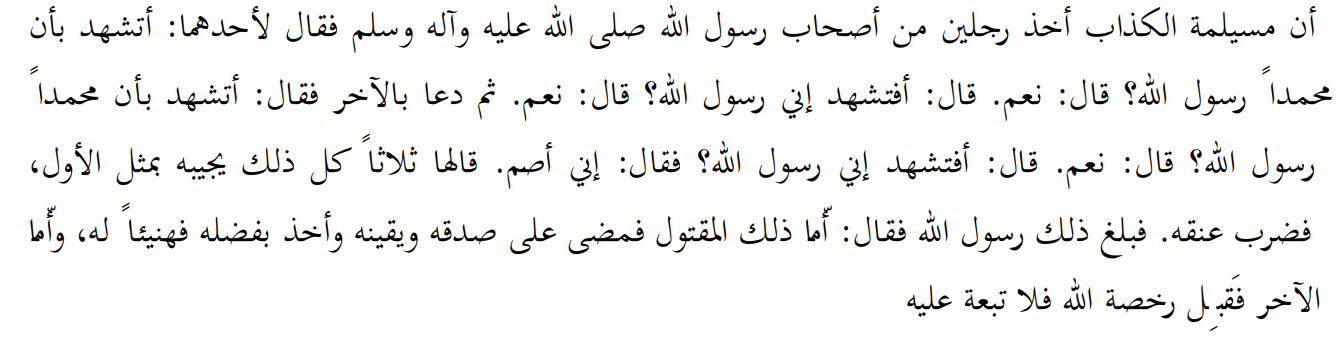
Huyo Musaylimah mwongo alimchukua wanaume wawili miongoni mwa Masahaba wa Mjumbe wa Allah ﷺ, akamwambia mmoja wao: Je, unashuhudia kwamba Muhammad ni Mjumbe wa Allah ﷺ? Alisema: Ndiyo. Akasema: Basi je, unashuhudia kwamba mimi ni Mjumbe wa Allah? Alisema: Ndiyo. Kisha akamwita mwingine na kumwambia: Je, unashuhudia kwamba Muhammad ni Mjumbe wa Allah ﷺ? Alisema: Ndiyo. Kisha akasema: Basi je, unashuhudia kwamba mimi ni Mjumbe wa Allah? Alisema: Mimi ni kiziwi (kwa hilo). Alirudia mara tatu kila mara akimjibu kama jibu la kwanza, hivyo akamkata shingo. Jambo hili lilimfikia Mjumbe wa Allah ﷺ, ambaye alisema: Kuhusu aliyeuawa, alisimama imara katika ukweli wake na imani yake, na alichukua fadhila yake, basi iwe heri kwake. Kuhusu mwingine, alikubali ruhusa ya Allah, hivyo hakuna lawama juu yake.
‘That Musaylimah the liar took two men of the Sahabah of the Messenger of Allah (saw) and said to one of them: Do you bear witness that Muhammad is a Messenger of Allah? He said: Yes. He said: Then do you bear witness that I am a Messenger of Allah? He said: Yes. Then he called for the other and said: Do you bear witness that Muhammad is a Messenger of Allah? He said: Yes. Then he said: Then do you bear witness that I am a Messenger of Allah? He said: I am deaf (to that). He said it thrice each time answering him like the first so he struck off his neck. This was conveyed to the Messenger of Allah who said: As for the one killed, he executed his truth and conviction, and he took his virtue so may it be good for him. As for the other, he accepted the concession of Allah so there is no liability on him.’
Kwa hiyo, taqiyyah ni ruhusa, na kusema ukweli waziwazi ni fadhila." (Maneno ya At-Tabarsi yanaishia hapo).
Accordingly taqiyyah is a dispensation and speaking clearly the truth is a virtue” (At-Tabarsi’s speech ends).
Kwa hiyo inaonekana kutokana na maneno ya wafasiri wawili, At-Tabari na At-Tabarsi, ambao ni wa madhehebu mawili tofauti, kwamba wamekubaliana katika kufafanua maana ya aya kama ilivyokuja, kwamba ni katazo kwa waumini kufanya urafiki na makafiri, na kwamba hali ya waumini wanapoogopa madhara ya makafiri imetengwa na katazo hili. Angalia maneno ya At-Tabari: "isipokuwa mkiwaogopa kwa jambo la kuogopwa (tuqat)" (yaani) isipokuwa mkiwa chini ya mamlaka yao na mkahofia maisha yenu kwao, hivyo mnawaonyesha urafiki kwa ndimi zenu. Na angalia maneno ya At-Tabarisi: "Kisha Yeye akatenga na kusema: 'isipokuwa mkiwaogopa kwa jambo la kuogopwa', na maana yake ni isipokuwa makafiri wakishinda na waumini wakishindwa, hivyo muumini akiwaogopa asipoonyesha makubaliano yake nao na asipoimarisha urafiki wao. Wakati huo inaruhusiwa kwake kuonyesha upendo wake kwao kwa ulimi wake na kuwatii kama tahadhari na kulinda nafsi yake." Wafasiri hao wawili wanakubaliana kwamba mada ni kutenga katazo la waumini kufanya urafiki na makafiri, na kwamba limewekewa mipaka kwa hilo. Isipokuwa At-Tabarisi alifuata jambo lililo nje ya mada, akaifanya aya kuwa ushahidi kwamba taqiyyah inaruhusiwa katika dini kwa ajili ya maisha ya mtu, jambo ambalo halipo katika aya kwa kuwa mada yake ni katazo la waumini kufanya urafiki na makafiri, na kutenga hali ya kuogopa makafiri wanapowashinda Waislamu, kwa kuruhusu urafiki wao katika hali hii. Hii si taqiyyah katika dini, wala haijabainishwa kuwa ni kuogopa maisha, kwa sababu kutengwa kwake ni kwa ujumla: "isipokuwa mkiwaogopa kwa jambo la kuogopwa" (yaani) isipokuwa mkiwaogopa kwa kile kinachopaswa kuogopwa kutoka kwao. Az-Zamakhshari alisema katika Al Kashaf
Accordingly it is shown from the words of the two mufasireen, At-Tabari and At-Tabarsi, who are of two different schools of thought, their agreement upon explaining the meaning of the ayah as it came in that it is a prohibition for believers befriending disbelievers and excluding the situation of believers fearing the harm of the disbelievers from this prohibition. Look at the words of At Tabari: “except if you fear from them something to be feared (tuqat)’ (i.e.) except if you are in their authority and you fear them over your lives so you show them friendship with your tongues.” And look at the words of At-Tabarisi: “Then He excluded and said: ‘except if you fear from them something to be feared’ and the meaning is except if the disbelievers are victorious and believers defeated so the believer fears them if he does not show his agreement with them and does not make good his friendship with them. At that time it is allowed for him to show his love for them by his tongue and compliance to them as a precaution and in protection of his soul.” The two mufasireen agree that the subject is excluding the prohibition of believers befriending disbelievers and that it is limited to that. Except that At-Tabarisi followed upon that which is outside the subject and made the ayah an evidence that taqiyyah is permitted in the deen during for one’s life which is not present in the ayah since its subject is the prohibition of believers befriending disbelievers and excluding the situation of fear of the disbelievers when they defeat the Muslims in allowing their friendship in this situation. It is not taqiyyah in the deen nor is it specified to fear over life because the exclusion is general “except if you fear from them something to be feared” (i.e.) except if you fear from them what is to be feared from. Az-Zamakhshari said in Al Kashaf
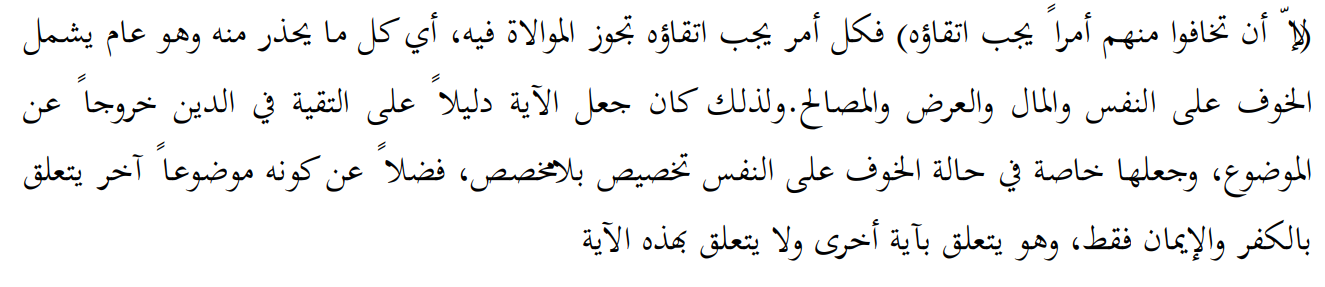
"Isipokuwa mkiwa na hofu juu yao kwa jambo linalohitaji kujikinga nalo," basi jambo lolote ambalo linapaswa kujikinga nalo linaruhusu kujifanya rafiki nalo, yaani kila kitu ambacho mnaogopa kutoka kwao, kinachojumuisha hofu juu ya uhai, mali, heshima na maslahi. Kwa hiyo, kuifanya aya hii kuwa dalili ya (taqiyyah) katika dini nje ya mada hii, na kuifanya iwe maalum kwa hali ya hofu juu ya uhai ni kutaja ubainishaji bila ushahidi unaobainisha. Zaidi ya hayo, hii ni mada nyingine inayohusiana na ukafiri na imani pekee, ambayo inahusiana na aya nyingine, na haihusiani na aya hii.
“Except if you fear from them a matter which requires protection from” so any matter which must be protected from permits befriending it i.e. all that you fear them which is general covering fear over life, wealth, honour and interests. Accordingly making the ayah an evidence for (taqiyyah) in the deen outside the subject, and making it specific in the situation of fear over life is specification without a specifying (evidence). This is besides it being another subject relating to kufr and iman only which is related to another ayah and it is not related to this ayah.
Kuhusu kauli ya At-Tabarisi: "Masahaba wetu wamesema (inaruhusiwa) katika mambo yote wakati wa dharura," basi yale anayomnukuu Al-Mufid kuhusu kuwa ni wajibu au si wajibu, hadi mwisho wa alichotaja, ni maneno yasiyo na ushahidi wowote. Aya haionyeshi hilo kwa namna yoyote, hata kwa mujibu wa tafsiri yake mwenyewe At-Tabarisi, wala hakuleta ushahidi mwingine wowote, si kutoka kwenye Kitabu, wala Sunnah, wala Ijmaa' ya Masahaba. Kwa hiyo inakataliwa na inaanguka kutoka daraja ya kuzingatiwa. Wala haisemwi kwamba ikiwa kuwa marafiki na makafiri katika hali ya kuwaogopa kunaruhusiwa, basi kutii mtawala dhalimu au mkiukaji mwenye madaraka ni jambo la kipaumbele zaidi. Hili halisemwi kwa sababu lile lenye kipaumbele zaidi ndilo maana ya kauli, na hili si miongoni mwake, wala hakuna mwanya wowote wa kuunganisha nalo. Haifanani na kauli ya Allah:
As for the statement of At-Tabarisi: “Our companions said (it is) permitted in all matters during necessity” then what he quotes from Al-Mufid of its being obligatory or not obligatory to the last of what he mentioned is abstract speech of any evidence. The ayah does not indicate this in any way even according to At-Tabarisi’s own tafsir, nor did he come with any other evidence neither from the Book or Sunnah or Ijma’a of the Sahabah, hence it is rejected and falls from the rank of consideration. Nor is it said that if befriending disbelievers in the situation of fear of them is allowed then compliance with the unjust or transgressor ruler with power is of greater precedent. This is not said because that which is of greater precedent is the sense of the speech and this is not from it nor is their any extention of any connection with it. It is not like Allah’s statement:
Miongoni mwao yupo mmoja ambaye, ukimkabidhi Dinari, hatakurudishia. [TMQ 3:75]
“Among them is one whom if you entrust him with a Dinar would not return it to you” [TMQ 3:75]
Wala si kama kauli ya Allah:
Nor is it like Allah’s statement:
"Na miongoni mwa Watu wa Kitabu yuko ambaye ukimwamini kwa rundo la dhahabu atakurudishia"
“And of the People of the Book is one whom if you entrusted with a qintar will return it to you” [TMQ 3:75].
Hii ni kwa sababu mkosaji si miongoni mwa kundi la makafiri wala katika daraja lao, na kwa sababu urafiki uliokatazwa katika aya hii ni kufanya urafiki badala ya waumini. Mtawala dhalimu na mkosaji mwenye madaraka yuko miongoni mwa waumini; dhuluma inayotokea kwake au uovu unaomfunika haufutii sifa ya imani kutoka kwake. Kwa hiyo mada hii haiingii katika utafiti wa ukufuru mkubwa, na hivyo ukufuru mkubwa haumhusu, hata kiasi cha kutumika kama ushahidi.
This is because the transgressor is not from the category of the disbeliever or from their class, and because the friendship prohibited in this ayah is befriending instead of the believers. The unjust and transgressor ruler with power is among the believers injustice occurring from him or the transgression covering him does not negate the description of iman from him. Hence this subject does not enter in the research of greater precedent, so accordingly the greater precedent does not come into it such that it is used as a witness.
Zaidi, kuwa rafiki wa mtawala dhalimu na mkiukaji mwenye madaraka pia kunaruhusiwa katika hali ya amani na katika hali ya hofu sawasawa, kwa sababu yeye ni muumini, na kuwa rafiki wa waumini kunaruhusiwa kabisa, kwa kuwa neno "waumini" katika kauli Yake: "badala ya waumini" ni la jumla linalowahusu waumini wote. Hakuna dalili yoyote iliyokatazaa kuwa rafiki wa mtawala dhalimu au mkiukaji, wala kuwa rafiki wa wakiukaji na waovu (fujjār); bali dalili zimekatazaa kwa uwazi urafiki na makafiri. Zaidi ya hayo, kumtii mtawala dhalimu ni wajibu katika mambo yasiyo ya dhambi, na jihadi ni wajibu chini ya bendera yake, na inaruhusiwa kuswali nyuma ya Imamu katika sala hata kama ni mkiukaji; haya ni miongoni mwa dalili kubwa zinazoonyesha kuruhusiwa kwa urafiki huo. Kinachokatazwa ni kuridhika na dhuluma ya mtawala na uovu wa mkiukaji. Kwa msingi huo, taqiyyah inakataliwa pale muumini anapoonyesha kinyume na anachokificha mbele ya mtawala dhalimu au mkiukaji mwenye nguvu, au mpinzani katika maoni au mfano wake; na kufanya hivyo ni haramu kwa sababu ni unafiki, na unafiki wote ni marufuku.
Moreover the befriending of the unjust and transgressor ruler with power is allowed in the situation of security and the situation of fear equally because he is a believer and befriending believers is definitely allowed because the word “believers” in His statement: “instead of believers” is general covering all believers. There did not come any text prohibiting befriending the unjust or transgressor ruler or befriending transgressors and the wicked (fujjar); rather the texts are specific in prohibiting the befriending of disbelievers. More than that, the obedience to the unjust ruler is obliged in other than sin and jihad is obliged under his banner and it is allowed to pray behind the Imam in prayer if he is a transgressor which are of the greatest indication regarding permitting their friendship. What is prohibited is the pleasure with the injustice of the ruler and the transgression of the transgressor. Accordingly taqiyyah is rejected when it is a believer showing opposite to what he hides in front of powerful unjust or transgressor ruler or opponent in the opinion or similar, and doing it is haram as it is hypocrisy and all hypocrisy is forbidden.
"Isipokuwa yule aliyelazimishwa na moyo wake umetulia juu ya imani" [TMQ 16:106].
“Except the one who is compelled and his heart is content upon iman” [TMQ 16:106].
Baadhi ya wafasiri wameliunganisha hili na aya: "isipokuwa mkiogopa kutoka kwao jambo la kuogopwa," na wanatoa hukumu kutokana nayo kwamba kuonyesha ukafiri na kuficha imani kunaingia katika kundi la urafiki, na kuingiza jambo hilo katika kile wanachokiita (taqiyyah). Wengine wanatoa hukumu kutokana nayo kwamba urafiki unaruhusiwa katika hali ya kuogopa maisha ya mtu peke yake, si katika hali nyingine. Hili ni kosa tupu, kwa sababu aya: "isipokuwa yule aliyelazimishwa na moyo wake umetulia katika imani" ina hali tofauti na mada tofauti. Mada yake ni kuritadi kutoka Uislamu katika hali ambayo kuna hofu ya kuuawa kwa hakika na kwa uhakika, si kwa dhana tu. Mada ya aya: "isipokuwa mkiogopa kutoka kwao jambo la kuogopwa" ni kukataza kufanya urafiki na makafiri katika aina zake zote, na kutoa ruhusa ya urafiki huo katika hali ya kuwepo kwa jambo linalohofiwa, iwe ni hofu juu ya maisha, mali, maslahi au madhara yoyote. Hivyo inatofautisha kati ya hali mbili na mada mbili, kiasi kwamba moja haliingii katika nyingine wala hazihusiani kwa sababu ya tofauti ya hali na mada. Muislamu anapokuwa chini ya mamlaka ya makafiri walioshinda juu ya jambo lake mbele yao, haijuzu kwake kuritadi kutoka Uislamu kama kuonyesha utii kwao; badala yake ni wajibu kwake kuhama ikiwa hawezi kutekeleza hukumu za dini yake. Hili ni tofauti na urafiki unaoruhusiwa. Lakini ikiwa Waislamu wanahofia kifo cha hakika juu ya maisha yake na akalazimishwa kwenye ukafiri, basi inaruhusiwa kwake kuonyesha ukafiri na kuficha imani. Zaidi ya hilo haijuzu, kutokana na maandiko ya aya hiyo:
Some mufasireen link it with the ayah: “except if you fear from them something to be feared” and deduce from it the entering of showing kufr and hiding iman in the category of friendship and making it to enter what they call (taqiyyah), with some deducing from it that friendship is allowed in the situation of fearing for one’s life only but not in other (situations). This is pure error because the ayah: “except the one who is compelled and his heart is content upon iman” has a different situation and a different subject as its subject is apostasy from Islam in the situation where there exists fear of definite, confirmed killing not probable and the subject of the ayah: “except if you fear from them something to be feared” is prohibiting befriending disbelievers in all its types and excluding the permissibility of this befriending in the situation of there existing what is feared from whether it was fear over life, wealth, interest or any harm. It distinguishes between the two situations and two subjects such that one does not enter into the other nor are they linked with it due to the difference in situation and subject. When the Muslim is under the authority of disbelievers defeated over his matter before them, it is not permitted for him to apostatise from Islam as a show of compliance to them; rather it is obligatory upon him to emigrate if he is unable to perform the rules of his deen contrary to befriending them which is allowed. However if the Muslims fear over his life a confirmed death and he is forced upon kufr then it is permitted for him to show kufr and hide iman, and other than that it is not permitted because of the text of the ayah:
“Yeyote anayekufuru Allah baada ya imani yake, isipokuwa yule aliyelazimishwa na moyo wake umetulia katika imani.” [TMQ 16:106].
“Whoever disbelieves in Allah after his iman except the one who is compelled and his heart is content upon iman.” [TMQ 16:106].
Mada hapa ni mada ya kufuru baada ya imani, yaani mada ya kuritadi kutoka Uislamu, na hali hapa ni hali ya kuogopa kifo. Hili ndilo wanachuoni wa fiqhi wanaloliita *alikrah al-mulji'* (kulazimishwa kwa kuhofia nafsi), ambalo ndilo pekee la kulazimishwa linalozingatiwa na Shari'a katika hali zote, na ambalo hukiondoa hukumu kwa yule aliyelazimishwa. Kulazimishwa ambako Shari'a imekitoa nje ya hukumu hii ni kulazimishwa kwa kuhofia kifo chenye hakika, yaani hali ya kuogopa kifo cha dhahiri. Hili linathibitishwa na aya iliyoteremshwa kuhusu Waislamu waliokufuru kwa kuogopa kifo. Imepokelewa kwamba aya hii iliteremshwa kumhusu Ammar bin Yasir. Ibn Jarir At-Tabari alisema: "Muhammad bin Sa'd alinisimulia, akasema: Ami yangu alinisimulia, akasema: Baba yangu alinisimulia kutoka kwa baba yake, kutoka kwa Ibn Abbas, kuhusu kauli yake (SWT): 'Atakayekufuru Mwenyezi Mungu baada ya imani yake, isipokuwa yule aliyelazimishwa na moyo wake umetulia katika imani'" hadi mwisho wa aya. Hii ilikuwa kwa sababu washirikina walimpiga Ammar bin Yasir na kumtesa, kisha wakamwacha. Basi akarejea kwa Mjumbe wa Mwenyezi Mungu ﷺ na kumjulisha alichokutana nacho kutoka kwa Quraishi na aliyosema. Ndipo Mwenyezi Mungu (SWT) akateremsha kutaja udhuru wake: "Atakayekufuru Mwenyezi Mungu baada ya imani yake," hadi kauli yake "adhabu kubwa." Bishr alinisimulia, akasema: Yazid alinisimulia, akasema: Sa'id alinisimulia kutoka kwa Qatadah: "Atakayekufuru Mwenyezi Mungu baada ya imani yake isipokuwa yule aliyelazimishwa na moyo wake umetulia katika imani," akasema: Ilitajwa kwetu kwamba aya hii iliteremshwa kumhusu Ammar bin Yasir, ambaye Banu al-Mughira walimkamata na kumfunika katika kisima cha Maymun, wakasema: Mkufuru Mwenyezi Mungu. Basi naye akafuata hayo kwao, na moyo wake ulikuwa umelazimishwa. Ndipo Mwenyezi Mungu (SWT) akateremsha kauli yake: "isipokuwa yule aliyelazimishwa na moyo wake umetulia katika imani." Na At-Tabari alisema: Ibn Abd al-‘Ala ametusimulia na akasema: Muhammad bin Thawr ametusimulia kutoka kwa Mu'ammar, kutoka kwa Abdulkareem Al-Juzri, kutoka kwa Abu Ubayd bin Muhammad bin Ammar bin Yasir, ambaye alisema:
So the subject is the subject of kufr after iman i.e. the subject of apostasy from Islam, and the situation is the situation of fearing death. This is what the fuqaha term as alikrah almulji (compulsion of refuge) which is the only compulsion considered by the Shar’a in all situations in which the rule is lifted from the one compelled. The compulsion which the Shar’a excluded is the compulsion by refuge i.e. the situation of fearing definite death. This is strengthened in the ayah that was revealed about Muslims who apostatised fearing death. It was narrated that this ayah was revealed about Ammar bin Yasir. At-Tabari said: “Muhammad bin S’aad related to me and said: My paternal uncle related to me and said: My father related to me from his father from ibn Abbas that His statement: ‘Whoever disbelieves in Allah after his belief except the one who is compelled and his heart is content upon iman’ to the end of the ayah. This was because the polytheists struck Ammar bin Yasir and punished him then left him. So he returned to the Messenger of Allah (saw) and informed him about what he met with from Quraysh and what he said. So Allah (swt) revealed his mention of his excuse: ‘Whoever disbelieves in Allah after his iman’ until His statement ‘great punishment.’ Bashr related to us and said: Yazid related to us and said: Saeed related to us from Qatadah: ‘Whoever disbelieves in Allah after his belief except the one who is compelled and his heart is content upon iman’ and said: It was mentioned to us that it was revealed about Ammar bin Yasir whom Banu Al-Mughira captured and covered him in the well of Maymun and said: Disbelieve in Allah, so he followed them in that and his heart was compelled. So Allah (swt) revealed His statement: ‘except the one who is compelled and his heart is content upon iman.’ And At-Tabari said: Ibn Abd al-‘Ala related to us and said: Muhammad bin Thawr related to us from Mu’ammar from Abdulkareem Al-Juzri from Abu Ubayd bin Muhammad bin Ammar bin Yasir who said:
Washirikina walimchukua Ammar bin Yasir na kumwadhibu hadi akasema kwao baadhi ya yale waliyokuwa wakitaka. Alimtajia hilo Mtume ﷺ, naye Mtume ﷺ akasema: "Moyo wako uliona vipi?" Akasema: "Umetulia katika imani." Mtume ﷺ akasema: "Ikiwa watarudia, basi nawe rudia."
The polytheists took Ammar bin Yasir and punished him until he said to them in some of what they wished. He mentioned that to the Prophet (saw) and the Prophet (saw) said: How did you find your heart? He said: Secured upon iman. The Prophet (saw) said: If they repeat, then you repeat.”
Ahadith hizi zinaonyesha kwamba sababu ya kushuka kwa aya ni tukio la Ammar, na mada yake ni kuritadi kutoka katika Uislamu. Hali mahususi inayohusika ni hofu ya uhakika ya kuuawa, ambayo yenyewe peke yake inatosha kuthibitisha kwamba haina uhusiano na aya: "isipokuwa ikiwa mnawaogopa kwa jambo la kuogopwa." Aya: "isipokuwa yule aliyelazimishwa na moyo wake umetulia katika imani" ilishuka Makka kuhusu suala la imani, na aya: "isipokuwa ikiwa mnawaogopa kwa jambo la kuogopwa" ni ya Madina, iliyoshuka kuhusu kutoa kutoka katika katazo la waumini kufanya urafiki na makafiri hali ya kuogopa jambo la kuogopwa. Kwa hiyo aya hii haitumiki katika mada hiyo.
These ahadith indicate that the circumstance of revelation of the ayah is the incident of Ammar and its subject is apostasy from Islam. The situation specific to it is the definite fear of killing which alone is sufficient to strengthen that it has no relationship with the ayah: “except if you fear from them something to be feared.” The ayah: “except the one who is compelled and his heart is content upon iman” was revealed in Makkah on the subject of iman, and the ayah: “except if you fear from them something to be feared” is Madinan revealed on the subject of excluding the situation of fearing what is to be feared from the prohibition of believers befriending disbelievers. Accordingly this ayah is not applicable on that subject.
Kuna kanuni kuhusu mtu anayetishiwa kuuawa kwa hakika: Je, ni bora zaidi kuonyesha kufuru na kuficha imani ili asalimike na kifo, au ni bora kushikilia imani yake hata ikipelekea kifo? Jibu ni kwamba kushikilia imani hata ikipelekea kifo ni bora, kwa sababu kuruhusiwa kuonyesha kufuru ni ruhusa (rukhsa) inayoondoa uzito, na kuhifadhi imani ni msimamo wa msingi (‘azeemah), kwa hiyo ni bora zaidi. Imesimuliwa
There remains the rule regarding the one threatened with confirmed killing: Is it more virtuous to show kufr and hide iman so as to be safe from death or is it better to persevere upon his iman even if it leads to death? The answer is that persevering to iman even if it leads to death is better because the permissibility of showing kufr is a dispensation and lifts difficulty, and preserving the iman is (‘azeemah) which is the principle therefore it is better. It is narrated

"Kwamba Musaylimah alimchukua watu wawili na akamwambia mmoja wao: Unasemaje kuhusu Muhammad ﷺ? Yeye akasema: Ni Mjumbe wa Allah ﷺ. Akasema: Basi unasemaje kuhusu mimi? Wewe pia. Hivyo akamwacha huru. Akamwambia yule wa pili: Unasemaje kuhusu Muhammad ﷺ? Yeye akasema: Ni Mjumbe wa Allah ﷺ. Akasema: Basi unasemaje kuhusu mimi? Yeye akasema: Mimi ni bubu. Alirudia hilo mara tatu, na yeye akarudia jibu lake, hivyo akamuua. Habari hizo zikamfikia Mjumbe wa Allah ﷺ, akasema: Kuhusu wa kwanza, alichukua ruhusa ya Allah. Kuhusu wa pili, alidhihirisha ukweli, basi heri yake iwe kubwa."
“That Musaylimah took two men and said to one of them: What do you say about Muhammad? He said: A Messenger of Allah. He said: Then what do you say of me? You as well. So he left him free. He said to the other: What do you say of Muhammad? He said: A Messenger of Allah. He said: Then what do you say of me? He said: I am dumb. He repeated it thrice and he repeated his answer, so he killed him. That reached the Messenger of Allah (saw) so he said: As for the first, he took the dispensation of Allah. As for the second, he exposed the truth so blessed be he.”
Hii ni wazi katika kuwapendelea wale waliosubiri na kushikamana na imani kuliko yule aliyechukua ruhusa ya Allah (swt) na kuonyesha kufuru kwa kuogopa maisha yake kutokana na kuuawa kwa hakika.
This is explicit in preferring the one who was patient and stuck to iman over the one who took the dispensation of Allah (swt) and showed kufr fearing for his life from a confirmed killing.
Hii ni kuhusu yule ambaye anaombwa kufanya kufr. Kwa yule ambaye anaombwa kitu kilicho chini ya hicho, kama kuacha da'wah ya Kiislamu au kufanya dhambi au kitu kama hicho, ruhusa haichukuliwi kutokana na aya hii. Kwa hiyo haisemwi kwamba ikiwa Mwenyezi Mungu alimruhusu Muislamu kuonyesha kufr, basi kilicho chini ya kufr kina uzito zaidi. Hili halisemwi kwa sababu uasi hauko katika jamii ya kufr, hivyo haiingii katika utafiti kwa njia ya kipaumbele cha juu zaidi. Vilevile, kulinganisha kufr na dhambi hakufanywi kwa kuwa hakuna sababu ya kufanya hivyo hadi kiwepo kipimo cha kulinganisha. Hata hivyo, yule anayeogopa maisha yake kwa kuuawa kwa hakika na akaombwa kufanya dhambi au kitu kilicho chini ya kufr, inaruhusiwa kwake kufanya hivyo ili kuokoa maisha yake, wala hakuna dhambi juu yake. Hii ni kwa sababu ya kauli yake ﷺ:
This is regarding the one from whom kufr is demanded. As for the one from whom is sought less than that like leaving the Islamic da’wah or performing a sin or something similar; permissibility is not taken from this ayah. Accordingly it is not said that if Allah permitted the Muslim to show kufr, then what is lesser than kufr is of greater precedent. This is not said because disobedience is not from the species of kufr, so it does not enter the research by greater precedent. Similarly an analogy between kufr and sin is not performed since there does not exist a reason until analogy occurs. However as for the one who fears for his life over confirmed killing and it is sought from him sin or doing less than kufr, it is permitted for him to do so to save his life and there is no sin upon him. This is due to his (saw) statement:
"Makosa, usahaulifu na yale aliyolazimishwa nayo binadamu yameondolewa kutoka kwa Ummah wangu."
“Lifted from my Ummah is the mistake, forgetfulness and what is compelled upon it”
Yaani, lawama na dhambi vinaondolewa, na hukumu inaondolewa, ambayo ina maana ya kuruhusiwa kufanya kitendo hicho. Hata hivyo, hii ni katika hali moja tu, nayo ni hali ya kuuawa kwa hakika na kuthibitika, ambayo wanazuoni wa fiqhi wameiita *al-ikrah al-mulji'* (kulazimishwa kwa kukimbilia usalama). Hii ndiyo aina pekee ya kulazimishwa inayozingatiwa na Shari'ah katika hali zote, ambapo kwa mtu aliyelazimishwa huondolewa hukumu za talaka, ndoa, biashara na vitendo na mikataba mingine. Kauli yake "na kile kinacholazimishwa juu yake" ni *al-ikrah al-mulji'* (kulazimishwa kwa kukimbilia usalama).
I.e. the blame and sin is lifted, and the rule is lifted, which means the permissibility of doing it. However (this is) only in one situation which is the situation of definite, confirmed killing which is what the fuqaha called alikrah almulji (compulsion by refuge) which is the only compulsion considered by the Shar’a in all conditions in which there is lifted from the one compelled like divorce, marriage, trade and other actions and contracts. His statement “and what is forced upon it” which is alikrah almulji (compulsion by refuge).