Hadith hii ni wazi katika kubainisha viongozi wema na viongozi waovu, na ni wazi katika kukataza kuwapinga kwa upanga mradi wanasimamisha dini, kwa kuwa kusimamisha swala kunaashiria kushikilia dini na kutawala kwa mujibu wake.
This hadith is clear in informing about the good and bad leaders, and clear in prohibiting confronting them with the sword as long as they establish the deen, since establishing the salat (prayer) indicates upholding of the deen and ruling by it.
Kwa hiyo, wajibu wa Waislamu kumteua Khalifah atakayesimamisha sheria za Uislamu na kufikisha da'wah yake ni jambo lisilo na shaka kuhusu uthabiti wake katika matini sahihi za Shari'ah. Zaidi ya hayo, ni wajibu wa lazima kwa sababu Allah (SWT) ameufanya kuwa fardhi juu ya Waislamu kusimamisha utawala wa Uislamu na kulinda heshima ya Waislamu. Hata hivyo, wajibu huu ni wa pamoja; kwa hiyo, ikiwa baadhi ya watu wa Ummah wametekeleza jukumu hilo, fardhi hiyo imetimizwa na dhamana inawaondokea wengine wa Ummah. Na ikiwa sehemu ya Ummah haikuweza kutekeleza fardhi hiyo, ingawa walifanya vitendo vinavyoisimamisha, basi dhamana inabaki juu ya Waislamu wote, na fardhi inabaki juu ya kila Muislamu mradi Waislamu wako bila Khalifah.
So the obligation upon Muslims to appoint the Khalifah who establishes the laws of Islam and conveys its call is a matter which has no doubt with regard to its certainty in the sound texts of Shari’ah. Moreover, it is an obligatory duty due to the fact that Allah (swt) made it fard upon Muslims to establish the rule of Islam and to protect the honour of Muslims. However, this duty is a collective one, so if some people of the Ummah accomplished it, the fard is fulfilled and thus responsibility drops from the rest of the Ummah. And if part of the Ummah was unable to achieve the fard, though they carried out the actions which establish it, then the responsibility remains upon all the Muslims, and the fard remains upon every Muslim as long as Muslims are without a Khalifah.
Kutoanzisha Khalifah kwa ajili ya Waislamu ni miongoni mwa dhambi kubwa kabisa, kwa sababu ni kujiepusha kutekeleza mojawapo ya faradhi muhimu zaidi za Uislamu, ambayo utekelezaji wa dini unategemea; hata kuwepo kwa Uislamu katika uwanja wa mapambano ya maisha kunategemea faradhi hiyo pia. Kwa hiyo Waislamu wote kwa pamoja wanatenda dhambi kubwa kwa kujizuia kuanzisha Khalifah kwa Waislamu wote. Na kama wote wangekubaliana kubaki bila Khalifah, dhambi ingewaangukia Waislamu wote katika maeneo yote yenye watu (dunia nzima). Hata hivyo, ikiwa baadhi ya Waislamu wangeanza kufanya kazi ya kuanzisha Khalifah na wengine wasifanye hivyo, dhambi itawaondokea mabegani wale walioanza kufanya kazi ya kuanzisha Khalifah, ingawa faradhi hiyo inabaki juu yao hadi Khalifah atakapoteuliwa. (Hii ni kwa sababu) kushiriki katika kuanzisha faradhi hiyo huondoa dhambi ya kuchelewesha kuianzisha kwa wakati wake sahihi, na dhambi ya kutoianzisha, kwa sababu ya juhudi za mtu za kuianzisha na chuki yake kwa kile kinachomzuia kuianzisha.
To refrain from establishing a Khalifah for the Muslims is among the greatest sins because it is abstaining from carrying out among the most important obligations of Islam upon which the implementation of the deen depends; nay even the very existence of Islam in the battlefield of life depends upon it as well. So Muslims as a whole commit a great sin by refraining from establishing a Khalifah for all Muslims. And if they all agreed to remain without a Khalifah the sin would befall all Muslims in all inhabited regions (entire world). However, if some of the Muslims embarked on working to establish a Khalifah and the others did not, the sin will drop from the shoulders of those who started to work to establish the Khalifah though the fard remains upon them until the Khalifah is appointed. (This is so) because the involvement in establishing the fard removes the sin for the delay in establishing it in its proper time, and for its non-establishment, due to one’s work to establish it and his hatred of that which prevents him from establishing it.
Kwa wale ambao hawakushiriki katika kazi ya kusimamisha fardh, dhambi itabaki juu yao baada ya kupita siku tatu tangu kuondoka kwa Khalifah mpaka kuteuliwa Khalifah mpya, kwa sababu Allah (swt) amewakabidhi fardh ambayo hawakuitekeleza wala kujishughulisha na kazi inayohitajika kwa kukamilishwa kwake. Kwa hiyo, wanastahili dhambi na wanastahili adhabu ya Allah (swt) katika dunia hii na Akhera. Kustahili kwao dhambi kwa sababu ya kujiepusha na kusimamisha Khalifah, au kutekeleza vitendo vinavyosimamisha Khalifah (kwa mujibu wa Shari'ah), kuko wazi kabisa kwa kuwa Muislamu anastahili adhabu ya Allah (swt) anapopuuza yoyote kati ya wajibu aliowekewa, hasa wajibu ambao kupitia kwake wajibu mwingine hutekelezwa, kanuni za dini zinasimamishwa, nguvu ya Uislamu inainuliwa, na neno la Allah (swt) linatukuzwa katika ardhi za Kiislamu na ulimwengu wote uliobaki.
As for those who were not engaged in the work to establish the fard, the sin will remain on them after three days have passed from the departure of the Khalifah until the appointment of a new Khalifah, because Allah (swt) has entrusted them with a fard which they did not carry out nor engage themselves in the work which is required for its completion. Therefore, they are deserving of sin and deserve the punishment of Allah (swt) in this life and the hereafter. Their deserving of sin due to their refraining from establishing the Khalifah, or performing the actions which (according to Shari’ah) establish the Khalifah, is explicitly clear in that a Muslim deserves the punishment of Allah (swt) when he ignores any of the duties enjoined upon him, particularly the obligation by which the other obligations are implemented, the rules of the deen are established, the cause of Islam is raised high and the word of Allah (swt) becomes exalted in the Islamic lands and the rest of the world.
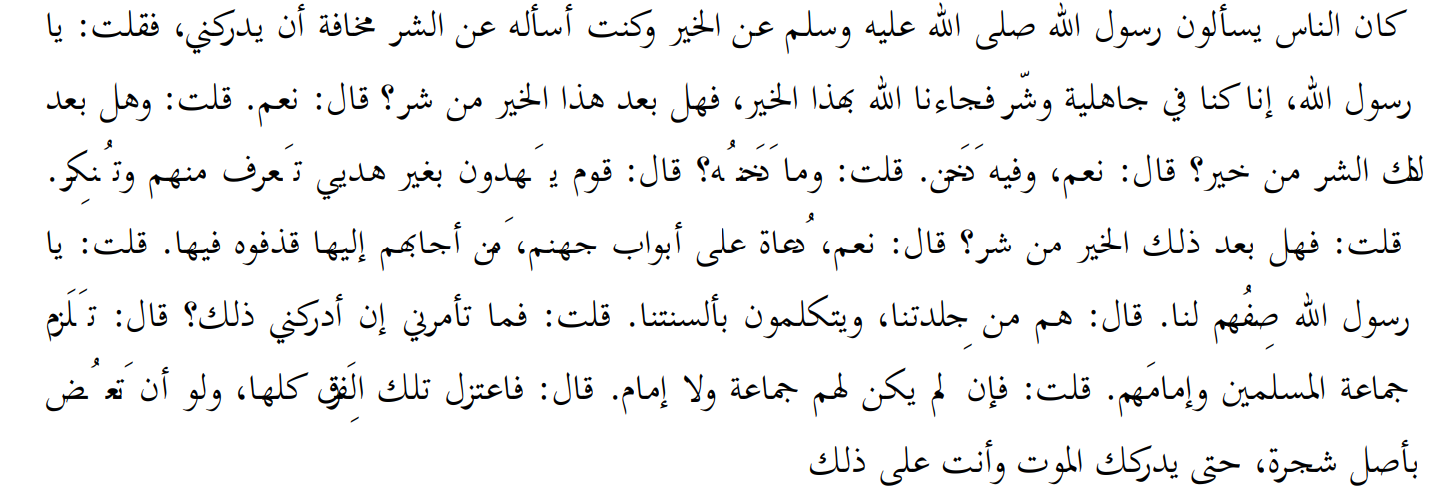
Kuhusu yale yaliyokuja katika baadhi ya Hadith kuhusu kujitenga na watu, na kujizuia kushikamana tu na mambo ya ibada binafsi ya mambo ya dini, Hadith hizi hazifai kuwa ushahidi wa kujizuia kuanzisha Khalifah wala kuondoa dhambi inayotokana na kujizuia huku. Yeyote atakayezisoma Hadith hizi kwa makini ataona kwamba zinahusiana na suala la kushikamana na dini, badala ya kuwa ruhusa ya kujizuia kuanzisha Khalifah kwa Waislamu. Kwa mfano, Al-Bukhari amesimulia kutoka kwa Bisr bin Ubaydullah al-Hadhrami kwamba alimsikia Abu Idrees al-Khoolani akisema kwamba alimsikia Hudhayfah bin al-Yaman akisema:
As for what came in some of the ahadith regarding isolation from the people, and restricting oneself to adhering only to matters of personal worship of the matters of the deen, these ahadith are not suitable as evidence to refrain from establishing a Khalifah nor removing the sin due to this abstention. Whoever studies these ahadith carefully will find them related to the matter of adhering to the deen rather than permission to refrain from establishing a Khalifah for Muslims. For example, Al-Bukhari narrated about Bisr bin Ubaydullah al-Hadhrami that he heard Abu Idrees al-Khoolani say that he heard Hudhayfah bin al-Yaman saying: