17.9 Shari'a Haikuteua Mtu Maalum Kwa Ajili ya Ukhalifa
17.9 The Shar'a Did Not Designate A Specific Person For The Khilafah
Mtazamo kwamba Mtume (saw) alimteua mtu maalum kuwa Khalifah baada yake unapingana na maandiko ya Shari'ah. Na kauli kwamba Mtume (saw) aliwateua watu fulani kuwa Makhalifah baada yake hadi Siku ya Kiyama inapingana zaidi na maandiko ya Kiislamu.
The view that the Messenger (saw) designated a specific person to be the Khalifah after him contradicts the Shari’ah texts. And the statement that the Messenger (saw) nominated certain persons to be Khulafaa after him until the Day of Judgement is even more contradictory to the Islamic texts.
Kuhusu kubatilisha (kauli) kwamba Mtume ﷺ alimteua mtu wa kumrithi katika ukhalifa baada yake, hilo linadhihirika kwa njia nyingi.
As for invalidating (the opinion) that the Messenger (saw) nominated the Khilafah for someone after him, this is apparent in numerous ways:
Kwanza: Hili linapingana na bay'ah, kwa kuwa kumteua mtu kunamaanisha kuwajulisha Waislamu ni nani atakayekuwa Khalifah juu yao. Hivyo Khalifah angekuwa anajulikana tayari, na wala haitakuwepo haja ya kuweka sheria (tashri') ya bay'ah, kwa kuwa bay'ah ndiyo njia ya kumteua Khalifah. Basi, kama tayari ameshateuliwa kabla, hakuna haja tena ya kuonyesha njia ya kumteua, kwa kuwa kwa kweli ameshateuliwa tayari. Wala haiwezi kusemwa kwamba bay'ah ni bay'ah ya utii kwa Khalifah, kwa kuwa Shari'ah imebainisha utii kwa Khalifah na kwa wenye mamlaka (ulu al-amr) katika maandiko mengine mengi tofauti na maandiko ya bay'ah. Utii umeombwa waziwazi kwa Waislamu; kuhusu bay'ah, imeombwa kwa Waislamu katika maombi mengine, si kwa kuzingatiwa kama utii tu, ingawa inajumuisha maana ya utii, bali kwa kuzingatiwa kama mkataba wa Ukhalifah. Maana yake katika Hadith zote zilizoitaja si utii, bali ni kuwapa uongozi yule anayeapwa bay'ah na kujiandaa kujisalimisha kwa uongozi huu. Kwa hiyo, kufanya bay'ah kuwa sharti la kuteua Ukhalifah kunapingana na Mtume ﷺ kumteua mtu maalum kuwa Khalifah baada yake. Zaidi ya hayo, maneno ya bay'ah yaliyokuja katika Hadith sahihi yamekuja kwa namna ya jumla ('aam) bila kubainishwa (takhsees), na ya kiujumla (mutlaq) bila kuwekewa kizuizi (taqyeed), kwa yeyote yule. Lau yangemaanisha bay'ah kwa mtu maalum, yasingekuwa ya jumla wala ya kiujumla. Maneno ya Hadith ni haya:
First: This contradicts the pledge (bay’ah) since nominating a person means informing the Muslims as to who will be the Khalifah over them. Hence the Khalifah would be known so there would remain no need for legislating (tashri’) the pledge as the pledge is the method of appointing the Khalifah. So if he has already been appointed in advance, there remains no need to demonstrate the method of appointing him as, in fact, he has already been appointed. Nor can it be said that the pledge is the pledge of obedience to the Khalifah since the Shar’a has enunciated the obedience to the Khalifah and those in charge (ulu al-amr) in many other texts distinct from the text of the pledge. Obedience has been explicitly requested from Muslims; as for the pledge, it has been requested from Muslims in other request(s) not in consideration as being (merely) obedience, though it does include the meaning of obedience, but in consideration as being a contract for the Khilafah. Its meaning in all the ahadith that mentioned it is not obedience, rather it is about giving leadership to the one who is pledged and preparing to submit to this leadership. So making the pledge a condition for appointing the Khilafah contradicts the Messenger (saw) nominating a specific person to be Khalifah after him. Moreover, the words of the pledge which came in the correct (Saheeh) ahadith came in a general manner (‘aam) without specification (takhsees), and unrestricted (mutlaq) without any restriction (taqyeed), for anyone. Were they to mean the pledge for a specific person they would not have been general and unrestricted. The word(s) of the ahadith are:
"Yeyote atakayekufa bila kuwa na bay'ah shingoni mwake,"
“He who dies without a pledge on his neck,”
"Yeyote anayemwapia Imamu,"
“Whosoever pledges an Imam,”
Na
And
"Mtu anayemwapia Imamu."
“A man who pledges an Imam.”
Maoni kwamba Mtume (saw) alimteua mtu maalum kuwa Khalifah baada yake yanapingana na kubatilisha ujumla na usio na kikomo wa bay'ah. Kwa hiyo, haiwezi kusemwa kwamba hii inamaanisha kuwa bay'ah ndiyo njia yenyewe ya kumteua Khalifah, huku uteuzi wa Khalifah ukiwa tofauti na bay'ah; ndiyo maana Khalifah huteuliwa kwanza kisha bay'ah hutolewa kwake. Hilo halipaswi kusemwa, kwa sababu bay'ah ndiyo njia ya kumteua Khalifah, na hilo halimaanishi kuwa ni sawa kabisa na uteuzi wake. Wala haipaswi kusemwa kuwa ni wajibu kumteua Khalifah kwanza na kukubali uteuzi wake kabla ya kumpa bay'ah, kwa sababu hilo lingemaanisha kuwepo njia nyingine ya kumteua Khalifah, kiasi kwamba bay'ah ingekuwa ni kwa ajili ya utii tu. Ilhali hadithi kuhusu bay'ah zote zinaonyesha kuwa ndiyo njia ya kumteua Khalifah, na hakuna njia nyingine. Zingatia kauli yake (saw):
The opinion that the Messenger (saw) designated a specific person to become Khalifah after him contradicts and invalidates the generality and unrestricted nature of the pledge. Therefore, it cannot be said that this means that the ba’yah is the very way of appointing the Khalifah while the appointment of the Khalifah is separate to the ba’yah, this is why the Khalifah is appointed first & then the ba’yah is given to him; one should not say this because the ba’yah is the method of appointing the Khalifah and this does not mean that it is exactly the same as his appointment. Nor should one say that it is compulsory to first appoint the Khalifah and acknowledge his appointment before giving him the ba’yah as this would mean that there is another method for appointing the Khalifah such that the ba’yah is merely for his obedience, whereas the ahadith about the ba’yah all indicate that it is the method to appoint the Khalifah and there is no other way. Consider his (saw) statement:
"Yeyote atakayekufa bila ahadi (bay'ah) shingoni mwake;"
“Whoever dies without a pledge on his neck”;
Ni wazi kabisa kimaana kwamba yeyote anayekufa bila kumteua Imamu wake kupitia bai'ah, na haimaanishi kwa namna yoyote yule anayekufa bila kumtii Imamu. Hii inaonyesha kwamba katika hadithi hii Mtume ﷺ anakusudia njia ya kumteua Khalifah, na hakusudii utiifu tu. Pia zingatia kauli yake ﷺ:
It is quite explicit in meaning that whoever dies without appointing his Imam via the pledge and it does not mean in any way whoever dies without obeying an Imam. This indicates that in this hadith the Prophet means the method of appointing the Khalifah and does not mean mere obedience. Also consider his (saw) statement:
"Ikiwa bai'ah itatolewa kwa makhalifa wawili, muueni wa mwisho."
“When the pledge is given to two Khalifahs, kill the latter”;
Ni wazi kwamba ikiwa Khalifah wawili watateuliwa, basi yule wa baadaye auawe. Vivyo hivyo, hadithi zote za Mtume ﷺ zinabainisha kwamba hiyo ni njia ya kumteua Khalifah. Hadithi za Mtume ﷺ hazimaanishi utiifu tu, wala utiifu usio na masharti (mutlaq); badala yake zinamaanisha kumfuata yule aliyeteuliwa kuwa Khalifah, kwa maana kwamba hii ndiyo njia ya kumteua Khalifah. Zaidi ya hayo, hakuna hadithi hata moja iliyothibitishwa, ya kinakili au ya kimaana, inayoonyesha njia nyingine ya kumteua Khalifah isipokuwa bay'ah.
This is explicit that if two Khalifahs are appointed, kill the later of them. Likewise all ahadith of the Prophet are explicit that it is the method of appointing the Khalifah. The ahadith of the Prophet are explicit in not meaning mere obedience or unrestricted (mutlaq) obedience; rather, they mean following the one appointed as the Khalifah with their meaning that this is the method of appointing the Khalifah. Further, there is not even one authenticated hadith, whether in narration or meaning, which demonstrates a method of appointing the Khalifah other than the ba’yah.
Pili: Hadithi zimesimuliwa kutoka kwa Mtume (saw) zikionyesha kwamba kutakuwa na migogoro na mizozo miongoni mwa watu kuhusu Ukhalifa na ushindani juu yake. Lau kama kungekuwepo na maandishi kutoka kwa Mtume (saw) kuhusu uteuzi wa mtu mahususi, lisingeibuka mzozo mbele ya maandishi hayo, au Mtume (saw) angeeleza kwamba watu wangeshindana na mtu huyo. Badala yake, maandishi yalikuja yakisema kwamba watu wangegombana wao kwa wao, na pia yakaeleza njia ya kutatua mzozo huu na kumaliza suala la Ukhalifa. Muslim alisimulia katika Saheeh yake: Wahab bin Baqiyyat al-Wasiti alinisimulia kwamba Khalid bin Abdullah al-Juzairi alitwambia kutoka kwa Abu Nadhra, kutoka kwa Abu Saeed al-Khudri, aliyesema: Mtume ﷺ alisema:
Second: Ahadith have been narrated from the Messenger (saw) indicating that there will be disputes and contentions among people about the Khilafah and competition over it. If there was a text from the Messenger (saw) concerning the appointment of a (specific) person, there would not arise a dispute in the presence of that text or the Messenger (saw) would state that people would dispute with that person. Whereas the texts came saying that people would dispute between themselves and it also clarified the method to resolve this dispute and settle the issue of the Khilafah. Muslim narrated in his Saheeh: Wahab bin Baqiyyat al-Wasiti narrated to me that Khalid bin Abdullah al-Juzairi told us from Abu Nadhra from Abu Saeed al-Khudri who said: The Messenger of Allah (saw) said:
"Ikiwa kiapo kitatolewa kwa makhalifa wawili, muueni yule wa mwisho kati yao."
“If the pledge is given to two Khalifahs, kill the latter of them.”
Muslim pia alisema katika Saheeh yake: Zuhayr bin Harb na Ishaq bin Ibrahim walinisimulia, huku Ishaq akisema: "Tulipewa habari," na Zuhayr akasema: "Ilisimuliwa kwetu na Jareer, kutoka kwa Al-‘Amash, kutoka kwa Zaid bin Wahhab, kutoka kwa Abdurrahman bin Abdurrabb al-Ka’aba, aliyesema: Niliingia msikitini, na Abdullah bin ‘Amru bin al-‘Aas alikuwa ameketi kwenye kivuli cha Ka’aba huku watu wamemzunguka. Nikajiunga nao na kuketi naye. Akasema: Tulikuwa pamoja na Mtume wa Allah ﷺ katika safari, tukasimama kwenye kambi, na mwadhini wa Mtume wa Allah ﷺ akatangaza swala ya jamaa. Basi sote tukakusanyika mbele ya Mtume wa Allah ﷺ, ambaye akasema:"
Muslim also said in his Saheeh: Zuhayr bin Harb and Ishaq bin Ibrahim narrated to me, with Ishaq saying we were informed and Zuhayr said it was narrated to us by Jareer, from Al-‘Amash from Zaid bin Wahhab from Abdurrahman bin Abdurrabb al-Ka’aba who said: I entered the mosque and Abdullah bin ‘Amru bin al-‘Aas was seated in the shade of the Ka’aba with people gathered around him. So I joined them and sat with him. He said: We were with the Messenger of Allah (saw) in a voyage and we stopped at an encampment when an announcer (mu’adhin) of the Messenger of Allah (saw) announced the collective prayer. So we all gathered before the Messenger of Allah (saw) who said:

"Hakuna nabii aliyekuja kabla yangu ila ilikuwa ni wajibu kwake kuwaongoza umma wake kwenye lililo jema zaidi alilolijua kwao, na kuwaonya dhidi ya lililo baya zaidi alilolijua kwao, mpaka akasema: Yeyote aliyemwekea mkono Imamu, akimpa kiganja cha mkono wake na tunda la moyo wake, amtii kadiri awezavyo. Mtu mwingine akija kubishana naye, ipigeni shingo ya huyo mtu mwingine."
“There was no Prophet before me except that it was obligatory upon him to guide his Ummah to the best that he knew for them and warn them of the worst he knew for them until he said: Whoever pledged an Imam, giving him the clasp of his hand and the fruit of his heart, should obey him as much as he can. If another comes to dispute with him, strike the neck of the other person.”
Muslim pia amesimulia katika Saheeh yake: Muhammad bin Bashar alitusimulia kwamba Muhammad bin Ja'far alitusimulia kwamba Shu'ba alitusimulia kutoka kwa Furrat al-Qazzaz, kutoka kwa Abu Hazm aliyesema: Nilikaa pamoja na Abu Hurayra kwa miaka mitano, nikamsikia akisimulia kutoka kwa Mtume ﷺ aliyesema:
Muslim also narrated in his Saheeh: Muhammad bin Bashar narrated to us that Muhammad bin Ja’far narrated to us that Shu’ba narrated to us from Furrat al-Qazzaz from Abu Hazm who said: I remained with Abu Hurayra for five years and heard him narrate from the Prophet (saw) who said:
"Wana wa Israili walikuwa na Manabii waliokuwa wakiyasimamia mambo yao kama wanasiasa (tasusuhum). Kila Nabii alipofariki, mwingine alimfuata. Hata hivyo, hakutakuwa na Nabii baada yangu ﷺ, lakini watakuwepo Khalifa wengi. Wakasema: Unatuamuru nini? Akasema: Timizeni ahadi mmoja baada ya mwingine."
“The children of Israel had Prophets taking care of their affairs as politicians (tasusuhum). Whenever one Prophet died, another followed him. However, there will be no Prophet after me but there will be Khulafaa who will be many. They said: What do you command us? He said: Fulfil the pledge one after the other.”
Muslim amesimulia katika Sahihi yake: Uthman bin Abu Shayba alitusimulia kwamba Yunus bin Abu Ya'fur aliwasimulia kutoka kwa baba yake, kutoka kwa Arfaja, ambaye alisema kwamba alimsikia Mtume wa Allah ﷺ akisema:
Muslim narrated in his Saheeh: Uthman bin Abu Shayba narrated to us that Yunus bin Abu Ya’fur narrated to them from his father from Arfaja who said he heard the Messenger of Allah (saw) saying:
"Yeyote utakayemwona, pale mambo yenu yote yanapokuwa yamekusanywa chini ya mtu mmoja, akikusudia kuchochea uasi au kuvuruga umoja wenu, mueleshe ukatili." Wait, I should translate faithfully: "kill him" means "muue." "Yeyote utakayemwona, wakati mambo yenu yote yamekusanywa chini ya mtu mmoja, akikusudia kuchochea uasi au kuvunja umoja wenu, muue."
“Whoever finds when all your affairs have been united under one man, intending to incite rebellion or divide your unity, kill him.”
Hii ina maana kwamba Khilafah ni haki ya Waislamu wote, kiasi kwamba mtu yeyote anaweza kuwania. Hili linapingana na (kauli inayosema) kwamba Mjumbe wa Allah ﷺ alimteua mtu maalum kuwa Khalifah baada yake.
This means that the Khilafah is the right of all Muslims such that anyone can contend for it. This contradicts the (saying that) the Messenger (saw) nominated a specific person to be the Khalifah after him.
Tatu: Hadithi zilizokuja na neno Imam likimaanisha Khalifah zilikuja na neno hili katika hali isiyobainishwa; na pale lilipokuja likiwa limebainishwa, lilikuja either limebainishwa kwa "the" ("al") ya jinsi, au likihusishwa na nomino ya jumla. Katika uwezekano ulioja ukiwa umebainishwa kwa "al", ilikuwa ni "al" ya jinsi kwa ushahidi wa sentensi. Mtume ﷺ alisema:
Third: The ahadith which came with the word Imam denoting the Khalifah came with this word in an unspecified form; and when it came in an specified one, it either came specified with “the” (“al”) of the species or related to a collective noun. In the possibilities which came specified with “al”, it was the “al” of species by evidence of the sentence. The Messenger said:
"Yeyote anayemwapia Imamu",
“Whoever pledges an Imam”,
"…alisimama dhidi ya Imamu dhalimu",
“…stood against an unjust Imam”,
"Kutakuwa na Maimamu baada yangu."
“there will be Imams after me.”
Akasema:
And he said:
"Imamu ni mtu anayewalinda (ra'i) watu, na anawajibika kwa raia wake."
“The Imam is the one who is a guardian (ra’i) over the people and he is responsible for his citizens”,
Hakika Imamu ni ngao ambayo nyuma yake watu hupigana na ambaye kwa sababu yake wanalindwa.
“Verily the Imam is a shield from behind whom they fight and by whom they are protected”
na akasema:
and he said:
"…kwa Imamu wa Waislamu",
“…to the Imam of the Muslims”,
"Bora kati ya Maimamu wenu",
“The best of your Imams”,
"…viongozi wenu wabaya kabisa."
“…the worst of your Imams.”
Yote haya yanaonyesha kwamba Mtume ﷺ aliacha suala la nani atakuwa Khalifah baada yake bila kulitaja, bila kumteua mtu maalum. Hili ni wazi katika dalili yake kwamba Mtume ﷺ hakumteua mtu mahsusi kwa ajili ya Khilafah, bali aliliacha kama haki ya Waislamu wote. Ukiongeza kwa hili kwamba baadhi ya maandiko yalikuja kwa lugha ya wingi (jam‘u), hili linakuwa ni nasi wazi wa kukanusha kwamba Imamu awe mtu mmoja maalum.
All this indicates that the Messenger (saw) left the issue concerning who would be the Khalifah after him unspecified without specifying him. This is explicit in its indication that the Messenger (saw) did not designate a specific person for the Khilafah but rather left it as a right for all Muslims. When you add to this that some texts came with the collective (jam’u) language, this becomes a clear text in negating the Imam being a specific person.
Nne: Masahaba (ra) walitofautiana wakati wao juu ya watu wa kuwa Khalifah miongoni mwao. Tofauti hii kati ya watu ni dalili kwamba Mtume (saw) hakumteua mtu maalumu kwa ajili ya Ukhalifa. Miongoni mwa watu waliotofautiana ni wale ambao inasemekana Mtume alitoa kauli kuhusu Ukhalifa wao, yaani: Abu Bakr (ra) na Ali (ra). Licha ya tofauti zao, hakuna hata mmoja wao aliyewahi kubishana kwamba kuna nasi kutoka kwa Mtume (saw) kwamba Ukhalifa ni wake, wala hakuna Masahaba (ra) aliyebishana kwamba kuna nasi kwa watu fulani kwa ujumla. Lau kungekuwepo nasi, wangebishana nao kwa nasi hiyo; kwa hiyo kushindwa kwao kubishana kwa kutumia nasi yoyote kunamaanisha kwamba hakuna nasi kwa mtu maalumu kwa ajili ya Ukhalifa. Wala mtu asiseme kwamba kuna nasi ambayo ilijulikana baada yao lakini haikuwafikia, kwa sababu sisi tunachukua dini yetu kutoka kwa Masahaba (ra). Wao ndio walioitufikishia Qur’an, na kutuhadithia Hadith. Kwa hiyo, ikiwa hakuna nasi yoyote kutoka kwa Masahaba (ra), basi haitambuliki kwa njia yoyote. Tunachukua kila kilichotoka kwao na kuacha kila kisichotoka kwao. Kuhusiana na suala la nasi kuhusu Khalifah baada ya Mtume (saw), tunaona kwamba Masahaba (ra) wote bila ubaguzi, pamoja na Abu Bakr (ra) na Ali (ra), walikubaliana juu ya kutokuwepo kwa nasi yoyote kwa mtu maalumu kwa ajili ya Ukhalifa, kwa sababu ya kushindwa kwao kuitaja, licha ya haja ya kuzungumza na umuhimu wa kuitaja nasi hiyo kama ingekuwepo. Hili linaonyesha ubatilifu wa Mtume (saw) kumteua mtu kwa ajili ya Ukhalifa. Wala mtu asiseme kwamba kushindwa kuitaja nasi hiyo kulitokana na tahadhari ya kulinda umoja wa Waislamu, kwa kuwa hilo lingemaanisha kuficha hukumu ya Allah na kutoiwasilisha wakati ilipohitajika kwa haraka, hasa katika jambo muhimu kama hilo kwa Waislamu. Kuficha dini ya Allah kwa namna hii hakuwezi kuwa kumetoka kwa Maswahaba (ra) wa Mtume wa Allah ﷺ.
Fourth: The Sahabah (ra) differed in their time about the persons to be the Khalifah among them. This difference among persons is evidence that the Messenger (saw) did not designate a specific person for the Khilafah. Among the very people who differed are those of whom it is said that the Messenger enunciated upon their Khilafah, namely: Abu Bakr (ra) and Ali (ra). Despite their differences, none of them ever argued that there was a text from the Messenger (saw) that the Khilafah is for him nor did any of the Sahabah (ra) argue that there was a text for certain people in general. Were there any text, they would have argued with them; so their failure to argue using any text means that there is no text for a specific person for the Khilafah. Nor should anyone say that there is a text which was known after them but it did not reach them, because we take our deen from the Sahabah (ra). They are the ones who conveyed the Qur’an, and narrated the hadith, to us. So if there is no text or any text from the Sahabah (ra), then it is not recognised in any way. We take whatever came from them while throwing away whatever did not come from them. In relation to the issue of a text for a Khalifah after the Messenger (saw), we find that all the Sahabah (ra) without exception including Abu Bakr (ra) and Ali (ra) agreed upon the absence of any text for a specific person for the Khilafah due to their failure to mention this despite the need for speaking and the necessity for mentioning the text if it existed. This indicates the invalidity of the Messenger (saw) designating a person for the Khilafah. Nor should one say that the failure to mention the text was due to the precaution to preserve the unity of the Muslims for this means hiding a rule of Allah and not delivering it at the very time it was urgently required, particularly in such an important matter for the Muslims. This hiding in the deen of Allah is not possible to come from the Sahabah (ra) of the Messenger of Allah (saw).
"Kama nikimteua Khalifa, hakika aliye bora kuliko mimi alimteua Khalifa, yaani Abu Bakr. Na kama sikumteua, basi aliye bora kuliko mimi hakumteua, yaani Mtume wa Allah ﷺ."
“If I appoint a Khilafah, verily one better than me did appoint a Khalifah i.e. Abu Bakr. And if I do not, then one better than me did not i.e. the Messenger of Allah (saw).”
Imepokewa na Muslim kutoka kwa Ibn Umar kwamba Umar bin al-Khattab (ra) alisema:
Muslim narrated from bin Umar that Umar bin al-Khattab (ra) said:
Hakika Allah ‘azza wa jall atauhifadhi dini. Nisipomteua Khalifa, hakika Mtume wa Allah ﷺ hakumteua; na nikimteua, hakika Abu Bakr alimteua.
“Verily Allah ‘azza wa jall will preserve the deen. If I do not appoint a Khalifah, verily the Messenger of Allah (saw) did not appoint; and if I do appoint, verily Abu Bakr did appoint.”
Hii ni dalili wazi kwamba Mtume (saw) hakumteua Khalifa. Wala haifai kusema kwamba hii ni maoni ya Umar, kwa kuwa pale Sahaba anaposema, "Mtume (saw) alifanya hivi au hakufanya hivi, au tulikuwa katika zama zake hivi, au kulikuwa katika zama zake kadhaa na kadhaa," hii ni hadithi inayotumika kama dalili, si maoni ya Sahaba tu. Zaidi ya hayo, Umar alisema hili mbele ya Masahaba (ra), wakiwa wanasikia na kuona, na Ali (ra) alikuwepo, kauli hii ikamfikia, wala hakuipinga, jambo linaloonyesha kwamba walikubaliana juu ya yale aliyoyasimulia Umar (ra).
This is a clear text that the Messenger (saw) did not appoint a Khalifah. Nor should one say that this is Umar’s opinion for when a companion says, ‘The Messenger (saw) did this or did not do this or we were in his time like this or there was in his time such and such’, this is a hadith used as evidence not merely a companion’s view. Moreover, Umar said this within the hearing and sight of the Sahabah (ra), and Ali (ra) was present and this statement reached him and he did not oppose it, which indicates their agreement upon what Umar (ra) narrated.
Haya yote yanatokana na kutokuwepo kwa maandishi yoyote mahsusi yanayomteua mtu mmoja kwa ajili ya Khilafah. Kuhusu maandiko yanayoletwa na wale wanaodai kuwepo kwa maandiko yanayomteua mtu mahsusi, miongoni mwa maandiko hayo ni yale yanayoletwa kuonyesha kwamba Mtume ﷺ alimteua Abu Bakr (ra) kuwa Khalifah baada yake, na mengine yanaletwa kuonyesha kwamba alimteua Ali (ra) kuwa Khalifah baada yake. Ni lazima tuyawasilishe na kueleza maudhui yake.
This is all with respect to the absence of any specific text designating a specific person for the Khilafah. As for the texts brought by those who say that there are texts designating a specific person, among these texts are those brought to indicate that the Messenger appointed Abu Bakr (ra) to become Khalifah after him whereas others are brought to indicate that he appointed Ali (ra) as the Khalifah after him. We must present them and explain their contents.
Kuhusu maandishi yanayotolewa na wale wanaosema kwamba Mtume (saw) alimteua Abu Bakr (ra), yamegawanyika katika sehemu mbili: Sehemu ya kwanza ni ile ambayo Mtume (saw) anamsifu Abu Bakr (ra), ambapo hakuna chochote kinachoonyesha kwamba Mtume ﷺ alimteua. Sehemu ya pili ni ile ambayo baadhi ya watu wanahitimisha kwa njia ya kukisia kwamba Mtume ﷺ alimteua Abu Bakr (ra), huku wengine wakihitimisha kwamba alimpendekeza Abu Bakr (ra). Tutawasilisha mfano wao kwa kutaja baadhi yao, huku tukizingatia kwamba hakuna hata mmoja wao anayezidi maana ya sifa.
As for the texts brought by those who say the Messenger (saw) appointed Abu Bakr (ra), they are divided into two: One portion in which the Messenger (saw) praises Abu Bakr (ra) wherein there is nothing to indicate that the Messenger (saw) appointed him. The other portion is one wherein some deduce by deduction that the Messenger (saw) appointed Abu Bakr (ra) while others deduce that he nominated Abu Bakr (ra). We will present their model by presenting some of them, noting that none of them exceed the meaning of praise.
"Hakika mtu mwenye fadhila zaidi kwangu katika urafiki wake na mali yake ni Abu Bakr. Lau ningalimchukua rafiki wa karibu (khaleel) mwingine asiyekuwa Mola wangu, ningalimchukua Abu Bakr (ra), lakini badala yake kuna undugu wa Uislamu na mapenzi yake. Haipaswi kubaki katika msikiti mlango wowote isipokuwa ufungwe, isipokuwa mlango wa Abu Bakr."
“Verily the most gracious of people to me in his companionship and wealth is Abu Bakr. Were I to take an intimate friend (khaleel) other than my Lord, I would have taken Abu Bakr (ra) but instead there is the brotherhood of Islam and its love. There should not remain in the mosque any door but that it should be closed except for the door of Abu Bakr.”
Muslim pia alisimulia hadith hii lakini kwa maneno tofauti, ingawa yanafanana na haya mengine. Hakuna chochote katika hadith hii kinachomfanya mtu aseme kwamba alimteua Abu Bakr (ra) kuwa Khalifah. Kilichomo ndani yake ni sifa kwa Abu Bakr (ra) kutoka kwa Mtume (saw), na Mtume (saw) aliwasifu sahaba wengi kwa majina. Zipo hadith zenye sifa kwa Umar (ra), Uthman (ra), Ali (ra), Sa'd bin Abu Waqqas (ra), Talha (ra), Az-Zubayr (ra), Abu 'Ubaydah bin al Jarrah (ra), Al-Hassan (ra) na Al-Hussein (ra), Zayd bin Haritha (ra), Usama bin Zayd (ra), Abdullah bin Ja'far (ra), Khadija (ra), Aisha (ra), Fatima (ra) binti ya Mtume (saw), Umm Salamah (ra), Bilal (ra) na wengineo. Sifa peke yake kwa namna yoyote ile haionyeshi uteuzi wa kuwa Khalifah.
Muslim also narrated this hadith but with different wording, although similar to these ones. There is nothing in this hadith to make a person say that he appointed Abu Bakr (ra) as Khalifah. All that it contains is praise for Abu Bakr (ra) from the Messenger (saw), and the Messenger (saw) praised many companions by name. There have come ahadith with praise for Umar (ra), Uthman (ra), Ali (ra), Sa’d bin Abu Waqqas (ra), Talha (ra), Az-Zubayr (ra), Abu ‘Ubaydah bin al Jarrah (ra), Al-Hassan (ra) and Al-Hussein (ra), Zayd bin Haritha (ra), Usama bin Zayd (ra), Abdullah bin Ja’far (ra), Khadija (ra), Aisha (ra), Fatima (ra) daughter of the Prophet (saw), Umm Salamah (ra), Bilal (ra) and others. Praise by itself does not in any way whatsoever indicate appointment to be Khalifah.
Kuhusu hadithi ambazo baadhi ya watu walizitumia kuthibitisha Ukhalifa wa Abu Bakr (ra), ni hadithi nne ambazo tutaziwasilisha na kufafanua yote zilizomo ndani yake. Hadithi hizo ni:
As for the ahadith from which some deduced the Khilafah of Abu Bakr (ra), they are four ahadith which we will present and clarify all that they contain. These ahadith are:
Kwanza: Al-Bukhari alisimulia kutoka kwa Al-Qasim bin Muhammad (ra) ambaye alisema:
First: Al-Bukhari narrated from Al-Qasim bin Muhammad (ra) who said:
Aisha alisema: Ee kichwa changu! Kisha Mtume wa Allah ﷺ alisema: Ikiwa jambo hilo lingetokea nami nikiwa hai, ningeomba msamaha kwa ajili yako na kukuombea dua. Aisha alisema: Hilo ni jambo zito. Kwa Allah, nadhani ungependa kifo changu ili, lingetokea, utumie siku zako zilizobaki ukiwa umeolewa kwa furaha na baadhi ya wake zako. Nabii ﷺ alisema: Bali ni kichwa changu kilicho kizito. Nilikusudia au nilipanga kutuma watu wamwite Abu Bakr na mwanawe ili nimpe ahadi ('ahd) ili mtu yeyote asiseme wala mtamani asitamani. Kisha nikasema kwamba Allah atakataa na waumini watazuia hilo, au Allah atazuia na waumini watakataa.
“Aisha said: O my head so the Messenger of Allah (saw) said: If it were to happen and I were alive, I would ask for you to be forgiven and pray for you. Aisha said: That is a serious matter. By Allah, I believe that you would like my death so that it if happened, you would spend the rest of your days wedded happily with some of your wives. The Prophet (saw) said: Rather it is my head which is heavy. I intended or planned to send for Abu Bakr and his son so as to give him a promise (‘ahd) so that no person will speak or a wisher wish. Then I said that Allah will reject and the believers prevent that or Allah will prevent and the believers reject.”
Muslim amesimulia hadith hii kutoka kwa Aisha (ra) kwa maneno haya kutoka kwake: Mjumbe wa Allah ﷺ alaniambia katika ugonjwa wake:
Muslim narrated this hadith from Aisha (ra) in this wording from her: The Messenger of Allah (saw) said to me in his illness:
"Niitie baba yako Abu Bakr na kaka yako ili niandike kitabu, kwa maana naogopa kwamba mtu mwenye kutamani atatamani, au msemaji atasema: Mimi ni bora (au nina haki ya kutangulia). Lakini Allah atakataa, na pia waumini, isipokuwa Abu Bakr."
“Call for me your father, Abu Bakr, and your brother so that I write a book for I fear that a wisher will wish or a speaker say: I am better (or take precedence). But Allah will reject, and so the believers, except for Abu Bakr.”
Pili: Al-Bukhari alipokea kutoka kwa Muhammad bin Jubayr bin Mut'im, kutoka kwa baba yake aliyesema:
Secondly: Al-Bukhari narrated from Muhammad bin Jubayr bin Mut’im from his father who said:
Mwanamke mmoja alimwendea Mtume ﷺ na kumzungumzia jambo fulani; naye akamwamuru arudi kwake. Akasema: Ee Mjumbe wa Allah, je, itakuwaje nikija nisikupate—kana kwamba alikusudia kifo—basi akasema: Usipoweza kunipata, basi nenda kwa Abu Bakr.
“A woman came to the Prophet (saw) and spoke to him about something; and he commanded her to return to him. She said: O Messenger of Allah, what if I came and did not find you—as if she meant death—so he said: If you do not find me, then go to Abu Bakr.”
Imepokewa na Muslim, kutoka kwa Muhammad bin Jubayr bin Mut'im, kutoka kwa baba yake, kwa maneno yafuatayo:
Muslim narrated this hadith from Muhammad bin Jubayr bin Mut’im from his father in the words:
Mwanamke mmoja alimuuliza Mjumbe wa Allah ﷺ jambo fulani, naye akamwamuru arudi kwake. Akasema: Ee Mjumbe wa Allah, je, itakuwaje nikija na nisikupate? Baba yangu alisema: Kana kwamba alikuwa anamaanisha kifo. Basi akasema: Usiponipata, basi nenda kwa Abu Bakr.
“A woman asked the Messenger of Allah (saw) something and he commanded her to return to him. She said: O Messenger of Allah, what if I come and do not find you—My father said: As if she meant death—so he said: If you do not find me, then go to Abu Bakr.”
Tatu: Al-Bukhari alisimulia kutoka kwa Aisha (ra), mama wa waumini,
Thirdly: Al-Bukhari narrated from Aisha (ra), the mother of the believers,
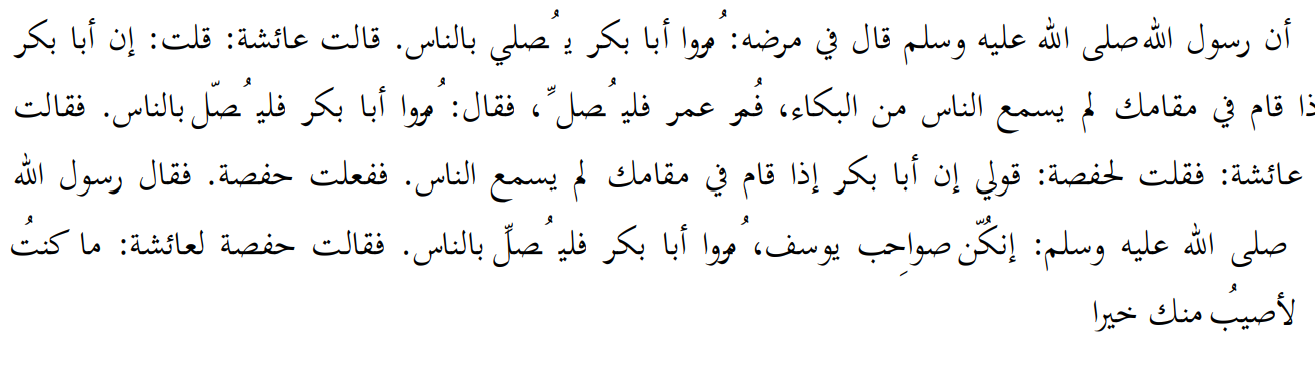
"Mjumbe wa Allah ﷺ aliniambia wakati wa maradhi yake: Mwamrishe Abu Bakr awaongoze watu katika sala. Aisha alisema: Nikasema: Abu Bakr atakaposimama mahali pako, watu hawatasikia kwa sababu ya kilio chake, basi mwamrishe Umar awaongoze sala. Akasema: Mwamrishe Abu Bakr awaongoze watu katika sala. Aisha alisema: Nikamwambia Hafsa: Sema kwamba Abu Bakr atakaposimama mahali pako, watu hawatasikia, naye akafanya hivyo. Mjumbe wa Allah ﷺ akasema: Ninyi mko kama wenzi wa Yusufu. Mwamrishe Abu Bakr awaongoze watu katika sala. Hafsa akamwambia Aisha: Sitapata kheri yoyote kupitia wewe kamwe!"
“That the Messenger of Allah (saw) told me during his illness: Command Abu Bakr to lead the people in prayer. Aisha said: I said: When Abu Bakr stands in your place, people do not hear him for his crying so command Umar to lead prayers. He said: Command Abu Bakr to lead people in prayer. Aisha said: I said to Hafsa: Say that when Abu Bakr stands in your place, the people do not hear, and she did that. The Messenger of Allah (saw) said: You are like the companions of Yusuf. Command Abu Bakr to lead the people in prayer. Hafsa said to Aisha: I will never achieve any good through you!”
Nne: Muslim ameeleza kutoka kwa bin Abu Mulkiyya aliyesema:
Fourthly: Muslim narrated from bin Abu Mulkiyya who said:

"Nilimsikia Aisha akiulizwa: Mtume wa Allah ﷺ angemteua nani kuwa Khalifah baada yake, kama angemteua? Akasema: Abu Bakr. Akaulizwa: Kisha baada ya Abu Bakr ni nani? Akasema: Umar. Kisha akaulizwa: Kisha baada ya Umar ni nani? Akasema: Abu ‘Ubaydah bin al-Jarrah, kisha akanyamaza hapo."
“I heard Aisha being asked: Whom would the Messenger of Allah (saw) have appointed as Khalifah after him had he so appointed? She said: Abu Bakr. She was asked: Then whom after Abu Bakr? She said: Umar. She was then asked: Then whom after Umar? She said: Abu ‘Ubaydah bin al-Jarrah, and she stopped at that.”
Ahadith hizi zote si ushahidi unaofaa kwamba Mtume ﷺ alimteua Abu Bakr (ra) kuwa Khalifah. Hadith ya kwanza inakataliwa kwa sababu mbili. Ya kwanza ni kwamba Mtume ﷺ alisema:
All these ahadith are not suitable evidence for the Messenger (saw) appointing Abu Bakr (ra) as Khalifah. The first hadith is rejected for two reasons: The first is that the Messenger (saw) said:
"Nilitamani au nilikusudia"
“I wished or intended”
Lakini hakufanya hivyo, kwa hiyo hili si ushahidi. Kwani ushahidi ni kauli ya Mtume ﷺ, kitendo chake, au kukubali kwake kimya; kisicho hayo hakizingatiwi kuwa ushahidi wa Shari'ah. Pili, Aisha (ra) ni binti yake Abu Bakr (ra), hivyo kama hadithi hii ingekuwepo angemjulisha Abu Bakr (ra). Kisha angebishana nayo alipokwenda katika uwanja wa Saqeefa kujadiliana na Ansar walipokusanyika kula kiapo cha utii kwa Khalifah miongoni mwao. Kwa hiyo hadithi hii imekataliwa (mardud) na haifai kuwa ushahidi wa kumteua Abu Bakr (ra) kuwa Khalifah.
But he did not do so, so this is not an evidence. For the evidence is the Messenger’s (saw) saying, action or silent consent; anything other than these is not considered Shari’ah evidence. Secondly, Aisha (ra) is Abu Bakr’s daughter so were this hadith present she would have informed Abu Bakr (ra). Then he would have argued with it when he went to the courtyard (saqeefa) to contend with the Ansar when they gathered to pledge allegiance to a Khalifah amongst them. Therefore this hadith is rejected (mardud) and is unsuitable to be an evidence for the appointment of Abu Bakr (ra) as Khalifah.
Kuhusu hadith ya pili, haidhihirishi uteuzi wa Abu Bakr (ra) kuwa Khalifah, kwa sababu huyo mwanamke alisema: "Nisipokukuta"; kwa hiyo ni sahihi kwamba alishindwa kumpata kutokana na kutokuwepo kwake vitani au katika jambo lingine lolote. Hakuna ndani yake kinachoonyesha kwamba alimaanisha kwa maneno yake "Nisipokukuta" kwamba wewe umekufa. Maneno yaliyokuja katika hadith "Kana kwamba alimaanisha kifo" ni maneno ya Jubayr na ufahamu wake. Kwa hiyo amri ya Mtume ﷺ kwake kwamba aende kwa Abu Bakr (ra) akija na asimkute si ushahidi wa uteuzi wa Abu Bakr (ra) kuwa Khalifah baada ya Mtume ﷺ. Hata kama tungelazimishwa kuchukulia ufahamu wake kuwa unamaanisha kifo, maneno haya bado yasingemteua Abu Bakr kuwa Khalifah baada yake ﷺ. Kuhusu hadith ya tatu, huu ni uteuzi wa kuongoza sala na si jambo jingine. Uteuzi wa kuongoza sala hauna maana ya uteuzi wa mamlaka (hukm). Kauli yao: "Mtume wa Allah alimridhia katika jambo la dini, basi kwa nini tusimridhie katika jambo la dunia?" ni ufahamu wao, nao ni wa makosa kwa sababu kuna tofauti kubwa kati ya sala na utawala. Si kila anayestahili kuwa kiongozi (Imam) wa sala anastahili kuwa kiongozi katika utawala. Zaidi ya hayo, maandiko yanahusu sala mahsusi, kwa hiyo hayahusishi mambo mengine, wala hayapaswi kuchukuliwa kumaanisha mambo mengine kutokana na ukhususiyya ya maandiko hayo.
As for the second hadith, it does not indicate the appointment of Abu Bakr (ra) as Khalifah because the woman said: “If I did not find you”; so it is correct that she failed to find him due to his absence in a war or any other matter. There is nothing in it to indicate that she meant by her words “If I did not find you” that you had died. The words which came in the hadith “As if she meant death” are the words of Jubayr and his understanding. So the Messenger’s command for her to go to Abu Bakr (ra) if she came and did not find him is no proof for the appointment of Abu Bakr (ra) as Khalifah after the Messenger (saw). Even if we were compelled to take her understanding to mean death, these words still would not designate Abu Bakr as Khalifah after him (saw). As for the third hadith, this is the appointment over prayer and nothing else. Appointment over prayer does not mean appointment in authority (hukm). As for their statement: “The Messenger of Allah was pleased with him in a matter of the deen, so should we not be pleased with him in a matter of the world (dunya)”; this is their understanding, and it is erroneous because there is a large difference between prayer and ruling. Not all who are suitable to become a leader (Imam) in prayer are suitable to be a leader in ruling. Moreover, the text is specific to prayer so it does not encompass other things, nor should it be taken to mean other things due to the specificity (khususiyya) of the text.

“Kwamba Mtume wa Allah ﷺ alisema: Kesho nitampa bendera (rayah) mtu ambaye Allah atashinda kwa mikono yake. Akasema: Basi watu wakatumia usiku wakifikiria ni nani kati yao atakayepewa. Watu walipoamka, wakaenda mapema asubuhi kwa Mtume wa Allah ﷺ wakitumaini kwamba atapewa wao, lakini yeye akasema: Yuko wapi Ali bin Abi Talib? Wakasema: Macho yake yanamuuma, Ee Mtume wa Allah. Akasema: Mtumeni aje kwangu. Alipokuja, alimtemea mate machoni na kumwombea dua. Akapona kana kwamba hakuwahi kuwa na maumivu, akampa bendera.”
“That the Messenger of Allah (saw) said: I will give the flag (rayah) tomorrow to someone by whose hands Allah will conquer. He said: So the people spent the night thinking which one of them it would be given to. When people woke up, they went early in the morning to the Messenger of Allah (saw) hoping it would be given to them, but he said: Where is Ali bin Abi Talib? They said: His eyes are paining O Messenger of Allah. He said: Send for him to come to me. When he came, he spit in his eyes and prayed for him. He was cured as if he never had pain, and he gave him the flag.”
Muslim alisimulia hadithi hii kutoka kwa Abu Hurairah kwa maneno yafuatayo:
Muslim narrated this hadith from Abu Hurairah with the words:

"Mjumbe wa Allah ﷺ alisema siku ya Khaybar: Nitakipa bendera hii mtu anayempenda Allah na Mjumbe Wake, na kwa mikono yake Allah atapata ushindi." Umar bin al-Khattab alisema: "Sikuwahi kutamani uongozi isipokuwa siku ile." Alisema: "Nilijiwazia nikitumaini kwamba ningeitwa kwa ajili yake." Alisema: "Mjumbe wa Allah ﷺ alimwita Ali bin Abi Talib akampa ile bendera."
“The Messenger of Allah (saw) said on the day of Khayber: I will give this flag to someone who loves Allah and His Messenger by whose hands Allah will conquer. Umar bin al-Khattab said: I had never wished for leadership except for that day. He said: I visualised it hoping that i would be called for it. He said: The Messenger of Allah (saw) called Ali bin Abi Talib and gave him the flag.”
Al-Bukhari alisimulia katika sura ya fadhila za Ali (ra) kwamba Mtume wa Allah ﷺ alimwambia Ali (ra):
Al-Bukhari narrated in the chapter of virtues of Ali (ra) that the Messenger of Allah (saw) said to Ali (ra):
"Wewe ni wangu, nami ni wako."
“You are of me and I am of you.”
Muslim alisimulia kutoka kwa ‘Amir bin Sa’ad bin Abi Waqqas (ra) kutoka kwa baba yake aliyesema: Muawiya bin Abu Sufyan (ra) alimwamuru Sa’aad (ra) akisema: Ni nini kilichokuzuia kumtukana Abu Turab (ra)? Akasema: Ninapokumbuka mambo matatu ambayo Mtume wa Allah ﷺ alisema kumhusu yeye, sitawahi kumtukana. Kwamba ningekuwa na hata moja kati ya haya ni kipendwa kwangu kuliko ngamia wekundu. Mtume wa Allah ﷺ alimwacha nyuma katika baadhi ya safari zake za vita, hivyo Ali (ra) akamwambia: Ewe Mtume wa Allah ﷺ, je, umeniacha nyuma pamoja na wanawake na watoto? Mtume ﷺ akamwambia:
Muslim narrated from ‘Amir Bin S’ad bin Abi Waqqas (ra) from his father who said: Muawiya bin Abu Sufyan (ra) commanded S’aad (ra) saying: What has prevented you from insulting Abu Turab (ra)? He said: When I remember three (things) which the Messenger of Allah (saw) said of him, I will never insult him. That I should have even one of these is more beloved to me than red camels. The Messenger of Allah (saw) left him behind in some of his war expeditions, so Ali (ra) said to him: O Messenger of Allah (saw), have you left me behind with women and children? The Messenger of Allah (saw) said to him:
"Je, huridhiki kuwa katika cheo kilekile karibu nami kama cheo cha Harun karibu na Musa, isipokuwa hakuna Nabii baada yangu?" ﷺ
“Are you not pleased to be in the same status next to me like the status of Harun next to Musa, except that there is no Prophet after me.”
Nilimsikia pia akisema siku ya Khaybar:
I also heard him say on the day of Khayber:
"Nitampa bendera mtu anayempenda Allah na Mtume Wake, na ambaye Allah na Mtume Wake wanampenda."
‘I will give the flag to a man who loves Allah and His Messenger, and whom Allah and His Messenger love.
Alisema: Tulihama kwa ajili yake, naye akasema:
He said: We moved for it and he said:
"Mwite Ali, akaletwa naye akiwa na macho yanayouma. Akamtemea mate machoni mwake akampa bendera, na Mwenyezi Mungu akashinda kupitia kwake."
“Call Ali, so he was brought and he had sore eyes. He spit in his eyes and gave him the flag, and Allah conquered through him.’
Na aya hii ilipoteremshwa:
And when this verse was revealed:
Njooni tuwaite wana wetu na wana wenu [TMQ 3:61],
Say: Come and let us call our sons and your sons [TMQ 3:61],
Mtume wa Allah ﷺ alimwita Ali (ra), Fatima (ra), Hassan (ra) na Husain (ra) akasema:
The Messenger of Allah (saw) called Ali (ra), Fatima (ra), Hassan (ra) and Husain (ra) and said:
"Ee Allah, hawa ni familia yangu."
‘O Allah, this is my family.’”
Muslim amesimulia kutoka kwa Sahl bin S'aad aliyesema: Mtu mmoja kutoka katika familia ya Marwan aliteuliwa (kuwa mtawala) juu ya Madinah. Alisema: Alimwita Sahl bin S'aad na kumwamuru amtukane Ali (ra). Alisema: Sahl alikataa, basi akaambiwa: Ukikataa, sema: Mwenyezi Mungu amlaani Abu Turab (ra). Sahl alisema: Ali (ra) hana jina lenye kupendwa zaidi kwangu kuliko Abu Turab (ra), na alikuwa akifurahi akiitwa kwa jina hilo. Akaambiwa: Tueleze tukio la sababu ya yeye kuitwa Abu Turab (ra). Hivyo akasema: Mtume wa Mwenyezi Mungu ﷺ alikuja nyumbani kwa Fatima, lakini hakumkuta ndani ya nyumba, basi akasema:
Muslim narrated from Sahl bin S’aad who said: A man from the family of Marwan was appointed (as ruler) over Madinah. He said: He called Sahl bin S’aad and commanded him to insult Ali (ra). He said: Sahl refused, so it was said to him: If you refuse, then say: Allah curse Abu Turab (ra). Sahl said: Ali (ra) has no name more beloved to me than Abu Turab (ra), and he would be pleased when called by it. It was said to him: Inform us of the incident as to why he was called Abu Turab (ra), so he said: The Messenger of Allah (saw) came to Fatima’s house and did not find him in the house, so he said:
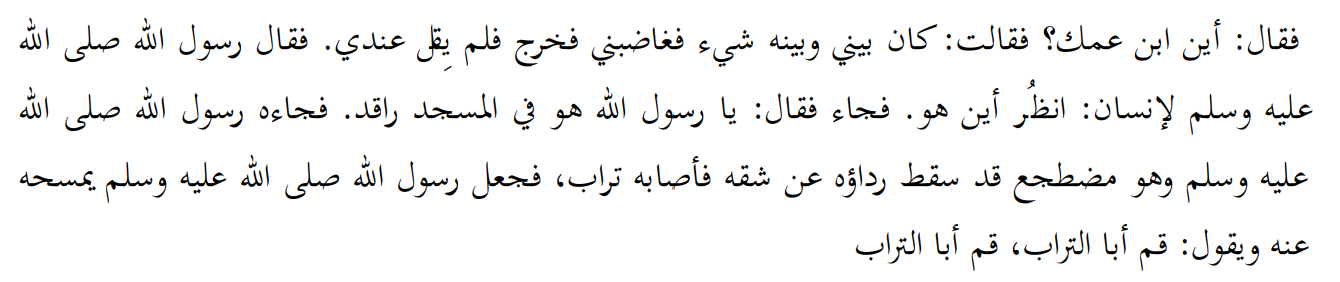
"Yuko wapi binamu yako wa upande wa baba?" Alisema: Kulikuwa na jambo kati yake na mimi, akanikasirisha, kisha akaondoka bila kuniambia. Basi Mtume wa Allah ﷺ akamwambia mtu fulani: "Nenda ukatafute alipo." Akarudi na kusema: Ee Mtume wa Allah, yuko msikitini amelala. Basi Mtume wa Allah ﷺ akamwendea alipokuwa amelala kwa mgongo. Vazi lake lilikuwa limeanguka mwilini mwake na vumbi lilikuwa limemgusa, hivyo Mtume wa Allah ﷺ akaanza kumfuta vumbi huku akisema: "Simama, Ee Abu Turab."
“Where is the son of your paternal uncle?” She said: There was something between him and me, and he made me angry and left without telling me. So the Messenger of Allah (saw) said to someone: “Go find out where he is.” He came back and said: O Messenger of Allah, he is resting in the mosque. So the Messenger of Allah (saw) came to him while he was reclining. His cloak had fallen from his body and dirt had touched him, so the Messenger of Allah (saw) began wiping it off him while saying: “Stand up, O Abu Turab.”
Muslim amesimulia kutoka kwa ‘Adiyy bin Thabit, kutoka kwa Dharr, aliyesema: Ali alisema:
Muslim narrated from ‘Adiyy bin Thabit from Dharr who said: Ali said:
"Kwa Yule ambaye aliyepasua mbegu na kuumba kiumbe hai, Mtume ﷺ alinipa ahadi kwamba hakuna atakayenipenda isipokuwa muumini, na hakuna atakayenichukia isipokuwa mnafiki."
“By Him Who split up the seed and created something living, the Prophet (may peace and blessings be upon him) gave me a promise that no one but a believer would love me, and none but a hypocrite would nurse grudge against me..”
Hakuna chochote katika hadith hizi kinachoweza kumfanya mtu aseme kwamba Mjumbe (saw) alimteua Ali (ra) kuwa Khalifah baada yake. Hadith ya Khaybar ni sifa kutoka kwa Mjumbe wa Allah ﷺ. Kauli ya Mjumbe ﷺ kwa Ali (ra):
There is nothing in these ahadith to make someone say that the Messenger (saw) appointed Ali (ra) to be Khalifah after him. The hadith of Khayber is praise from the Messenger of Allah. The Messenger’s (saw) statement to Ali (ra):
"Wewe ni wangu, nami ni wako."
“You are of me and I am of you”
Ni sifa kutoka kwa Mjumbe wa Allah ﷺ. Kuhusu hadithi ya Sa'ad iliyokuja kwamba:
Is a praise from the Messenger of Allah (saw). As for the hadith of S’aad in which came:
"Je, hufurahii kuwa na nafasi mbele yangu kama ile ya Harun kwa Musa?"
“Are you not pleased to have the status before me as that of Harun with Musa”,
Mada hii itajadiliwa katika kundi la pili la hadithi zinazohusu mada hiyo. Ndani yake pia kuna hadithi ya Khaybar, ambayo ni sifa, na ndani yake imo kwamba Ali (ra), Fatima (ra), Hassan (ra) na Husain (ra) ni ahlu bayt wake ﷺ, jambo ambalo ni sifa, pamoja na hadithi ya Sahl bin Sa'd, ambayo ni sifa. Kama vile Mtume ﷺ alivyomsifu Ali (ra), pia amewasifu wengine miongoni mwa Masahaba wake (ra). Sifa ambayo Mtume ﷺ amempa mtu haina maana kwa namna yoyote kwamba amemteua.
This subject will be discussed in the second category of the ahadith on the topic. In it is also the hadith of Khayber which is a praise and in it is that Ali (ra), Fatima (ra), Hassan (ra) and Husain (ra) are his family which is a praise, and the hadith of Sahl bin S’ad is a praise. Just like the Messenger of Allah (saw) praised Ali (ra), he also praised others among his Sahabah (ra). The Messenger’s praise for a person does not in any way indicate his appointment.
Kundi la pili la hadithi ni zile ambazo baadhi ya watu wamezitumia kuhitimisha kwamba Mtume ﷺ alisema waziwazi kwamba Ali atakuwa Khalifah baada yake. Hadithi hizo zimefupishwa katika matini nne zifuatazo:- 1- Al-Bukhari amesimulia kutoka kwa Mus’ab bin S’ad kutoka kwa baba yake.
As for the second category of ahadith which are those from which some deduced that the Messenger (saw) stated textually that Ali would be the Khalifah after him, they are summarised in these four texts:- 1- Al-Bukhari narrated from Mus’ab bin S’ad from his father
"Kwamba Mtume wa Mwenyezi Mungu ﷺ alitoka kwenda Tabuk akamteua Ali, basi akasema: Je, unaniacha nyuma pamoja na wanawake na watoto? Akasema: Je, huridhii kuwa na cheo sawa na changu kama alivyokuwa Harun kwa Musa, isipokuwa hakuna Nabii baada yangu?"
“That the Messenger of Allah (saw) left for Tabuk and appointed Ali, so he said: Do you leave me behind along with women and children? He said: Are you not pleased to have the same status with me as Harun had with Musa, except that there is no Prophet after me?”
Muslim amesimulia kutoka kwa ‘Amir bin S’ad bin Abi Waqqas (ra), kutoka kwa baba yake aliyesema: Mtume wa Allah ﷺ alimwambia Ali (ra):
Muslim narrated from ‘Amir bin S’ad bin Abi Waqqas (ra) from his father who said: The Messenger of Allah (saw) said to Ali (ra):
"Wewe kwangu una hadhi sawa na ile ya Harun kwa Musa, isipokuwa kwamba hakuna Nabii baada yangu."
“You are to me of the same status as Harun was to Musa, except that there is no Prophet after me.”
Na Muslim alisimulia kutoka kwa Ibrahim bin S'ad, kutoka kwa S'ad, kwamba Mtume ﷺ alimwambia Ali (ra):
And Muslim narrated from Ibrahim bin S’ad from S’ad that the Prophet (saw) said to Ali (ra):
"Je, hufurahii kuwa na uhusiano nami sawa na ule aliokuwa nao Harun na Musa?"
“Are you not pleased to have the same relation with me as Harun had with Musa”
Ibn Ishaq alisimulia kwa kusema: Mjumbe wa Allah ﷺ alimwacha Ali bin Abi Talib (ra) ili amtunze na kusimamia familia yake. Wanafiki walianza kueneza uvumi wa uongo na kumwambia kwamba: Hakumwacha nyuma isipokuwa kwa sababu ilikuwa ngumu kwake, na ili iwe rahisi kwake. Wanafiki walipoyasema hayo, Ali bin Abi Talib (ra) alichukua silaha zake na kutoka hadi alipokutana na Mjumbe wa Allah ﷺ ambaye alikuwa amepiga kambi huko Al-Jarf, akasema: Ewe Nabii wa Allah ﷺ, wanafiki wanadai kwamba umeniacha nyuma kwa sababu ilikuwa ngumu kwangu, na ili iwe rahisi kwangu. Akasema:
Ibn Ishaq narrated by saying: The Messenger of Allah (saw) left behind Ali bin Abi Talib (ra) to look after and supervise his family. The hypocrites started spreading false rumors and said to him that: He (saw) did not leave him behind except for the reason that it was hard on him and so that it could become easy for him. When the hypocrites said that, Ali bin Abi Talib (ra) took his weapons and moved out until he met the Messenger of Allah (saw) who was encamped at Al-Jarf and said: O Prophet of Allah (saw), the hypocrites claimed that you left me behind because it was hard for me and to make it easy for me. He said:

"Walisema uongo; bali nilikuacha nyuma kwa sababu ya yale niliyoyaacha nyuma yangu, kwa hiyo rudi ukasimamie familia yangu na familia yako kwa niaba yangu. Je, hufurahi, ewe Ali, kuwa na hadhi mbele yangu kama ile ambayo Harun alikuwa nayo mbele ya Musa, isipokuwa kwamba hakuna Nabii baada yangu?" ﷺ
“They lied; rather I left you behind due to what I left behind me so return and supervise my family and your family on my behalf. Are you not pleased, O Ali, to have the same status before me as Harun had before Musa except that there is no Prophet after me?”
Basi Ali alirejea Madinah, na Mtume wa Allah ﷺ akaendelea na safari yake. As-Sayyid Abd al-Husain Sharaf ud-Deen alitaja yafuatayo katika kitabu “Al-Muraja’at”: “Hadith ya Jabir bin Abdullah aliyesema: Mtume wa Allah ﷺ alisema:
So Ali returned to Madinah and the Messenger of Allah (saw) continued on his journey. As-Sayyid Abd al-Husain Sharaf ud-Deen mentioned the following in the book “Al-Muraja’at ”: “The hadith of Jabir bin Abdullah who said: The Messenger of Allah (saw) said:
Ewe Ali, hakika ni halali kwako katika msikiti yale ambayo ni halali kwangu, na uhusiano wako nami ni kama uhusiano wa Harun na Musa, isipokuwa kwamba hakuna Nabii baada yangu.ﷺ
O Ali, verily it is allowed for you in the mosque what is allowed for me, and your relation with me is that of Harun with Musa except that there is no Prophet after me.”
2. Muslim amesimulia kutoka kwa Yazid bin Hayyan aliyesema: Nilitoka pamoja na Husain bin Sabra na Umar bin Muslim kwenda kwa Zayd bin Arqam (ra). Tulipoketi naye, Husain alimwambia: "Hakika, Ee Zayd, umepata wema mwingi. Umemwona Mjumbe wa Allah ﷺ, umesikia hadithi yake, umepigana pamoja naye na umeswali nyuma yake. Hakika, Ee Zayd, umepata wema mwingi. Basi tusimulie, Ee Zayd, kile ulichosikia kutoka kwa Mjumbe wa Allah ﷺ." Akasema: "Ee mwana wa nduguye, kwa Allah nimekuwa mzee na wakati wangu umekaribia. Nimesahau baadhi ya yale niliyoyaelewa kutoka kwa Mjumbe wa Allah ﷺ, basi kubali chochote nitakachokusimulia, wala usinilazimishe juu ya kile nisichosimulia." Kisha akasema: "Siku moja Mjumbe wa Allah ﷺ alisimama mbele yetu akizungumza kwenye maji yajulikanayo kama Khum, yaliyoko kati ya Makka na Madina. Alimshukuru Allah, akamsifu, akaonya na kukumbusha, kisha akasema:"
2. Muslim narrated from Yazid bin Hayyan who said: I left with Husain bin Sabra and Umar bin Muslim to Zayd bin Arqam (ra). When we sat with him, Husain said to him: “Verily, O Zayd, you met a great deal of good. You saw the Messenger of Allah (saw), heard his hadith, fought with him and prayed behind him. Verily, O Zayd, you met a great deal of good. So relate to us, O Zayd, of what you heard from the Messenger of Allah (saw). He said: O son of my brother, by Allah I have become old and my time has approached. I have forgotten some of that, which I understood from the Messenger of Allah (saw), so accept whatever I relate to you and do not force me on that which I do not relate. Then he said: The Messenger of Allah (saw) stood one day before us speaking at the waters known as Khum between Makkah and Madinah. He thanked Allah, praised Him, exhorted and reminded then said:
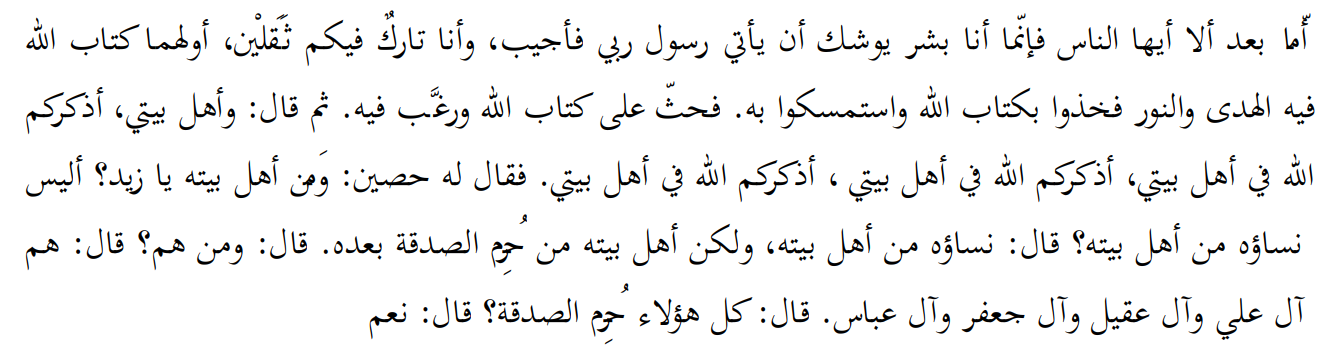
Sasa, kwa lengo letu. Enyi watu, mimi ni binadamu. Karibu nipokee mjumbe (malaika wa mauti) kutoka kwa Mola wangu, na mimi, kwa kuitikia wito wa Allah, (nitawaaga), lakini ninawaachia mambo mawili yenye uzito: la kwanza ni Kitabu cha Allah ambamo mna uongofu ulio sahihi na nuru, basi shikamaneni na Kitabu cha Allah na mkifuate. Alitusisitiza (tushikamane) na Kitabu cha Allah, kisha akasema: La pili ni watu wa kaya yangu. Nawakumbusha (wajibu wenu) kwa watu wa familia yangu. Yeye (Husain) alimwambia Zaid: Watu wa kaya yake ni nani? Je, wake zake si watu wa familia yake? Ndipo akasema: Wake zake ni watu wa familia yake, lakini hapa watu wa familia yake ni wale ambao kukubali Zakat kumekatazwa kwao. Akasema: Ni akina nani? Ndipo akasema: Ni 'Ali na wazao wa 'Ali, 'Aqil na wazao wa 'Aqil, na wazao wa Ja'far na wazao wa 'Abbas. Husain akasema: Hawa ndio ambao kukubali Zakat kumekatazwa kwao. Zaid akasema: Ndiyo.
" Now to our purpose. O people, I am a human being. I am about to receive a messenger (the angel of death) from my Lord and I, in response to Allah's call, (would bid good-bye to you), but I am leaving among you two weighty things: the one being the Book of Allah in which there is right guidance and light, so hold fast to the Book of Allah and adhere to it. He exhorted (us) (to hold fast) to the Book of Allah and then said: The second are the members of my household I remind you (of your duties) to the members of my family. He (Husain) said to Zaid: Who are the members of his household? Aren't his wives the members of his family? Thereupon he said: His wives are the members of his family (but here) the members of his family are those for whom acceptance of Zakat is forbidden. And he said: Who are they? Thereupon he said: 'Ali and the offspring of 'Ali, 'Aqil and the offspring of 'Aqil and the offspring of Ja'far and the offspring of 'Abbas. Husain said: These are those for whom the acceptance of Zakat is forbidden. Zaid said: Yes.”
As-Sayyid Abd al-Husain Sharaf ud-Deen ametaja katika kitabu chake “Al-Muraja’at” hadithi hii kupitia usimulizi ufuatao ambao At-Tabarani aliusimulia kupitia mnyororo wa wasimulizi ambao usahihi wake umekubaliwa kwa pamoja, kutoka kwa Zayd bin Arqam (ra) ambaye alisema: Mtume wa Allah ﷺ alizungumza huko Ghadeer Khum chini ya baadhi ya miti na akasema:
As-Sayyid Abd al-Husain Sharaf ud-Deen mentioned in his book “Al-Muraja’at” this hadith via the following narration which At-Tabarani narrated through a chain whose authenticity is unanimously accepted from Zayd bin Arqam (ra) who said: The Messenger of Allah (saw) spoke at Ghadeer Khum underneath some trees and said:
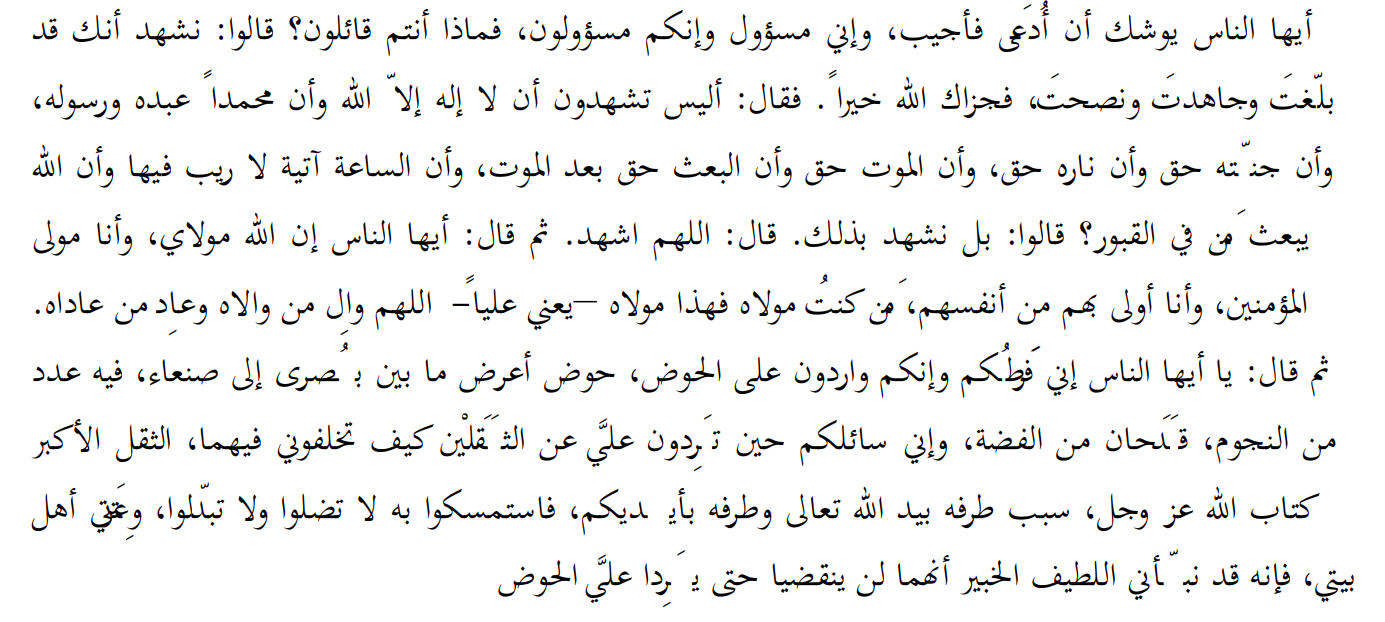
“Enyi watu, karibu itafika wakati nitaitwa nami nitaitika (kumaanisha kifo). Hakika mimi ni mwenye kuwajibika na nyinyi ni wenye kuwajibika, basi mtasema nini?” Wakasema: “Tutashuhudia kwamba umefikisha, umepigania na umenasihi, basi Mwenyezi Mungu akulipe vema.” Akasema: “Je, hamshuhudii kwamba hakuna mungu isipokuwa Mwenyezi Mungu, na Muhammad ﷺ ni mja Wake na Mjumbe Wake, kwamba Pepo ni kweli na Moto ni kweli, kwamba mauti ni kweli na ufufuo baada ya mauti ni kweli, kwamba Saa (ya Hukumu) itakuja bila shaka yoyote, na kwamba Mwenyezi Mungu atawafufua wote waliomo makaburini?” Wakasema: “Ndiyo, tunashuhudia.” Kisha akasema: “Enyi watu, hakika Mwenyezi Mungu ndiye Mlinzi wangu, nami ni mlinzi wa waumini kiasi kwamba ninatangulizwa mbele yao kuliko nafsi zao wenyewe. Yeyote anayenichukua mimi kuwa mlinzi wake, basi huyu ndiye mlinzi wake,” yaani Ali. “Ee Mwenyezi Mungu, mpende yeyote anayempenda yeye, na mfanye adui yeyote anayemfanya adui.” Kisha akasema: “Enyi watu, hakika nitawaacha nanyi mtanikuta kwenye Kisima, kisima kilicho pana kuliko umbali kutoka Basra hadi Sana’a. Ndani yake mna mabakuli ya fedha kwa idadi ya nyota. Hakika nitawauliza mtakapokuja mbele yangu kuhusu vitu viwili vizito, jinsi mlivyovitunza baada yangu. Kitu kizito na kikubwa zaidi ni Kitabu cha Mwenyezi Mungu ‘azza wa jalla, ambacho ncha moja yake iko mikononi mwa Mwenyezi Mungu na nyingine mikononi mwenu. Kishikilieni kwa nguvu ili msipotee wala kubadilika, na Itrah yangu (kizazi), watu wa nyumba yangu. Hakika Mwenye Upole na Mjuzi wa yote (swt) amenijulisha kwamba hawatatengana kamwe hadi watakapokuja mbele yangu kwenye Kisima (chemchemi).”
“O people, it is about to be that I am called and I will respond (indicating death). Verily, I am accountable and you are accountable, so what will you say? They said: We will testify that you conveyed, struggled and advised so may Allah recompense you well. He said: Do you not bear witness that there is no deity but Allah and Muhammad is His slave and Messenger, that Paradise is true and Hellfire is true, that death is true and resurrection after death is true, that the Hour (of Judgement) will come without any doubt, and that Allah will resurrect all those in their graves? They said: Yes, we do bear witness. Then he said: O people, verily Allah is my Patron and I am the patron of the believers such that I take precedence before them over their own selves. Whoever takes me as his patron then this one is his patron—meaning Ali. O Allah, befriend whoever befriends him and take as enemy whoever takes him as an enemy. Then he said: O people, verily I will leave you and you will find me at the Cistern, a cistern wider than the distance from Basra to Sana’a. In it are tumblers of silver the number of stars. Verily I will ask you when you come before me on the two weighty things, how you took care of them after me. The weightier and greater one is the Book of Allah ‘azza wa jalla, a (sabab) of which one end is in the hands of Allah and the other in your hands. Hold tightly to it so that you do not go astray or change, and my Utra (household), the people of my house. Verily The Kind & All-Knowing (swt) has informed me that they will never seperate until they come before me at the cistern (fountain)”
(Hii ndiyo mwisho wa yale aliyoyataja As-Sayyid Abd al-Husain Sharaf ud-Deen.) Na Shaikh Abd al-Husain Ahmad Al-Ameeni An-Najafi alisema yafuatayo katika kitabu chake "Al Ghadeer": "Alipomaliza ibada zake, yaani Mtume ﷺ, na kuondoka kuelekea Madina pamoja na kundi lililotajwa la watu, alifika Ghadeer Khum huko Al-Jahfa, mahali ambapo njia hugawanyika kwa watu wa Madina, Misri na Iraq. Hii ilikuwa siku ya 15 ya mwezi wa Dhul-Hijja, na Jibril, mwaminifu, alishuka kwake kutoka kwa Allah (SWT) kwa kauli Yake:
(This is the end of what As-Sayyid Abd al-Husain Sharaf ud-Deen mentioned). And Shaikh Abd al-Husain Ahmad Al-Ameeni An-Najafi stated the following in his book “Al Ghadeer”: “When he finished his rites of worship i.e. the Prophet (saw) and left for Madinah, together with the mentioned group(s) of people, he reached Ghadeer Khum in Al-Jahfa where the roads branch for the people of Madinah, Egypt and Iraq. This was the 15th day of Dhul-Hijja and Jibril, the trustworthy, descended to him from Allah (swt) with His saying:
"Ee Mtume, fikisha yale yaliyoteremshwa kwako kutoka kwa Mola wako" [TMQ 5:67]
‘O Messenger, deliver what was revealed to you from your Lord” [TMQ 5:67]
Na Yeye alimwamuru amsimamishe Ali (ra) ili awajulishe watu na awafahamishe yale yaliyoteremshwa kuhusu uongozi wake na wajibu wa kumtii kila mmoja. Watu wa mwanzo walikuwa karibu na Al-Jahfa, hivyo Mjumbe wa Allah ﷺ aliwaamuru wale waliokuwa wametangulia warudi, na akawakusanya wale waliokuwa wamechelewa mahali pale. Pia alikataza watu kupiga kambi chini ya miti mikubwa mitano. Watu walipopiga kambi, wale waliokuwa chini ya miti hiyo wakasimama hadi swala ya adhuhuri ilipotangazwa, akaelekea kwao na kuswali chini yake. Ilikuwa siku ya joto kali, mtu mmoja akiweka sehemu ya vazi lake juu ya uso wake na sehemu nyingine chini ya miguu yake kwa sababu ya joto kali, na Mjumbe wa Allah ﷺ alikuwa amekingwa na jua kwa kitambaa juu ya mti wa sumra. Alipomaliza swala yake ﷺ, alisimama kuzungumza katikati ya watu juu ya nundu ya ngamia, akizungumza kwa sauti ya juu ili kila mmoja amsikie, kisha ﷺ akasema:
And He commanded him to cause Ali (ra) to stand to let the people know and inform what was revealed regarding his patronage and the obligation of obedience upon every one. The first of the people were close to Al-Jahfa so the Messenger of Allah (saw) commanded those who had proceeded to return and enclosed those who had delayed at that place, and he prohibited people from encamping beneath the five large trees. When the people took camp and those underneath them (the trees) stood until the dhuhr prayer was announced, he headed for them and prayed beneath them. It was a sizzling day where a man placed some of his cloak upon his face and some under his feet due to the severe heat, and the Messenger of Allah was shaded by a garment upon the sumra tree due to the sun. When he (saw) finished his prayer, he stood to speak in the middle of the people on the hump of a camel and he spoke with a raised tone with every one hearing him and he (saw) said
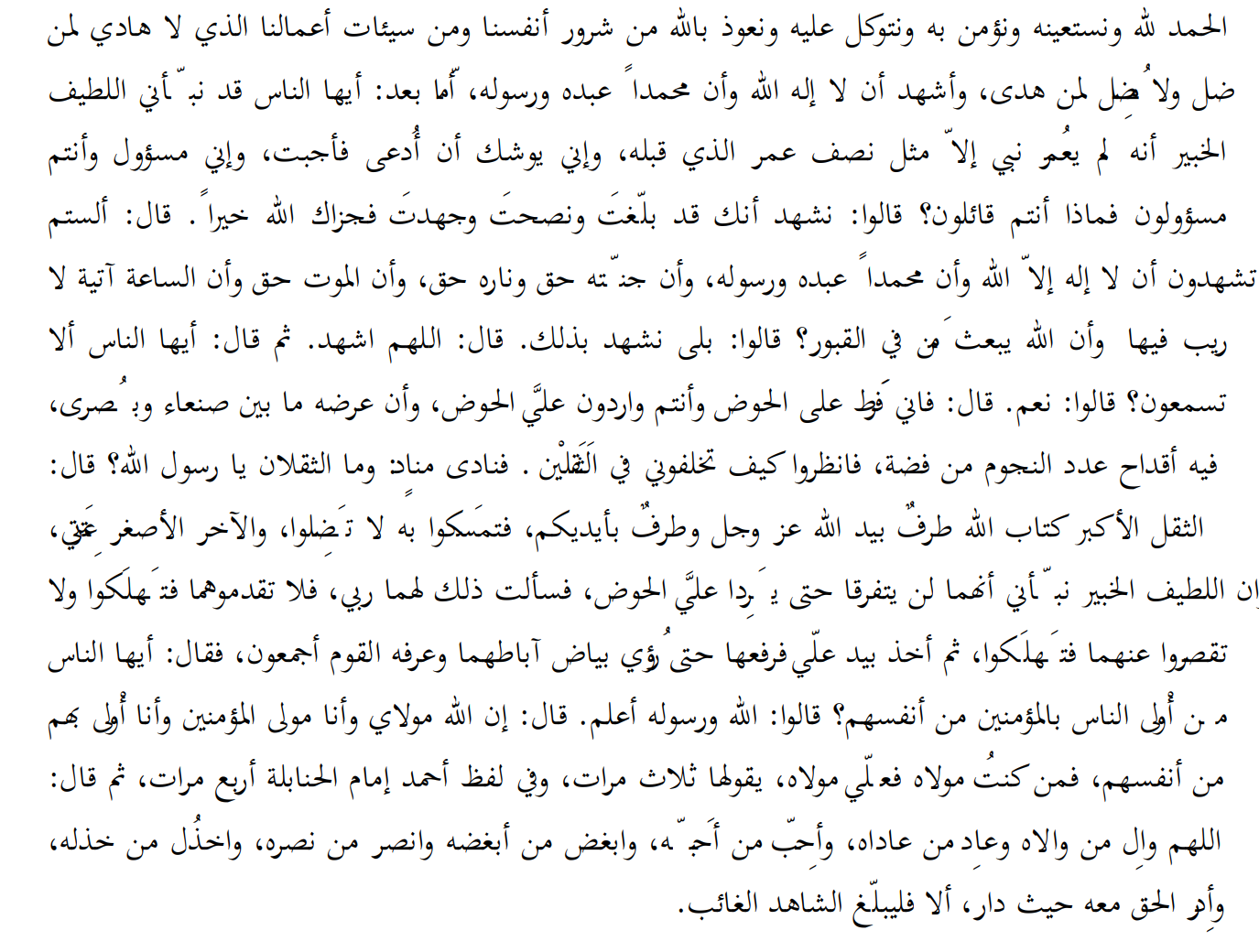
Sifa zote ni za Allah, tunayemtaka msaada, tunayemwamini na tunayemtegemea. Tunamwomba Allah atulinde na maovu ya nafsi zetu na matendo yetu mabaya. Yeye ambaye hakuna awezaye kumwongoza yule amwachaye apotee, na hakuna awezaye kumpoteza yule amwongozaye. Nashuhudia kwamba hakuna mungu isipokuwa Allah, na kwamba Muhammad ni mja wake na Mjumbe wake ﷺ. Basi baada ya hayo: Enyi watu, hakika Mwenye upole na Mjuzi wa yote (swt) amenijulisha kwamba hakumpa Nabii umri mrefu isipokuwa nusu ya umri wa Nabii aliyetangulia kabla yake. Hakika karibu nitaitwa nami nitaitikia. Hakika mimi nitawajibishwa, nanyi mtawajibishwa, basi mtasema nini? Wakasema: Tunashuhudia kwamba hakika umefikisha ujumbe, umetoa nasaha na umejitahidi, basi Allah akulipe kheri nyingi. Akasema: Je, hamshuhudii kwamba hakuna mungu isipokuwa Allah, na kwamba Muhammad ni mja wake na Mjumbe wake ﷺ, kwamba pepo yake ni ya kweli, na moto wake ni wa kweli, kwamba kufa ni kweli, kwamba Saa itakuja bila shaka, na kwamba Allah atawafufua wale walio makaburini? Wakasema: Ndiyo, tunashuhudia hayo. Akasema: Ee Allah, shuhudia. Kisha akasema: Enyi watu, hamtasikiliza? Wakasema: Ndiyo. Akasema: Hakika mimi nitatangulia kwenye birika (al-Kawthar), nanyi mtafikishwa kwenye birika mbele yangu, ambalo upana wake ni sawa na umbali kati ya Sana'a na Basra. Ndani yake kuna vikombe vya fedha vyenye idadi ya nyota, basi angalieni jinsi mtakavyoshughulika na mambo mazito mawili baada yangu. Mtangazaji alitangaza: Na mambo mazito mawili ni yapi, Ee Mjumbe wa Allah? Akasema: Lililo kubwa zaidi kati ya mazito mawili ni Kitabu cha Allah, ncha moja yake iko mkononi mwa Allah na ncha nyingine mikononi mwenu, basi kishikilieni na hamtapotea. La pili, dogo zaidi, ni Ahlul-Bayt wangu ('Itrah). Hakika Mwenye upole na Mjuzi wa yote (swt) amenijulisha kwamba hawatatengana hadi Ali atakapofika kwenye birika, nami nilimwomba hilo kutoka kwa Mola wangu. Basi msiwatangulie wala msiwapuuze, na mkifanya hivyo mtaangamia. Kisha akamshika mkono Ali na kuunyanyua mpaka makwapa yao yakaonekana, na kila mtu akamtambua, akasema: Enyi watu, ni nani mwenye haki zaidi kwa waumini kuliko nafsi zao wenyewe? Wakasema: Allah na Mtume wake ndio wanaojua zaidi. Akasema: Hakika Allah ndiye mlinzi wangu (mawla) nami ni mlinzi wa waumini, kiasi kwamba ninatangulia kuwa na haki zaidi kwao kuliko nafsi zao wenyewe. Basi yeyote anayenikubali mimi kuwa mlinzi wake, basi Ali ni mlinzi wake. Alisema hivi mara tatu, na kwa maneno ya Imam Ahmad, Imamu wa Mahanbali, mara nne. Kisha akasema: Ee Allah, mpende yeyote anayempenda yeye, na uwe adui wa yeyote anayemfanya kuwa adui yake. Mpende yeyote anayempenda, na mchukie yeyote anayemchukia, umsaidie yeyote anayemsaidia, na umwache yeyote anayemwacha, na ukweli uwe pamoja naye popote alipo. Hakika, shahidi aliyepo na amfikishie asiyekuwepo.
"All praise is due to Allah whom we ask for help, believe in and depend upon. We ask Allah to protect us from the evils of our souls and bad deeds, the One whom none can guide whom He causes to go astray or misguide whom He guides. I bear witness that there is no god but Allah and Muhammad is His slave and Messenger. As for what follows: O people, verily the The Kind & All-Knowing (swt) has informed me that He does not grant longevity to a Prophet except half the like of the one before him. Verily it is about to be that I will be called and I will respond. Verily I am accountable and you are accountable, so what will you say? They said: We bear witness that verily you have conveyed, advised and struggled so may Allah reward you well. He said: Do you not bear witness that there is no god but Allah and that Muhammad is His slave and Messenger that His paradise is true and His hellfire is true, that death is true, that the Hour will come without any doubt and that Allah will resurrect those in the graves? They said: Yes, we bear witness to this. He said: O Allah, do bear witness. Then he said: O people, will you not listen? They said: Yes. He said: Verily I will go to the cistern (alkauthar) and you will be presented at the cistern, whose breadth is that between Sana’a and Basra, before me. In it are cups of silver the number of which are the number of stars, so look how you take care of the two weighty things after me. An announcer announced: And what are the two weighty things, O Messenger of Allah? He said: The greater of the two weighty things is the Book of Allah, one end of which is in the hand of Allah and the other in your hands so hold fast to it and you will not go astray. The other smaller one is my household (‘utra). Verily the Kind & All-Knowing (swt) informed me that they will not go away until Ali reaches the cistern and I asked that from my Lord. So do not precede them or neglect them and if you do so you will perish. Then he took the hand of Ali and raised it until their armpits were seen and everyone recognised him and he said: O people, who takes precedence before the believers over their own selves? They said: Allah and His Messenger know best. He said: Verily Allah is my Patron (mawla) and I am the patron of the believers such that I take precedence before them over their own selves. So whoever has me as his patron then Ali is his patron. He said this three times, and in the words of Imam Ahmad, Imam of the Hanbalis, four times. Then he said: O Allah, befriend whoever befriends him and become an enemy to whoever takes him as an enemy. Love whoever loves him and hate whoever hates him, support whoever supports him and abandon whoever abandons him, and let the truth be with him wherever he is resides. Verily, let the witness who is present inform the (one who is) absent.’”
3. Wale wanaosema kwamba Mtume ﷺ alitangaza waziwazi Ukhalifa wa Ali (ra) wamesimulia hadithi katika vitabu vyao. Kuhusu hadithi hizi, hatutafanya uchunguzi wetu uwe juu ya usimulizi wake, licha ya ukweli kwamba masheikh wawili, Al-Bukhari na Muslim, hawakuzisimulia, wala hazikusimuliwa kupitia wasimulizi wowote wanaoaminika, na nyingi kati yake ni miongoni mwa hadithi za kutungwa. Hatutafanya usimulizi wake kuwa mada ya uchunguzi kwa kusema kwamba hadithi hizi hazikusimuliwa na wasimulizi wanaoaminika kwenu, lakini zilisimuliwa na wasimulizi wanaoaminika kwetu, ili yule ambaye hadithi imethibitishwa kwake aitumie kama ushahidi. Hatutafanya hilo kuwa uwanja wa uchunguzi; badala yake, tutafanya suala la uchunguzi kuwa yenyewe matini kama zilivyokuja katika masimulizi. Hizi ndizo matini ambazo walizitumia kuhitimisha kwamba Mtume ﷺ alimteua Ali kuwa Khalifa baada yake, na hadithi hizi zinajulikana kama hadithi za “wilayah”. Kati yake tutawasilisha baadhi, na zilizobaki zina maana hiyo hiyo, hata maneno yale yale.
3. Those who say that the Messenger (saw) clearly announced the Khilafah of Ali (ra) narrated ahadith in their books. As for these ahadith, we will not make the place of research in them their narrations, despite the fact that the two sheikhs Al-Bukhari and Muslim did not narrate them, nor were they narrated via any trustworthy narrators and most of them are among the fabricated ahadith. We will not make their narrations the subject of research such that they say that these ahadith were not narrated by trustworthy narrators before you but were narrated by trustworthy narrators before us so that the one for whom the hadith is authenticated uses it as an evidence. We will not make that the domain of research; rather we will make the matter of research the texts themselves as they came in the narrations. These are the texts from which they deduced that the Messenger (saw) appointed Ali to be the Khalifah after him—and these ahadith are known as the ahadith of “wilayah”—from which we will present some of them and the rest carry the same meaning and even the same wordings.
a) Abu Dawud At-Tayalisi alisimulia kutoka kwa ‘Ibn Abbas (ra) kwamba Mtume wa Allah ﷺ alimwambia Ali ibn Abi Talib (ra):
a) Abu Dawud At-Tayalisi narrated from ‘Ibn Abbas (ra) that the Messenger of Allah (saw) said to Ali ibn Abi Talib (ra):
"Wewe ni walii wa waumini wote baada yangu."
“You are the waliy of all believers after me.”
b) Imepokewa katika Kanz al-’Ammal kutoka kwa Imran bin Husain, ambaye alisema kwamba Mjumbe wa Allah ﷺ alituma kikosi cha jeshi na akamweka Ali bin Abi Talib juu yao. Yeye (Ali) alijichagulia mjakazi kutoka kwenye khumsi, nao wakamkataa kwa jambo hilo. Watu wanne kati yao walikubaliana kumlalamikia kwa Mtume ﷺ. Walipofika, mmoja wao alisimama na kusema: Ee Mjumbe wa Allah ﷺ, je, huoni kwamba Ali amefanya kadhaa na kadhaa? Naye (Mtume ﷺ) akageuka mbali naye. Wa pili alisimama na kusema vivyo hivyo, naye akageuka mbali naye. Wa tatu alisimama na kusema vivyo hivyo, naye akageuka mbali naye. Na wa nne alisimama na kusema kama walivyokuwa wamesema. Mjumbe wa Allah ﷺ aligeuka kuwaelekea huku hasira zikionekana usoni mwake, akasema:
b) It has been narrated in Kanz al-’Ammal from Imran bin Husain who said that the Messenger of Allah (saw) sent an expedition and appointed Ali bin Abi Talib (ra) over them. He chose for himself a slave girl from the fifth (khums) and they rejected this from him. Four of them agreed to complain about him to the Prophet (saw) so, when they came, one of the four stood and said: O Messenger of Allah (saw), do you not see that Ali (ra) did such and such, and he (saw) turned away from him. The second stood and said the same, so he turned away from him. The third stood and said the same, so he turned away from him. And the fourth stood and said the same as they had said. The Messenger of Allah (saw) turned towards them with anger visible in his face and said:
Unataka nini kwangu kuhusu Ali? Hakika Ali ni kutoka kwangu, nami ni kutoka kwake, naye ndiye walii wa kila muumini baada yangu.
What do you want for me with regards to Ali? Verily Ali is from me and I am from him, and he is the waliy of every believer after me.”
c) Na katika hadithi ndefu kutoka kwa ‘Amru bin Maymun, kutoka kwa ‘Ibn Abbas (ra), aliyesema: Mjumbe wa Allah ﷺ alimtuma fulani pamoja na Surat At-Tawbah. Kisha akamtuma Ali (ra) nyuma yake ili kuichukua kutoka kwake, akasema:
c) And in a long hadith from ‘Amru bin Maymun from ‘Ibn Abbas (ra) who said: The Messenger of Allah (saw) sent so and so with Surah At-Tawbah. He then sent Ali (ra) after him to take it from him and said:
"Hakuna mtu anayepaswa kuichukua isipokuwa mtu aliye kutoka kwangu, na mimi nimetoka kwake."
“No one should take it except a man who is from me and I am from him.”
d) Kanz al-‘Ummal kutoka kwa Wahhab bin Hamza, aliyesema: Nilisafiri pamoja na Ali (ra) nikaona ukali kutoka kwake, kwa hiyo nikasema kwamba nitakaporudi nitamlalamikia. Nikarudi na kumtaja Ali (ra) mbele ya Mjumbe wa Allah ﷺ, naye akasema:
d) IKanz al-’Ammal from Wahhab bin Hamza who said: I travelled with Ali (ra) and I saw harshness from him, so I said that when I will return I will complain about it. So I returned and mentioned Ali (ra) to the Messenger of Allah (saw) and he said:
"Usimwambie hivyo Ali, kwa kuwa yeye ni waliy wako baada yangu."
“Do not say this for Ali, as he is your waliy after me.”
e) Katika Kanz al-’Ammal kutoka kwa Ibn Abbas, aliyesema: Mtume wa Allah ﷺ alisema:
e) In Kanz al-’Ammal from ‘ibn Abbas who said: The Messenger of Allah (saw) said:
"Yeyote anayefurahia kuishi maisha yangu, kufa kifo changu, na kuishi katika pepo ya Edeni iliyomwagiliwa na Mola wangu, basi na amfanye Ali kuwa waliy baada yangu."
“Whoever is pleased to live my life, die my death and to reside in the paradise of Eden irrigated by my Lord then let him befriend Ali as a waliy after me.”
f) Katika Muntakhab al-Kanz, kutoka kwa Ziyad bin Mutarraf, aliyesema: Nilimsikia Mtume wa Allah ﷺ akisema:
f) In Muntakhab al-Kanz from Zayyad bin Mutarraf who said: I heard the Messenger of Allah (saw) saying:
"Yeyote anayetaka kuishi maisha yangu, kufa kifo changu, na kuingia peponi aliyoahidiwa na Mola wangu—nayo ni pepo ya milele—basi na amfanye Ali na kizazi chake kuwa marafiki zake baada yangu. Hakika hawatakutoa kamwe mlangoni mwa uongofu, wala hawatakuingiza kwenye lango la upotevu."
“Whoever would like to live my life, die my death, and enter the paradise promised to me by my Lord—and it is an eternal paradise—then let him befriend Ali and his descendants after me. Verily they will never remove you from the door of guidance nor enter you into the gate of misguidance.”
g) Katika Kanz al-’Ammal, kutoka kwa Ammar bin Yasir aliyesema: Mtume wa Allah ﷺ alisema:
g) In Kanz al-’Ammal from Ammar bin Yasir who said: The Messenger of Allah (saw) said:
"Ninamwachia kila anayeniamini na kunitegemea uongozi (wilayah) wa Ali bin Abi Talib. Anayemfanya rafiki yake amenifanya mimi rafiki yake, na anayenifanya mimi rafiki yake amemfanya Allah rafiki yake. Anayempenda amenipenda mimi, na anayenipenda mimi amempenda Allah. Anayemchukia amenichukia mimi, na anayenichukia mimi amemchukia Allah."
“I bequeath whoever believes in me and trusts me with the wilayah of Ali bin Abi Talib. Whoever befriends him has befriended me and whoever befriends me has befriended Allah. Whoever loves him has loved me, and whoever loves me has loved Allah. Whoever hates him has hated me, and whoever hates me has hated Allah.”
h) Pia katika Al-Kanz, kutoka kwa Ammar, imepokewa katika hadithi marfu'u kwamba:
h) Also in Al-Kanz from Ammar it has been narrated in a marfu hadith :
"Ee Allah, yeyote anayeniamini na kunitegemea, na amfanye Ali bin Abi Talib kuwa rafiki yake. Hakika uwalii wake ni uwalii wangu ﷺ, na uwalii wangu ni uwalii wa Allah Mtukufu."
“O Allah, whoever believes and trusts in me, let him befriend Ali bin Abi Talib. Verily his wilayah is my wilayah and my wilayah is the wilayah of Allah ta’ala.”
4. Kuna hadithi zinazosimuliwa na wale wanaosema kwamba Mtume ﷺ alitangaza waziwazi ukhalifa wa Ali (ra). Hadithi hizi hazijasimuliwa na mtu yeyote aliyeaminika, na nyingi kati yake ni hadithi zilizotungwa. Tunaziwasilisha si ili kuzichunguza kwa upande wa usimulizi wake, ili zidaiwe kuwa zimethibitishwa kwa wale wanaozisimulia. Bali tunaziwasilisha ili kutoa hoja ya kuchunguza matini zake kulingana na yale yaliyomo katika matini hizo. Hadithi hizi zina udugu wa Mtume ﷺ na Ali (ra), na kumfanya kuwa mrithi baada yake. Tunawasilisha baadhi yake, huku zilizobaki zikibeba maana ile ile na hata maneno yale yale.
4. There are ahadith narrated by those who say that the Messenger (saw) openly declared the Khilafah of Ali (ra). These ahadith have not been narrated by any trustworthy person and most of them are fabricated ahadith. We present them not to research them from the angle of their narration so that they are claimed to be authenticated for those who narrate them. Rather we present them to make the point of research their texts according to what came in their texts. These ahadith contain the brotherhood of the Messenger (saw) with Ali (ra), and making him the heir after him. We present a few of them with the remainder carrying the same meaning and even the same wordings.
a) Mtume ﷺ alianzisha undugu baina ya Muhajirina, akamchagua Ali (ra) kwa ajili yake mwenyewe. Katika yaliyotokana na hadithi ya undugu wa kwanza, "Ali akasema: Ewe Mjumbe wa Allah ﷺ, hakika roho yangu imeniacha na uti wangu wa mgongo umevunjika nilipokuona ukifanya ulichowafanyia wenzako wengine zaidi yangu. Ikiwa hii ni ishara ya hasira yako kwangu, basi ninalalamika kwako tu na kuomba msamaha wako." Mjumbe wa Allah ﷺ akasema:
a) The Prophet (saw) established a brotherhood between the Muhajirin and chose Ali (ra) for himself. In what came of the hadith of the first brotherhood, “so Ali said: O Messenger of Allah (saw), verily my soul left me and my spine has been broken when I saw you do what you did with your companions other than me. If this is a sign of your anger with me, then I complain only to you and beg your pardon. The Messenger of Allah (saw) said:
Kwa Yule aliyenituma kwa haki, sikukuacha ila kwa ajili yangu mwenyewe. Wewe kwangu una cheo cha Harun kwa Musa, isipokuwa kwamba hakuna Nabii baada yangu. Wewe ni ndugu yangu na mrithi wangu. Akasema: Nitarithi nini kutoka kwako? Akasema: Walichorithi Manabii kabla yangu, Kitabu cha Mola wao na Sunnah ya Manabii wao.
By the One who sent me with truth, I only left you for myself. You are to me of the status of Harun to Musa except that there is no Prophet after me. You are my brother and inheritor. He said: What will I inherit from you. He said: What did the Prophets inherit before me, the Book of their Lord and the Sunnah of their Prophets.”
b) Mtume ﷺ alifanya udugu kati ya Muhajirina na Answari miezi mitano baada ya hijra, lakini hakufanya udugu kati ya Ali (ra) na yeyote kati ya Answari; badala yake alimchagua Ali kwa ajili yake mwenyewe. Hili limekuja katika hadithi ya udugu wa pili.
b) The Prophet (saw) made a brotherhood between the Muhajirin and the Ansar five months after the hijrah, but he did not make a brotherhood between Ali (ra) and any of the Ansar; rather he chose him (Ali) for himself. It came in the hadith of the second brotherhood
"Kwamba Mjumbe (saw) alimwambia Ali: Je, ulikasirika kwangu nilipoweka undugu kati ya Muhajirina na Answari lakini sikuweka undugu kati yako na yeyote kati yao? Je, huridhii kuwa na nafasi sawa na Harun kwa Musa kwangu, isipokuwa kwamba hakuna Nabii baada yangu?" Note: the instruction asks for ﷺ after every mention of the Prophet, so the corrected version is below. "Kwamba Mjumbe ﷺ alimwambia Ali: Je, ulikasirika kwangu nilipoweka undugu kati ya Muhajirina na Answari lakini sikuweka undugu kati yako na yeyote kati yao? Je, huridhii kuwa na nafasi sawa na Harun kwa Musa kwangu, isipokuwa kwamba hakuna Nabii baada yangu?"
“That the Messenger (saw) said to Ali: Did you become angry at me when I made a brotherhood between the Muhajirin and Ansar but did not make a brotherhood between you and any of them? Are you not pleased to be similar to the status of Harun to Musa for me except that there is no Prophet after me”
c) Imepokewa kwamba Mtume ﷺ alitoka siku moja kwenda kwa maswahaba zake akiwa na uso wenye furaha, basi Abdurrahman bin Awf (ra) akamuuliza, naye akasema:
c) It is narrated that the Messenger (saw) went out one day to his companions with his face brightened so Abdurrahman bin Awf (ra) asked him and he said:
"Habari njema zilinijia kutoka kwa Mola wangu kuhusu ndugu yangu na mwana wa ami yangu na binti yangu, kwamba Mwenyezi Mungu atamuoza Ali kwa Fatima." ﷺ
“Good news came to me from my Lord about my brother and paternal uncle’s son and my daughter, that Allah will marry Ali with Fatima.”
Wakati mume anayestahili kumuoa sayyida Annisa (kiongozi wa wanawake) alipokuwa akizingatiwa, Mtume ﷺ alisema:
When the sayyid Annisa’s (leader of the women) deserving groom for her marriage was being considered, the Prophet (saw) said:
"Ee Umm Ayman, mwite kaka yangu kwa ajili yangu." Akasema: "Yeye ni kaka yako, na bado unamwoa (kwa binti yako)?" Akasema: "Ndiyo, ee Umm Ayman." Basi akamwita Ali, naye akaja.
“O Umm Ayman, call my brother for me. She said: He is your brother yet you are marrying him (to your daughter)? He said: Yes, O Umm Ayman. So she called Ali and he came.”
Siku moja Mtume ﷺ alizungumza naye kuhusu hukumu baina yake, ndugu yake Ja'far na Zayd bin Haritha, akisema:
And the Prophet (saw) spoke to him one day regarding a judgement between him, his brother Ja’far (saw) and Zayd bin Haritha (saw), saying:
"Kwa upande wako, Ee Ali, wewe ni ndugu yangu, baba wa mwanangu, na wewe unatoka kwangu na upo kwa ajili yangu."
“As for you, O Ali, (you are) my brother, the father of my son, and from me and for me.”
d) Mtume ﷺ alimwahidi Ali (ra) siku moja akisema:
d) The Messenger (saw) promised to Ali (ra) one day saying:
"Wewe ni ndugu yangu na waziri wangu. Utalipa madeni yangu, utatimiza ahadi zangu na utakamilisha majukumu yangu."
“You are my brother and my wazeer. You will repay my debts, fulfill my commitments and complete my responsbilities.”
3) Katika Kanz al-’Ammal, alisema ﷺ
3) In Kanz al-’Ammal, he (saw) said
"Imeandikwa juu ya lango la Peponi: Hakuna mungu isipokuwa Allah, Muhammad ni Mjumbe wa Allah ﷺ, Ali ni ndugu wa Mjumbe wa Allah ﷺ."
“It is written on the gate of Paradise: There is no god but Allah, Muhammad is the Messenger of Allah, Ali is the brother of the Messenger of Allah.”
Maandishi haya manne, ambayo ndani yake Mtume (saw) alimfanya Ali kuwa na hadhi ya Harun kwa Musa, maandishi ambayo aliacha Kitabu cha Allah na kizazi chake, maandishi ya wilaya, na maandishi ya udugu, ndiyo maandishi ambayo baadhi ya Waislamu walitoa hitimisho kwamba Mtume (saw) alimteua Ali (ra), yaani alimfanya kuwa Khalifa baada yake. Tuyachukue kimoja baada ya kingine.
These four texts, which are the texts in which the Messenger (saw) made him (Ali) of the status of Harun to Musa, the text that he left the Book of Allah and His progeny, the text of wilayah, and the text of brotherhood, are the texts from which some Muslims deduced that the Messenger (saw) appointed Ali (ra) i.e. made him the Khalifah after him. Let us take them text by text:
Kuhusu maandishi ya kwanza, ambayo ndiyo yaliyomfanya Ali apate hadhi ya Harun kwa Musa mbele ya Mtume ﷺ, maana yake hufafanuliwa kwa kusoma tukio lililosababisha kusemwa kwake na kuchunguza maneno yake. Kwa upande wa tukio, Mtume ﷺ alitoa hadithi hii siku ya vita vya Tabuk. Humo Mtume ﷺ alimteua Muhammad bin Maslamah (ra) huko Madina mahali pake, ili asimamie mambo ya Waislamu na kuendesha utawala, na alimteua bwana wetu Ali (ra) juu ya familia yake, akamwamuru awasimamie. Wanafiki walimdharau na kusema: Hakumwacha nyuma isipokuwa kwa sababu jambo hilo lilikuwa gumu kwake, alitaka kumrahisishia. Wanafiki walipoyasema haya, Ali (ra) alichukua silaha yake akaondoka hadi alipokutana na Mtume ﷺ, aliyekuwa amepiga kambi huko Al-Jarf, akasema:
As for the first text, which is the text which made Ali at the status of Harun to Musa before the Messenger (saw), its meaning is clarified though studying the occcasion in which it was said and studying its wording. As for the occasion, the Messenger (saw) said this hadith on the day of the battle of Tabuk. Therein the Messenger (saw) appointed in Madinah in his place Muhammad bin Maslamah (ra) to supervise the Muslims’ affairs and administer the rule, and appointed our master Ali (ra) over his family and commanded him to supervise them. The hypocrites shook him and said: He did not leave him behind except because it had become hard on him he wanted to make it easy for him. When the hypocrites said this, Ali (ra) took his weapon and left until he met the Messenger (saw) who was encamped at Al-Jarf and said:
“Ee Nabii wa Allah, wanafiki walidai kwamba ulinikacha nyuma kwa sababu uliona mimi ni mzigo, na ulitaka kuniondolea mzigo huo.” Akasema ﷺ: “Wamesema uongo; bali nilikuacha nyuma kwa sababu ya yale niliyoacha nyuma yangu. Basi rudi, ukachukue nafasi yangu juu ya familia yangu na familia yako. Je, huridhiki, ee Ali, kwamba wewe una daraja kwangu sawa na la Harun kwa Musa, isipokuwa kwamba hakuna Nabii baada yangu?”
“O Prophet of Allah, the hypocrites claimed that you left me behind because you found a burden on meand wished to make it light for me. He (saw) said: They lied, rather I left you behind due to what I left behind me. So return and take my place over my family and your family. Are you not pleased, O Ali, that you are of the same status to me as Harun to Musa except that there is no Prophet after me?”
Basi Mjumbe wa Allah ﷺ aliendelea na safari yake. Hadithi kuhusu Ali (ra) kuwa na cheo kile kile kwa Mjumbe ﷺ kama Harun kwa Musa inahusu kuteuliwa kwake na Mjumbe ﷺ kusimamia familia yake, kwa ushahidi wa kauli ya Ali (ra) mwenyewe.
So the Messenger of Allah (saw) continued on his travel. The hadith about Ali (ra) being the same status for the Messenger (saw) as Harun for Musa concern to his (saw)’s appointing him over his (saw) family by the evidence of Ali’s (ra) own statement:
"Je, unaniacha nyuma pamoja na wanawake na watoto?"
“Do you leave me behind with women and children?”
Ukweli wa tukio ni kwamba alimteua juu ya familia yake, kwa hiyo haiwezi kufasiriwa kuwa alimteua juu ya Khilafah, hasa ikijulikana kwamba Mtume ﷺ alimteua Muhammad bin Maslamah kuwa mtawala mahali pake, na alimtaja Ali (ra) kusimamia familia yake alipomwambia, “familia yangu na familia yako.” Zaidi ya hayo, Mtume ﷺ kumteua mmoja wa masahaba wake juu ya utawala alipoondoka kwenda vitani hakumaanishi kwamba huyo aliyeteuliwa ndiye Khalifah mahali pake, kwa ushahidi kwamba Mtume ﷺ aliteua wengi katika vita. Katika vita vya Al-‘Asheera alimteua Abu Salamah bin Abd al-Asad juu ya Madinah, katika vita vya Safwan alimteua Zayd bin Haritha (ra) juu ya Madinah, katika vita vya Banu Lahyan alimteua ibn Umm Maktum (ra) juu ya Madinah, na kadhalika. Kumteua Mtume ﷺ mtu kutawala Madinah hadi atakaporudi kutoka vitani hakuonyeshi kwamba huo ni uteuzi wake juu ya Khilafah, kwa hiyo vipi kama alimteua tu juu ya familia yake huku akimweka mwingine madarakani hadi atakaporudi kutoka vitani kwake?
The reality of the incident is that he was appointed over his family so it cannot be taken to mean that he was appointed over the Khilafah, particularly when it is known that he (saw) appointed Muhammad bin Maslamah as the ruler in his place and specified Ali (ra) to supervise over his family when he said to him, “my family and your family.” Moreover, the Messenger’s (saw) appointment of one of his companions over the rule when he left for battle does not mean that this appointed person is the Khalifah in his place by the evidence that the Messenger (saw) appointed many in the battles. In the battle of Al-‘Asheera he appointed Abu Salamah bin Abd al-Asad over Madinah, in the battle of Safwan he appointed Zayd bin Haritha (ra) over Madinah, in the battle Banu Lahyan he appointed ibn Umm Maktum (ra) over Madinah, and so on. The appointment by the Messenger (saw) of someone to rule over Madinah until he returns from his battles does not indicate that means his appointment over the Khilafah, so what if he appointed him only over his family while appointing another in authority until he returns from his battle.
Hii inahusiana na uteuzi. Kuhusu kauli ya Mtume ﷺ:
This is in relation to the appointment. As for the saying of the Messenger (saw):
"Je, hufurahii kuwa na hadhi sawa na ile ya Harun kwa Musa?"
“Are you not pleased to be similar to the status of Harun with Musa?”
Je, hufurahii kwamba kuna kwako, katika yale unayowekwa kusimamia, kile ambacho Harun alisimamia kwa ajili ya Musa? Ni mfano wa Ali (ra) na Harun katika njia ya kufanana, ambayo ni uteuzi; yaani, mfano wako katika kuteuliwa kwangu wewe (au kukuacha nyuma) ni sawa na ule wa Harun alipoteuliwa na Musa. Hii ndiyo maana ya maneno ya hadith, na maneno haya hayana maana nyingine yoyote. Maana hii imebainishwa na kuwa maana pekee kutokana na kauli ya Ali (ra) kwa Mtume ﷺ.
The meaning of its words is: Are you not pleased that there is for you, in what you are appointed over, what Harun supervised for Musa. It is the resemblance of Ali (ra) with Harun in the way of resemblance being the appointment i.e. your similitude in my appointing you (or leaving you behind) is similar to that of Harun when Musa appointed him. This is the meaning of the words of the hadith and these words do not have any other meaning. This meaning is specified and becomes the only meaning due to Ali’s (ra) saying to the Messenger:
"Je, unaniacha nyuma na watoto na wanawake?"
“Do you leave me behind with children and women?”
Kwa kauli ya Mtume ﷺ:
With the Messenger’s statement:
"Je, hufurahi kuwa na uhusiano nami sawa na cheo cha Harun kwa Musa?" ﷺ
“Are you not pleased to be related to me similar to the status of Harun with Musa?”
Hili lilijibu swali la Ali (ra) na kama jibu la kauli yake. Ili kuelewa maana ya hadithi hii, mtu lazima arejee kwenye Qur'ani Tukufu ili kuona ndani ya suala la Musa kumteua Harun ni nini. Tukirejea kwenye Qur'ani Tukufu, tunakuta tukio hili limetajwa katika Qur'ani kwa maandishi yafuatayo:
This came in response to this question of Ali (ra) and as a response to his statement. To understand what is meant by this hadith one must return to the Glorious Qur’an to see within the issue of Musa’s appointing Harun to see what it is. Returning to the Glorious Qur’an, we find that this event is mentioned in the Qur’an in the following text:
“Na tulimwekea Mūsā (Musa) siku thelathini, kisha tukaziongeza kwa kumi (zaidi), basi muda wa Mola wake ulitimia kuwa siku arobaini. Na Mūsā (Musa) akamwambia nduguye Hārūn (Haruni): ‘Nishike mahali pangu miongoni mwa watu wangu, tenda mema (kwa kuwaamrisha watu wamtii Allah na kumwabudu Yeye Peke Yake), wala usifuate njia ya Mufsidūn (wafanyao uharibifu).’” [TMQ 7:142]
“And we appointed for Mûsâ (Moses) thirty nights and added (to the period) ten (more), and he completed the term, appointed by his Lord, of forty nights. And Mûsâ (Moses) said to his brother Hârûn (Aaron): "Replace me among my people, act in the right way (by ordering the people to obey Allâh and to worship Him Alone) and follow not the way of the Mufsidûn (mischief-makers)” [TMQ 7:142].
Hivyo maana ya hadithi inakuwa: Je, hufurahii kwamba mimi nakuweka juu ya familia yangu kama Musa alivyomweka Harun juu ya watu wake, ili uwe mbele yangu katika daraja la Harun kwa Musa kutokana na kuteuliwa huko? Kwa hiyo lengo la hadithi ni kuituliza moyo wa bwana wetu Ali, kwa kuwa alikuja akiwa amekasirishwa na uteuzi huu, na wakati huo huo inamjulisha Ali (ra) kwamba atachukua nafasi ya Mtume ﷺ juu ya familia yake atakapokuwa hayupo, kama tu Harun alivyochukua nafasi ya Musa juu ya watu wake alipokuwa hayupo. Kuhusu kauli yake:
So the hadith’s meaning becomes: Are you not pleased that I appoint you over my family like Musa appointed Harun over his people, so that you become before me of the status of Harun to Musa due to the appointment? So the hadith’s intent is to pacify our master Ali’s heart as he came displeased by this appointment, and at the same time it informs Ali (ra) that he will take his (saw) place over his family when he is absent just like Harun took Musa’s place over his people when he was absent. As for his saying:
"Isipokuwa kwamba hakuna Nabii baada yangu ﷺ"
“Except that there is no Prophet after me”
Hii inaondoa mfanano wa Unabii, kwa kuwa Harun alikuwa Nabii (saw), hivyo alikuwa Nabii (saw) anayesimama mahali pa Nabii mwingine (saw) alipokuwa hayupo. Kwa hiyo Mtume ﷺ alitoa kando Unabii ili kuondoa dhana yoyote kwamba yeye yuko katika hadhi moja ya Unabii. Wala haifai kusema kwamba kauli yake,
This negates the resemblance of Prophethood because Harun was a Prophet (saw) so he was a Prophet (saw) taking the place of another Prophet (saw) when he was absent. So the Messenger (saw) excluded Prophethood to remove any imagination that he is of the same status in Prophethood. Nor should one say that his statement,
"Hakuna Nabii baada yangu"
“No Prophet after me”
Maana yake ni baada ya kifo changu, kwa kuwa maneno hayo yanahusu kuteuliwa wakati wa uhai wake. Hii ni kwa sababu Harun alikuwa Nabii pamoja na Musa wakati wa uhai wake, si baada ya kifo chake; alikuwa khalifa wake juu ya watu wake wakati Musa (a.s.) alipokuwa mbali nao wakati wa uhai wake, si baada ya kifo chake. Kwa hiyo Mtume ﷺ alitoa kauli yake tu: “Isipokuwa hakuna Nabii baada yangu,” kwa sababu Harun alikuwa Nabii wakati wa kutokuwepo kwa Musa alipokuwa hai; hivyo alitoa kauli hii ili kukanusha Unabii kwa Ali (r.a.). Zaidi ya hayo, Mtume wa Allah ﷺ alitujulisha katika hadithi sahihi iliyopokewa na Al-Hakim kwamba Harun alifariki wakati wa uhai wa Musa. Hivyo hakuna suala la kuteuliwa baada ya kifo, kwa kuwa halikuwepo kwa Harun na Musa, ambao ndio wanaofananishwa, basi halipo kwa Mtume ﷺ na Ali (r.a.) ambao ndio wanaofanana nao.
Means after my death as the words are related to appointment during his life. This is because Harun was a Prophet along with Musa during his life not after his death; he was his deputy (khalifa) over his people while he (Musa) was absent during his life not after his death. So the Messenger only made his statement: “Except that there is no Prophet after me” because Harun was a Prophet during Musa’s absence while he lived; so he made this statement in order to negate Prophethood from Ali (ra). Moreover, the Messenger of Allah (saw) informed us in an authenticated hadith narrated by Al-Hakim that Harun died during Musa’s life. So there does not raise the issue of appointment after death as it did not exist in Harun and Musa, who are those with whom resemblance is made, thus it does not exist in the Prophet (saw) and Ali (ra) who are the resemblers.
Hiyo maana ya hadith hii haina dalili yoyote ya kumteua mtu kuwa Khalifah, wala haiwezi kueleweka kwa namna yoyote kwamba Mtume ﷺ alikusudia kwa hadith hii kutamka wazi na kumfanya Ali (ra) kuwa Khalifah juu ya Waislamu baada ya kufariki kwa Mtume ﷺ. Hadith inayojadiliwa inahusu kumteua Ali (ra) juu ya familia ya Mtume ﷺ wakati wa kutokuwepo kwake kutokana na vita vya Tabuk. Kuhusu maneno mengine yaliyokuja katika hadith hii, yaani kauli yake ﷺ:
This is the hadith’s meaning nor does it contain any indication to appointment for the Khilafah nor can it be understood in any way that the Messenger (saw) intended by this hadith to clearly state and make Ali (ra) the Khalifah over the Muslims after the Messenger’s (saw) death. The hadith discussed is related to the appointment of Ali (ra) over the Messenger’s (saw) family during his absence due to the battle of Tabuk. As for the remaining narrations which came in this hadith i.e. his (saw) saying:
"Je, hutaridhika kuwa kwangu mimi kama vile cheo cha Harun kwa Musa?"
“Are you not please to be before me of the status of Harun with Musa?”
Baadhi yao ni hadith sahihi kama zile zilizopokewa na Al-Bukhari na Muslim katika hadith zao kutoka kwa ‘Amir na Ibrahim, wana wawili wa S’ad, huku nyingine zikiwa si sahihi, lakini zote zimekuja kwa maneno yale yale. Hii inamaanisha kwamba hadith hiyo ilisemwa huko Tabuk na pia nyakati nyingine. Jibu kwa hili ni kwamba simulizi sahihi ni simulizi ambayo ni sehemu ya tukio lenyewe, yaani simulizi zenye maneno ya Mtume ﷺ peke yake, zikitenganishwa na tukio, na hilo halimaanishi kuwa ni tukio jingine tofauti na tukio la Tabuk. Wapokezi na wakusanyaji wa hadith mara nyingi husimulia sehemu ya hadith au sehemu ya tukio, wakiifupisha hadi mahali pa ushahidi. Hata tukikubali kwamba hadith hiyo haikuhusu tukio la Tabuk peke yake, bali ilisemwa huko Tabuk na nyakati nyingine, bado hii haimaanishi kwamba Mtume ﷺ alimteua bwana wetu Ali (ra) kuwa msimamizi wa familia yake kwa kudumu wakati wa Tabuk na nyakati nyingine; wala haimaanishi uteuzi wake (Mwenyezi Mungu amtukuze uso wake) wa Ukhalifa baada ya kufa kwa Mtume ﷺ. Kile ambacho ufafanuzi wa maneno na maana ya hadith unaonyesha ni hiki: Je, hufurahii kwamba nimekuteua kuwa msimamizi wa familia yangu wakati wa kutokuwepo kwangu, kama vile Harun alivyomsimamia Musa wakati wa kutokuwepo kwake, isipokuwa kwamba Harun alikuwa Nabii, nawe si Nabii kwa sababu hakuna Nabii baada ya Unabii wangu ﷺ. Hili limekuja katika simulizi ya Muslim kutoka kwa ‘Amir bin S’ad kutoka kwa baba yake.
Some of them are authenticated narrations like those by Al-Bukhari and Muslim in their hadith from ‘Amir and Ibrahim, the two sons of S’ad, while others are not authenticated, but all of them came with the same text. This means that the hadith was said in Tabuk and at other times. The response to this is that the authentic narrations are a narration which is a part of the incident i.e. narrations with the Messenger’s (saw) words alone separated from the incident which does not mean that it is an incident other than the incident of Tabuk. Narrators and collectors of hadith frequently narrate a part of a hadith or a part of an incident, shortening it to the place of evidence. Even if we accept that the hadith was not only about the incident of Tabuk but was said in Tabuk and other times, then this would mean that the Messenger (saw) appointed our master Ali (ra) over his family permanently during Tabuk and at other times; nor would it mean his appointment (may Allah ennoble his face) over the Khilafah after the Messenger’s (saw) death. All that the explanation of the hadith’s word and meaning indicate is: Are you not pleased that I appointed you over my family during my absence just like Harun supervised for Musa during his absence, except that Harun was a Prophet and you are not a Prophet because there is no Prophet after my Prophethood. This came in Muslim’s narration from Amir bin S’ad from his father:
"Je, hutaridhika kuwa kwangu mimi una cheo kama cha Harun kwa Musa, isipokuwa kwamba hakuna Nabii baada yangu?"
“Are you not pleased that you become before me of the status of Harun with Musa except that there is no Prophet after me”
i.e. baada ya Utume wangu. Huu ndio mfano ambao Mjumbe (saw) alimlinganisha Ali (ra) nao kuhusiana naye, kama vile Harun alivyohusiana na Musa, yaani uteuzi, na si jambo jingine; uteuzi wakati wa kutokuwepo kwake, na si jambo jingine; na uteuzi juu ya familia yake, kama ilivyokuja katika matini ya hadithi kwa ukamilifu wake. Idadi ya mara ambazo hadithi inasimuliwa haibadilishi maana yake ili kuipa maana nyingine mbadala. Kwa hiyo uteuzi huko Tabuk ulikuwa juu ya familia ya Mjumbe (saw) peke yake, jambo lililothibitishwa bila shaka yoyote, wakati simulizi nyingine zilizo nje ya Tabuk zilifikisha matini ile ile iliyotajwa huko Tabuk kwa maneno na maana, bila kutaja kizuizi cha tukio la Tabuk, yaani familia. Bali hazitaji kizuizi chochote kabisa, hivyo tunazipima kwa yale yaliyotajwa katika simulizi ya Tabuk. Hii ni kwa sababu simulizi ya Tabuk imefungwa kwa familia, ilhali simulizi nyingine hazina kizuizi chochote katika uteuzi, hivyo tunapima lisilo na kizuizi juu ya lenye kizuizi. Wala haifai kusema kwamba simulizi nyingine ni za jumla, kwa kuwa maneno ya hadithi hayatokani na maneno ya jumla; matini za simulizi zote, iwe simulizi: “Je, hufurahii”, au simulizi: “Hakika wewe”, au simulizi: “Wewe”, na mfano wake ambao una uzito wa cheo cha Harun kwa Musa, maneno haya yote ni mahsusi kwa hadhi maalum, ambayo ni hadhi ya Harun kwa Musa, si hadhi ya jumla. Isipokuwa kwamba hadhi ya Harun kwa Musa ilikuja bila kizuizi katika baadhi ya simulizi ambazo hazikufungwa na kizuizi chochote, wakati katika baadhi ya simulizi nyingine zilifungwa kwa familia; hivyo tunapima lisilo na kizuizi juu ya lenye kizuizi, ili simulizi zote zifungwe kwa familia.
i.e. after my Prophethood. This is the similitude with which the Messenger (saw) compared Ali (ra) in relation to him just like Harun in relation to Musa i.e. the appointment and nothing else, appointment during his absence and nothing else, and appointment over his family as came in the hadith’s text in its entirety. The frequency with which a hadith is repeated does not change its meaning to give it an alternative meaning. So the appointment in Tabuk was only over the Messenger’s (saw) family as is proven without doubt, while the other narrations in other than Tabuk conveyed the same text mentioned in Tabuk in words and meaning without mentioning the restriction in the incident of Tabuk i.e. the family. Rather, they do not mention any restriction at all thus we measure them upon what was mentioned in the narration of Tabuk. This is because the narration of Tabuk is restricted to the family while the other narrations are free of any restriction in the appointment so we measure the unrestricted upon the restricted. Nor should one say that the other narrations are general as the words of the hadith are not from the general words as the texts of all the narrations whether the narration: “Are you not pleased” or the narration: “Verily you” or the naration: “You” and the similar which is of the weightage of Harun with Musa; all these words are specific to a specific status which is of the status of Harun with Musa which is not of the general status. Except that the status of Harun to Musa came unrestricted in some of the narrations which were not restricted by any restriction, while they were restricted to the family in some of the narrations so we measure the unrestricted upon the restricted such that all the narrations are restricted to the family.
"Na nijaalie msaidizi kutoka katika jamaa yangu, Haruni (Aaron), ndugu yangu. Nipe nguvu kupitia yeye, Na amshirikishe katika jukumu langu (la kufikisha Ujumbe wa Allah na Unabii)" [TMQ 20:29].
“And appoint for me a helper from my family, Hârûn (Aaron), my brother. Increase my strength with him, And let him share my task (of conveying Allâh's Message and Prophethood” [TMQ 20:29].
Hakuna nafasi yao kuhusiana na hadhi ya Harun kwa Musa wala kuteuliwa kuwa Khalifa, kwa kuwa hiyo ni dua ambayo Musa alimwomba Allah (SWT) ili amfanye ndugu yake kuwa msaidizi wake na kumpa Utume pamoja naye, kwa sababu mambo ambayo Musa alimwomba Allah (SWT) amshirikishe nayo Harun ni Utume na Ujumbe, hivyo ushirikiano ulikuwa katika mambo haya tu, si katika utawala, kwa kuwa Musa hakuwa mtawala bali alikuwa Nabii tu. Zaidi ya hayo, ombi lilikuwa ombi la msaada kwake na kumshirikisha katika jambo lake, si ombi la kumteua (katika utawala).
There is no place for them in relation to the status of Harun to Musa nor the appointment as the Khalifa since it is a prayer which Musa Made to Allah to make his brother an assistant to him and to give him the Prophethood along with him because the matters which Musa prayed to Allah (swt) to associate Harun with him upon were Prophethood and the Message so the association was only in these matters not the rule, as Musa was not a ruler but only a Prophet. Moreover, the request was a request for assistance for him and associating him in his matter, not a request for his appointment (in rule).
Zaidi ya hayo yote, mambo haya si dalili ya hadhi ya Musa kwa Harun; bali dalili ya hadhi ya Musa kwa Harun ni kumteua kuwasimamia watu wake wakati wa kutokuwepo kwake. Hivyo hadhi yake mbele yake ni kwamba alitunza watu wake wakati wa kutokuwepo kwake. Hakuna kuwepo kwa msaada na ushirikiano katika Unabii katika kauli ya Mjumbe ﷺ: "kwa hadhi ya Harun kwa Musa", bali maana yake imewekewa mipaka katika kuteuliwa kuwasimamia watu, na maandishi hayabebi maana nyingine yoyote isipokuwa hii.
Above all this, these matters are not an indication to the status of Musa to Harun; rather an indication for the status of Musa to Harun is his appointing him over his people during his absence; so his status before him is that he took care of his people during his absence. There is no existence for assistance and association in the Prophethood in the statement of the Messenger: “of the status of Harun to Musa” infact the meaning is restricted to the appointment over the people and the texts do not carry any meaning other than this.
Imesemwa kwamba Musa alikuwa mtawala, kwa sababu Sharia iliteremshwa kwake ili aitawale kwayo, kwani ndani yake mna suluhisho na adhabu, na alikuwa kiongozi wa jeshi lililokusudia kuuteka Bait al-Maqdis, wakati watu wake walipomwambia:
It has been said that Musa was a ruler because a Shari’ah was revealed to him to rule by ,as there are solutions and punishments within it, and he was a leader of an army which intended to occupy Bait al-Maqdis when his people said to him:
"Wewe na Mola wako nendeni mkapigane" [TMQ 5:24],
You and your Lord go and fight” [TMQ 5:24],
Kwa hiyo kuteuliwa kwake Harun juu ya watu wake kulikuwa uteuzi wa unabii na pia wa mamlaka. Jibu la hili ni kwamba Musa hakuwa mtawala, wala haikusimuliwa katika Qur'ani au kwingineko kwamba alitekeleza sheria juu ya Bani Israili (Banu Israil) kwa nguvu na mamlaka, au kwamba alikuwa mtawala juu yao. Wale waliotawala Bani Israili kwa Sharia ya Musa hawakuwa Musa mwenyewe wala katika uhai wake, bali walikuwa Manabii waliokuja baada yake kama Dawud, Sulayman na wafalme wengine. Kuhusu uongozi wa Musa juu ya majeshi, jambo hilo halikutokea kamwe. Aya zilizomo katika Surat Al-Ma'idah, kuanzia aya ya 19 hadi aya ya 26, hazina chochote ndani yake kinachoonyesha uongozi wa Musa juu ya jeshi; badala yake, zilichomo ni kwamba Musa (as) aliwaomba watu wake waingie Ardhi Takatifu. Wao walikataa na wakamwambia kwamba ndani yake kuna watu wakubwa wenye uchokozi, hivyo kamwe hawataingia mpaka watu hao wakubwa waondoke; wakamwomba yeye na Mola wake waende wakapigane, lakini yeye hakwenda, hivyo matokeo yake yalikuwa kufukuzwa kwao kwa miaka arobaini jangwani. Kuhusu kuteremshwa kwa Sharia kwa Musa (as) pamoja na suluhisho na adhabu, hilo halimaanishi kwamba Musa (as) alitawala kwa hizo; bali ukweli ni kwamba alikuja nayo na kuwafikishia Bani Israili. Alijaribu kuwapeleka Bayt al-Maqdis lakini walipotea jangwani, wala hawakutulia hadi muda wake ulipomalizika. Baada ya adhabu yao ya kufukuzwa kumalizika, walihama na wakatawaliwa na wafalme na Manabii miongoni mwao kwa Sharia ya Musa, jambo ambalo limetajwa na Qur'ani katika Surat zaidi ya moja. Zaidi ya hayo, aya ambazo Harun aliteuliwa ndani yake ziko wazi kwamba ilikuwa uteuzi kwa niaba ya Musa katika unabii alipokwenda kukutana na Allah (swt), ambayo iko katika Surat Al-A'raf kuanzia aya ya 141:
So his appointment of Harun over his people was an appointment in Prophethood and also in authority. The response to this is that Musa was not a ruler, nor is it narrated in the Qur’an or elsewhere that he would execute the rules upon the children of Israel (Banu Israil) by strength and the authority or that he was a ruler over them. Those who ruled Banu Israil with the Shari’ah of Musa were not Musa himself or in his lifetime, rather it was those Prophet who came after him like Dawud, Sulayman and other kings. As for Musa’s leadership over the armies, it never occurred. The ayaat which are in Surah Al-Maidah from ayah 19 to ayah 26 do no have anything within them which indicates Musa’s leadership over the army; rather what is within them is that Musa (as) requested his people to enter the Holy Land. They refused and said to him that there are giant aggressive people within it so they would never enter until these giants left; they asked him and his Lord to go and fight but he did not go so the result was their exile for fourty years in the wilderness. As for the revelation of the Shari’ah to Musa (as) with solutions and punishments, this does not mean that Musa (as) ruled with these; rather the reality is that he came with it and conveyed it to Banu Israil. He tried to take them to Bait al-Maqdis but they strayed in the wilderness and they did not stabilise until his period had ended. After their punishment with the exile ended, they moved and were ruled by kings and Prophets among them by the Shari’ah of Musa, which is stated by the Qur’an in more than one Surah. Moreover, the ayaat in which Harun was appointed are explicit that it was an appointment on behalf of Musa in Prophethood when Musa went to meet Allah (swt), which is in Surah Al-‘Araf from ayah 141:
“Na tulimwekea Mūsā (Musa) siku thelathini, kisha tukaziongeza kwa kumi (zaidi), basi muda wa Mola wake ulitimia kuwa siku arobaini. Na Mūsā (Musa) akamwambia nduguye Hārūn (Haruni): ‘Nishike mahali pangu miongoni mwa watu wangu, tenda mema (kwa kuwaamrisha watu wamtii Allah na kumwabudu Yeye Peke Yake), wala usifuate njia ya Mufsidūn (wafanyao uharibifu).’” [TMQ 7:142]
“And we appointed for Mûsâ (Moses) thirty nights and added (to the period) ten (more), and he completed the term, appointed by his Lord, of forty nights. And Mûsâ (Moses) said to his brother Hârûn (Aaron): "Replace me among my people, act in the right way (by ordering the people to obey Allâh and to worship Him Alone) and follow not the way of the Mufsidûn (mischief-makers)” [TMQ 7:142].
"Na Musa akawachagua watu sabini miongoni mwa kaumu yake" [TMQ 7:155].
“And Musa chose from his people seventy men” [TMQ 7:155].
Yote haya yanahusiana na Unabii na kuteuliwa kuwa Nabii, na kutupwa kwa mbao za maandiko (na Musa), na Banu Israili kuanza kuabudu ndama na mengineyo yanayofanana na hayo; hakuna ndani yake chochote chenye uhusiano hata kidogo na utawala na mamlaka. Haiwezekani kudhani kuwa yanahusiana na utawala na mamlaka, kwa hiyo hakuna ushahidi kwamba Musa alikuwa mtawala, wala hakumteua Harun katika utawala kabisa.
All of these are related to the Prophethood and appointment in it, and the throwing of the tablets (by Musa), and the Banu Israil taking to worship the calf and the like; there is nothing within them with the slightest relationship to rule and authority. It is not possible to suspect that it is related with the rule and authority, so there is no evidence that Musa was a ruler and he never appointed Harun in the rule at all.
Huu ndio maana ya Hadith zote zilizopokewa, iwe zilikuja pamoja na sababu kama tukio la Tabuk au bila sababu yoyote, ambazo zinaonyesha kwamba Mtume ﷺ alimfanya Ali (ra) asimamie familia yake wakati yeye hayupo wakati wa uhai wake, sawa na jinsi Musa alivyomfanya Harun asimamie watu wake wakati yeye hayupo wakati wa uhai wake. Kwa kitendo hiki, yaani uteuzi wa Mtume ﷺ wa Ali (ra), Ali alikuwa, kwa Mtume ﷺ, sawa na hadhi ya Harun kwa Musa. Hakuna dalili katika Hadith hizi kwamba Mtume ﷺ alisema kwamba Ali (ra) angekuwa Khalifah juu ya Waislamu katika utawala baada ya kifo cha Mtume ﷺ.
This is the meaning of all the revealed ahadith whether they came with a cause like the incident of Tabuk or without any cause, which indicate that the Messenger (saw) made Ali (ra) supervise his family while he was absent during his lifetime similar to how Musa made Harun supervise his people while he was absent during his lifetime. With this action i.e. the Messenger’s (saw) appointment of Ali (ra), Ali became to the Messenger (saw) comparable to the status of Harun to Musa. There is no indication in these ahadith that the Messenger (saw) stated that Ali (ra) would become the Khalifah over the Muslims in ruling after the Messenger of Allah (saw)’s death.
Kuhusu maandishi ya pili na hadith ya Ghadeer Khum, katika riwaya iliyothibitishwa, yaani riwaya ya Muslim, inawahimiza Waislamu kushikamana na Kitabu cha Allah na watu wa nyumba ya Mtume ﷺ, kuwafanyia wema, kuwaheshimu na kutowaudhi. Hakuna dalili ndani yake kwamba Mtume ﷺ aliwateua watu wa nyumba yake kuwa viongozi wa Ukhalifa. Hadith inasema: "Kuhusu watu wa nyumba yangu, nawausia mbele ya Allah kuhusu watu wa nyumba yangu"; hakuna kitu ndani ya haya kinachoonyesha kwamba alifanya watu wa nyumba yake kuwa Makhalifa wa kutawala watu baada ya kifo chake. Maneno yako wazi katika maandishi yake (mantuq) na maana yake, kiasi kwamba haiwezekani kabisa kueleweka kwamba alimteua watu wa nyumba yake, au yeyote kati yao, kutawala Waislamu kwa Ukhalifa baada yake. Kuhusu riwaya ya pili na ya tatu, na riwaya zote zinazofanana nazo, hazibadilishi kilichomo ndani yake. Kuna mambo mawili katika riwaya hizi. Kwanza, kumfanya Allah kuwa mlinzi katika kauli yake:
Hakika Allah ndiye Mlinzi wangu, nami ni mlinzi wa waumini kiasi kwamba mimi ni mpenzi kwao kuliko nafsi zao wenyewe. Basi yule ambaye mimi ni mlinzi wake, huyu ndiye mlinzi wake, yaani Ali. Ee Allah, mpende yeyote anayempenda yeye, na uwe adui wa yeyote aliye adui yake.ﷺ
“Verily Allah is my Patron, and I am the patron of the believers such that I am dearer to them than their own souls. So the one for whom I am his patron, then this is his patron meaning Ali. O Allah, befriend whoever befriends him and be an enemy to whoever is an enemy to him.”
Kuhusu jambo la pili, nalo ni kwamba aliwausia wazawa wake kufanya matendo mema kwa kusema:
As for the second matter, this is that he advised his progeny to undertake good deeds by saying:
"Na kizazi changu, watu wa nyumba yangu, kwani hakika Mwenye fadhili na Mjuzi wa yote aliniambia kwamba hawatakoma mpaka watakapofika kwenye kisima."
“And my progeny, the people of my house, for verily the kind and All knowing informed me that they will never end until they arrive at the cistern.”
Hakuna kitu kingine isipokuwa mambo haya mawili katika Hadith hizi zote, licha ya wingi wake na tofauti za upokezi wake. Kuhusu jambo la kwanza, ambalo ni urafiki, tutalijadili wakati wa majadiliano juu ya Hadith za (wilayat) mara baada ya maandiko haya. Kuhusu jambo la pili, halitofautiani na kuwa ni wito kwa Waislamu kuwatendea mema kizazi chake, watu wa nyumba yake, kwa kuwa wapole kwao, kuwaheshimu na kutowaudhi, kwa kuwa watahojiwa kuhusu wao. Pia, ya kwamba familia ya nyumba hiyo na Kitabu cha Allah (SWT) vitabaki vimeunganishwa hadi Siku ya Hukumu. Hakuna kitu katika Hadith hii na Hadith ya Ghadeer Khum zaidi ya kuwashauri Waislamu kuwatendea mema kizazi chake; hakuna ndani yake dalili ya kumteua Ali (RA), au watu wa nyumba yake, kuwa khalifa baada ya kifo cha Mtume wa Allah ﷺ. Wapi kuna uteuzi katika kauli ya Mtume ﷺ kulingana na upokezi wote uliotangulia uliosimuliwa katika Hadith ya Ghadeer Khum:
There is nothing other than these two matters in all these ahadith, despite all their number and differing narrations. As for the first matter, which is the friendship, we shall discuss it during the discussion upon the ahadith of (wilayat) directly after this text. As for the second matter, it does not differ from being an advice to Muslims to be good to his progeny,, the people of his house, by being gracious to them, honouring and not annoying them as they will be questioned about them. Also that the family of the house and the Book of Allah (swt) will remain linked until the Day of Judgement. There exists nothing in this ahadith and the ahadith of Ghadeer Khum more than advising Muslims to do good to his progeny; there is nothing within in it indicating the appointment of Ali (ra), or the people of his house, over the Khilafah after the death of the Messenger of Allah (saw). Where is the appointment in the Messenger’s (saw) statement according to all previous narrations narrated in the hadith of Ghadeer Khum:
Hakika mimi nitawauliza mtakapinifikia kuhusu mambo mawili mazito: Kitabu cha Allah na (‘utra) yangu, watu wa nyumba yangu.
“Verily I will question you when you reach me about the two weighty matters, the Book of Allah and my (‘utra), the family of my house”
Au kauli yake:
Or his statement:
Hakika nimewaachia ninyi mambo mawili makubwa: Kitabu cha Allah Ta'ala na kizazi changu (‘Utra)
“Verily I have left for you two weighty matters, the Book of Allah ta’ala and my progeny (‘utra)”
Au
Or
Hakika mimi ninawaachia mambo mawili makubwa, Kitabu cha Allah na kizazi changu (‘utra), ahli wa nyumba yangu ﷺ.
“Verily I leave for you two weighty things, the Book of Allah and my progeny (‘utra), the family of my house”
Au:
Or:
"Kuwa makini unapochukua nafasi yangu katika mambo mawili."
"Be careful how you take my place over the two matters”
Au:
Or:
"Msitangulie mbele yao ili mpate kuangamia, wala msiwapuuze ili mpate kuangamia."
“Do not go ahead of them so that you perish nor neglect them so that you perish.”
Je, kuna kitu kingine zaidi katika maandiko haya isipokuwa kuwakumbusha Waislamu kuhusu kizazi chake (saw) na kuwahimiza kuwatendea mema? Je, kuna yeyote anayefahamu kutoka humu kwamba wao ndio Khulafaa wa kutawala Waislamu baada ya kifo cha Mjumbe wa Allah (saw)? Hili limetolewa wapi? Kutoka katika maneno yaliyotajwa, au kutoka maana zake? Hivyo basi hakuna ushahidi katika hadithi ya Khum wa kumteua Ali (ra), au watu wa familia yake, juu ya Khilafah; kwa hiyo kuhitimisha kupitia hilo kunashindwa.
Is there more in these texts than reminding the Muslims about his progeny (saw) and exhorting them to be good to them? Does anyone understand from this that this means that they are the Khulafaa in ruling over Muslims after the Messenger of Allah (saw)’s death? From where is this taken? From the stated text of the words or their meanings? Thus there is no evidence in the hadith of Khum for the appointment of Ali (ra), or the people of his family, over the Khilafah; so deducing through it fails.
Kuhusu maandishi ya tatu, ambayo ni hadithi za (wilaya), hadithi hizi kwa maneno hayo hazikusimuliwa na Sheikh wawili, Al-Bukhari na Muslim. Zaidi ya hayo, hata kama hadithi hizi zitathibitishwa kuwa sahihi mbele ya wale wanaozitegemea kama ushahidi wa kuteuliwa kwa Ali, maandishi wanayoyawasilisha hayawezi kabisa kutumika kuthibitisha uteuzi huo. Maneno yao yote si zaidi ya
As for the third text, which is the ahadith of (wilayah), these ahadith by these words were not narrated by the two Sheikhs Al-Bukhari and Muslim. Moreover, even if these ahadith are authenticated before those who rely upon them as evidence for Ali’s appointment, the texts they present cannot possibly be used to deduce such appointment. All their words are no more than
"Walii wa kila muumini baada yangu,"
“The waliy of every believer after me”,
"Walii wako baada yangu",
“Your waliy after me”,
"Wewe ndiwe waliy wa kila muumini baada yangu,"
“You are the waliy of every believer after me”,
"Mlinzi (waliy) wa waumini baada yangu,"
“The waliy of the believers after me”,
"Hakika yeye ni waliyyu wenu baada yangu"
“Verily he is your waliy after me”,
"Na amchukue Ali kuwa waliy baada yangu",
“Let him take Ali as waliy after me”,
"Amchukue Ali na vizazi vyake kuwa waliy baada yangu",
“Let him take Ali and his descendants as waliy after me”,
"Yeyote atakayemfanya kuwa waliyy wake amenifanya mimi kuwa waliyy wake"
“Whoever takes him as waliyy has taken me as waliy”,
"Hakika uwalii wake ni uwalii wangu",
“Verily his wilayah is my wilayah”,
"Mpende yule anayempenda."
“Befriend whoever befriends him.”
Maneno haya yote na mengine kama hayo yaliyomo katika riwaya nyingine zote hayatofautiani na neno al-waliyy, al-mawla na al-muwalat; hivyo yanajulikana kama hadithi ya (al-wilayah). Tafsiri ya yote hayo iko katika hadithi ya Ghadir Khum:
All these words and their like from all the rest of the narrations do not differ from the word al waliyy, al-mawla and al-muwalat; so they are known as the hadith of (al-wilayah). The interpretation of all of them is in the hadith of Ghadeer Khum:
"Ee Allah, uwe mlinzi kwa wale wanaomfanya yeye kuwa mlinzi wao, na uwe adui kwa wale wanaomfanya yeye kuwa adui yao."
“O Allah, be a waliyy for those who take him as waliy, and be an enemy for those who take him as an enemy.”
Maana yake hapa ni kuwasaidia na kuwa pamoja nao, na kuwa na urafiki (al-walaa) na upendo kwao. Neno "waliyy" na "tawallaa" yamekuja katika Qur'ani. Allah (SWT) amesema:
The meaning here is their support and that they be with him and bear friendship (al-wala) and love for them. The word “waliyy” and “tawallaa” have come in the Qur’an. Allah (swt) said:
"Yeye (SWT) huwalinda (yatawalla) wacha Mungu (as-saliheen)" [TMQ 7:196]
“He (swt) protects (yatawalla) the righteous (as-saliheen)” [TMQ 7:196]
Na:
And:
"Na yeyote atakayemfanya Allah na Mtume Wake na walioamini kuwa walinzi wake (yatawalla), basi hakika kundi la Allah ndilo litakalokuwa washindi."
“And whoever protects (yatawalla) Allah and His Messenger and the beleivers, verily the party of Allah are the victorious”
Na:
And:
Hakika walii wenu ni Allah tu, na Mtume Wake, na walioamini. [TMQ 5:55]
“Verily your only waliy is Allah and His Messenger and those who believe” [TMQ 5:55]
Na:
And:
"Mamlaka yake (Shetani) ni juu ya wale tu wanaomfanya kuwa waliy." [TMQ 16:100]
“His (Satan) only authority is over those who take him as waliy” [TMQ 16:100]
Na:
And:
Allah ndiye Waliy wa waumini [TMQ 2:257]
“Allah is the waliy of the believers” [TMQ 2:257]
Na:
And:
"Wao hawana kwake Yeye mlinzi yoyote (waliy)" [TMQ 6:70]
“They do not have against Him any waliy” [TMQ 6:70]
Na:
And:
"Na yeyote anayemfanya Shetani kuwa walii wake" [TMQ 4:119]
“And whoever takes Satan as his waliy” [TMQ 4:119]
Na:
And:
"Usiwafanye Mayahudi na Wakristo kuwa awliyaa" [TMQ 5:51]
“Do not take the Jews and Christians as awliyaa” [TMQ 5:51]
Na:
And:
Hakika Sisi tumemwekea waliyyi wake njia. [TMQ 17:33]
“Verily We have ordained for his waliy a way” [TMQ 17:33]
Na:
And:
Hakika mlinzi wangu ni Allah [TMQ 7:196]
“Verily my waliy is Allah” [TMQ 7:196]
Na:
And:
Hiyo ni kwa sababu Allah ndiye Waliyy wa wale walioamini, na makafiri hawana waliyy [TMQ 47:11].
“That is because Allah is the waliy of those whose believe and the disbelievers had no waliyy” [TMQ 47:11].
Katika lugha ya Kiarabu: rafiki (al-waliyy) ni kinyume cha adui, hivyo husemwa: Alimchukua kuwa rafiki. Mawla ni msaidizi na bwana (as-sayyid). Urafiki ni kinyume cha uadui. Na waliy: ni yule anayesimamia mambo ya mtoto mdogo, kama baba na babu. Waliy wa mkataba wa ndoa, wa mali, na wa yatima ni yule anayesimamia jambo hilo na kuwa mdhamini wake. Katika kitabu Mu’jam Lisan al-‘Arab (kamusi ya Kiarabu): "Al-waliy ni miongoni mwa majina ya Allah (SWT), ambaye ni Msaidizi (An-Nasir), na Yeye ndiye Msimamizi (Al-Mutawalli) wa mambo ya ulimwengu na viumbe vyote, Mlinzi (Al-Qaim) juu yao." Na imesemwa: "Waliy ni mkweli (as-siddiq), Msaidizi, mfuasi (at-tab’i) na mpendwa." Abu Al-‘Abbas alisema kuhusu kauli yake ﷺ: "Yule ambaye mimi ni mawla wake, basi Ali ni mawla wake", yaani: yeyote anayenipenda na kunifanya rafiki, na amfanye rafiki yake pia. Hakuna hata moja kati ya haya lenye maana ya utawala (hukm) na mamlaka (sultan). Hata wafasiri wa hadithi hii wanaosema kuwa ni dalili wazi ya Ukhalifa wa Ali (ra) hawawezi kutoa maana yoyote wazi katika lugha inayoonyesha kuwa neno "mawla" linamaanisha utawala na mamlaka kilughawi. Kwa mfano, Sheikh Abd al-Husain Ahmad Al-Amini An-Najafi anasema yafuatayo katika kitabu chake "Al Ghadeer" akieleza hadithi ya Al-Ghadeer: "Katika hatua hii haibaki tena kwa mtafiti kimbilio lolote isipokuwa kujiangamiza kwa kusema kwamba "mawla" ina maana ya yule anayefaa zaidi katika jambo fulani, hata kama tutakubali kwamba hii ni moja ya maana zake, na kwamba kilughawi ni neno lenye maana kadhaa." Neno "mawla" limekuja na maana ishirini na saba bila kutajwa utawala na mamlaka miongoni mwao. Alisema: Baada ya kujua maana za "mawla" ambazo zinafikia maana ishirini na saba, haiwezekani kwamba inakuja na maana katika hadithi isipokuwa ile inayolingana nayo kimaana, (na maana hizo) ni:
In the (Arabic) language: the friend (al-waliyy) is opposite to the enemy so it is said: He took him as a friend. The (mawla) is the supporter and the master (as-sayyid). Friendship is opposite to enemity. And the waliy: One who takes care of affairs of the minor like the father and grandfather. The waliy of the marriage contract, the properties and the orphan is the one who takes care of the affair and becomes his sponsor. In the Mu’jam Lisan al-‘Arab (an Arabic dictionary): “Al-waliy is among the names of Allah (swt) who is the Helper (An-Nasir) and he is the One in Charge (Al-Mutawalli) of the affairs of the universe and all creatures, the Supervisor (Al-Qaim) over them.” And it said: “The waliy is the truthful (as-siddiq), the Helper, the follower (at-tab’i) and the beloved.” Abu Al-‘Abbas said about his statement (saw): “The one for whom I am his (mawla), then Ali is his (mawla)”i.e. whoever loves and befriends me should befriend him. None of this is the meaning of rule (hukm) and authority (sultan). Even the interpreters of this hadith who say that it is a clear text for the Khilafah of Ali (ra) are unable to come with any clear meaning in the language that the word “mawla” means the rule and authority linguistically. For example, Sheikh Abd al-Husain Ahmad Al-Amini An-Najafi says the following in his book “Al Ghadeer” in explaining the hadith of Al-Ghadeer: “At this point there no longer remains for the researcher any refuge from committing suicide that “mawla” came with the meaning of the foremost suitable in something even if we condescend that this is one of its meaning and that linguistically it is a word with several meanings.” The word “mawla” came with twenty seven meanings without mentioning the rule and authority among them. He said: After we know about the meanings of “mawla” which reach up to twenty seven meanings, it is not possible that it comes with a meaning in the hadith except with that which conforms to it in meaning, (and these meanings) are:
Hakika tunachokiona katika suala hili mahsusi, baada ya kutafiti kwa kina katika wingi wa lugha, kamusi za fasihi na kamusi za Kiarabu, ni kwamba maana halisi ya "al-mawla" haiwezi kuwa ila ile inayofaa zaidi kuliko zote, ambayo inakusanya maana hizi zote kwa pamoja na kuchukua kutoka kila moja yao kwa namna ya umakini.
“Verily that which we consider in this specific issue after researching in the deluge of the language, the dictionaries of literature and the dictionaries of Arabic is that the reality of the meaning of “al-mawla” cannot be but the foremost suitable in something which collect these meanings collectively and is taken from each one of them with a manner of attention.”
Kwa hiyo inadhihirika kutokana na hili kwamba neno halikuja likimaanisha mtawala, na kwamba "al-muwalat" haikuja ikimaanisha utawala, si katika Qur'an wala Hadithi wala katika lugha. Maneno hufasiriwa either kwa maana zao za kilugha au kwa maana zao za Shari'ah, basi maelezo ya hadithi hizi yalichukuliwa wapi kwamba "waliy" na "muwalat" zinamaanisha kumpa Ali (ra) na familia yake uongozi wa Khilafah? Tunapowafuata wale waliotoa hukumu kwa hadithi hizi katika maana yoyote ya "waliy" na "muwalat", hakuna popote katika matini zote maana ya kusimamia utawala inayojitokeza. Ni kweli kwamba tukiliunganisha neno "waliy" na neno "amr", basi maana yake inakuwa mtawala, na husemwa "waliyy al-amr". Katika hadithi wanazoziita hadithi za "al-wilayah", neno "amr" halijawahi kuja pamoja na neno "waliy" katika simulizi zao zozote, wala katika simulizi nyingine yoyote, jambo linalokanusha maana ya kushughulikia Khilafah baada ya Mtume wa Allah ﷺ kutoka katika hadithi hizo.
So it is apparent from this that the word did not come with the meaning of ruler and that “al muwalat” did not come with the meaning of rule, neither in the Qur’an or Hadith or the language. Words are interpreted either by their linguistic or Shari’ah meanings, so from where was the explanation of this ahadith taken that the “waliy” and “muwalat” means giving the Khilafah to Ali (ra) and his family? When we follow those who deduced by these ahadith in any of the meanings of “waliy” and “muwalat”, there never comes the meaning of supervising the rule in any of the texts. It is true that if we relate the word “waliy” with the word “amr”, then its meaning becomes the ruler and it is said “waliyy al-amr”. In the ahadith which they call the ahadith of “al-wilayah”, the word “amr” never comes together with the word “waliy” in any of their narrations, or any other narrations, which negates the meaning of taking care of the Khilafah after the Messenger of Allah (saw) from the ahadith.
Ni kweli kwamba neno "wilayah" peke yake, si maneno "mawla" au "waliy" au "muwalat", ni neno lenye maana nyingi, zikiwemo msaada (nusra) na mamlaka, yaani utawala. Katika hadithi walizozipokea ipo hadithi iliyotajwa katika Kanz al-'Ammal iliyokuja na neno "wilayah", hivyo mtu anaweza kusema kwamba maana yake ni utawala kulingana na kile lugha inavyoeleza. Jibu ni kwamba neno hili limekuja katika hadithi kwa maana ya kumfanya mtu rafiki, jambo linalodhihirishwa na matini ya hadithi. Matini yake, kulingana na kile kinachopokelewa na wale wanaoitumia kama ushahidi, ni:
It is true that the word “wilayah” alone not the words “mawla” or “waliy” or “muwalat” is a word with many meanings including support (nusra) and authority i.e. the rule. In the ahadith which they narrated is the hadith mentioned in Kanz al-’Ammal which came with the word “wilayah” so one may say this means rule according to what the language states. The response is that this word came in the hadith by the meaning of taking as a friend which is indicated by the hadith’s text. Its text, according to what is narrated by those who use it as evidence, is:
"Ee Allah, yeyote anayeniamini na kunitegemea, na amfanye Ali bin Abi Talib kuwa rafiki yake, kwa kuwa hakika uongozi wake (wilayah) ni uongozi wangu, na uongozi wangu ni uongozi wa Allah ta'ala."
“O Allah, whoever believes in me and trusts me, let him befriend Ali bin Abi Talib for verily his wilayah is my wilayah and my wilayah is the wilayah of Allah ta’ala.”
Maandishi haya yanabainisha kwamba maana yake ni kuunga mkono, kama alivyoomba Mtume ﷺ kwamba yeyote anayemwamini yeye ﷺ amfanye Ali (ra) rafiki, kwa sababu yeyote anayemuunga mkono Ali anamuunga mkono Mtume ﷺ, na yeyote anayemuunga mkono Mtume ﷺ anamuunga mkono Allah (swt). Hii ndiyo maana ya neno "wilayah", na ndiyo sababu lilionyeshwa kwa neno "faa".
This text specifies that its meaning is support as the Messenger (saw) requested that whoever believes in him (saw) to befriend Ali (ra) because whoever supports him supports the Messenger (saw) and whoever supports the Messenger (saw) supports Allah (swt). This is the meaning of the word “wilayah” and this is why it was expressed by the word “faa”:
"Kwa hakika, wilaya yake ni wilaya yangu."
“For verily his wilayah is my wilayah.”
Haiwezekani kuelewa kwamba kumpa mamlaka (sultan) ni kunipa mimi (mamlaka hiyo hiyo); bali ufahamu pekee ni kwamba anayemuunga mkono humuunga mkono mimi. Hivyo inadhihirika kwamba hadithi zote zilizokuja zikisema kwamba Ali (ra) ni "waliy" wa kila muumini baada ya Mtume ﷺ na "mawla" wao, na kwamba wanapaswa kumpa "muwalat" na kuwa rafiki yake kwa sababu "wilayah" yake ni "wilayah", hadithi hizi zote, kwa mujibu wa lugha na matini za Qur'ani, haziwezi kabisa kuchukuliwa kama maana ya kushika madaraka ya utawala, iwe kwa kuzingatia maana ya neno au nafasi yake katika sentensi zilizokuja katika hadithi hizo. Kwa hiyo hizi si ushahidi kwamba Mtume ﷺ alimteua Ali (ra) kwa Ukhalifa baada yake, hivyo hoja yao ya kutumia matini hizi inashindwa. Hapa tunapaswa kuzingatia mambo mawili. La kwanza kati ya hayo mawili ni kwamba neno linatokana na mzizi maalum, na haimaanishi kwamba aina zote za maumbo ya mzizi huo zina maana moja, hata mmoja wao kuchukua maana ya mwingine. Lugha inaweza kuwa na maneno zaidi ya moja kwa maana moja, au inaweza kutoa maana moja tu iliyowekwa kwa neno bila kuipa maana hiyo neno jingine lolote, kulingana na jinsi Waarabu walivyoiweka. Ufanano wa maneno katika umbo la mzizi hauleti ufanano wa maana; bali neno huchukua maana ambayo Waarabu waliliwekea bila kuzingatia umbo la mzizi wake. Neno "ja'a" na neno "aja'a" yanatokana na mzizi mmoja; licha ya hayo, maana ya "ja'a" ni alikuja, na maana ya "aja'a" ni kumpa hifadhi (alja'a). "An-nadhuw" kwa kasra juu ya "nun" maana yake ni ngamia aliyekonda, ilhali kwa dhumma juu ya "nun" maana yake ni nguo. Kuhusu neno "mawla", halina maana hiyo kwa sababu moja ya maana zake ni wakala na mwenye kusimamia jambo, na aliye bora zaidi kati ya watu. Hivyo haimaanishi utawala na mamlaka, kwa sababu neno "waliy al-amr" lina maana ya utawala na mamlaka kutokana na muundo huo huo wa kisarufi. "Mawla" linatofautiana kimaana na "waliy al-amr" kama vile wakala na mwenye kusimamia jambo linavyotofautiana na "waliy al-amr". "Waliy al-amr" ni mahsusi kwa mtawala, ilhali "mawla" lina maana nyingi, na hakuna hata moja kati ya hizo ni mtawala. Wakala katika mambo maana yake ni mwenye kusimamia kila jambo, si mtawala mahsusi, na utawala hauelewi kutokana nalo kwa sababu lugha haikuliwekea maana hiyo. Jambo hili ni la kukubalika kulingana na kile ambacho Waarabu wameliwekea neno, si kile ambacho mtu anaweza kukielewa kutokana na mkusanyiko wa maneno au dalili mbalimbali. Kwa hiyo, mradi Waarabu hawakutumia neno "mawla" kwa maana ya utawala na mamlaka, haliwezi kamwe kufasiriwa hivyo. Hii ni hoja ya kwanza. Hoja ya pili ni muktadha wa jumla wa maneno. Hata hivyo, hawawezi kulipa neno maana nyingine tofauti na ile ambayo Waarabu wameliwekea katika usemi wao wa wazi. Miktadha huweka bayana moja ya maana za neno lenye maana nyingi, au huliweka kinyume na neno jingine, na kulielekeza mbali na maana nyingine, lakini haiundi maana mpya kwa neno hilo ambayo Waarabu hawakuliwekea. Neno "mawla" limekuja katika hadithi iitwayo hadithi ya mambo mawili mazito, au hadithi ya Khum. Ndani yake kuna miktadha katika sentensi inayoonyesha kuwahimiza Waislamu kumwamini kutokana na imani yao kwa Mtume ﷺ, lakini hilo halimpi neno maana mpya ya kwamba Ali (ra) atakuwa mtawala baada ya Mtume ﷺ, mradi lugha haikuliwekea maana hii. Kutokana na hili inadhihirika wazi kwamba hadithi ya Khum na nyinginezo zilizokuja kwa maneno "mawla" na "waliy" haziwezi kupelekea hitimisho kwamba Ali (ra) ndiye Khalifa, kwa sababu Waarabu hawakuweka waziwazi maana hiyo kwa neno hilo.
"Wewe ni ndugu yangu na mrithi wangu",
“You are my brother and inheritor”,
"Kaka yangu na mtoto wa ami yangu wa baba,"
“My brother and paternal uncle’s son”,
"Ndugu yangu na baba wa mwanangu",
“My brother and father of my son”,
"Kutoka kwangu na kwa ajili yangu",
“From me and for me”,
"Ndugu yangu na msaidizi wangu (wazeer) ambaye hunilipia madeni yangu, hutimiza ahadi yangu na kuniondolea majukumu yangu"
“My brother and assistant (wazeer) who repays my debts, fulfills my promise and frees me from by responsibilities”
Ali ni ndugu wa Mtume wa Allah ﷺ.
“Ali is the brother of the Messenger of Allah.”
Haya yote ni maneno na sentensi ambazo haiwezekani kwa njia yoyote kupata kutoka kwake uteuzi wowote. Hii ni kwa sababu hayavuki mambo yanayohusu uhusiano kati ya watu wawili; la kwanza likieleza ukaribu mkubwa wa la pili kwake kwa (kusema kwamba yeye ni) ndugu yake. Mjumbe wa Allah ﷺ alionyesha ukaribu wake mkubwa kwa Ali (ra) kwa kumwita ndugu yake na kusema kwamba yeye anatoka kwake, ni msaidizi wake na hulipa madeni yake. Hili si jambo la jumla, wala halihusiani na utawala au Khilafah. Hata kama tutasisitiza kwamba Ali (ra) ni ndugu wa Mjumbe wa Allah ﷺ au mwanawe, hilo halionyeshi maana yake kuwa yeye ndiye Khalifah baada yake. Kauli yake kwa Ali kwamba:
All of these are words and sentences from which one cannot possibly deduce the appointment in any way. This is because they do not go beyond matters linked between a pair, the first expressing the extreme closeness of the second to him by (saying he is) his brother. The Messenger (saw) expressed his extreme closeness to Ali (ra) to him by calling him his brother and saying that he is from him, is his assistant and repays his debts. This is not any general matter nor does it relate to the rule or Khilafah. Even if we insist that Ali (ra) is the Messenger’s (saw) brother or his son, this does not indicate its meaning to be that he is the Khalifah after him. His statement to Ali that:
"Wewe ni ndugu yangu, au mwanangu, au msaidizi wangu"
“You are my brother or son or assistant”
Au mambo mengine yanayofanana nayo hayana uhusiano wowote kabisa, iwe katika lugha au katika Shari'ah, na kanuni hiyo wala hayabebi dalili yoyote inayohusiana na kuteuliwa kwa Ukhalifa. Hadithi hizi hazifai kuwa dalili kwamba Mtume ﷺ alimwahidi Ali (ra) Ukhalifa baada yake, na kwa hiyo hazitimizi sifa ya kuwa ushahidi. Kuhusu aina ya tatu, ambayo kuna nassi zilizo wazi kwamba Mtume ﷺ alimteua Ali (ra) kuwa Khalifah baada yake, ni hadithi mbili: ya kwanza ni mojawapo ya riwaya za hadithi ya Ghadeer katika riwaya moja ya mwandishi wa kitabu "Al-Ghadeer", na ya pili ni hadithi wanayoiita hadithi ya nyumba. Kuhusu riwaya ya mwandishi wa kitabu cha "Al Ghadeer", alitaja riwaya mwanzoni mwa kitabu chake bila kutaja maneno "mrithi wangu na Khalifah", kisha akataja riwaya nyingine baadaye aliyoinasibisha kwa At Tabari, iliyokuja na maneno "mrithi wangu na Khalifah" waziwazi. Basi yeye, Sheikh Abd al Husain Ahmad Al-Amini An-Najafi, mwandishi wa kitabu "Al-Ghadeer", alisema katika kitabu chake chini ya sura "Al-Ghadeer katika Kitabu cha Al-'Aziz": "Al-Hafidh Abu Ja'far Muhammad bin Jareer At Tabari aliyefariki mwaka 310 Hijria alisimulia katika riwaya yake katika kitabu cha "Al-Wilayah" miongoni mwa mnyororo wa hadithi ya Al-Ghadeer kutoka kwa Zayd bin Arqam (ra) aliyesema: 'Mtume ﷺ alipositisha safari kwenye Ghadeer Khum katika kurudi kwake kutoka Hijja ya kuaga, wakati wa adhuhuri jua likiwa kali sana, aliamuru kukusanywa mahema yaliyokuwa karibu na miti mirefu iliyokusanyika. Akaita sala ya jamaa hivyo tukakusanyika. Akatoa khutba ndefu akasema: "Hakika Allah (swt) amenifunulia:"
Or other similar things have no relationship in any way whatsoever, either in the language or the Shari’ah, to the rule or carry any indication relating to the appointment over the Khilafah. These ahadith are not suitable to be evidence that the Messenger (saw) promised Ali (ra) the Khilafah after him, and accordingly they do not fulfil as evidence. As for the third type in which clear texts(s) came that the Messenger (saw) appointed Ali (ra) to become Khalifah after him, they are two ahadith: the first is one of the narrations of the hadith of Ghadeer in one narration by the writer of the book “Al-Ghadeer” and the second is the hadith which they call the hadith of the house. As for the narration of the writer of the book of “Al Ghadeer”, he mentioned a narration in the beginning of his book without mentioning the words “my heir and Khalifah” and then mentioned another later narration which he ascribed to At Tabari which came with the words “my heir and Khalifah” explicitly. So he, Sheikh Abd al Husain Ahmad Al-Amini An-Najafi, the writer of the book “Al-Ghadeer” said in his book under the chapter “Al-Ghadeer in the Book of Al-‘Aziz”: “Al-Hafidh Abu Ja’far Muhammad bin Jareer At Tabari who died in 310 Hijri narrated in his narration in the book of “Al-Wilayah” among the chains of the hadith of Al-Ghadeer from Zayd bin Arqam (ra) who said: ‘When the Prophet (saw) stopped at Ghadeer Khum in his return from the farewell pilgrimage at the time of forenoon when the sun was very hot, he commanded to assemble the tents around the lofty trees which were assembled. He called for the collective prayer so we gathered. He gave a lengthy khutbah and said: “Verily Allah (swt) revealed to me:
“Fikisha yale yaliyoteremshwa kwako kutoka kwa Mola wako. Na usipofanya hivyo, basi hujafikisha ujumbe wake. Na Allah atakulinda na watu.” [TMQ 5:67]
‘Convey what has been revealed to you from your Lord And if you don’t then you have not delivered his message and Allah will protect you from the people’ [TMQ 5:67]
Jibril aliniamuru kwa niaba ya Mola wangu nisimame mahali hapa pa ushahidi na niwajulishe watu wote weupe na weusi (yaani watu wote) kwamba Ali bin Abi Talib ni ndugu yangu, mrithi wangu, Khalifah wangu, na Imam baada yangu.”
Jibril commanded me ob behalf of my Lord that I stand at this witness point and inform all white and black persons (i.e. all people) that Ali bin Abi Talib is my brother, heir, Khalifah and the Imam after me.’”
Hii ni moja ya riwaya za hadithi ya Ghadeer Khum, na kwa sababu ya maana ya matini yake inakataliwa, kwa hiyo yale yanayosemwa ndani yake kuhusu wasia, uteuzi na uongozi baada ya Mjumbe ni batili bila msingi kwa sababu nyingi kama vile:
This is one of the narrations of the hadith of Ghadeer Khum, and due to the meaning of its text it is rejected so that what is said within it of the bequest, appointment and leadership after the Messenger is void without any basis for many causes such as:
1. Aya hii haikushushiwa wakati wa Hijja ya kuaga, bali ilishushwa baada ya Surat Al-Fath katika mwaka wa Hudaybiyya. Aya hii imo katika Surat Al-Ma'ida ambayo ilishushwa baada ya Surat Al-Fath, na Surat Al-Fath ilishushwa wakati wa kurudi kwake ﷺ kutoka Mkataba wa Hudaybiyya. Kuangalia tu Mushaf kunaonyesha wazi wakati wa kushushwa kwa aya: "Ee Mtume, fikisha yale yaliyoteremshwa kwako" na inaonyesha kuwa ilishushwa baada ya Al-Fath. Kwa hiyo aya ilishushwa miaka minne kabla ya Hijja ya kuaga, na haina uhusiano wowote na hadithi ya Ghadeer Khum, kwani simulizi zote za hadithi ya Ghadeer Khum zinasema kuwa ilitokea katika Hijja ya kuaga. Hili peke yake linatosha kuikataa hadithi hii na kuthibitisha kuwa haina msingi wa yale yanayodaiwa ndani yake kuhusu wasia na uteuzi.
1. This ayah was not revealed in the farewell pilgrimage, rather it was revealed after Surah Al Fath in the year of Hudaybiyya. This ayah is from Surah Al-Maidah which was revealed after Surah Al-Fath, and Surah Al-Fath was revealed during his (saw) return from the Treaty of Hudaybiyya. One glance to the Mushaf shows clearly the time of the revelation of the ayah: “O Prophet, convey what has been revealed to you” and shows it was revealed after Al-Fath. So the ayah was revealed four years before the farewell pilgrimage and has no relationship with the hadith of Ghadeer Khum in all the narrations since all narrations of the hadith of Ghadeer Khum say that it happened in the farewell pilgrimage. This alone is enough to reject this hadith and certify its invalidity of what is claimed within it about the testament and appointment.
2. Maana ya aya hii iko wazi katika maneno yake yaliyoelezwa, na kuelewa kwamba Mtume ameamriwa kufikisha yale yaliyoteremshwa kwake kutoka kwa Mola wake, na yale yaliyoteremshwa kwake kutoka kwa Mola wake yalikuwa ni Ujumbe wa Kiislamu. Hili limebainishwa na kufanywa kuwa maana pekee iliyokusudiwa, wala si nyingine yoyote, kwa kauli yake katika aya hiyo hiyo: "Na ukiacha kufanya hivyo, basi hukufikisha Ujumbe Wake", yaani, ikiwa hutafikisha yale yaliyoteremshwa kwako, basi kwa hakika hujafikisha ujumbe wake. Hii ni dalili wazi kwamba maana ya aya "Yale yaliyoteremshwa kwako" ni ujumbe wa Allah na si kitu kingine. Zaidi ya hayo, kila neno "balligh" (fikisha) linapokuja katika Qur'an, lina maana ya kufikisha ujumbe wa Allah (SWT), na halijawahi kuja katika Qur'an likiwa na maana nyingine yoyote. Allah (SWT) amesema:
Nao wakawafikishia ujumbe wa Allah [TMQ 33:39]
“And they conveyed the message of Allah” [TMQ 33:39]
Na:
And:
"Ninakufikishieni ujumbe wa Mola wangu Mlezi." [TMQ 7:62]
“I convey to you the message of my Lord” [TMQ 7:62]
Na:
And:
"Ninawafikishia ujumbe wa Mola wangu" [TMQ 72:28]
“I convey the message of my Lord” [TMQ 72:28]
Ninaona ujumbe wako umekatika baada ya maneno "Also, whenever the words". Tafadhali tuma maandishi kamili unayotaka nitafsiri kutoka Kiingereza kwenda Kiswahili.
Also, whenever the words
"Kilichofunuliwa kwako" [TMQ 5:64]
“What was revealed to you” [TMQ 5:64]
Aya hizi ziliteremshwa katika Qur'an, madhumuni yake ni Shari'ah, na haina maana nyingine yoyote katika Qur'an. Allah (SWT) amesema:
These ayat were revealed in the Qur’an, the purpose is the Shari’ah and it does not come with any other meaning in the Qur’an. Allah (swt) said:
"Na wale wanaoamini yale yaliyoteremshwa kwako na yale yaliyoteremshwa kabla yako" [TMQ 2:4]
“And those who believe in what was revealed to you and what was reveeld before you” [TMQ 2:4]
Na:
And:
"Tunaamini yale yaliyoteremshwa kwako" [TMQ 2:91
“We believe in what was revealed to you” [TMQ 2:91
Na:
And:
"Tumemwamini Allah na yale yaliyoteremshwa kwetu, na yale yaliyoteremshwa kwa Ibrahim." [TMQ 2:136]
“We believed in Allah and what was revealed to us and what was revealed to Ibrahim” [TMQ 2:136]
Na:
And:
Na hakika miongoni mwa Watu wa Kitabu wapo wanaomwamini Allah na yale yaliyoteremshwa kwako, na yale yaliyoteremshwa [TMQ 3:199]
“And verily among the people of the Book are those who believe in Allah and what was revealed to you and what was revealed” [TMQ 3:199]
Na:
And:
"Je, unatukasirikia kwa sababu tu tumemwamini Allah na yale yaliyoteremshwa kwetu na yale yaliyoteremshwa kabla yetu?" [TMQ 5:59]
“Are you angry with us except that we believed in Allah and what was revealed to us and what was revealed earlier?” [TMQ 5:59]
Na:
And:
"Laiti wangelisimamisha Taurati na Injili na yale yaliyoteremshwa kwao kutoka kwa Mola wao Mlezi." [TMQ 5:66]
“If only they had established the Torah and Gospel and what was revealed to them from their Lord” [TMQ 5:66]
Na:
And:
"Hadi mtakaposimamisha Taurati na Injili na yale yaliyoteremshiwa kutoka kwa Mola wenu. Lakini yale yaliyoteremshiwa kwako kutoka kwa Mola wako yatawazidishia wengi wao uasi na ukafiri." [TMQ 5:68]
“Until you establish the Torah and Gospel and what was revealed to you from your Lord. But what was revealed to you from your Lord will only increase the excess and disbelief of many of them” [TMQ 5:68]
Na:
And:
"Walipoyasikia yale yaliyoteremshwa kwa Mtume ﷺ, utawaona macho yao yakimwagika machozi." [TMQ 5:83]
“When they heard what was revealed to the Messenger you see their eyes flowing with tears” [TMQ 5:83]
Na hivyo ndivyo ilivyo katika aya zote za Qur'ani. Kuhusu aya:
And so in all the ayat of the Qur’an. As for the ayah:
"Fikisha yale yaliyoteremshwa kwako" [TMQ 5:67],
“Convey what was revealed to you” [TMQ 5:67 ],
Katika aya iliyotangulia na katika aya inayofuata yake, maneno "yale yaliyoteremshwa" yametajwa kwa maana moja, yaani Shari'ah. Hata maneno yaliyo katika aya inayofuata ni hayo hayo.
In the ayah before and in the ayah after it was mentioned the words “what was revealed” with one meaning i.e. the Shari’ah. Even the words in the following ayah are the same:
"Yale yaliyoteremshwa kwako kutoka kwa Mola wako" [TMQ 5:67].
“What was revealed from your Lord” [TMQ 5:67].
Yote haya yanalenga kubainisha maana ya "kile kilichoteremshwa kwako" katika Kauli Yake: "Fikisha yale yaliyoteremshwa kwako" [TMQ 5:67] kuwa ni Shari'ah ya Kiislamu. Hili liko wazi kwa kila anayefuatilia maneno haya mawili, "fikisha" na "yale yaliyoteremshwa kwako", katika aya zote za Qur'an.
All this goes to specify the meaning of “what was revealed to you” in His saying: “Convey what was revealed to you” [TMQ 5:67] to be the Islamic Shari’ah. This is clear to all who follow these two words, “convey” and “what was revealed to you”, in all the ayat of the Qur’an.
3. Neno "limeteremshwa" katika Kauli Yake: "yaliyoteremshwa kwako" ni kitenzi cha wakati uliopita kilichojengwa juu ya sura ya kitenzi isiyotajwa mtendaji (f'il madhi mubni li al-majhul), ambacho maana yake ni kwamba kinachokusudiwa kwake ni kufikisha yote yaliyokwisha teremshwa kwake kutoka kwa Mola wake, yaani yale yaliyomfikia katika wahyi na yaliyoteremshwa kwa Mtume ﷺ. Basi Allah (SWT) anamwamuru Mtume ﷺ afikishe kwa watu yale yaliyokwisha teremshwa kwake hapo awali. Kwa hiyo maana yake inakuwa ni kufikisha kitu kilichoteremshwa kabla ya kuteremka kwa aya hiyo, si kufikisha jambo maalum lililokuja pamoja na kuteremka kwa aya hiyo, kiasi kwamba aya ilishushwa kwa sababu yake na akaamriwa kulifikisha. Hivyo Mtume ﷺ alilitafsiri kuwa ni wasia na uteuzi. Kwa hiyo haiwezekani kufanya hadithi kuwa ufafanuzi wa aya, kwa kuwa hadithi inayokuwa sababu ya kuteremka kwa aya inasema kwamba aya iliteremka kutokana na tukio lililotajwa katika hadithi hiyo, hivyo iliteremka kwa sababu ya jambo lililokuwepo wakati wa kutokea kwake. Ilhali aya iko wazi kwamba ni kufikisha jambo lililotokea kabla ya aya kuteremshwa. Kwa hiyo hadithi hiyo haifai kuwa sababu ya kuteremka.
3. The word “revealed” in His saying: “what was revealed to you” is a past participle verb built upon an ambigous (f’il madhi mubni li al-majhul) which means that what is intended from him is to convey all that has already been revealed to him from his Lord i.e. what came to him from the revelation and revealed to the Messenger (saw); so Allah (swt) commands the Messenger (saw) to convey to the people what has previously been revealed to him. So the meaning becomes to convey something revealed before the ayah’s revelation not to convey a specific matter which came with the ayah’s revelation such that the ayah was revealed because of it and he was commanded to convey it so the Messenger translated it to mean the testament and appointment. Therefore it is not possible to make the hadith an explanation for the ayah as the hadith which became the cause of the ayah’s revelation says that the ayah was revealed upon the incident mentioned by the hadith, so it was revealed upon something at the time of its happening. Whereas the ayah is explicit that it is the conveyance of something that occurred before the ayah was revealed. Therefore the hadith is not suitable to be the cause of the revelation.
4. Neno "ma" (nini/kile) katika kauli Yake: "kile kilichoteremshwa kwako" ni kiwakilishi cha uhusiano (ism mawsul), au ni nomino ya kutobainishwa iliyokusudiwa (nakira maqsuda), jambo ambalo hufanya iwezekane kwamba "kilichoteremshwa kwake" kiwe jambo moja na hukumu moja, au mambo mengi na hukumu nyingi. Yaani maana yake inaweza kuwa ni kufikisha hukumu iliyoteremshwa kwako, au kufikisha kila kitu ambacho Sisi (SWT) tulikiteremsha kwako katika mambo na hukumu mbalimbali. Kinachobainisha mojawapo ya maana hizi mbili ni muktadha (qarina ya kimuktadha), na kusoma tu aya, achilia mbali kuichunguza, kunadhihirisha kwamba kauli Yake: "Basi hukufikisha ujumbe Wake" inaonyesha kwa maneno "ujumbe Wake" kwamba maana ya "kile" ni kila kilichoteremshwa kwako, ambacho ni ujumbe wa Allah (SWT). Hili linakanusha kwa uhakika kwamba maana ya "kile" ni hukumu moja iliyoteremshwa kwako; zaidi ya hayo, neno "ujumbe Wake" limebainisha kwamba maana ya "kile kilichoteremshwa kwako" ni ujumbe wa Allah.
Allah atakulinda kutoka kwa watu. Hakika Allah hawaongoi watu makafiri. [TMQ 5:67]
“Allah will protect you from the people. Verily Allah does not guide the disbelieving folk” [TMQ 5:67]
Ni ahadi kutoka kwa Allah kwa Mtume (saw) na usalama kwake kutokana na madhara yatakayompata kwa sababu ya kufikisha ujumbe wa Allah (swt). Ahadi hii haitokani na madhara yatakayompata kwa kufikisha kanuni moja tu, bali kwa kufikisha ujumbe wote kwa makafiri, hasa pale ufikishaji wake unapoambatana na mapigano. Maana ya mwisho wa aya ni kwamba Allah atakulinda katika kufikisha ujumbe huu kwa jihadi kutokana na madhara ya watu, kwa sababu aya ilipoteremshwa njia ya kufikisha ujumbe ilikuwa ni jihadi, yaani mapigano kwa panga. Haiwezekani kusemwa kwamba anakusudiwa kwamba Allah (swt) atakulinda dhidi ya wale wenye wivu juu ya Ali (ra) kwa kumfanya kuwa khalifa, yaani akulinde, kwa mujibu wa mtazamo wao, dhidi ya Abu Bakr (ra), Umar (ra), Uthman (ra) na wenzao, kwa kuwa ulinzi katika aya ni dhidi ya watu, si dhidi ya waumini. Maana ya "watu" imebainishwa kuwa ni makafiri kupitia kauli yake katika kuhitimisha aya.
Is an assurance from Allah to the Messenger (saw) and safety to him from the harm which will affect him as a result of delivering His (swt) message. This assurance is not because of harm which will affect him from delivering one rule, rather from conveying the entire message to the disbelievers and particularly where its conveyance is accompanied by fighting. The meaning of the end of ayah is that Allah will protect you in conveying this message by jihad from the harm of the people because when the ayah was revealed, the method of delivering the message was jihad i.e. fighting with swords. It is not possible that it is meant that He (swt) will protect you from those envious of Ali (ra) in making the Khilafah for him i.e. protect you according to their view from Abu Bakr (ra), Umar (ra), Uthman (ra) and their like as the protection in the ayah is from the people not believers. The meaning of “the people” is specified to be the disbelievers by His statement in concluding the ayah:
"Hakika Allah hatawaongoza watu makafiri" [TMQ 5:67].
“Verily Allah will not guide the disbelieving folk” [TMQ 5:67].
Basi ahadi hii kutoka kwa Allah (SWT) kwa Mtume Wake (ﷺ) ya kumlinda na kumhifadhi dhidi ya madhara ya makafiri katika kufikisha yale yaliyofunuliwa kwake inabainisha kwamba maana ya kufikisha katika aya ni kufikisha ujumbe wa Uislamu. Imesemwa kwamba hakuna maana katika kauli Yake: "Fikisha yale yaliyoteremshwa kwako" ilhali yeye tayari anafikisha kwa vitendo. Jibu la hili ni kwamba amri hii ya kufikisha haitoki nje ya mambo mawili: Either Mtume (ﷺ) ameficha ujumbe bila kuufikisha, au kuna watu ambao ujumbe haujawafikia, hivyo kukosekana kwa ufikishaji kwao kunachukuliwa kuwa ni kukosekana kwa ufikishaji kwa ulimwengu. Haiwezekani amri hii ikamaanisha kwamba alificha hukumu fulani maalum iliyofunuliwa kwake asiyoifikisha, wala kufikisha hukumu moja ambayo bila hiyo ujumbe haukamiliki, kwa sababu kuficha hukumu moja kutadhalilisha unabii wa Mtume (ﷺ) na ujumbe wake kama vile kuficha ujumbe wote, hivyo haiwezekani kumaanisha kuficha hukumu moja maalum. Pia aya inasema:
So this promise from Allah (swt) to His Messenger (saw) to protect and preserve him from the harm of disbelievers in conveying what was revealed to him specifies that the meaning of the conveyance in the ayah is the conveyance of the message of Islam. It has been said that there is no meaning in His statement: “Convey what was revealed to you” while he is conveying in practice. The response to this is that this command to convey does not depart from one of two matters: Either the Messenger has concealed the message without conveying it, or there are people to whom the message has not been conveyed so the absence of conveyance to them is considered the absence of conveyance to the world. It is impossible for this command to mean his concealing a specific rule revealed to him which he did not convey or conveyance of one rule without which the message is not complete because the concealment of one rule will denigrate the Messenger’s (saw) Prophethood and his message like the concealment of the entire message, so it is impossible for it to mean the concealment of one specific rule. Also the ayah says:
"Kisha hutakuwa umefikisha ujumbe Wake" [TMQ 5:67].
“Then you would not have conveyed His message” [TMQ 5:67].
Hii inakanusha ubalighi, yaani kwamba hakuwasilisha ujumbe, si kwamba hakufikisha hukumu fulani maalum. Kufikisha hukumu moja maalum kunachukuliwa kuwa ni kufikisha ujumbe. Mtume ﷺ tangu siku ya kwanza alifikisha hukumu kulingana na jinsi zilivyoteremshwa, kiasi kwamba kufikishwa kwa kila hukumu kulichukuliwa kuwa ni ubalighi. Kwa hiyo haiwezekani maana iwe ni kutofikisha hukumu moja maalum; bali maana ya aya ni kwamba hakufikisha ujumbe. Kwa kuwa haiwezekani yeye kutofikisha ujumbe, na imethibitika kwamba kabla ya aya hii alikuwa tayari anafikisha, maana ya ufunuo wa aya inakuwa kwamba kuna watu ambao ujumbe haujawafikia, hivyo kutowafikia kwao kunachukuliwa kuwa ni kutowafikia dunia nzima. Na kufikisha ujumbe hakuchukuliwi kuwa ni ufikishaji isipokuwa kama ni ufikishaji kwa dunia nzima. Kwa sababu hiyo, Allah (swt) alimwamuru amfikishie ujumbe watu ambao haujawafikia, yaani auwasilishe kwa dunia hadi ufikishaji huo uchukuliwe kuwa ni ufikishaji kamili, na ufikishaji huu ufanyike kwa njia ya jihadi. Maana hii inaimarishwa na ukweli kwamba aya hii iliteremshwa kwa Mtume ﷺ baada ya Mkataba wa Hudaybiyya. Maquraishi walikuwa ndio maadui wakuu ambao Mtume ﷺ alipigana nao katika kueneza da'wah hadi wakati ule, hivyo mkataba nao ungeweza kuleta fikira ya kusimamishwa kwa ufikishaji kupitia jihadi. Ndipo Allah akamwamuru aendelee kufikisha kupitia njia ya jihadi kwa watu wengine ambao hajawafikishia miongoni mwa Waarabu, Warumi, Waajemi, Wakopti na wengineo, ili ufikishaji wake uwe ufikishaji wa ujumbe kwa dunia, na ili ufikishaji wa ujumbe huu uchukuliwe kuwa ni wa ulimwengu mzima. Hili ndilo lililotokea kiutendaji. Baada ya kushuka kwa aya hii, Mtume ﷺ aliwapigana Mayahudi huko Khaibar, akaandaa vita vya Mu'tah, akaenda na jeshi kubwa hadi Tabuk na kubaki huko, akaiteka Makka, na akaandikia wafalme wa Uajemi, Wakopti, Roma na wafalme wengine, jambo lililoweka wazi kutoka kwake maana ya ufunuo wa kauli Yake:
This negates the conveyance which means that he has not delivered the message not that he has not conveyed a specific rule, in particular the conveyance of one rule is considered the conveyance of the message. The Messenger (saw) from the first day onwards conveyed the rules according to their revelation such that the conveyance of each rule was considered the conveyance. Thus it is impossible for the meaning to be not conveying one specific rule; rather the sentence’s meaning is that he has not conveyed the message. Since it is impossible for him to not convey the message, and it has been proven that before the ayah he was (already) conveying, the meaning of the ayah’s revelation becomes that there are people to whom the message has not been conveyed such that the absence of conveyance to them is considered absence of conveyance to the world. And the message’s conveyance is not considered conveyance except if it is conveyance to the world. Due to this Allah (swt) commanded him to convey the message to the people whom it has not reached i.e. convey it to the world until it is considered conveyance and that this conveyance be by the method of jihad. This meaning is strengthened (by the fact) that the ayah was revealed to the Messenger (saw) after the Treaty of Hudaybiyya. Quraysh used to be the chief enemy whom the Messenger (saw) fought with in spreading the da’wa until that time, so the treaty with them would perhaps lead one to understand the stopping of conveyance via jihad. So Allah commanded him to continue the conveyance via the method of jihad to the rest of the people whom he has not conveyed to among the Arabs, Romans, Persians, Copts and others such that his conveyance becomes conveyance of the message to the world so that the conveyance of this message is considered universal. This is what occurred in practice. After the revelation of this ayah the Messenger (saw) fought the Jews at Khayber, prepared the battle of Mu’tah, went with a large army to Tabuk and remained there, conquered Makkah, and wrote to the kings of Persia, the Copts, Rome and other kings which clarified from him the meaning of the revelation of His statement:
"Wafikishe yale yaliyoteremshwa kwako" [TMQ 5:67].
“Convey what was revealed to you” [TMQ 5:67].
Na:
And:
"Kisha hutakuwa umefikisha ujumbe Wake" [TMQ 5:67].
“Then you would not have conveyed His message” [TMQ 5:67].
Na:
And:
"Mwenyezi Mungu atakulinda dhidi ya watu" [TMQ 5:67].
“Allah will protect you from the people” [TMQ 5:67].
Na:
And:
"Hakika Allah hawaongozi watu makafiri." [TMQ 5:67].
“Verily Allah will not guide the disbelieving folk”. [TMQ 5:67].
Kuhusu hadithi ya nyumba kama ilivyosimuliwa katika Kanz al-‘Ammal na kama ilivyofafanuliwa katika Nahj al-Balagha, inafupishwa kama ifuatavyo: Wakati
As for the hadith of the house as narrated in Kanz al-‘Ammal and as explained in Nahj al-Balagha, it is summarised as followed: When
“Na wakonye jamaa zako walio karibu zaidi” [TMQ 26:214]
“And warn your nearest kinsfolk" [TMQ 26:214]
...ilipoteremshwa, Mtume ﷺ alimwita Ali (ra) amwandalie chakula na awaite jamaa ya Abd al-Muttalib. Ali (ra) akatekeleza amri hizo. Baada ya watu kushiba na kutulia, Mtume ﷺ alisimama mbele yao akasema:
was revealed, The Messenger (saw) called Ali (ra) to prepare food and call the family of Abd al-Muttalib so Ali (ra) executed these commands. After the people had become satisfied and relaxed, the Messenger stood before them speaking:
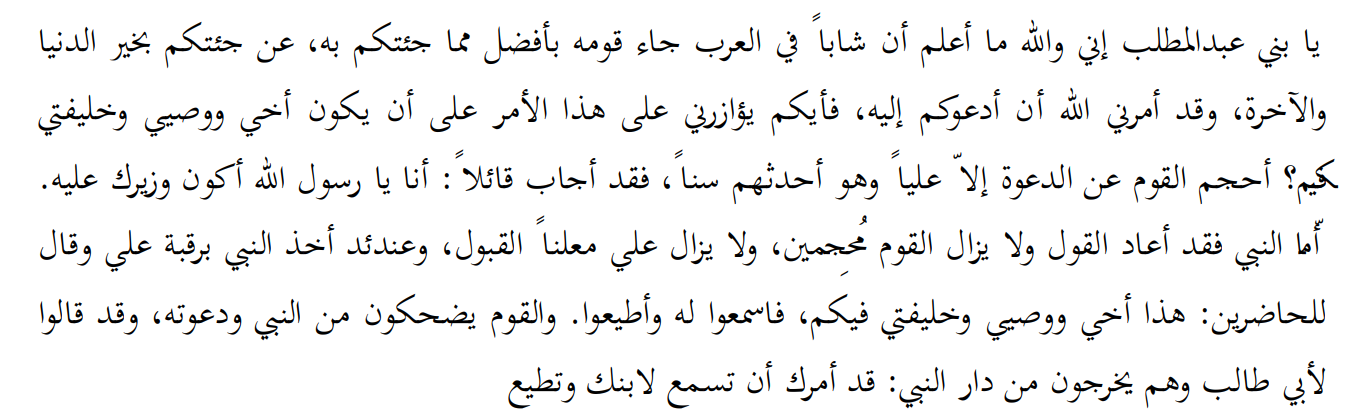
Ee Banu Abd al-Muttalib, kwa hakika sijui kijana yeyote miongoni mwa Waarabu ambaye amekuja kwa watu wake na jambo bora kuliko lile nililokuja nalo kwenu. Hakika nimekuja kwenu na mema ya dunia hii na Akhera. Allah ameniamuru niwaite kwake, basi ni nani kati yenu atakayenisaidia katika jambo hili ili awe ndugu yangu, mrithi wangu na Khalifah wangu miongoni mwenu?" Watu wakajitenga na wito huo isipokuwa Ali, aliyekuwa mdogo kuliko wote, ambaye alijibu akisema: "Mimi, ee Mjumbe wa Allah ﷺ, nitakuwa msaidizi wako katika jambo hili." Mjumbe ﷺ alirudia kauli yake, na watu wakabaki mbali, huku Ali akiendelea kutangaza kukubali kwake. Basi Mjumbe ﷺ alimshika shingo Ali na kuwaambia waliokuwepo: "Huyu ni ndugu yangu, mrithi wangu na Khalifah wangu miongoni mwenu, basi msikilizeni na mtiini." Watu wakamcheka Nabii ﷺ na wito wake, na wakamwambia Abu Talib waliposhuka nyumbani kwa Mjumbe ﷺ: "Amekuamuru umsikilize mwanao na umtii."
O Banu Abd al-Muttalib, by Allah I do not know any youth among the Arabs who has come to his people with a thing better than what I have come to you with. Verily I have come to you with the good of this world and the Hereafter. Allah has commanded me to call you to Him, so which one of you will assist me in this matter so that he may become my brother, inheritor and my Khalifah among you? The people kept away from the da’wa except Ali, the youngest among them, who responded saying: I, O Messenger of Allah, will be your assistant upon this matter. The Messenger repeated his statement and the people remained away while Ali continued announcing his acceptance. So the Messenger took the neck of Ali and said to those present: This is my brother, inheritor and my Khalifah among you so listen to him and obey. The people laughed at the Prophet and his invitation, and said to Abu Talib while leaving the Messenger’s house: ‘He has commanded you to listen to your son and obey him.’”
Hii ni muhtasari wa hadithi ya nyumba kama ilivyosimuliwa na wale wanaoitegemea kama ushahidi.
This is the summary of the hadith of the house as narrated by those who depend upon it as evidence.
Al-Bukhari alisimulia tukio la siku ambayo
Al-Bukhari narrated the incident of the day when
"Na uwaonye jamaa zako walio karibu nawe." [TMQ 26:214]
“And warn your nearest kinsfolk” [TMQ 26:214]
Ilifunuliwa (ikisema) kwamba Mtume ﷺ alisimama juu ya (Mlima) Safa, bila kutaja maandalizi ya chakula. Imam Ahmad bin Hanbal alisimulia katika Musnad yake hadithi mbili: moja kuhusu maandalizi ya chakula bila kutaja kwamba ilikuwa siku ambayo {Na waonye jamaa zako wa karibu} iliteremshwa, na nyingine ikitaja kwamba maandalizi ya chakula yalikuwa siku ambayo aya hiyo iliteremshwa. Tutaonyesha matini hizi kwanza, kisha tueleze yaliyomo ndani yake.
Was revealed (saying) that the Messenger (saw) stood upon (Mount) Safa, without mentioning the preparation of food. Ahmad bin Hanbal narrated in his Musnad two hadiths, one about the preparation of food without mentioning it was the day in which “And warn your nearest kinsfolk” was revealed and another mentioning that the preparation of food was on the day the ayah was revealed. We will show these texts first then explain what they contain.
Al-Bukhari alisimulia kutoka kwa Ibn ‘Abbas (ra) ambaye alisema: Wakati
Al-Bukhari narrated from Ibn ‘Abbas (ra) who said: When
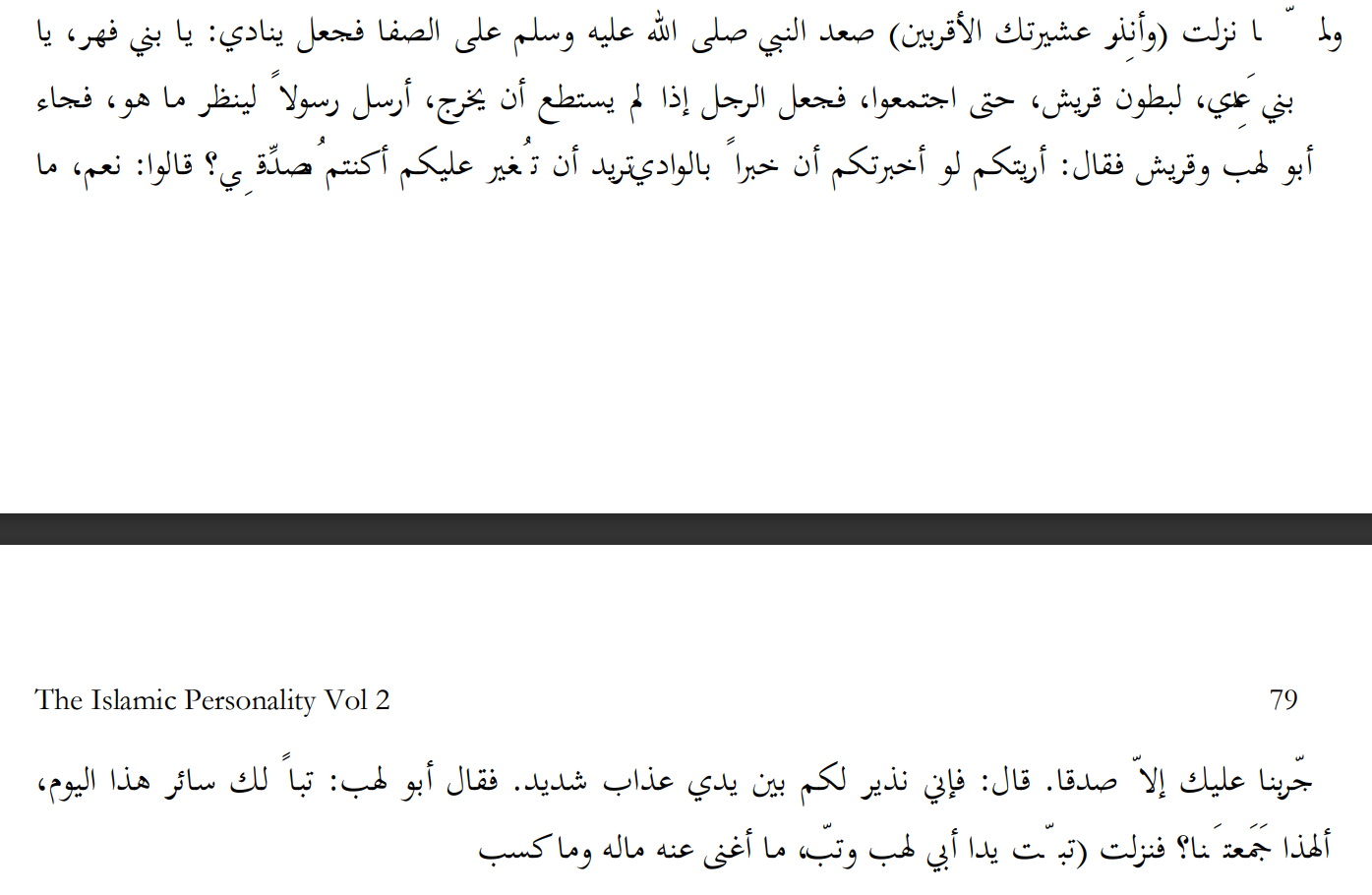
“Na ilipoteremshwa: *Na waonye jamaa zako walio karibu*, Mtume alisimama juu ya Safa na kuanza kutangaza: Enyi Banu Fihr, enyi Banu Adiyy, kwa ajili ya (butun) wote wa Quraysh, hadi wakakusanyika pamoja. Yule ambaye hakuweza kwenda alikuwa amemtuma mjumbe kwenda kuona kinachoendelea. Abu Lahab na Quraysh walifika, naye akasema: ‘Je, kama ningewaambia kuwa kuna farasi (wanaume) katika bonde wanaokusudia kuwashambulia ghafla, mngeniamini?’ Wakasema: Ndiyo, hatujawahi kukujaribu katika jambo lolote isipokuwa kukuona ukisema ukweli. Akasema: Hakika mimi ni mwonyaji kwenu kabla ya adhabu kali! Abu Lahab akasema: Laana iwe juu yenu kwa siku yote iliyobaki. Je, ndiyo maana mkatukusanya? Ndipo *Mikono miwili ya Abu Lahab na aangamie, mali yake na watoto wake havitamnufaisha!* [TMQ 111:1-2] ikateremshwa.”
“And when And warn your nearest kinsfolk was revealed, the Messenger stood upon Safa and started announcing: O Banu Fihr, O Banu Adiyy for all the (butun) of Quraysh until they gathered together. Whoever was unable to go had sent a messenger to see what was happening. Abu Lahab and Quraysh came and he said: ‘If I told you there were horses (men) in the valley intending to attack you suddenly, would you believe me?’ They said: Yes, we have not tried you in anything except to find you saying the truth. He said: Verily, I am a warner to you before a severe punishment! Abu Lahab said: Woe be upon you for the rest of the day. Is it because of this that you gathered us? So “Perish the two hands of Abû Lahab (an uncle of the Prophet [sal-Allâhu 'alayhi wa sallam]) and perish he!, His wealth and his children will not benefit him!” [TMQ 111:1-2] was revealed”
Hii inaonyesha kwamba tukio la kuandaa chakula halikutokea siku ile ambayo "Na waonye jamaa zako wa karibu" ilifunuliwa, kwa sababu hailingani na yaliyomo katika matini ya hadithi. Ahmad bin Hanbal alisema katika Musnad yake: 'Affan ametusimulia kwamba Abu Awana ametusimulia kutoka kwa Uthman bin al-Mughira kutoka kwa Abu Sadiq kutoka kwa Rabi'a bin Najidh kutoka kwa Ali (ra) aliyesema: Mjumbe wa Allah ﷺ aliwakusanya au kuwaita Banu Abd al-Muttalib katika makundi yao yote ili kula na kunywa. Aliwaandalia chakula kingi ambacho walikula mpaka wakashiba. Akasema: Chakula kilibaki kana kwamba hakikuguswa. Kisha akaomba kinywaji cha zafarani ambacho walikinywa mpaka wakashiba, na kinywaji kikabaki kana kwamba hakikuguswa. Kisha ﷺ akasema:
This indicates that the incident of the preparation of food was not on the day in which “And warn your nearest kinsfolk” was revealed as it does not concur with what occurred in the hadith’s text. Ahmad bin Hanbal said in his Musnad: ‘Affan related to us that Abu Awana related to us from Uthman bin al-Mughira from Abu Sadiq from Rabi’a bin Najidh from Ali (ra) who said: The Messenger of Allah (saw) gathered or called Banu Abd al-Muttalib in all their groups to eat and drink. He prepared for them a quantity of food which they ate until they were satisfied. He said: The food remained as if it had not been touched. Then he called for a saffron drink which they drank until they will full, and the drink remained as if it had not been touched. Then he (saw) said:

"Enyi Banu Abd al-Muttalib, nimetumwa kwa ajili yenu peke yenu na kwa wanadamu wote kwa ujumla. Mmeona sasa katika ishara hii (aya) mliyoiona, basi ni nani miongoni mwenu atanipa ahadi ili awe ndugu yangu na mwenzangu?" Akasema: Hakuna hata mmoja wao aliyesimama, kwa hiyo mimi nilisimama kwa ajili yake, ingawa nilikuwa mdogo kuliko wote waliokuwepo. Naye akasema: Keti chini. Akarudia hilo mara tatu, na baada ya hapo nilisimama kwa ajili yake, naye akasema: "Keti chini," hadi mara ya tatu alipopiga mkono wangu kwa mkono wake.
“O Banu Abd al-Muttalib, I have been sent specifically to you and to humanity in general. You have now seen of this sign (ayah) what you saw, so which one of you will give me a pledge in order to become my brother and companion?’ He said: None of them stood, so I stood for him though I was the youngest of the group and he said: Sit down. He repeated it three times following which I stood for him and he said ‘Sit down’, until the third time he struck my hand with his hand.”
Hii inaweka wazi kwamba hakuna wakati wowote katika tukio hili wa kushuka kwa aya "Na waonye jamaa zako wa karibu", na kwamba Mtume ﷺ aliwatolea Uislamu ili yeyote atakayesilimu awe ndugu yake na mwandani wake, na kwamba hakumwambia chochote Ali (ra).
This clarifies that there is no moment in this incident of the revelation of “And warn your nearest kinsfolk”, and that the Messenger (saw) offered Islam to them so that whoever became a Muslim would become his brother and companion and that he did not say anything to Ali (ra).
Kuhusu simulizi ya pili, Ahmad bin Hanbal alisimulia katika Musnad yake: "Aswad bin Amir alitusimulia kwamba Shareek alitusimulia kutoka kwa Al-‘Amash kutoka kwa Al-Minhal kutoka kwa ‘Ibad bin Abdullah al Asadi kutoka kwa Ali aliyesema: Aya isemayo “Na waonye jamaa zako wa karibu” ilipoteremshwa, Mtume ﷺ aliwakusanya watu wa nyumba yake. Walikusanyika watu thelathini; wakala na kunywa, kisha akawaambia ﷺ:
As for the second narration, Ahmad bin Hanbal narrated in his Musnad: “Aswad bin Amir related to us that Shareek related to us from Al-‘Amash from Al-Minhal from ‘Ibad bin Abdullah al Asadi from Ali who said: When the ayah “And warn your nearest kinsfolk” was revealed, the Messenger (saw) gathered the family of his house. Thirty people gathered; they ate and drank then he (saw) said to them:
"Ni nani atakayedhamini madeni yangu na ahadi zangu ili awe pamoja nami Peponi, na awe khalifa wangu juu ya familia yangu?" Mtu mmoja, ambaye Shareek hakumtaja jina lake, alisema: Ewe Mjumbe wa Allah ﷺ, wewe ulikuwa bahari, basi ni nani anayeweza kusimamia jambo hili? Kisha mwingine akasema (vivyo hivyo?). Alitoa jukumu hilo kwa watu wa nyumba yake, basi Ali (RA) akasema: Mimi (nitafanya).
"Which one will guarantee my debts and promises so as to be with me in Paradise, and he will be my Khalifah over my family? A man, whom Shareek did not name, said: O Messenger of Allah, you were an ocean (bahr) so who could take care of this? Then another said (the same?). He offered that to the family of his house, so Ali (RA) said: I (will).”
Neno "mrithi" au "Khalifah" halionekani katika matini hizi mbili kwa namna yoyote ile kabisa. Badala yake, ni neno "Khalifah" pekee linalotumika, lililofungamanishwa na familia yake, na Khilafah juu ya familia hiyo si Khilafah ya cheo cha utawala au uongozi, wala haina uhusiano wowote nayo. Haya ni matini zilizokuja katika vitabu vya Sahih, na zimekuja katika riwaya nyingi zenye maneno yanayofanana na maana iliyoungana. Hakuna hata moja kati yake iliyoonyesha maneno "mrithi" au "Khilafah". Hakuna kabisa, ama kupitia mmoja wa waandishi wa vitabu vya Sahih au mmoja wa wasimulizi waaminifu, hadithi hata moja yenye maneno "mrithi" au "Khalifah" kwa namna yoyote ile, iwe kuhusiana na Ali au mtu mwingine yeyote. Kwa hiyo ushahidi huo unaanguka kwa kukosekana kwa ushahidi wowote kwake katika vitabu vya Sahih.
The word inheritor or Khalifah does not appear in these two texts in any way at all. Rather it is only the word Khalifah which appears restricted to his family, and the Khilafah over the family is not the Khilafah in the post of rule or leadership nor does it have any relationship with that. These are the texts which came in the Saheeh books, and they came in numerous narrations with similar wordings and unified meanings, and there did not appear in any of them the words inheritor or Khilafah. There has never appeared, either via any of the compilers of the Saheeh (books of ahadith) or any of the trustworthy narrators, in even one hadith the word(s) inheritor of Khalifah in any way at all either in relation to Ali or anyone else, so the evidence falls due to the absence of any evidence for it in the Saheeh books.
Kuhusu tafsiri ya hadithi inayosimuliwa na wale wanaobishania uteuzi wa Ali, ambayo wameiita hadithi ya nyumbani, hadithi hii yenye usimulizi (riwayah) huo imekataliwa kwa maana yake (dirayah). Hadithi hukataliwa kwa dirayah yake kwa msingi wa maana yake, na usimulizi wake kwa msingi wa mnyororo wake wa wasimulizi. Kwa hiyo, ikiwa imekataliwa kwa mnyororo wake au kwa maana yake, basi haiwezi kuzingatiwa na inaanguka kama ushahidi. Kuhusu kukataliwa kwa maana yake, hii ni kwa sababu nyingi, zikiwemo:
As for the text narrated by those who contend about the appointment of Ali which they named the hadith of the house, this text with this narration (riwayah) is rejected in its meaning (Dirayah).A hadith is rejected in its dirayah based on its meaning, and its narration based on its chain. So if it is rejected in its chain or meaning then it cannot be considered and it falls as evidence. As for rejecting its meaning, this is due to many reasons including:
Kwanza: Katika hadith hii inaonekana kuwa Mtume ﷺ alitafuta msaada wa ukoo wa Abd al-Muttalib katika da'wa yake kwa sharti kwamba utawala ungekuwa wao baada yake. Hili ni batili kwa sababu mbili: kwanza, hili linapingana na kauli na tendo la Mtume ﷺ katika tukio ambalo alikataa ombi la kabila ambalo lilitaka utawala uwe wao baada yake endapo wangesilimu, ambapo alijibu:
"Mamlaka ni jambo ambalo ni mali ya Allah, na Yeye (SWT) ataiweka pale anapotaka."
“Authority is a matter which belongs to Allah, and He (swt) will place it where He wishes.”
Ibn Hisham alisimulia katika kitabu chake cha Sira ya Mtume ﷺ: Ibn Ishaq alisema kwamba Az-Zuhri alisimulia kwamba alikutana na Banu Amr bin Sa'sa'ah, akawaalika kwa Allah ‘azza wa jalla na akajitolea nafsi yake kwao. Mtu mmoja miongoni mwao, aliyeitwa Bayjirat bin Furra, alimwambia: Kwa Allah, ikiwa ningemchukua kijana huyu wa Quraysh, ningewashinda Waarabu kupitia yeye. Kisha akasema: Vipi ikiwa tutaahidi kukusaidia katika jambo lako, kisha Allah akakupa ushindi dhidi ya wale wanaokupinga, je, utawala utakuwa mikononi mwetu baada yako? Akasema: "Utawala ni wa Allah, naye huuweka pale anapotaka." Akamwambia: Je, tutatoa shingo zetu kwa ajili yako, kisha Allah (swt) akikupa ushindi utawala unakuwa wa mtu mwingine? Basi hatuna haja na jambo lako, wakamkataa. Inawezekanaje Mtume ﷺ kusema: "Jambo ni la Allah, naye ataliweka pale anapotaka," yaani jambo la Khilafah na utawala baada yake, kisha akawaambia Banu Abd al-Muttalib:
Ibn Hisham narrated in his book of the Sirah of the Prophet (saw): Ibn Ishaq said that Az-Zuhri narrated that he met Banu Amr bin Sa’sa’ah so he invited them to Allah ‘azza wa jalla and offered himself to them. One man among them, whom they called Bayjirat bin Furra, said to him: By Allah, if I were to take this youth from the Quraysh, I will eat (i.e. conquer) the Arabs through him. Then he said: What if we were to pledge to support your matter then Allah will grant you victory over those who oppose you. Will the rule be with us after you? He said: “The rule is for Allah and He places it where He wills.” He said: So he said to him: Will we sacrifice our throats for you, then when Allah (swt) grants you victory the rule becomes for someone else? Then we have no need of your matter, and they rejected him.” How can the Messenger (saw) say: “The matter belongs to Allah and He will place it where He wills” i.e. the matter of the Khilafah and the rule after him, yet he says to Banu Abd al-Muttalib:
"Ni nani miongoni mwenu atakayenisaidia katika jambo hili ili awe ndugu yangu, mrithi wangu na Khalifah miongoni mwenu?"
“Which one of you will assist me upon this matter so that he may become my brother, inheritor and Khalifah among you?”
Je, hii si kinyume wazi? Bila shaka, ni lazima mojawapo ya kauli hizi mbili likataliwe. Kwa kuwa inasemwa kuhusu hadith ya nyumba kwamba ilitokea wakati
Is this not a clear contradiction? Inevitably, it is necessary that one of these two statements be rejected. Since it is said of the hadith of the house that it occurred when
"Waonye jamaa zako wa karibu" [TMQ 26:214]
“Warn your nearest kinsfolk” [TMQ 26:214]
Ilifunuliwa, yaani mwaka wa tatu wa utume wa Mtume ﷺ, na hadithi:
Was revealed i.e. the third year of the messenger ship and the hadith:
"Jambo ni la Allah, naye huliweka mahali apendapo."
“The matter belongs to Allah and He places it where He wills”
wakati Mjumbe (saw) alipojitolea kwa makabila, yaani katika mwaka wa kumi baada ya safari ya Mjumbe, na hivyo baada ya hadithi ya nyumba; basi ni hadithi ya nyumba ndiyo inayokataliwa. Kwa upande wa pili, ni kwamba Mjumbe (saw) katika hadithi hii alitoa kitu kwa makafiri ili waingie Uislamu, bali alitoa kwao jambo kubwa zaidi, ambalo ni Ukhalifa baada yake juu ya Waislamu wote, kama malipo ya kuingia kwao Uislamu. Hili linapingana na kitendo cha Mjumbe katika da'wa yake na kanuni za Shari'ah. Mjumbe alikuwa akawaalika watu kwenye Uislamu kwa sababu ni dini sahihi, wala haijapokewa kutoka kwake, hata kupitia hadithi dhaifu, kwamba alitoa chochote, kidogo au kikubwa, kwa kafiri kama kubadilishana na kuingia kwake Uislamu. Kwa upande wa wale ambao nyoyo zao zinapaswa kutulizwa, ni Waislamu wanaopewa katika zakat ili kuimarisha Dola kupitia wao, si makafiri wanaopewa ili waingie Uislamu. Wala haifai kuwapa makafiri kitu kwa kubadilishana na kuingia kwao Uislamu.
when the Messenger (saw) offered himself to the tribes i.e. in the tenth year after the messenger ship and therefore after the hadith of the house; so it is the hadith of the house which is rejected. As for the second side, it is that the Messenger (saw) in this hadith offered something to the disbelievers so that they may become Muslims, rather he offered them the greatest thing which is the Khilafah after him over all Muslims as the price for their entering into Islam. This contradicts the Messenger’s action in his da’wa and the Shari’ah rules. The Messenger would invite people to Islam because it is the correct deen and it has never been narrated from him, even through a weak hadith that he offered anything whether small or large to a kafir in exchange for his entering into Islam. As for those whose hearts are to be reconciled, they are Muslims who are given from the zakat in order to strengthen the State through them, not kuffar who are given so that they enter Islam. Nor is it allowed to give something to kuffar in exchange for their entering Islam.
Pili: Hadithi inataja kwamba Mtume (saw) aliandaa karamu na chakula cha harusi kwa makafiri ili awaalike kwenye Uislamu, na aliwakusanya karibu na chakula ili waingie Uislamuni, lakini hakuandaa chakula kwa Ali (ra) ambaye alikuwa tayari amekubali Uislamu. Kwa hiyo, ikiwa watu hawa wanakataa Uislamu na wanakataa kwamba uongozi utakuwa wao baada yake badala ya Uislamu, hapana nafasi hapo kwa Ali (ra) kutoa kukubali kwake kwa kuwa hajaalikwa kwenye Uislamu kwa sababu tayari ni Muislamu, wala hakuna hotuba iliyoelekezwa kwake. Ndiyo maana hakuna nafasi katika kusanyiko hili ambapo mtu anamwambia yeye:
Secondly: The hadith mentions that the Messenger (saw) prepared a wedding feast and meal for kuffar in order to invite them to Islam, and he gathered them around a meal so that they may enter Islam and he did not prepare food for Ali (ra) who had already accepted Islam. So if these people reject Islam and reject that the rule becomes theirs after him in exchange for Islam, there is no place there for Ali (ra) for giving his acceptance as he is not being invited to Islam because he is already a Muslim, and there is no speech addressed to him. This is why there is no place in this gathering such that he says to him:
"Huyu ni ndugu yangu, mrithi wangu na Khalifah wangu miongoni mwenu, basi msikilizeni na mtii."
“This is my brother, inheritor and my Khalifah among you so listen to him and obey”
Tatu, kwa kuwa yeye si mlengwa wa hotuba wala wa mazungumzo. Tatu: Hadithi inaeleza kwamba kundi hilo lilikataa Uislamu, na licha ya yeye kurudia pendekezo lake, waliendelea kukataa Uislamu na kukataa kwamba utawala utakuwa wao baada yake kwa sharti la kuingia Uislamu. Waliendelea kuwa makafiri, basi ilikuwaje Mtume ﷺ kuwaambia wao kwa kuwahutubia?
Since he is not the target of the address or the negotiation. Thirdly: The hadith mentions that the group rejected Islam, and despite him repeating his offer they persisted in rejecting Islam and rejecting that the rule becomes theirs after him in exchange for entering Islam. They remained kuffar so how could the Messenger (saw) say to them in addressing them:
"Huyu ndiye Khalifah wangu miongoni mwenu"
“This is my Khalifah among you”
Kuwaamuru kuwasikiliza na kumtii huku akijua kwamba ni makafiri waliokikataa Uislamu? Na vipi angeweza kuwa Khalifah miongoni mwao ilhali wao ni makafiri?
Commanding them with hearing and obeying him while he knows they are kuffar who have rejected Islam? And how could he be the Khalifah among them while they are kuffar?
Nne: Hadithi wanayoisimulia inasema:
Fourthly: The narration they narrate says:
"Huyu ni ndugu yangu, mrithi wangu na Khalifah wangu miongoni mwenu, basi msikilizeni na mtii."
“This is my brother, inheritor and my Khalifah among you so listen to him and obey”
Hii ni hotuba iliyoelekezwa kwa familia ya Abd al-Muttalib kwa kuwa maneno yalianza kwa kauli yake "Enyi Banu Abd al-Muttalib." Kwa hiyo ni mahsusi kwao, kwani alimfanya kuwa Khalifah juu yao, yaani juu ya familia ya Abd al-Muttalib, si Khalifah wa Waislamu, kwa kuwa alisema, "na Khalifah wangu juu yenu." Hivyo basi, yeye si Khalifah kwa Waislamu kama inavyoonyeshwa na maandishi ya wazi. Wala haiwezekani kusema hapa kwamba funzo linatokana na ujumla wa maandishi na si ukomo wa sababu, kwa kuwa hili ni tukio mahsusi, si sababu (sabab). Halafu, maneno yenyewe pia ni mahsusi wala si ya jumla: "Enyi Banu Abd al-Muttalib" na "Khalifah wangu miongoni mwenu." Kwa hiyo ukomo unahitajika kwa sababu tukio hili ni mahsusi, si sababu, na pia kwa kukosekana kwa maneno ya jumla.
This is an address to the family of Abd al-Muttalib since the words started with his saying “O Banu Abd al-Muttalib.” So it is specific to them as he made him a Khalifah over them i.e. over the family of Abd al-Muttalib not the Khalifah of the Muslims since he said, “and my Khalifah over you.” Thus he is not the Khalifah for the Muslims as is depicted by the explicit text. Nor can one say here that the lesson is by the generality of the text not the specificity of the cause since this is a specific incident not a cause (sabab) not mentioning that the words are also specific and not general: “O Banu Abd al-Muttalib”, “my Khalifah among you” so the specification is demanded due to this being a specific incident not a cause, and also due to the absence of general words.
Jambo moja tu kati ya haya manne linatosha kufichua uongo wa hadithi hii na upingamizi wake, na ni wajibu kuikataa riwaya yake (dirayah). Kwa hiyo, imefafanuliwa wazi kwamba Mtume ﷺ hakusema waziwazi kumfanya Ali (ra) kuwa Khalifah baada yake. Kutokana na haya yote inadhihirika kwamba hadithi zinazosimuliwa na wale wanaodai kwamba Mtume ﷺ alimteua mtu kwa ajili ya Ukhalifa baada yake ni hadithi zilizokataliwa, zisizofaa kutegemewa kama ushahidi, hivyo zinaanguka. Hakubaki ushahidi wowote kwamba Mtume ﷺ alimteua mtu yeyote kuwa msimamizi wa Ukhalifa baada yake; bali ushahidi umethibitika kinyume cha hilo, yaani kwamba Mtume ﷺ aliliachia Waislamu jambo hilo, wachague wamtakaye kwa mtu huyo, lakini akawabainishia njia ya kumteua Khalifah.
Just one of these four matters suffices to reveal the falsehood of this hadith and its contradiction, and it is obligatory to reject its narration (dirayah). Therefore it is clarified that the Messenger (saw) did not explicitly state making Ali (ra) the Khalifah after him. From all this it becomes clear that the ahadith narrated by those who argue that the Messenger (saw) designated a person for the Khilafah after him are rejected ahadith unsuitable to depend upon as evidence so they fall. There remains no evidence that the Messenger (saw) designated anyone to be in charge of the Khilafah after him; rather the evidence has been established contrary to that i.e. that the Messenger (saw) left the matter to the Muslims to choose whom they want in relation to the person but he specified for them the method for appointing the Khalifah.