3.1 Ukusanywa kwa Qur’ān
3.1 The Compilation Of The Qur’ān
Imethibitishwa kwa ushahidi wa wazi na wa hakika kwamba Qur’ani yote ilikuwa imeandikwa wakati Nabii ﷺ alipofariki, kwenye vipande vya mifupa ya mabega ya wanyama, kwenye matawi ya mitende, na kwenye lukhaf (jiwe jeupe jembamba na pana). Yote hayo yalihifadhiwa pia mioyoni mwa Masahaba (radhi za Allah ziwe juu yao). Aya au aya kadhaa zilipoteremshwa, alikuwa akiamuru ziandikwe mbele yake mara moja. Hakuwakataza Waislamu kuandika Qur’ani kwa njia nyingine tofauti na ile aliyokuwa akiwaamuru waandishi walioandika wahyi. Muslim ameripoti hadithi kutoka kwa Abu Sa'id al-Khudri kwamba Mtume wa Allah ﷺ alisema:
It has been proven by decisive and definite evidence that when the Prophet died the whole Qur’ān had been written on pieces of shoulder blades (of animals), palm risps and on lukhaf’s (a thin broad white stone). All of it was preserved in the hearts of the Sahabah (may Allah be pleased with them). When an ayah or ayāt would be revealed he would order that they be written down before him at once. He did not prevent the Muslims from writing the Qur’ān in other than what he used to dictate to the scribes who wrote down the revelation. Muslim reported a hadīth from Abu Sa'id al-Khudri that the Messenger of Allah said:
"Msiandike chochote kutoka kwangu, na yeyote aliyeandika kitu chochote nilichosema isipokuwa Qur'ani, na afute."
“Do not write down anything from me, whosoever writes anything I have said other than the Qur’ān let him erase it”
Kile ambacho waandishi waliandika kutoka katika wahyi kilikusanywa kwenye karatasi. Yeye alisema:
What the scribes wrote from the revelation was collected on sheets. He said:
Mtume kutoka kwa Allah, akisoma kurasa zilizotakaswa (suhuf) (za Qur'ani) ﷺ [TMQ Bayyinah:2]
“A Messenger from Allah, reciting purified pages (suhuf) (of the Qur’ān)” [TMQ Bayyinah:2]
yaani, kusoma karatasi zilizotakaswa kutokana na uongo, zilizoandikwa kwa mkono, hakika ni za kweli kabisa na za haki. Allah amesema:
i.e, reciting sheets purified from falsehood, honestly handwritten unequivocally true and just. Allah said:
Hakika hizi (aya za Qur’ani) ni ukumbusho. Basi atakayetaka, na azingatie. Zimo katika Kitabu kilichohifadhiwa kwa heshima kubwa. Kimetukuzwa, kimetakaswa, Mikononi mwa waandishi, Watukufu na wema. [TMQ ‘Abasa: 11-16]
“Nay, indeed it (verses of the Qur’ān) are an admonition (tazkirah). So whoever wills, let him pay attention to it. (It is) in Records held (greatly) in honour. Exalted (in dignity), purified. In the hands of scribes. Honourable and obedient” [TMQ ‘Abasa: 11-16]
Yaani onyo hili lililoandikwa katika kumbukumbu linashikiliwa kwa heshima kubwa mbele ya Allah na lina thamani tukufu, liko mbali na mikono ya wale walio potovu, na kwamba liliandikwa na waandishi wenye kumcha Mungu. Aliacha kila kitu kilichokuwa kimeandikwa kati ya jalada mbili za mushafu, ambacho kilikuwa kimeandikwa mbele yake. 'Abd al-'Aziz b Rufayya' amesimulia:
i.e this admonition established in the records is held (highly) in honour with Allah and exalted in value, free from the hands of those that are corrupt and that they have been written down by God fearing scribes. He left everything that was written between the two covers of the mushaf which had been written down in front of him. 'Abd al-'Aziz b Rufayya' narrated:
“Shaddad bin Ma'qil na mimi tuliingia kwa Ibn 'Abbas. Shaddad bin Ma'qil alimwuliza, 'Je, Mtume ﷺ aliacha chochote (zaidi ya Qur'ani)?' Akajibu, 'Hakuacha chochote isipokuwa kilichomo ndani ya vifuniko (vya Qur'ani).' Kisha tulimtembelea Muhammad bin al-Hanafiyya na tukamwuliza (swali hilohilo). Akajibu, 'Mtume ﷺ hakuacha chochote isipokuwa kilichomo ndani ya vifuniko (vya Qur'ani).'”
“Shaddad bin Ma'qil and I entered upon Ibn 'Abbas. Shaddad bin Ma'qil asked him, 'Did the Prophet leave anything (besides the Qur’ān)?' He replied. “He did not leave anything except what is between the bindings (of the Qur’ān).' Then we visited Muhammad bin al-Hanafiyya and asked him (the same question). He replied, 'The Prophet did not leave except what is between the bindings (of the Qur’ān)”
Kumekubaliwa kwa kauli moja (Ijma') kwamba aya zote za Qur'ani, katika sura zao husika, ziliandikwa mbele ya Mtume ﷺ wakati wahyi ulipokuwa ukiteremshwa kwake, na kwamba ziliandikwa kwenye vipande vya karatasi (suhuf). Mtume mkuu kuliko Mitume wote ﷺ alifariki akiwa ameridhika kuhusu Qur'ani, muujiza wake mkuu ulioweka hoja kwa Waarabu na dunia nzima. Hakuogopa kwamba aya za Qur'ani zitapotea, kwa sababu Allah {SWT} ameihifadhi Qur'ani kwa maandishi ya wazi.
An Ijma' (consensus) has been established on the fact that all of the verses of the Qur’ān in their respective chapters (Sura’s) had been written down directly in front of the Messenger when the revelation was being revealed to him, and that they were written on sheets (suhuf). The greatest of the Messengers died content about the Qur’ān, his greatest miracle which established the proof for the Arabs and the world. He did not fear for the verses of the Qur’ān that they would be lost because Allah has preserved the Qur’ān with an explicit text:
Hakika Sisi: ni Sisi tuliyoteremsha Ukumbusho (Qur'ani), na hakika Sisi ndio tutakaoilinda (dhidi ya upotovu). [TMQ Hijr: 9]
“Verily We: It is We who have sent down the Zikr (the Qur’ān) and surely, We will guard it (from corruption)” [TMQ Hijr: 9]
Kwa sababu aya hizi zilihifadhiwa kwa njia ya kudumu kupitia kuandikwa kabla ya kifo chake, na kuhifadhiwa mioyoni mwa Masahaba, na kwa ruhusa aliyopewa Waislamu ya kuandika Qur’ani. Ndiyo maana baada ya kufariki kwa Mtume ﷺ, Masahaba hawakuona haja ya kukusanya Qur’ani katika kitabu kimoja wala haja ya kuiandika, hadi wengi wa Huffaz (wanaohifadhi Qur’ani kwa moyo) walipouawa katika vita vya Riddah. Kutokana na hilo, 'Umar alihofia kupotea kwa karatasi (suhuf) na kifo cha Qurra' (wale waliohifadhi Qur’ani yote kwa moyo), jambo ambalo lingesababisha baadhi ya aya kupotea. Hivyo akafikiria kukusanya pamoja karatasi zilizoandikwa (kuwa kitabu kimoja). Akaliwasilisha wazo lake kwa Abu Bakr, na hivyo ukusanyaji wa Qur’ani ukafanyika. Imepokewa na 'Ubayd ibn al-Sibaq kwamba Zayd bin Thabit al-Ansari alisema: Abu Bakr alinituma baada ya (hasara kubwa) ya mashujaa (wa vita) vya Yamama (ambapo idadi kubwa ya Qurra' waliuawa). 'Umar alikuwepo kwa Abu Bakr, ambaye alisema: "'Umar amekuja kwangu na kusema: Watu wamepata hasara kubwa siku ya (vita vya) Yamama, nami nahofia kwamba kutakuwa na vifo zaidi miongoni mwa Qurra' (wale wanaojua Qur’ani kwa moyo) katika uwanja mwingine wa vita, hivyo sehemu kubwa ya Qur’ani inaweza kupotea, isipokuwa ukiikusanya. Na mimi ni wa maoni kwamba unapaswa kukusanya Qur’ani." Abu Bakr aliongeza: "Nilimwambia 'Umar,
Because these verses had been preserved permanently via them being written down before him , and being preserved in the hearts of the Sahabah and by the permission granted to the Muslims to write down the Qur’ān. This is why after the death of the Messenger the Sahabah did not feel the need to compile the Qur’ān in one book or the need to write it down until many of the Huffaz (memorisers of the Qur’ān) had been killed in the Riddah wars. So due to this 'Umar feared for the loss of the sheets (suhuf) and the death of the Qurra' (Those who had committed the whole of the Qur’ān to memory), thereby causing some verses to be lost. So he thought about bringing the written sheets together (in one compilation). He presented his idea to Abu Bakr and so the compilation of the Qur’ān was performed. It has been narrated by 'Ubayd ibn al-Sibaq that Zayd b al-Thabit al-Ansari said: Abu Bakr sent for me after the (heavy) casualties among the warriors (of the battle) of Yamama (where a great number of Qurra' were killed). 'Umar was present with Abu Bakr who said, 'Umar has come to me and said, The people have suffered heavy casualties on the day of (the battle of) Yamama, and I am afraid that there will be more casualities among the Qurra' (those who know the Qur’ān by heart) at other battle-fields, whereby a large part of the Qur’ān may be lost, unless you collect it. And I am of the opinion that you should collect the Qur’ān.” Abu Bakr added, “I said to 'Umar ,
"Unawezaje kufanya jambo ambalo Mtume wa Allah ﷺ hakulifanya?"
'How can you do something which Allah's Apostle did not do?'
ʿUmar alisema (kwangu),
'Umar said (to me),
"Kwa Mwenyezi Mungu, hakika ni jambo zuri."
'By Allah, it is (really) a good thing.'
Hivyo ‘Umar aliendelea kunishawishi na kunisihi nikubali pendekezo lake, hadi Allah alipofungua moyo wangu kulikubali, nami nikawa na maoni sawa na ‘Umar. (Zayd b. Thabit aliongeza:) ‘Umar alikuwa ameketi naye (yaani Abu Bakr) wala hakuzungumza nami. (Abu Bakr alisema:) “Wewe ni kijana mwenye hekima, na hatukushuku (kwamba unasema uongo au unasahau). Pia ulikuwa ukiandika wahyi kwa ajili ya Mtume wa Allah ﷺ. Basi tafuta Qur’ani na uikusanye (katika mkusanyiko mmoja).” “Kwa Allah, kama yeye (Abu Bakr) angeniamuru kuhamisha mojawapo ya milima kutoka mahali pake, isingekuwa ngumu kwangu kuliko alivyoniamuru kuhusu ukusanyaji wa Qur’ani.” Nikawaambia wote wawili: “Mnathubutuje kufanya jambo ambalo Mtume ﷺ hakulifanya?” Abu Bakr akasema: “Kwa Allah, hilo ni jambo jema kweli.” Basi nikaendelea kubishana naye juu ya jambo hilo hadi Allah alipofungua moyo wangu kwa lile ambalo alilolifungulia mioyo ya Abu Bakr na ‘Umar. Hivyo nikaanza kutafuta sehemu za Qur’ani na kuzikusanya kutoka kwenye vipande vya ngozi, mifupa ya bega, mabua ya mitende, na kutoka kwenye kumbukumbu za watu (waliokuwa wameihifadhi moyoni). Nilikuta aya mbili za Surat at-Tawba kwa Abu Khuzaima ambazo sikuzikuta kwa mtu mwingine yeyote, nazo ni:
So ‘Umar kept on trying to convince me and persuade me to accept his proposal till Allah opened my heart for it and I had the same opinion as 'Umar.' (Zayd b al-Thabit added:) Umar was sitting with him (i.e Abu Bakr) and was not speaking to me). 'You are a wise young man and we do not suspect you (of telling lies or of forgetfulness): and you used to write the revelation (wahy) for Allah's Apostle . Therefore, look for the Qur’ān and collect it (in one manuscript). 'By Allah, if he (Abu Bakr) had ordered me to shift one of the mountains (from its place) it would not have been harder for me than what he had ordered me concerning the collection of the Qur’ān. I said to both of them, “How dare you do a thing which the Prophet has not done?' Abu Bakr said, 'By Allah, it is (really) a good thing So I kept on arguing with him about it till Allah opened my heart for that which He had opened the hearts of Abu Bakr and Umar . So I started locating the Qur’ānic material and collecting it from the parchments, scapula bones, leaf-stalks of date palms and from the memories of men (who knew it by heart). I found two Verses of Sura at-Tawba with Abu Khuzaima which I did not find with anybody else, (and they were):
Hakika amekujieni Mtume kutoka miongoni mwenu. Inamhuzunisha sana kuona mnapatwa na madhara au dhiki yoyote. [TMQ Tawba: 128]
“Verily, there has come unto you a Messenger from amongst yourselves. It grieves him that you should receive any injury or difficulty” [TMQ Tawba: 128]
hadi mwisho wa Surat Bara'ah. Muswada ambao Qur'ani ilikusanywa juu yake ulibaki kwa Abu Bakr hadi alipofariki dunia, kisha ukabaki kwa 'Umar wakati wa uhai wake, na mwishowe ukabaki kwa Hafsa binti 'Umar. Mkusanyiko wa Zayd wa Qur'ani haukujumuisha yale aliyoandika kutoka kwa Huffaz (yaani wale waliohifadhi Qur'ani kwa moyo). Badala yake, mkusanyiko wake ulikusanya yale aliyoyaandika mwenyewe mbele ya Mtume wa Allah ﷺ. Hakuweka karatasi moja juu ya karatasi nyingine ili kuzikusanya isipokuwa mashahidi wawili walithibitisha kwa kila karatasi iliyowasilishwa kwake kwamba iliandikwa mbele ya Mtume wa Allah ﷺ. Zaidi ya hayo, hakukubali karatasi isipokuwa ikitimiza masharti mawili: kwanza, kwamba ilikuwepo kwa maandishi kwa mmoja wa Sahaba. Na pili, kwamba ilikuwa imehifadhiwa kwa moyo na mmoja wa Sahaba. Maandishi na yaliyohifadhiwa yalipolingana na karatasi iliyokusudiwa kukusanywa, aliikubali. Vinginevyo hakuikubali. Ndiyo sababu alisita kuchukua mwisho wa Surat al-Bara'ah hadi alipoupata kwa maandishi kwa Abu Khuzayma, ijapokuwa Zayd mwenyewe aliweza kuukumbuka na kuuhifadhi. Imesimuliwa kupitia Yahya bin 'Abd al-Rahman bin Hatib kwamba alisema:
until the end of Sura Bara'ah. The manuscript on which the Qur’ān was collected, remained with Abu Bakr till he passed away, and then with 'Umar during his lifetime, and finally it remained with Hafsa bint Umar . Zayd's compilation of the Qur’ān did not consist of what he wrote down from the Huffaz (i.e the memorisers of the Qu’ran). Rather his compilation brought together what he had written himself in front of the Messenger of Allah . He did not place one sheet/page with another sheet in order to compile them unless two witnesses testified, for every sheet that had been presented to him that it was written in the presence of the Messenger of Allah . Furthermore, he did not accept a sheet unless it met two conditions; firstly, that it was present in written form with one of the Sahabah. And second, that it had been memorised by one of the Sahabah. When the written and memorised forms concurred with the sheet that was intended to be compiled, he accepted it. Otherwise he did not accept it. This is why he refrained from taking the end of sura al-Bara'ah until he found it in written form with Abu Khuzayma even though Zayd could himself recall and remember it. It has been narrated via Yahya b 'abd al-Rahman ibn Hatib that he said:

“Umar (ra) alisimama na kusema: Yeyote aliyepokea chochote cha Qur'ani kutoka kwa Mjumbe wa Allah ﷺ, na alete. Walikuwa wakiandika hayo kwenye karatasi, mbao na vipande vya mitende. Ibn Hatib alisema: Yeye (Zayd) hakukubali chochote kutoka kwa mtu yeyote mpaka mashahidi wawili wathibitishe kwamba ni kweli. Hii inaonyesha kwamba Zayd hakuridhika kwa kupata tu kitu kilichoandikwa mpaka yule aliyekipokea atoe ushahidi kwamba alikisikia kutoka kwa Mtume ﷺ, ingawa Zayd tayari alikuwa amekihifadhi moyoni. Alifanya hivi kwa sababu ya tahadhari kubwa aliyokuwa nayo.”
“Umar (ra) stood up and said; whosoever has received anything of the Qur’ān from the Messenger of Allah , let him bring it forth. They used to write that on sheets, tablets and palm risps. Ibn Hatib said: He (Zayd) did not accept anything from anyone until two witnesses had given testimony to it. This shows that Zayd was not satisfied by merely finding something in written form until the one who received it testified that he had heard it despite the fact that Zayd had memorised it already. He used to do this due to his extreme caution”.
Hivyo, mchakato wa ukusanyaji haukuwa chochote zaidi ya kukusanya pamoja kurasa zilizokwisha andikwa mbele ya Mtume wa Allah ﷺ kuwa kitabu kimoja kati ya jalada mbili. Qur’ān ilikuwa ikiandikwa kwenye kurasa, lakini zilikuwa zikihifadhiwa kando kando. Kwa hiyo Abu Bakr alizikusanya mahali pamoja. Ndiyo maana amri ya Abu Bakr ya kukusanya Qur’ān haikuwa amri ya kuiandika katika mushaf moja, bali ilikuwa amri ya kuleta pamoja kurasa zilizoandikwa mbele ya Mtume ﷺ mahali pamoja, na ilikuwa amri ya kuhakikisha kuwa ziko katika hali ile ile walivyokuwa nayo, kwa kuungwa mkono na ushahidi wa mashahidi wawili kwamba ziliandikwa mbele ya Mtume wa Allah ﷺ, na kwamba zilikuwa mikononi mwa Maswahaba katika maandishi, na kwamba wao walikuwa wamezihifadhi kwa kukariri. Kurasa hizi zilibaki zimehifadhiwa mikononi mwa Abu Bakr wakati wa uhai wake, kisha kwa ‘Umar wakati wa uhai wake, kisha kwa Hafsa binti ‘Umar, mama wa Waumini, kufuatana na wasia wa ‘Umar. Kutokana na haya inadhihirika kwamba ukusanyaji wa Qur’ān uliofanywa na Abu Bakr ulikuwa ni kuleta pamoja tu kurasa zilizoandikwa mbele ya Mtume wa Allah ﷺ, wala haukuwa ukusanyaji halisi wa Qur’ān. Na kukariri kulihusu kurasa hizi, yaani hati zilizoandikwa mbele ya Mtume wa Allah ﷺ, na si kukariri kwa Qur’ān yenyewe. Kukusanya vipande hivi pamoja na kuvihifadhi hakukufanywa isipokuwa kwa tahadhari, na kwa kutumia juhudi zote katika kuthibitisha ukariri wa yale hasa yaliyopokewa kutoka kwa Mtume wa Allah ﷺ. Kuhusu Qur’ān yenyewe, ilihifadhiwa mioyoni mwa Maswahaba na kukaririwa katika kumbukumbu zao. Katika kukariri, kutegemewa kulikuwa kwa kundi kubwa la Maswahaba, kwa sababu wale waliokariri yote au sehemu yake walikuwa wengi.
Thus, the (process) of compilation was nothing other than the bringing together of sheets that had already been written in the presence of the Messenger of Allah into one book between two covers. The Qur’ān used to be written down on sheets but they were kept seperately. So Abu Bakr assembled them in one place. That is why Abu Bakr's order to compile the Qur’ān was not an order to write it down in one mushaf, rather it was an order to bring the sheets that had been written in the Messenger's presence together in one place and it was an order to make certain; that they are in the same form as they were by supporting it with the testimonies of two witnesses that they had been written in front of the Messenger of Allah and that they were in the possession of the Sahabah in written form and that they had memorised them. These sheets remained preserved in the possession of Abu Bakr during his life and then with 'Umar during his lifetime and them with Hafsa the daughter of 'Umar , the mother of the Believers in accordance with 'Umar's bequest. From this it becomes clear that Abu Bakr's compilation of the Qur’ān constituted only the bringing together of sheets that had been written in the presence of Allah's Messenger and it was not an actual compilation of the Qur’ān. And the memorisation was in regard to these sheets i.e the documents which were written in front of the Messnegr of Allah and not the memorisation of the Qur’ān. The bringing together of such pieces and their preservation was not done except by way of cautiousness and expending all efforts in examining the memorisation of exactly what had been reported from the Messenger of Allah . As for the Qur’ān itself, it was preserved in the hearts of the Sahabah and memorised in their memory. In memorization, dependence was put on a great multitude of Sahabah because those memorising it completely or partially were many.
"Na timizeni Hija na 'Umra kwa ajili ya Allah (wa atimmul hajja wal 'umrata lillah)" [TMQ Baqarah: 196]
“And perform properly the hajj and 'Umra for Allah (wa atimmul hajja wal 'umrata lillah)” [TMQ Baqarah: 196]
Na mwingine alisoma:
And the other read:
"Na kamilisheni Hijja na 'Umra kwa ajili ya Nyumba (ya Allah)" (wa atimmul hajja wal 'umrata lil bayt)
''And perform properly the hajj and 'Umra to the House (of Allah)(wa atimmul hajja wal 'umrata lil bayt)”
Hivyo Huzayfah alikasirika na macho yake yakawa mekundu kwa hasira. Imepokewa kutoka kwa Huzayfah kwamba alisema:
So Huzayfah became angry and his eyes went red with rage. It has been narrated about Huzayfah that he said:
Watu wa Kufa wanashikamana na usomaji wa Ibn Mas'ud, na watu wa Basra wanashikamana na usomaji wa Abu Musa. Wallahi! Nikimwendea Amiri al-Mu'minina (Kiongozi wa Waumini), nitamwamuru aufanye usomaji mmoja. Kisha akasafiri kwenda kwa 'Uthman.
The people of Kufah adhere to the recitation of Ibn Mas'ud and the people of Basra adhere to the recitation of Abu Musa . By Allah ! If I go to the Ameer al Mumineen (Leader of the Believers) I will order him to make it a single recitation. So he travelled to 'Uthman .
Imepokewa na Ibn Shihab kwamba Anas bin Malik alisimulia: Huzayfa bin al-Yaman alimwendea Uthman wakati watu wa Sham na watu wa Iraq walipokuwa wanapigana vita vya kuteka Armenia na Azerbaijan. Huzayfa aliogopa tofauti zao (za watu wa Sham na Iraq) katika usomaji wa Qur'ani, basi akamwambia Uthman,
It has been reported by Ibn Shihab that Anas ibn Malik narrated: Huzayfa bin al-Yaman came to Uthman at the time when the people of al-Sham and the people of Iraq were waging a war to conquer Armenia and Azerbaijan. Hudhayfa was afraid of their (the people of al-Sham and Iraq) differences in the recitation of the Qur’ān, so he said to 'Uthman ,
"Ee Amiri wa Waumini! Iokoe umma hii kabla hawajatofautiana kuhusu Kitabu (Qur'ani) kama walivyofanya Mayahudi na Wakristo kabla yao."
'O Ameer Al Mumineen! Save this nation before they differ about the Book (Qur’ān) as Jews and the Christians did before.'
'Uthman alituma ujumbe kwa Hafsa akisema,
So 'Uthman sent a message to Hafsa saying,
Tutumie nakala za Qur'ani ili tuweze kukusanya vifaa vya Qur'ani katika nakala kamili, kisha tutakurudishia nakala hizo.
Send us the manuscripts of the Qur’ān so that we may compile the Qur’ānic materials in perfect copies and return the manuscripts to you.
Hafsa alimtumia 'Uthman. 'Uthman kisha akawaamuru Zaid bin Thabit (ra), 'Abd Allah ibn al Zubair, Said ibn al-'As na 'Abd al-Rahman ibn Harith ibn Hisham waandike upya nakala kamilifu za maandiko hayo. 'Uthman aliwaambia wale wanaume watatu wa Kiquraishi:
Hafsa sent it to 'Uthman . 'Uthman then ordered Zaid bin Thabit (ra), 'Abd Allah ibn al Zubair, Said ibn al-'As and 'Abd al-Rahman ibn Harith ibn Hisham to rewrite the manuscripts in perfect copies. 'Uthman said to the three Qurayshi men,
"Ikiwa unatofautiana na Zaid ibn al-Thabit (ra) juu ya jambo lolote katika Qur'ani, basi liandike kwa lahaja ya Quraysh, kwa kuwa Qur'ani iliteremshwa kwa lugha yao."
'Incase you disagree with Zaid ibn al-Thabit (ra) on any point in the Qur’ān, then write it in the dialect of Quraysh, the Qur’ān was revealed in their tongue.'
Walifanya hivyo, na walipokwisha kunakili nakala nyingi, 'Uthman alirudisha yale maandishi asilia kwa Hafsa. 'Uthman alituma nakala moja ya zile walizokuwa wamenakili katika kila mkoa wa Waislamu, na akaamuru kwamba vifaa vyote vingine vya Qur'ani, iwe vimeandikwa katika maandishi yaliyovunjika au katika nakala kamili, vichomwe moto. Idadi ya nakala zilizonakiliwa ilikuwa saba. Ile mushafu saba zilipelekwa Makkah, al-Sham, Yemen, Bahrain, Basra, Kufah, na nakala moja ikahifadhiwa Madinah.
They did so, and when they had written many copies, 'Uthman returned the original manuscripts to Hafsa . 'Uthman sent one copy of what they have copies to every Muslim province, and ordered that all the other Qur’ānic materials, whether written in fragmentary manuscripts or whole copies, be burnt. The number of copies made was seven. The seven mushaf’s were sent to Makkah, al-Sham, Yemen, Bahrain, Basra, Kufah, and one copy was kept in Madinah.
Kwa hiyo, kitendo cha 'Uthman hakikuwa ukusanyaji wa Qur’ani, bali kilikuwa ni kunakili na kuandika upya kile kile kilichoandikwa kutoka kwa Mjumbe wa Allah ﷺ kama kilivyokuwa. Hakufanya chochote zaidi ya kutengeneza nakala saba kutoka kwenye nakala iliyohifadhiwa iliyokuwa kwa Hafsa, mama wa Waumini, na kuwaunganisha watu juu ya mtindo huu mmoja wa maandishi, akakataza mtindo mwingine wowote wa maandishi au usomaji mwingine wowote isipokuwa huo. Jambo hilo lilikamilika juu ya nakala hii kama mtindo wa maandishi na usomaji. Ni mtindo ule ule wa maandishi na usomaji ambao kurasa ziliandikwa nao mbele ya Mjumbe wa Allah ﷺ wakati wahyi ulipoteremshwa. Na ni nakala ile ile ambayo Abu Bakr alikuwa ameikusanya. Kisha Waislamu wakaanza kutengeneza nakala kutoka kwenye nakala hii, na si kutoka nakala nyingine yoyote. Hakubaki kitu isipokuwa msahafu wa 'Uthman katika mtindo wake wa maandishi. Watengenezaji wa vitabu walipokuja, msahafu ulichapishwa kutoka kwenye nakala hii, kwa mtindo uleule wa maandishi na usomaji.
Therefore, 'Uthman's action was not the compilation of the Qur’ān rather it constituted in only the copying and transcription of the same thing transcribed from the Messenger of Allah as it was. He did not do anything other than make seven copies from the preserved copy in the possession of Hafsa , the mother of the Believers and unite the people on this single script and forbade any other script or dictation other than it. The matter was settled on this copy as a script and dictation. It is the same script and dictation in which the sheets were written as was written in the presence of Allah's Messenger when the revelation was revealed. And it is the same copy which Abu Bakr had compiled. Then the Muslims began to make copies from this copy and not any other copy. Nothing remained except the mushaf of 'Uthman in its script. When printers came about, the mushaf was printed from this copy with the same script and dictation.
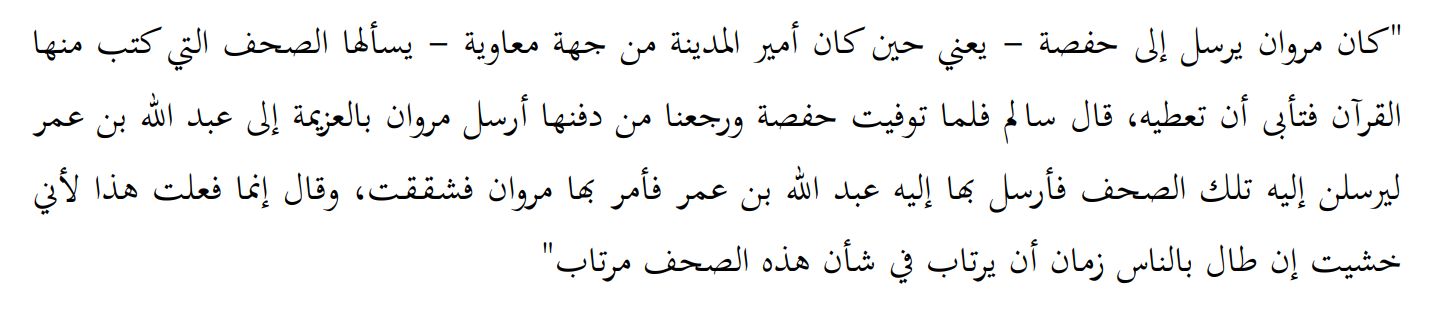
Kwamba Marwan alikuwa akimtumia mtu kwa Hafsa – yaani alipokuwa amiri wa Madina kupitia Mu'awiyya – akimuomba karatasi ambazo Qur'ani iliandikwa juu yake. Yeye alikataa kumpa. Salim alisema: Hafsa alipofariki, wakati tukirudi kutoka mazishi yake, Marwan alimjulisha 'Abd Allah ibn 'Umar uamuzi wake thabiti wa kumtaka amtumie ule mushafu. Kwa hiyo 'Abd Allah ibn 'Umar akamtumia. Marwan akaamuru uteketezwe. Alisema: Nimefanya hivi kwa sababu niliogopa kwamba ikiwa ungebaki kwa watu kwa muda mrefu, watu wangekuwa na shaka kuhusu karatasi hizi.
‘That Marwan used to send for Hafsa – i.e when he was the amir of Madinah via Mu'awiyya - asking her for the sheets from which the Qur’ān was written. She refused to give him it. Salim said: When Hafsa died, while we were returning from her burial Marwan communicated his firm decision to 'Abd Allah ibn 'Umar that he send him that mushaf. So 'Abd Allah ibn 'Umar sent it to him. Marwan ordered it to be destroyed. He said: I did this because I feared that if it remained with people for a long time then people will have doubts regarding these sheets’.