21.6 Mikataba ya Dharura
21.6 Emergency Treaties
Waislamu wanaweza kukabiliwa na hali ngumu sana zinazowalazimisha kufanya mambo yasiyoruhusiwa, lakini dharura inaruhusu hilo. Dola ya Kiislamu inaweza kukabiliwa na migogoro ya ndani au ya nje inayoilazimisha kuingia mikataba isiyoongoza moja kwa moja katika kufikisha da‘wah au kupigana jihad katika njia ya Allah (SWT), lakini inayowezesha kuunda mazingira yatakayoruhusu kuifikisha da‘wah baadaye, au kuzuia uovu wa kusimamishwa kwa da‘wah, au kuhifadhi uwepo wa Waislamu. Dharura inalazimisha aina hizi za mikataba kufungwa; hivyo inaruhusiwa kwa Khalifah kuingia katika mikataba hiyo, na inatekelezwa kwa Waislamu wote. Mikataba ya aina hii hutokea katika hali mbili ambazo wanafiqhi (fuqaha) wameziainisha wazi, nazo ni:
Muslims can fall into severe situations which compel them to matters which are not allowed but the necessity obliges it. The Islamic State can fall into internal or external crises which compel it to contract treaties which do not lead directly to conveying the da’wah or fighting in the way of Allah (swt) but they facilitate creating conditions which will enable conveying it in the future or prevent the evil of stopping the da’wah or preserve the entity of the Muslims. Necessity compels these types of treaties to be contracted therefore it is allowed for the Khalifah to contract them and they are executed upon Muslims. These treaties occur in two situations which the jurisprudents (fuqaha) stated clearly, and they are:
Hali ya kwanza: Ikiwa baadhi ya watu wa vita watataka mkataba kutoka kwa Waislamu kwa miaka maalum, kwa sharti kwamba watu wa vita watoe kharaji kila mwaka kwa kiasi kilichoainishwa na kwamba sheria za Kiislamu zisitekelezwe juu yao katika ardhi zao; hili halifanywi kwa kuwa ni kuridhia kufuru, isipokuwa dola isiweze kuzuia dhulma na ikaona katika mkataba huu manufaa kwa Waislamu. Wakati huo inaruhusiwa kuingia mkataba huo kwa sababu ya dharura. Katika hali hii hakuna msaada wala nusura kutoka kwa Dola ya Kiislamu kwao, kwa kuwa mkataba huu hauwalazimishi kufuata sheria za Kiislamu, na hawatoki katika hali ya kuwa watu wa vita pale wasipotii kanuni za Uislamu. Kwa hiyo kuchukua jukumu la kuwasaidia hakuwawajibikii Waislamu. Mtume wa Allah ﷺ alifanya mkataba na Yuhanna bin Rub'ah alipokuwa Tabuk katika mipaka ya Bilad ash-Sham. Alimwacha katika eneo lake akiwa na dini yake, wala hakuingia chini ya bendera ya Waislamu na utawala wao. Mkataba huu wa muda maalum hufanya usalama wa nchi hii kuhakikishwa na Dola ya Kiislamu. Yeyote anayeingia humo miongoni mwa Waislamu anaingia kwa usalama wa mkataba, si kwa usalama wa mtu binafsi, na hairuhusiwi kwake kupinga watu wake. Yeyote anayeingia katika ardhi za Waislamu miongoni mwa raia wa nchi hii anaingia kwa usalama wa mkataba, wala hahitaji usalama mpya zaidi ya mkataba, wala hairuhusiwi kwa yeyote miongoni mwa Waislamu kumpinga. Wafanyabiashara hawazuiwi kupeleka bidhaa kwenda nchi hii isipokuwa vifaa vinavyotumika vitani kama silaha na zana za vita na vilivyo kama hivyo, kwa kuwa wao ni watu wa vita hata kama Waislamu wana mkataba nao.
The first situation: If some people of the people of war seek a treaty from the Muslims for specific years on condition that the people of war give kharaj every year for a specified amount and that the Islamic rules are not executed upon them in their lands; this is not done as it is consenting upon disbelief unless the State is not able to prevent oppression and sees in this treaty good for Muslims, then at this point it is allowed to contract it out of necessity. In this situation there is no assistance or support for them from the Islamic State because they are not compelled by this treaty with the Islamic rules and do not depart from being people of war when they do not obey the rules of Islam. So undertaking support for them is not obliged upon the Muslims. The Messenger of Allah (saw) made a treaty with Yuhanna bin Rub’ah while he was at Tabuk in the boundaries of Bilad AsSham. He left him in his zone upon his religion, and he did not enter under the banner of Muslims and their rule. This treaty of limited period makes the security of this State guaranteed by the Islamic State. Whoever enters it from the Muslims enters it with the security of the treaty and not an individual security, and it is not allowed for him to oppose its people. Whoever enters the Muslim lands from the citizens of this land enters with the security of the treaty and does not require a new security other than the treaty, nor is anyone from the Muslims allowed to oppose him. Traders are not prevented from carrying merchandise to this State except tools used in war like weapons and war materials and what is similar to this because they are people of war even if the Muslims have a treaty with them.
Hali ya pili: Hii ni kinyume cha hali ya kwanza, ambapo Waislamu hulipa pesa kwa adui yao badala ya ukimya wake dhidi yao. Wanazuoni wa fiqhi wametaja kwamba ikiwa adui atawazingira Waislamu na kudai mkataba wa amani kwa miaka fulani, kwa sharti kwamba Waislamu wawalipe makafiri kiasi fulani kila mwaka, basi si sahihi kwa Khalifah kukubali masharti hayo kwa sababu ya udhalilifu na unyonge unaomo ndani yake kwa Waislamu, isipokuwa kwa dharura. Hii ni pale Waislamu wanapohofia kuangamizwa kwa ajili yao wenyewe, na Khalifah anaona kuna manufaa katika usitishaji huu vita. Katika hali hii, hakuna ubaya katika jambo hilo kutokana na yaliyosimuliwa.
The second situation: This is opposite to the first situation wherein the Muslims pay money to their enemy in return for their silence regarding them. The fuqaha mentioned that if the enemy sieges the Muslims and require a treaty for specified years on condition that the Muslims pay the disbelievers a specific amount every year, it is not correct for the Khalifah to comply to them upon that due to the contemptibility and humiliation therein for Muslims except under necessity. This is (when) the Muslims fear extermination for themselves, and the Khalifah views there is good in this truce. At this point, there is no harm in that due to what was narrated
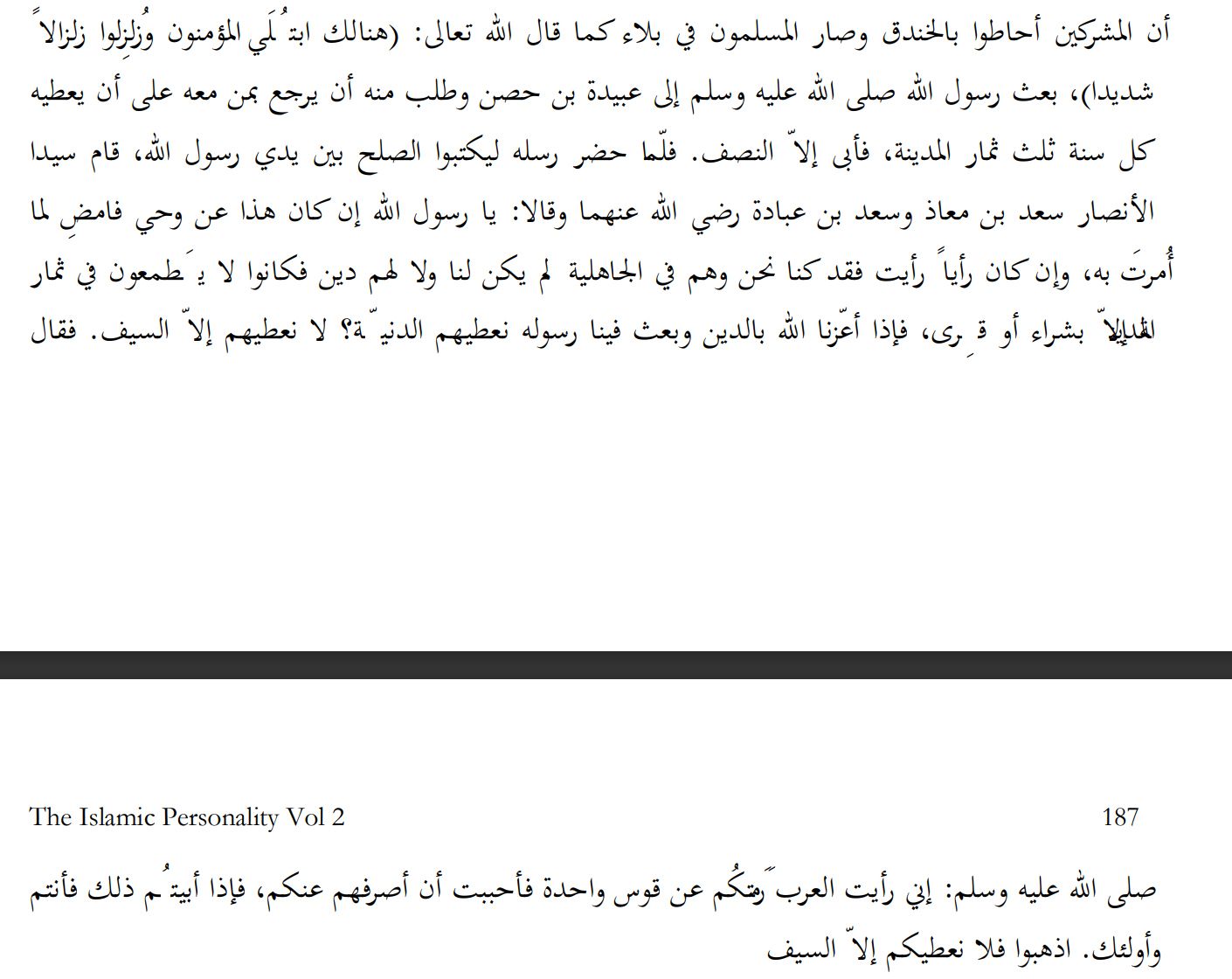
Kwamba washirikina walizunguka handaki na Waislamu walikuwa katika mtihani kama Allah (swt) alivyosema: ‘Hapo ndipo waumini walipojaribiwa na kutikiswa kwa mtikisiko mkubwa’ [TMQ 33:11]. Mtume wa Allah ﷺ alimtumia ujumbe ‘Uyaynah bin Hasan, akimwomba arudi pamoja na watu walio pamoja naye, kwa kumpa theluthi moja ya mazao ya Madina. Lakini alikataa isipokuwa nusu. Wajumbe wake walipokuja kuandika mkataba wa kusitisha vita mbele ya Mtume wa Allah ﷺ, wakuu wawili wa Ansari, Sa'ad bin 'Ubadah na Sa'ad bin Mu'adh (ra), walisimama na kusema: ‘Ee Mtume wa Allah ﷺ, ikiwa hili ni kutoka kwa wahyi, basi tekeleza kile ulichoamrishwa. Lakini ikiwa ni maoni uliyoyazingatia, basi wao na sisi tulikuwa katika ujahiliyya, wakati wao wala sisi hatukuwa na dini bado. Hawakula matunda ya Madina isipokuwa kwa kununua au kwa ukarimu. Basi Allah alipotutukuza kwa dini na kumtuma Mtume wake miongoni mwetu, je, tuwape dunia hii huku sisi tukiwa wanyonge? Hapana, hatutawapa isipokuwa upanga.’ Hivyo Mtume ﷺ akasema: ‘Nimeona Waarabu wakirusha mishale kutoka upinde mmoja, kwa hiyo nilipenda kuwaelekeza mbali nanyi. Ikiwa mtakataa hilo, basi ni nyinyi na hao. Ondokeni, kwa maana hatutawapa nyinyi isipokuwa upanga!’
“That the polytheists surrounded the trench and Muslims were in trial like Allah (swt) said: ‘Therein the believers were tested and shaken with a severe shaking’ [TMQ 33:11].The Messenger of Allah (saw) sent to ‘Uyaynah bin Hasan and requested that he return with those together with him upon giving him a third of the fruits of Madinah but he refused except a half. When his messengers appeared to write the truce in front of the Messenger of Allah, the two chiefs of the Ansar, S'aad bin ‘Ubadah and S'aad bin Mu’adh (ra) stood and they said: ‘O Messenger of Allah, if this is from revelation then execute what you are commanded with but if it is an opinion which you considered, then they and we were in jahiliyyah when neither they nor we had a religion yet they did not eat of the fruits of Madinah except through purchase or hospitality. So when Allah honoured us with the deen and sent His Messenger among us, should we give them this dunya while being contemptible? No, we will not give them except the sword. So he (saw) said: ‘I saw the Arabs shooting from one bow so I liked to divert them from you. If you reject that, then it is you and those. Go away for we will not give you except the sword!’”
Hii inaonyesha kwamba Mtume wa Allah ﷺ alielekea kwenye usitishaji vita kutokana na alichokihisi cha udhaifu wa Waislamu. Alipoona nguvu ndani yao kutokana na yale aliyosema Sa'ad bin 'Ubadah na Sa'ad bin Mu'adh (ra), aliacha lile ambalo linaonyesha kwamba hakuna madhara katika kufanya mkataba na makafiri kwa kuwalipa fedha pale kunapokuwa na hatari ya kudhurika. Hii ni kwa sababu, endapo wangewashinda Waislamu, wangechukua mali yote pamoja na familia zao kama mateka (sabaya), hivyo kuwalipa sehemu ya mali ili kuwalinda Waislamu, familia zao na mali zao ni jambo lisilo la aibu sana na lenye manufaa zaidi.
This indicates that the Messenger of Allah (saw) initially inclined to the truce due to what he sensed of the Muslims’ weakness. When he saw the strength in them due to what S'aad bin ‘Ubadah and S'aad bin Mu’adh (ra) said, he refrained from that which indicates that there is no harm from contracting a treaty with disbelievers paying them money when there is danger of harm. This is because if they conquered Muslims they would take all the wealth and the families as captives (sabaya), so paying some wealth to safeguard Muslims and their families and wealth is less contemptible and more beneficial.