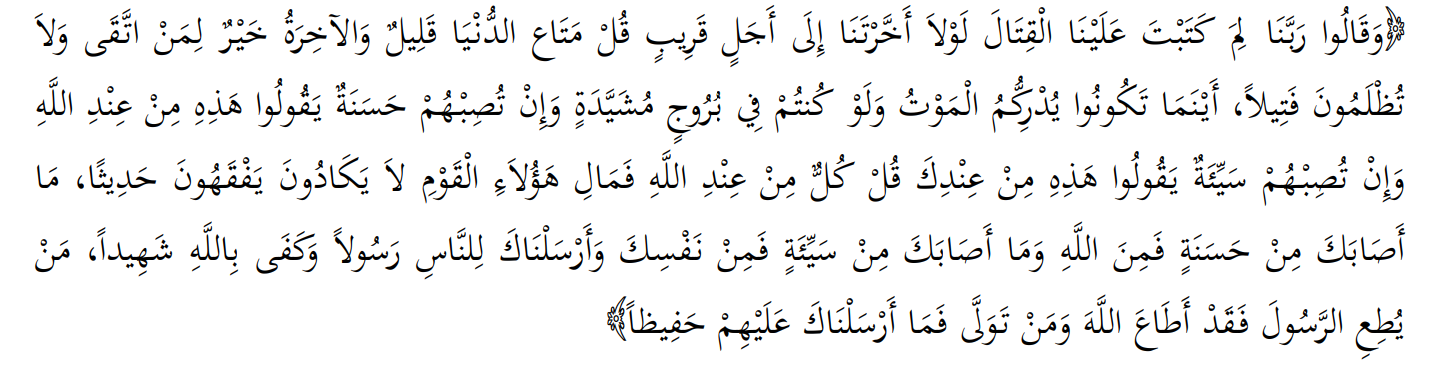
Kwa hiyo mada ni kile kinachowapata wao na si kile wanachokifanya. Kwa hivyo haihusiani na somo la al-qadā’ wa‘l-qadar.
So the subject is what befalls them and not what they are doing. Thus it has nothing to do with the study of al-qadā’ wa‘l-qadar.
Kwa hiyo, yote yaliyotajwa hapo juu hayana uhusiano wowote na somo la al-qadā’ wa‘l qadar; hayaingii katika maana yake wala hayahusiani kabisa na yale yaliyotajwa hapo juu. Badala yake, al-qadā’ wa‘l-qadar kama dhana imetokana na falsafa ya Kigiriki, ambayo ilipitishwa na Mu'tazilah waliotoa maoni yao kuhusu hilo. Ahl al-Sunnah na Jabriyyah wakawakanusha, nao Ahl al-Sunnah wakaifanyia Jabriyyah pia ukanushaji. Mjadala ulikuwa umejikita katika dhana ile ile na ulijengwa juu ya msingi ule ule. Hivyo suala hili ni dhana iliyotokana na falsafa ya Kigiriki, na likaja mbele katika mdahalo uliokuwa ukifanyika kati ya Waislamu na makafiri waliokuwa wakijihami kwa falsafa ya Kigiriki. Ni dhana inayohusiana na ‘aqīdah (imani), kwa hiyo lengo ni kutoa msimamo wa Uislamu kuhusu dhana hii. Mu'tazilah walitoa maoni, Jabriyyah wakawakanusha na kutoa maoni mengine. Ahl al-Sunnah wakawakanusha wote na kutoa maoni yao, wakisema kuwa ni maoni ya tatu yaliyotokana na yale mawili, na wakalielezea kwa maneno ya “maziwa safi, tamu kunywa, yanayotoka kati ya kinyesi na damu”.
Therefore, all that has been mentioned above has nothing to do with the study of al-qadā’ wa‘l qadar; they do not come under its meaning and have no relation whatsoever with what has been mentioned above. Rather, al-qadā’ wa‘l-qadar as a meaning has come from Greek philosophy which was transmitted by the Mu'tazilah who gave an opinion with regards to it. Ahl al-Sunnah and the Jabriyyah refuted them and Ahl al-Sunnah (also) made a refutation of the Jabriyyah. The discussion was confined to the same meaning and preceded upon the same premise. Thus the issue is a meaning/sense that came from Greek philosophy and it came to the fore in the debate which used to take place between the Muslims and the kuffar who used to be armed with the Greek philosophy. It is a meaning which has a relevance to the ‘aqīdah (creed), thus what is desired is to give Islam's opinion regarding this meaning. The Mu'tazilah gave an opinion and the Jabriyyah refuted them and gave another opinion. Ahl al-Sunnah refuted all of them and gave an opinion, and said about it that it is a third opinion which has come out from the two opinions and they described it as ‘the pure milk, sweet to drink, that comes out from between excrement and blood’.
Kwa hiyo, mada ya majadiliano iliyotokana na falsafa ya Kigiriki ikajulikana, na kwa kuwa inahusiana na ‘aqīdah (itikadi), Muislamu lazima awe wazi kuhusu imani yake juu ya mada hii. Waislamu kwa kweli walitoa maoni yao, na madhehebu matatu ya fikra yakaibuka. Hivyo hairuhusiwi kuirejesha masuala ya al-qadā’ wa‘l-qadar kwenye yale yaliyotokana na maana ya al-qadā’ au al-qadar, kwa lugha na katika Sharī’ah, wala hairuhusiwi kuwazia au kubuni kwa al-qadā’ au al-qadar maana yoyote kwa dhana tupu, fikra au mawazo, na kusema, kwa mfano, kwamba al-qadā’ ni hukumu ya jumla juu ya mambo ya jumla pekee na al-qadar ni hukumu ya jumla juu ya mambo mahususi na maelezo yake, au kusema kwamba al-qadar ni mpango wa milele wa mambo na al-qadā’ ni utekelezaji na uumbaji kulingana na uamuzi huo wa awali na mpango huo. Kwa kweli, hili haliruhusiwi kwa sababu hii ni mawazo tu, dhana na jaribio lisilofanikiwa la kutumia baadhi ya maneno ya kilugha na ya kishari‘ah kwa maana ambazo hazihusiki nazo, bali zinaonyesha maana za jumla. Itakuwa basi kitendo cha kiholela kuyafunga maneno hayo mawili katika maana hizo mahususi bila ushahidi.
Therefore, the subject of discussion, which came from the Greek philosophy, became known, and since it is related to the ‘aqīdah (creed), the Muslim must be clear as to what his belief is regarding this subject. The Muslims did actually state their opinion and three schools of thought arose. Thus it is not allowed to refer the issue of al-qadā’ wa‘l-qadar to what has come of the meaning of al-qadā’ or al-qadar, linguistically and in the Sharī’ah, nor is it allowed to imagine or conceive for al-qadā’ or ‘al-qadar any meaning from mere supposition, conception or imagination, and to say, for example, that al-qadā’ is the universal judgement on only the universals and al qadar is the universal judgement on the partial aspects and its details, or to say that al-qadar is the eternal plan for things and al-qadā’ is the execution and creation according to that predetermination and plan. Indeed, this is not allowed because this is mere imagination, assumption and a failed attempt of applying certain linguistic and shar’i expressions because they do not apply to it, they rather indicate general meanings; . It would then be an arbitrary action to restrict the two words to these specific meanings without evidence.
Vivyo hivyo, haijuzu kudai kwamba al-qadā’ wa‘l-qadar ni siri miongoni mwa siri za Allah na kwamba tumekatazwa kuzungumzia jambo hilo, kwa sababu hakuna dalili ya kishari’ah inayosema kwamba ni mojawapo ya siri za Allah, achilia mbali ukweli kwamba mada yenyewe ni kitu kinachoweza kuonekana kwa hisi, ambacho kinahitaji kutolewa maoni, sasa itawezekanaje kusemwa kwamba hakiwezi kusomwa?! Zaidi ya hayo, ni uchunguzi wa kiakili na mada inayohusu mambo yanayochunguzwa na akili kama uhalisia unaoweza kuonekana kwa hisi; na kwa kuwa inahusiana na imani kwa Allah. Kwa hiyo, al-qadā’ wa‘l-qadar, kwa maana iliyowekwa kama mada ya kujifunza na ambayo ikawa sehemu ya ‘aqīdah (itikadi), lazima ichunguzwe.
Similarly, it is not allowed to claim al-qadā’ wa‘l-qadar is a secret from amongst the secrets of Allah and that we have been forbidden to discuss it, because there is no shar’i text to say that it is one of the secrets of Allah , not to mention the fact that the subject matter is sensorially perceivable, for which an opinion must be given, so how can it be said that it cannot to be studied?! In addition to the fact that it is a rational inquiry and a subject which relates to matters that are studied by the intellect as a reality that is sensorially-perceivable; and since it relates to the imān in Allah . Thus, al-qadā’ wa‘l-qadar, in the meaning placed as the subject matter and which became part of the ‘aqīdah (creed) must be studied.
Suala la al-qadā’ wa‘l-qadar, yaani suala la al-qadā’ wa‘l-qadar, ni kuhusu vitendo vya waja na sifa za mambo. Hii ni kwa sababu suala lililotajwa ni vitendo vya mja na yanayotokana na vitendo hivyo, yaani sifa anazozileta mja katika mambo: je, ni uumbaji wa Allah ? Je, Yeye ndiye aliyeviumba na kuvileta kuwepo? Au ni mja? Je, mja ndiye aliyeviumba na kuvileta kuwepo?
Mu‘tazilah, wote, walisema kwamba mja ndiye anayeumba vitendo vyake mwenyewe: ndiye anayeumba kitendo na kukileta kuwepo. Walitofautiana kuhusu sifa. Baadhi yao walisema kwamba mja ndiye anayeumba sifa zote zinazosababishwa na binadamu na ndiye anayezileta kuwepo. Wengine walitofautisha kati ya sifa. Baadhi yao walizifanya kuwa zinaumbwa katika mambo na mja na kuletwa kuwepo naye, na sehemu nyingine walizifanya kuwa zinaumbwa katika mambo na Allah na kuletwa kuwepo na Yeye.
Kuhusu Jabriyyah, walisema kwamba Allah anaumba vitendo vyote vya binadamu pamoja na sifa zote zinazosababishwa na binadamu katika mambo. Yeye ndiye anayezileta kuwepo; mja hana chochote cha kufanya katika uumbaji na uundaji wa kitendo wala katika kusababisha sifa katika kitu. Ahl us-Sunnah walisema kwamba vitendo vya mja na sifa zinazosababishwa katika mambo na mja vinaumbwa na Allah. Lakini walisema kwamba Allah huviumba wakati mja ana uwezo na matakwa, na si kwa uwezo wake mwenyewe na matakwa yake mwenyewe.
The question of al-qadā’ wa‘l-qadar, or in other words, the issue of al-qadā’ wa‘l-qadar, is the actions of the servants and the attributes of things. This is because the issue mentioned is the actions of the servant and what arises from these actions, that is, the attributes brought about by the servant in things: are they the creation of Allah ? Is He the one who has created them and brought them into being? Or is it the servant? Is the servant the one who created them and brought them into being? The Mu'tazilah, all of them, said that the servant is the one who creates his own actions: he is the one who creates the action and brings it into being. They differed about the attributes. Some of them said that the servant is the one who creates all of the attributes that are caused by man and he is the one who brings them into existence. Others differentiated between the attributes. Some of these made them as being created in things by the servant and brought into existence by him and part of them made them as being created in things by Allah and brought into existence by Him. As for the Jabriyyah, they said that Allah creates all the actions of man as well as all the attributes caused by man in things. He is the one who brings them into existence; the servant has nothing to do with the creation and formation of the action or in causing the attribute in the thing. Ahl us-Sunnah said that the actions of the servant and the attributes caused in things by the servant are created by Allah . But they said that Allah creates them while the servant performs the action and the servant causes the attribute. So Allah creates them when the servant has the ability and will and not by his own ability and will.
Hili ndilo suala la al-qadā' wa'l-qadar, na hii ni muhtasari wa maoni yaliyotolewa kuhusu jambo hilo. Yeyote anayechunguza maoni haya lazima ajue msingi ambao mjadala umejengwa juu yake, ili mjadala uwe juu ya msingi wa pamoja. Hivyo matokeo yatakuwa kama yanavyohitajika na msingi wa mjadala, wala hayatakuwa yasiyo sahihi. Msingi wa mjadala katika al-qadā' wa'l-qadar si tendo la mja, yaani kama alilitengeneza tendo hilo mwenyewe au Allah (SWT) ndiye aliyelitengeneza. Wala si mapenzi ya Allah (SWT), kwa maana kwamba mapenzi yake yanategemea tendo la mja, hivyo lazima yawepo pamoja na mapenzi hayo. Wala si Elimu ya Allah (SWT), kwa maana kwamba Yeye anajua kwamba mja atafanya tendo fulani, au kwamba Elimu yake inamzunguka mja, au kwamba tendo hilo la mja limeandikwa katika Lawh al-Mahfūdh, hivyo lazima atende kulingana na yale yaliyoandikwa. Kwa hakika, msingi wa mjadala si mojawapo ya mambo haya, kwa sababu hayana uhusiano na somo hilo kwa upande wa thawabu na adhabu. Yanahusiana na swali hilo kwa upande wa kuumbwa kutoka kwenye hakuna kitu, uhusiano wa mapenzi na uwezekano wote, Elimu inayozunguka vitu vyote, na Lawh al-Mahfūdh. Hili ni tofauti kabisa na somo la thawabu na adhabu kwa tendo. Mada ya mjadala ambayo swali la al-qadā' wa'l-qadar limejengwa juu yake ni suala la thawabu na adhabu kwa tendo, yaani: je, mwanadamu analazimika kutekeleza tendo, jema au ovu, au ana hiari? Na je, mwanadamu ana hiari ya kutekeleza tendo, au hana hiari yoyote? Mtu anayechunguza kwa makini matendo ya waja huona kwamba binadamu anaishi ndani ya nyanja mbili: moja ambayo yeye anaitawala, nayo ni nyanja iliyopo ndani ya eneo la mwenendo wake, na ndani yake matendo yake hutokea kabisa kwa hiari yake; nyingine (nyanja) inamtawala yeye; yeye yupo ndani ya mamlaka yake, na matendo yanayotokea ndani yake, iwe yanatokana naye au yanamwangukia, hutokea bila hiari yake.
This is the issue - the issue of al-qadā’ wa‘l-qadar – and this is a summary of the opinions that have been opined about it. Anyone who scrutinises these views must know the basis on which the discussion has been built such that the discussion is on a common basis. Thus the outcome will be as required by the basis of the discussion and it will not be an incorrect one. The basis of the discussion in al-qadā’ wa‘l-qadar is not the action of the servant in terms of whether he created the action or Allah created it, nor is it the will of Allah in that His will is conditional on the action of the servant so it must exist with this will, nor is it the Knowledge of Allah in terms of Him knowing that the servant will do such and such an action or that His Knowledge encompasses the servant, or that this action of the servant is written in the Lawh al-Mahfūdh so he must act according to what has been written. Indeed, the basis of the discussion is definitely none of these things, because they have no relation to the subject from the perspective of reward and punishment; they are related to the question from the perspective of formation from nothing, the connection of the will to all possibilities, the all-encompassing Knowledge of all things and the Lawh al-Mahfūdh. This is quite different from the subject of the reward and punishment for an action.The topic of discussion on whose basis the question of al-qadā’ wa‘l qadar is built is the issue of reward and punishment for an action, that is, is man obliged to perform an action, good or evil, or does he have a choice? And, does man have the choice to perform an action, or does he have no choice? The person who scrutinises the actions of the servants sees that man lives within two spheres: one which he dominates, the sphere that is present within the region of his conduct, and within which his actions happen absolutely by his choice; the other (sphere) dominates him; he exists within its domain, and the actions that occur within it, whether they originate from him or fall upon him, occur without his choice.
Kwa hiyo, vitendo vilivyo ndani ya nyanja inayomtawala mwanadamu, mwanadamu hana hiari juu yake wala juu ya kuwepo kwake; vitendo hivyo ni aina mbili: aina moja ni matokeo ya sheria za ulimwengu, na aina nyingine haitokani na sheria za ulimwengu, ingawa mambo yote yanayotokea huenda yasitokane na sheria hizi. Kuhusu vitendo vinavyotokana na sheria za ulimwengu, mwanadamu hujisalimisha kabisa kwake; hutenda kwa mujibu wake kwa lazima, kwa sababu husogea pamoja na Ulimwengu na Uhai, ambavyo vimewekwa chini ya kanuni maalum isiyobadilika. Kwa hiyo vitendo vya mwanadamu katika nyanja hii hutokea bila mapenzi yake; analazimishwa katika vitendo hivyo na hana hiari. Alikuja katika maisha haya bila mapenzi yake na ataondoka humo bila mapenzi yake; hawezi kuruka kwa kutumia mwili wake peke yake, wala hawezi kutembea juu ya maji katika umbo lake la kawaida, wala kujichagulia rangi ya macho yake, umbo la kichwa chake au ukubwa wa mwili wake. Hakika, ni Allah aliyeumba haya yote bila athari yoyote wala uhusiano wowote kutoka kwa binadamu aliyeumbwa, kwa sababu Allah aliumba sheria za Ulimwengu, akazifanya zidhibiti ulimwengu, na akauwezesha ulimwengu kutenda kwa mujibu wake bila kuwa na uwezo wa kubadilika. Kuhusu aina ya pili, ni vitendo vinavyotokea nje ya udhibiti wa mwanadamu, ambavyo hawezi kuviepuka, na ambavyo havihusiani na sheria za ulimwengu; ni vitendo vinavyotokea bila kukusudia kupitia kwake au juu yake, na ambavyo hawezi kuviepuka, kama mtu akimwangukia mwingine na kumuua, au mtu akipiga risasi kwa ndege na bila kukusudia akampiga mtu na kumuua, au gari, treni au ndege ikipata ajali bila uwezekano wa kuepuka tukio hilo, na kwa sababu hiyo abiria wakafa. Mifano hii yote ni vitendo vilivyotokea kutoka kwa mwanadamu au juu yake; ingawa vimefungwa na sheria za ulimwengu, vilitokea bila mapenzi yake na nje ya uwezo wake wa kuvidhibiti, na viko ndani ya nyanja inayomtawala mwanadamu. Vitendo vyote vinavyotokea ndani ya uwanja unaomtawala mwanadamu huitwa qadā, kwa sababu Allah peke yake ndiye aliyevipangia, na hakumpa mja uhuru wa kuchagua katika vitendo hivyo; hana chaguo kuhusu hivyo. Kwa hiyo mwanadamu hahesabiwi kwa vitendo hivi, iwe kwa mtazamo wa mwanadamu vina faida au madhara ndani yake, au vinapendeza au kuchukiza, yaani, bila kujali kama kwa mtazamo wa mwanadamu ni vizuri au vibaya; Allah peke yake ndiye anayejua wema na ubaya katika vitendo hivi, kwa sababu mwanadamu hana athari juu yake; hajui wala hajui jinsi vinavyotokea, na hana uwezo kabisa wa kuviepuka au kuvileta. Kwa hiyo hakuna thawabu wala adhabu kwa ajili yake. Basi hii ndiyo qadā, na ndiyo maana husemwa kwamba kitendo kilitokea kwa qadā. Ni wajibu kwa mwanadamu kuamini qadā hii na kwamba qadā hii inatoka kwa Allah, Mtukufu na Mwenye enzi.
Thus, the actions that fall within the sphere that dominates man, man has no choice in them or in their existence; they are of two types: a type which is a requirement of the laws of the universe, and a type not necessitated by the universal laws, even though all the things (that occur) may not emanate from these laws. As for the actions necessitated by the laws of the universe, man submits to them totally; he acts according to them as a matter of compulsion, because he moves with the Universe and Life, which are subjected to a specific regulation, which does not change. Subsequently, man's actions in this sphere occur without his will, he is forced in these actions and has no choice. He came to this life without his will and he will leave it without his will; he cannot fly merely by the use of his own body, nor can he walk in his natural form on water, nor choose for himself the colour of his eyes, the shape of his head or the size of his body. Indeed, it was Allah who created all of this without any influence or relation from the created man, because Allah created the laws of the Universe, made them regulate the universe and made the universe act according to them without having the ability to change. As for the second type, they are actions which happen beyond man's control, which he cannot avoid and which are not related to the laws of the universe; they are the actions which occur either unintentionally through him or upon him and which he cannot avoid, such as if someone falls on a person and thus kills him, or if someone shoots at a bird and unintentionally hits a person and kills him, or if a car, train or plane should crash, without any possibility to avoid the incidents, and as a result the passengers die. All these examples are actions which occurred from a man or upon him - though they are bound by the laws of the universe - they happened without his will and outside his ability to control them, and they are within the sphere that dominates man. All the actions which occur within the sphere that dominates man are termed qadā, because Allah alone has decreed them, and has not given the servant the freedom of will in such actions; he has no choice with regards to them. Therefore man is not reckoned on these actions, whether, with respect to man, there is benefit or harm in them or like or dislike, that is, regardless of whether they are, according to man, good or bad; Allah alone knows the good and bad in these actions, because man has no influence on them; he does not know them or how they are brought into existence, and he is absolutely unable to avoid and bring them about. Therefore there is no reward or punishment for them. Thus this is qadā’, and it is therefore said that the action happened by qadā’. It is upon man to have imān in this qadā’ and that this qadā’ is from Allah , the Glorified and Exalted.
Kuhusu vitendo vinavyotokea katika nyanja ambayo binadamu anaitawala, ni nyanja ambayo yeye huendelea nayo kwa hiari kulingana na mfumo anaouchagua, iwe ni Sharī‘ah ya Allah au mwingine wowote. Nyanja hii ni ile ambayo vitendo vinavyofanywa na binadamu au vinavyomhusu hutokea kwa mapenzi yake. Hivyo, hutembea, hula, hunywa na kusafiri wakati wowote apendapo; vilevile hujizuia kufanya mojawapo ya mambo haya wakati wowote apendapo; pia huchoma kwa moto na kukata kwa kisu anapochagua, na hutosheleza silika zake za kuzaliana, kumiliki na njaa apendavyo. Yote haya hufanya au kujizuia nayo kwa uchaguzi wake. Kwa hiyo, binadamu anawajibika kwa vitendo vinavyotokea ndani ya nyanja hii. Hivyo, hulipwa thawabu kwa kitendo kinachostahili thawabu na huadhibiwa kwa kitendo kinachostahili adhabu. Vitendo hivi havina uhusiano wowote na qadā’, wala qadā’ haina uhusiano navyo, kwa sababu binadamu ndiye aliyevifanya kwa mapenzi na uchaguzi wake mwenyewe. Kwa hiyo, vitendo vya kuchagua havimo chini ya al-qadā’.
As for the actions that occur in the sphere that man dominates, it is the sphere in which he proceeds with choice according to the system he chooses, whether it is the Sharī’ah of Allah or any other. This sphere is the one in which actions carried out by man or involving him occur by his will. Thus he walks, eats, drinks and travels anytime he likes; likewise he refrains from doing any of these things whenever he likes; he also burns with fire and cuts with a knife when he chooses, and he satisfies his instincts of procreation, ownership and hunger as he likes. All this he performs or abstains from, by his choice. Therefore, man is accountable on actions which occur within this sphere. Thus, he is rewarded for the action deserving reward and is punished for the action deserving punishment. These actions have nothing to do with qadā’ nor does it have anything to do with them because man is the one who undertook them with his own will and choice. Therefore, actions of choice do not come under al-qadā’.
Kuhusu al-qadar, inahusu matendo, iwe yanatokea katika eneo ambalo mwanadamu anatawala au katika eneo linalomtawala yeye, ambayo yanatokea kutoka kwenye vitu au juu ya vitu kupitia jambo la ulimwengu, mwanadamu na maisha, na kusababisha athari, yaani, kitu fulani hutokea kutokana na tendo; je, utaratibu huu ambao mwanadamu husababisha katika vitu kwa upande wa sifa, umeumbwa na mwanadamu au na Allah, kama vile Yeye alivyoviumba vitu venyewe? Yeyote anayechunguza suala hili atakuta kwamba mambo haya yanayosababishwa katika vitu ni miongoni mwa sifa za vitu, si matendo ya mwanadamu, kama inavyothibitishwa na ukweli kwamba mwanadamu hawezi kuviunda (yaani athari hizi) isipokuwa katika vitu vyenye sifa husika miongoni mwa sifa zake. Kwa upande wa vitu ambavyo havina sifa husika miongoni mwa sifa zake, mwanadamu hawezi kusababisha ndani yake kile anachotaka. Kwa hiyo mambo haya si katika matendo ya mwanadamu, bali ni katika sifa za vitu.
As for al-qadar, it relates to the actions, whether they occur in the sphere which man dominates or in the sphere which dominates him, which occur from or on things through the matter of the universe, man and life, and cause an effect, that is, something results from the action; so this mechanism that man causes in things in terms of attributes, is it created by man or by Allah just as He has created the things themself. The one who scrutinises this issue will find that these matters which are caused in things are from the attributes of the things, not from the action of man, as evidenced by the fact that man is not able to form them (i.e these effects) except in the things which possess the (relevant) attribute amongst its attributes. As for the things which do not have the (relevant) attribute amongst their attributes, man is not able to cause in them what he wants. Therefore these matters are not from the actions of man but from the attributes of the things.
Hivyo, Mwenyezi Mungu ameviumba vitu na kuviwekea [qaddara] sifa ndani yake kwa namna ambayo haiwezekani kutoka kwake chochote isipokuwa kile alichokiweka ndani yake, kama vile kuweka katika mbegu ya tende sifa ya kuota mtende wa tende kutoka humo na si mti wa tufaa, na vivyo hivyo mbegu ya mwanadamu kuzaa binadamu si mnyama mwingine yeyote. Mwenyezi Mungu ameviumbia vitu sifa maalum, kwa mfano, ameumba katika moto sifa ya kuunguza, katika kuni sifa ya kuwaka moto, na katika kisu sifa ya kukata. Ameyafanya hayo masifa kuwa sehemu ya msingi na ya kudumu ya vitu hivyo kulingana na Sheria za Ulimwengu. Pale inapoonekana kwamba sifa hizo hazipo tena, maana yake ni kwamba Mwenyezi Mungu ameziondoa, na tukio kama hilo ni la kawaida; hutokea tu kwa Manabii kama muujiza kwao. Vivyo hivyo, kama vile Mwenyezi Mungu alivyoumba sifa kwa vitu, ameumba kwa mwanadamu silika na mahitaji ya kimaumbile, na kama vile alivyoumba sifa katika vitu, ameumba katika silika na mahitaji ya kimaumbile sifa maalum. Hivyo, katika silika ya uzazi Mwenyezi Mungu ameumba mvuto wa kijinsia, na katika mahitaji ya kimaumbile ameumba sifa ya njaa. Amefanya sifa hizi zishikamane nazo kulingana na sheria za ulimwengu. Sifa maalum ambazo Mwenyezi Mungu Mtukufu ameziumba katika vitu, silika na mahitaji ya kimaumbile huitwa al-qadar, kwa sababu Mwenyezi Mungu peke yake ndiye aliyeviumba vitu, silika na mahitaji ya kimaumbile, na kuamua ndani yake sifa zake. Hivyo, hamu ya ngono inapotokea kwa mwanadamu, anapofumbua macho na kuona, na jiwe linapopandishwa juu likitupwa juu na kushuka chini likitupwa chini, yote haya si kwa tendo la mwanadamu, bali ni kwa tendo la Allah ; yaani, ni katika maumbile ya vitu kuwa hivyo, yaani, Allah aliviumba na akaweka ndani yake sifa maalum, hivyo basi sifa hizo ni kutoka kwa Allah na si kutoka kwa mwanadamu; mwanadamu hana chochote cha kufanya nazo, wala hawezi kuziathiri kwa namna yoyote. Hii ndiyo al-qadar, na hivyo ndivyo inavyosemwa kwamba al-qadar katika mada ya al-qadā’ wa‘l-qadar ni sifa za vitu ambazo mwanadamu huzisababisha ndani yake. Ni wajibu wa mwanadamu kuamini kwamba aliyeweka sifa hizi katika vitu hivi ni Allah .
Thus, Allah has created the things and set [qaddara] in them attributes in a manner that nothing else is possible to come from them except what He has set in them, such as setting in the date pit (the attribute) of growing date palm from it and not apple, and such the human sperm to result in humans not any other animal. Allah has created specific attributes in things, for example, He created in fire the attribute of burning, in wood the attribute of catching fire, and in the knife the attribute of cutting. He made the attributes an essential and perpetual part of the objects in accordance with the Laws of the Universe. When it appears that the attributes are no longer present, it means Allah has stripped them off, and such an event would be unusual; it only happens to the prophets as a miracle for them. Likewise, in the manner that Allah created attributes for the objects, He created in man instincts and organic needs and, as He created attributes in objects, He created in the instincts and organic needs specific attributes. Hence, in the procreational instinct Allah created the sexual inclination, and in the organic needs He created the attribute of hunger. He made these attributes adhere to them according to the laws of the universe. The particular attributes that Allah the Exlated has created in objects, instincts and organic needs are called al-qadar, because Allah alone created the things, instincts and organic needs and determined in them their attributes. Thus when the sexual desire occurs in man, when he sees upon opening his eyes and when the stone goes up when thrown upwards and down when thrown downward, all of this is not by man’s action, rather it is by the action of Allah ; meaning that it is from the nature of the things to be so, that is, Allah created them and created particular attributes in them, thus they (the attributes) are from Allah and are not from man; man has nothing to do with them, nor can he effect them in any way. This is al-qadar, and it is thus said that al-qadar in the subject of al-qadā’ wa‘l-qadar is the attributes of the things which man causes in them. It is upon man to have imān in that the one who determined the attributes in these things is Allah .
Hivyo basi al-qadā’ wa‘l-qadar ni vitendo vinavyotokea katika nyanja inayotawala mwanadamu, bila kujali kama ni matokeo ya Sheria za Ulimwengu au la, na kama vinatoka kwake au vinamwangukia, pamoja na sifa zinazozalisha vitu. Maana ya imani katika al-qadā’ wa‘l-qadar, kwamba jema lake na baya lake vyote vinatoka kwa Allah (SWT), ni kuamini kwamba vitendo vinavyotokea kutoka kwake au kumwangukia kinyume na mapenzi yake, na hana uwezo wa kuvizuia, na kwamba sifa ambazo mwanadamu huzisababisha katika vitu zinatoka kwa Allah (SWT) wala hazitoki kwa mja, wala yeye hana chochote cha kufanya nazo. Kwa hiyo vitendo ambavyo mwanadamu ana uchaguzi navyo vimetengwa na mada ya al-qadā’ wa‘l-qadar, kwa sababu vitendo hivi hutokea kutoka kwake au kumwangukia kwa uchaguzi wake. Allah (SWT) alipomuumba mwanadamu, na kuumba sifa katika vitu, na katika silika na mahitaji ya kimwili, na kumuumbia akili inayobagua, alimpa uchaguzi wa kufanya kitendo au kujizuia nacho, wala hakumlazimisha kukifanya wala kukiacha. Wala hakuweka katika sifa za vitu, au katika silika na mahitaji ya kimwili, kitu kinachomlazimisha mwanadamu kufanya au kutofanya kitendo hicho. Kwa hiyo mwanadamu ana uchaguzi wa kufanya kitendo au kujizuia nacho kwa njia ya akili yake inayobagua aliyopewa na Allah (SWT), na Allah (SWT) ameifanya akili (salama) kuwa kipimo cha uwajibikaji. Kwa hiyo amemwekea mwanadamu thawabu kwa kutenda mema, kwa sababu akili yake ilichagua kutekeleza amri za Allah (SWT) na kujiepusha na makatazo yake, na pia amemwekea adhabu kwa kutenda maovu, kwa sababu akili yake ilichagua kuasi amri za Allah (SWT) na kufanya yale aliyokataza. Hivyo hesabu yake juu ya vitendo hivyo ni ya kweli na ya haki, kwa kuwa mwanadamu ana uchaguzi wa kutenda na halazimishwi kufanya hivyo; na al-qadā’ wa‘l-qadar haina uhusiano wowote na jambo hili, ni suala la mtu mwenyewe kufanya kitendo chake kwa hiari. Kwa hiyo mwanadamu anawajibika kwa kile anachokichuma.
Hence al-qadā’ wa‘l-qadar are the actions which occur in the sphere that dominates man, irrespective of whether they are a requirement of the Laws of the Universe or not, or if they emanate from him or fall upon him, and the attributes which results in the objects. The meaning of imān in al-qadā’ wa‘l-qadar, both the good and the bad thereof being from Allah , is (having) imān in that the actions which occur from him or upon him against his will, and he has no power to drive them away, and the attributes which man causes in the object are from Allah and are not from the servant, nor does he have anything to do with them. Thus the actions with regards to which man has a choice are excluded from the subject of al-qadā’ wa‘l-qadar, because these actions occur from man or upon him by his choice, and because when Allah created man and created the attributes in the objects and in the instincts and the organic needs, and created in man the distinguishing intellect, He gave him the choice to carry out the action, or abstain from it, and He did not oblige him to do or not do it. Nor did He make in the attributes of things, or in the instincts and organic needs anything that obliges man to do or not to do the action. Therefore man has the choice to carry out the action or abstain from it by way of the distinguishing mind that Allah bestowed him with, and He made the (sound) intellect the criteria of the accountabilty. Therefore He set for man reward for doing good, because his mind chose to carry out the orders of Allah and abstain from his prohibitions, and He also set for him punishment for doing bad, because his mind chose to disobey the the orders of Allah and commit what He had prohibited. So his accounting on such actions is true and just, because man has the choice to carry out the actions and is not compelled to do so; and al qadā’ wa‘l-qadar has nothing to do with this matter, it is a question of the man himself doing his action by choice. Therefore man is accountable for what he earns,