17.3 Kiapo cha Utii (bay'ah)
17.3 The Pledge (bay’ah)
Bay'ah ni wajibu kwa Waislamu wote, na ni haki kwa kila Mwislamu, mwanamume au mwanamke. Dalili ya kuwa ni wajibu inapatikana katika Hadith nyingi za Mtume ﷺ, ambamo alisema:
Bay’ah is an obligation upon all Muslims, and it is a right for every Muslim, man or woman. The evidence for it being an obligation is in many ahadith of the Prophet (saw), in which he said:
"Yeyote anayekufa bila kuwa na bay'ah shingoni mwake, hufa kifo cha jahiliyyah."
“Whosoever dies without having a bay’ah upon his neck dies a death of jahiliyyah.”
Kuhusu kuwa ni haki ya Waislamu, bay'ah yenyewe inaashiria hilo, kwa kuwa bay'ah hutolewa na Waislamu kwa Khalifah, na si Khalifah kuwapa Waislamu. Bay'ah ya Waislamu kwa Mtume ﷺ imethibitishwa katika hadithi. Al-Bukhari alipokea kutoka kwa 'Ubadah bin as-Samit (ra) aliyesema:
As for being a right for Muslims, the bay’ah itself indicates that, because the bay’ah is offered by the Muslims to the Khalifah, and not by the Khalifah to the Muslims. The bay’ah of the Muslims to the Prophet (saw) was confirmed in the ahadith. Al-Bukhari reported that ‘Ubadah bin as-Samit (ra) said:
Tulimpa bay'ah Mtume ﷺ kwamba tutasikiliza na kutii katika jambo lolote linalotupendeza na lisilotupendeza, kwamba hatutabishana juu ya amri ya wale waliopewa mamlaka, kwamba tutasema ukweli popote tulipo, na kwamba hatutaogopa lawama ya yeyote tunapotenda au kusema kwa ajili ya Allah.
“We made a bay’ah to the Prophet (saw) to hear and to obey in whatever pleases and displeases us, and that we would not dispute the order of those in charge, that we would speak the truth wherever we are, and that we would not fear the blame of anyone when acting or speaking for the sake of Allah.”
Al-Bukhari alisimulia kutoka kwa Ayyub, kutoka kwa Hafsa, kutoka kwa Umm ‘Atiyyah aliyesema:
Al-Bukhari reported from Ayyub from Hafsa from Umm ‘Atiyyah who said:
"Tulimpa bay'ah Mtume ﷺ, naye akanisomea aya isemayo: {Kwamba hawatamshirikisha Allah na chochote} (TMQ 60.12). Pia alituzuia kulia kwa sauti na kuomboleza juu ya maiti. Mwanamke mmoja miongoni mwetu alinyoosha mkono wake na kusema: 'Fulani alilia juu ya maiti wa familia yangu, nami nataka kumlipa kwa kulia huko.' Mtume ﷺ hakusema neno la kujibu, naye akaondoka na kurudi."
“We gave a bay’ah to the Prophet (saw) and he recited to me the verse That they will not associate anything in worship with Allah (TMQ 60.12). And he also prevented us from wailing and lamenting over the dead. A woman from us held her hand out and said, "Such-and-such a woman cried over a dead person belonging to my family and I want to compensate her for that crying" The Prophet did not say anything in reply and she left and returned.”
Na katika Al-Bukhari kutoka kwa Abu Hurairah (ra) ambaye alisema: Nabii ﷺ alisema:
And in Al-Bukhari from Abu Hurairah (ra) who said: The Prophet (saw) said:
"(Kuna) watu watatu ambao Allah hatasema nao Siku ya Kiyama, wala hatawatakasa, na kwao kuna adhabu kali: Mtu aliye na maji ya ziada njiani na akamzuia msafiri asiyanywe; mtu anayemwapia Imamu kiapo cha utii kwa ajili ya mambo ya dunia tu, hivyo, Imamu akimpa anayoyataka hutekeleza kiapo kwake, la sivyo hatekelezi; na mtu anayeuza bidhaa kwa mwingine baada ya alasiri, akaapa kwa Allah kwamba ametolewa kiasi fulani kwa ajili yake, ilhali hakutolewa, naye mnunuzi akamwamini na kuinunua."
“(There are) three persons to whom Allah will not talk on the Resurrection Day, nor purify them, and for them is a severe punishment: A person who has an excess of water on the road and prevents the wayfarer from it; a person who gives bay’ah to an Imam for his worldly affairs only, so if the Imam gave him that which he wants he fulfilled (the bay’ah) to him, otherwise he would not; and a person trading a commodity to another after asr (late afternoon) and he swore by Allah that he was offered so and so for it, although he was not, and the person believed him and bought it.”
Al-Bukhari alisimulia kutoka kwa ‘Abdullah bin ‘Umar (ra) aliyesema:
Al-Bukhari narrated from ‘Abdullah bin ‘Umar (ra) who said:
Tulipompa kiapo cha utii kwa Mtume ﷺ cha kusikiliza na kutii, alikuwa akituambia: "Kadiri mnavyoweza."
“When we gave a bay’ah to the Prophet (saw) to hear and obey, he would say to us: As much as you are capable of”
Tulipompa kiapo cha utii kwa Mtume ﷺ cha kusikiliza na kutii, alikuwa akituambia: "Kwa kadri mnavyoweza."
“When we gave a bay’ah to the Prophet (saw) to hear and obey, he would say to us: As much as you are capable of”
"Nilimpa bay'ah Mtume ﷺ kwamba nitasikiliza na kutii, naye akaniagiza: Kadiri uwezavyo, na kuwapa nasaha njema kila Muislamu."
“I gave bay’ah to the Prophet (saw) to hear and obey and he instructed me: As much as you are able, and to give good advice to every Muslim.”
Al-Bukhari ameripoti kutoka kwa Junada bin Abu Umayyah aliyesema:
Al-Bukhari narrated from Junada bin Abu Umayyah who said:
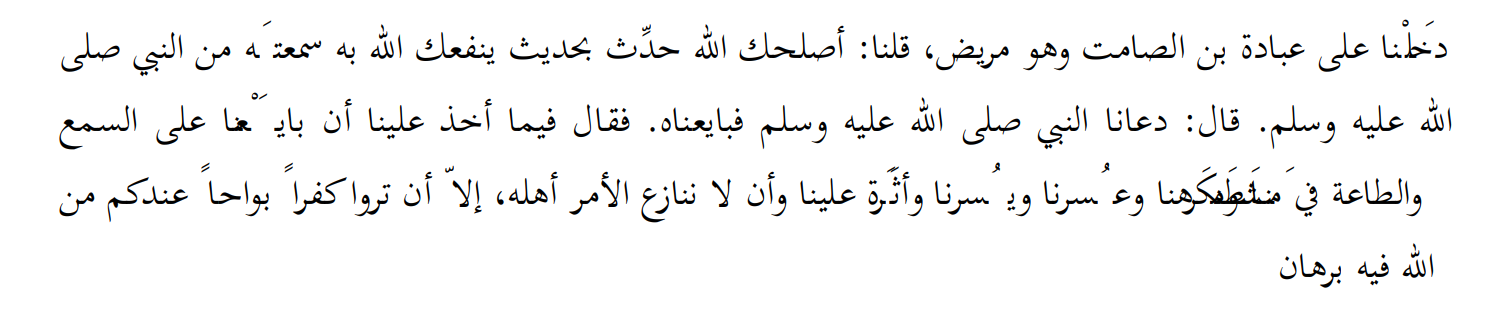
Tuliingia nyumbani kwa ‘Ubadah bin as-Samit alipokuwa mgonjwa, nasi tukasema: Mwenyezi Mungu akufanye uwe mzima, tuhadithie hadithi uliyoisikia kutoka kwa Mtume ﷺ ambayo kwayo Mwenyezi Mungu (SWT) anaweza kukunufaisha. Akasema: Mtume ﷺ alitualika, nasi tukampa bay’ah (kiapo cha utii). Miongoni mwa masharti aliyotuchukulia kiapo ni kwamba tusikilize na tutii (amri), wakati tukiwa hai na wakati tumechoka, katika nyakati za wepesi na za shida, na wakati tunapoona upendeleo (wa wengine juu yetu), na kwamba tusibishane na mamlaka ya wale waliokabidhiwa nayo, tukisema: Isipokuwa mwone ukafiri wa wazi (kufr bawah) ambao mnao ushahidi wazi kutoka kwa Mwenyezi Mungu.
“We entered the house of ‘Ubadah bin as-Samit while he was ill and we said: May Allah make you healthy, inform us of a hadith you heard from the Prophet (saw) by which Allah (swt) may benefit you. He said: The Prophet (saw) invited us and we gave him our bay’ah (pledge of Allegiance). And among the conditions on which he took the pledge from us, was that we were to listen and obey (the orders) both at the time when we were active and when we were tired , and in the times of ease and hardship and when we see preference (for others over us), and not to dispute the authority of those who are entrusted with it saying: Unless you see open disbelief (kufr bawah) upon which you have a clear proof from Allah.”
Bay'ah kwa Khalifah iko mikononi mwa Waislamu, nayo ni haki yao; ni wao wanaotoa bay'ah, na ni bay'ah yao inayofanya Khilafah ifungwe kwa Khalifah. Bay'ah inaweza kuwa kwa kupeana mkono au kwa maandishi. 'Abdullah bin Dinar alisimulia akisema:
The bay’ah for the Khalifah is in the hands of the Muslims, and it is their right; it is they who give the bay’ah, and it is their bay’ah which makes the Khilafah contracted for a Khalifah. The bay’ah can be by shaking hand or by writing. ‘Abdullah bin Dinar narrated saying:
Nilishuhudia Ibn ‘Umar wakati watu walipokusanyika kumzunguka ‘Abdulmalik bin Marwan. Aliandika: Ninakubali kusikiliza na kutii kwa mtumwa wa Allah, ‘Abdulmalik Amir al-Mu’mineen, kulingana na Sunnah ya Allah na Sunnah ya Mtume Wake ﷺ kadiri ninavyoweza.
“I witnessed bin ‘Umar where the people gathered around ‘Abdulmalik bin Marwan. He wrote: I agree to listen and obey to the slave of Allah, ‘Abdulmalik the Amir al-Mu’mineen, according to the Sunnah of Allah and the Sunnah of His Prophet as much as I am able.”
Zaidi, bay'ah hiyo ni sahihi kwa njia yoyote ile (waseelah). Hata hivyo, bay'ah lazima itolewe na mtu aliyebaleghe, hivyo si sahihi kutolewa na mtu mdogo. Abu Aqeel Zahra bin Ma‘bed alisimulia kutoka kwa babu yake 'Abdullah bin Hisham--aliyemshuhudia Mtume ﷺ--kwamba mama yake Zaynab, binti Hameed, alimchukua hadi kwa Mtume ﷺ na kusema: Ee Nabii wa Allah, mchukulie bay'ah. Mtume ﷺ akasema:
Moreover, the bay’ah is correct by any means (waseelah). However, the bay’ah has to be given by the mature person, so it is improper to be given by the young. Abu Aqeel Zahra bin Ma‘bed reported from his grandfather ‘Abdullah bin Hisham--who witnessed the Prophet (saw)--that his mother Zaynab, the daughter of Hameed, took him to the Prophet (saw) and said: O Prophet of Allah, take a pledge from him. The Prophet (saw) said:
Ni mtoto, akapapasa kichwa chake na kumwombea du‘aa.
“He is a child, wiped his head and made a du‘a for him.”
Kuhusu maneno ya bay'ah, hayazuiliwi kwa maneno maalum. Hata hivyo, lazima yajumuishe kutenda kwa mujibu wa Kitabu cha Allah (swt) na Sunnah ya Mtume Wake (ﷺ) kwa Khalifah, na utii katika shida na wepesi, na utii, na kila kinachopendeza na kisichopendeza upande wa mtu anayetoa bay'ah (kwa Khalifah). Mtu anapokuwa ametoa bay'ah yake kwa Khalifah, au Khilafah imefungwa kwa Khalifah kwa bay'ah ya Waislamu wengine, basi bay'ah imekuwa amana shingoni mwa anayetoa bay'ah, na hairuhusiwi kuirudisha. Ni haki ya mkataba wa Khilafah hadi ameitoa, na mara akishaitoa lazima aizingatie. Hairuhusiwi kujiondoa kutoka kwake. Al-Bukhari amesimulia kutoka kwa Jabir bin 'Abdullah (ra) kwamba Mbedui mmoja alimpa Mtume (ﷺ) bay'ah yake juu ya Uislamu, kisha ugonjwa ukamshambulia, hivyo akamwambia Mtume (ﷺ): "Niruhusu nirudishe bay'ah yangu," lakini Mtume (ﷺ) alikataa, na yule mtu akaondoka. Kisha Mtume (ﷺ) akasema:
As for the words of the bay’ah they are not restricted to specific terms. However they must include acting according to the Book of Allah (swt) and the Sunnah of His Prophet (saw) by the Khalifah, and obedience in hardship and ease and obedience, and whatever pleases and displeases on the part of the person who gives the bay’ah (to the Khalifah). Whenever the one who pledges has given his bay’ah to the Khalifah or the Khilafah is contracted to the Khalifah by the bay’ah of other Muslims, then the bay’ah has become a trust on the neck of the one who gives the bay’ah and he is not allowed to retract it. It is a right for the contract of the Khilafah until he has given it, and once he has given it he must abide by it. He is not allowed to retract from it. Al-Bukhari narrated from Jabir bin ‘Abdullah (ra) that a Bedouin gave the Prophet (saw) his pledge on Islam, and an illness struck him so he said to the Prophet (saw): “Let me withdraw my bay’ah but the Prophet (saw) refused, and the man left. The Prophet (saw) then said:
"Madina ni kama tanuru, huondoa uchafu na kuchagua yaliyo mema na kuyafanya kuwa kamilifu."
“Medina is like a furnace, it expels out the impurities and selects the good ones and makes them perfect.”
Na imepokewa kutoka kwa Nafi‘a aliyesema: Ibn ‘Umar (ra) aliniambia kwamba alimsikia Mtume ﷺ akisema:
And it is narrated from Nafi‘a who said: Ibn ‘Umar (ra) said to me that he heard the Prophet (saw) saying:
"Yeyote atakayeondoa mkono wake katika utii (kwa Amiri), hatakuwa na hoja (ya kujitetea) atakaposimama mbele ya Allah Siku ya Kiyama."
“Whoever withdraws his hand from obedience (to the Amir) will find no argument (in his defense) when he stands before Allah on the Day of Resurrection.”
Kuvunja bay'ah ya Khalifah ni kuondoa mkono wa mtu kutoka kwenye utii kwa Allah (swt). Hii ndiyo hali ikiwa bay'ah yake kwa Khalifah ni bay'ah ya mkataba, au ikiwa ni bay'ah ya utii kwa Khalifah ambaye Waislamu wameumkubali na kumpa bay'ah yao. Lakini, ikiwa alitoa bay'ah yake mwanzoni kwa Khalifah na haikukamilika kwa sababu Waislamu kwa ujumla hawakumkubali kuwa Khalifah, basi ana haki ya kujiondoa kwenye bay'ah hiyo. Katazo lililotajwa katika hadith linalenga kuondoa bay'ah kwa Khalifah, si kwa mtu ambaye Khilafah haikukamilika kwake.
To break the bay’ah of the Khalifah is withdrawing of one’s hand from the obedience of Allah (swt). This is the case if his bay’ah to the Khalifah is a bay’ah of contract or it is a bay’ah of obedience to a Khalifah whom the Muslims accepted and gave their bay’ah to. However, if he gave his bay’ah in the beginning to a Khalifah and it was not completed because the Muslims as a whole did not accept him as Khalifah, then he has the right to withdraw from that bay’ah. The prohibition mentioned in the hadith is focused on the withdrawal of a bay’ah to a Khalifah, not to a man for whom the Khilafah was not accomplished