20.3 Shahidi
20.3 The Martyr
Mashahidi (shuhadaa) ni wa aina tatu; shahidi wa Akhera lakini si kwa kanuni za dunia; shahidi wa dunia pekee na shahidi wa dunia na Akhera. Kuhusu shahidi wa Akhera pekee na si wa dunia hii, wametajwa katika hadithi. Katika baadhi ya riwaya ni saba, katika baadhi ni nane, katika baadhi ni tisa na katika baadhi ni kumi na moja. Msimamo sahihi kama ulivyokuja katika Muslim ni kwamba ni watano: (al-mat'un) ambaye ni mtu anayekufa kwa tauni, yaani ugonjwa maarufu wa tauni; (al-mabtun) ambaye ni mtu mwenye kuhara; mtu aliyezama ambaye hufa kwa sababu ya maji; mtu anayekufa kwa (al-hadm), yaani jengo lililoporomoka; na mtu anayekufa katika njia ya kuinua neno la Allah nje ya uwanja wa vita. Muslim amesimulia kutoka kwa Abu Hurayra (ra) kwamba Mtume wa Allah ﷺ alisema:
Martyrs (shuhadaa) are of three types; the shaheed of the Akhirah but not by the rules of the world; the shaheed of the world only and the shaheed of the world and Akhirah. As for the shaheed of the Akhirah only and not of this world, they are mentioned in the ahadith. In some narrations they are seven, in some eight, in some nine and in some eleven. The authentic (position) as what came in Muslim is that they are five who are: (al-mat’un) who is the one who dies in the plague i.e. the famous pestilence, the (mabtun) who is the one with diarrhoea, the drowned person who dies because of water, the one who dies of (al-hadm) i.e. the collapsed building, and the one who dies in the way of raising the word of Allah outside the battlefield. Muslim narrated from Abu Hurayra (ra) that the Messenger of Allah (saw) said:
“Mtu mmoja aliyekuwa akitembea barabarani aliona mwiba wa mti barabarani akauondoa. Allah alimshukuru kwa hilo akamsamehe. Mtume ﷺ alisema: Mashahidi (shuhadaa) ni watano: (al-mat’un), (al-mabtun), aliyezama majini, aliyekufa kwa kuanguka kwa jengo, na shahidi katika njia ya Allah ‘azza wa jalla.”
“A man walking along the road found a thorn-branch in the road and removed it. Allah was grateful to him and forgave him. He (saw) said: The martyrs (shuhadaa) are five: (al-mat’un), (al-mabtun), the drowned one, the one who died in a collapsed (building) and the shaheed in the way of Allah ‘azza wa jalla.”
Imepokewa na Muslim kutoka kwa Abu Hurairah (ra) ambaye alisema: Mtume wa Allah ﷺ alisema:
Muslim narrated from Abu Hurairah (ra) who said: The Messenger of Allah (saw) said:
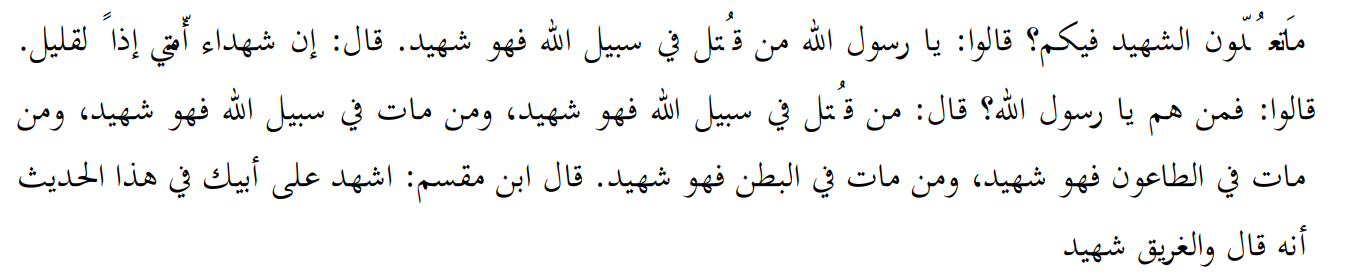
"Ni nani miongoni mwenu anayemchukulia kuwa shahidi?" Wakasema: "Ewe Mjumbe wa Allah, aliyeuawa katika njia ya Allah ni shahidi." Akasema: "Basi mashahidi miongoni mwa Ummah wangu watakuwa wachache." Wakasema: "Basi ni akina nani, ewe Mjumbe wa Allah?" Akasema: "Aliyeuawa katika njia ya Allah ni shahidi, aliyekufa katika njia ya Allah ni shahidi, aliyeuawa kwa tauni ni shahidi, aliyeuawa kwa sababu ya tumbo ni shahidi (Ibn Muqsim alisema: Nashuhudia juu ya baba yako katika hadithi hii kwamba alisema) na aliyezama majini ni shahidi."
“Whom do you consider a shaheed among you? They said: O Messenger of Allah, the one killed in the way of Allah is a shaheed. He said: Then the shuhadaa among my Ummah would be few. They said: Then who are they, O Messenger of Allah? He said: The one killed in the way of Allah is a shaheed, the one who dies in the way of Allah is a shaheed, the one killed in pestilence is a shaheed, the one killed due to the stomach is a shaheed (ibn Muqsim said: I testify that upon your father in this hadith that he said) and the drowned person is a shaheed.”
Maana ya hawa mashahidi ni kwamba wana malipo ya mashahidi huko Akhera; kwa upande wa dunia hii, wao huoshwa na kuswaliwa. Neno "shaheed" linapotajwa kuhusiana na malipo na hadithi inayohusu hilo, ni sahihi kulijumuisha neno hilo kwa watu hawa. Lakini neno "shaheed" likitumika bila kuwekewa masharti wala maana nyingine, halieleweki kuwa linawahusu watu hawa, bali linamaanisha tu wale waliouawa katika njia ya Allah.
The meaning of these shuhadaa is that there is for them in the Akhirah the reward of the shuhadaa; as for this world, they are washed and prayed over. When the word “shaheed” is said in connection with reward and the hadith about that, it is correct to generalize it to these (persons). However, if the word “shaheed” is used in an unrestricted manner without any connotation, then it is not taken to denote these (persons) but rather to denote only those killed in the way of Allah.
Kuhusu shahidi wa dunia, si wa Akhera, yeye ni yule anayepata hukumu za shahidi wa dunia kwa kiwango kwamba hanaoshwi wala hasalishwi, bali anazikwa akiwa amevaa nguo zake. Hata hivyo, hapati katika Akhera thawabu ya shahidi aliyepigana ili neno la Allah liwe juu kabisa. Huyu ni yule anayepigana kwa jambo lisilokuwa njia ya Allah, kama vile kupigania sifa au ngawira peke yake, au akiwa anarudi nyuma. Hii ni kwa sababu hadithi zimebainisha thawabu ya shahidi kwa yule anayepigana katika njia ya Allah (SWT), na yule anayepigana akisonga mbele, si akirudi nyuma. Muslim amepokea kutoka kwa Abu Musa al-Ash'ari.
As for the shaheed of the world not the Akhirah, he is the one who takes the rules of the shaheed of the world in so far as he is not washed nor prayed over but rather buried in his clothes. However he does not take in the Akhirah the reward of the shaheed who fought to raise the word of Allah the highest. This is the one who fights in other than the way of Allah such as fighting for fame or booty alone or while retreating. This is because the ahadith specified the shaheed’s reward for the shaheed who fights in the way of Allah (swt), and the one fighting advancing not retreating. Muslim narrated from Abu Musa al-Ash’ari
"Kwamba mtu mmoja alimjia Mtume ﷺ akasema: Ee Mjumbe wa Allah, mtu anayepigana kwa ajili ya ngawira, mtu anayepigana ili atajwe, na mtu anayepigana ili cheo chake kionekane. Ni yupi kati yao yuko katika njia ya Allah? Mjumbe wa Allah ﷺ akasema: 'Yule anayepigana ili neno la Allah liwe juu ndiye aliye katika njia ya Allah.'"
“That a man came to the Prophet (saw) and said: O Messenger of Allah, the man who fights for booty, the man who fights to be mentioned and the man who fights so that his rank is seen. Which one is in the way of Allah? The Messenger of Allah (saw) said: ‘The one who fights so that the word of Allah be highest is the one in the way of Allah.”
Muslim amesimulia kutoka kwa Abu Musa
Muslim narrated from Abu Musa
Mtume wa Allah ﷺ aliulizwa kuhusu mtu anayepigana vita ili kuonyesha ushujaa wake, mtu anayepigana kwa hasira, na mtu anayepigana ili kujionyesha (kinafiki). Mtume wa Allah ﷺ alisema: Yule anayepigana ili neno la Allah liwe juu zaidi, ndiye yuko katika njia ya Allah.
“The Messenger of Allah (saw) was asked about the man who fights (to show his) courage, the one who fights out of anger, and the one who fights to show off (hypocritically). The Messenger of Allah (saw) said: The one who fights so that the word of Allah is highest is in the way of Allah.”
Mjumbe wa Allah ﷺ aliweka sharti la shahidi kusamehewa dhambi zake kwamba apigane akiwa anasonga mbele, si akiwa anarudi nyuma. Muslim alisimulia kutoka kwa Abdullah bin Abi Qatadah, kutoka kwa Qatadah, kwamba alisikia ikisimuliwa kutoka kwa Mjumbe wa Allah ﷺ.
The Messenger made a condition of the shaheed being forgiven his sins that he fights advancing not retreating. Muslim narrated from Abdullah bin Abi Qatadah from Qatadah that he heard it being narrated from the Messenger of Allah
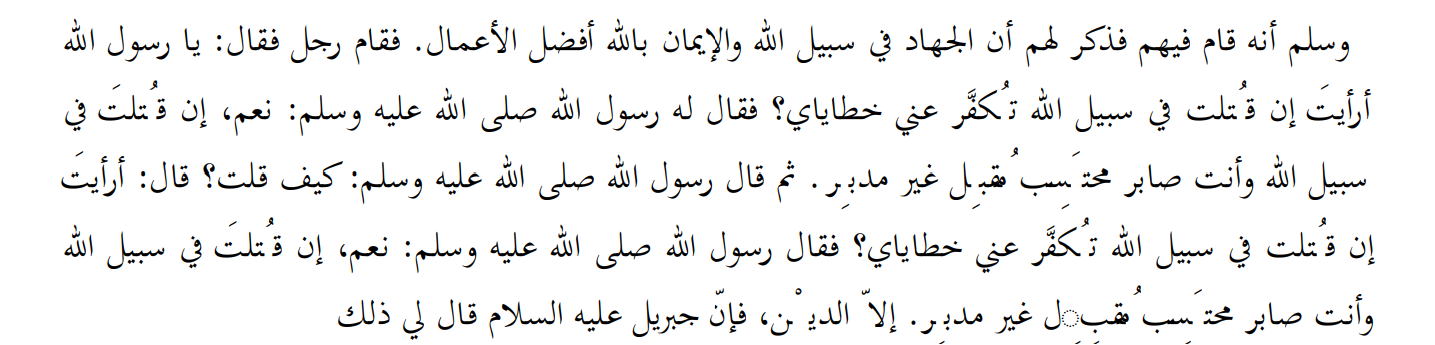
Alisimama miongoni mwao na kuwakumbusha kwamba jihadi katika njia ya Allah na imani thabiti kwa Allah ndiyo matendo bora. Kisha mtu mmoja alisimama akasema: Ee Mjumbe wa Allah, je, unaona kwamba iwapo nitapigana katika njia ya Allah, makosa yangu yote yatasamehewa? Mjumbe wa Allah ﷺ alimwambia: Ndiyo, ikiwa utapigana katika njia ya Allah na ukawa mvumilivu, mwenye matumaini, unasonga mbele wala hurudi nyuma. Kisha Mjumbe wa Allah ﷺ akasema: Ulisema nini? Akasema: Je, unaona kwamba iwapo nitapigana katika njia ya Allah, dhambi zangu zote zitasamehewa? Mjumbe wa Allah ﷺ alisema: Ndiyo, ikiwa wewe ni mvumilivu, mwenye matumaini, unasonga mbele wala hurudi nyuma, isipokuwa kwa deni, kama Jibril (AS) aliniambia hivyo.
“That he stood among them and reminded them that jihad in the way of Allah and decisive belief in Allah is the best deeds. So a man stood up and said: O Messenger of Allah, do you see that if I fought in the way of Allah that all my errors would be forgiven? The Messenger of Allah (saw) said to him: Yes, if you fought in the way of Allah and you are patient, hopeful, advancing and not retreating. Then the Messenger of Allah (saw) said: What did you say? He said: Do you see that if I fought in the way of Allah that all my sins would be forgiven? The Messenger of Allah (saw) said: Yes, if you are patient, hopeful, advancing and not retreating except for debts as Jibril (AS) told me that.”
Uelewa wa hili ni kwamba dhambi za mpiganaji anayekimbia vita hazisamehewi, wala hana thawabu ya shahidi. Kuhusu mtu anayepigana kwa ajili ya sifa, Mtume ﷺ alifafanua kwamba ataadhibiwa, na bado akamwita shahidi. Muslim alipokea kutoka kwa Sulayman bin Yasar, ambaye alisema: Watu walitawanyika kumzunguka Abu Hurairah (ra), na Natil, ambaye alikuwa miongoni mwa watu wa Sham, akamwambia: Ewe Sheikh, tuambie hadithi uliyoisikia kutoka kwa Mtume ﷺ. Akasema: Ndiyo, nilimsikia Mtume ﷺ akisema:
The understanding of this is that the retreating fighter’s sins are not forgiven nor does he have the reward of the shaheed. As for the one fighting for fame, the Messenger (saw) clarified that he would be punished and (yet) called him shaheed. Muslim narrated from Sulayman bin Yasar who said: People dispersed about Abu Hurairah (ra) and Natil who was from the people of Sham said to him: O Sheikh related to us a hadith you heard from the Messenger of Allah (saw). He said: Yes, I heard the Messenger of Allah (saw) saying:
"Hakika, mtu wa kwanza kuhukumiwa siku ya Kiyama ni mtu aliyeuawa akiwa shahidi. Ataletwa mbele Yake (Allah) naye atamjulisha neema Zake, naye atazikiri. Atasema (swt): Je, ulizifanyia nini? Atajibu: Nilipigana kwa ajili Yako hadi nikauawa kama shahidi. Atasema: Umesema uongo. Bali ulipigana ili isemwe 'yeye ni jasiri', na imesemwa. Kisha Ataamuru juu yake, naye ataburuzwa kwa uso wake hadi atakapotupwa Motoni." (swt)
“Verily the first person(s) to be judged on the Day of Judgement is a man who was killed as a shaheed. He is brought to Him (Allah) and He informs him of the bounties (of Allah) and he acknowledges them. He (swt) says: What did you do with them? He answers: I fought for you until I was killed as a shaheed. He says: You lied. Rather you fought so that it be said ‘(he is) brave’ and it has been said. Then He commands regarding him and he is dragged upon his face until he is thrown into the Fire”
Hadi mwisho wa hadithi. Hii inaonyesha kwamba mtu aliyeuawa kwa ajili ya kujulikana, hata akipewa hukumu za shahidi katika dunia hii, hatapata thawabu ya shahidi siku ya Kiyama, bali ataadhibiwa.
Till the end of the hadith. This indicates that the one killed for fame, even if he takes the rules of the shaheed in this world, will not gain the reward of the shaheed on the Day of Judgement but would be punished.
Kwa upande wa shahidi wa dunia na Akhera, ni yule anayepigana na makafiri ili kuinua neno la Allah, na akauawa katika uwanja wa vita kati ya Waislamu na makafiri, iwe mapigano hayo yalikuwa katika ardhi ya vita au katika ardhi ya Kiislamu. Allah (SWT) amesema:
As for the shaheed of the world and the Akhirah, he is the one who fights the disbelievers to raise the word of Allah and was killed in the battle (field) between Muslims and disbelievers, whether the fighting was in the land of war or the Islamic land. Allah (swt) said:
Usidhani kwamba wale waliouawa katika njia ya Allah wamekufa. Bali wao ni hai na wanaruzukiwa mbele ya Mola wao Mlezi. {Qur'an 3:169}
“Do not think that those killed in the way of Allah are dead. Rather they are alive and receiving sustenance before their Lord” [TMQ 3:169].
Shahidi huyu ndiye ambaye haki zake zimekuja katika kanuni za Shari'ah. Amebainishwa kuwa ni yule aliyeuawa katika vita dhidi ya makafiri; vilevile yule aliyejeruhiwa uwanjani vitani kisha akafa kwa jeraha alilolipata uwanjani vitani naye anachukuliwa kuwa kama aliyeuawa uwanjani vitani. Kwa wengine zaidi ya hawa, hawachukuliwi kuwa mashahidi. Kwa hiyo yule aliyeuawa katika mapigano na waasi (bughat) hachukuliwi kuwa shahidi, wala yule aliyejeruhiwa uwanjani vitani kisha akapona jeraha hilo kisha akafa kwa sababu yake. Shahidi mwenye kanuni maalum, na yule ambaye Allah amesema kuwa yu hai, amebainishwa kuwa ni yule aliyeuawa uwanjani vitani dhidi ya makafiri ili kuinua neno la Allah, na yule aliyejeruhiwa uwanjani vitani kisha akafa kwa sababu ya jeraha hili.
This shaheed is the one upon whose rights came in the Shari’ah rules. He is specified as the one killed in the war with disbelievers; similarly the one who was wounded in the battlefield then died of the wound he received in the battlefield is also considered like the one killed in the battlefield. As for other than these, they are not considered shaheed. Accordingly the one killed in fighting with rebels (bughat) is not considered shaheed nor the one wounded in the battlefield then recovered from the wound then died because of it. The shaheed who has specific rules, and the one about whom Allah stated that he is alive, is specified to the one killed in the battlefield with the disbelievers to raise the word of Allah and the one injured in the battlefield then died due to this wound.
Sheria iliyotajwa kuhusu shahidi huyu ni kwamba hanawishwi wala hafunikwi kwa sanda za mazishi; badala yake anazikwa kwa damu yake na nguo zake, kwa sababu shahidi atafufuliwa Siku ya Hukumu akiwa na harufu ya damu yake kama harufu ya miski tamu zaidi. Kuhusu kutomnawisha shahidi, hili linatokana na yale aliyoyasimulia Al-Bukhari kutoka kwa Jabir, aliyesema:
The rule of this mentioned shaheed is that he is neither washed nor shrouded in burial shrouds; rather he is buried in his blood and clothes because the shaheed is resurrected on the Day of Judgement with the smell of his blood like the sweetest-smelling musk. As for not washing the shaheed, this is due to what Al-Bukhari narrated from Jabir who said:
Mtume ﷺ alikuwa akiwakusanya watu wawili miongoni mwa waliouawa katika Uhud katika nguo moja, kisha akasema: "Ni yupi kati yao aliyekuwa anajua Qur'an zaidi?" Ikiwa mmoja wao alionyeshwa kwake, alimtanguliza kaburini (lihd) na akasema: "Mimi ni shahidi juu ya hawa." Aliamuru wazikwe pamoja na damu yao, wala hakuwaswalia wala kuwaosha.
“The Messenger of Allah (saw) would collect two men of those killed in Uhud in one cloth, and then he would say: Which one of them knew more of the Qur’an? If one of the two was indicated to him, he brought him forward in the grave-niche (lihd) and said: I am a witness over these. He commanded their burial with their blood and did not pray over them nor wash them.”
Na Ahmad (amesimulia) kwamba Mtume ﷺ alisema kuhusu wale waliouawa katika vita vya Uhud:
And Ahmad (narrated) that the Prophet (saw) said about those killed in Uhud:
"Msiwaoshe, kwa sababu kila jeraha au (kila tone la) damu litatoa harufu ya miski Siku ya Kiyama, na yeye (Mtume) hakuwaswalia."
“Do not wash them because each wound or (each drop of) blood will diffuse musk on the Day of Judgement and he did not pray over them.”
Imepokewa kwamba Mtume ﷺ alisema kuhusu wale waliouawa katika vita vya Uhud:
It is narrated that the Prophet (saw) said about those killed in Uhud:
"Mfunike kwa damu yao wala msiwaoshe, kwani hakuna jeraha linalopata jeraha katika njia ya Allah isipokuwa litakuja Siku ya Kiyama likiwa na mshipa wake wa shingo ukitiririka damu, rangi yake ni rangi ya damu na harufu yake ni harufu ya musk."
“Cover them in their blood and do not wash them as there is no wound wounded in the way of Allah save that it will come on the Day of Judgement with its jugular vein flowing blood whose colour is the colour of blood and the odour is the odour of musk.”
Imepokewa kutoka kwa Anas
It has been narrated from Anas
"Kwamba Mtume ﷺ hakusali juu ya waliouawa katika vita vya Uhud, wala hakuwasalia."
“That the Prophet (saw) did not pray over those killed in Uhud or pray over them.”
Kama vile yeye hakuwaosha wale waliouawa Uhud, hakuwaosha pia mashahidi wa Badr; vilevile hakuwaosha mashahidi wa Khandaq na Khaybar. Hivyo ikadhihirika kwamba shahidi haoshwi. Vilevile shahidi haviringishwi sanda kama anavyoviringishwa maiti; badala yake huvikwa nguo alizo nazo, kutokana na kauli ya Mtume ﷺ kuhusu waliouawa Uhud.
Just as he did not wash those killed in Uhud, he did not wash the shuhadaa of Badr; similarly he did not wash the shuhadaa of Khandaq and Khayber. So it became clear that the shaheed is not washed. Similarly the shaheed is not enshrouded as the dead person is shrouded; rather he is shrouded in the clothes that he has due to the Messenger of Allah (saw)’s statement about those killed in Uhud:
"Wafunikeni kwa majeraha yao na damu yao" (amesimulia Ahmad)
“Cover them in their wounds and blood” (narrated by Ahmad)
Na pia kwa sababu ya kile alichosimulia Ibn Abbas (ra)
And also due to what ibn Abbas (ra) narrated
Kwamba Mtume wa Allah ﷺ aliamuru kuhusu waliouawa katika vita vya Uhud kwamba chuma na ngozi ziondolewe kutoka kwao, na wazikwe pamoja na damu yao na nguo zao (amepokea Abu Dawud).
“That the Messenger of Allah (saw) commanded about those killed in Uhud that the iron and skins be removed from them and that they be buried with their blood and clothes” (narrated by Abu Dawud).
Kuhusu kumswalia shahidi, inaruhusiwa kumswalia na inaruhusiwa pia kutomswalia. Kuhusu ruhusa ya kumswalia, hii ni kwa sababu ya Hadithi zilizopokewa kwamba Mtume ﷺ aliwaswalia wale waliouawa Uhud baada ya kuzikwa, na akamswalia Hamza na mtu mmoja aliyeuawa uwanjani. Katika Al-Bukhari imepokewa kutoka kwa Uqbah bin ‘Amir
As for the prayer over the shaheed, it is allowed to pray over them and it is allowed not to pray over them. As for the permissibility of prayer over them, this is due to the narrations which came that the Messenger (saw) prayed over those killed in Uhud after their burial and prayed over Hamza and a man killed in the battlefield. In Al-Bukhari it is narrated from Uqbah bin ‘Amir
Alisali juu ya waliouawa katika Uhud baada ya miaka minane ﷺ, na sala ile juu ya maiti ilikuwa kama kuaga kwa walio hai na kwa waliokufa.
“He (saw) prayed over those killed in Uhud after eight years, the prayer over the dead was like a farewell to those alive and those dead.”
Na kutoka kwa Abu Dawud, kutoka kwa Malik al-Ghiffari
And from Abu Dawud from Malik al-Ghiffari
Aliswali juu ya wale waliouawa Uhud kwa makundi ya kumi kumi, huku Hamza akiwa katika kila kumi, hadi akamswalia Hamza mara sabini ﷺ.
“He (saw) prayed over those killed in Uhud in groups of ten with Hamza in each ten until he prayed seventy times over him.”
Abu Dawud alisimulia kutoka kwa Abu Salim, kutoka kwa mtu mmoja katika Maswahaba wa Mtume ﷺ, ambaye alisema:
Abu Dawud narrated from Abu Salim from a man of the Prophet (saw)’s Sahabah who said:

Tulishambulia kwa mshangao kabila moja kutoka Juhainah. Mtu mmoja miongoni mwa Waislamu alimtafuta mtu mmoja wao ili ampige, lakini alikosa na akajipiga mwenyewe. Mjumbe wa Allah ﷺ alisema: "Ndugu yenu, enyi jamii ya Waislamu." Watu wakaharakisha na kumkuta amekufa. Mjumbe wa Allah ﷺ alimfunika kwa nguo zake na damu yake, akamswalia na kumzika. Wakasema: "Je, yeye ni shahidi?" Akasema: "Ndiyo, na mimi ni shahidi kwake."
“We attacked by surprise a tribe from Juhainah. A man of the Muslims sought a man of them to strike him, but he missed and struck himself. The Messenger of Allah (saw) said: Your brother, O community of Muslims so the people hastened and found him dead. The Messenger of Allah (saw) covered him in his clothes and blood, prayed over him and buried him. They said: Is he a shaheed? He said: Yes, and I am a witness for him.”
Tulishambulia kwa mshtuko kabila moja kutoka Juhainah. Mtu mmoja miongoni mwa Waislamu alimfuata mtu mmoja wao ili ampige, lakini alikosa na kujipiga mwenyewe. Mtume wa Allah ﷺ alisema: "Ndugu yenu, enyi jumuiya ya Waislamu." Watu wakaharakisha na kumkuta amekufa. Mtume wa Allah ﷺ alimfunika kwa nguo zake na damu yake, akamswalia na kumzika. Wakasema: "Je, yeye ni shahidi?" Akasema: "Ndiyo, na mimi ni shahidi kwake."
“We attacked by surprise a tribe from Juhainah. A man of the Muslims sought a man of them to strike him, but he missed and struck himself. The Messenger of Allah (saw) said: Your brother, O community of Muslims so the people hastened and found him dead. The Messenger of Allah (saw) covered him in his clothes and blood, prayed over him and buried him. They said: Is he a shaheed? He said: Yes, and I am a witness for him.”
Kwamba Mtume ﷺ hakuwasalia wale waliouawa katika Uhud, wala hakuwaosha.
“That the Prophet (saw) did not pray over those killed in Uhud or wash them.”
Na Ahmad alisimulia kutoka kwa Anas
And Ahmad narrated from Anas
Mashahidi wa Uhud hawakuoshwa. Walizikwa wakiwa wamevaa nguo zao, wala hawakuswaliwa.
“The shuhadaa of Uhud were not washed. They were buried in their clothes and not prayed over.”
Al-Bukhari alisimulia kutoka kwa Jabir bin Abdullah (ra) aliyesema:
Al-Bukhari narrated from Jabir bin Abdullah (ra) who said:

Mtume ﷺ alikuwa akiwakusanya wanaume wawili kati ya waliouawa katika Uhud kisha akasema: "Yupi kati yao alikuwa amehifadhi Qur'ani zaidi?" Mmoja wao alipoonyeshwa kwake, alimtangulizha kwenye shimo la kaburi, akasema: "Mimi ni shahidi juu ya hawa siku ya Kiyama." Aliamuru wazikwe wakiwa na damu zao, wala hakuwaosha wala kuwaswalia.
“The Prophet (saw) would combine between two men of those killed in Uhud then say: Which one of them memorized more of the Qur’an? When one of the two was indicated to him, he would bring him forward in the grave-niche and he said: I am the witness over these on the Day of Judgement, commanded their burial in their blood and did not wash them or pray over them.”
Ahadith hizi ni sahihi na zina dalili wazi kwamba shahidi hasaliwi. Ash-Shafi'i alijibu hadithi ya Ibn Abbas (ra) na kile kilichokuja katika maana yake kuhusu kuwasalia wale waliouawa Uhud kabla ya kuzikwa, akisema: "Taarifa hiyo imekuja kama ilivyo kwa watu maalum, mbele ya mutawatir kwamba Mtume hakuwasalia wale waliouawa Uhud." Ahadith hizi zote ni sahihi, zile zinazosimulia kwamba Mtume ﷺ aliwasalia mashahidi na zile zinazosimulia kwamba hakuwasalia. Hakuna njia ya kuzikataa kwa sababu ya usahihi wake, kwa kuwa ni miongoni mwa zinazotumika kama dalili, kwa upokezi na kwa maana. Wala hakuna njia ya kuipa nguvu moja juu ya nyingine, kwa kuwa si jambo la kawaida kwa Masahaba kusahau kuwasalia mashahidi hao, kama vile si jambo la kawaida kwao kuacha jambo linalopingana na kile kilichothibitika kutoka kwake ﷺ cha kuwasalia wafu. Basi vipi moja inaweza kupewa nguvu juu ya nyingine? Wala haifai kusema kwamba kusali katika hadithi zinazothibitisha kumsalia shahidi ni dua, ili kauli yake "alisali" iwe na maana ya "aliomba dua." Hili haliwezekani, kwa kuwa maana za kisheria hutangulia maana za kilugha mradi hakuna dalili ya kinyume. Hapa hakuna dalili kama hiyo, hivyo ni lazima maana ya kusali ni sala ya kisheria juu ya maiti. Wala haifai kusema kwamba hadithi za kuwasalia wafu zinafuta hadithi za kutowasalia, kwa kuwa moja yao, ambayo ni sala juu ya walioawa Uhud baada ya miaka nane, imekuja baadaye kuliko hadithi zote, kwani imekuja katika upokezi wa Ibn Hibban.
These ahadith are established and of explicit indication that the shaheed is not prayed over. Ash Shafi’ responded to the hadith of ibn Abbas (ra) and what came of its meaning regarding praying over those killed in Uhud before their burial “that the information came as if it were specific ones in the face of mutawatirah that the Messenger did not pray over those killed in Uhud.” All these ahadith are established whether those narrated that the Messenger (saw) prayed over the shuhadaa or those narrated that he didn’t pray over them. There is no way to reject any of them due to their authenticity, and because they are of those used as proofs in narration and meaning. There is no way to outweigh one over the other as it is remote that the Sahabah forgot to pray over those shuhadaa, just as it is also remote for them to leave an issue which is opposite of what is established about him (saw) of praying over the dead. So how can one be outweighed over the other? Nor should one say that the prayer in the ahadith which established the prayer over the shaheed is the du’a so that his saying “prayed” means made du’a. One cannot say this since the Shari’ah realities precede the linguistic (realities) as long as there is no connotation. Here there is no connotation so it is inevitable that the meaning of prayer is the Shari’ah prayer over the dead. Nor should one say that the ahadith of praying over the dead abrogates the ahadith of not praying over them since one of them, which is the prayer over those killed in Uhud after eight years is prayed to later than all the ahadith since it came in the narration of ibn Hibban
Kisha akaingia nyumbani kwake na hakutoka tena hadi Allah alipomfanya afe.
“Then he entered his house and did not go out until Allah caused him to die.”
Haipaswi kusemwa kwamba kuchelewa kwa hadithi peke yake si dalili ya kutosha ya kufutwa kwa hukumu (naskh); badala yake lazima iwepo dalili nyingine inayoonyesha kufutwa huko. Hapa hakuna dalili kama hiyo, kwa hiyo hakuna kufutwa kwa hukumu ndani yake. Hivyo, riwaya zote zinabaki kukubalika na zinafahamika kwamba kutomswalia shahidi kunaruhusiwa. Haikupokewa kwamba Mtume ﷺ aliwaswalia waliouawa katika Badr, Khandaq au Khaybar. Pia zinafahamika kwamba mtu akimswalia shahidi hakuna ubaya wowote katika hilo, na watu hawazuiwi kuwaswalia. Shahidi anaitwa shahidi (mashahidi) kwa sababu Pepo inashuhudiwa kwake kwa maandishi wazi ya Qur'an. Allah (SWT) amesema:
One should not say that because the lateness of the hadith alone is not sufficient indication of abrogation; rather there must be another connotation from which abrogation is understood. Here no connotation is present so there is no abrogation in it. So all the narrations remain recognized and are taken to mean that not praying over the shaheed is allowed. It is not narrated that the Messenger (saw) prayed over those killed in Badr, Khandaq or Khayber. They are also taken to mean that if one prays over the shaheed there is nothing (wrong) in that and people are not prevented from praying over them. The shaheed is named shaheed (witness) as Paradise is witnessed for him by the explicit text of the Qur’an. Allah (swt) said:
Hakika Allah amewanunulia waumini nafsi zao na mali zao kwa malipo ya Pepo. Wao hupigana katika njia ya Allah, huua na huuawa. {Hakika Allah amewanunulia waumini nafsi zao na mali zao kwa malipo ya kuwa wao watapata Pepo. Wao hupigana katika njia ya Allah, huua na huuawa} [TMQ 9:111].
“Verily Allah purchased from the believers there souls and wealth in return for paradise. They fight in the way of Allah, killing and being killed” [TMQ 9:111].
Muslim alipokea kutoka kwa Jabir aliyesema:
Muslim narrated from Jabir who said:
Mtu mmoja alisema: Je, mimi nitakuwa wapi, ee Mjumbe wa Allah, nikiuawa? Akasema: Peponi. Basi akazitupa tende zilizokuwa mikononi mwake, akapigana hadi akauawa. Na katika hadithi ya Suwaid: Mtu mmoja alimwambia Mtume ﷺ siku ya Uhud.
“A man said: Where am I, O Messenger of Allah, if I am killed? He said: In Paradise. So he threw the dates that were in his hands and fought until he was killed and in the hadith of Suwaid. A man said to the Prophet (saw) on the day of Uhud.”
Imepokewa kutoka kwa Anas bin Malik (ra) kwamba Mtume wa Allah ﷺ alienda pamoja na Maswahaba zake hadi wakawatangulia washirikina kufika Badr. Washirikina walipofika, Mtume wa Allah ﷺ alisema:
It is narrated from Anas bin Malik (ra) that the Messenger of Allah (saw) went with his Sahabah until they preceded the polytheists to Badr. The polytheists came and the Messenger of Allah (saw) said:
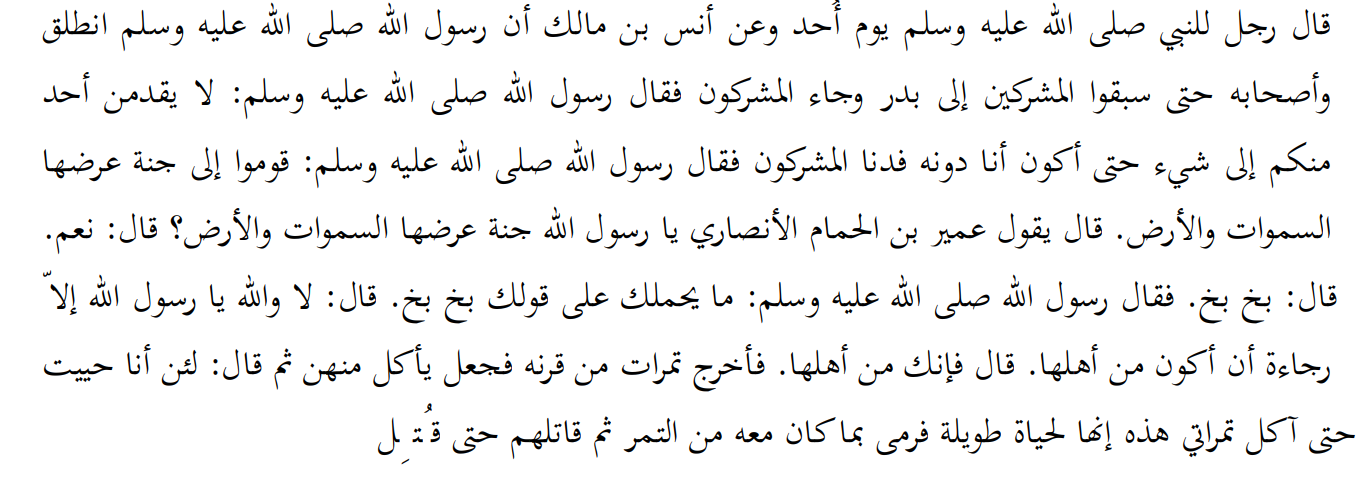
"Mmoja wenu asitangulie kufanya lolote bila ruhusa yangu. Washirikina walikaribia, basi Mjumbe wa Allah ﷺ akasema: Simameni kwenda Peponi ambayo upana wake ni sawa na mbingu na ardhi. Akasema: 'Umayr bin al-Hammam al-Ansari alisema: Ee Mjumbe wa Allah ﷺ, Pepo yenye upana sawa na mbingu na ardhi? Akasema: (Bakh! Bakh!). Basi Mjumbe wa Allah ﷺ akasema: Nini kilikusukuma kusema (Bakh! Bakh!)? Akasema: Hakuna chochote, kwa Allah, isipokuwa matumaini ya kuwa miongoni mwa watu wake. Akasema: Hakika wewe ni miongoni mwa watu wake. Akatoa tende kutoka kwenye mfuko wake (qaran) na kuanza kula. Kisha akasema: Ikiwa nitaishi hadi nizile tende hizi, basi huo utakuwa umri mrefu! Akazitupa tende alizokuwa nazo, kisha akapigana nao hadi akauawa." (Amepokewa na Muslim).
“Let none of you precede to anything without my being. The polytheists came close so the Messenger of Allah (saw) said: Stand forth to a Paradise whose breadth is that of the heavens and the earth. He said: ‘Umayr bin al-Hammam al-Ansari said: O Messenger of Allah, a Paradise whose breadth is that of the heavens of the earth? He said: (Bakh! Bakh!). So the Messenger of Allah (saw) said: What carried you to your statement, (Bakh! Bakh!). He said: Nothing, by Allah, except the hope that I be one of its people. He said: Verily you are one of its people. He removed dates from his (qaran) and began eating from them. Then he said: If I were to live until I ate these dates, it would then be a long life! He threw the dates that had then fought them until he was killed” (Narrated by Muslim).
Kwa hiyo Allah (SWT) na Mtume wa Allah ﷺ wameshuhudia Pepo kwa ajili ya shahidi. Kuhusu uhai wa shahidi, umethibitishwa kwa maandishi wazi ya Qur'ani. Allah (SWT) amesema:
So Allah (swt) and the Messenger of Allah (saw) have witnessed the Paradise for the shaheed. As for the life of the shaheed, it is established by the explicit text of the Qur’an. Allah (swt) said:
{Usifikiri kwamba wale waliouawa katika njia ya Allah ni wafu, bali ni hai wakiruzukiwa mbele ya Mola wao. Wakifurahia yale aliyowapa Allah katika fadhila zake, na wakiwa na bishara njema kwa wale walio nyuma yao ambao hawajajiunga nao, kwamba hakuna hofu juu yao wala hawatahuzunika. Wanapata bishara njema ya neema kutoka kwa Allah na fadhila zake, na hakika Allah hapotezi ujira wa Waumini}" [TMQ 3:169].
“Do not think that those killed in the way of Allah are dead, rather (they are) alive with sustenance before their Lord. Pleased with what Allah gave them of His favours and with good tidings for those behind them who have not met them, that there is no fear for them nor do they grieve. They have glad tidings of blessings from Allah and His favour, and verily Allah does not cause the reward of the believers to be lost” [TMQ 3:169].
Maisha haya ya mashahidi ni ya siri ambayo hatuielewi wala hatuwezi kuyatambua jinsi yalivyo katika makao ya milele. Ingawa hatuelewi maisha haya yaliyofichika wala hatuwezi kuyatambua, hata hivyo tunaamini kuwepo kwake lakini hatuelewi uhalisia wake. Imani yetu juu ya kuwepo kwake ni jambo lisiloepukika kwa kuwa limethibitishwa na dalili wazi ya Qur'an. Allah (SWT) amesema:
This life for the shuhadaa is unseen which we do not understand nor perceive as it is in the eternal abode. Although we do not understand this hidden life nor perceive it, nevertheless we believe in its existence but do not understand its reality. Our conviction in its existence is an inevitable matter as it is established by a definite Qur’anic text. Allah (swt) said:
"Msiseme juu ya wale waliouawa katika njia ya Allah kwamba ni 'wafu'... Bali wao ni hai lakini nyinyi hamtambui" [TMQ 2:154].
“Do not say of those killed in the way of Allah (are) ‘dead’... Rather they are alive but you do not know” [TMQ 2:154].
Maisha ya mashahidi ni miongoni mwa mambo ya ghaibu ambayo imani juu yake ni wajibu. Kuhusu fadhila ya mashahidi, ni fadhila kubwa isiyo na mfano, na Mtume ﷺ ameifafanua katika hadithi nyingi. Al-Bukhari amesimulia kutoka kwa Qatadah aliyesema: Nilimsikia Anas bin Malik (ra) akisimulia kutoka kwa Mtume ﷺ aliyesema:
The life of the shuhadaa is from the unseen (matters) in which iman is obliged. As for the virtue of the shuhadaa, it is a great virtue without an equivalent and he (saw) clarified it in numerous ahadith. Al-Bukhari narrated from Qatadah who said: I heard Anas bin Malik (ra) from the Prophet (saw) who said:
Hakuna mtu atakayeingia Peponi ambaye angependa kurudi duniani ili kupata kila kilichomo duniani, isipokuwa mashahidi, ambao watatamani kurudi duniani wauawe mara kumi kwa sababu ya heshima (karamah) wanayoiona.
“No one who enters Paradise would like to return to the world to obtain all that is upon the world except the shuhadaa who would wish to return to the world to be killed ten times due to what he sees of the honour (karamah).”
Na katika Al-Bukhari:
And in Al-Bukhari:
"Al-Mughira bin Shu’bah alisema kwamba Mtume wetu ﷺ alituarifu ujumbe wa Mola wetu kwamba yeyote miongoni mwetu atakayeuawa ataingia Peponi, na Umar akamwambia Mtume ﷺ: ‘Je, wafu wetu si watakuwa Peponi na wafu wao motoni?’ Akasema: Ndiyo."
“Al-Mughira bin Shu’bah said that our Prophet (saw) informed us of the message of our Lord that whoever is killed among us goes to Paradise and Umar said to the Prophet (saw): ‘Are not our dead in Paradise and their dead in the Fire. He said: Yes.”
Na kutoka kwa Abdullah bin ‘Amru bin al-‘Aas kwamba Mtume wa Allah ﷺ alisema:
And from Abdullah bin ‘Amru bin al-‘Aas that the Messenger of Allah (saw) said:
"Dhambi zote za shahidi husamehewa isipokuwa deni" (imepokewa na Muslim).
“All the shaheed’s sins are forgiven except the debt” (narrated by Muslim).
"Dhambi zote za shahidi husamehewa isipokuwa deni" (imepokewa na Muslim).
“All the shaheed’s sins are forgiven except the debt” (narrated by Muslim).
"Aliyeuawa katika njia ya Allah, dhambi zake zote hufutwa isipokuwa deni."
“The one killed in the way of Allah has all his sins wiped out except the debt.”
Na Al-Bukhari na Muslim walisimulia kutoka kwa Abu Hurairah (ra), kutoka kwa Mtume ﷺ, ambaye alisema:
And Al-Bukhari and Muslim narrated from Abu Hurairah (ra) from the Prophet (saw) who said:
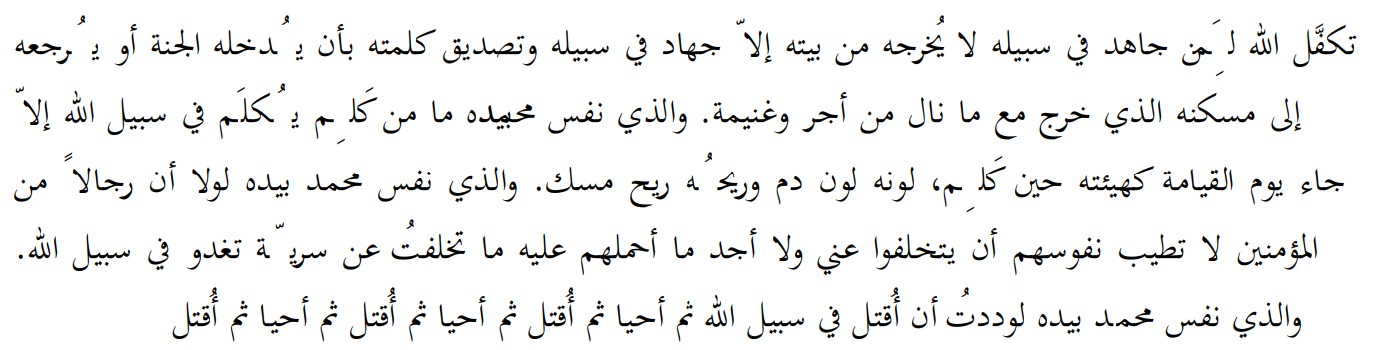
Allah anatoa dhamana ya usalama kwa yule anayekufa katika jihadi kwa njia yake, asiyeacha nyumba yake kwa sababu nyingine yoyote isipokuwa jihadi kwa njia yake na kwa kuamini maneno yake, kwamba atamwingiza Peponi au atamrudisha kwenye makazi yake aliyoondoka nayo, pamoja na alichopata cha thawabu au ngawira. Kwa Yule ambaye mkononi mwake mna roho ya Muhammad ﷺ, yeyote atakayejeruhiwa katika njia ya Allah hatakuja Siku ya Kiyama isipokuwa katika umbo lake alipojeruhiwa, rangi yake ikiwa rangi ya damu na harufu yake ikiwa harufu ya miski. Kwa Yule ambaye mkononi mwake mna roho ya Muhammad ﷺ, kama isingekuwa kwamba miongoni mwa Waumini kuna watu ambao roho zao hazifurahii kubaki nyuma yangu (ninapoenda), wala sipati kitu cha kuwabebea, nisingebaki nyuma ya msafara wowote unaotoka kwenda katika njia ya Allah asubuhi. Kwa Yule ambaye mkononi mwake mna roho ya Muhammad ﷺ, ningependa kufa katika njia ya Allah, kisha nifufuliwe kisha niuawe, kisha nifufuliwe kisha niuawe, kisha nifufuliwe kisha niuawe.
“Allah guarantees security for the one who dies jihad in His way, not leaving his house for any other reason except jihad in His way and believing in His words, that He will enter him into Paradise or return him to his abode from which he left together with what he achieved of reward or booty. By the One in whose hand lies the should of Muhammad, whoever is wounded in the way of Allah will not come on the Day of Judgement except in his form when he was wounded, his colour the colour of blood and his odour the odour of musk. By the one in whose hand lies the soul of Muhammad, were it not that there were men among the believers whose souls are not pleased to stay behind me (when I go) nor do I find that could carry them upon, I would not stay behind any expedition that goes out in the way of Allah in the morning. By the One in whose hand lies the soul of Muhammad, I would love to die in the way of Allah then I am resurrected then killed, then resurrected then killed, then resurrected then killed.”