1.1 Die geistige Notwendigkeit des Prophetentums
1.1 The Spiritual Necessity Of Prophethood
In uns allen lebt eine ruhelose Sehnsucht nach geistiger Erfüllung. Wird sie ignoriert, erleidet der Geist heftige Durstzustände, die ihn von einer Fata Morgana zur nächsten treiben, von denen jede ihm für einen Augenblick die Hoffnung auf eine Oase schenkt, bevor die nächste Enttäuschung folgt. Das ist die Tragödie der menschlichen Existenz, wann immer sie innerlichen Frieden in der äußeren Welt sucht oder sich durch fleischliche Begierden selbst verwirklichen will, obwohl sie geschaffen wurde, um all dies zu übersteigen und einem höheren Zweck zu dienen:
Within us all is a restless craving for spiritual fulfillment. When ignored, the spirit experiences intense thirsts which send it chasing one mirage after another, each offering it momentary hope of an oasis before yet another letdown. This is the tragedy of the human condition whenever it seeks inner peace from the outer world, or seeks to self-actualize through carnal pursuits, when it was created to transcend all that for a higher purpose:
aufrichtige Hingabe an Gott. Allah sagt im Qur'an: {Und Ich habe die Dschinn und die Menschen nur erschaffen, damit sie Mir dienen.}16
sincere devotion to God. Allah says in the Qur’an, “And I did not create the jinn and mankind except to worship Me.”16
Die Dienerschaft gegenüber Gott, nicht nur das angeborene Wissen um Seine Existenz, ist daher nicht nur eine Pflicht, sondern auch ein grundlegendes menschliches Bedürfnis. Sie ist notwendig, um unseren Geist zu nähren, so wie Nahrung und Sauerstoff notwendig sind, um unseren Körper zu nähren. Sie stimmt uns auf unsere Wirklichkeit ein, als geistige Wesen in physischen Körpern, und nicht als physische Wesen, die zufällig eine geistige Dimension genießen. Natürlich ist all das nicht möglich, ohne dass der Schöpfer durch Propheten zu uns spricht und uns zeigt, wie wir eine sinnvolle Beziehung zu Ihm haben können. Ohne diese Kommunikation wären wir nicht in der Lage, Ihn auf tieferer Ebene zu erkennen und zu lieben, und nur dadurch, dass wir für Ihn leben, erfahren wir, was es wirklich bedeutet, lebendig zu sein. Wie der Prophet Muhammad ﷺ einst sagte: „Das Gleichnis dessen, der Allah gedenkt, und dessen, der Allah nicht gedenkt, ist das des Lebenden und des Toten.“17
Servitude to God, not just the inborn recognition of His existence, is therefore not only a duty but also a fundamental human need. It is necessary to nourish our spirit just as food and oxygen are necessary to nourish our body. It attunes us to our reality as spiritual beings in physical bodies, not physical beings that happen to enjoy a spiritual dimension. Of course, none of that is possible without the Creator communicating to us through prophets how to have a meaningful relationship with Him. Without this communication, we would be unable to know and love Him on deeper levels, and it is only through living for Him that we experience what it truly means to be alive. As the Prophet Muhammad صلى الله عليه وسلم once said, “The similitude of someone who is mindful of Allah and someone not mindful of Allah is that of the living and the dead.”17
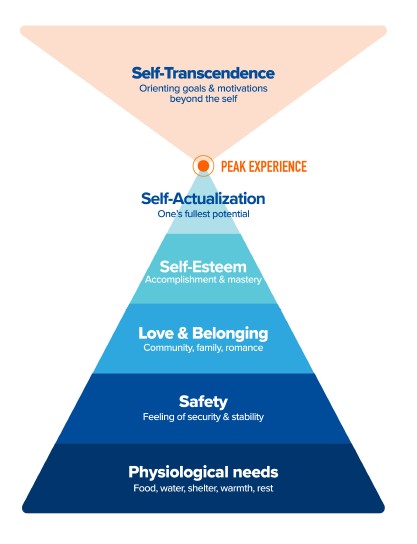
Als Abraham Maslow seine berühmte Bedürfnishierarchie überarbeitete, stellte er das Streben nach Selbsttranszendenz als die stärkste aller Motivationen dar, noch über der Selbstverwirklichung.18
When Abraham Maslow amended his famous hierarchy of needs, he set the desire for self-transcendence as the greatest motivator of them all, above self-actualization.18
Doch ohne die Propheten und die göttliche Offenbarung bleibt selbst diese Einsicht einigermaßen unbelehrend. Sie lässt zu, dass Vorstellungen wie der Monismus (das Eins-Sein mit dem Universum) oder der Altruismus (das Selbstlose-Sein) fälschlicherweise als ebenso erfüllend empfunden werden wie die Hingabe an Gott. Altruistisch eingestellte Menschen berichten häufig von einer höheren Lebenszufriedenheit, und das ist zu erwarten, da Selbstlosigkeit per Definition ein transzendenteres Ziel ist als Selbstbezogenheit.
However, without the prophets and divine revelation, even that insight remains somewhat uninstructive. It allows for notions such as monism (being one with the universe) or altruism (being selfless) to be misperceived as equally fulfilling as devotion to God. Altruistic people often report higher life satisfaction, and that is expected since being selfless is, by definition, a more transcendent purpose than being self-centered.
Doch das wesentliche Bedürfnis nach Selbsttranszendenz wird niemals vollständig gestillt werden durch bloße Hingabe an beliebige Ziele, die größer sind als man selbst (etwa den Dienst an der menschlichen Gemeinschaft). Es gibt eine einzigartige Seelenruhe, die ganz und gar von der Hingabe an das absolut Größte abhängt: den Allmächtigen. Der Dienst an anderen kann Teil davon sein, kann jedoch niemals an ihre Stelle treten, wie Allah sagt: „Gewiss, nur durch das Gedenken an Allah finden die Herzen Ruhe.“19 Ibn al-Qayyim (gest. 1350), ein angesehener muslimischer Theologe, schreibt: „Im Herzen existiert eine Unruhe, die nichts zu beruhigen vermag außer der Annäherung an Gott. Und eine Einsamkeit legt sich über es, die nichts vertreiben kann außer dem Genuss Seiner ...
But the essential need to self-transcend will never be fully satisfied by just any involvement in ends greater than oneself (such as serving the human collective). There is a unique tranquillity that hinges squarely on one’s devotion to the absolute greatest: the Almighty. Serving others can be part of that, but can never replace it, as Allah says, “Unquestionably, it is only by the remembrance of Allah that hearts are assured.”19 Ibn al-Qayyim (d. 1350), a renowned Muslim theologian, writes, In the heart, there exists an anxiousness that nothing can calm but drawing nearer to God. And a loneliness overcasts it that nothing can remove but enjoying His
company in private. Und in ihm wohnt eine Traurigkeit, die nichts lindern kann außer der Freude daran, Ihn zu kennen, und dem aufrichtigen Sich-Hingeben an Ihn. Und eine Sorge beunruhigt es, die nichts beruhigen kann außer dem Ausrichten auf Ihn und dem Fliehen von Ihm zu Ihm. Und die Flammen der Reue lodern unablässig in ihm, und nichts kann sie löschen außer dem Zufriedenwerden mit Seinen Geboten, Verboten und Seiner Bestimmung und dem geduldigen Festhalten an alledem bis zu dem Zeitpunkt, an dem man Ihm begegnet. Und in ihm besteht ein drängendes Verlangen; es hört nicht auf, bis Er allein sein Streben wird. Und in ihm herrscht eine dringende Not; nichts wird sie stillen außer Ihn zu lieben, Seiner ständig zu gedenken und Ihm aufrichtig ergeben zu sein. Und selbst wenn einem Menschen diese ganze Welt mit allem, was sie enthält, gegeben würde, würde sie diese Not niemals stillen.20
company in private. And a sadness dwells within it that nothing can alleviate but the joy of knowing Him and genuinely devoting oneself to Him. And a worry unsettles it that nothing can reassure but focusing on Him and fleeing from Him to Him. And the flames of regret continue to flare inside it, and nothing can extinguish them but becoming content with His commands, prohibitions, and destiny, and patiently holding onto all that until the time one meets Him. And in it exists a pressing demand; it will not stop until He alone becomes its pursuit. And in it is a dire need; nothing will satisfy it except loving Him, constantly remembering Him, and being sincerely devout to Him. And if a person were given this entire world and all it contains, it would never fulfill that need.20
Um diese psychospirituelle Tragödie abzuwenden und für den allmächtigen Gott zu leben, ist das Prophetentum eine existenzielle Notwendigkeit. Derselbe barmherzigste Gott, der uns alles gewährt hat, was wir auf diesem Planeten für das Leben und das, was es erhält, brauchen, hat uns durch das Prophetentum das gesichert, was wir am dringendsten brauchen: die Rechtleitung zu Ihm und Sein Wohlgefallen in diesem Leben und im Jenseits.
Hence, to avert this psychospiritual tragedy, and to live for Almighty God, prophethood is an existential necessity. The same most compassionate God who afforded us all we need on this planet for life and what sustains it, has ensured for us through prophethood what we need most: guidance to Him and His pleasure in this life and the next.
16 Der Koran 51:56, Saheeh-International-Übersetzung.
16 The Qur’an 51:56, Saheeh International Translation.
17 al-Bukhārī, Ṣaḥīḥ al-Bukhārī, 8:86 #6407; Muslim ibn al-Ḥajjāj al-Qushayrī, Ṣaḥīḥ Muslim (Beirut: Dār Iḥyāʼ al-Kutub al-ʻArabīyah, 1955), 1:539 #779.
17 al-Bukhārī, Ṣaḥīḥ al-Bukhārī, 8:86 #6407; Muslim ibn al-Ḥajjāj al-Qushayrī, Ṣaḥīḥ Muslim (Beirut: Dār Iḥyāʼ al-Kutub al-ʻArabīyah, 1955), 1:539 #779.
18 Lloyd Greene und George Burke, „Beyond Self-Actualization“, Journal of Health and Human Services Administration (2007): 116-128.
18 Lloyd Greene and George Burke, “Beyond Self-Actualization,” Journal of Health and Human Services Administration (2007): 116-128.
19 Der Koran 13:28, Saheeh International Übersetzung.
19 The Qur’an 13:28, Saheeh International Translation.
20 Ibn Qayyim al-Jawzīyah, Madārij al-Sālikīn Bayna Manāzil Īyāka Na’budu wa Īyāka Nasta’īn (Beirut: Dār al-Kutub al-ʻArabī, 1996), 3:156.
20 Ibn Qayyim al-Jawzīyah, Madārij al-Sālikīn Bayna Manāzil Īyāka Na’budu wa Īyāka Nasta’īn (Beirut: Dār al-Kutub al-ʻArabī, 1996), 3:156.