5.29 Muslime werden leichte Beute
5.29 Muslims Becoming Easy Prey
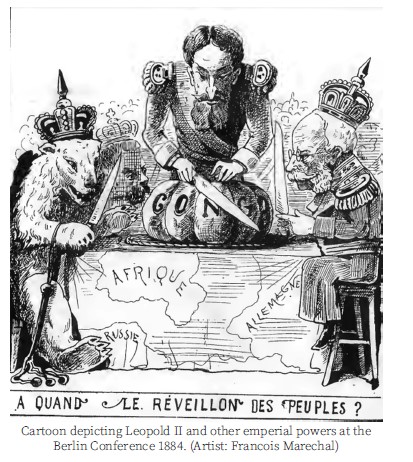
Der Prophet ﷺ prophezeite auch, dass die fleischlichen Begierden nicht nur seine Gemeinschaft befallen, sondern die Ursache ihres Niedergangs und ihrer Verwüstung sein würden. Thawbān berichtet, dass der Prophet ﷺ sagte: „Die Nationen werden bald einander dazu einladen, euch zu verschlingen, so wie Esser zu einer Speise eingeladen werden.“ Man fragte: „Wird es an unserer geringen Zahl an diesem Tag liegen?“ Er sagte: „Nein, vielmehr werdet ihr an jenem Tag zahlreich sein, aber ihr werdet wie Schaum sein, gewichtslos, wie der Schaum auf dem Fluss. Und Allah wird die Furcht vor euch aus den Herzen eurer Feinde nehmen und Schwäche in eure Herzen werfen.“ Jemand sagte: „O Gesandter Allahs, was wird diese Schwäche sein?“ Er sagte: „Die Liebe zu dieser Welt und die Abneigung gegen den Tod.“333 Es ist erstaunlich, dass vor etwa einem Jahrhundert König Leopold von Belgien sehr berühmt seine kolonialen Ambitionen als „diesen prächtigen afrikanischen Kuchen“ bezeichnete, den die europäischen Mächte während der Berliner Konferenz von 1884 nach Belieben zerschnitten. Man kann leicht die vielen politischen Karikaturen jener Zeit finden, die diese Konferenz in Begriffen von Essen darstellen, fast genau so, wie es der obige Hadith ausgesagt hatte.
The Prophet صلى الله عليه وسلم also prophesied that carnal pursuits would not only infect his nation but would be the cause of their downfall and devastation. Thawbān reports that the Prophet صلى الله عليه وسلم said, “The nations will soon invite one another to devour you, just as diners are invited to a dish.” It was said, “Will it be because of our small number on that day?” He said, “No, rather you will be many on that day, but you will be weightless foam, like the foam on the river. And Allah will remove the fear of you from the hearts of your enemies and will cast weakness into your hearts.” Someone said, “O Messenger of Allah, what will this weakness be?” He said, “The love of this world, and the hatred of death.”333 It is incredible how one century ago, King Leopold of Belgium very famously referred to his colonial ambitions as “this magnificent African cake,” which the European powers carved at will during the Berlin Conference of 1884. A person can easily find the many political cartoons of that day conceptualizing this conference in food terms, almost exactly like the hadith above had stated.
Dies lag zum Teil an König Leopolds Metapher, aber auch daran, dass die Teilnehmer nur dort waren, um die Aufteilung Afrikas förmlich festzuschreiben, in voller Überzeugung, dass der große und ressourcenreiche Kontinent keinem nennenswerten Widerstand gegen ihre unersättliche Gier und ihren imperialen Appetit standhalten könne.
This was in part due to King Leopold’s metaphor, but also because the attendees were only there to formalize the divisions of Africa, fully confident that the large and resourceful continent could not hold its weight in any meaningful resistance to their ravenous greed and imperial appetite.
Um diese Aussage zu bekräftigen, berichtet Anas ibn Mālik, dass der Prophet ﷺ sagte: „Wenn meine Gemeinschaft fünf Dinge für erlaubt hält, wird Verderben über sie hereinbrechen: wenn das gegenseitige Verfluchen aufkommt, Wein getrunken wird, Seide getragen wird, Musikinstrumente gespielt werden, und Männer sich mit Männern begnügen und Frauen sich mit Frauen begnügen.“334 Gewiss sind Muslime heute nicht gegen Ideologien gefeit, die gleichgeschlechtliche Handlungen akzeptieren. Dies ist sogar für einen praktizierenden, die Moschee besuchenden Muslim vorstellbar, wenn er seine Religiosität auf eine kulturelle Identität reduziert, wie der Prophet ﷺ in einem Hadith sagte, der von ‘Abdullah ibn ‘Amr überliefert ist: „Es wird ganz gewiss eine Zeit kommen, in der die Menschen sich in den Moscheen versammeln und beten, während unter ihnen nicht ein einziger Gläubiger ist.“335
Reinforcing this point, Anas ibn Mālik narrates that the Prophet صلى الله عليه وسلم said, “Once my nation considers five things permissible, then destruction will befall them: when cursing one another appears, wine is drunk, silk is worn, musical instruments are played, and men suffice themselves with men and women suffice themselves with women.”334 Certainly, Muslims today are not insulated from the ideologies that accept same-sex acts. This is even imaginable for a practicing, mosque-attending Muslim, if they allow their religiosity to be reduced to a cultural identity, as the Prophet صلى الله عليه وسلم said in a hadith narrated by ‘Abdullah ibn ‘Amr , “An age will surely come when people gather and pray in the mosques, while there is not a single believer amongst them.”335
333 Abū Dāwūd, Sunan Abī Dāwūd, 4:111 #4297; von al-Albānī in den Anmerkungen als authentisch bewertet.
333 Abū Dāwūd, Sunan Abī Dāwūd, 4:111 #4297; authenticated by al-Albāni in the comments.
334 Aḥmad ibn al-Ḥusayn al-Bayhaqī, Shuʿab al-Īmān (Riad: Maktabat al-Rushd lil-Nashr wal-Tawzīʿ, 2003), 7:328 Nr. 5084; ein ḥasan (annehmbarer) Überlieferungsstrang laut al-Albānī in Ṣaḥīḥ al-Targhīb wal-Tarhīb (Riad: Maktabat al-Maʿārif, 2000), 2:608 Nr. 2386.
334 Aḥmad ibn al-Ḥusayn al-Bayhaqī, Shu‘ab al-Īmān (Riyadh: Maktabat al-Rushd lil-Nashr wal-Tawzī’, 2003), 7:328 #5084; a ḥasan (acceptable) chain according to al-Albānī in Ṣaḥīḥ al-Targhīb wal-Tarhīb (Riyadh: Maktabat al-Maʻā rif, 2000), 2:608 #2386.
Obwohl diese Verbote hier absolut erscheinen, haben die Gelehrten sie unter Berücksichtigung ihrer kumulativen Betrachtung anderer prophetischer Überlieferungen eingeschränkt. So wird etwa das Verbot von Seide hier dadurch eingeschränkt, dass es nur für Männer gilt, und zwar bei erheblichen Mengen und in Abwesenheit einer Notwendigkeit. Ebenso betrachten die Gelehrten im Allgemeinen das Schlagen der Tamburin als Ausnahme vom Verbot der Musikinstrumente, zumindest gelegentlich, und einige erweitern das Zugeständnis noch weiter.
While these prohibitions appear absolute here, scholars have qualified them considering their cumulative read of other prophetic traditions. For instance, the prohibition of silk here is qualified by being applicable to men only, and in significant amounts, and in the absence of necessity. Similarly, scholars generally consider striking the tambourine an exception to the prohibition of musical instruments, at least on occasion, and some widen the concession further.
335 Abū Bakr ibn Abī Shaybah, Al-Īmān (Beirut: al-Maktab al-Islāmī, 1983), 1:40
335 Abū Bakr ibn Abī Shaybah, Al-Īmān (Beirut: al-Maktab al-Islāmī, 1983), 1:40
#101; von al-Albānī in den Anmerkungen als authentisch (ṣaḥīḥ) bestätigt.
#101; authenticated by al-Albānī in the comments.