2.2 Sa simplicité et son humilité
2.2 His Simplicity and Humility
Le mode de vie simple et austère du Prophète ﷺ est un indicateur majeur que sa mission ne pouvait être motivée par l'intérêt personnel, surtout lorsqu'on le compare aux modes de vie décadents et extravagants de tant de faux prophètes dans l'histoire du monde. Après tout, il s'agissait d'un homme qui contrôlait toute l'Arabie à la fin de sa vie. Même avant cela, il avait des milliers de disciples à Madinah, des disciples qui étaient passionnés par lui et auraient tout fait au monde pour lui. Pourtant, nous ne voyons aucun signe de luxe dans aucun aspect de sa vie.
The simple, austere lifestyle of the Prophet صلى الله عليه وسلم is a major indication that his mission could not have been self-serving, especially when contrasted with the decadent, extravagant lifestyles of so many false prophets in world history. After all, this was a man who controlled all of Arabia by the end of his life. Even before that, he had thousands of followers in Madinah, followers who obsessed over him and would have done anything in the world for him. Yet, we see no signs of luxury in any sphere of his life.
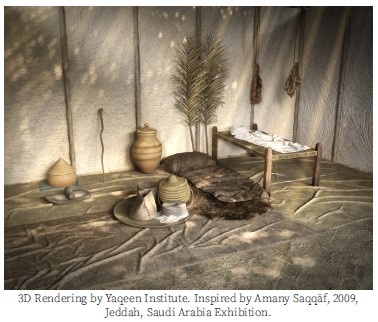
Ses quartiers étaient si exigus que lorsqu'il ﷺ souhaitait prier, il tapotait ‘Āishah pour qu'elle plie ses jambes afin de lui faire de la place pour se prosterner. Pour boire ou se laver, il tendait la main vers la petite outre en cuir qui pendait dans sa chambre. Pendant des mois entiers, aucun feu n'était allumé pour cuisiner dans sa maison, et sa famille se contentait de dattes et d'eau, à moins que quelqu'un ne leur offre du lait.58 ‘Umar ibn al-Khattāb rapporte qu'il entra un jour dans la chambre du Messager d'Allah ﷺ pour le trouver allongé et remarqua que la rudesse de la natte de paille sous lui avait laissé des marques sur son flanc. En remarquant cela, ainsi que les maigres rations d'orge et de feuilles, et le sac en cuir suspendu dans le coin, ses yeux se remplirent de larmes. Le Prophète ﷺ dit : « Qu'est-ce qui te fait pleurer, ô fils d'al-Khaṭṭāb ? » Il répondit : « Ô Prophète d'Allah, comment ne pourrais-je pas pleurer après avoir vu comment la natte a laissé ces marques sur votre flanc, et combien peu vous avez dans votre garde-manger ? César et Chosroès vivent entourés de fruits et de sources d'eau, alors que vous êtes le Messager de Dieu et Son élu, et pourtant voici votre condition. » Le Prophète ﷺ dit : « Ô fils d'al-Khaṭṭāb, cela ne te réjouit-il pas que ces [luxes] soient pour nous dans l'Au-delà et pour eux dans ce monde ? » Je dis : « Bien sûr. »59 Dans une autre narration, il commença sa réponse par : « Es-tu dans le doute, ô fils d'al-Khaṭṭāb ? Ce sont des gens dont les plaisirs ont été précipités dans la vie de ce monde. »60
His living quarters were so tight that when he صلى الله عليه وسلم wished to pray, he would tap ‘Āishah to bend her legs to make room for him to prostrate. To drink or bathe, he would reach for the small leather water skin that hung in his room. For months on end, no fire would be kindled for cooking in his home, and his family was content with dates and water unless someone gifted them some milk.58 ‘Umar ibn al-Khattāb reports that he once entered the room of the Messenger of Allah صلى الله عليه وسلم to find him lying down and noticed that the coarseness of the straw mat under him had left marks on his side. Upon noticing that, and the meager rations of barley and leaves, and the leather bag hanging in the corner, his eyes welled with tears. The Prophet صلى الله عليه وسلم said, “What makes you weep, O son of al-Khaṭṭāb?” He said, “O Prophet of Allah, how can I not cry after seeing how the mat has left these marks on your side, and how little you have in your food cupboard? Caesar and Chosroes live surrounded by fruits and springs of water, while you are the Messenger of God and His chosen one, and yet this is your condition.” The Prophet صلى الله عليه وسلم said, “O son of al-Khaṭṭāb, does it not please you that these [luxuries] are for us in the Hereafter and for them in this world?” I said, “Of course.”59 In another narration, he began his response with, “Are you in doubt, O son of al-Khaṭṭāb? These are a people whose pleasures have been expedited in the life of this world.”60
58 al-Bukhārī, Ṣaḥīḥ al-Bukhārī, 8:97 #6459.
58 al-Bukhārī, Ṣaḥīḥ al-Bukhārī, 8:97 #6459.
59 Muslim, Ṣaḥīḥ Muslim, 2:1105 #1479.
59 Muslim, Ṣaḥīḥ Muslim, 2:1105 #1479.
60 al-Bukhārī, Ṣaḥīḥ al-Bukhārī, 3:133 #2468.
60 al-Bukhārī, Ṣaḥīḥ al-Bukhārī, 3:133 #2468.
61 Edward Gibbon, Decline and Fall of the Roman Empire: Volume the Fifth (London:
61 Edward Gibbon, Decline and Fall of the Roman Empire: Volume the Fifth (London:
Electric Book Co, 2001), chapitre L, 252.
Electric Book Co, 2001), chapter L, 252.
62 Ibid., 251-252.
62 Ibid., 251-252.
63 Washington Irving et Bertram R. Davis, The Life of Mahomet (Londres : G.
63 Washington Irving and Bertram R. Davis, The Life of Mahomet (London: G.
Routledge & Co, 1850), 186-187.
Routledge & Co, 1850), 186-187.
64 Ibid., 203.
64 Ibid., 203.
65 al-Tirmidhī, Sunan al-Tirmidhī, 5:90 #2754 ; authentifié par al-Tirmidhī dans les commentaires.
65 al-Tirmidhī, Sunan al-Tirmidhī, 5:90 #2754; authenticated by al-Tirmidhī in the comments.
66 Bosworth Smith, Mohammed and Mohammedanism (London: Smith, Elder, and Co., 1874), 235.
66 Bosworth Smith, Mohammed and Mohammedanism (London: Smith, Elder, and Co., 1874), 235.
67 Muslim, Ṣaḥīḥ Muslim, 1:1 #8.
67 Muslim, Ṣaḥīḥ Muslim, 1:1 #8.