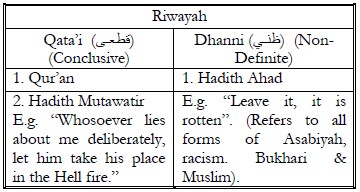
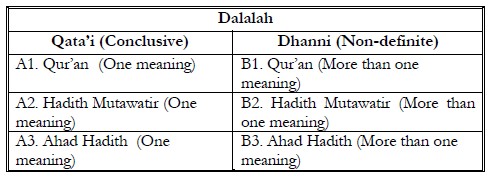
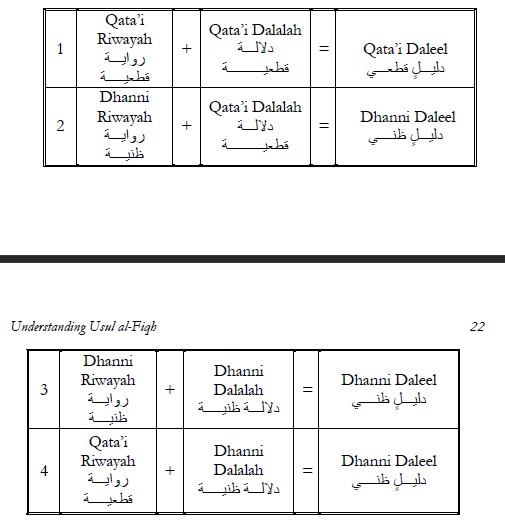
Toute idée, pensée ou concept lié au fait que la croyance (Aqeedah) doit être fondée sur une preuve (Daleel) certaine (Qata'i). Par exemple, le concept selon lequel les Anges existent est fondé sur une preuve (Daleel) certaine (Qata'i) et non conjecturale (Dhanni). De même, en fondements de la jurisprudence (Usul al-Fiqh), pour établir une source d'extraction des règles selon l'avis le plus fort, la source doit également se fonder sur une preuve (Daleel) certaine (Qata'i).
Any idea, thought, or concept related to the „Aqeedah has to be based upon a Qata‟i Daleel. As an example, the concept that Angels exists is based upon a Qata‟i Daleel not Dhanni. Also, in Usul al-Fiqh, to establish a source for extracting rulings according to the strongest view, the source must base upon a Qata‟i Daleel as well.
Par exemple, pour considérer l'Ijma’ as-Sahabah (consensus des Compagnons) comme une source de règles, la preuve (Daleel) pour établir l'autorité de l'Ijma’ as-Sahabah doit être Qata’i tant au niveau de la Riwayah que de la Dalalah, bien qu'une règle puisse être dérivée d'une preuve Qata’i ou Dhanni.
As an example, to consider Ijma‟ as-Sahabah (consensus of the Companions) as a source of rulings, the Daleel to prove the authority of Ijma‟ as-Sahabah has to be Qata‟i both in Riwayah and Dalalah, though a ruling can be derived from either Qata‟i or Dhanni Daleel.
On pourrait se demander pourquoi la compréhension du texte du Qur'an et de la sunna est si complexe ?
One might wonder why understanding the text of Qur‟an and Sunnah is so complicated?
En examinant le texte du Coran et de la sunna, on peut constater que son volume est limité. Avec son texte limité, on peut générer des règles pour n'importe quel problème nous affectant, n'importe où et n'importe quand, jusqu'au Jour du Jugement.
By examining the text of Qur‟an and Sunnah one can see that it is limited in its volume. With its limited text one can generate rulings to any problems affecting us anywhere and anytime until the Day of Judgment.
C'est un miracle d'Allah (SWT) que les textes du Coran et de la sunna aient la capacité d'exprimer de nombreuses règles à partir d'un seul verset (Ayah) et d'un seul hadith ; alors que la capacité de comprendre de nombreux sens à partir d'un seul texte ne peut être trouvée dans aucun autre texte juridique au monde ! Le défi pour les musulmans de chaque génération est de tenter de comprendre le texte et de le relier à leur vie, puisque le Coran et la sunna sont pertinents pour tous les temps et tous les lieux.
It is a miracle from Allah (swt) that the texts of the Qur‟an and Sunnah have the ability to express numerous rulings from a single Ayah and Hadith; whereas, the ability to understand many meanings from a single text cannot be found in any other legal text in the world! The challenge is for Muslims in each generation to try to understand the text and relate it to their lives since the Qur‟an and Sunnah are relevant to all times and places.
Outre le point mentionné ci-dessus, nous devons réaliser qu'il existe des règles et des directives relatives à la compréhension et à la dérivation des lois à partir du Qur'an et de la sunna. Personne, sans être initié à ces règles (langue arabe, règles qui différencient un type de texte d'un autre, etc.), ne peut comprendre le texte du Qur'an et de la sunna.
Besides the point mentioned above, we have to realise that there are rules and guidelines related to understanding and deriving laws from the Qur‟an and Sunnah. No one, without being acquainted with these rules (Arabic language, rules which differentiate one type of text from another, etc.) can understand the text of Qur‟an and Sunnah.
Même pour comprendre les constitutions humaines, il faut consacrer quelques années à l'étude et à la compréhension du texte. Dès lors, comment pouvons-nous attendre d'un individu qui ne connaît pas les fondements de la jurisprudence (Usul al-Fiqh) d'ouvrir le Coran et la sunna pour commencer à en extraire des lois ?
Even to understand man-made constitutions, one has to spend a few years studying and understanding the text. So, how can we expect an individual who is unfamiliar with the Usul al-Fiqh to open up the Qur‟an and Sunnah and start extracting laws from it?