4.3 Termes de base dans le hadith
4.3 Basic Terms in Hadith
• Sanad : ( ع ٕذ ) Une chaîne de transmission (Isnad) remontant jusqu'au Prophète ﷺ.
• Sanad: ( ع ٕذ ) A chain of reporters leading back to the Prophet (saw).
• Tabaqah : (غرمس) Une classe de rapporteurs de la même génération, c'est-à-dire les compagnons (Sahabah), les Tabi'een.
• Tabaqah: (غرمس ) A class of reporters in the same generation, i.e. Sahabah, Tabi‟een.
• Marfu’ : ( شِفٛع ) Un hadith dont la chaîne de transmission (Isnad) remonte au Prophète ﷺ.
• Marfu‟: ( شِفٛع ) A Hadith whose Sanad leads to the Prophet (saw).
• Mawquf : (موقوف) Un hadith dont la chaîne de transmission (Isnad) s'arrête à un compagnon (Sahabah).
• Mawquf: (ِٛلٛف ) A Hadith whose Sanad ends with a Sahabi.
• Mursal : (شِعً ) Un hadith qui remonte au Prophète ﷺ mais dont le nom du compagnon (Sahabah) qui l'a rapporté est manquant.
• Mursal: (شِعً ) A Hadith leading to the Prophet (saw) but missing the name of the Sahabi who reported it.
• Qudsi : (لذعٟ ) Un hadith dont la chaîne de transmission (Isnad) remonte au Prophète ﷺ et le Prophète ﷺ le rapporte d'Allah (SWT).
• Qudsi: (لذعٟ ) A Hadith whose Sanad leads to Prophet (saw) and the Prophet (saw) is reporting it from Allah (swt).
Le rapport d'un hadith qudsi peut commencer de l'une des deux manières suivantes :
The report of Hadith Qudsi can begin in one of two ways:
a) Le Prophète ﷺ dit, rapportant d'Allah (SWT).
a) The Prophet (saw) says reporting from Allah (swt).
b) Allah (SWT) a dit, tel que rapporté par Son Messager ﷺ.
b) Allah (swt) has said as reported by His Messenger (saw).
Types de hadith :
Types of Hadith:
Différents types de hadiths existent en raison de la méthode de transmission, du nombre de rapporteurs dans chaque chaîne et de l'authenticité du hadith.
Different types of Ahadith exist due to the method of transmission, number of reporters in each class, and the authenticity of the Hadith.
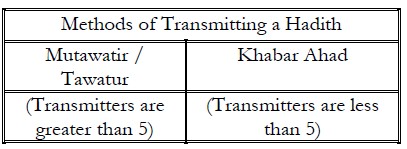
Mutawatir / Tawatur : une preuve (Daleel) transmise par un nombre indéterminé de personnes. En raison du grand nombre de personnes rapportant la preuve (Daleel) et de la diversité de leurs lieux de résidence, de leur fiabilité et de leurs convictions, il est inconcevable que cette preuve (Daleel) puisse être fabriquée.
Mutawatir / Tawatur: a Daleel transmitted by an indefinite number of people. Due to the large number of people reporting the Daleel and their diversity of residence, reliability, and conviction, it is inconceivable that this Daleel could be fabricated.
Le nombre minimum de rapporteurs requis pour classer une preuve (Daleel) comme transmis par de multiples voies (Mutawatir) est généralement de cinq. Cependant, certains savants peuvent avoir des critères plus stricts. Le caractère des rapporteurs narrant des hadiths Mutawatir doit être noble.
The minimum number of transmitters that are required to classify a Daleel as Mutawatir is generally five. However, some scholars may have more stringent criteria. The character of the reporters narrating Mutawatir Ahadith has to be noble.
Ahad : (آقحد) La Riwayah Ahad est un nombre inférieur au transmis par de multiples voies (Mutawatir).
Ahad: (آقحد ) Riwayah Ahad is a number less than the Mutawatir.
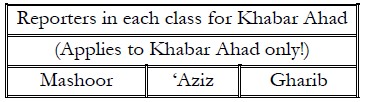
Mashoor : Un hadith rapporté par au moins trois individus à chaque génération (compagnons (Sahabah), Tabi’een, etc.).
Mashoor: A Hadith reported by at least three individuals in every class (Sahabah, Tabi‟een, etc.).
'Aziz : un hadith rapporté par au moins deux individus à chaque niveau.
„Aziz: A Hadith reported by at least two individuals in every class.
Gharib : un hadith rapporté par un seul individu dans une ou plusieurs chaînes de transmission.
Gharib: A Hadith reported by only one individual in one or more classes.
Authentique :
Sahih:
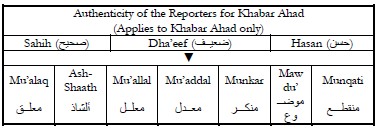
Un hadith rapporté par une personne 'Adl (non connue pour ses manquements) et Daabit (qui maintient l'exactitude du rapport) de la part d'une autre personne possédant des qualités similaires jusqu'à la fin du rapport. Le rapport doit également exclure tout Shudhudh (désaccord avec d'autres rapporteurs crédibles).
A Hadith narrated by an „Adl (not known for misconduct) and Daabit (maintains accuracy of the report) person from another person of similar qualities until the end of the report. The report should also exclude any Shudhudh (disagreement with other credible reporters).
Hasan :
Hasan:
Il a deux définitions :
It has two definitions:
a) Un hadith, qui répond aux exigences de Sahih à un degré moindre.
a) A Hadith, which meets the requirements of Sahih to a lesser degree.
b) Un hadith, qui est acceptable par la majorité des juristes (Fuqaha).
b) A Hadith, which is acceptable by the majority of the Fuqaha.
Dha‟eef :
Dha‟eef:
Un hadith faible qui ne remplit les conditions ni du hadith sahih ni du hadith hasan, il peut être l'un des suivants :
A weak Hadith which does not meet the requirement of either the Sahih or the Hasan Hadith, it can be one of the following:
Mu‟alaq : un hadith auquel il manque un ou plusieurs rapporteurs, que ce soit au début de la chaîne de transmission (Isnad), au milieu ou à la fin.
Mu‟alaq: A Hadith which is missing one or more reporters either at the beginning of the Isnad, in the middle or in the end.
Mu‟addal : hadith auquel il manque deux rapporteurs consécutifs ou plus.
Mu‟addal: Hadith which is missing two or more consecutive reporters.
Munqati : un hadith qui présente une interruption dans sa chaîne de transmission.
Munqati: A Hadith which has interruption in the class.
Ash-Shaath : un hadith dans lequel un rapporteur crédible rapporte quelque chose qui contredit d'autres rapporteurs crédibles.