1.1 A Necessidade Espiritual da Profecia
1.1 The Spiritual Necessity Of Prophethood
Dentro de todos nós existe um anseio inquieto por realização espiritual. Quando ignorado, o espírito experimenta sedes intensas que o lançam em busca de uma miragem após outra, cada uma oferecendo-lhe a esperança momentânea de um oásis, antes de mais uma decepção. Esta é a tragédia da condição humana sempre que ela busca a paz interior no mundo exterior, ou procura realizar-se através de prazeres carnais, quando foi criada para transcender tudo isso em vista de um propósito mais elevado:
Within us all is a restless craving for spiritual fulfillment. When ignored, the spirit experiences intense thirsts which send it chasing one mirage after another, each offering it momentary hope of an oasis before yet another letdown. This is the tragedy of the human condition whenever it seeks inner peace from the outer world, or seeks to self-actualize through carnal pursuits, when it was created to transcend all that for a higher purpose:
devoção sincera a Deus. Allah diz no Alcorão: "E Eu não criei os jinn e os humanos senão para que Me adorassem."16
sincere devotion to God. Allah says in the Qur’an, “And I did not create the jinn and mankind except to worship Me.”16
A servidão a Deus, e não apenas o reconhecimento inato da Sua existência, é, portanto, não só um dever, mas também uma necessidade humana fundamental. É necessária para nutrir o nosso espírito da mesma forma que a comida e o oxigênio são necessários para nutrir o nosso corpo. Ela nos sintoniza com a nossa realidade como seres espirituais em corpos físicos, e não como seres físicos que, por acaso, desfrutam de uma dimensão espiritual. É claro que nada disso seria possível sem que o Criador se comunicasse conosco, por meio dos profetas, ensinando-nos como ter um relacionamento significativo com Ele. Sem essa comunicação, não seríamos capazes de conhecê-Lo e amá-Lo em níveis mais profundos, e é somente vivendo para Ele que experimentamos o que significa verdadeiramente estar vivo. Como disse certa vez o Profeta Muhammad ﷺ: “A semelhança entre quem se lembra de Allah e quem não se lembra de Allah é a de quem está vivo e a de quem está morto.”17
Servitude to God, not just the inborn recognition of His existence, is therefore not only a duty but also a fundamental human need. It is necessary to nourish our spirit just as food and oxygen are necessary to nourish our body. It attunes us to our reality as spiritual beings in physical bodies, not physical beings that happen to enjoy a spiritual dimension. Of course, none of that is possible without the Creator communicating to us through prophets how to have a meaningful relationship with Him. Without this communication, we would be unable to know and love Him on deeper levels, and it is only through living for Him that we experience what it truly means to be alive. As the Prophet Muhammad صلى الله عليه وسلم once said, “The similitude of someone who is mindful of Allah and someone not mindful of Allah is that of the living and the dead.”17
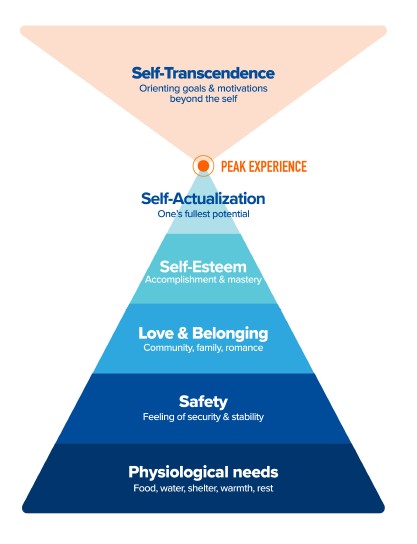
Quando Abraham Maslow reformulou sua famosa hierarquia de necessidades, ele colocou o desejo de autotranscendência como o maior motivador de todos, acima da autorrealização.18
When Abraham Maslow amended his famous hierarchy of needs, he set the desire for self-transcendence as the greatest motivator of them all, above self-actualization.18
No entanto, sem os profetas e a revelação divina, mesmo essa percepção permanece de certo modo pouco instrutiva. Ela permite que noções como o monismo (estar unido ao universo) ou o altruísmo (ser desinteressado) sejam percebidas erroneamente como igualmente satisfatórias quanto à devoção a Deus. Pessoas altruístas relatam frequentemente maior satisfação com a vida, e isso é o esperado, uma vez que ser desinteressado é, por definição, um propósito mais transcendente do que ser centrado em si mesmo.
However, without the prophets and divine revelation, even that insight remains somewhat uninstructive. It allows for notions such as monism (being one with the universe) or altruism (being selfless) to be misperceived as equally fulfilling as devotion to God. Altruistic people often report higher life satisfaction, and that is expected since being selfless is, by definition, a more transcendent purpose than being self-centered.
Mas a necessidade essencial de autotranscendência jamais será plenamente satisfeita por qualquer envolvimento em fins maiores que si mesmo (como servir à coletividade humana). Existe uma tranquilidade única que depende, de forma direta, da devoção ao Absolutamente Maior: Allah. Servir aos outros pode fazer parte disso, mas nunca pode substituí-la, como diz Allah: {Por certo, é somente com a lembrança de Allah que os corações se tranquilizam.}19 Ibn al-Qayyim (m. 1350), renomado teólogo muçulmano, escreve: No coração existe uma inquietação que nada pode acalmar senão a aproximação de Deus. E uma solidão o envolve, a qual nada pode remover senão o deleite em Sua
But the essential need to self-transcend will never be fully satisfied by just any involvement in ends greater than oneself (such as serving the human collective). There is a unique tranquillity that hinges squarely on one’s devotion to the absolute greatest: the Almighty. Serving others can be part of that, but can never replace it, as Allah says, “Unquestionably, it is only by the remembrance of Allah that hearts are assured.”19 Ibn al-Qayyim (d. 1350), a renowned Muslim theologian, writes, In the heart, there exists an anxiousness that nothing can calm but drawing nearer to God. And a loneliness overcasts it that nothing can remove but enjoying His
company in private. E há uma tristeza que nele habita e que nada pode aliviar senão a alegria de conhecê-Lo e de genuinamente se devotar a Ele. E há uma preocupação que o inquieta e que nada pode tranquilizar senão concentrar-se n'Ele e fugir d'Ele para Ele. E as chamas do arrependimento continuam a arder em seu interior, e nada pode extingui-las senão contentar-se com os Seus mandamentos, Suas proibições e Seu decreto, e perseverar pacientemente em tudo isso até o dia em que se encontre com Ele. E nele existe uma exigência premente; ela não cessará até que somente Ele se torne o seu objetivo. E nele há uma necessidade extrema; nada a satisfará senão amá-Lo, lembrar-se constantemente d'Ele e ser sinceramente devoto a Ele. E ainda que se desse a uma pessoa todo este mundo e tudo o que nele existe, essa necessidade jamais seria preenchida.20
company in private. And a sadness dwells within it that nothing can alleviate but the joy of knowing Him and genuinely devoting oneself to Him. And a worry unsettles it that nothing can reassure but focusing on Him and fleeing from Him to Him. And the flames of regret continue to flare inside it, and nothing can extinguish them but becoming content with His commands, prohibitions, and destiny, and patiently holding onto all that until the time one meets Him. And in it exists a pressing demand; it will not stop until He alone becomes its pursuit. And in it is a dire need; nothing will satisfy it except loving Him, constantly remembering Him, and being sincerely devout to Him. And if a person were given this entire world and all it contains, it would never fulfill that need.20
Portanto, para evitar esta tragédia psicoespiritual e viver para Deus Todo-Poderoso, a profecia é uma necessidade existencial. O mesmo Deus, o Mais Misericordioso, que nos proporcionou tudo o que precisamos neste planeta para a vida e para aquilo que a sustenta, assegurou-nos, por meio da profecia, aquilo de que mais necessitamos: a orientação para Ele e o Seu agrado nesta vida e na próxima.
Hence, to avert this psychospiritual tragedy, and to live for Almighty God, prophethood is an existential necessity. The same most compassionate God who afforded us all we need on this planet for life and what sustains it, has ensured for us through prophethood what we need most: guidance to Him and His pleasure in this life and the next.
16 O Alcorão 51:56, Tradução Saheeh International
16 The Qur’an 51:56, Saheeh International Translation.
17 al-Bukhārī, Ṣaḥīḥ al-Bukhārī, 8:86 #6407; Muslim ibn al-Ḥajjāj al-Qushayrī, Ṣaḥīḥ Muslim (Beirut: Dār Iḥyāʼ al-Kutub al-ʻArabīyah, 1955), 1:539 #779.
17 al-Bukhārī, Ṣaḥīḥ al-Bukhārī, 8:86 #6407; Muslim ibn al-Ḥajjāj al-Qushayrī, Ṣaḥīḥ Muslim (Beirut: Dār Iḥyāʼ al-Kutub al-ʻArabīyah, 1955), 1:539 #779.
18 Lloyd Greene e George Burke, "Beyond Self-Actualization", Journal of Health and Human Services Administration (2007): 116-128.
18 Lloyd Greene and George Burke, “Beyond Self-Actualization,” Journal of Health and Human Services Administration (2007): 116-128.
19 O Alcorão 13:28, Tradução Saheeh International.
19 The Qur’an 13:28, Saheeh International Translation.
20 Ibn Qayyim al-Jawzīyah, Madārij al-Sālikīn Bayna Manāzil Īyāka Na’budu wa Īyāka Nasta’īn (Beirute: Dār al-Kutub al-ʻArabī, 1996), 3:156.
20 Ibn Qayyim al-Jawzīyah, Madārij al-Sālikīn Bayna Manāzil Īyāka Na’budu wa Īyāka Nasta’īn (Beirut: Dār al-Kutub al-ʻArabī, 1996), 3:156.