5.29 Muçulmanos se tornando presas fáceis
5.29 Muslims Becoming Easy Prey
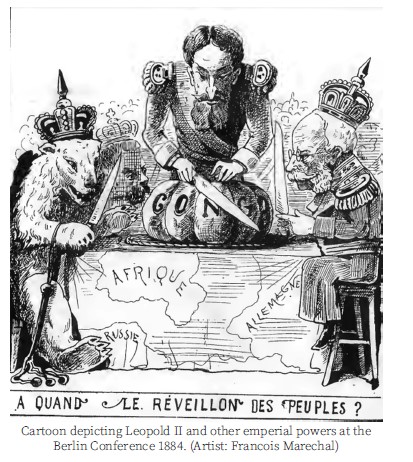
O Profeta ﷺ também profetizou que os desejos carnais não apenas infectariam a sua nação, mas seriam a causa de sua queda e devastação. Thawbān relata que o Profeta ﷺ disse: “As nações em breve convidarão umas às outras para devorarem vocês, assim como os comensais são convidados para um prato.” Perguntaram: “Será por causa do nosso pequeno número naquele dia?” Ele disse: “Não, pelo contrário, naquele dia vocês serão muitos, mas serão como espuma sem peso, como a espuma do rio. E Allah tirará o temor de vocês dos corações de seus inimigos e lançará a fraqueza em seus corações.” Alguém disse: “Ó Mensageiro de Allah, o que será essa fraqueza?” Ele disse: “O amor por este mundo e o ódio pela morte.”333 É incrível como, há um século, o Rei Leopoldo da Bélgica se referiu muito famosamente às suas ambições coloniais como “este magnífico bolo africano”, que as potências europeias repartiram à vontade durante a Conferência de Berlim de 1884. Uma pessoa pode facilmente encontrar as muitas caricaturas políticas daquele dia que conceituavam essa conferência em termos de comida, quase exatamente como o hadith acima havia afirmado.
The Prophet صلى الله عليه وسلم also prophesied that carnal pursuits would not only infect his nation but would be the cause of their downfall and devastation. Thawbān reports that the Prophet صلى الله عليه وسلم said, “The nations will soon invite one another to devour you, just as diners are invited to a dish.” It was said, “Will it be because of our small number on that day?” He said, “No, rather you will be many on that day, but you will be weightless foam, like the foam on the river. And Allah will remove the fear of you from the hearts of your enemies and will cast weakness into your hearts.” Someone said, “O Messenger of Allah, what will this weakness be?” He said, “The love of this world, and the hatred of death.”333 It is incredible how one century ago, King Leopold of Belgium very famously referred to his colonial ambitions as “this magnificent African cake,” which the European powers carved at will during the Berlin Conference of 1884. A person can easily find the many political cartoons of that day conceptualizing this conference in food terms, almost exactly like the hadith above had stated.
Isso se deveu em parte à metáfora do Rei Leopoldo, mas também ao fato de que os participantes estavam ali apenas para formalizar as divisões da África, plenamente confiantes de que o grande e rico continente não poderia sustentar qualquer resistência significativa à sua voraz ganância e ao seu apetite imperial.
This was in part due to King Leopold’s metaphor, but also because the attendees were only there to formalize the divisions of Africa, fully confident that the large and resourceful continent could not hold its weight in any meaningful resistance to their ravenous greed and imperial appetite.
Reforçando este ponto, Anas ibn Mālik narra que o Profeta ﷺ disse: "Quando a minha nação considerar lícitas cinco coisas, então a destruição se abaterá sobre ela: quando surgir a maldição mútua, beber-se vinho, usar-se seda, tocarem-se instrumentos musicais, e os homens se satisfizerem com homens e as mulheres se satisfizerem com mulheres."334 Certamente, os muçulmanos de hoje não estão imunes às ideologias que aceitam os atos entre pessoas do mesmo sexo. Isso é até concebível para um muçulmano praticante que frequenta a mesquita, caso permita que sua religiosidade se reduza a uma identidade cultural, como o Profeta ﷺ disse em um hadith narrado por ʿAbdullāh ibn ʿAmr: "Certamente virá um tempo em que as pessoas se reunirão e rezarão nas mesquitas, enquanto não haverá entre elas nem um único crente."335
Reinforcing this point, Anas ibn Mālik narrates that the Prophet صلى الله عليه وسلم said, “Once my nation considers five things permissible, then destruction will befall them: when cursing one another appears, wine is drunk, silk is worn, musical instruments are played, and men suffice themselves with men and women suffice themselves with women.”334 Certainly, Muslims today are not insulated from the ideologies that accept same-sex acts. This is even imaginable for a practicing, mosque-attending Muslim, if they allow their religiosity to be reduced to a cultural identity, as the Prophet صلى الله عليه وسلم said in a hadith narrated by ‘Abdullah ibn ‘Amr , “An age will surely come when people gather and pray in the mosques, while there is not a single believer amongst them.”335
333 Abū Dāwūd, Sunan Abī Dāwūd, 4:111 #4297; autenticado por al-Albāni nos comentários.
333 Abū Dāwūd, Sunan Abī Dāwūd, 4:111 #4297; authenticated by al-Albāni in the comments.
334 Aḥmad ibn al-Ḥusayn al-Bayhaqī, Shu‘ab al-Īmān (Riad: Maktabat al-Rushd lil-Nashr wal-Tawzī’, 2003), 7:328 #5084; um isnād ḥasan (aceitável) segundo al-Albānī em Ṣaḥīḥ al-Targhīb wal-Tarhīb (Riad: Maktabat al-Ma‘ārif, 2000), 2:608 #2386.
334 Aḥmad ibn al-Ḥusayn al-Bayhaqī, Shu‘ab al-Īmān (Riyadh: Maktabat al-Rushd lil-Nashr wal-Tawzī’, 2003), 7:328 #5084; a ḥasan (acceptable) chain according to al-Albānī in Ṣaḥīḥ al-Targhīb wal-Tarhīb (Riyadh: Maktabat al-Maʻā rif, 2000), 2:608 #2386.
Embora essas proibições pareçam absolutas aqui, os estudiosos as qualificaram à luz de sua leitura cumulativa de outras tradições proféticas. Por exemplo, a proibição da seda, tal como aparece aqui, é qualificada por se aplicar apenas aos homens, em quantidades significativas e na ausência de necessidade. Da mesma forma, os estudiosos geralmente consideram o toque do pandeiro (duff) uma exceção à proibição de instrumentos musicais, pelo menos em certas ocasiões, e alguns ampliam ainda mais essa concessão.
While these prohibitions appear absolute here, scholars have qualified them considering their cumulative read of other prophetic traditions. For instance, the prohibition of silk here is qualified by being applicable to men only, and in significant amounts, and in the absence of necessity. Similarly, scholars generally consider striking the tambourine an exception to the prohibition of musical instruments, at least on occasion, and some widen the concession further.
335 Abū Bakr ibn Abī Shaybah, Al-Īmān (Beirute: al-Maktab al-Islāmī, 1983), 1:40
335 Abū Bakr ibn Abī Shaybah, Al-Īmān (Beirut: al-Maktab al-Islāmī, 1983), 1:40
#101; autenticado por al-Albānī nos comentários.
#101; authenticated by al-Albānī in the comments.