2.1 Estrutura do Daleel
2.1 Structure of Daleel
Como mencionado anteriormente, um Daleel é uma evidência para uma opinião, conceito, regra ou pensamento do Islã. Há dois aspectos relacionados a qualquer Daleel: a Riwayah (transmissão) e a Dalalah (significado).
As mentioned earlier, a Daleel is an evidence for an opinion, concept, ruling, or a thought from Islam. There are two aspects related to any Daleel, Riwayah (reportage) and Dalalah (meaning).
A riwayah trata das questões relacionadas à forma como a informação nos foi transmitida, o que inclui o número e a integridade de seus transmissores.
The Riwayah covers issues related to how the information was relayed to us, which includes the number and the integrity of its reporters.
A dalalah está relacionada ao significado do texto no daleel. Há também dois termos usados em conexão com a riwayah e a dalalah: qat'i e dhanni.
The Dalalah is related to the meaning of the text in the Daleel. There are also two terms used in connection with Riwayah and Dalalah; Qata‟i and Dhanni.
Qata'i é definido como conclusivo ou decisivo, enquanto Dhanni é o oposto de Qata'i e significa não definitivo, especulativo ou indeciso.
Qata‟i is defined as being conclusive or decisive, while Dhanni is the opposite of Qata‟i and means non-definite, speculative or indecisive.
Riwayah
Riwayah
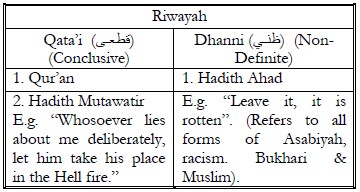
Qualquer Ayah do Alcorão ou Hadith Mutawatir é considerado Qat'i (conclusivo) em sua Riwayah (transmissão).
Any Ayah from the Qur‟an or Hadith Mutawatir is considered Qata‟i (conclusive) in its Riwayah (report).
O qat'i na riwayah implica que a evidência é autêntica sem qualquer sombra de dúvida. Essa autenticidade é estabelecida com base na metodologia de transmissão.
The Qata‟i in Riwayah implies that the evidence is authentic without any shadow of doubt. This authenticity is established based on the methodology of transmission.
A metodologia pela qual o Alcorão nos foi transmitido exclui qualquer possibilidade de fabricação. A narração foi transmitida de geração em geração exatamente da mesma maneira. É impossível que uma geração inteira fabrique, apague ou acrescente conteúdos ao Alcorão. É inconcebível acreditar que cada indivíduo daquela geração se tenha reunido e concordado em acrescentar ou suprimir partes do Alcorão. Todos os membros daquela geração recitavam os mesmos conteúdos do Alcorão, autenticando assim o seu conteúdo.
The methodology by which the Qur‟an was transmitted to us precludes any possibility of fabrication. The report was transmitted generation by generation in exactly the same manner. It is impossible for an entire generation to fabricate, erase, or add contents to the Qur‟an. It is inconceivable to believe that every single individual in that generation assembled together and agreed to add or delete parts of the Qur‟an. Everyone in that generation was reciting the same contents of the Qur‟an, thus authentifying its contents.
O Hadith Mutawatir não foi transmitido geração após geração, mas sim por um grande número de pessoas. Devido ao grande número de pessoas que relatam o Daleel, à diversidade de suas residências e à sua reconhecida confiabilidade e convicção, é inconcebível que esse Daleel possa estar errado. Qualquer relato de informação que não seja transmitido pelo Alcorão ou pelo Hadith Mutawatir, como o Hadith Ahad, é considerado Dhanni (não definitivo), o que significa que há uma possibilidade mínima de que o Daleel contenha algum erro. Em resumo:
Hadith Mutawatir was not transmitted generation-by-generation, but rather by a large number of people. Due to the large number of people reporting the Daleel, and their diversity of residence, their established reliability and conviction, it is inconceivable that this Daleel could be wrong. Any report of information other than through the Qur‟an or Hadith Mutawatir, such as Hadith Ahad, is considered Dhanni (non-definite), meaning that there is a minute possibility that the Daleel could contain error. To summarise:
Dalalah
Dalalah
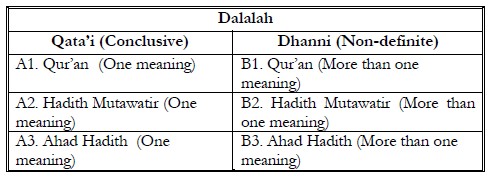
O segundo aspecto do Daleel é a Dalalah (significado). Se o texto do Alcorão, o Hadith Mutawatir ou o Hadith Ahad é claro, específico e tem apenas um significado, então é considerado Qata'i. O texto de um Daleel Qata'i tem de ter apenas um significado e não pode estar aberto a qualquer outra interpretação. Se o texto está aberto a mais de uma interpretação, então é considerado Dhanni. Como as interpretações se devem à língua árabe, qualquer interpretação tem de ser justificada através da língua árabe. Em resumo:
The second aspect of the Daleel is the Dalalah (meaning). If the text of Qur‟an, Hadith Mutawatir or Hadith Ahad is clear, specific, and has only one meaning, then it is considered Qata‟i. The text of a Qata‟i Daleel has to have only one meaning and cannot be open to any other interpretation. If the text is open to more than one interpretation, then it is considered Dhanni. Since interpretations are due to the Arabic language, any interpretation has to be justified through the Arabic language. To summarise:
A1. Exemplo de Alcorão com significado Qata'i (conclusivo):
A1. Example of Qur‟an with a Qata‟i (conclusive) meaning:
“E a vós pertence a metade do que deixam vossas esposas, se elas não tiverem filhos”. (Alcorão, An-Nisa: 12)
“What your wives leave, your share is a half, if they leave no child”. (TMQ An-Nisa: 12)
“Aqueles que acusam mulheres castas de zina (adultério) e não apresentam quatro testemunhas (para comprovar), açoitem-nos com oitenta chicotadas.” (TMQ An-Nur: 4)
“Those who accuse chaste woman of zina (adultery) and fail to bring four witnesses (to prove it) flog them eighty stripes.” (TMQ An-Nur: 4)
Os aspectos quantitativos dessas decisões, a saber, a metade e oitenta, são claros e, portanto, não podem estar abertos a quaisquer outras interpretações.
The quantitative aspect of these rulings, namely one half and eighty are clear and therefore cannot be open to any other interpretations.
A2. Exemplo de Hadith Mutawatir com significado Qat‘i (conclusivo):
A2. Example of Hadith Mutawatir with Qata‟i (conclusive) meaning:
"Quem mentir deliberadamente sobre mim (o Profeta Muhammad ﷺ) que tome o seu lugar no fogo do inferno." (Bukhari e Muslim)
“Whosoever lies about me (Prophet Muhammad saw) deliberately let him take his place in the hell-fire.” (Bukhari & Muslim)
Este Hadith Mutawatir é muito claro em seu assunto; assim, há apenas uma compreensão do texto: quem mentir sobre o que o Profeta ﷺ disse, intencionalmente, irá para o fogo do inferno.
This Mutawatir Hadith is very clear in its subject; thus there is only one understanding from the text that whoever lies about what Prophet (saw) said, intentionally, he will go to hell-fire.
A3. Exemplo de Hadith Ahad com significado Qata'i (conclusivo):
A3. Example of Hadith Ahad with Qata‟i (conclusive) meaning:
Relata-se, a partir de um hadith não mutawatir, que o Profeta ﷺ jejuou 6 dias em Shawwal. Os significados conclusivos deste hadith são os seguintes:
It is reported from a non-Mutawatir Hadith that the Prophet (saw) fasted 6 days in Shawwal. The conclusive meanings from this Hadith are the following:
a) Permissibilidade de jejuar 6 dias em Shawwal.
a) Permissibility of fasting 6 days in Shawwal.
b) Exceto no primeiro dia de Shawwal, pois é o dia de Eid, e é Haram jejuar no Eid.
b) Except on the first day of Shawwal, since it is the day of Eid, and it is Haram to fast on Eid.
B1. Exemplo de Ayah do Alcorão com um significado Dhanniy (não definitivo):
B1. Example of Quranic Ayah with a Dhanniy (non-definite) meaning:
Allah (SWT) diz:
Allah (swt) says:
"Ó vós que credes! Quando vos dispuserdes a realizar As-Salat (a oração), lavai os vossos rostos e as vossas mãos (antebraços) até os cotovelos, passai as mãos molhadas sobre as vossas cabeças e (lavai) os vossos pés até os tornozelos. Se estiverdes em estado de Janaba (ou seja, tiverdes tido uma descarga sexual), purificai-vos (banhai todo o corpo). Mas se estiverdes doentes, ou em viagem, ou se algum de vós vier de satisfazer a necessidade natural, ou tiverdes tido contato com mulheres e não encontrardes água, então realizai o Tayammum com terra limpa e passai com ela os vossos rostos e as vossas mãos." (Alcorão Sagrado, Al-Ma'ida: 6)
“O you who believe! When you intend to offer As-Salat (the prayer), wash your faces and your hands (forearms) up to the elbows, rub (by passing wet hands over) your heads, and (wash) your feet up to ankles. If you are in a state of Janaba (i.e. had a sexual discharge), purify yourself (bathe your whole body). But if you are ill or on a journey or any of you comes from answering the call of nature, or you have been in contact with women and you find no water, then perform Tayammum with clean earth and rub therewith your faces and hands.” (TMQ Al-Maida: 6)
O versículo diz que, se vocês „lamastum“ as mulheres, isso anula o Wudu. A palavra „lamastum“ tem sido interpretada como tendo dois significados:
The verse says if you „lamastum‟ the women, it breaks the Wudhu. The word „lamastum‟ has been interpreted as having two meanings:
a) Toque b) Relação sexual. Assim, o versículo possui uma Dalalah Dhanni, isto é, pode significar que tocar nas mulheres invalida o Wudhu, ou que a relação sexual com uma mulher invalida o Wudhu.
a) Touching b) Sexual intercourse Thus the Ayah has a Dhanni Dalalah, i.e. it could mean touching women breaks the Wudhu, or sexual intercourse with a woman breaks the Wudhu.
B2. Exemplo de Hadith Mutawatir com um significado Dhanniy (não definitivo):
B2. Example of Hadith Mutawatir with a Dhanniy (non-definite) meaning:
Foi relatado que o Profeta (saw) costumava tirar o seu Ihram de uma maneira específica. No entanto, quando os Sahabah (ra) disseram ao Profeta (saw) que eles tiravam o Ihram de uma maneira diferente da forma como ele (saw) o tirava, o Profeta (saw) aprovou as ações deles. Embora este incidente seja Mutawatir, as regras para tirar o Ihram são muitas.
It was reported that the Prophet (saw) used to take off his Ihram in a specific manner. However, when the Sahabah (ra) told the Prophet (saw) that they took it off in a manner different from the way he (saw) took it off, the Prophet (saw) approved of their actions. Though this incident is Mutawatir, the rules to take off one‟s Ihram are many.
B3. Exemplo de um Hadith Ahad com significado Dhanniy (não definitivo):
B3. Example of a Hadith Ahad with a Dhanniy (non-definite) meaning:
Relata-se, a partir de um hadith não mutawatir, que o Profeta ﷺ jejuou 6 dias em Shawwal. Os significados não definitivos deste hadith são:
It is reported from a non-Mutawatir Hadith that the Prophet (saw) fasted 6 days in Shawwal. The non-definite meanings of this Hadith are:
a) Os seis dias de jejum precisam ser consecutivos ou não?
a) Whether the six days of fasting are consecutive or not?
b) Jejum em qual parte de Shawwal?
b) Fasting in which part of Shawwal?
Até agora discutimos separadamente os aspectos Qata'i e Dhanni tanto da Riwayah quanto da Dalalah. No entanto, o método para determinar se o Daleel (tanto na Riwayah quanto na Dalalah) é Qata'i (conclusivo) ou Dhanni (não definitivo) é o seguinte:
So far we have discussed the Qata‟i and Dhanni aspects of both Riwayah and Dalalah separately. However, the method to determine whether the Daleel (both in Riwayah and Dalalah) is Qata‟i (conclusive) or Dhanni (non-definite) is the following:
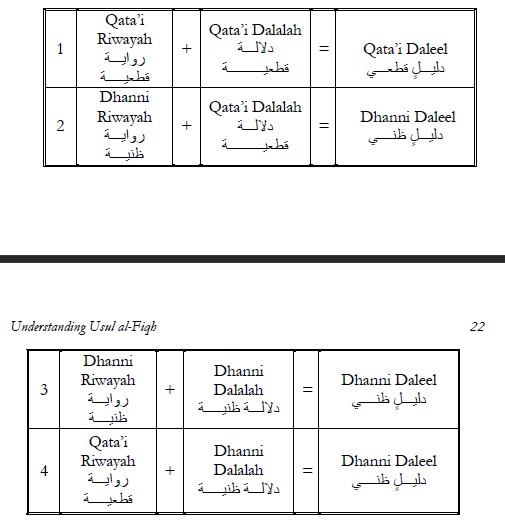
Qualquer ideia, pensamento ou conceito relacionado à 'Aqeedah deve estar baseado em uma Daleel Qata'i. Por exemplo, a crença de que os Anjos existem está baseada em uma Daleel Qata'i, e não Dhanni. Além disso, em Usul al-Fiqh, para que uma fonte seja estabelecida como base para extrair regras jurídicas, segundo a visão mais forte, essa fonte também deve estar baseada em uma Daleel Qata'i.
Any idea, thought, or concept related to the „Aqeedah has to be based upon a Qata‟i Daleel. As an example, the concept that Angels exists is based upon a Qata‟i Daleel not Dhanni. Also, in Usul al-Fiqh, to establish a source for extracting rulings according to the strongest view, the source must base upon a Qata‟i Daleel as well.
Por exemplo, para considerar o Ijma‟ as-Sahabah (consenso dos Companheiros) como fonte de regras, a prova que estabelece a autoridade do Ijma‟ as-Sahabah deve ser Qata‟i tanto em Riwayah quanto em Dalalah, embora uma regra possa ser derivada de uma prova Qata‟i ou Dhanni.
As an example, to consider Ijma‟ as-Sahabah (consensus of the Companions) as a source of rulings, the Daleel to prove the authority of Ijma‟ as-Sahabah has to be Qata‟i both in Riwayah and Dalalah, though a ruling can be derived from either Qata‟i or Dhanni Daleel.
Alguém poderia perguntar por que compreender o texto do Alcorão e da Sunnah é tão complicado?
One might wonder why understanding the text of Qur‟an and Sunnah is so complicated?
Ao examinar o texto do Alcorão e da Sunnah, percebe-se que ele é limitado em volume. Com esse texto limitado, é possível derivar juízos para quaisquer problemas que nos afetem, em qualquer lugar e em qualquer tempo, até o Dia do Juízo.
By examining the text of Qur‟an and Sunnah one can see that it is limited in its volume. With its limited text one can generate rulings to any problems affecting us anywhere and anytime until the Day of Judgment.
É um milagre de Allah (SWT) que os textos do Alcorão e da Sunnah tenham a capacidade de expressar inúmeras disposições legais a partir de um único versículo e de um único Hadith; ao passo que a capacidade de compreender muitos significados a partir de um único texto não pode ser encontrada em nenhum outro texto legal do mundo! O desafio para os muçulmanos de cada geração é tentar compreender o texto e relacioná-lo com as suas vidas, uma vez que o Alcorão e a Sunnah são relevantes para todos os tempos e lugares.
It is a miracle from Allah (swt) that the texts of the Qur‟an and Sunnah have the ability to express numerous rulings from a single Ayah and Hadith; whereas, the ability to understand many meanings from a single text cannot be found in any other legal text in the world! The challenge is for Muslims in each generation to try to understand the text and relate it to their lives since the Qur‟an and Sunnah are relevant to all times and places.
Fontes do Hukm Shar‘i
Sources of Hukm Shar‟i
Conforme definido anteriormente, o Hukm Shar‟i são as determinações de Allah (swt) que regem as nossas ações. Essas determinações são extraídas de certas fontes. As fontes que são utilizadas para extrair as determinações devem estar fundamentadas em Adilla Qata‟iya (evidências decisivas).
As defined earlier, Hukm Shar‟i are the rulings of Allah (swt) addressing our actions. These rulings are derived from certain sources. The sources, which are used to extract rulings, have to be based on Adilla Qata‟iya (Decisive evidences).
As quatro fontes definitivas do Hukm Shar‟i são: o Alcorão, a Sunnah, o Ijma‟ as-Sahabah e o Qiyas. Estas serão discutidas nos capítulos seguintes. A seguir, será apresentado um breve resumo das fontes controversas, quanto às quais os estudiosos discordam.
The four definitive sources of Hukm Shar‟i are; the Qur‟an, Sunnah, Ijma‟ as-Sahabah and Qiyas. These will be discussed in the following chapters. This will be followed by a brief summary of the disputed sources which the scholars disagree on.