1.1 La necesidad espiritual de la profecía
1.1 The Spiritual Necessity Of Prophethood
Dentro de todos nosotros existe un anhelo inquieto de plenitud espiritual. Cuando se ignora, el espíritu padece sed intensa, que lo lleva a perseguir un espejismo tras otro, cada uno de los cuales le ofrece por un momento la esperanza de un oasis antes de otra decepción. Esta es la tragedia de la condición humana cada vez que busca la paz interior en el mundo exterior, o pretende realizarse a través de placeres carnales, cuando fue creada para trascender todo eso en pos de un propósito superior:
Within us all is a restless craving for spiritual fulfillment. When ignored, the spirit experiences intense thirsts which send it chasing one mirage after another, each offering it momentary hope of an oasis before yet another letdown. This is the tragedy of the human condition whenever it seeks inner peace from the outer world, or seeks to self-actualize through carnal pursuits, when it was created to transcend all that for a higher purpose:
la devoción sincera a Dios. Allah dice en el Corán: “No he creado a los genios ni a los humanos sino para que Me adoren.”16
sincere devotion to God. Allah says in the Qur’an, “And I did not create the jinn and mankind except to worship Me.”16
La servidumbre a Dios, no solo el reconocimiento innato de Su existencia, es, por tanto, no solo un deber sino también una necesidad humana fundamental. Es necesaria para nutrir nuestro espíritu del mismo modo que el alimento y el oxígeno son necesarios para nutrir nuestro cuerpo. Nos sintoniza con nuestra realidad como seres espirituales en cuerpos físicos, y no como seres físicos que casualmente disfrutan de una dimensión espiritual. Por supuesto, nada de eso es posible sin que el Creador se comunique con nosotros, a través de los profetas, para enseñarnos cómo tener una relación significativa con Él. Sin esta comunicación, no podríamos conocerlo y amarlo en niveles más profundos, y solo viviendo para Él experimentamos lo que significa estar verdaderamente vivos. Como dijo en una ocasión el Profeta Muhammad ﷺ: «La similitud de quien recuerda a Allah y de quien no lo recuerda es la de los vivos y los muertos».17
Servitude to God, not just the inborn recognition of His existence, is therefore not only a duty but also a fundamental human need. It is necessary to nourish our spirit just as food and oxygen are necessary to nourish our body. It attunes us to our reality as spiritual beings in physical bodies, not physical beings that happen to enjoy a spiritual dimension. Of course, none of that is possible without the Creator communicating to us through prophets how to have a meaningful relationship with Him. Without this communication, we would be unable to know and love Him on deeper levels, and it is only through living for Him that we experience what it truly means to be alive. As the Prophet Muhammad صلى الله عليه وسلم once said, “The similitude of someone who is mindful of Allah and someone not mindful of Allah is that of the living and the dead.”17
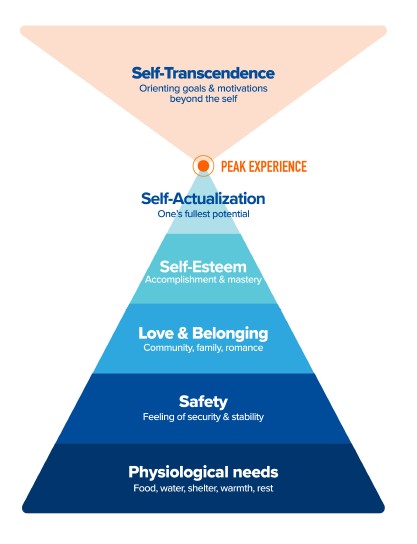
Cuando Abraham Maslow reformuló su célebre jerarquía de necesidades, situó el deseo de autotrascendencia como el mayor de todos los motivadores, por encima de la autorrealización.18
When Abraham Maslow amended his famous hierarchy of needs, he set the desire for self-transcendence as the greatest motivator of them all, above self-actualization.18
Sin embargo, sin los profetas y la revelación divina, incluso esa intuición resulta algo poco instructiva. Permite que nociones como el monismo (estar uno con el universo) o el altruismo (ser desinteresado) sean percibidas erróneamente como igualmente plenificantes que la devoción a Dios. Las personas altruistas suelen declarar una mayor satisfacción con la vida, y eso es de esperar, pues ser desinteresado es, por definición, un propósito más trascendente que estar centrado en uno mismo.
However, without the prophets and divine revelation, even that insight remains somewhat uninstructive. It allows for notions such as monism (being one with the universe) or altruism (being selfless) to be misperceived as equally fulfilling as devotion to God. Altruistic people often report higher life satisfaction, and that is expected since being selfless is, by definition, a more transcendent purpose than being self-centered.
Pero la necesidad esencial de trascenderse a uno mismo nunca quedará plenamente satisfecha con cualquier implicación en fines mayores que uno mismo (como el servicio a la colectividad humana). Existe una tranquilidad única que depende precisamente de la devoción al Absoluto, el Más Grande: Allah. Servir a los demás puede ser parte de ello, pero nunca puede reemplazarlo, como dice Allah: {Ciertamente, solo con el recuerdo de Allah se tranquilizan los corazones}.19 Ibn al-Qayyim (m. 1350), un renombrado teólogo musulmán, escribe: «En el corazón existe una inquietud que nada puede calmar salvo acercarse a Dios. Y una soledad lo envuelve que nada puede eliminar salvo disfrutar de Él».
But the essential need to self-transcend will never be fully satisfied by just any involvement in ends greater than oneself (such as serving the human collective). There is a unique tranquillity that hinges squarely on one’s devotion to the absolute greatest: the Almighty. Serving others can be part of that, but can never replace it, as Allah says, “Unquestionably, it is only by the remembrance of Allah that hearts are assured.”19 Ibn al-Qayyim (d. 1350), a renowned Muslim theologian, writes, In the heart, there exists an anxiousness that nothing can calm but drawing nearer to God. And a loneliness overcasts it that nothing can remove but enjoying His
company in private. Y en su interior habita una tristeza que nada puede aliviar, salvo la alegría de conocerle y de consagrarse verdaderamente a Él. Y en él hay una inquietud que nada puede tranquilizar, salvo centrarse en Él y huir de Él hacia Él. Y las llamas del arrepentimiento siguen ardiendo en su interior, y nada puede apagarlas, salvo estar conforme con Sus mandatos, Sus prohibiciones y Su destino, y aferrarse pacientemente a todo ello hasta el momento de encontrarle. Y en él existe una exigencia apremiante; no cesará hasta que solo Él se convierta en su objetivo. Y en él hay una necesidad imperiosa; nada la saciará sino amarle, recordarle constantemente y ser sinceramente devoto a Él. Y aunque a una persona se le diera todo este mundo y cuanto contiene, nunca satisfaría esa necesidad.20
company in private. And a sadness dwells within it that nothing can alleviate but the joy of knowing Him and genuinely devoting oneself to Him. And a worry unsettles it that nothing can reassure but focusing on Him and fleeing from Him to Him. And the flames of regret continue to flare inside it, and nothing can extinguish them but becoming content with His commands, prohibitions, and destiny, and patiently holding onto all that until the time one meets Him. And in it exists a pressing demand; it will not stop until He alone becomes its pursuit. And in it is a dire need; nothing will satisfy it except loving Him, constantly remembering Him, and being sincerely devout to Him. And if a person were given this entire world and all it contains, it would never fulfill that need.20
Por lo tanto, para evitar esta tragedia psicoespiritual y vivir para Dios Todopoderoso, la profecía es una necesidad existencial. El mismo Dios, el más misericordioso, que nos concedió todo lo que necesitamos en este planeta para la vida y lo que la sostiene, nos ha asegurado mediante la profecía lo que más necesitamos: la guía hacia Él y Su complacencia en esta vida y en la otra.
Hence, to avert this psychospiritual tragedy, and to live for Almighty God, prophethood is an existential necessity. The same most compassionate God who afforded us all we need on this planet for life and what sustains it, has ensured for us through prophethood what we need most: guidance to Him and His pleasure in this life and the next.
16 El Corán 51:56, traducción Saheeh International
16 The Qur’an 51:56, Saheeh International Translation.
17 al-Bujārī, Ṣaḥīḥ al-Bujārī, 8:86 #6407; Muslim ibn al-Ḥajjāj al-Qushayrī, Ṣaḥīḥ Muslim (Beirut: Dār Iḥyāʼ al-Kutub al-ʻArabīyah, 1955), 1:539 #779.
17 al-Bukhārī, Ṣaḥīḥ al-Bukhārī, 8:86 #6407; Muslim ibn al-Ḥajjāj al-Qushayrī, Ṣaḥīḥ Muslim (Beirut: Dār Iḥyāʼ al-Kutub al-ʻArabīyah, 1955), 1:539 #779.
18 Lloyd Greene y George Burke, “Más allá de la autorrealización”, Journal of Health and Human Services Administration (2007): 116-128.
18 Lloyd Greene and George Burke, “Beyond Self-Actualization,” Journal of Health and Human Services Administration (2007): 116-128.
19 El Corán 13:28, traducción Saheeh International.
19 The Qur’an 13:28, Saheeh International Translation.
20 Ibn Qayyim al-Jawzīyah, Madārij al-Sālikīn Bayna Manāzil Īyāka Na’budu wa Īyāka Nasta’īn (Beirut: Dār al-Kutub al-ʻArabī, 1996), 3:156.
20 Ibn Qayyim al-Jawzīyah, Madārij al-Sālikīn Bayna Manāzil Īyāka Na’budu wa Īyāka Nasta’īn (Beirut: Dār al-Kutub al-ʻArabī, 1996), 3:156.