5.29 Los musulmanes convertidos en presas fáciles
5.29 Muslims Becoming Easy Prey
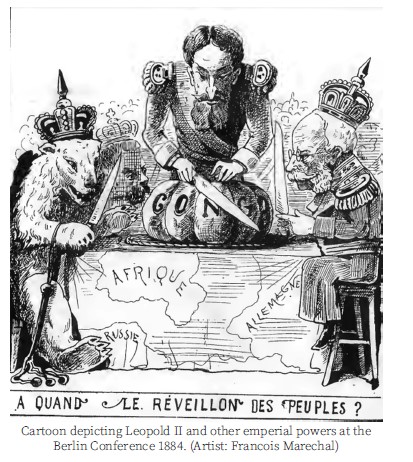
El Profeta ﷺ también profetizó que los placeres carnales no solo infectarían a su nación, sino que serían la causa de su decadencia y destrucción. Zawbān informa que el Profeta ﷺ dijo: "Pronto las naciones se invitarán unas a otras a devorarlos, tal como los comensales son invitados a un plato." Se le preguntó: "¿Será por nuestro escaso número ese día?" Respondió: "No, sino que ese día seréis muchos, pero seréis como la espuma sin peso, como la espuma del río. Y Allah quitará de los corazones de vuestros enemigos el temor hacia vosotros y arrojará debilidad en vuestros corazones." Alguien preguntó: "¡Oh Mensajero de Allah, qué será esa debilidad?" Respondió: "El amor a este mundo y el odio a la muerte."333 Resulta asombroso que hace un siglo, el rey Leopoldo de Bélgica se refiriera muy célebremente a sus ambiciones coloniales como "este magnífico pastel africano", que las potencias europeas repartieron a su antojo durante la Conferencia de Berlín de 1884. Cualquiera puede encontrar fácilmente las numerosas caricaturas políticas de aquella época que representaban esta conferencia en términos de comida, casi exactamente como había dicho el hadiz anterior.
The Prophet صلى الله عليه وسلم also prophesied that carnal pursuits would not only infect his nation but would be the cause of their downfall and devastation. Thawbān reports that the Prophet صلى الله عليه وسلم said, “The nations will soon invite one another to devour you, just as diners are invited to a dish.” It was said, “Will it be because of our small number on that day?” He said, “No, rather you will be many on that day, but you will be weightless foam, like the foam on the river. And Allah will remove the fear of you from the hearts of your enemies and will cast weakness into your hearts.” Someone said, “O Messenger of Allah, what will this weakness be?” He said, “The love of this world, and the hatred of death.”333 It is incredible how one century ago, King Leopold of Belgium very famously referred to his colonial ambitions as “this magnificent African cake,” which the European powers carved at will during the Berlin Conference of 1884. A person can easily find the many political cartoons of that day conceptualizing this conference in food terms, almost exactly like the hadith above had stated.
Esto se debió en parte a la metáfora del rey Leopoldo, pero también a que los asistentes solo estaban allí para formalizar las divisiones de África, totalmente seguros de que el vasto y rico continente no podría oponer ninguna resistencia significativa a su voraz codicia y a su apetito imperial.
This was in part due to King Leopold’s metaphor, but also because the attendees were only there to formalize the divisions of Africa, fully confident that the large and resourceful continent could not hold its weight in any meaningful resistance to their ravenous greed and imperial appetite.
Reforzando este punto, Anas ibn Mālik narra que el Profeta ﷺ dijo: "Cuando mi nación considere lícitas cinco cosas, entonces la destrucción caerá sobre ellos: cuando aparezcan las maldiciones mutuas, se beba vino, se vista seda, se toquen instrumentos musicales, y los hombres se contenten con hombres y las mujeres se contenten con mujeres".334 Ciertamente, los musulmanes de hoy no están aislados de las ideologías que aceptan los actos entre personas del mismo sexo. Esto incluso es imaginable en un musulmán practicante que asiste a la mezquita, si permite que su religiosidad se reduzca a una identidad cultural, como dijo el Profeta ﷺ en un hadiz narrado por ‘Abdullah ibn ‘Amr: "Ciertamente llegará una época en que la gente se reúna y rece en las mezquitas, mientras que no habrá entre ellos ni un solo creyente".335
Reinforcing this point, Anas ibn Mālik narrates that the Prophet صلى الله عليه وسلم said, “Once my nation considers five things permissible, then destruction will befall them: when cursing one another appears, wine is drunk, silk is worn, musical instruments are played, and men suffice themselves with men and women suffice themselves with women.”334 Certainly, Muslims today are not insulated from the ideologies that accept same-sex acts. This is even imaginable for a practicing, mosque-attending Muslim, if they allow their religiosity to be reduced to a cultural identity, as the Prophet صلى الله عليه وسلم said in a hadith narrated by ‘Abdullah ibn ‘Amr , “An age will surely come when people gather and pray in the mosques, while there is not a single believer amongst them.”335
333 Abū Dāwūd, Sunan Abī Dāwūd, 4:111 #4297; autenticado por al-Albānī en los comentarios.
333 Abū Dāwūd, Sunan Abī Dāwūd, 4:111 #4297; authenticated by al-Albāni in the comments.
334 Aḥmad ibn al-Ḥusayn al-Bayhaqī, Shu‘ab al-Īmān (Riad: Maktabat al-Rushd lil-Nashr wal-Tawzī’, 2003), 7:328 #5084; un isnad ḥasan (aceptable) según al-Albānī en Ṣaḥīḥ al-Targhīb wal-Tarhīb (Riad: Maktabat al-Ma‘ārif, 2000), 2:608 #2386.
334 Aḥmad ibn al-Ḥusayn al-Bayhaqī, Shu‘ab al-Īmān (Riyadh: Maktabat al-Rushd lil-Nashr wal-Tawzī’, 2003), 7:328 #5084; a ḥasan (acceptable) chain according to al-Albānī in Ṣaḥīḥ al-Targhīb wal-Tarhīb (Riyadh: Maktabat al-Maʻā rif, 2000), 2:608 #2386.
Si bien estas prohibiciones parecen absolutas en este texto, los eruditos las han matizado teniendo en cuenta su lectura acumulativa de otras tradiciones proféticas. Por ejemplo, la prohibición de la seda que aquí aparece se matiza al limitarse a los hombres, a cantidades significativas y en ausencia de necesidad. De igual modo, los eruditos generalmente consideran que tocar la pandereta constituye una excepción a la prohibición de los instrumentos musicales, al menos en ocasiones, y algunos amplían aún más esta concesión.
While these prohibitions appear absolute here, scholars have qualified them considering their cumulative read of other prophetic traditions. For instance, the prohibition of silk here is qualified by being applicable to men only, and in significant amounts, and in the absence of necessity. Similarly, scholars generally consider striking the tambourine an exception to the prohibition of musical instruments, at least on occasion, and some widen the concession further.
335 Abū Bakr ibn Abī Shaybah, Al-Īmān (Beirut: al-Maktab al-Islāmī, 1983), 1:40
335 Abū Bakr ibn Abī Shaybah, Al-Īmān (Beirut: al-Maktab al-Islāmī, 1983), 1:40
«101»; autenticado por al-Albānī en los comentarios.
#101; authenticated by al-Albānī in the comments.