2.2 Su sencillez y humildad
2.2 His Simplicity and Humility
La vida sencilla y austera del Profeta ﷺ es una indicación importante de que su misión no pudo haber sido en beneficio propio, sobre todo si se compara con los estilos de vida decadentes y extravagantes de tantos falsos profetas a lo largo de la historia del mundo. Después de todo, este fue un hombre que controló toda Arabia al final de su vida. Incluso antes de eso, tenía miles de seguidores en Madinah, seguidores que lo idolatraban y que habrían hecho cualquier cosa en el mundo por él. Sin embargo, no vemos ningún signo de lujo en ninguna esfera de su vida ﷺ.
The simple, austere lifestyle of the Prophet صلى الله عليه وسلم is a major indication that his mission could not have been self-serving, especially when contrasted with the decadent, extravagant lifestyles of so many false prophets in world history. After all, this was a man who controlled all of Arabia by the end of his life. Even before that, he had thousands of followers in Madinah, followers who obsessed over him and would have done anything in the world for him. Yet, we see no signs of luxury in any sphere of his life.
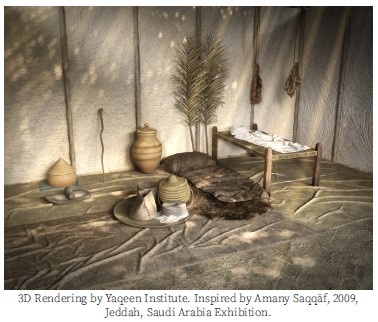
Su habitación era tan estrecha que, cuando deseaba orar, daba unos golpecitos a ‘Āishah para que doblara las piernas y así le dejara sitio para postrarse. Para beber o bañarse, alcanzaba el pequeño odre de cuero que colgaba en su habitación. Durante meses enteros no se encendía fuego para cocinar en su casa, y su familia se conformaba con dátiles y agua, salvo que alguien les regalara leche.58 ‘Umar ibn al-Khattāb relata que en una ocasión entró en la habitación del Mensajero de Allah ﷺ y lo encontró tumbado, y notó que la aspereza de la esterilla de paja sobre la que estaba le había dejado marcas en el costado. Al percatarse de ello, así como de las escasas raciones de cebada y hojas, y del odre de cuero colgado en un rincón, sus ojos se llenaron de lágrimas. El Profeta ﷺ le dijo: “¿Qué te hace llorar, hijo de al-Khaṭṭāb?”. Él respondió: “Oh Profeta de Allah, ¿cómo no voy a llorar al ver cómo la esterilla te ha dejado estas marcas en el costado, y lo poco que tienes en tu despensa? César y Cosroes viven rodeados de frutos y manantiales de agua, mientras que tú eres el Mensajero de Dios y Su elegido, y aun así este es tu estado”. El Profeta ﷺ dijo: “Hijo de al-Khaṭṭāb, ¿no te complace que estas [comodidades] sean para nosotros en la Otra Vida y para ellos en este mundo?”. Dije: “Por supuesto”.59 En otra narración, comenzó su respuesta diciendo: “¿Tienes dudas, hijo de al-Khaṭṭāb? Estos son un pueblo cuyos placeres han sido adelantados en la vida de este mundo”.60
His living quarters were so tight that when he صلى الله عليه وسلم wished to pray, he would tap ‘Āishah to bend her legs to make room for him to prostrate. To drink or bathe, he would reach for the small leather water skin that hung in his room. For months on end, no fire would be kindled for cooking in his home, and his family was content with dates and water unless someone gifted them some milk.58 ‘Umar ibn al-Khattāb reports that he once entered the room of the Messenger of Allah صلى الله عليه وسلم to find him lying down and noticed that the coarseness of the straw mat under him had left marks on his side. Upon noticing that, and the meager rations of barley and leaves, and the leather bag hanging in the corner, his eyes welled with tears. The Prophet صلى الله عليه وسلم said, “What makes you weep, O son of al-Khaṭṭāb?” He said, “O Prophet of Allah, how can I not cry after seeing how the mat has left these marks on your side, and how little you have in your food cupboard? Caesar and Chosroes live surrounded by fruits and springs of water, while you are the Messenger of God and His chosen one, and yet this is your condition.” The Prophet صلى الله عليه وسلم said, “O son of al-Khaṭṭāb, does it not please you that these [luxuries] are for us in the Hereafter and for them in this world?” I said, “Of course.”59 In another narration, he began his response with, “Are you in doubt, O son of al-Khaṭṭāb? These are a people whose pleasures have been expedited in the life of this world.”60
Edward Gibbon (m. 1794), historiador y miembro del Parlamento de Inglaterra, escribió: «El buen juicio de Muhammad ﷺ despreciaba el boato de la realeza. El Apóstol de Dios ﷺ se sometía a los oficios humildes de la familia: encendía el fuego, barría el suelo, ordeñaba las ovejas y remendaba con sus propias manos sus sandalias y sus vestiduras. Desdeñando la penitencia y el mérito de un ermitaño, observaba sin esfuerzo ni vanidad la dieta frugal de un árabe.»61
Edward Gibbon (d. 1794), a historian and member of England’s Parliament, wrote, The good sense of Muhammad despised the pomp of royalty. The Apostle of God submitted to the menial offices of the family; he kindled the fire; swept the floor; milked the ewes; and mended with his own hands his shoes and garments. Disdaining the penance and merit of a hermit, he observed without effort or vanity the abstemious diet of an Arab.61
En otras palabras, él ﷺ no solo soportó la dureza de una vida austera, sino que le resultaba natural. No trataba de fomentar el monacato ni el estoicismo, ni fingía este minimalismo para ganarse elogios. Gibbon continúa: En las ocasiones solemnes, agasajaba a sus compañeros con una abundancia rústica y hospitalaria. Pero, en su vida doméstica, pasaban muchas semanas sin que se encendiera un fuego en el hogar del Profeta ﷺ.62
In other words, he صلى الله عليه وسلم not only endured the coarseness of an austere life, but it came naturally to him. He was not trying to encourage monkship or stoicism, nor was he faking this minimalism to earn praise. Gibbon continues, On solemn occasions, he feasted his companions with rustic and hospitable plenty. But, in his domestic life, many weeks would pass without a fire being kindled on the hearth of the Prophet.62
Según Washington Irving (m. 1859), biógrafo y diplomático estadounidense, era sobrio y moderado en su dieta y un riguroso observador de los ayunos. No se entregaba a ninguna magnificencia en su vestimenta, ostentación propia de una mente mezquina; tampoco su sencillez en el vestir era afectada, sino fruto de un verdadero desdén por la distinción proveniente de una fuente tan trivial…63
According to Washington Irving (d. 1859), an American biographer and diplomat, He was sober and abstemious in his diet and a rigorous observer of fasts. He indulged in no magnificence of apparel, the ostentation of a petty mind; neither was his simplicity in dress affected but a result of real disregard for distinction from so trivial a source…63
Sus triunfos militares no despertaron en él orgullo ni vanagloria, como habría ocurrido si se hubieran logrado con fines egoístas. En el tiempo de su mayor poder, mantuvo la misma sencillez de trato y de apariencia que en los días de su adversidad. Lejos de adoptar un porte regio, le desagradaba que, al entrar en una habitación, se le mostraran muestras de respeto poco habituales.64
And, His military triumphs awakened no pride nor vainglory, as they would have done had they been effected for selfish purposes. In the time of his greatest power, he maintained the same simplicity of manners and appearance as in the days of his adversity. So far from affecting a regal state, he was displeased if, on entering a room, any unusual testimonials of respect were shown to him.64
Con respecto a estos «testimonios inusuales de respeto», Anas ibn Mālik dijo: «Nadie era más querido para ellos (los Compañeros)
Regarding these “unusual testimonials of respect,” Anas ibn Mālik said, “Nobody was more beloved to them (the Companions)
que el Mensajero de Allah ﷺ. A pesar de ello, cuando lo veían, no se levantaban para recibirlo, sabiendo cuánto le desagradaba eso.”65 Bosworth Smith (m. 1908), un reverendo y autor, escribe: "Jefe del Estado y también de la Iglesia; era César y Papa a la vez; pero era Papa sin las pretensiones del Papa, y César sin las legiones de César, sin un ejército permanente, sin guardia personal, sin una fuerza de policía, sin una renta fija. Si alguna vez un hombre gobernó por derecho divino, fue Muhammad ﷺ, pues tenía todos los poderes sin sus apoyos. No se preocupaba por los adornos del poder. La sencillez de su vida privada estaba en consonancia con su vida pública."66
than the Messenger of Allah صلى الله عليه وسلم. Despite that, when they would see him, they would not stand for him, knowing how much he disliked that.”65 Bosworth Smith (d. 1908), a reverend and author, writes, Head of the State as well as the Church; he was Caesar and Pope in one; but he was Pope without the Pope’s pretensions, and Caesar without the legions of Caesar, without a standing army, without a bodyguard, without a police force, without a fixed revenue. If ever a man ruled by a right divine, it was Muhammad, for he had all the powers without their supports. He cared not for the dressings of power. The simplicity of his private life was in keeping with his public life.66
Hasta el día de hoy, los tratados de ética islámica y los sermones semanales de los predicadores musulmanes están repletos de ejemplos del Profeta ﷺ como paradigma de humildad. Fue el educador que nunca se avergonzó de decir «No lo sé», 67
Until this very day, the canons of literature on Islamic ethics, and the weekly sermons of Muslim preachers, are replete with examples of the Prophet صلى الله عليه وسلم as the paragon of humility. He was the educator who was never ashamed to say “I don’t know,” 67
el general que permitiría que otros compartieran su animal de monta,68
the general who would allow others to share his riding animal,68
el estadista más ocupado que permitía a los miembros más débiles de la sociedad tomarle de la mano para satisfacer sus necesidades,69 el anciano que competía con los jóvenes por acarrear los ladrillos de la primera mezquita,70 y el marido considerado que notaba las sutiles señales de que su esposa estaba disgustada con él.71 Finalmente, él ﷺ fue el más grande de los mensajeros de Dios, quien repetía a lo largo de su vida: "Mi semejanza comparada con los profetas que me precedieron es la de una persona que construyó una estructura hermosa y brillante, completando su construcción salvo por un solo ladrillo en una de sus esquinas.
the busiest statesman who would allow the weakest members of society to take him by the hand for their needs,69 the elder who would compete with the youth to carry the bricks of the first mosque,70 and the considerate husband who noticed subtle signs of his wife being upset with him.71 Finally, he صلى الله عليه وسلم was the greatest messenger of God who would reiterate throughout his life, “My similitude compared to the prophets before me is that of a person who built a beautiful, brilliant structure—completing its construction save for a single brick in one of its corners.
La gente comenzó a rodear el edificio, admirando su construcción, pero diciendo: "Ojalá se colocara ese último ladrillo, sería perfecto". Yo soy ese ladrillo, y soy el sello de los profetas".72 En otro hadiz, con humildad, advirtió: "No me exaltéis como los cristianos exageraron al alabar al hijo de María. Yo soy solo un siervo, así que llamadme siervo de Dios y su mensajero".73
People began to walk around it, admiring its construction, but saying, ‘If only that final brick were set in place, it would have been perfect.’ I am that brick, and I am the seal of the prophets.”72 In another hadith, he humbly cautioned, “Do not aggrandize me as the Christians exaggerated in praising the son of Mary. I am but a slave, so call me the slave of God and His messenger.”73
58 al-Bukhārī, Ṣaḥīḥ al-Bukhārī, 8:97 #6459.
58 al-Bukhārī, Ṣaḥīḥ al-Bukhārī, 8:97 #6459.
59 Muslim, Ṣaḥīḥ Muslim, 2:1105 #1479.
59 Muslim, Ṣaḥīḥ Muslim, 2:1105 #1479.
60 al-Bukhārī, Ṣaḥīḥ al-Bukhārī, 3:133 #2468.
60 al-Bukhārī, Ṣaḥīḥ al-Bukhārī, 3:133 #2468.
61 Edward Gibbon, Decline and Fall of the Roman Empire: Volume the Fifth (London:
61 Edward Gibbon, Decline and Fall of the Roman Empire: Volume the Fifth (London:
Electric Book Co, 2001), capítulo L, 252.
Electric Book Co, 2001), chapter L, 252.
62 Ibid., 251-252.
62 Ibid., 251-252.
63 Washington Irving and Bertram R. Davis, The Life of Mahomet (London: G. Nota: el texto original es una referencia bibliográfica en inglés, por lo que se traduce manteniendo los nombres de autores, títulos y editorial tal como aparecen. Traducción: 63 Washington Irving y Bertram R. Davis, The Life of Mahomet (Londres: G.
63 Washington Irving and Bertram R. Davis, The Life of Mahomet (London: G.
Routledge & Co, 1850), 186-187.
Routledge & Co, 1850), 186-187.
64 Ibid., 203.
64 Ibid., 203.
65 al-Tirmidhī, Sunan al-Tirmidhī, 5:90 #2754; autentificado por al-Tirmidhī en los comentarios.
65 al-Tirmidhī, Sunan al-Tirmidhī, 5:90 #2754; authenticated by al-Tirmidhī in the comments.
66 Bosworth Smith, Mohammed and Mohammedanism (London: Smith, Elder, and Co., 1874), 235.