2.1 Estructura de Daleel
2.1 Structure of Daleel
Como se mencionó anteriormente, un Daleel es una evidencia para una opinión, concepto, dictamen o pensamiento del Islam. Hay dos aspectos relacionados con cualquier Daleel: la Riwayah (transmisión) y la Dalalah (significado).
As mentioned earlier, a Daleel is an evidence for an opinion, concept, ruling, or a thought from Islam. There are two aspects related to any Daleel, Riwayah (reportage) and Dalalah (meaning).
La Riwayah abarca las cuestiones relacionadas con la forma en que la información nos fue transmitida, lo que incluye el número y la integridad de sus transmisores.
The Riwayah covers issues related to how the information was relayed to us, which includes the number and the integrity of its reporters.
La dalalah se relaciona con el significado del texto en el daleel. También existen dos términos utilizados en relación con la riwayah y la dalalah: qat'i y dhanni.
The Dalalah is related to the meaning of the text in the Daleel. There are also two terms used in connection with Riwayah and Dalalah; Qata‟i and Dhanni.
Qat'i se define como lo concluyente o decisivo, mientras que Dhanni es lo opuesto a Qat'i y significa no definitivo, especulativo o indeciso.
Qata‟i is defined as being conclusive or decisive, while Dhanni is the opposite of Qata‟i and means non-definite, speculative or indecisive.
Riwayah
Riwayah
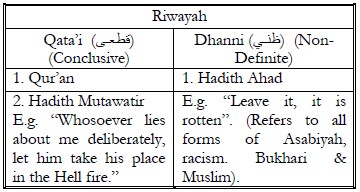
Cualquier Aya del Corán o Hadiz Mutawatir se considera Qat‘i (concluyente) en su Riwayah (transmisión).
Any Ayah from the Qur‟an or Hadith Mutawatir is considered Qata‟i (conclusive) in its Riwayah (report).
El Qat'i en la riwayah implica que la evidencia es auténtica sin sombra alguna de duda. Esta autenticidad se establece con base en la metodología de transmisión.
The Qata‟i in Riwayah implies that the evidence is authentic without any shadow of doubt. This authenticity is established based on the methodology of transmission.
El método mediante el cual el Corán nos ha sido transmitido descarta cualquier posibilidad de falsificación. La narración se transmitió de generación en generación de exactamente la misma manera. Es imposible que una generación entera falsificara, borrara o añadiera contenidos al Corán. Resulta inconcebible creer que cada uno de los individuos de esa generación se hubiera reunido y acordado añadir o suprimir partes del Corán. Todos en esa generación recitaban los mismos contenidos del Corán, autenticando así su contenido.
The methodology by which the Qur‟an was transmitted to us precludes any possibility of fabrication. The report was transmitted generation by generation in exactly the same manner. It is impossible for an entire generation to fabricate, erase, or add contents to the Qur‟an. It is inconceivable to believe that every single individual in that generation assembled together and agreed to add or delete parts of the Qur‟an. Everyone in that generation was reciting the same contents of the Qur‟an, thus authentifying its contents.
El Hadiz Mutawatir no se transmitió de generación en generación, sino por un gran número de personas. Debido a la gran cantidad de personas que transmiten el Daleel, a la diversidad de sus lugares de residencia, y a su fiabilidad y convicción establecidas, es inconcebible que este Daleel pueda ser erróneo. Cualquier informe de información distinto del Corán o del Hadiz Mutawatir, como el Hadiz Ahad, se considera Dhanni (no definitivo), lo que significa que existe una posibilidad mínima de que el Daleel contenga algún error. En resumen:
Hadith Mutawatir was not transmitted generation-by-generation, but rather by a large number of people. Due to the large number of people reporting the Daleel, and their diversity of residence, their established reliability and conviction, it is inconceivable that this Daleel could be wrong. Any report of information other than through the Qur‟an or Hadith Mutawatir, such as Hadith Ahad, is considered Dhanni (non-definite), meaning that there is a minute possibility that the Daleel could contain error. To summarise:
Dalalah
Dalalah
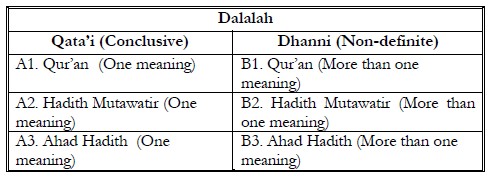
El segundo aspecto del Daleel es la Dalalah (significado). Si el texto del Qur'an, del Hadiz Mutawatir o del Hadiz Ahad es claro, específico y tiene un único significado, entonces se considera Qata'i. El texto de un Daleel Qata'i debe tener un único significado y no puede estar abierto a ninguna otra interpretación. Si el texto admite más de una interpretación, entonces se considera Dhanni. Dado que las interpretaciones dependen de la lengua árabe, toda interpretación debe justificarse a través de la lengua árabe. En resumen:
The second aspect of the Daleel is the Dalalah (meaning). If the text of Qur‟an, Hadith Mutawatir or Hadith Ahad is clear, specific, and has only one meaning, then it is considered Qata‟i. The text of a Qata‟i Daleel has to have only one meaning and cannot be open to any other interpretation. If the text is open to more than one interpretation, then it is considered Dhanni. Since interpretations are due to the Arabic language, any interpretation has to be justified through the Arabic language. To summarise:
A1. Ejemplo del Corán con un significado qat'i (concluyente):
A1. Example of Qur‟an with a Qata‟i (conclusive) meaning:
«Y a vosotras os corresponde la mitad de lo que dejen vuestras esposas, si no tienen hijos».
“What your wives leave, your share is a half, if they leave no child”. (TMQ An-Nisa: 12)
«Quienes acusen a mujeres honradas de zina (adulterio) y no presenten cuatro testigos (que lo prueben), azótenlos con ochenta latigazos.» (TMQ An-Nur: 4)
“Those who accuse chaste woman of zina (adultery) and fail to bring four witnesses (to prove it) flog them eighty stripes.” (TMQ An-Nur: 4)
Los aspectos cuantitativos de estos dictámenes, a saber, la mitad y ochenta, son claros y, por tanto, no pueden admitir ninguna otra interpretación.
The quantitative aspect of these rulings, namely one half and eighty are clear and therefore cannot be open to any other interpretations.
A2. Ejemplo de Hadiz Mutawatir con significado Qat'i (concluyente):
A2. Example of Hadith Mutawatir with Qata‟i (conclusive) meaning:
«Quien mienta deliberadamente sobre mí ﷺ, que ocupe su lugar en el fuego del infierno.» (Bujari y Muslim)
“Whosoever lies about me (Prophet Muhammad saw) deliberately let him take his place in the hell-fire.” (Bukhari & Muslim)
Este hadiz mutawatir es muy claro en su tema; por tanto, solo existe una interpretación del texto: quien mienta deliberadamente sobre lo que el Profeta ﷺ dijo, irá al fuego del infierno.
This Mutawatir Hadith is very clear in its subject; thus there is only one understanding from the text that whoever lies about what Prophet (saw) said, intentionally, he will go to hell-fire.
A3. Ejemplo de Hadiz Ahad con significado Qat'i (concluyente):
A3. Example of Hadith Ahad with Qata‟i (conclusive) meaning:
Se relata en un hadiz no mutawatir que el Profeta ﷺ ayunó 6 días en Shawwal. Los significados concluyentes de este hadiz son los siguientes:
It is reported from a non-Mutawatir Hadith that the Prophet (saw) fasted 6 days in Shawwal. The conclusive meanings from this Hadith are the following:
a) Licitud de ayunar 6 días en Shawwal.
a) Permissibility of fasting 6 days in Shawwal.
b) Excepto el primer día de Shawwal, puesto que es el día de la Fiesta (Eid), y es haram ayunar en el Eid.
b) Except on the first day of Shawwal, since it is the day of Eid, and it is Haram to fast on Eid.
B1. Ejemplo de aleya coránica con un significado dhanniy (no definitivo):
B1. Example of Quranic Ayah with a Dhanniy (non-definite) meaning:
Allah (SWT) dice:
Allah (swt) says:
«¡Oh vosotros que creéis! Cuando os dispongáis a hacer la oración (As-Salat), lavaos el rostro y las manos hasta los codos, pasad las manos mojadas por vuestras cabezas y lavaos los pies hasta los tobillos. Si estáis en estado de Janaba (es decir, habéis tenido una eyaculación), purificaos (bañad todo el cuerpo). Pero si estáis enfermos o de viaje, o si alguno de vosotros viene de satisfacer sus necesidades naturales, o habéis estado en contacto con mujeres y no encontráis agua, entonces haced Tayammum con tierra limpia y pasad con ella vuestros rostros y manos.» (TMQ Al-Maida: 6)
“O you who believe! When you intend to offer As-Salat (the prayer), wash your faces and your hands (forearms) up to the elbows, rub (by passing wet hands over) your heads, and (wash) your feet up to ankles. If you are in a state of Janaba (i.e. had a sexual discharge), purify yourself (bathe your whole body). But if you are ill or on a journey or any of you comes from answering the call of nature, or you have been in contact with women and you find no water, then perform Tayammum with clean earth and rub therewith your faces and hands.” (TMQ Al-Maida: 6)
El versículo dice que si "lamastum" a las mujeres, se rompe el Wudu. La palabra "lamastum" ha sido interpretada con dos significados:
The verse says if you „lamastum‟ the women, it breaks the Wudhu. The word „lamastum‟ has been interpreted as having two meanings:
a) Tocar b) Relación sexual. Así, el aleya tiene una dalalah dhanni, es decir, podría significar que tocar a las mujeres rompe el wudu, o que la relación sexual con una mujer rompe el wudu.
a) Touching b) Sexual intercourse Thus the Ayah has a Dhanni Dalalah, i.e. it could mean touching women breaks the Wudhu, or sexual intercourse with a woman breaks the Wudhu.
B2. Ejemplo de Hadiz Mutawatir con un significado Dhanniy (no definitivo):
B2. Example of Hadith Mutawatir with a Dhanniy (non-definite) meaning:
Se narró que el Profeta (saw) solía quitarse el Ihram de una manera específica. Sin embargo, cuando los Sahabah (ra) le dijeron al Profeta (saw) que ellos se lo quitaban de una manera distinta a la forma en que él (saw) se lo quitaba, el Profeta (saw) aprobó sus acciones. Aunque este incidente es Mutawatir, las normas para quitarse el Ihram son muchas.
It was reported that the Prophet (saw) used to take off his Ihram in a specific manner. However, when the Sahabah (ra) told the Prophet (saw) that they took it off in a manner different from the way he (saw) took it off, the Prophet (saw) approved of their actions. Though this incident is Mutawatir, the rules to take off one‟s Ihram are many.
B3. Ejemplo de un Hadiz Ahad con un significado dhanniy (no definitivo):
B3. Example of a Hadith Ahad with a Dhanniy (non-definite) meaning:
Se narra en un hadiz no mutawatir que el Profeta ﷺ ayunó 6 días en Shawwal. Los significados no definitivos de este hadiz son:
It is reported from a non-Mutawatir Hadith that the Prophet (saw) fasted 6 days in Shawwal. The non-definite meanings of this Hadith are:
a) ¿Los seis días de ayuno deben ser consecutivos o no?
a) Whether the six days of fasting are consecutive or not?
b) ¿En qué parte de Shawwal se ayuna?
b) Fasting in which part of Shawwal?
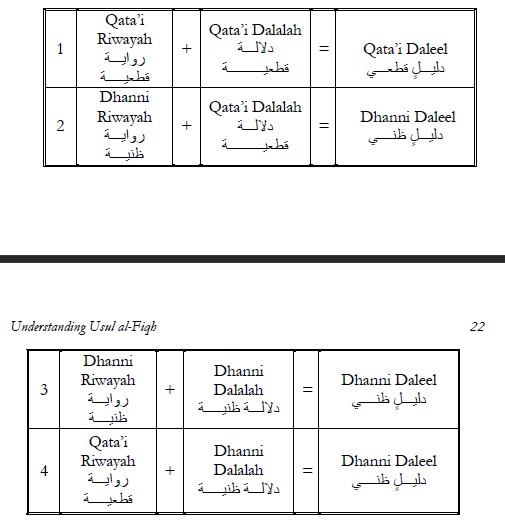
Hasta ahora hemos analizado por separado los aspectos Qata'i y Dhanni tanto de la Riwayah como de la Dalalah. Sin embargo, el método para determinar si el Daleel (tanto en la Riwayah como en la Dalalah) es Qata'i (concluyente) o Dhanni (no definitivo) es el siguiente:
So far we have discussed the Qata‟i and Dhanni aspects of both Riwayah and Dalalah separately. However, the method to determine whether the Daleel (both in Riwayah and Dalalah) is Qata‟i (conclusive) or Dhanni (non-definite) is the following:
Toda idea, pensamiento o concepto relacionado con la 'Aqeedah debe basarse en un Daleel Qata'i. Por ejemplo, el concepto de que los ángeles existen se basa en un Daleel Qata'i, no en uno Dhanni. Asimismo, en Usul al-Fiqh, para establecer una fuente para extraer dictámenes según la postura más sólida, dicha fuente debe basarse también en un Daleel Qata'i.
Any idea, thought, or concept related to the „Aqeedah has to be based upon a Qata‟i Daleel. As an example, the concept that Angels exists is based upon a Qata‟i Daleel not Dhanni. Also, in Usul al-Fiqh, to establish a source for extracting rulings according to the strongest view, the source must base upon a Qata‟i Daleel as well.
Como ejemplo, para considerar el Ijma‟ as-Sahabah (consenso de los Compañeros) como fuente de dictámenes, el Daleel que demuestra la autoridad del Ijma‟ as-Sahabah debe ser Qata‟i tanto en Riwayah como en Dalalah, aunque un dictamen puede derivarse de un Daleel Qata‟i o de un Daleel Dhanni.
As an example, to consider Ijma‟ as-Sahabah (consensus of the Companions) as a source of rulings, the Daleel to prove the authority of Ijma‟ as-Sahabah has to be Qata‟i both in Riwayah and Dalalah, though a ruling can be derived from either Qata‟i or Dhanni Daleel.
¿Por qué uno podría preguntarse que la comprensión del texto del Corán y la Sunnah es tan complicada?
One might wonder why understanding the text of Qur‟an and Sunnah is so complicated?
Al examinar el texto del Corán y la Sunnah, se observa que su volumen es limitado. Con este texto limitado se pueden derivar dictámenes para cualquier problema que nos afecte, en cualquier lugar y en cualquier tiempo, hasta el Día del Juicio.
By examining the text of Qur‟an and Sunnah one can see that it is limited in its volume. With its limited text one can generate rulings to any problems affecting us anywhere and anytime until the Day of Judgment.
Es un milagro de Allah (swt) que los textos del Corán y la Sunnah tengan la capacidad de expresar numerosos dictámenes a partir de un solo aleya y un solo hadiz; mientras que la capacidad de comprender muchos significados de un único texto no se encuentra en ningún otro texto legal del mundo. El desafío para los musulmanes de cada generación es tratar de comprender el texto y relacionarlo con sus vidas, ya que el Corán y la Sunnah son relevantes para todos los tiempos y lugares.
It is a miracle from Allah (swt) that the texts of the Qur‟an and Sunnah have the ability to express numerous rulings from a single Ayah and Hadith; whereas, the ability to understand many meanings from a single text cannot be found in any other legal text in the world! The challenge is for Muslims in each generation to try to understand the text and relate it to their lives since the Qur‟an and Sunnah are relevant to all times and places.
Fuentes del Ḥukm Shar‟ī
Sources of Hukm Shar‟i
Según se definió anteriormente, el Hukm Shar‟i son los mandatos de Allah (swt) que se dirigen a nuestros actos. Estos mandatos se derivan de ciertas fuentes. Las fuentes que se utilizan para extraer los mandatos tienen que basarse en Adilla Qata‟iya (pruebas decisivas).
As defined earlier, Hukm Shar‟i are the rulings of Allah (swt) addressing our actions. These rulings are derived from certain sources. The sources, which are used to extract rulings, have to be based on Adilla Qata‟iya (Decisive evidences).
Las cuatro fuentes definitivas del Hukm Shar‟i son: el Corán, la Sunnah, el Ijma‟ de los Compañeros y el Qiyas. Estas serán tratadas en los capítulos siguientes. A continuación se ofrecerá un breve resumen de las fuentes controvertidas, sobre las que los eruditos discrepan.
The four definitive sources of Hukm Shar‟i are; the Qur‟an, Sunnah, Ijma‟ as-Sahabah and Qiyas. These will be discussed in the following chapters. This will be followed by a brief summary of the disputed sources which the scholars disagree on.