4.3 Términos básicos en el hadiz
4.3 Basic Terms in Hadith
• Sanad: ( ع ٕذ ) Una cadena de transmisores que se remonta hasta el Profeta ﷺ.
• Sanad: ( ع ٕذ ) A chain of reporters leading back to the Prophet (saw).
• Tabaqah: (غرمس) Una clase de transmisores de la misma generación, es decir, los Sahabah y los Tabi'in.
• Tabaqah: (غرمس ) A class of reporters in the same generation, i.e. Sahabah, Tabi‟een.
• Marfu‟: (شِفٛع) Un hadiz cuya cadena de transmisión (sanad) llega hasta el Profeta ﷺ.
• Marfu‟: ( شِفٛع ) A Hadith whose Sanad leads to the Prophet (saw).
• Mawquf: (موقوف) Un hadiz cuyo isnad termina en un compañero (sahabi).
• Mawquf: (ِٛلٛف ) A Hadith whose Sanad ends with a Sahabi.
• Mursal: (شِعً ) Un hadiz que se remonta hasta el Profeta ﷺ, pero al que le falta el nombre del Sahabi que lo transmitió.
• Mursal: (شِعً ) A Hadith leading to the Prophet (saw) but missing the name of the Sahabi who reported it.
• Qudsi: (لذعٟ ) Un hadiz cuyo isnad llega hasta el Profeta ﷺ, y el Profeta ﷺ lo transmite de Allah (SWT).
• Qudsi: (لذعٟ ) A Hadith whose Sanad leads to Prophet (saw) and the Prophet (saw) is reporting it from Allah (swt).
El relato de un hadiz qudsi puede comenzar de una de dos maneras:
The report of Hadith Qudsi can begin in one of two ways:
a) El Profeta ﷺ dice, transmitiendo de Allah (SWT).
a) The Prophet (saw) says reporting from Allah (swt).
b) Allah (SWT) ha dicho, según lo transmitido por Su Mensajero ﷺ.
b) Allah (swt) has said as reported by His Messenger (saw).
Tipos de Hadiz:
Types of Hadith:
Existen distintos tipos de Ahadith según el método de transmisión, el número de transmisores en cada clase y la autenticidad del Hadiz.
Different types of Ahadith exist due to the method of transmission, number of reporters in each class, and the authenticity of the Hadith.
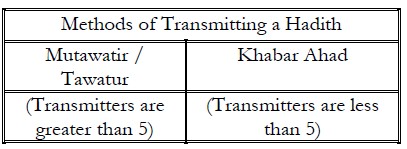
Mutawatir / Tawatur: un daleel transmitido por un número indefinido de personas. Debido a la gran cantidad de personas que transmiten el daleel y a la diversidad de su lugar de residencia, su fiabilidad y su convicción, es inconcebible que este daleel pudiera haber sido fabricado.
Mutawatir / Tawatur: a Daleel transmitted by an indefinite number of people. Due to the large number of people reporting the Daleel and their diversity of residence, reliability, and conviction, it is inconceivable that this Daleel could be fabricated.
El número mínimo de transmisores necesarios para clasificar un daleel como mutawatir es, por lo general, cinco. Sin embargo, algunos eruditos pueden tener criterios más estrictos. El carácter de los narradores que transmiten los ahadiz mutawatir debe ser noble.
The minimum number of transmitters that are required to classify a Daleel as Mutawatir is generally five. However, some scholars may have more stringent criteria. The character of the reporters narrating Mutawatir Ahadith has to be noble.
Ahad: (آقحد) Riwayah Ahad es un número inferior al de la Mutawatir.
Ahad: (آقحد ) Riwayah Ahad is a number less than the Mutawatir.
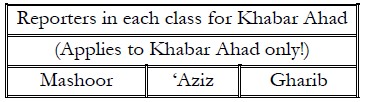
Mashhur: Un hadiz transmitido por al menos tres personas en cada generación (los Compañeros, los Tabi'in, etc.).
Mashoor: A Hadith reported by at least three individuals in every class (Sahabah, Tabi‟een, etc.).
Aziz: Un hadiz transmitido por al menos dos personas en cada una de las generaciones de transmisores.
„Aziz: A Hadith reported by at least two individuals in every class.
Gharib: Un hadiz transmitido por un solo narrador en una o más de sus generaciones.
Gharib: A Hadith reported by only one individual in one or more classes.
Sahih:
Sahih:
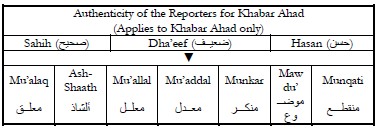
Un hadiz narrado por un 'Adl (no conocido por mala conducta) y Dabit (que mantiene la exactitud del relato) a través de otra persona de cualidades similares hasta el final del relato. El relato también debe excluir cualquier Shudhudh (desacuerdo con otros narradores fiables).
A Hadith narrated by an „Adl (not known for misconduct) and Daabit (maintains accuracy of the report) person from another person of similar qualities until the end of the report. The report should also exclude any Shudhudh (disagreement with other credible reporters).
Hasan:
Hasan:
Tiene dos definiciones:
It has two definitions:
a) Un hadiz que cumple con los requisitos del Sahih en un grado menor.
a) A Hadith, which meets the requirements of Sahih to a lesser degree.
b) Un Hadiz aceptado por la mayoría de los Fuqaha.
b) A Hadith, which is acceptable by the majority of the Fuqaha.
Ḍa'īf:
Dha‟eef:
Un hadiz débil es aquel que no cumple con los requisitos ni del hadiz sahih ni del hadiz hasan, y puede ser uno de los siguientes:
A weak Hadith which does not meet the requirement of either the Sahih or the Hasan Hadith, it can be one of the following:
Mu‟alaq: Un hadiz al que le falta uno o más narradores, ya sea al comienzo del isnad, en medio o al final.
Mu‟alaq: A Hadith which is missing one or more reporters either at the beginning of the Isnad, in the middle or in the end.
Mu'addal: Hadiz en el que faltan dos o más narradores consecutivos.
Mu‟addal: Hadith which is missing two or more consecutive reporters.
Munqaṭiʿ: Un hadiz con interrupción en la cadena de transmisión.
Munqati: A Hadith which has interruption in the class.
Ash-Shaath: Un hadiz en el que un narrador fiable transmite algo que contradice a otros narradores fiables.
Ash-Shaath: A Hadith in which one credible reporter reports something that disagrees with other credible reporters.