1.1 De spirituele noodzaak van het profentschap
1.1 The Spiritual Necessity Of Prophethood
Binnen ons allemaal bestaat een rusteloze hunkering naar spirituele vervulling. Wanneer deze wordt genegeerd, ervaart de geest intense dorst die hem achter de ene mirage na de andere laat jagen, waarbij elke mirage een momentane hoop op een oase biedt voordat er weer een teleurstelling volgt. Dit is de tragedie van de menselijke conditie wanneer zij innerlijke vrede zoekt in de buitenwereld, of probeert zichzelf te verwezenlijken door middel van vleselijke streven, terwijl zij is geschapen om al datgene te overstijgen voor een hoger doel:
Within us all is a restless craving for spiritual fulfillment. When ignored, the spirit experiences intense thirsts which send it chasing one mirage after another, each offering it momentary hope of an oasis before yet another letdown. This is the tragedy of the human condition whenever it seeks inner peace from the outer world, or seeks to self-actualize through carnal pursuits, when it was created to transcend all that for a higher purpose:
oprechte toewijding aan Allah. Allah zegt in de Qur’an: “En Ik heb de djinn en de mens niet geschapen om Mij te aanbidden.”16
sincere devotion to God. Allah says in the Qur’an, “And I did not create the jinn and mankind except to worship Me.”16
Dienstbaarheid aan Allah, en niet slechts de aangeboren erkenning van Zijn bestaan, is daarom niet alleen een plicht maar ook een fundamentele menselijke behoefte. Het is noodzakelijk om onze geest te voeden, net zoals voedsel en zuurstof noodzakelijk zijn om ons lichaam te voeden. Het stemt ons af op onze realiteit als spirituele wezens in fysieke lichamen, en niet als fysieke wezens die toevallig een spirituele dimensie ervaren. Uiteraard is niets hiervan mogelijk zonder de Schepper die via profeten met ons communiceert over hoe we een betekenisvolle relatie met Hem kunnen hebben. Zonder deze communicatie zouden we niet in staat zijn om Hem op diepere niveaus te kennen en lief te hebben, en het is alleen door voor Hem te leven dat we ervaren wat het werkelijk betekent om in leven te zijn. Zoals de Profeet Muhammad ﷺ ooit zei: “De gelijkenis van iemand die bewust is van Allah en iemand die niet bewust is van Allah, is die van de levende en de dode.”17
Servitude to God, not just the inborn recognition of His existence, is therefore not only a duty but also a fundamental human need. It is necessary to nourish our spirit just as food and oxygen are necessary to nourish our body. It attunes us to our reality as spiritual beings in physical bodies, not physical beings that happen to enjoy a spiritual dimension. Of course, none of that is possible without the Creator communicating to us through prophets how to have a meaningful relationship with Him. Without this communication, we would be unable to know and love Him on deeper levels, and it is only through living for Him that we experience what it truly means to be alive. As the Prophet Muhammad صلى الله عليه وسلم once said, “The similitude of someone who is mindful of Allah and someone not mindful of Allah is that of the living and the dead.”17
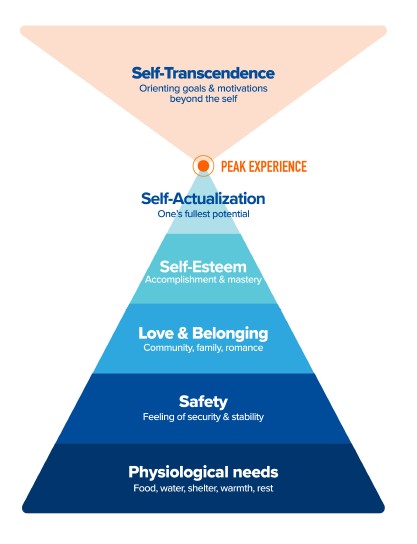
Toen Abraham Maslow zijn beroemde behoeftehiërarchie wijzigde, stelde hij het verlangen naar zelftranscendentie als de grootste motivator van allemaal, boven zelfactualisatie.18
When Abraham Maslow amended his famous hierarchy of needs, he set the desire for self-transcendence as the greatest motivator of them all, above self-actualization.18
Echter, zonder de profeten en goddelijke openbaring blijft zelfs dat inzicht enigszins oninstructief. Het maakt het mogelijk dat concepten zoals monisme (één zijn met het universum) of altruïsme (onbaatzuchtig zijn) verkeerd worden waargenomen als even vervullend als toewijding aan God. Altruïstische mensen rapporteren vaak een hogere levensvoldoening, en dat is te verwachten aangezien onbaatzuchtig zijn, per definitie, een meer transcendente doelstelling is dan zelfgericht zijn.
However, without the prophets and divine revelation, even that insight remains somewhat uninstructive. It allows for notions such as monism (being one with the universe) or altruism (being selfless) to be misperceived as equally fulfilling as devotion to God. Altruistic people often report higher life satisfaction, and that is expected since being selfless is, by definition, a more transcendent purpose than being self-centered.
Maar de essentiële behoefte aan zelfoverstijging zal nooit volledig bevredigd worden door louter elke betrokkenheid bij doelen die groter zijn dan men zelf (zoals het dienen van het menselijk collectief). Er is een unieke rust die rechtstreeks afhankelijk is van iemands toewijding aan de absoluut grootste: de Almachtige. Anderen dienen kan daar deel van uitmaken, maar kan het nooit vervangen, zoals Allah zegt: “Ongetwijfeld, het is slechts door de herinnering aan Allah dat harten rust vinden.”19 Ibn al-Qayyim (gest. 1350), een vooraanstaand moslimtheoloog, schrijft: In het hart bestaat een onrust die niets kan kalmeren behalve het dichter bij God komen. En een eenzaamheid overschaduwt het die niets kan wegnemen behalve het genieten van Zijn
But the essential need to self-transcend will never be fully satisfied by just any involvement in ends greater than oneself (such as serving the human collective). There is a unique tranquillity that hinges squarely on one’s devotion to the absolute greatest: the Almighty. Serving others can be part of that, but can never replace it, as Allah says, “Unquestionably, it is only by the remembrance of Allah that hearts are assured.”19 Ibn al-Qayyim (d. 1350), a renowned Muslim theologian, writes, In the heart, there exists an anxiousness that nothing can calm but drawing nearer to God. And a loneliness overcasts it that nothing can remove but enjoying His
...in het geheim. En er woont een droefheid in die niets kan verlichten behalve de vreugde van het kennen van Hem en het oprecht toewijden aan Hem. En er rust een onrust op die niets kan kalmeren behalve het focussen op Hem en het vluchten van Hem naar Hem. En de vlammen van berouw blijven binnenin oplaaien, en niets kan ze doven behalve tevreden zijn met Zijn geboden, verboden en bestemming, en geduldig vasthouden aan al het ware tot het moment dat men Hem ontmoet. En er bestaat een dwingende behoefte; deze zal niet stoppen totdat Hij alleen het doel ervan wordt. En er is een schrijnende nood; niets zal deze bevredigen behalve het liefhebben van Hem, het voortdurend gedenken van Hem, en het oprecht toegewijd zijn aan Hem. En als een persoon deze hele wereld en alles wat zij bevat zou krijgen, zou het die behoefte nooit vervullen.20
company in private. And a sadness dwells within it that nothing can alleviate but the joy of knowing Him and genuinely devoting oneself to Him. And a worry unsettles it that nothing can reassure but focusing on Him and fleeing from Him to Him. And the flames of regret continue to flare inside it, and nothing can extinguish them but becoming content with His commands, prohibitions, and destiny, and patiently holding onto all that until the time one meets Him. And in it exists a pressing demand; it will not stop until He alone becomes its pursuit. And in it is a dire need; nothing will satisfy it except loving Him, constantly remembering Him, and being sincerely devout to Him. And if a person were given this entire world and all it contains, it would never fulfill that need.20
Om deze psychospirituele tragedie te voorkomen en om voor de Almachtige God te leven, is het profentschap een existentiële noodzaak. Dezelfde meest barmhartige God die ons alles heeft geschonken wat we op deze planeet nodig hebben voor het leven en wat het in stand houdt, heeft voor ons door middel van het profentschap verzekerd wat we het meest nodig hebben: leiding naar Hem en Zijn welbehagen in dit leven en het volgende.
Hence, to avert this psychospiritual tragedy, and to live for Almighty God, prophethood is an existential necessity. The same most compassionate God who afforded us all we need on this planet for life and what sustains it, has ensured for us through prophethood what we need most: guidance to Him and His pleasure in this life and the next.
16 De Qur’an 51:56, Saheeh International Vertaling.
16 The Qur’an 51:56, Saheeh International Translation.
17 al-Bukhārī, Ṣaḥīḥ al-Bukhārī, 8:86 #6407; Muslim ibn al-Ḥajjāj al-Qushayrī, Ṣaḥīḥ Muslim (Beirut: Dār Iḥyāʼ al-Kutub al-ʻArabīyah, 1955), 1:539 #779.
17 al-Bukhārī, Ṣaḥīḥ al-Bukhārī, 8:86 #6407; Muslim ibn al-Ḥajjāj al-Qushayrī, Ṣaḥīḥ Muslim (Beirut: Dār Iḥyāʼ al-Kutub al-ʻArabīyah, 1955), 1:539 #779.
18 Lloyd Greene en George Burke, “Beyond Self-Actualization,” Journal of Health and Human Services Administration (2007): 116-128.
18 Lloyd Greene and George Burke, “Beyond Self-Actualization,” Journal of Health and Human Services Administration (2007): 116-128.
19 De Qur'an 13:28, Saheeh International Vertaling.
19 The Qur’an 13:28, Saheeh International Translation.
20 Ibn Qayyim al-Jawzīyah, Madārij al-Sālikīn Bayna Manāzil Īyāka Na’budu wa Īyāka Nasta’īn (Beirut: Dār al-Kutub al-ʻArabī, 1996), 3:156.
20 Ibn Qayyim al-Jawzīyah, Madārij al-Sālikīn Bayna Manāzil Īyāka Na’budu wa Īyāka Nasta’īn (Beirut: Dār al-Kutub al-ʻArabī, 1996), 3:156.