5.29 ムスリムが容易な標的になる
5.29 Muslims Becoming Easy Prey
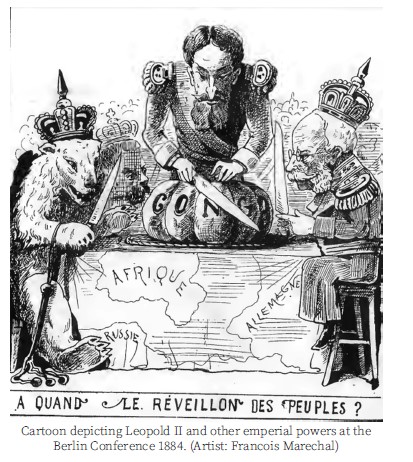
預言者ﷺは、肉欲的な追求が自らの共同体を蝕むだけでなく、その共同体の衰退と荒廃の原因にもなるとも予言されました。サウバーンは、預言者ﷺが次のように言われたと伝えています。「諸民族はまもなく、食卓に料理が招かれるように、互いにあなたがたを貪り食おうと呼び合うであろう。」すると人々は言いました。「その日、私たちの数が少ないからでしょうか。」預言者ﷺは言われました。「いや、その日あなたがたは数多くいるが、川に浮かぶ泡のように、重みのない泡のようになるのだ。アッラーは敵の心からあなたがたへの恐れを取り除き、あなたがたの心に弱さを投げ込まれる。」ある者が言いました。「アッラーの使徒よ、その弱さとは何でしょうか。」預言者ﷺは言われました。「現世への愛と、死への嫌悪である。」333 驚くべきことに、一世紀ほど前、ベルギーの国王レオポルド二世は、自らの植民地的野心を「この壮麗なアフリカのケーキ」と非常に有名な言い方で呼びました。ヨーロッパ列強は1884年のベルリン会議でこのケーキを思いのままに切り分けたのです。当時の多くの政治風刺画が、この会議を食べ物にたとえて描いており、それは上のハディースが述べていたことにほぼそのまま一致しています。
The Prophet صلى الله عليه وسلم also prophesied that carnal pursuits would not only infect his nation but would be the cause of their downfall and devastation. Thawbān reports that the Prophet صلى الله عليه وسلم said, “The nations will soon invite one another to devour you, just as diners are invited to a dish.” It was said, “Will it be because of our small number on that day?” He said, “No, rather you will be many on that day, but you will be weightless foam, like the foam on the river. And Allah will remove the fear of you from the hearts of your enemies and will cast weakness into your hearts.” Someone said, “O Messenger of Allah, what will this weakness be?” He said, “The love of this world, and the hatred of death.”333 It is incredible how one century ago, King Leopold of Belgium very famously referred to his colonial ambitions as “this magnificent African cake,” which the European powers carved at will during the Berlin Conference of 1884. A person can easily find the many political cartoons of that day conceptualizing this conference in food terms, almost exactly like the hadith above had stated.
これは、レオポルド国王の比喩に一部起因するものでしたが、それだけでなく、会議の参加者たちはアフリカの分割を正式に決めるためにそこに集まっていたにすぎず、この広大で資源に恵まれた大陸が、彼らの貪欲で帝国主義的な欲望に対して意味のある抵抗を示すことなど到底できないと、完全に確信していたのです。
This was in part due to King Leopold’s metaphor, but also because the attendees were only there to formalize the divisions of Africa, fully confident that the large and resourceful continent could not hold its weight in any meaningful resistance to their ravenous greed and imperial appetite.
さらに強調すると、アナス・イブン・マーリクは、預言者ﷺが次のように言われたと伝えています。「わたしの共同体が五つのことを許されるものと見なすようになれば、破滅が彼らに降りかかるだろう。すなわち、互いに呪い合うことが現れ、酒が飲まれ、絹が身につけられ、楽器が演奏され、男は男で満足し、女は女で満足するようになったときである。」334 今日のムスリムも、同性間の行為を受け入れる思想から無縁ではありません。礼拝を行い、モスクに通う敬虔なムスリムであっても、その信仰を文化的なアイデンティティにまで矮小化してしまえば、そうしたことは十分に起こりえます。預言者ﷺは、アブドゥッラー・イブン・アムルが伝えたハディースの中で次のように言われました。「人々がモスクに集まり礼拝するが、その中に一人の信者もいない時代が必ず来るだろう。」335
Reinforcing this point, Anas ibn Mālik narrates that the Prophet صلى الله عليه وسلم said, “Once my nation considers five things permissible, then destruction will befall them: when cursing one another appears, wine is drunk, silk is worn, musical instruments are played, and men suffice themselves with men and women suffice themselves with women.”334 Certainly, Muslims today are not insulated from the ideologies that accept same-sex acts. This is even imaginable for a practicing, mosque-attending Muslim, if they allow their religiosity to be reduced to a cultural identity, as the Prophet صلى الله عليه وسلم said in a hadith narrated by ‘Abdullah ibn ‘Amr , “An age will surely come when people gather and pray in the mosques, while there is not a single believer amongst them.”335
333 Abū Dāwūd、Sunan Abī Dāwūd、4:111 #4297;アルバーニーが注釈においてこれを真正と認定している。
333 Abū Dāwūd, Sunan Abī Dāwūd, 4:111 #4297; authenticated by al-Albāni in the comments.
334 アフマド・イブン・アル=フサイン・アル=バイハキー『シュア・アブ・アル=イーマーン』(リヤド:マクタバト・アル=ルシュド・リル=ナシュル・ワル=タウズィー、2003年)7:328 #5084;アル=アルバーニーが『サヒーフ・アル=タルギーブ・ワル=タルヒーブ』(リヤド:マクタバト・アル=マアーリフ、2000年)2:608 #2386で、ハサン(受容可能)な伝承経路であるとしている。
334 Aḥmad ibn al-Ḥusayn al-Bayhaqī, Shu‘ab al-Īmān (Riyadh: Maktabat al-Rushd lil-Nashr wal-Tawzī’, 2003), 7:328 #5084; a ḥasan (acceptable) chain according to al-Albānī in Ṣaḥīḥ al-Targhīb wal-Tarhīb (Riyadh: Maktabat al-Maʻā rif, 2000), 2:608 #2386.
これらの禁止事項はここでは絶対的であるかのように見えますが、学者たちは他の預言者の伝承を総合的に検討した上で、それらに条件を付けてきました。例えば、ここでの絹の禁止は、男性に対してのみ、かつ多量の場合に、必要がない限りにおいて適用されるとして限定されています。同様に、学者の多くは、少なくとも時には、タンバリンを打つことを楽器の禁止に対する例外と見なしており、さらにその容認範囲を広げる学者もいます。
While these prohibitions appear absolute here, scholars have qualified them considering their cumulative read of other prophetic traditions. For instance, the prohibition of silk here is qualified by being applicable to men only, and in significant amounts, and in the absence of necessity. Similarly, scholars generally consider striking the tambourine an exception to the prohibition of musical instruments, at least on occasion, and some widen the concession further.
335 アブー・バクル・イブン・アビー・シャイバ『アル=イーマーン』(ベイルート:アル=マクタブ・アル=イスラーミー、1983年)、1巻40
335 Abū Bakr ibn Abī Shaybah, Al-Īmān (Beirut: al-Maktab al-Islāmī, 1983), 1:40
#101; アル=アルバーニーがコメント欄で真正(サヒーフ)と認定したもの。
#101; authenticated by al-Albānī in the comments.