2.1 デリールの構造
2.1 Structure of Daleel
前述のとおり、ダリール(daleel)とは、イスラームにおける見解、概念、判決、または考えを裏づける根拠である。すべてのダリールには二つの側面がある。リワーヤ(riwayah、伝承)とダラーラ(dalalah、意味)である。
As mentioned earlier, a Daleel is an evidence for an opinion, concept, ruling, or a thought from Islam. There are two aspects related to any Daleel, Riwayah (reportage) and Dalalah (meaning).
リワヤ(Riwayah)は、情報がどのようにして私たちに伝えられたかに関わる事柄を扱うものであり、それには伝達者の人数と誠実さ(信頼性)が含まれる。
The Riwayah covers issues related to how the information was relayed to us, which includes the number and the integrity of its reporters.
ダラーラ(dalālah)は、ダリール(dalīl)におけるテキストの意味に関わるものである。また、リワーヤ(riwāyah)とダラーラに関連して用いられる二つの用語があり、それがカタイー(qaṭʿī)とザンニー(ẓannī)である。
The Dalalah is related to the meaning of the text in the Daleel. There are also two terms used in connection with Riwayah and Dalalah; Qata‟i and Dhanni.
Qat'i(قطعي)は確定的あるいは決定的なものを意味し、Dhanni(ظني)はQat'iの反対であり、非確定的、推測的あるいは不確定なものを意味します。
Qata‟i is defined as being conclusive or decisive, while Dhanni is the opposite of Qata‟i and means non-definite, speculative or indecisive.
伝承
Riwayah
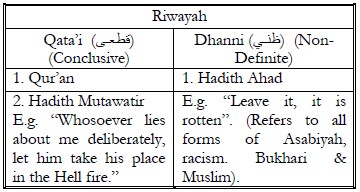
「クルアーンの節やハディース・ムタワātirからのいかなるものも、その伝承(リワーヤ)においてカタイ(確定的)であるとみなされる。」
Any Ayah from the Qur‟an or Hadith Mutawatir is considered Qata‟i (conclusive) in its Riwayah (report).
「リワーヤ(伝承)」におけるカタイー(確定的)とは、その証拠が疑いの余地なく真正であることを意味する。この真正性は伝承の方法論に基づいて立証される。
The Qata‟i in Riwayah implies that the evidence is authentic without any shadow of doubt. This authenticity is established based on the methodology of transmission.
コーランが私たちに伝えられた伝承の方法は、いかなる改ざんの可能性も排除するものです。その伝承は、世代から世代へと、まったく同じ方法で伝えられてきました。一つの世代全体がコーランの内容を捏造したり、消去したり、付け加えたりすることは不可能です。その世代の一人ひとりが集まり、コーランの一部を加えたり削除したりすることに同意したと考えることは、考えられないことです。その世代の全員が同じコーランの内容を朗誦しており、それによってその内容が裏付けられていたのです。
The methodology by which the Qur‟an was transmitted to us precludes any possibility of fabrication. The report was transmitted generation by generation in exactly the same manner. It is impossible for an entire generation to fabricate, erase, or add contents to the Qur‟an. It is inconceivable to believe that every single individual in that generation assembled together and agreed to add or delete parts of the Qur‟an. Everyone in that generation was reciting the same contents of the Qur‟an, thus authentifying its contents.
ハディース・ムタワātir(多伝承)は、世代から世代へと個々の伝達者によって受け継がれたものではなく、多数の人々によって伝えられたものである。その証拠を伝える人々の数が非常に多く、居住地も様々であり、その信頼性と確信が確立していることから、この証拠が誤りである可能性は考えられない。クルアーンやハディース・ムタワātir以外の方法で伝えられる情報、例えばハディース・アーハードなどは、ザンニー(蓋然的)とみなされる。つまり、その証拠に誤りが含まれている可能性がごくわずかながら存在するということである。要約すると以下のとおりである。
Hadith Mutawatir was not transmitted generation-by-generation, but rather by a large number of people. Due to the large number of people reporting the Daleel, and their diversity of residence, their established reliability and conviction, it is inconceivable that this Daleel could be wrong. Any report of information other than through the Qur‟an or Hadith Mutawatir, such as Hadith Ahad, is considered Dhanni (non-definite), meaning that there is a minute possibility that the Daleel could contain error. To summarise:
ダラーラ
Dalalah
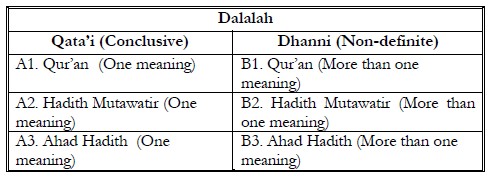
ダリールの第二の側面はダラーラ(意味)である。クルアーン、ハディース・ムタワティル、またはハディース・アーハードのテキストが明確で、特定的であり、ただ一つの意味しか持たない場合、それはカタイー(確定的)とみなされる。カタイーのダリールのテキストはただ一つの意味しか持ってはならず、他のいかなる解釈にも開かれていてはならない。テキストが複数の解釈に開かれている場合、それはザンニー(推定的)とみなされる。解釈はアラビア語によるものであるため、いかなる解釈もアラビア語によって正当化されなければならない。要約すると、次のとおりである。
The second aspect of the Daleel is the Dalalah (meaning). If the text of Qur‟an, Hadith Mutawatir or Hadith Ahad is clear, specific, and has only one meaning, then it is considered Qata‟i. The text of a Qata‟i Daleel has to have only one meaning and cannot be open to any other interpretation. If the text is open to more than one interpretation, then it is considered Dhanni. Since interpretations are due to the Arabic language, any interpretation has to be justified through the Arabic language. To summarise:
A1. クルアーンの確定的(カタイー)な意味を持つ例:
A1. Example of Qur‟an with a Qata‟i (conclusive) meaning:
「もし妻たちに子がいなければ、彼女たちが遺したものの半分はあなたがたのものである」{アン=ニサー:12}(タフシーム・アル=クルアーン)
“What your wives leave, your share is a half, if they leave no child”. (TMQ An-Nisa: 12)
「貞淑な女性を姦通(ザナー)の罪で告発しておきながら、四人の証人を連れてくることができない者は、八十回の鞭打ちにせよ。」(コーラン アン=ヌール章 4節)
“Those who accuse chaste woman of zina (adultery) and fail to bring four witnesses (to prove it) flog them eighty stripes.” (TMQ An-Nur: 4)
これらの判定の数量的な側面、すなわち半分と八十は明白であり、それゆえ他のいかなる解釈の余地もありません。
The quantitative aspect of these rulings, namely one half and eighty are clear and therefore cannot be open to any other interpretations.
A2. 確定的(qaṭʿī)な意味を持つハディース・ムタワātirの例:
A2. Example of Hadith Mutawatir with Qata‟i (conclusive) meaning:
「私(預言者ムハンマド ﷺ)について故意に嘘をつく者は、火獄に自分の席を用意させよ。」(ブハーリーとムスリム)
“Whosoever lies about me (Prophet Muhammad saw) deliberately let him take his place in the hell-fire.” (Bukhari & Muslim)
このムタワātir(多伝承)のハディースは主題がきわめて明確であり、そのため本文から導かれる理解はただ一つである。すなわち、預言者ﷺが言われたことについて故意に嘘をつく者は、地獄の火に入るということである。
This Mutawatir Hadith is very clear in its subject; thus there is only one understanding from the text that whoever lies about what Prophet (saw) said, intentionally, he will go to hell-fire.
A3. 慎重な意味(カトイ)を持つハディース・アーハードの例:
A3. Example of Hadith Ahad with Qata‟i (conclusive) meaning:
一部の非ムタワーティル(伝承経路が多数に及ばない)ハディースによれば、預言者ﷺは シャッワール月に6日間断食されたと伝えられています。このハディースから導かれる確定的な意味は次のとおりです。
It is reported from a non-Mutawatir Hadith that the Prophet (saw) fasted 6 days in Shawwal. The conclusive meanings from this Hadith are the following:
a) シャウワール月に6日間断食することの許容性
a) Permissibility of fasting 6 days in Shawwal.
b) シャッワールの第一日を除く。その日はイードの日であり、イードの日に断食することは禁じられている(ハラーム)からである。
b) Except on the first day of Shawwal, since it is the day of Eid, and it is Haram to fast on Eid.
B1. ظنّي(ダンニー)の意味を持つクルアーンの節の例:
B1. Example of Quranic Ayah with a Dhanniy (non-definite) meaning:
アッラーは(SWT)こう仰せられます:
Allah (swt) says:
「信仰する者たちよ。礼拝(サラー)に立とうとするときは、顔と、肘までの両腕を洗い、頭に濡れた手で拭いをかけ、くるぶしまでの両足を洗いなさい。もし大浄(ジャナーバ、性的な排出を伴う状態)にあるなら、身を清めなさい(全身を洗い清めなさい)。しかし、病気であるか旅路にあるか、あるいは用を足した後であるか、女性と接触した後で水が見つからないなら、清浄な土でタヤンムム(乾いた清めの儀式)を行い、それで顔と両手をさすりなさい。」(タフスィール・マアーニ・クルアーン 『アル=マーイダ』: 6)
“O you who believe! When you intend to offer As-Salat (the prayer), wash your faces and your hands (forearms) up to the elbows, rub (by passing wet hands over) your heads, and (wash) your feet up to ankles. If you are in a state of Janaba (i.e. had a sexual discharge), purify yourself (bathe your whole body). But if you are ill or on a journey or any of you comes from answering the call of nature, or you have been in contact with women and you find no water, then perform Tayammum with clean earth and rub therewith your faces and hands.” (TMQ Al-Maida: 6)
その節には、女性に「ラマストゥム(lamastum)」した場合、ウドゥーが無効になるとあります。「ラマストゥム」という語は、二つの意味で解釈されてきました。
The verse says if you „lamastum‟ the women, it breaks the Wudhu. The word „lamastum‟ has been interpreted as having two meanings:
a) 接触 b) 性交 このように、このアーヤ(節)は「ザンニー・ダラーラ」、すなわち女性に触れることがウドゥーを無効にするという意味にも、女性と性交することがウドゥーを無効にするという意味にもなり得る、という性質を持っています。
a) Touching b) Sexual intercourse Thus the Ayah has a Dhanni Dalalah, i.e. it could mean touching women breaks the Wudhu, or sexual intercourse with a woman breaks the Wudhu.
B2. 意味が確定的ではない(ザンニー)ハディース・ムタワティルの例:
B2. Example of Hadith Mutawatir with a Dhanniy (non-definite) meaning:
預言者(saw)はイフラームを脱ぐ際に特定の方法をとっていたと伝えられています。しかし、サハーバ(ra)が預言者(saw)に対し、預言者(saw)のやり方とは異なる方法で自分たちがイフラームを脱いだと伝えたところ、預言者(saw)はその行いを認められました。この出来事はムタワーティルであるものの、イフラームを脱ぐ際のルールは多くあります。
It was reported that the Prophet (saw) used to take off his Ihram in a specific manner. However, when the Sahabah (ra) told the Prophet (saw) that they took it off in a manner different from the way he (saw) took it off, the Prophet (saw) approved of their actions. Though this incident is Mutawatir, the rules to take off one‟s Ihram are many.
B3. ظanniy(非確定的な意味)を持つḤadīth Aḥādの例: Wait—I must translate, not add content. Correct output: B3. 非確定的な意味(ظanniy)を持つḥadīth aḥādの例:
B3. Example of a Hadith Ahad with a Dhanniy (non-definite) meaning:
このハディースは非ムタワーティルのハディースとして伝えられており、預言者ﷺがシャウワールの月に6日間断食されたという内容です。このハディースの非確定的な意味は次のとおりです。
It is reported from a non-Mutawatir Hadith that the Prophet (saw) fasted 6 days in Shawwal. The non-definite meanings of this Hadith are:
a) 六日間の断食は連続していなければならないのか、それとも連続していなくてもよいのか。
a) Whether the six days of fasting are consecutive or not?
b) シャウワール月のどの部分で断食するか
b) Fasting in which part of Shawwal?
ここまで、リワーヤ(伝承)とダラーラ(意味)のそれぞれについて、カタイー(確定的)とザンニー(推測的)の側面を別々に論じてきました。しかし、ダリール(論拠)がリワーヤとダラーラの両面において、カタイー(確定的)であるかザンニー(推測的)であるかを判断する方法は、次のとおりです。
So far we have discussed the Qata‟i and Dhanni aspects of both Riwayah and Dalalah separately. However, the method to determine whether the Daleel (both in Riwayah and Dalalah) is Qata‟i (conclusive) or Dhanni (non-definite) is the following:
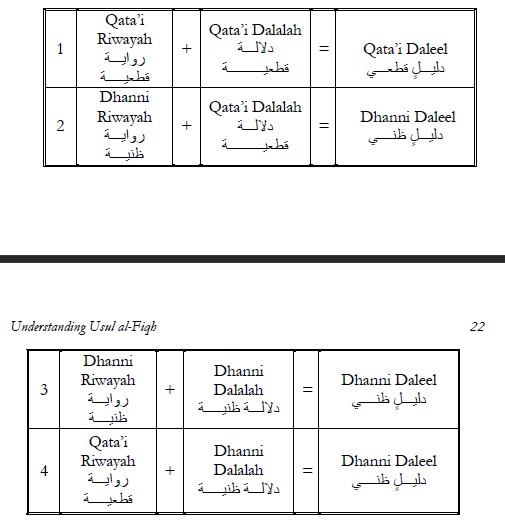
「アキーダ」に関するあらゆる観念、考え、概念は、カタイー・ダリール(決定的な典拠)に基づかなければならない。例えば、天使が存在するという概念は、ザンニー(蓋然的)な典拠ではなく、カタイー・ダリールに基づいている。また、ウスール・アル=フィクフにおいては、最も強い見解に従って判断を導き出すための法源を確立するには、その法源もまたカタイー・ダリールに基づかなければならない。
Any idea, thought, or concept related to the „Aqeedah has to be based upon a Qata‟i Daleel. As an example, the concept that Angels exists is based upon a Qata‟i Daleel not Dhanni. Also, in Usul al-Fiqh, to establish a source for extracting rulings according to the strongest view, the source must base upon a Qata‟i Daleel as well.
例えば、サハーバ(教友)のイジュマー(合意)を法的判断の源泉とみなすためには、サハーバのイジュマーの権威を証明する根拠(ダリール)は、伝承(リワーヤ)の面でも意味(ダラーラ)の面でも、確実(カṭʿī)でなければならない。ただし、判断は確実なダリールからも、推測的(ẓannī)なダリールからも導き出されうる。
As an example, to consider Ijma‟ as-Sahabah (consensus of the Companions) as a source of rulings, the Daleel to prove the authority of Ijma‟ as-Sahabah has to be Qata‟i both in Riwayah and Dalalah, though a ruling can be derived from either Qata‟i or Dhanni Daleel.
なぜクルアーンとスンナの本文を理解することがこれほど複雑なのか、疑問に思う人もいるかもしれません。
One might wonder why understanding the text of Qur‟an and Sunnah is so complicated?
クルアーンとスンナの本文を検討すると、その分量は限られていることがわかる。その限られた本文から、いつどこにいても、審判の日まで私たちに影響するあらゆる問題について裁定を導き出すことができるのである。
By examining the text of Qur‟an and Sunnah one can see that it is limited in its volume. With its limited text one can generate rulings to any problems affecting us anywhere and anytime until the Day of Judgment.
アッラーからの奇跡として、クルアーンとスンナの文章は、一つのアーヤや一つのハディースから数多くの規定を導き出す力を備えている。一方、一つの文章から多くの意味を理解する力は、世界の他のいかなる法的文献にも見出すことはできない。各世代のムスリムにとっての課題は、クルアーンとスンナが全ての時代と場所に関わるものであるがゆえに、その文章を理解し、自分たちの生活と結びつけようと努めることである。
It is a miracle from Allah (swt) that the texts of the Qur‟an and Sunnah have the ability to express numerous rulings from a single Ayah and Hadith; whereas, the ability to understand many meanings from a single text cannot be found in any other legal text in the world! The challenge is for Muslims in each generation to try to understand the text and relate it to their lives since the Qur‟an and Sunnah are relevant to all times and places.
前述の点とは別に、クルアーンとスンナから理解し法規定を導き出すことに関する規則や指針があることを認識しなければなりません。アラビア語や、ある種類のテキストを他と区別する規則などを知らずして、クルアーンとスンナの本文を理解できる者はいません。
Besides the point mentioned above, we have to realise that there are rules and guidelines related to understanding and deriving laws from the Qur‟an and Sunnah. No one, without being acquainted with these rules (Arabic language, rules which differentiate one type of text from another, etc.) can understand the text of Qur‟an and Sunnah.
シャリーア的判断(ホクム・シャルイー)の源泉
Sources of Hukm Shar‟i
前述のとおり、ハクム・シャルイー(シャリーアの判断)とは、人間の行為に関わるアッラー(swt)の裁定である。これらの裁定は一定の典拠から導き出される。裁定を導き出すために用いられる典拠は、アディッラ・カタイーヤ(確定的な証拠)に基づいていなければならない。
As defined earlier, Hukm Shar‟i are the rulings of Allah (swt) addressing our actions. These rulings are derived from certain sources. The sources, which are used to extract rulings, have to be based on Adilla Qata‟iya (Decisive evidences).
ハッカム・シャルイー(シャリーアの裁定)の四つの確定的な典拠は、クルアーン、スンナ、サハーバによるイジュマー(合意)、そしてキヤースである。これらは以下の章で論じる。その後に、学者たちの意見が分かれる、争いのある典拠について簡潔にまとめる。
The four definitive sources of Hukm Shar‟i are; the Qur‟an, Sunnah, Ijma‟ as-Sahabah and Qiyas. These will be discussed in the following chapters. This will be followed by a brief summary of the disputed sources which the scholars disagree on.